What people want to know about Britain, part twelveish

What do people want to know about Britain? The results of a highly skewed and unreliable survey, based on the search engine questions that mislead people to Notes, show that they want to know about the following issues. 

Please note: The questions have been reproduced here in all their oddity.

A rare relevant photo: This is Fast Eddie, our resident cat expert.

CATS

can cats eat sticky toffee pudding

Yes. No law of physics or biology prevents that. Will it be good for them? No, but that’s not what you asked.

Is sticky toffee pudding good for humans? Absolutely. It makes us fat and happy. And sticky, which reminds us to wash, which is good for our health if not done to excess. 

Will cats stick to the bowl if they do eat sticky toffee pudding? No. It doesn’t acti like a glue trap. It’s sticky only when compared to your average dessert. You won’t end up rushing your cat and its bowl to the emergency vet, hoping to get dessert detached from cat while one is still edible and the other doesn’t yet have PTSD.

Are cats interested in eating sticky toffee pudding? Not as far as I know, but we don’t have any around the house so I can’t get an opinion from our resident cat expert (and, incidentally, cat), Fast Eddie. But he’s never asked for any any. That’s got to mean something, because if the neighborhood cats were all talking about how good it is, he’d have come home wanting some.

Cats are protein eaters. Meat for breakfast, meat for dinner, and meat for dessert.

Me? I’m a vegetarian. And in case I don’t sound pure enough, I’m (very) gradually losing my taste for desserts. I do swear fluently, mostly to make sure I’m still part of the human race. 

cats mine myself sweet

It’s hard to know how to answer that. It’s hard to know if it’s even a question. Still, I’ll do what I can.

Fast Eddie–I repeat, in case you skipped the last answer, that he’s our resident cat–can be sweet. He can also kill things, and does. Whether that’s sweet or not very much depends on your point of view.

Eddie’s still pissed off about that mouse my partner threw away. Yesterday he accused her of eating it herself. So even if we don’t talk about the rodents and the occasional bird, he’s not all sweetness.

In contrast (and to address the rest of the alleged question), I me mine myself do (or possibly does) not, for the most part, kill things. I make a reluctant exception for slugs and some bugs. I am not, however,  sweet.

I am also not a cat, although I wouldn’t mind having fur.

I’m glad we got all that straightened out. I feel we know each other much better now.

FOOD

Most questions about food, especially as we approach Christmas each year, are from people struggling to understand the religious symbolism of brussels sprouts in the Christmas tradition.

They have so come to the wrong place.  

why do we have sprouts at christmas

Because Santa doesn’t like you.

+what year did brussel sprouts became a thanksgiving tradition

As far as I know, that year hasn’t gotten here yet, but then I haven’t lived in the U.S. for something like thirteen years and things have gotten pretty weird over there since I left. So someone tell me: Has everyone suddenly decided that brussels sprouts are a Thanksgiving tradition? Because traditions sometimes get pasted in retroactively. All of a sudden a nation decides that some small ball of green leaves always was part of a traditional meal and even though people remember that they didn’t eat them when they were kids, they can still believe that it’s a tradition because, you know, their families were a bit odd and everyone else probably ate them. So no one says anything and the next thing you know we all believe it.

But more to the point, when did the plus sign at the beginning of a question become a thing? This isn’t the only search engine question that’s wandered in sporting one.

when was did we start to eat brussels sprouts at christmas

Six pm, and everyone’s finished but you. Eat up or Santa will ask about that “when was did” and won’t let you have any Christmas pudding. 

QUESTIONABLE TASTE

We’re isolating these questions in their own category so they don’t contaminate the rest of the batch. And when I say we, of course, I mean me mine myself cats. Ready? Got a strong stomach and an ability to get disturbing images out of your mind? If not, just skip these.

You’re reading on, aren’t you? You don’t have to, you know.

breastaurant

How did this question find me? Lord Google has decided that anything too odd to go someplace else shall henceforth come to me. Some of that I appreciate but, Lord G., you’ve pushed your luck with this one and I will not leave the usual tribute of data at your portal. In the meantime, whoever sent this, either learn to type or go somewhere else. People can’t necessarily choose not to be over-interested in one or another body part, but they can learn not to pester the rest of us about it. 

sainsburys sex tots

I can only hope we’re talking about Tater Tots here. Speaking only for myself, I’ve never found frozen, shredded, prefabricated potatoes even remotely sexy, but I do understand that everyone’s tastes are different and as long as no one gets hurt, hell, go ahead. But, honest, most of us don’t want the details and there’s a thin line between enjoying your sexuality and inflicting it on other people, at which point it becomes harrassment. So keep the details for those specialty chat sites, okay? And if Sainsburys–that’s a supermarket, in case you’re not British–has a Facebook page, it’s not one of the sites I was suggesting.

CLOTHES

the origins of wig in britain

There is only one wig in Britain, and this creates real problems in the court system. You think it’s budget cuts that are throwing it into chaos? It’s not. It’s all the lawyers and judges waiting for that one damn wig to circulate. They can’t say a word in court till it’s planted on their head.

And its origins? It was made by that Stradivarius of wig makers, Anonymous, in February of 1751. All the other wigs in the country have been torched.  

And if you’re new here, please watch for statements that are too absurd to believe. You’re not supposed to believe them. And more than that, you’re not meant to quote them as fact. Ideally, you’re supposed to take them with a grain of salt and laugh, but inevitably they won’t all work.

what does an mp wear

A cluster of these questions came over a couple of days, so either that’s one person returning several times to a site that wasn’t much help to start with or it’s a class assignment and some poor kids landed here, copied out everything I said, handed the assignment in, and got an F. The world is unkind.

So why did the question landed here? I googled “MP clothes” and found an assortment of sites for clothing sold or made by companies with an M and a P in their names, including MissPap, which sells clothes that are about as sleazy as you’d expect from a fashion house named after a vaginal smear test. Since I spent ten or so seconds on the site, I’ll probably start seeing their ads on the side of the screen when I check my email.

As long as it’s not Tater Tots, I’ll be okay.

Then I changed tactics and googled the original question and I found some quite sensible information, which everyone whose question landed them here must have passed by in order to find their way to me.

So what do MPs (that’s members of parliament) wear? Clothes. They are known for not appearing in parliament naked.

What follows, by the way, is true. You can quote it safely.

MPs are expected to wear businesslike clothes. If they don’t, either the speaker pretends they’re invisible and won’t call on them to speak or someone complains and the speaker’s supposed to do something more active about it. Two women have gotten away with wearing tee shirts bearing feminist slogans, possibly because “businesslike” is less well defined for women than for men. Or possibly because they didn’t care if they got called on to speak since their shirts had already made their point.

A few men have been seen wearing the jackets and ties that are required but in eye-popping colors. Everyone pretends not to notice.

MPs are not allowed to wear hats or armor in the House of Commons. I assume exceptions can be made if anyone’s religion demands headgear but I don’t know that. It may not have come up yet. Or if their religion demands armor, although I’ve never heard of a religion that does. Armor’s awkward stuff, not to mention expensive. Even the Pastafarian Church of the Flying Spaghetti Monster doesn’t ask believers to wear armor, only colanders. 

You need a link for that. You know you do.

The only person who can carry a weapon into the chamber is the sergeant at arms, whose title is spelled serjeant. MPs are expected to hang their swords on the purple ribbons provided in the cloakroom.

No, really. I did not make any of that up. 

MPs are not allowed to bring in briefcases. Female MPs, however, are allowed to bring in a small handbag and at some point male MPs demanded the right to do the same. That news came under a headline about man bags, which I almost skipped thinking they involved a bit of the male anatomy that has never really interested me. But I’m here to enlighten, so I followed the link and learned that it has nothing to do with frozen potatoes. Men may now bring in small, butch-looking (or femmy ones if they’re brave enough) handbags but they still can’t bring in briefcases.

One of the wonderful things about Britain is that it not only has these insane traditions, it takes such pleasure in making fun of them. So let’s move on to a related subject.

TRADITIONS & HISTORY

why do we not call november 5 guy faulkes night anymore

Because no one cares about Guy Fawkes anymore. November 5 is when all the wigs got burned–except of course that one fabulous one.

Salt.

history of two fingers insult in british language

No one really knows where this came from. According to one story–

But wait. Not everyone knows what we’re talking about and that’s rude. In Britain, if you hold up your index and center finger with the knuckles facing out, you’ve just insulted someone. Even if what you meant to do was let the bartender know you wanted two beers. It’s a close relative of holding up the middle finger but involves a few extra muscles because, hey, the British are tough.

According to one story, the gesture came from the Battle of Agincourt, which was fought during the Hundred Years War. English and Welsh archers did so much damage to the French that if an archer was captured the French cut off the two fingers he needed to pull the string of his longbow. The theory goes that the remaining archers held up their two fingers to show the French that they still had them.

Great story. According to Oxford Reference, unfortunately, there’s no evidence of the gesture being around any earlier than the twentieth century and the Battle of Agincourt was in 1415.

Nice try, though.

If there’s any evidence of the French cutting off fingers, I haven’t found it.

LANGUAGE

+definition of tickety tonk

I googled this and landed someplace considerably more sensible than Notes. Tickety tonk is outdated, upper class slang, meaning goodbye. The queen mother ended a World War II-era letter by saying, “Tickety tonk old fruit and down with the Nazis.”

She also thought the Jeeves and Wooster novels were “so realistic.”

What can I tell you? This whole monarchy / aristocracy thing is surreal. Not to mention expensive.

what does it mean to tell someone your spiffing me off

It means you’ve gotten your outdated, upper-class slang wrong. And you’ve misspelled you’re

LANGUAGE & GEOGRAPHY

what the Country’s Called

That depends which country you’re asking about. The world’s full of countries. Ukraine used to be called The Ukraine. Now it’s just called Ukraine. You get used to it after a while. The United Kingdom is usually called Britain because it has fewer syllables. It’s also  less accurate, but what the hell. Its full name is the United Kingdom of Britain and Northern Ireland. It also answers to Hey, You.

why is britain called britain

Because.

great britain also called as

Great Britain’s called many things, but never As.

why is great britain called uk

It isn’t. Great Britain’s that biggest chunk of land you see on a map of the British Isles. The U.K. is that plus Northern Ireland.

why was britain known as superior

Ooh, you fell for it, didn’t you? Great doesn’t mean better, superior, smarter, or better dressed. It means bigger. Although, like many (possibly all) countries, it’s capable of getting a swelled head and acting superior. Just remind it that its MPs aren’t free to wear armor to work. That’ll let it know who’s who and what’s what. 

All told, having multiple names wasn’t the U.K.’s best marketing decision. I could fill a very dull book with the questions that come in on the topic.

RANDOM OTHER STUFF

news from elsewhere

This makes an odd sort of sense. We all get tired of the same old news and gossip from wherever it is we live. The rest of the world looks more interesting. And larger. So without saying where here is, someone asked for news from places that weren’t their here. So far, so sensible. And as it happens, I posted something titled “News from Britain. And elsewhere.” So Lord G. sent the question to me.

Unless some silly person was actually looking for me. You never do know.

sample lettet to decline the award that is not deserved

“Dear Person Who Offered Me an Award,

“I am not worthy. I am so not worthy that I dare not accept this most flattering, important, and selective of awards. Thank you for thinking of me but something has got to be wrong with you that you even considered me.”

You’re welcome. See below for a note on self-respect.

bellringer for self respect

I’m not a fan of the theory that most of the world’s considerable stock of problems stem from people not having enough self-respect. Or the idea that they (that’s the problems, but it could just as easily be the people) can be fixed by surgically implanting self-respect in people who lack it. In fact,

Not that I’m discounting the idea of surgical implantation. I know some people who could do with a bit less self-respect. They could be donors. We could do transplants.

But set that aside, because no one asked for my opinion. This is about facts. Can bell ringing increase anyone’s self-respect? If you think you’re so insignificant that no one notices you, it might. Ring that damn bell, make some noise, wake the friggin’ village up at 2 a.m. There, they heard you that time.

In general, though? There’s probably some better way.

crotchetwor, minim workksheet

Oddly enough, I almost understand this. Where American music counts time in whole notes, half notes, quarter notes, and so on until the fractions get so small they swallow themselves, British music uses crotchets, minims, quavers, semiquavers, hemidemisemiquavers, and other odd fragments of sound that humans call speech, although I’ve never heard of a crotchetwor and I’m pretty sure no one else has either.

After almost thirteen years of living here and messing around with various sorts of music, I should have learned to understand what they’re talking about by now. But no, my mind pretty much shuts down when someone says anything along the lines of, “That’s actually a crotchet.” I smile radiantly. I may even look like I understand what they’re saying. I don’t. I can get as far as knowing that it has to do with timing. If they’re telling me about it, it means I’ve gotten it wrong again, but I’m much more inclined to giggle than to feel bad about it.

Do I have a worksheet to offer? Absolutely not. And if I ever create one, I advise you not to use it. 
Tea, opium, and the East India Company

Is any drink more innocent than a nice cup of tea?

Almost any of them, and I say that having done no comparative research whatsoever. But forget the comparisons. Innocent tea is not. Its history is deeply interwoven with opium. Here’s how it worked:

In the seventeenth century, England began drinking serious amounts of tea, which it bought from China. China looked at what England offered to sell it in return and said, “Ho, hum,” and didn’t drink it / wear it / eat it / or more importantly, buy it. Which meant, since England wanted to keep drinking tea, that silver poured out of England and into China. And what with silver being heavy and all, the world was turning more slowly on its axis.

The world only turned properly when more silver flowed into England than out.

I shouldn’t say stuff like that or we’ll have another one of those incidents with the Druids worshiping the Great Brussels Sprout. (An explanation is hidden behind this link. You’ll find it a few paragraphs below the photograph. It wasn’t one of my finer moments, which is probably why I can’t help thinking it’s funny.) I could shorten my explanations by making a grain-of-salt logo and adding it when I say something ridiculous. We’ll all have hypertension by the time I’m done.

Irrelevant photo: begonia blossom

Anyway, with all that silver sitting in China instead of England, where nature had decreed that it belonged, the earth’s rotation was going out of sync with the standard twenty-four hour day and something had to be done.

Enter the East India Company, also called the English East India Company, or a bit later the British East India Company once Britain acquired a political existence, to distinguish it from assorted other countries’ East India companies, which it competed with.

The English East India Company got its charter in 1600 from Queen Elizabeth. A trade imbalance wasn’t the problem yet. What Liz wanted was to have it break the Portuguese and Spanish hold on trade from the Indian Ocean. Which the company did, in part by piracy.

Yeah, those were times to make the heart swell with pride. When we talk about making Britain great again…

No, that’s too far off topic.

A combination of a weakening government in India and competition with the company’s French counterpart (the French East India Company–no one involved had the least bit of imagination) ended up with the English company taking direct control of territory in India. And deciding that holding territory was such fun that it took more. And for a hundred years, starting in 1757, it was both a military and a political power, regulated by no government and answerable only to itself. And it ruled of India.

Yeah, that’s the point where I can’t help thinking I’ve misread something. This is a private business openly governing a country–and not even its own country. In 1803, it had a private army twice the size of Britain’s.

India didn’t grow tea yet. Its exports included silk, cotton, sugar, indigo dye, and (here we get to the point at last) opium. The East India company established a monopoly on opium in Bengal.

I couldn’t find much information about the impact this had on India, but its production relied on forced labor and the trade would, inevitably, have led to some addiction. The shift away from small farming also meant a shift away from food production, which kept people fed but wasn’t where the money could be made. Before the East India company took over, India’s ability to feed its people had been equal to or a bit better than Europe’s. (Europe’s wasn’t great at the time, but I’m not sure whose was.) What British did rule was to commercialize agriculture, after which the country experienced repeated famines. You can find a grim timeline of them here.

Now let’s go back to China for a minute. Opium reached China in the sixth or seventh century, and it was used (as it had been for centuries in India and the ancient Mediterranean) medicinally–to relieve pain, the help people sleep, and maybe for a bit of fun here and there. With the introduction of tobacco, though, came the idea of smoking the stuff, and in this form it became much more powerful and much more addictive.

China’s emperor banned recreational use. The edict was roughly as effective as the US war on drugs has been.

China banned imports in 1729. Which was a problem for the East India Company, because it had a lot of it and was £28 million in debt from its wars in India and from all the Chinese tea it had to pay for in that heavy, annoying metal.

So what’s a law-abiding company / government / army to do when a foreign government blocks its access to a market? The East India Company started smuggling the stuff, and by 1739 it had gotten Britain and China involved in the Opium Wars, which eventually, in the name of free trade, opened the Chinese market to opium imports. The balance of payments problem was–from Britain’s point of view–taken care of.

And from China’s point of view? When it banned imports, 200 chests were coming in a year. By 1858, 70,000 were coming in and addiction had become a massive problem. I’m not sure about its balance of payments but I’d bet a damn good chocolate cake that it Britain’s improved China’s got worse.

But Britain got more than tea in this exchange. It got opium as well.

In western Europe, medical opium had been recommended as early as 1527. Paracelsus called the opium mixture he used laudanum–Latin for “worthy of praise.” Or so one source says. The last time I tried to translate something into and out of Latin (it happened to be raisin), we ran into no end of odd translations, so this time I’m not even looking it up, I’m just pretending I know what I’m talking about. Who’ll notice if I’m wrong?

Laudanum was about 10% opium.

The more Europeans traded in opium, the more it made its way to their home countries. In the eighteenth century, doctors were both prescribing it and using it themselves.

As the nineteenth century creaked onward, opium escaped the tinctures it initially came in and was available to be smoked. The Victorian public could read and be horrified by tales of opium dens (which were dedicated to smoking opium), although not many dens seem to have existed outside of London. In a nice little irony, though, they were associated in the popular imagination with–shudder–foreigners, especially the Chinese. Who else would bring such a dangerous drug to someone else’s country?

Having read about the horrors of opium smoking, the Victorian public could then put down its newspapers and buy laudanum from the chemist (which if you’re American is a druggist) or at the market. No big deal. It was the aspirin of its day, available everywhere and taken for just about everything: coughs, rheumatism, colicky babies, hiccups, and women’s troubles (no, that didn’t mean the social and economic condition of woman, although that was enough to drive anyone to opium; it also didn’t mean men; it meant anything associated with–I’m blushing just to think of it–the reproductive system).

It also mended broken chair legs, straightned curly hair, and curled straight.

Yes, yes: grain of salt.

People who used opium in its respectable forms included Charles Dickens, Elizabeth Barrett Browning, Samuel Taylor Coleridge, Elizabeth Gaskell, George Eliot, and Percy Bysshe Shelley. And even though it was less addictive in this form than it was if you smoked it, it was still addictive enough to get you into trouble. The Brontes’ brother, Branwell, is said to have been an opium addict, not to mention an alcoholic and an all-around mess. I’m not sure what form he used. Probably anything he could get his hands on, which is most likely to have meant laudanum.  

So predictably that they sound like a caricature of themselves, the guardians of public morality saw the use of opiates among the poor and working class as a problem and among their own class nothing worse than as a habit.

Now let’s go back to the medical uses of opium, because it was a useful painkiller. At the beginning of the nineteenth century, a German scientist developed the even more effective morphine from an opium base. It was so effective that some 400,000 soldiers came out of the American Civil War addicted to it.

By the middle of the nineteenth century, scientists were looking for a less addictive painkiller. Working from a morphine base, they came up with heroin. 

And they all lived happily ever after.

Anybody want a cup of tea and a dash of irony? I’ve got the kettle on. A nice cup of tea never hurt anyone.

Victorian Christmas carols: a link

I was going to shut up till next Friday, but this post at News from the Past is timely and makes me think (as if I didn’t already) that the spirit of love and joy struggles to hold its own against the spirit of outrage and complaint. It’s about Christmas carols and the great offense they caused in Victorian times. Have fun.

Christmas in Britain

brussels sprout-flavored crisps

Relevant photo: These are brussels sprouts flavored crisps. Or potato chips, if you’re American, which I mostly am. Notice that lovely seasonal package they come in?

Brussels sprouts are part of the traditional British Christmas dinner, but they’re not usually eaten in the form of potato chips–or crisps, as they’re called in Britain to distinguish them from what Americans call french fries, which are called chips.

Have I lost you yet? Oh, good.

This is the first year I’ve seen brussels sprout-flavored potato chips, and I don’t predict a great future for them, even as a seasonal oddity. I ate three out of I didn’t count how many in the package I bought: one to see what they tasted like, a second to make sure I hadn’t hallucinated the first, and the third to see if they might just possibly grow on me.

Boy, did they ever not.

I threw the rest away.

By way of background: I do like brussels sprouts, but only in their natural, vegetabilian form. And I don’t, as a habit, waste food, but for some things you have to make exceptions.

If you celebrate Christmas, I wish you a merry one. Please be careful what you buy if you’re tempted to grab something in nice-looking seasonal packaging.

And if you don’t celebrate Christmas, I wish you a happy whatever you may or may not celebrate at this time of year. It should make you very happy that your tradition isn’t responsible for inventing brussels sprout-flavored crisps.

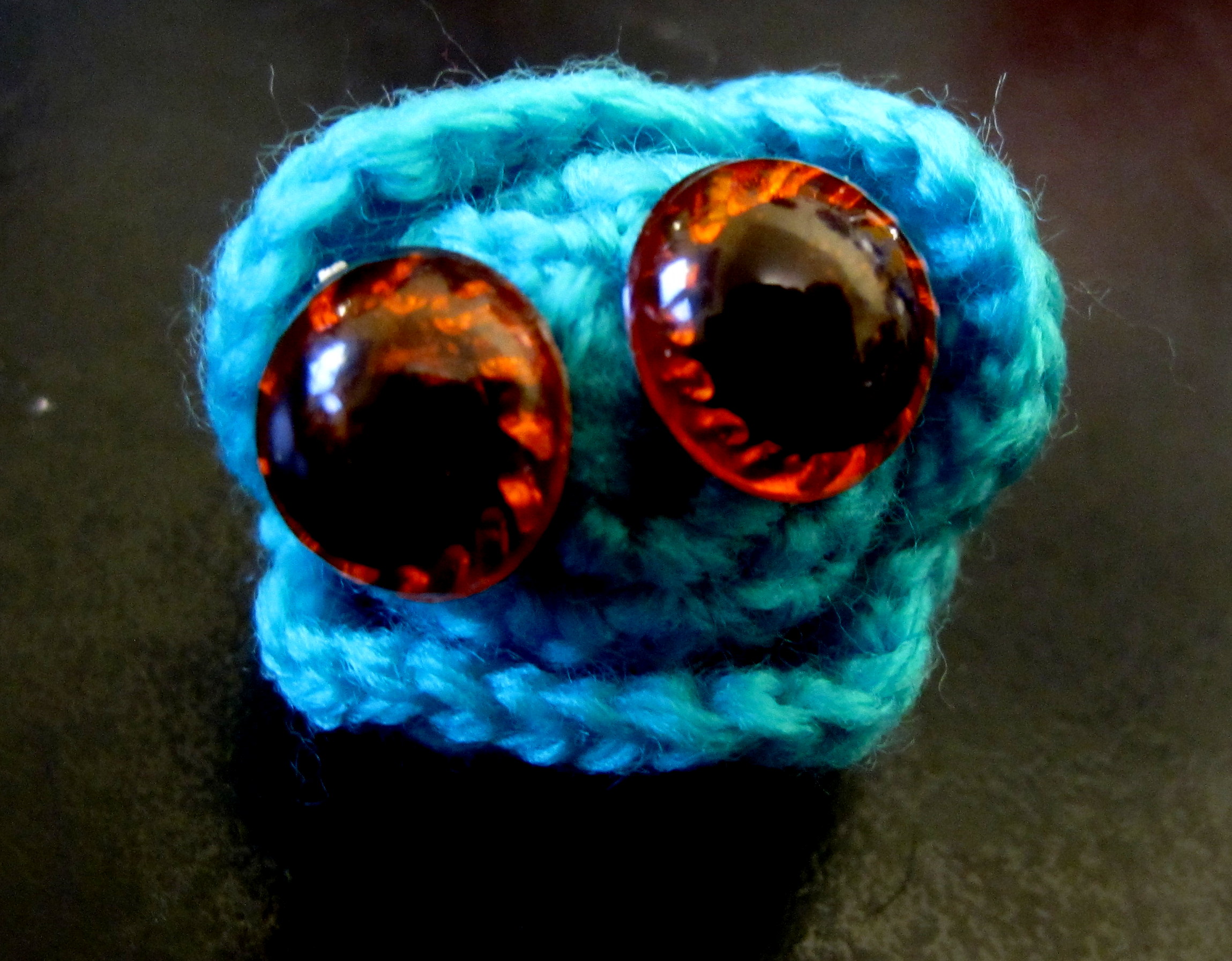
Only in Britain: What did I get for Christmas this year? Why, a lovely, hand-crocheted brussels sprout. With eyes. In real life (if that’s what I lead, given that I’m taking pictures of a crocheted brussels sprout with eyes), it’s green, not blue.

Recipe links: scones, clotted cream, and other good stuff

I’ve run a series of posts about food, in response to which Jean at Delightful Repast sent me links to recipes, all for several things that have either I or someone leaving a comment mentioned. I thought I’d pass them on for the benefit of anyone out there who cooks. Or who knows someone who can be bribed or strongarmed into cooking.

Clotted cream. A number of people asked what it is, so here you go–make your own.

Scones. Because what’s clotted cream without a scone and jam?

English muffins, which Jean swears are just called muffins in England, although I’d swear I saw them sold as English muffins once at the Co-op.

Crumpets, which I can’t think of anything to say about. Except that I’m ending that sentence with a preposition and, yeah, it’s okay: The English language likes to end sentences with prepositions. (I tried to maneuver “with” to the end of that sentence, but I can’t do it.)

Teacakes, a.k.a. toasted teacakes, but you have to toast them before you can calll them that.

And finally, a brandy-soaked British fruitcake. This works for Christmas and for weddings, although not if you’re in the U.S., where wedding cakes are cut from sponge rubber and then iced elaborately.

Crime in London: a bonus post

In an effort to find material for an article, the New York Times asked  for people’s experiences of petty crime in London. Then the Times tweeted the article and nothing’s been the same since. To read the responses for yourself, you can follow the link or search Twitter using the hashtag #PettyCrime, which for no reason I understand calls up a whole different set of answers. I’ll quote entirely too many. I lost the better part of a rainy afternoon to the thread and I don’t see why you should be spared.

“An American talked loudly on his mobile in a restaurant then drank red wine with a fish course. Gave him an extra loud tut.”

“Increasingly people respond to the question ‘How are you?’ With ‘I’m good’ instead of the grammatically correct (and far more polite) ‘I’m very well, thank you.’ It’s only going to escalate.”

Only the excessively boastful and self-satisfied would respond with “I’m very well, thank you”! The acceptable answers are a) ‘not bad’ and b) ‘not too bad at all’ from which we can infer a) ‘my life is falling apart’ or b) ’I’m positively ecstatic’ “

“I fell down a flight of steps at Bank and immediately apologised for causing such a kerfuffle and holding up people’s journeys. So ashamed of myself”

“I once offered a class set of rubbers to a fellow American teacher, trying to offer some good old Limey hospitality. The response was criminally rude and the offer was declined.
I never knew pencil erasers were so contentious”

Ah, yes, friends. Rubbers are one of those things that shouldn’t be discussed with people from the opposite side of the Atlantic. On one side, they’re prophylactics (translation: birth control, as worn by the male of the species). On the other side, they’re erasers–things you use to rub out pencil marks.

“This morning, in Streatham South London, I said ‘good morning’ as I walked passed a fellow pedestrian, they didn’t say ‘good morning’ back. So rude. This will stay with me all day. Traumatised.”

“I left the house after lunch and a street-sweeper said ‘mornin’ to me.  I had to bite my lip not to correct him.”

“On the tube a young man got up and offered me his seat as the carriage was busy. I saw it as a ploy to mug me so I called the police.”

“I stood on someone’s foot on the train today, and they didn’t even say ‘excuse me’. I don’t know what the world is coming to.”

“I recently took my 10 month old daughter on the underground. She stared at people, it frightened them. She doesn’t know the code. She now lives in the north. The tube is safe once more.”

“I asked a man directions to a Burmese restaurant on Edgware Road, he pointed me in the right direction and said it would take 3 minutes to walk there but it actually took 20. Admittedly I stopped for a pint but he should have factored that in.”

“Kitten stole my croissant. Despite obvious trail of crumbs, stolen item was not recovered”

“I fear I’m responsible for a #PettyCrime as on Monday I took a crowded tube, lost my balance and ended up grabbing the arm of a fellow passenger (who I didn’t know!) in a panicked attempt to stay upright. Totally unacceptable behaviour.”

“I was in a busy pub just yesterday, I knew the gentleman a few people to my right was there before me but he was looking at his phone. I placed my order without alerting him. I haven’t been sleeping since.”

“I was blatantly blocked on escalator by a left standing tourist… I didn’t just sigh loudly but also tutted AND HARRUMPHED. To no avail. Said sightseer turned and looked at me. Obviously I apologized, moved to the right and carried on sighing. These people should be locked up.”

“I stopped to let another car pass down a narrow road. They did not gesticulate a thank  you. I have the police report if you wish for more details.”

“I was waiting for a bus recently. When it came, someone who had arrived at the bus stop after me got on before me.”

“A man got on my tube train wearing brown brogues when everyone knows a gentleman only wears brown in the country and black in town.  It was shocking”

“A close friend and I, approaching from different ends of the street, accidentally acknowledged each other outside a polite speaking distance.  I pretended I was waving goodbye and hid in the nearest shop until they were gone. We have never spoken of this.”

“I witnessed an Italian tourist standing on the left side of the up escalators at Piccadilly Circus station preventing people from walking up. Naturally I said nothing but stood close behind them seething and encouraging fellow commuters to join me in silent rage.”

“I have had entire conversations without mentioning the weather. I’ll go quietly, officer.”

“Some guy didn’t apologise to me once after I bumped into him. I was very dissapointed in that exchange and think he should be banged up”

“When I was 21 years old, I worked in a London hotel and one morning I was asked, by an American couple, how to use the microwave in the room. It was the safe deposit box.”

“A publican of fine reputation went rather overboard with an extra splash or two of Tabasco in my Bloody Mary recently. I was so flustered I nearly told him”

*

My thanks to Mardi for sending me a link to the BBC’s coverage of these outrages.

How tea soaked through Britain’s social structure

The world’s falling apart around us, my friends, but we can panic later. In the meantime, this is Britain, so let’s have a nice cup of tea.

Or, since it’s hard to boil water online, let’s talk about tea instead.

China has been growing and drinking tea since the third millennium B.C.E., or so legend has it, although it can only be documented from the third century B.C.E. Which isn’t bad. That’s an entire nation that’s known how to stay awake for well over two thousand years.

And with that quick nod to the larger picture, we’ll leave them not sleeping while we hop continents and a pocketful of centuries, because what we’re talking about is how Britain became a tea-drinking nation.

The British weren’t the first Europeans to latch onto the drink. That was the Portuguese. Traders and missionaries who sipped it in “the East,” as one of Lord Google’s minions puts it, and brought some home as souvenirs.  

Irrelevant and out of season photo: begonias

“The East” is kind of a big area, but we’ll just nod cynically and move on.

It was the Dutch who first made a business out of importing the stuff to Europe. That was in 1606, when they were trading out of Java, the port that gave coffee its nickname. By the time tea made it’s wind-powered way to Europe, it cost a small fortune, so drinking it was a way for the upperest of the upper crust in first Holland and then western Europe in general to show off their couth, not to mention their money.

You ever notice how much more specific our information is about, say, Europe, than about that vast, undifferentiated East?

But we were talking about tea. And England. Or Britain, since we’re in that murky period when England and Scotland had the same king but not the same government and Wales  had the same king and government but didn’t want either or them because it was less than delighted about having been conquered. As people tend to be.

To keep things relatively simple, we’ll keep our eye on England, which wasn’t about to be seduced by this effete continental brew. England was a nation of beer drinkers, thanks, except for people with money, who weren’t opposed to wine and might drink a bit of tea now and then for medicinal purposes, since it invigorated  the body and kept the spleen free of obstructions.

Obstructions? That’s when the spleen’s on its way to an important meeting and some damn county department’s closed the road just because it’s washed out or something silly. The spleen isn’t the most easy-going of organs. You know the word splenetic? Bad-tempered, cranky, ill-humored, and other synonyms. So, a nice cup of tea and the road is magically open before it.

No, I don’t understand it either, but medicine, like spelling, was more imaginative back then. 

According to a website about tea, tea, and nothing but tea, The first dated reference to tea [in Britain] is from an advert in a London newspaper, Mercurius Politicus, from September 1658. It announced that ‘China Drink, called by the Chinese, Tcha, by other Nations Tay alias Tee’ was on sale at a coffee house in Sweeting’s Rents in the City. The first coffee house had been established in London in 1652, and the terms of this advert suggest that tea was still somewhat unfamiliar to most readers, so it is fair to assume that the drink was still something of a curiosity.”

It wasn’t until Charles II married the Portuguese princess Catherine of Braganza in 1662 that the English took tea drinking to their hearts. Or more accurately, to their thin, aristocratic lips. Catherine loved her tea, and legend has it that since she was coming to a land of barbarians she brought a hefty supply of tea leaves in her very substantial baggage.

With Catherine drinking the stuff, tea suddenly looked less like medicine and more like a status symbol–a term that, however well it was understood, hadn’t been invented yet.

Tea was still expensive. A pound cost roughly what a “working class citizen” made in a year. What kind of working class citizen, since men’s and women’s pay differed dramatically? (Ah, the bad old days. Aren’t you glad we’re past all that?) Put your money on the male variety of citizen and you’re less likely to lose it. The female variety are generally referred to as “women,” not “citizens.” Or if the citizenship bit is important, their sex will be specified.

Odd, isn’t it?

As tea drinking spread among aristocratic women, so did tea paraphernalia. Tea drinkers needed imported porcelain teapots. And the thinnest of thin cups. And dainty dishes for sugar. They may not have actually liked tea, but they sure as hell knew how to make a ritual of it.

All those peripherals were imported by the Portuguese as well.

It was at this period–in other words, right from the start–that they began adding milk to their tea. The cups were so delicate that they cracked if the tea went in without something to cool it.  

Starting in 1664, the East India Company–a British creation–moved in on the trade and imported tea into England, and from aristocratic ladies, tea made its way down the social scale into the coffee houses, where middle- and upper-class men did business, and into the homes of middle- and upper-class women, who didn’t get out the way the men did.

Tea was still too expensive for the working class. The East India company got itself a monopoly on British imports and kept the price high. And tea was taxed heavily, which means that by the eighteenth century it worth smuggling. By the end of the eighteenth century, organized crime networks had gotten involved. Smugglers brought in seven million pounds of the stuff. How does anyone know, since they’d have been wise to keep it out of sight and uncounted? Good question. But legal tea? Only five million pounds came into the country.

Tea–especially the smuggled stuff–was often mixed with leaves that had been brewed once and then dried. Or with leaves from other plants. To make the color more convincing, some clever devil hit on the idea of adding sheep manure. Or so say the articles I read. People kept drinking it, so it couldn’t have been too off-putting.

In 1784, the government reduced the import tax and tea smuggling pretty well ended.

As the price came down, tea became a “common luxury” for working class people, and by the 1830s had become a “necessary luxury.” As the temperance movement grew it became a substitute for alcohol.

The working class diet at this point was made up mostly of bread, potatoes, and tea.

Why would class people buy something that didn’t fill their bellies and had no nutritional value when money was scarce and food wasn’t plentiful? Hot tea with sugar offered energy, a brief break from work, and the illusion that you’d had a hot meal. 

In the 1820s, the East India Company began growing tea in India, and in the 1860s it began to be grown in Sri Lanka, which was Ceylon at the time even though it occupied the same spot on the globe as it does now, under the new name. The price dropped.

Predictably enough, as soon as the working class started drinking serious amounts of tea, the overseers of public morality went into a panic about how it would affect them. Excessive tea drinking, they warned, would cause weakness and melancholy. But only in working-class people. Not among their, ahem, betters.

Then the public moralizers realized that if working people drank tea they’d have less time and money to drink beer, so they settled down and accepted the situation.

Tea became so much a part of British life that in the first and second world wars the government took control of importing it to ensure that it stayed both available and affordable. They were afraid morale would collapse without it.

And today? Britain sips its way through 60 billion cups of tea per year. That’s 900 cups per person, but that includes people who’ve just been born, so the rest of us have to drink their share. And sixteen- to thirty-four-year-olds aren’t drinking their share either, possibly because they’re afraid it’ll stain their teeth but possibly because tea doesn’t make a statement.

A statement?

The article that enlightened me about this quoted food futurologist Morgaine Gaye, who said, “A cup of English breakfast or builder’s tea is only cool when you are slumming it. You might have a cup of tea at your mum’s, but not when you are out or in a cafe because it doesn’t say anything.”

Slumming it at your mother’s? I’m going to tell her mother she said that and–I can predict this much of the food future–she won’t be eating there this holiday season. Or if she does, she’ll be drinking lukewarm water from the dog’s bowl.

Anyway, this defection by the irresponsible young means their brown-toothed elders–those of us who don’t want anything that lives inside our cups to make statements to the world at large or even whisper to us personally–have to drink even more.

And to make ourselves feel okay with that, we’ve started asking if it doesn’t, oh please, have some medicinal effects. In other words, since we’re drinking it anyway, doesn’t it cure something?

The definitive answer is, maybe. The evidence disagrees with itself. Pitch your tent with the people who say it does and you may be wrong but you’ll feel better about it all. 

Kate Fox, an anthropologist and the author of the inspired Watching the English, reports that the higher up the class structure you go, the weaker the tea. Which is why I’ve decided not to hang out with the queen anymore. I like a nice, strong brew and furthermore I like to drink it with people who aren’t afraid to swear, or who at least (a) understand the words and (b) don’t pass out when I do.

Fox also says, “Tea-making is the perfect displacement activity: whenever the English feel awkward or uncomfortable in a social situation (that is, almost all the time), they make tea.” Which may be why so much of it gets made.

And once you’ve brewed it, it’d be wasteful not to drink it. And since the young aren’t doing their share, it’s up to those of us who are over 34.

*

After Christmas, we’ll finally get around to the connection between tea and the opium trade.

How the scone discovered Britain

Like so many of the things I write about here, the history of the scone is murky.

But first a definition. And if you already know what a scone is, stay with me for the pleasure of watching me fall on my face as I struggle to do something simple.

Definition

Lord Google will tell you that the scone is a small, unsweetened or lightly sweetened cake. Lord Google couldn’t find his ass with his many floury hands. A scone is not a cake, it’s a baked thing made without yeast.

And that, my friends, is why I’m not in the dictionary business.

Irrelevant photo: The Cornish coastline. Oh, hell, I think I used this one not long ago.

Wikiwhatsia does a more accurate if less specific and less linguistically convincing job by defining it as a baked good.

Can a baked good survive without enough friends to become baked goods, plural? And if it can, is a baked evil lurking out there somewhere? Don’t we have enough to worry about in the world today?

The first stumbling block in defining the scone is that what things taste like runs off the edge of the English language. And probably of other languages.

The next stumbling block is that different recipes find different ways to make the dough rise, so you can’t define it by that. It can be made with assorted combinations of baking powder; cream of tartar; bicarbonate of soda, which Americans know as baking soda; self-raising (or self-rising) flour, which is cheating but go on, it’s your kitchen and no one’s watching. So you end up defining it by what it doesn’t use: yeast.

Defining things by what they don’t include is inherently dangerous. Scones also don’t include chopped liver. Or gravel. They don’t include fire extinguishers or (at least in my experience) pickled onions. The world is rich in things they don’t include.

But in spite of that, let’s charge in where angels fear to bake and talk about what a scone isn’t: It’s not highly sweetened. It’s not a cake. It’s not a baking powder biscuit. It’s not an American scone because the American scone takes the British scone and adds steroids. It’s also not an anvil or a soup or an armchair.

You’re welcome. I do try to be helpful.

And there endeth in failure my attempts to define the thing. Aren’t you glad you stuck around?

Variations

Whatever the scone is, the British eat it happily, generally with butter and jam or (in the southwest, if they’re going to hell in a handbasket) with clotted cream and jam. Or if they’re me (which of course they’re not; I’m more American than British, no matter how long I’ve been here), just with butter.

All that changes if the scones are savory, which means not sweet and spelled with an extra U but it went wandering somewhere and I can’t be bothered looking for it just now. Savory scones can involve cheese or herbs or anything along those lines, in which case skip the jam and stuff and just slather on some butter and be happy.

History

The scone’s origins (and we’re back, at last, to where I should have started) are murky.

A food reference site tells me they were either originally Dutch (from the Dutch for beautiful bread, schoonbrot, or Scottish, a descendant of the Scottish oat cake. Let’s take those possibilities one at a time.

I humbliy petitioned Lord Google to translate schoonbrot for me. First he corrected my spelling: It’s schoonbrood. Then he told me it means clean bread.

I told him to dust the flour off his hands because he was getting my screen dirty, but if he’s not listening I’ll admit to you that I can actually see a connection there.

I slipped a few more words into his all-devouring maw and learned that schoonbrot is Middle Dutch, so I can keep my snarky remarks about the site where I found the word to myself.

A WikiWhatsia article translates the Middle Dutch as fine bread and says the language was first brought to England by about a third of William the Conqueror’s soldiers, who came from Dutch-speaking Flanders, and more bits of it were brought by Flemish refugees between the eleventh until the seventeenth centuries, who were fleeing floods, overpopulation, and warfare.

“When England’s population numbered 5 million, London alone had tens of thousands of Flemings, while an estimated third of the Scottish population has a Flemish background,” it said.

That’s not the same as saying that a third of the population of Scotland was Flemish, but never mind. The point is that the English language picked up a pretty fair dusting of Middle Dutch and (irrelevantly) that Britain has assimilated large numbers of refugees in the past without losing its essential Britishness, whatever the hell that may be.

So there, and also harumph.

All of that is actually more interesting than scones–at least to me–but, sigh, we’re talking about scones so let’s go back to our topic.

I made a quick effort to find out what schoonbrood was (and may still be) and found that it’s a company that sells “art by a number of painters” (a “perfect gift for someone starting his/her life in Maastricht. or leaving the city after graduation”) and also a not-uncommon last name. If it’s yours, I can point you at ways to trace your ancestry or to a possible relative who’s raising money for pancreatic cancer. Not, I assume, for the disease itself, which needs no help from us and isn’t interested in money anyway, but either for research or to support people who have it.

None of which was what I was looking for.

I tried “schoonbrood recipe” and came up with a recipe for harissa coleslaw with pomegranate and an article on emulsion polymerization (no idea what that is–I know my limits). It’s that last name business. So never mind. We’ve spent a lot of time on this and learned almost nothing. We’ll just have to assume the one baked good and the other baked good are in some way related to each other and are willing to form the happily pluralized phrase baked goods.

We’ll also assume that both are very clean because around here we wash our hands before cooking.

But where are my manners? Thank you, Lord G. I have left the usual offering of data. I’m not sure how much is in there. More than I expected, I expect.

And with that, we can move to the next possible origin for scones: Scotland in the early 1500s. These proto-scones would have been rolled out to the size of a smallish dinner plate, baked on a griddle, and cut into wedges, and they’d have been made without baking powder (or soda) because baking soda only became commercially available in 1846 and baking powder hit the store shelves a bit later. Although the ancient Egyptians did use baking soda as part of the mummification process.

If that doesn’t put you off the next baked good you see, I’m not sure what will.

Baking powder, to be technical about it, is just baking soda plus some other stuff that makes it easier to use, but it revolutionized baking. You can find an explanation here.

The scottish proto-scone would have been made of oats and barley. Or of just one of them. Whatever was grown locally, I expect.

And now we get a bit where scones go upmarket.

According to the food reference site I linked to above (and you’ll need several grains of salt to do with this, so have some at hand, please), “Scones became popular and an essential part of the fashionable ritual of taking tea in England when Anna, the Duchess of Bedford (1788 – 1861), one late afternoon, ordered the servants to bring tea and some sweet breads, which included scones. She was so delighted by this, that she ordered it every afternoon and what now has become an English tradition is the ‘Afternoon Tea Time’ (precisely at 4:00 p.m.). They are still served daily with the traditional clotted cream topping in Britain.”

The site’s American, which you can spot by its recipes (cups, not grams and millithingies) and by its conviction that England stops dead at 4 p.m. and has afternoon tea. Also by its claim that all of Britain has scones with clotted cream.

Geez. Who knew Americans were so easy to spot?

So that’s two grains of salt.

The third one? A food historian, Joyce White, says the Duchess of Bedford’s early teas would have been dainty bread-and-butter sandwiches, not scones.

It is true, however, that the D of B introduced the idea of food with her afternoon cup of tea, because until she got loose on the tradition, having a cup of tea involved nothing more than having a cup of tea. After a longish evolution and the democratization of tea (because in her day it was both expensive and aristocratic), it’s indirectly thanks to her that we now have people talking about eating their tea. No one except outsiders like me thinks that’s an odd thing to say.

The D of B also started that business of high tea and low tea. Low tea was set on a low table. High tea involved a meal and was eaten off a table high enough to slide chairs under.

I tried to find out when the scone escaped the D of B’s elegant clutches and lowered itself to be eaten by the likes of you and me, but Lord Google and his minions (of whom, in spite of myself, I am one) aren’t interested. But escape her they did, and they now cost less than half a pound for ten at a discount supermarket. Or more. It all depends where you shop.

*

Now that the scone’s baked, bagged, and priced, we can move on to tea. Because what’s a scone without a cup of tea? In the next couple of weeks, I hope to inflict on you first a post about tea and then one about opium, which most people don’t ask for with their scone and tea but is related anyway.

More news from Britain–and (as a bonus) New Zealand

This wasn’t supposed to post until next week, but what the hell, here it is: bonus.

It’s happening again: Ordinary people are weighing in on the great symbols of British culture in a struggle to reshape them to suit the modern world. The last time we followed one of these moments in any depth was when 124,000 people voted to name the UK’s newest, biggest, best, most advanced, and cleanest (since it hadn’t been used yet) polar research ship Boaty McBoatface.

They lost, as people who fight for good causes so often do, but at least something on the ship was named Boaty McBoatface. The name only gets italicized if it belongs to a boat or a ship and I can’t remember if the name was stuck on a small remotely operated sub or a mop and bucket (the mop being Boaty and the bucket McBoatface), so we’ll leave off the itals. I wouldn’t call it a win, but it was a gesture in the direction of justice.

We can blame the Natural Environment Research Council for asking what people wanted to name the ship and then ignoring the vote when they didn’t like the answer. They named the ship the Sir David Attenborough. As one headline put it, “Sir David Attenborough launches ‘Boaty’ polar ship.”

It’s got to be tough, being upstaged by something named Boaty McBoatface–and even worse when that isn’t the thing’s name.

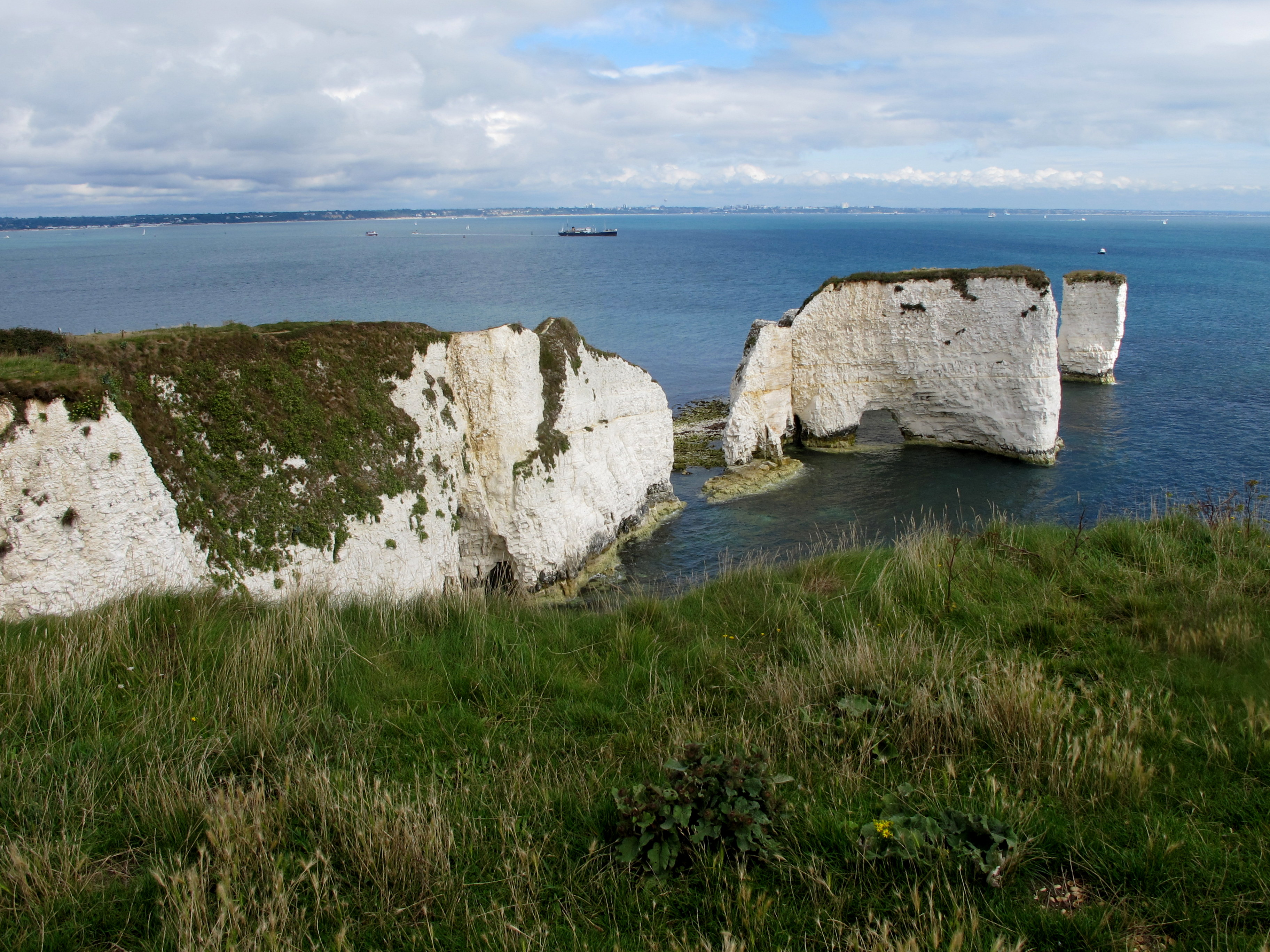
Screamingly irrelevant photo: The white cliffs of–nope, not Dover. They’re in Dorset, near Swannage.

Having learned from that fiasco, the government isn’t asking whose face the Great British Public (GBP) wants to see on the forthcoming, horribly plasticated £50 bill. But that’s not stopping the GBP. Campaigns are underway. Give the GBP a silly cause and it will rise in its glorious thousands.

Small- and large-C conservatives are pushing for Maggie Thatcher’s image. Lefties are–typically, I suppose–pushing in several directions at once. I got a petition promoting Mary Seacole, a black Jamaican-born Briton who worked as a nurse during the Crimean War, even though Florence Nightingale wouldn’t have her. She came to be much loved, was known as Mother Seacole, and was awarded the Victoria Cross. Others are backing Noor Inayat Khan, a British spy in occupied France who died at Dachau and was posthumously awarded the George Cross.

So far, so sensible, but when I last checked the petition with the most signatures was for a picture of England defender Harry Maguire riding an inflatable unicorn and wearing not much at all. I tried to find out who Harry Maguire was and what about England he could defend on an inflatable unicorn, but the information came in a package marked, “May contain sports,” and I have a serious sports allergy so I didn’t open it. You’ll have to google him yourself. The unicorn, though? That’s a mythical beast that does not exist in the world we live in and never has. Making it all the more appropriate to grace something associated with finance.

Or at least its non-existence is true in the world where I live. The world’s weird enough that I don’t want to make assumptions about where you live or what you might be using by way of facts.

There’s also a suggestion that two stars from Only Fools and Horses should be on the bill (or note, if we’re talking British) dressed as Batman and Robin. 

That’s a sitcom reference and my allergy to sitcoms is milder than my allergy to sports, but I was too bored to open the box. You’re welcome to look inside if you want, but I’m voting for the unicorn.

*

I really meant to stop writing news posts, either permanently or for long enough to convince myself I’d given everyone a much-needed break, but the news has been too good lately, although not all of it has been British.

Point of clarification: By good, I don’t mean containing good news. I don’t think there’s enough good news out there to fill out a thousand-to-two-thousand-word post. I mean that the news has contained moments of lunacy that damn near lift the depression that settles over me when I open the newspaper. To wit:

New Zealand asked the Great New Zealand Public (GNZP) to vote on its bird of the year and it chose the kereru, a Maori word that’s pronounced with a light tap on the Rs and the accent on the first syllable. I hope you’re impressed that I know that and I hope to hell I got the accent in the right place.

A tap, in case you want to try this at home (it’s quite safe), is when you tap (surprise!) your tongue on the top of your mouth, just behind the front teeth. Do that and give it some air. It should work.

The kereru (which should have a long line above the U but I have no idea where to find one or not much of an inclination to look) is basically a wood pigeon on steroids–the kind of pigeon you wouldn’t want to meet late at night in a dark alley. It’s got huge shoulders, a big chest, and a little bitty head. It’s native to both the north and south islands and to rural areas, urban areas, and dark alleys.

A wood pigeon, in case you don’t live in wood pigeon territory, already looks like a pigeon on steroids, but a lower dose than the kereru.

Why does the GNZP love the kereru? Maybe because it’s known for eating fruit that’s so old that it’s fermented, getting itself drunk on the stuff and falling out of trees. [You’ll have to fill in the blank here, because I’m not sure who actually does this] scoops them up and takes them to wildlife centers where they can sober up.

The centers won’t release them until they participate in a two-step program (they tried a twelve-step program but birds just don’t have the concentration), then they go back out and do it all over again. The recovery rate is zero, but that doesn’t stop the centers from trying.

In its sober moments, the kereru also swallows (whole) the fruit of several native trees and then plants the seeds wherever the mood takes it, along with a carefully measured bit of fertilizer. Not many birds are big enough to do that, so drunks that they are, they play an important role in the ecosystem.

*

While we’re sort of on the subject of the Maori language, Coca Cola introduced a New Zealand ad campaign that–okay, I’m even more of an outsider than usual here but I think I can safely say they were looking to pick up a bit of cool by using the Maori language. So they wrote, “Kia ora, mate,” all over vending machines.

They were doing okay with kia ora, which means hello and is recognized by pretty much any New Zealander.

Mate, though? In Maori, it has two syllables and means death.

Hi, Death. Wanna Coke? 

*

Back in England, the city of York has been discovered. Not by Vikings this time but by hen and stag parties.

Old as I am, I wasn’t around for the Viking raids, but if you put together an argument that the hen and stag parties do more damage than the Vikings ever did, you’d stand a fighting chance of convincing me. It’d be bullshit, of course, but it’d be funny bullshit.

Hen and stag parties are known for staggering off the trains and heading into the walled city center, where they drink themselves witless, wave inflatable penises (that’s the hen parties), and pee in the streets (that’s not just the stags).

In the interest of promoting hysteria, a local paper and unnamed city leaders said the city center had become a no-go area on Saturdays. Even though crime isn’t actually up. It’s not about danger, it’s about inflatable penises and peeing in the street.

Ah, but there’s worse to come. The thing is that when the British get drunk, they sing, and to bring order back to the city center, York is trying to keep buskers–a British word for street performers–from handing their mics over to the drunks. Because there’s nothing a British drunk wants more than to sing into a microphone. Sloppily, badly, and publicly. Patrols are handing out laminated cards that performers can show the drunks saying, more or less, “Sorry, but if I hand you my mic the Vikings will attack and so will the neighbors, and it’ll all be your fault. Go home and sleep it off.”

And since it’s on a laminated card, of course the drunks will respect it.

Has it occurred to anyone other than me that hens and stags probably shouldn’t marry each other? I don’t like to think I’m narrow minded, but cross-species marriages have some inherent problems. Especially when they’re as far apart as a mammal and a bird. Maybe if instead of getting married, they just, you know, dated or something–.

*

In the interest of efficiency, Britain’s Royal Mail was partially privatized in 2013, and this year its incoming chief executive got a £5.8 million bonus for walking through the door efficiently. That would’ve been enough to hire 252 postpeople, whose starting pay is, according to one source, £23,000, although according to another the average (not the starting) pay is £22,500.

Or maybe the lower pay was for a different category of postal worker, but it’s close enough. We don’t need details to spot a small difference between the pay at the top and the pay at the bottom. 

The Communications Workers Union thought it might be worth knowing that postal workers’ pensions were cut just months before the bonus was agreed on because the Royal Mail absolutely, no fooling around, had to save money.

The outgoing CEO got a bonus of £774,000 plus twelve months’ salary, which was £547,500. For walking out the door efficiently.

Three quarters of its stockholders refused to back the incoming CEO’s bonus but it went through anyway because the vote’s only advisory. It can embarrass the company but that’s about it. Royal Mail promised to “reflect very carefully” on shareholder concerns and has admitted that it is indeed embarrassed over not having engaged with shareholders ahead of time.

You may have already guessed that “engage with shareholders” isn’t my choice of words. I stole them and I’d have loved to replace them with the kind of words that actual human beings on this planet use instead of the ones inflatable unicorns speak on some mythical planet, but I can’t think of anything a human being would say in that situation so I left them.

The Magna Carta and the Charter of the Forest

A man was arrested in October for trying to steal a copy of the Magna Carta. Or–depending on what news source you like–on suspicion of trying to steal it. It happened in Salisbury, where it was on display in the cathedral, so for all we know he may have been a public-spirited citizen who wanted the city to be known for something other than novichok poisonings.

But enough about him. Let’s talk about the thing he was trying to steal.

We’ll start, while we still remember that someone tried to steal it, by saying that only four copies of the 1215 Magna Carta survive. They’re written by hand (as everything was in those days) and in Latin (as everything that mattered was).

In 2015, a version from 1300 was found in the archives in Maidstone, Kent. Stay with me and you’ll see why they have different dates. It had somehow gotten filed inside the pages of a Victorian scrapbook and was (don’t ask me how these two facts can coexist) cuddled up next to a Charter of the Forest. We’ll get to the Charter of the Forest eventually, but in the meantime we can pretend it was in the scrapbook as well.

Irrelevant photo: hemp agrimony–a wildflower.

Part of this newly found version of the Magna Carta is missing, but it was still valued at around £10 million. So stealing one? Yeah, you could make a few bucks that way. Or quid, if you prefer. But put your wallet away, because it’s not for sale. It belongs to the town of Sandwich, which decided to use it as tourist bait. Presumably it’s worth more that way, at least in the long run.

The find supports the belief that the Magna Carta was issued more widely than historians had thought–that it was sent to at least fifty ports and cathedral cities.

So let’s talk about what the Magna Carta is and why it matters.

The story starts, or at least can start, as many stories from this period of English history do, with the English fighting in France, parts of which belonged to England. Or at least the English thought they belonged to England, and so did what passed for international law at the time. We’ll skip the details. What matters is that however many times England won or everyone involved worked out a peace deal, France was still across a big damn chunk of water, England’s French lands were still on the other side of the aforesaid water, and the next thing anyone knew everyone involved was fighting again.

That’s why I feel free to skip the details. Just when you get the kids all settled down to eat a meal in peace, they start the whole thing over again. If it’s not fighting over who said what to who, it’s over who lost the remote and who was the first one to throw food. Besides, we’ve already got a long post here.

All that fighting took money. Lots of money. And that money had to come from somewhere. Keep that in mind while we swerve left to avoid a pothole and explore a bit of church history.

In 1205, the archbishop of Canterbury died. The monks of Canterbury and King John couldn’t agree on the next archbishop, so they appealed to the Pope (if that sounds peaceful and cooperative, it wasn’t), who had a third candidate in mind.

King John did what any sensible adult would do in that situation, he banished the Pope’s candidate, and the Pope did what any pope would do and placed an interdict on the country, which meant that no religious services could be held. Church bells couldn’t be rung. According to one source, people couldn’t be buried, but I seriously doubt they were left lying where they dropped. Let’s agree that for the sake of public health they were put in the ground but without the religious rituals that people of the time considered necessary.

Eventually, the Pope excommunicated John, which meant his subjects were freed from their oaths of allegiance and the French were free to invade, which they did, although not until a sentence and a half from now. John felt free to confiscate church property, which he did. Then he sold it back to the church, making a profit that he used, in part, to create a navy, which he used first to invade Ireland (in case he didn’t have enough trouble) and then to defeat the French invasion that happened at the beginning of the paragraph, which has been in suspension until we got to this point.

John’s  excommunication also gave some of his barons the excuse they needed to start plotting against him. John grew suspicious. Tensions rose.

John accepted the Pope’s candidate for archbishop, humbled himself publicly, and paid 100,000 marks to compensate the church for the trouble he’d caused. That got him re-communicated. Tensions fell. Everyone kissed and made up and buried the dead bodies they’d left lying around, but none of them (that’s the living people, not the dead) liked each other any more than they had before.

Then John invaded France. It didn’t go particularly well and he returned to England trailing a whiff of cowardice, at which point the barons who’d been plotting rose against him, because if there was one thing aristocrats of the era couldn’t stand it was the scent of cowardice. The accusations of cowardice may or may not have been justified, but it didn’t matter. They’d been in conflict with him for a long time and this was a great excuse, so a few of them met with the Pope’s shiny new archbishop (who might just possibly have harbored a resentment or two) at Bury St. Edmunds and swore to fight the king if he didn’t grant them a charter.

Keep the thought of a charter in your mind while we wander off again. The story’s full of potholes. We’ll get to the charter eventually.

Charter, charter, charter, charter.

A few barons put clothespins on their noses to block that whiff and declared for John, but most of them burrowed deep in their beds and waited to see who’d come out ahead, John or the rebels. A few baronial families did even better than that: They split their allegiance, planting family members on both sides. Whatever happened, the family would come out ahead.

The rebels chose Robert FitzWalter was their leader. He’d been tangling with the king for years. But although personalities loom large in the tales that lead up to the Magna Carta, they’re not what matter most. The world’s full of personalities and conflicts between them, and most of the time they’re not much more than a background hum. It’s only occasionally that events give them space to flower. The root of the trouble seems to be what the monk Roger of Wendover described as the king’s “unjust exaction which reduced [the barons of England] to extreme poverty.”

You might want to think of that as relative extreme poverty. They were still barons. Their poverty would’ve been a peasant’s most outrageous dreams of more-than-plenty.

The newly re-communicated King John got the Pope’s backing against the rebel barons, so he had god’s support and could take the field as a crusader. The Pope excommunicated the rebels, but they also had god’s support–they declared themselves the Army of God and the Holy Church, even if the church was backing the other side.

If you believe in the same god they did, you can assume that he was, at best, confused and might understandably have decided to sit this dance out.

The barons sent John a list of demands. He read it and said, “Go fish.”

Okay, he didn’t say, “Go fish.” That’s from a kids’ card game that hadn’t been invented yet. What the kids of that era did to keep themselves out of trouble I can’t imagine. What John actually said was some era-appropriate version of “When I see pigs fly by this arrow slit that I call a window, I’ll put my name to this piece of crap.”

The barons responded by besieging Northampton, where John defeated them, but London opened its gates and FitzWalter and his Army of God marched in. King John, with his own lower case army of god, held onto the Tower of London.

The two sides negotiated and eventually met at Runnymede, a field of no particular distinction at the time but now famous for being the place where they met, where they’d agreed that John would sign the Magna Carta, which wasn’t called that yet and was the same thing John had called an era-appropriate version of “this piece of crap.” It guaranteed the rights of the Church–an interesting provision, given that the rebels were still excommunicated. It also limited some of the ways the king could exploit feudal customs, confirmed people’s rights under Common Law, and protected the barons’ from any repercussions of their rebellion.

One clause said twelve knights would be elected within every county to investigate abuses by sheriffs, foresters, and other royal officials. Another set up a committee of barons to enforce the settlement. In return, the rebels promised to surrender London.

Both sides crossed their fingers behind their backs and John signed.

Neither side kept its side of the bargain, or meant to. The rebels kept London. For his part, John sent out copies of the charter but put the sherriffs in charge of investigating abuses by the sherriffs and their cronies. He also sent a copy to the Pope, who (as John had expected) promptly nullified it. He wasn’t about to have either a king–or by extension, a pope–rule under the supervision of his subjects.

But for all that no one planned to abide by it, the charter bought both sides a short stretch of peace, which was all they’d hoped for. Then the two sides were fighting again. You had the remote last. Yeah, but you threw mashed potatoes at me. With gravy. The rebels offered the English crown to Prince Louis of France. Predictably enough, Louis’ proud father, Philip, sent troops.

Things looked bleak for John. By now, a good two-thirds of his barons had gambled on the French, and John and his troops were being harried through the countryside. If that wasn’t embarrassing enough, when his army and, more importantly, his baggage train were crossing some muddy tidal flats of Lincolnshire that are called the Wash, a rising tide swept away his treasury and the crown jewels. The land there is flat and the tide, according to the BBC, which knows these things, can rise faster than a running man. Or, presumably, woman. At the full and new moons, it can outrun a horse without stopping to ask if it’s male or female.

It was all looking pretty grim for John when he played a card that turned a losing hand into a winning one: He caught dysentery and died, the clever devil. His son was crowned Henry III and he reissued the Magna Carta, which left the rebels without much to rally around. Barons changed sides and suddenly the French troops looked more French and less English than they had a few minutes before. The war changed from a civil war to a war of resistance against the French.

Louis was defeated, in a nice bit of balance, at Sandwich, which appeared early in our post, making a sandwich of the intervening potholes, detours, and information. Less helpfully, he was also defeated at Lincoln, which has nothing to do with our tale.

He withdrew in 1217.

And the Magna Carta? It was re-reissued in 1225 and again whenever the king and some element of his country were at odds with each other. In the 1270s, the Church demanded that a copy of Magna Carta be displayed on the door of every major monastery and every cathedral church.

What made the Magna Carta so important? Well, it made the king subject to the rule of law. That was not just new, it was shocking. It established the idea that taxation depended on the consent of the kingdom. A few hundred years later, the American Revolution dropped that thought into the social media of the time and it went either bacterial. Or viral–no one knew the difference then.

It–it being the Magna Carta here–also made taxation all the more necessary because it blocked many other sources of kingly revenue. So the great and powerful (although sub-royal) would now have to be summoned to give their consent to new taxes, and that opened the door, for the first time, to what would become a parliament.

In theory (and I’m borrowing this thought from a British Library video by professors David Carpenter and Nicholas Vincent) it put an end to arbitrary kingship, although in practice kings went right on being arbitary. They continued taxing and tyraninzing. “What mattered about Magna Carta . . . was Magna Carta the idea, not necessarily Magna Carta the political tool. It survived long after the tyranny of any individual king and therefore it became a point of principle rather than of practical politics.” 

Now let’s go back to the Charter of the Forest, which you could be forgiven for having forgotten was found sandwiched in with the Magna Carta in the Sandwich archives.

The Charter of the Forest was issued in 1217, when Henry III issued a new version of the Magna Carta. By then, roughly a third of the country (or of southern England, depending on your source) had become royal forest, and the king made a big honkin’ chunk of money from fining people for various offenses within its bounds. The charter reduced its area by un-foresting everything that had been added since Henry II’s time. It also got rid of capital  punishment and mutilation for poaching (which is basically hunting game that belongs to some aristocrat). People could still be fined or imprisoned for poaching, but hey, they weren’t being killed or mutilated. Progress has a  bleak sense of humor.

It allowed  free men (notice the limitations there) who had woods within the forest to put up buildings and clear land for farming.

How can people have woods within a forest? Forest, as it turns out, didn’t mean forest. Ever since the Normans conquered England, it meant an enclosed area claimed by a king or lord, along with all the huntable animals in it and the vegetation they fed on. A forest could be forest, grassland, wetlands, whatever–blue sky, presumably, if you could enclose it. The royal forest grew big enough to create a hardship for people trying to do frivolous things like farm, fish, gather fuel, pasture animals, and generally feed their families.

Where the Magna Carta was most immediately about the rights of the powerful, the Charter of the Forest was about common people’s rights. Some of its clauses stayed in force until the 1970s.

At the same time that the Charter of the Forest was issued, the Magna Carta was modified so that widows could refuse to remarry and could retain some of their husbands’ land and their rights to the common, which meant they could still make a living–a reduced one, but better than what they’d been able to do before.

It was the Charter of the Forest that established the name of the Magna Carta, which wasn’t called the Great Charter because it was fantastic, wonderful, and better looking than your average charter. It was bigger than the little charter–the Charter of the Forest. Calling it Magna was a way to keep them straight.

The Charter of the Forest isn’t as well known as the Magna Carta, but for hundreds of years every church had to read it out four times a year. It provided a legal basis for commoners–meaning people with a right under feudal law to use a common plot of land–to defend that right for centuries to come.

England has never had another king named John.

*

Someone left me a comment about the Charter of the Forest a good long while ago. I’d never heard of it and without that shove wouldn’t have found it. The information’s easy enough to find, but even so you won’t find it unless you look. My thanks, and my apologies for losing track of who you are. Give me a shout and I’ll post a link to your blog.