Easter eggs, crime sprees, and personal delivery

Last Saturday’s Western Morning News had a story about a “£300,000 rural crime spree” in which six men stole four-wheel-drives, tractors, trailers, boats, farm equipment, and–this reads like it wandered in from a different story but I swear it didn’t–chocolate Easter eggs. Thousands of pounds worth of chocolate Easter eggs. I’d give you a link but I can’t find the story online. I read it in the print edition. It was on–do you remember paper? It was on paper. So you’ll just have to trust me on this.

Or not. If you think I made it up, no harm done. I’ll get credit for a bizarre imagination.

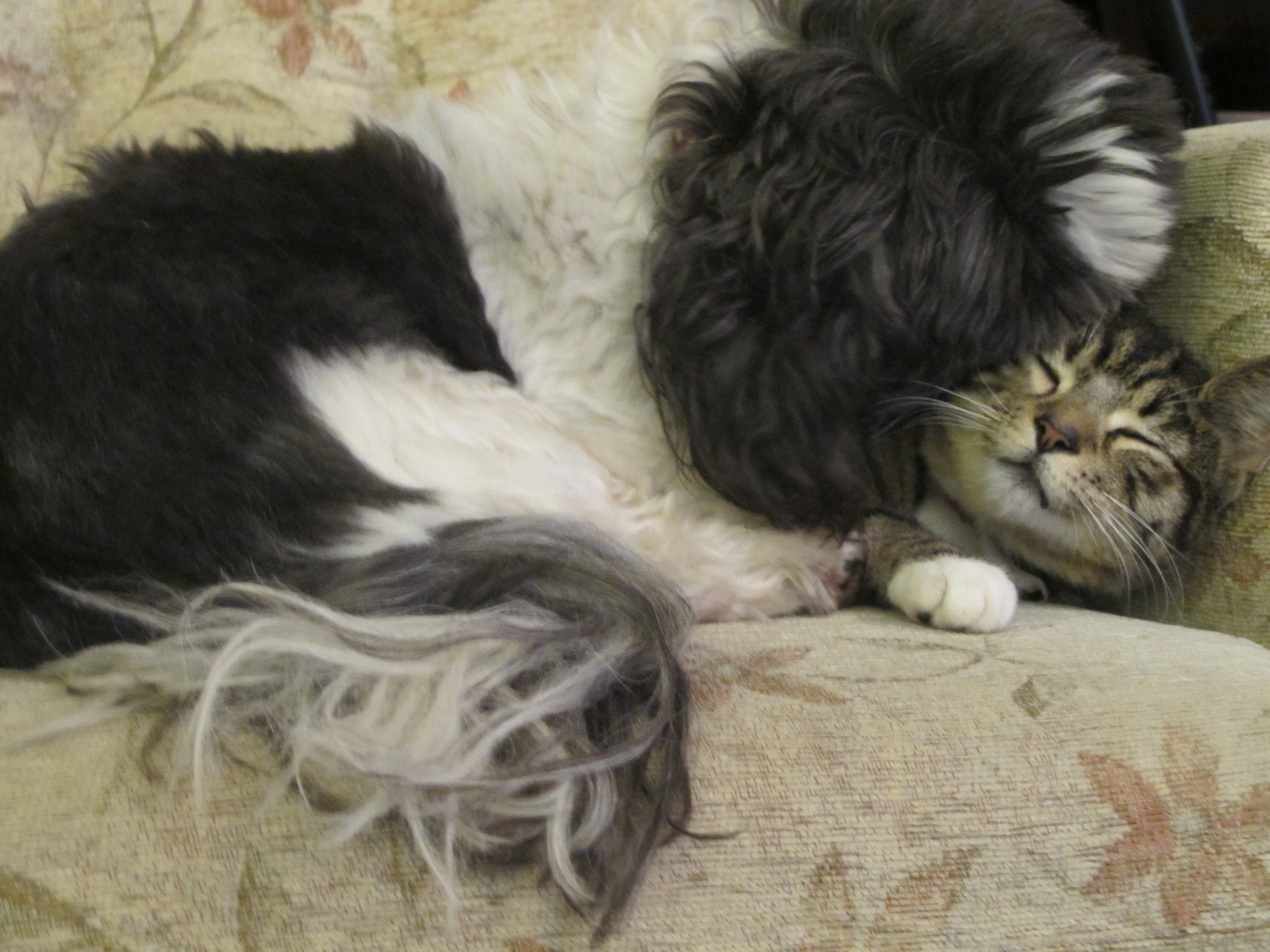
Screamingly irrelevant photo. J. with Moose. I'll stop with the cat and dog photos soon, but everything else I've shot lately is overexposed.

Screamingly irrelevant photo. J. with Moose. Or the other way around. I’ll stop with the cat and dog photos eventually, but everything else I’ve shot lately is overexposed. Besides, who can resist this one?

How much space does it take to store thousands of pounds worth of Easter eggs? Well, that depends on how much the Easter eggs cost, which (if you were buying instead of stealing them) is another way of saying it depends on your income, or at least outgo. It might take less space than you’d think. Hotel Chocolat sells one for £75, but at Fortnum and Mason, you can drop £90 for a chocolate Easter egg or £250 for a “chocolate beehive sculpture” (sorry–I can’t take that seriously enough to leave it outside of quotation marks; I don’t want the blame for that description). And for that amount, I’ll throw in more quotation marks: It’s made from “majestic” Valrhona chocolate. Whatever the hell Valrhona chocolate is, the price went up by £50 pounds when they glued that adjective to it.

I worked in a candy factory for long enough to lost my taste for the stuff, and although I wouldn’t say they used particularly good chocolate and I wouldn’t hold it up as setting the world standard for chocolates–well, what I’m trying to say is that I’ve never seen majestic chocolate.

Fortnum and Mason can’t send the beehive, by the way. Maybe at £250 you’re not paying enough for that or maybe it’s just too valuable to ship. Either way,you’ll have to pick it up at the store.

Or you can spend your £250 at Betty’s of Harrogate and get Betty’s “Imperial Easter Egg.” Betty delivers. “Personally.” That goes in quotes too. I assume that’s personally to you, not personally by Betty. In fact, I don’t even know that there is a Betty, or that there ever was. And while we’re talking about things I don’t know, I don’t know how much she charges to deliver, because you have to call to find out–the information isn’t online–but if you’re spending £250 for a chunk of decorated chocolate, why quibble about delivery costs?

Okay, let’s get back to that personal delivery. Have you ever had anything sent to you that wasn’t delivered personally? I’m guessing the personally, in this context, means by a person (as opposed to a drone) and to a person. Even if the package is left in the garage, or with a neighbor, it’s still to you, personally. Or, if they insist on it going directly into your anxious little paws, all it means is that you’re stuck waiting around for it.

Who writes this stuff? I once saw a real estate brochure for an apartment building that said it had an indoor elevator. That’s as opposed, presumably, to a trebuchet, which is a £250 word for the kind of catapult used in medieval sieges–an outdoor arrangement that delivers you memorably to granny’s fourth floor apartment if her place doesn’t have an indoor elevator. After you arrive splat in her living room, her place won’t have glass in the window either, blurring the line between indoor and outdoor.

I’ve wandered, haven’t I? We were talking about the Easter eggs.Betty’s is 5.4 kilos of chocolate, milk or dark, If you think in pounds rather than kilos, you can either multiply that by 2.2 or simply accept that it’s a shitload of chocolate. You can also multiply, divide, and go into shock over how much you’re spending per pound. Or ounce.

From Betty’s site I went to Cadbury’s, which asked how much I wanted to spend. The answer was, Oh, lots! and I clicked on the most expensive category, which was “over £50.” That’s me,the reckless spender, but the best they could do for me was offer hampers–enough stuff thrown together to take the price up to an even £50. Given where I’d just come from, I wasn’t impressed. So I checked out Lidl’s, the discount supermarket, where I could buy a bag of chocolate (I think) mini-eggs for £1.29, and they’ll ring them up at the cash register for me personally. After that, I can personally carry it out to my car, munching as I go. Except that I used to work in that candy factory and I’m immune to the lure of anything but good (although not majestic), very plain dark chocolate.

So–returning to the actual story I was telling, and you may have forgotten that there was one but I haven’t–it’s not clear how much storage space the stolen Easter eggs needed. Especially since the Westy didn’t say how many thousands of pounds of Easter eggs it was talking about. The Westy‘s like that. It tells you what it tells you, which is often that the neighbors were shocked and horrified, and leaves out what it leaves out, which can be a great deal. But it does spell neighbors with a U. Always.

Before I leave the topic entirely, I need to credit the members of my writers group, who pointed me in the direction of the Betty’s of Harrogate egg. They’re wonderful, and every bit as strange as I am.

If you celebrate Easter, have a good Easter. And if you don’t–well, neither do I. Whatever you believe, don’t steal any Easter eggs, okay? At the end of it all, you just eat them (it’s too late in the season to sell them) and eating a £250 egg–well, what does that leave you with?

Making fun of the House of Lords: an appreciation

One of the joys of living in Britain is that you get to make fun of the House of Lords, and I’ve had at least my share of fun with that and probably used up someone else’s portion as well, but a recent (okay, not so recent; it’s taken me a while to get around to this) article in the Guardian’s weekend magazine made me wonder if the chamber may serve some genuine purpose.

But let’s go for the ridiculous first. I learned from the article that the House of Lords has a blue carpet that you can only walk on silently. If you stop and stand on it, you get told off. I’m not sure how you walk on a carpet noisily—maybe you need spurs—but you can’t do that either. The house’s senior official is called Black Rod, but his full title is the Gentleman Usher of the Black Rod. He comes to work in pantaloons and wears a ruffle where a twenty-first century male would wear a tie. Or—well, he probably wears street clothes until he gets to work and then changes. Absurd as the get-up is in the House of Lords, wearing it on the bus would be worse. (I’d love a photo, though. Rush hour. People hanging on the poles. Frilly tie. Pantaloons. I don’t know what kind of shoes you wear with that.)

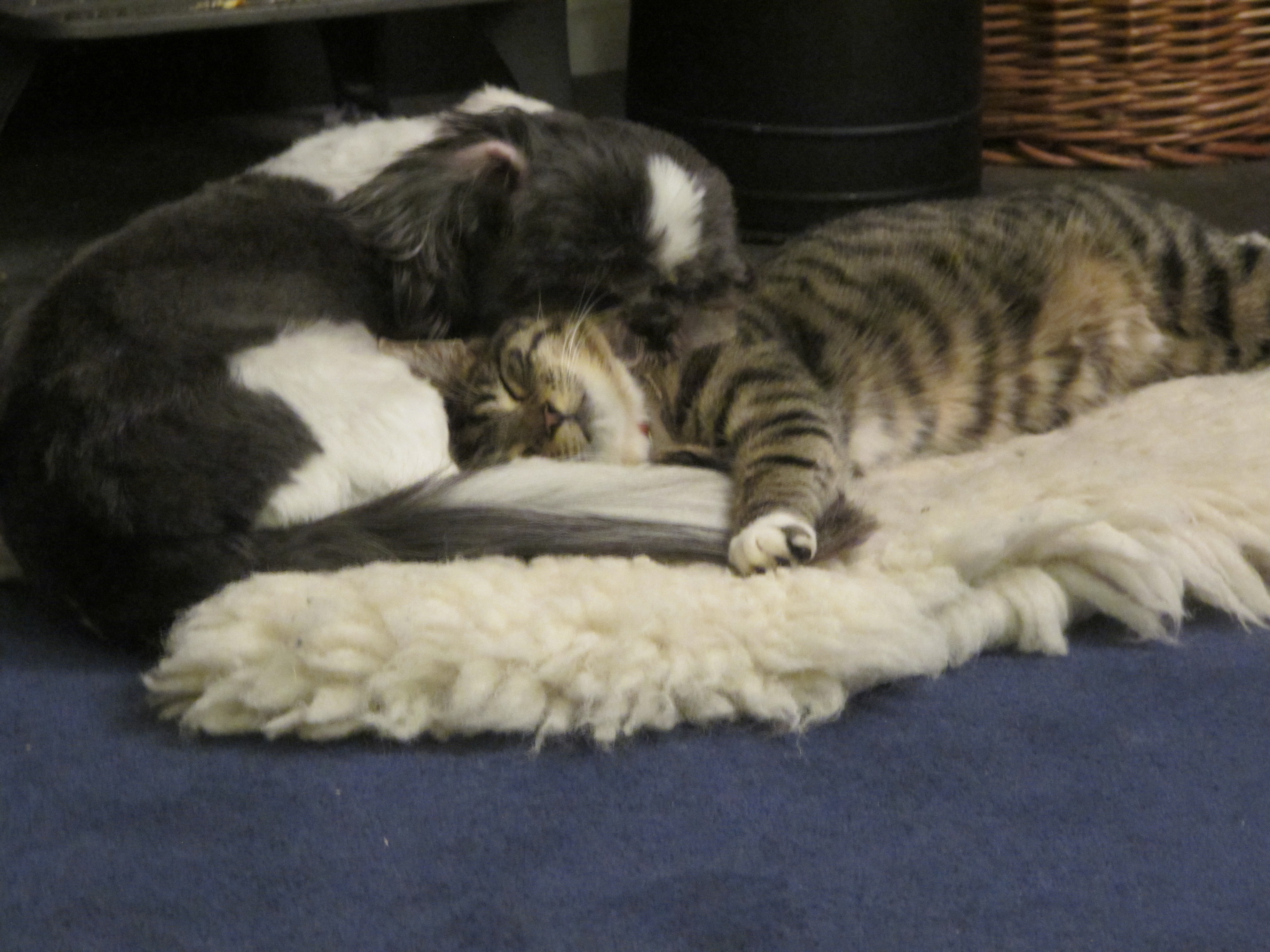
Irrelevant photo: Minnie the Moocher and Fast Eddie, in a moment of bliss.

Irrelevant photo: Minnie the Moocher and Fast Eddie, in a moment of bliss.

When the lords vote, they line up in corridors, one for Content (adjective, not verb, with the accent on the last syllable) and one for Not Content. Their names are ruled off a list and they’re then counted off by a peer holding a drumstick (“musical, not chicken,” added the lord who described the procedure). When women first joined the Lords, they weren’t allowed to address the doorkeepers.

Why not?

Because.

In case anyone’s interested, I’m capitalizing Lords when it stands in for House of Lords but not when it applies to members of the house, unless the name’s included, in which case it becomes a title and is capped. Is that baroque or what? Normal usage is probably to capitalize it both times but it just seems too damn worshipful and, good (L)lord, I can’t do it. Besides, a lot of Brits capitalize all sorts of words that I’d leave lower case. I suspect they’re overdoing it not just according to American usage but to British as well, but it’s so widely done that it must mean something. Maybe that they’re closer to the German roots of English than Americans are. Or maybe capital letters are on sale and no one’s told me.

I should rush out and Buy and half Dozen.

But back to the Lords: The speaker sits on a woolsack (the current speaker is, apparently, short enough that her feet dangle) and the clerks are equipped with both white wigs and iPads. Is that a great combination or what?

The lords meet in a room built to seat 240 members and there are now 859. Of those, 92 are hereditary. Under Tony Blair, there was a massive cull of hereditary peers; they’re what’s left. Why them instead of some of the others? Haven’t a clue. Other peers are appointed for life and the theory is that they’re experts in one thing or another—science, history, law, medicine, chutney, building blocks—but they also include party hacks and donors, former civil servants, a cheese maker, a children’s TV presenter, a rock star or two (or seven, but who’s counting?), former MPs, 26 bishops (whose bench is the only one that has arms), and the occasional stray novelist.

Peers are nominated by political parties and can be nominated by the public as well. Good luck with that, public. If anyone wants to nominate Wild Thing, go ahead. It’ll be interesting. The governing party gets to make more appointments than the parties that aren’t governing. Are you surprised? Then the appointees have to be approved by an independent commission (exactly how independent it is I’m couldn’t say, although I could take a reckless guess or two), which can make its own nominations, and the list is then approved by the prime minister. I don’t know if he gets to do any final tinkering or not. After all that, the queen waves her magic feather over it. Of 45 appointments in August 2015, 26 belonged to the party currently in office, the Conservatives. One of them is a former MP (that’s Member of Parliament, in case you don’t speak British) who stepped down in 2010 after the public learned that he’d claimed the £2,200 he spent for cleaning his moat on his expenses.

So yes, the system’s working perfectly. They don’t seem to have appointed the guy who got caught claiming the cost of a floating duck island for his country house.

The average age is 69, but the lone Green peer is quoted as saying “You can’t die in parliament. You’re not allowed.” I’d put that down to comic overstatement, but since we’re dealing with the House of Lords it’s probably not.

When the Lords were considering a bill that many people thought would have a disastrous effect on the National Health Service (it passed, and we were right: it has), several friends and I divided up the list of lords who we thought might be swing votes and wrote to all of them. I learned from this that some of them are elderly or ill and don’t show up anymore. They’re not required to, although they’re paid only for days they show up. Last I heard it was £300 a day.

A person could live on that.

I also learned that the peers aren’t provided with a clerical staff. They answer their own mail or they don’t. Mostly they don’t, but one member, Baroness (that’s what the women are called; the men are called Lord) Someone or Other, emailed back. And I emailed her back and she wrote back again and we argued the bill endlessly and purposelessly, since it quickly became clear that neither of us was going to change the other one’s position. It was all I could do to keep from asking, “Why are you writing me? Don’t you have a country to run or something?”

Anyway, she assured me that the bill would work to the benefit of the entire universe and that the sun would shine twenty-five hours a day and Britain would bask in eternal summer. I later saw her name on a list of peers who had investments that should have barred them from voting on the bill (but didn’t), since they were conflicts of interest.

I comfort myself with the thought that when she was writing to me she wasn’t accomplishing anything else.

But. Some of the peers interviewed in the Guardian article made a good case for the Lords having a use.

“A lot of bills are not debated at all in the House of Commons,” one said. “They fall to the House of Lords.”

A lot of the MPs barely even read them.

In the Lords, a certain number of members will actually read the damn things, line by line by dreary line, instead of just voting as their party tells them to. For one thing, they have the commitment and time. For another, since they’re appointed for life they can, if they want to, be independent of their party.

Still, the Lords is an unelected body, and that’s a dangerous way to govern.

The Lords has less power than the Commons (don’t ask; it’s as complicated as the rules governing carpets), but it can in some situations slow legislation down and in others amend or kill it. Since the British system gives a hell of a lot of power to the party that holds a majority in the Commons, the Lords is the only brake the system has. The current gridlock in the U.S. has made me understand what’s wrong with the checks and balances system the U.S. Constitution created. All it takes is one party dedicated to stopping the other for everything to grind to a halt—as long as that party is large enough and ruthless enough. But the British system has made me understand what’s wrong with efficiency. The governing party has a huge amount of power, which can be equally destructive if the governing party’s ruthless enough. The Lords is the one place it may (emphasis on may) not entirely control. Unless it’s in office long enough to stuff it with donors and hacks.

I don’t know what the answer is. But as long as the senior official wears a frilly tie and you can’t stand still on a blue rug, at least we get to laugh about it.

Comparative idiot-proofing

Brits are smarter than Americans. Want proof? They’re surrounded by less idiot-proofing and they—or at least enough of them to keep the country staggering forward—survive.

Example number one: The cliffs here in north Cornwall are high and dangerous, and in places the footpaths run right along the edge. And no one builds a hand rail or fence (unless the fence is there to keep the cattle or sheep back; the humans are left to fend for themselves). For the most part, no one even puts up a sign. They’re cliffs. It’s assumed you’ll have sense enough not to walk off the edge. Besides, you’d have to fence off half the Cornish coastline if you wanted to protect everyone from themselves.

Our local beach does have a sign about falling rock on one side. People ignore it, but short of installing sheepdogs to herd them away, the council’s done as much as it’s willing to. No fences.

Penkenna, north cornwall

Irrelevant photo: The beach on a much nicer day than the day when I’m typing this. The gusts are high enough that I took the dogs on a stagger,  not a walk.

Example number two: Our car doesn’t have as many you-idiot buzzers as American cars, and I assume other people’s are the same. The makers count on you having the brains to take your key out of the ignition when you get out. In the U.S., they know better, because as it turns out I don’t have the brains–and let’s pretend for a moment that I’m typical of the human race. The other night, I not only left my key in the car, I left it turned so that it drained the battery. (On the positive side, the car was still where I left it.) So in the morning, when I went to drive Wild Thing to a doctor’s appointment (ah, yes, excitement; we were younger when she first got her name, but she still manages to live up to it) the car was dead, dead, dead.

You wouldn’t expect a person to complain about a car not insulting her intelligence, would you? But it does make me miss my insulting American car, which would’ve given me some sort of nasty you-idiot sound and I would have rolled my eyes and put the key in my pocket and sworn I didn’t need the reminder.

Here, the only thing I do (and I do it fairly regularly) to make my car give me the you-idiot noise is leave the lights on. You know, when it’s not dark enough for me to see that they’re on but overcast enough that they made me more visible. And then I forget I turned them on but the car—thank you, car—remembers.

When I drove cab—and we’re going back a few thousand years here—the company bought a bunch of new cars that, for the first time in Blue & White Cab Co. history, made a deeply aggressive you-idiot noise when the driver didn’t wear a seatbelt. A sizable percent of the drivers were of the Don’t You Tell Me What to Do persuasion, and they dealt with it by either fastening the belts permanently behind them or unplugging the wire between the belt and the screamy thing.

They even took a certain joy in it, as if they’d snatched back some control over their lives from an overwhelming and powerful system, and I do understand the impulse, just not the direction they take with it.

The going justification for not wearing a seatbelt was that we jumped in and out of the cab dozens of times a day—to open doors, to load and unload groceries and luggage, to ring doorbells and roust out passengers who said they’d be outside waiting for us but weren’t, so who could be bothered fastening and unfastening the damn thing each time?

Well, me, actually. Maybe it was just innate caution and maybe it was tales from friends and family who’d had their seatbelts fastened during accidents and had come through without a scratch. Maybe it was the accident I had, in a car with no seatbelt, where I ended up in the back seat with the lid of a coffee pot on my head and one boot still beside the gas pedal, ready to keep driving even without my foot to help it. I didn’t have a scratch on me, but I was dazed for the rest of the day.

We didn’t really jump out of the cab that many times a day. I mean, come on. Open the door for people? Only for the elderly and for people who needed to be, um, encouraged to leave. We weren’t fuckin’ limo drivers, trying to make our passengers think they were aristocrats.

Yes, cab driving did wonders for my attitude.

Anyway, I wear a seatbelt so regularly that it took me nine years to find out our current car screams when the driver doesn’t wear one. But I now officially miss all that other you-idiot buzzing. I not only had to ask our neighbor to drive Wild Thing to her appointment, I had to call the roadside assistance, which I’m grateful that we have because we don’t have a charger. While I waited for them, I was so pissed off that I tried out a hot cross bun recipe I’d found on the internet. I couldn’t think of anything else to do with myself. But the recipe turned out to have some uncertainties: How sticky a dough is a somewhat sticky dough? Is that bread flour or plain flour? Are those photographs really the buns you made or did you download it so we’d be impressed?

I used bread flour and left the dough too sticky, so the buns flattened out and even if they hadn’t they wouldn’t have been round anyway because I’m a practical baker, not a decorative one, plus they didn’t taste particularly like hot cross buns although they weren’t bad, and since I couldn’t be bothered putting a cross on top because the cross is decorative and I don’t have a lot of patience for that and would feel kind of weird about the religious symbolism anyway although I wouldn’t if I were buying them instead of baking them [quick pause for breath here], they ended up being cold secular buns. Not at all bad but not hot cross buns.

Then the guy came to jump the car and the world looked like a marginally better place. I don’t need a buzzer to keep me back from the cliff edges, but I will not complain about being insulted by my car.

If you want a cold secular bun, stop by soon. They’re going fast.

How people find a blog, part 2. Or 3.

What does the world really want to know about Britain? For the second (or possibly third; I’ve lost track) time, I’ll tell you. And how do I know? you ask (if you have any sense). I track the questions that lead people here, and this is an entirely scientific and reliable system because search engines are entirely reliable and the internet is a place of complete sobriety and good sense.
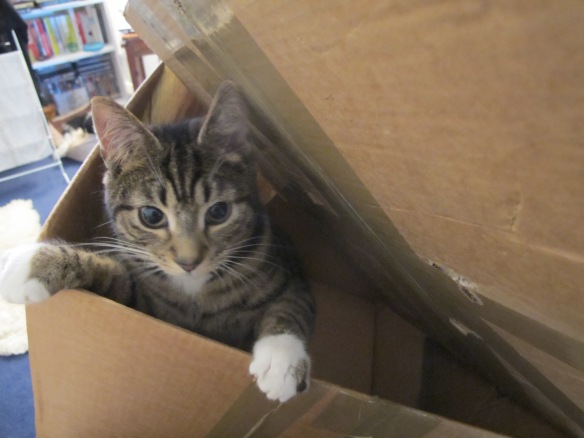
Semi-relevant photo: Fast Eddie, who gets a mention below.

Semi-relevant photo: Fast Eddie, who gets a mention below.

People have asked about:

Geography:

Why Britain is called Great Britain. This is the most commonly asked question and it comes in assorted forms and with an interesting misspelling or three thrown in to keep me amused. It’s also one of the questions I actually answered.

The Silly Isles in Britain. This search is so logical and so wrong. Give the writer credit for knowing how the islands are pronounced, then get out your red pen and write “Scilly Isles.”

Do Brits still like American tourists? I’m not sure. Did they ever? Maybe not, because people also want to know Why Brits hate American tourists, Not to mention Do Brits see Americans as naughty children? and (irrelevantly) Why do Americans love the British? None of this is exactly geography, but I’m assuming the writers are thinking of traveling. Close enough. And really, folks, the answer to all of this is that there is no single answer. The British haven’t achieved a unanimous opinion on this. I’m tempted to add “or on anything else,” but that’s just wise-assing around. They have a consensus and maybe even unanimity on the weather and on baked beans.

Culture:

Gloucester cheese rolling. I’m glad to see it getting some recognition. This is a deep and resonant part of British culture. It must be, because I can’t think of any other way to explain it. Someone was also looking for British culture celebrations, although it’s hard to know if they wanted deep-rooted folk traditions (in which case see not just Gloucester but also the flaming tar barrels) or high culture, in which case go elsewhere because I’m useless.

(A note about why I’m providing links on some topics and not on others: Some posts are easy enough for me to dig out. Others are buried somewhere in this morass, and as people here say with such style, I can’t be arsed.)

American and British manners. That’s easy: We (that’s Americans) have none; they (that’s the British) have lots. I’ll group this with American and British dinner manners TekeT. What does TekeT mean? For all I know, it’s some obscure element of British dinner-table manners that I haven’t picked up on and, oh, how I’ve been offending people. Or the cat walked across the keyboard. But what I really want to know is how the writer got two capital letters past Google’s No Caps filter, because those capital Ts are from the actual search question. And no, it’s not really a question, but let’s move on. For no particular reason, I’ve added caps into the questions in this post, except for those two Ts. But to answer briefly, British eating is knife right, fork left and how you hold the fork indicates your class. What should a foreigner do? Dive for cover, because whatever impression you want to leave people with—except the impression that you’re an outsider—you won’t get it right. Americans, on the other hand, juggle the tableware from one hand to the other. Not the plates, though. Or the glasses. Sorry. Just the fork and knife. What should be done to show good manners in Britain? I had a burst of these, possibly from some single person who didn’t find an answer but kept coming back, and possibly from the misdirected half of a class whose teacher assigned the question. It’s an interesting concept. I always thought of good manners as something you have—you know, the way you have a dime or a stomach ache or black hair. But this is about showing them, the way you show a bus pass. If I ever figure out the answer or why the difference is significant, I’ll write a post.

Poster showing difference between city life and village life (maxi…). I’m guessing that “maxi…” is a word limit that got cut off, although how a word limit applies to a poster I don’t know. But whatever the word limit is, kid, go do your own homework.

American swearing vs. British swearing. Ah, now this is important. Sadly, I don’t feel I can do justice to the British side of the topic. Maybe we could explore it as a community. If we put all our twisted little minds together we’ll learn something interesting. As for me, I swear in American and if you’ll forgive me for bragging, I’m not bad at it. Still, I don’t want to monopolize that side of the conversation, so I welcome all contributions, British, American, and other. I’ll open by saying that Americans don’t use bloody as a swearword and—if you’ll forgive a generalization—aren’t sure if it’s a mild one or a strong one. Who’s next?

The British and their pets. They have them. They love them. (Sorry—more generalizations. When you write about a culture as if it was all one thing, that happens.) If you want to start a conversation, look for someone with a dog and ask about it. Or talk to the dog. The person may answer.

New subsection, same topic:

Why are these stupid wigs worn in court? This came from a lawyer or judge. Notice that phrase “these stupid wigs.” The writer has one in hand. Or on head. And is not happy about it. I sympathize. I got several versions of the question. Most included the word stupid, one was about judges’ wigs, one was about lawyers’ wigs, and one was about ill-fitting wigs.

What has happened to Mrs. Baggit signs? Ah, nothing goes to the heart of British culture like a judge’s wig or a Mrs. Baggit sign. They read (and that read can be read as either present tense or past; take your pick), “Mrs. Baggit says, ‘Keep Britain tidy.’ ” But to answer the question, I have no idea. They are (or if they’ve all disappeared, were) so obnoxiously fussy that I just loved them. In a twisted sort of way. If they’d been in the American countryside, they’d have been used for target practice. Or they’d be decorating the walls of some teenage bedrooms.

Do bearskin hats grow? No. Once the bear’s dead, the hat can’t grow.

Neutral accent different from British accent if migrating to UK. There is no such thing as neutral accent, my friend. Every accent’s an accent. Even yours. Even the one you teach yourself in order not to sound like yourself.

British pub archive quizzes. Sorry, if an archive exists, you won’t find here. I hate quizzes. Go make up your own.

Who are the emmits? If you’re asking, sorry, dear, but you are. And so am I.

Tutting in U.K. This also goes to the heart of British culture. Probably even more than the Mrs. Baggit signs, the wigs, and the baked beans. Since I’m not only an emmit but a foreigner, I can’t give a tutorial on either tutting or being tutted. All I can tell you is that if you’ve been tutted, you broke one of the culture’s unwritten rules. And the laws of probability state that it was probably about standing in line—or queuing, as the British say. It’s the national religion and if you sin you will be tutted.

Brit TV. Yes, they have it here. Some of it is good. Some of it isn’t. And some of it is the Chelsea flower show. Or Springwatch—an hour a day for an entire week on wildlife in spring. Whether that’s good or bad depends on your taste in TV.

Crime in Britain. They have that too. Possibly even at the Chelsea Flower Show.

Flying the flag, U.S. & U.K. They tend to do it less here. I’m guessing they already know what country they’re in. In the U.S., we have to reassure ourselves about that.

Food:

Scheme to compliment Dorset cream 68. Does it have to be a scheme? Can’t you just come out and tell it it’s wonderful? But before you compliment the Devon stuff, you should at least check out Cornish cream. They’re exactly the same (as far as this emmit can tell), but in bitter competition. But about that “68”: It worries me. If it’s a year, the cream will have gone bad by now.

Toffee sticky pudding recipe. (Also sticky toffee pudding recipe.) A few people knows what matters in life.

Must eat sprouts during Christmas in U.K. I had a burst of questions about brussels sprouts and then silence—maybe because the season was over. They’ll be back next year.

Why English beer tastes like American beer. Dunno. I always heard that it didn’t.

British garlic cheese. I haven’t seen any anywhere. On the other hand, I haven’t been looking. It doesn’t taste like American beer, though.

Scones with jam in the middle. You put the jam in the middle after you bake them. Scones are like toast that way—a do-it-yourself operation. The only time I can remember seeing them pre-jammed is at village events, probably to keep anyone from taking too much. Or (to put a kinder interpretation on it) because it’s faster and less messy .

Lemon drizzle cake using cup measurements. Every time I review the searches that lead people here, someone—and usually several someones—is (or are, take your pick since we’re working with both the singular and the plural) asking for a lemon drizzle recipe using cup measurements. Sadly, I completely bungled the one I posted. Will the shame never end?

A nice cup of tea analysis. Is that Freudian or chemical? Did someone spill tea on the couch? What does it all mean, doctor? Who wrote on making tea? Um, lots of people. Including me. Which goes to show you that it doesn’t take an expert. As far as I know (and that’s not far), Freud had nothing to say on the subject.

Random:

The difference between US and UK bureaucracies. What a strange world. Someone actually asked that and more or less found an answer, although I wouldn’t offer it as a definitive one.

UK headline style. That came from someone with the mind of a copy editor, only instead of going to an authoritative source (as any good copy editor would) he or she cast his or her (this gets silly very quickly, doesn’t it?) self at the mercy of Google and the internet and just look where he or she landed. In a blog written by someone who wants to use they as the generic pronoun but hesitates to do it in a sentence about copy editing even though she (that’s me—or I, if you like) does (or do) it elsewhere. Oh, stop. Even I lost my way in that mess, and I once knew what I was trying to say. Anyway, I don’t know what the official style guide is over here. I’m retired and even if I weren’t I doubt I could adjust well enough to edit in British. But having worked as an editor and copy editor in the U.S., I can insist on finding some authoritative source, which is to say NOT THIS BLOG.

Season’s greetings. I’m afraid it’s a bit late for the holidays. This seems to be an email that someone typed into the search box. I had no way to let the sender know it went astray. I feel bad about this one.

Weather:

I had a bunch of questions about naming storms in the UK and in Ireland, maybe because that was in the news for a while. The topic’s dropped out of the news and so have the questions, but storm Jacob was pounding us on Wednesday morning, when I started writing this. One of the dogs got blown over on the way to the store. Not that the winds were apocalyptic. He’s the pup—the silly one you’ll find in the photos here—and he was off balance anyway. But it was wild out there. I got them home just before it started hailing.

Not about Britain but too good to leave out:

Could a bat have flown into a high shelf for shoes in my closet? Yes, I’m pretty sure it could have. Did it? Well, it didn’t take the train, so if you found one there I’d say the answer’s yes. Are the shoes relevant to your question? Probably not, but they’re interesting. It never crossed my mind to put shoes on a high shelf. At my house, they go on the floor, where my feet spend their time. That’s either logical or unimaginative. Or maybe it’s just because I’m short.

American greeting rituals. Mostly we just say “hi,” but occasionally we tear off our clothes and run three circles around the nearest piece of furniture while waving feathers. Then put our clothes back on and act as if nothing happened. But that’s only with people we know well. As a casual visitor, you’re not likely to witness it or have to take part.

Sex scandal American. What, was there only one?

Americans commenting on your U.K. accent. Ah, yes, they will. But they’ll love it. Even if they make fun of it, somewhere in there they’ll believe it’s the most sophisticated accent on earth.

The cutest kitten in the universe. That would be mine. Just ask him. But he’s almost a cat now. He’s still cute, but he’s lost that kitten factor. Very sad.

All-time strangest search:

Veri veri sepr sex. I’m reasonably sure that’s not Latin for I had super sex last night and want to tell someone I don’t know all about it. But I never studied Latin, so don’t take my word for it.

Divorce Diet on sale

The Divorce Diet ebook is on sale for $4.99  “at all major ebook retailers” until April 3.

How major is major? I have no idea–the information comes from my publisher and I didn’t ask. If it costs more at the first outlet you find, it’s minor: Try another.

And if you have no idea what I’m on about? Follow the link above for a description, the cover (I know–you can’t tell a book by, but it’s a nice cover anyway), and everything else I can think to tell you.

Fighting gay marriage with nuclear weapons, and other fun stuff

I’ve been unfair to my homeland. Here I’ve been writing about the spidery corners of British politics (I could add other links, but enough) and ignoring the ones in the good ol’ U.S. of A..

I have an excuse. For the past almost ten years I’ve been living in Britain, and it can be hard to spot the spiders when you’re ten years and an ocean away. On top of which, British politics dresses up some (but sadly not all) of its political insanity in ermine and ruffles and wigs, which are always good for a laugh, and what can the U.S. do to rival that? But fair’s fair. Let’s talk about Amurrican spiders. Because if I want something to make fun of, holy batshit, have people in my country ever been getting up to some strange stuff lately.

Strangely relevant photo (just keep reading; it'll almost make sense): Minnie the Moocher and Fast Eddie

Strangely relevant photo (just keep reading; it’ll almost make sense): Minnie the Moocher and Fast Eddie

Let’s start with Ted Cruz, who’s running for president in the Republican primary. In August 2015 he told a crowd of cheering supporters that the Southern states should build a nuclear bomb to protect their Christian beliefs. Or maybe it was their right to those beliefs. Subtle difference. Either way, it seems an odd way to wage the battle of beliefs. But it seems gays, lesbians, transsexuals, and bisexuals are persecuting Christians by, you know, getting married and having sex (or more likely the other way around) and then making toast together in the morning and instead of being all lovey dovey like people who are just going out, the married ones are all rumply over their toast and if they talk at all it’s about the cat. If they’re lesbians. Lesbians are known for having cats. There. Now I’ve let you in on our big secret (if, of course, you’re not already lesbian; if you are, you know). Wild Thing and I also have two dogs, so I’m not sure if we’re busting a stereotype or falling right into it. I also don’t know what gay men or transsexuals do to parallel that, so I won’t speculate on what they talk about in the morning. I will say that I personally made toast just yesterday—not for myself but for Wild Thing. I ate oatmeal. With fruit. I’m not sure if Mr. Cruz understands the subtleties this indicates in our relationship or if he cares, but believe me, this is important information.

For the record, we’re not married but we do have a civil partnership. And we’re usually quite civil, even if we don’t always eat the same breakfast. All relationships have these little hiccups now and then.

Okay, full disclosure: I wrote “yesterday” in the last paragraph, but what I really mean is that it was yesterday when I wrote the sentence. It’s now long past. And I’m in Britain, where my toaster and I don’t threaten Mr. Cruz quite as directly as we did when we lived in Minneapolis. But still, our toast is a sign of how seriously civic morality has deteriorated. I have no doubt that some Christian lost his or her faith as I was spreading the butter. As a direct result of what I did.

Damn, I’m powerful.

Cruz also said Christians were being lynched. Presumably by gays, although his wording leaves it ambiguous. Does he understand what the word lynched means? That it’s a real thing that was done to real people of the black persuasion by god-fearing Christian people of the white persuasion? That it was done to terrify an entire community and maintain power? Or does he just think it’s a powerful word and he wants it on his side?

It’s not easy to make fun of this stuff. He’s already gone past exaggeration. He’s gone past absurdity. He’d make a great humor writer if only he had a sense of humor, but as far as I can tell he doesn’t.

Cruz, by the way, has promised that if he’s elected president he’ll ban gluten-free MREs (meals ready to eat—the prepacked stuff soldiers eat in the field) in the military, because they’re politically correct nonsense. That’ll pose a serious problem if he gets elected, because but the military doesn’t offer gluten-free MREs.

Be careful what you promise, Ted, because they’ll be hard to ban.

Personally, if I’m elected president I’m going to keep the army from using frilly pink uniforms. They’re undignified. Besides, I never did like pink. I don’t see why the army can’t humor me on this.

In the meantime, either the good senator himself or his campaign hired an “adult film” actress (as the news story delicately puts it) for a campaign video.

But I don’t want to pick on Cruz alone. Those just happen to be the stories that rose to the top of the cess pool. So let’s consider Texas pastor Rick Scarborough who announced he’d be willing to be burned to death to fight gay marriage. If he said how that would help, I missed it. The same article also mentions a couple who said they’d get a divorce if gay marriage was legalized.

That’ll show ‘em.

None of them said anything about toast. It may be too perverse for their tender sensibilities.

And then there’s Texas Attorney General Ken Paxton, who’s so fired up about the threat gay marriage poses to the Great State that he’s trying to get the word spouse taken off the death certificate of a man who married his partner in a different state but died in Texas. I’m glad to know he hasn’t lost his perspective on what matters in life. And death.

Mr. Paxton himself is under indictment of securities fraud.

So there you have it: my random round-up of American political insanity. It lacks wigs and ruffles, and sometimes it’s hard to read it and keep laughing, but I do my best. Hope I haven’t put you off your toast.

Wishing you a happy but belated Pancake Day

Pancake Day came and went quietly this year. It’s a holiday I never heard of before I moved to the U.K. and it’s such a quiet one that I’d been here a couple of years before I even noticed it.

Pancake Day is also known as Shrove Tuesday, the day before Lent starts. Traditionally, anyone who kept Lent gave up everything fun, and that put a lot of pressure on that last pre-Lent day. So New Orleans went wild with Mardi Gras and still does. Brazil cut loose during Carnival and keeps right on doing it. And the British? They eat pancakes.

Does this country know how to throw a party or what?

Screamingly irrelevant photo: This is from New Zealand and has nothing to do with anything. Nice, isn't it? Photo by Ida Swearingen

Screamingly irrelevant photo: This is from New Zealand and has nothing to do with anything here. Nice, isn’t it? Photo by Ida Swearingen

The logic of Pancake Day is inescapable. People were supposed to give up eggs, milk, and sugar during lent, so they used them up the night before by making pancakes. What were they supposed to do with the eggs the chickens went right on laying and the milk the cow kept on giving? Because cows and chickens don’t care if it’s Lent. They don’t believe in any religion, and even if they did biological processes are hard to control But what do I know? I’m Jewish and I’m an atheist, and if that isn’t enough I grew up in New York, where we didn’t keep a lot of cows or chickens. So I’m not an expert on this stuff. In fact, I thought all a person had to do during Lent was give up one thing, like orange bubble gum or blue frosting. But maybe that’s a toned-down modern approach.

Anyway, these days Britain’s long on tradition but light on traditional religion. So it substitutes eating pancakes for emptying the cupboards of all the good stuff and entering a somber season in a sugar-free, egg-free, lactose-free condition. And even I can get behind eating pancakes, although not on a fixed day every year, which accounts for me being late with this post.

So let’s talk about pancakes. They never go out of season.

British pancakes—at least the ones I’ve had—are more like French crepes, which is to say, thin. I first tasted them when a neighbor borrowed some flour because he had to make pancakes that night–it was Pancake Day–and in payment he brought us each a pancake, with lemon (I think) and (definitely) sugar. They were good. I can’t think of a bad thing to say about them. But sometimes a person just wants a thick ol’ American pancake. So be warned, I’m leading up to a recipe. Because no matter how good British pancakes are, I believe in the American version. What can I tell you? Talk to me about food and I’m capable of unreasoning patriotism.

I’ve seen British food writers offer approximations of American pancakes and they have some strange ideas about how we make them. One adds vanilla and honey but no baking soda or baking powder. Which is why she has to beat hell out of the egg whites. Another beats hell out of the whole mix until it’s thoroughly blended and lumpless, which is a good idea if you’re making a cake but not so great if you want pancakes, because they need a lumpy batter.

Why the food writers don’t just look in an American cookbook I don’t know, but here’s my recipe.

Pancakes

Serves 2 moderate eaters; for enthusiastic eaters, double the recipe and eat the leftovers cold and straight from the refrigerator

1 cup (4 oz.) flour

1 tsp. sugar

½ tsp. salt

¾ tsp. baking powder

½ tsp. bicarbonate of soda

1 egg

½ cup (or more) buttermilk (or plain milk with about 1 tsp. of cider or white vinegar added*)

1 Tbsp. (½ oz.) melted butter

Optional: blueberries, peaches, or raspberries

Put the dry ingredients in a bowl and whisk them together. That’s instead of sifting. I’m a lazy cook and this works. Beat the egg into the milk and add it to the dry ingredients. Add the butter. Stir until just barely mixed, leaving some lumps. Add more milk if you need to until you get a thick but pourable batter. The thinner the batter, the thinner the pancakes will be.

Stir the fruit in last.

Heat the frying pan (or several pans, which will let you cook them faster) over a medium-high heat until a drop of water bounces (in theory; I usually settle for it sizzling madly). Add a bit of oil or butter and spread it with a spatula. If you’re using a non-stick pan, you don’t need much; if you’re not, you’ll need more and will have to add more before each new pancake. Pour in a ladleful of batter. I generally make my pancakes a bit bigger than CD-size. but you can make smaller ones if you like. Hell, you can shape them into the letters of the alphabet if you want, but they’ll be hard to flip. Don’t put a cover on the the pan. Bubbles will rise and then break, signaling that the bottom’s probably done. Sneak a look and if it’s brown, flip the pancake. Leave the second side on the pan long enough for the center to cook through.

You may need to adjust the heat as you go. If the pancakes burn, turn it down. If they don’t brown, turn it up. You’d probably have figured that out without me saying it.

You can feed them to the ravening hordes as they get done of keep them warm in a very low oven until they’re all cooked and you can sit down yourself.

Serve with butter and maple syrup. Or if you’re in a Lenten kind of mood, with plain old yogurt, which is surprisingly good with them.


*The milk will curdle when you mix in the vinegar. That’s fine.

Important stories from the British press

What people lose

You can learn a lot about a country by what it leaves behind. So what does Transport for London report having found on the city’s trains and buses? A life-sized Spiderman doll. A prosthetic leg. Endless wallets, phones, and tablets. Umbrellas. A judge’s wig, a room-sized carpet, and an urn with human ashes. “Enough musical instruments to form a band,” including drum kits. No grand pianos, apparently.

I’m not sure who I’m quoting about that band, but unlike some quotes that drift through the culture, this one seems to have actually been said because the newspaper article I’m stealing the information from put it in quotes. It’s probably from a TfL spokesperson.

Oh, and a brown paper envelope with £15,000. Which the finder actually turned in.

A rare relevant photo: A London tube station. Photo by Ida Swearingen

Vaguely relevant photo: Public transportation, although not in London. This is the Exeter St. David’s train station. Photo by Ida Swearingen

I don’t know what any of that tells you about British culture. That judges wear wigs and ride the tube. That someone either thinks or knows that a judge’s wig is different from a lawyer’s. That stuff drops out of people’s pockets. You know—phones,  wallets, room-sized rugs, tubas. An archeologist would have a field day.

But the real treasures are in the comments at the end of the article, where readers talk about the stuff they’ve lost on public transportation (Guardian readers write the best letters to the editor and their online comments aren’t bad either): “the will to live” (Northern Line, winter of 1993), “the woman I love” (Chalk Farm Station), “my heart” (San Francisco, which is a city, not public transportation, but what are categories for if you can’t break out of them?), and democracy (location not specified but probably also not on public transportation). I won’t spoil all the fun. A lot of the jokes are about that prosthetic leg, but not all. I’ll leave you to discover them for yourself.

Tom Lehrer said, “Life is like a sewer: What you get out of it depends on what you put into it.” That may not be entirely relevant, although in an odd way it does seem to  belong here, but it is at least a genuine quote. (In a comment, Retirementally Challenged introduced the theory that some of the best quotes never got said.) Lehrer’s comment was on a record I played endlessly when I was in my teens. He may be to blame for the way I am.

What someone bought

You can also learn a lot about a country from what it sells. Want to buy a title? One was going to be auctioned off in December with (as far as I can figure out) a starting price of £7,250. I assume it sold. Sorry I didn’t let you know about it earlier but the clipping sank into the morass I call a computer desk and only just surfaced. So let me tell you what you (may have) missed:

The lordship of the manor of Woodbury Salterton village is roughly 1,000 years old. Buy the title (lord or lady) and you can use it on your checks and credit cards. You can join the Manorial Society of Great Britain. You can—. Oh. That’s pretty much it. I suppose you could put it on your mailbox. You could try to get mail and packages addressed to you that way. I have a post about that somewhere. Good luck finding it.

And all that for just £7,250–or maybe more, since it was an auction. What a thrill.

The manor (sorry, not the title; oooh, I’m getting all English, apologizing for stuff that isn’t my fault) was mentioned in the Domesday Book. If you haven’t heard of that, it was commissioned by William the Conqueror not long after 1066, when he decided to find out what he’d gotten his paws on in conquering England. The country, as it turned out, had no football teams at the time, no umbrellas, and no tea. You wonder why he bothered. It probably didn’t even have scones, since baking soda (that’s bicarbonate of soda if you’re British) and baking powder weren’t in use yet. At least not in baking. The Egyptians used a relative of baking soda to clean things and mummify people, but for baking? Nope. Not until the nineteenth century. Next time you find a list of all the marvelous things you can do with bicarbonate of soda, see if mummification’s on it. If not, it’s incomplete.

Where were we? Titles. The Lord or Lady of Whatsit. The newspaper article gushed a bit about the title (or maybe that was the manor; do you really care?) being steeped in English history, but I wasn’t impressed. Pretty much everything here is steeped in history. When they dug trenches for sewage pipes in a neighboring village, they found the remains of a prehistoric encampment and a burial site that mixed Christian (east-west burials) and pre-Christian (buried with grave goods, and I think north-south). One person was buried east-west and with grave goods, so whatever happened after death he or she would be ready for it. So history? You don’t need a title around here, just a sewage pipe.

What the British drink

Sales of tea have gone down 6% over the past five years and ordinary teabags—the ones that make what people call builder’s tea—have gone down 13%. It’s all (or mostly, anyway) the fault of coffee. The British have discovered that coffee can be something more than instant granules stirred into hot water and swallowed quickly enough to keep the taste from becoming noticeable. Coffee’s gone upscale. Tea sales are going down downscale.

There’s an English song that I have got to find time to make fun of someday, “There’ll Always Be an England.” It’s full of pomp and Empire and flag waving, and my apologies if you love it but the first time I heard it I was in one of those situations where you can’t let yourself laugh. I built up enough residual hysteria that I splutter when I so much as read the title. But the reason I’m bringing it up now is this: If tea is losing ground to coffee, will there always be an England? And not, how much longer can we count on it?

Long enough for the British Standards Institution to publish a guide to making the perfect cup of tea. It has the catchy title “Preparation of a Liquor of Tea for Use in Sensory Tests.”

What does it recommend? According to the Independent, it says, “You need a pot made of porcelain, and there must be at least two grams of tea to every 100ml of water. The temperature can’t go beyond 85 degrees when served but should be above 60 degrees for “optimum flavour and sensation.”

The Independent then interrupts the poetic prose and steps in to summarize: ‘The perfect pot size is apparently between 74mm and 78mm wide, and 83mm and 87mm tall. Since the average tea bag contains 1.5g of tea leaves, at least two tea bags should be used for a small pot, and four for a large one.”

The tea should brew for six minutes. And you should pour the milk into the cup first. That last decree is controversial. Seriously. If we have a civil war anytime soon, it will be over whether the tea or the milk should hit the cup first.

Which makes me think that, yeah, there probably always will be an England.

The war on imaginary drugs, U.K. style

What catches a politician’s attention even more than drugs? Why, the chance to appear in public pontificating about drugs, that’s what. And that’s how a Member of Parliament got scammed into publicly condemning an imaginary drug.

You can’t make this stuff up. Or—well, yes, somebody did, but I couldn’t. The best I can do is look on in amazement. The human imagination is endless. Not to mention bizarre.

Back in 1997, David Amess, a Conservative MP representing Basildon, filmed a video condemning a drug called Cake. Which does not now and never has existed. That left him so impressed with his own expertise that he got up in Parliament to ask what the government planned to do about the stuff.

Irrelevant Photo: Sometimes I feel like I'm being watched. That's Moose on the left and Minnie the Moocher on the right. And no, they can't come in.

Irrelevant Photo: Sometimes I feel like I’m being watched. That’s Moose on the left and Minnie the Moocher on the right. And no, they can’t come in.

Cake was invented—if an imaginary substance can be invented—by a TV show, Brass Eye, which among other things satirized moral panics. You made your point there, folks. It doesn’t take much to start one. The drug was also supposed to give users a bloated neck because they retained water and to distort the user’s perception of time by affecting a part of the brain called Shatner’s bassoon. Now, at that point some of us might feel a slight tug on one leg and think, Someone’s pulling that. We might do a bit of research or plug Shatner’s bassoon into Google or, y’know, ask a relative or neighbor who has some first- (or at least third-) hand knowledge of drugs if they’d ever heard of the stuff. But not the intrepid (I think that should technically be the Hono[u]rable) Mr. Amess. He just got up and condemned it as “a big yellow death bullet” and he mentioned that unhappy users were called custard gannets.

Excuse me for a minute. I’m laughing too hard to type. Custard gannets? Can’t you imagine the scene in the Brass Eye writers’ room where someone says, “Let’s call them custard gannets,” and the only sensible (or at least momentarily sober) person in the room says, “Oh, come on, you can’t call them that. Nobody’ll believe it.” But then the sensible person goes out for a cup of tea or—who knows—a shot of much-needed vodka and they quick put it to a vote and custard gannet it is. And poor Mr. Amess not only believes it, he talks about them on video and in the House of Commons.

Of such stuff are great political careers made.

His great moment came in October 2015 (which is why this admittedly old story re-surfaced), when he has appointed to co-chair a committee to shape the government’s new drug policy—the Bill Committee on Psychoactive Drugs. The bill they were considering has since passed and is expected to be signed by the Queen—also, I’m sure, an expert on drugs—in April. It makes formerly legal highs illegal and has been much criticized for being too broad. The substances that will become illegal include including laughing gas and poppers, and one brave soul got up in the House of Lords to say he uses poppers, which have a reputation for giving the user a sexual rush. A fair number of gay men do use them. I’m not sure how many, but enough that even I know about them, and being female and all I don’t hang out where I assume they’re used. For all I know even—gasp, wheeze—straight people use them. I also have no idea what, if anything, they do for women. Remember, I’m 603 years old and can’t be expected to do first-hand research on the subject. If you want to find out, you’ll have to do your own. What I can say is that sexual chemistry works differently in women than in men, as the makers of Viagra could explain. They’d have a second profitable drug if only it were that simple. So I’m guessing they don’t do much for women, but if I’m wrong do let me know.

Where were we?

The bill is so broad that according to the Independent it may accidentally ban marker pens, some glues, pheromone products, and lots of other fun stuff. It has to specifically exclude a few safe psychoactive substances like alcohol, and tobacco. And caffeine. Mind you, I won’t quibble about excluding caffeine. It’s not good for you but I know for a fact that it’s good for me, especially first thing in the morning, and it needs to stay legal. I don’t like breaking laws before noon. But proving that alcohol or tobacco do less damage than poppers or laughing gas—or cake—is going to take some fancy footwork.

So there you have it. Another great moment in politics. My thanks to P., who sent me the links. Without his high-minded civic action I’d have lived out the rest of my days not knowing how easy it is to start a moral panic. And how much fun.

Two links, one update

The Update

Karen emailed to say, “PT Barnum said ‘there’s a sucker born every minute,’ H.L. Mencken said the thing about underestimating the American public.” The quote I misattributed to Barnum is “No one ever went broke underestimating the taste of the American public. It was in response to something in the Comments and I’d link back but–oh, hell, it’s in there somewhere. You don’t really care, do you? She went on to say, “Anyway, both quotes are applicable to the Trump situation.” She signed her email, “Karen, who just blogged that John Gardner wrote a book calledThe Art of the Novel, when it’s actually The Art of Fiction (and a reader helpfully pointed that out).”

I should’ve known better than to try to attribute that (or any other) quote. I can quote lots of people on lots of subjects but always get in trouble when I claim to know who said whatever I just quoted. When I worked as an editor, I must’ve seen “kill your darlings” attributed to five different writers, so I gather it’s not just my problem. The only one of the five I remember was T.S. Elliot, not because necessarily because he’s the one who actually said it but because I had a high school teacher who called him T.S. Undergarment, so his name kind of jumps out anytime I read or hear it.

Thanks, Karen.

The Links

1, Ice Badger sent a link that just has to break out of the comments section. Somewhere in it you’ll find Poldark on mopeds. And—well, I shouldn’ve spoil all the fun. The BBC will never be the same. Go take a look. Now.

2, If you want to hear a Cornish accent (and some of you clearly do), Beat Company sent a link to a recording. If you want to check out his blog, know that it’s is in both German and English. If you can’t manage the German (and no, I can’t either), keep looking and you’ll find something you can read.

I’m assuming that if you’re here you read English.