English Food: Cheese

The last time I wrote about English food, it was to make fun of baked beans. So let’s talk about a good part of English food: The English are known for their cheese, and justifiably. Cheddar takes as much space in the cheese aisle as baked beans do in the canned vegetable, only it tastes good. And it’s not just connoisseurs and food snobs who go in for the strong stuff, it’s normal people—kids, adults, people who eat baked beans on toast. Cheese turns up in soups, in sauces, on baked potatoes. Okay, everything turns up in baked potatoes, but still. If a store only sells one vegetarian sandwich, it’ll be cheddar. And it’ll be grated, not sliced.

English Blue Stilton. Photo by Dominik Hundhammer

English Blue Stilton. Photo by Dominik Hundhammer

Every year, at Cooper’s Hill in Gloucester, people race—or slide, or roll—down an insanely steep hill chasing a wheel of double Gloucester cheese. The winner gets to keep the cheese. And a generous portion of mud. The race’s official site says of the 2013 race:

“Due to warnings from the police … a substitute, plastic cheese was used this year, so a real cheese was not in fact rolled*.

“This did not seem to matter to either contestants or spectators, but it was a failure as it just did not have the weight to roll properly! In the ladies race, one lady (not the winner) picked it up and carried it down to the finish line.”

“*Upon careful analysis of the movement of the cheese in the videos of the events, it appears that the “cheese” in the first event was significantly heavier than the ones used in subsequent races, it was the only “fast cheese” of the day, it also bounced a lot higher. There is a strong suspicion that this was a ‘real Cheese,’ the ones in the remaining races were made of foam plastic and were much slower, in most cases being passed by the contestants.”

The only injuries that year were a dislocated shoulder and a broken leg. It took more than two hours to get the guy with the broken leg off the hill, with the rescuers walking backward and held back by ropes. It’s that steep. But, hey, the prize is a cheese, right?

One winner said publicly that she didn’t like cheese and was going to offer her prize on E-bay. The bids didn’t come up to reserve price and I hope she learned to love the stuff, because she was the proud owner of an eight-pound wheel of the stuff.

Folk Music and English Accents

I’ve lived in Cornwall for eight years, and I’ve gotten used to the gap between, on the one hand, Wild Thing’s and my accents and on the other the accents of pretty much everyone else we know. Most of the time, I don’t hear the difference. Even when I listen to the other Americans in the village, I don’t notice their accents. I’m listening to words, not what they’re wrapped in.

Except for the times when I do, of course, when it’s like being hit on the head with a rock. A small, soft rock, but still a rock.

I was at Singers Night at a nearby pub last week when out of nowhere I heard my accent. Whack: small, soft rock to the side of the head.
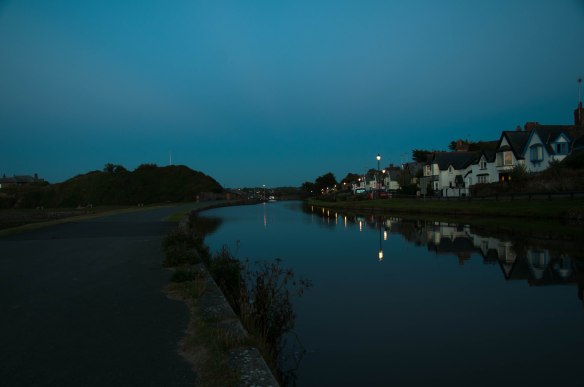
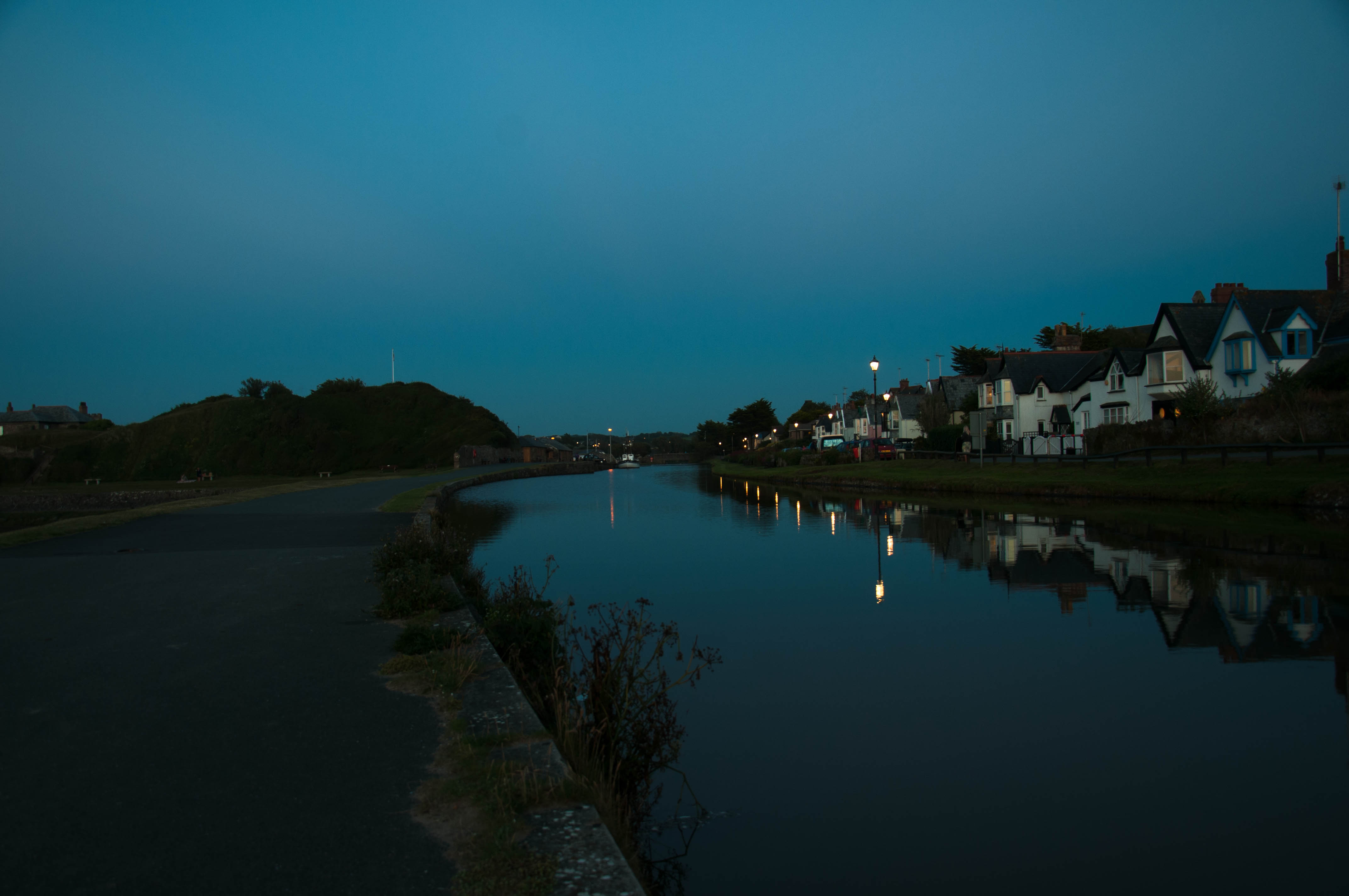
Irrelevant Photo #2: Bude Canal in the late evening light. Photo by Ida Swearingen

Irrelevant Photo #2: Bude Canal in the late evening light. Photo by Ida Swearingen

Singers night is a wonderful, unpredictable gathering of mostly amateur singers, although one professional shows up regularly, for the sheer love of singing. In the summer, the place gets crowded, with some of the visitors singing and others listening and occasionally taking pictures, which is strange since they’ll go home with pictures of a bunch of people in chairs, with their mouths open. But who am I to judge? This particular night gathered in a strong group singers, and any song with a chorus sounded great—rich voices, good energy, harmonies. I admire the hell out of people who can harmonize spontaneously.

G. had started a song whose chorus repeats the line “Didn’t I dance?” and we must’ve sung the words three times before I heard myself: dahnce. My accent had melted into the accents around me instead of sending that good ol’ American A up my nose to spin itself so flat you could use if for a plate.

Dahnce? I thought. Dahnce? Who the hell am I turning into?

Some people pick up accents when they move, but I’m not one of them. To lose my accent, or even modify it, has always seemed like a much larger loss, as if I’d be losing some part of who I am, or hiding it behind a cardboard cut-out of a personality. I lived in Minnesota for decades without picking up more than a bit of shading on the O. Or so M.’s friend, who’s a dialogue coach, tells me. I’d have sworn I still sounded like the purest of New Yorkers, but she has an ear for accents, so I’ll have to take her word for it.

I’m not claiming my attitude’s better than anyone else’s, and to demonstrate how little sense it makes, I’ll tell you that I’m not bad at picking up accents in other languages. In my head, that’s a matter of respect—for the language; for the people who speak it. In English, though, I count the same act as disrespect.

To make even marginal sense of this, I have to mention the toxic history that imitating other people’s accents has in the U.S. When I was a kid, whites imitating African-American or Mexican accents did it badly and to make fun of them. It was skin-crawlingly awful. These days, I know white kids (okay, they used to be kids; you turn your back for ten minutes and they grow up) who adopt African-American accents because they like them and want to blend in. I’m not sure how I feel about that, but I don’t suppose it matters, because it’s not my feelings that count.

My point here is that there’s a do-not-cross line in my head that keeps me from picking up accents in English, but there I was, singing dahnce.

Every language, and every accent within a language, is a song. I’d love to claim credit for that insight, but I heard someone say it in a radio interview. Unfortunately, I haven’t a clue who it was. A woman, I think, so that narrows it down a bit. Whoever you are, I apologize for not crediting you. But to illustrate your point, whoever you are, when I was still living in the U.S., I heard a recording of kids playing in a schoolyard, and without being able to catch a single word I could tell they were English. The song of their accent rose free of the words. And that’s what swept me along in that chorus: the song.

British singers often sing in American accents. It drives the purists nuts, and they blame it on American rock music. If you listen to enough of it, the accent pours itself on top of the notes and you may not even notice that you’ve picked it up.

Unfortunately, picking up an accent doesn’t guarantee that you’ll get it right. You’re likely to revert to your own accent at any time. Sometimes a word is so firmly stuck in your head that you don’t notice you’re reverting: Michigan comes out Mitchigan; Houston comes out Hooston. The line that tickles me is from a hard-luck, down-and-out folk song with the line “I can’t go back home this a-way.” Only it was an English singer, and it came out as cahn’t. “I cahn’t go back home this a-way.” Hard-luck, down-and-out meets silver-spoon. Cahn’t isn’t limited to a silver-spoon accent here, but put it in an American song and it sure sounds like one. And that’s one of the problems with singing in accents that aren’t your own.

Me? I avoid songs that demand an accent transplant. Most of what I sing is American folk music, and the U.S. is a long way from here, so if I end up singing songs I can’t lay claim to by right of either geography or heritage (and I do; they’re fantastic songs), from this distance they don’t sound as absurd as they would if I were back home.

To the extent that I sing English songs, I keep my accent in place and avoid anything I know is going to sound ridiculous. And if anyone who’s heard me wants to warn me off some particular song because I do sound ridiculous, just throw a nice, soft rock at my head. It would be a kindness.

Tea

Americans think tea’s something you drink with your little finger in the air, as if you’d broken it and put it in a splint. We think it’s something you put on a funny accent to ask for. And America’s tea snobs reinforce that. You can’t just drink tea, you need tea made from leaves that were picked while the morning dew was  still fresh on the plant and which were then individually dried and sung to the whole time—by a tenor, thanks; a soprano might crisp the edges and a bass would leave them open to mold. And you need to pay lots o’ money for the resulting tea. I’ve been to restaurants, when I still lived in the U.S., where asking for a cup of tea meant the waiter had to haul out a wooden chest left from the time when restaurants kept a set of dueling pistols on hand in case, you know, a customer needed them. Only now it holds a complete set of hermetically sealed packets, each entombing one lonely teabag. And after all that, they bring you water that isn’t hot enough to lift any flavor out of the tea so you end up with, basically, a cup of bath water.

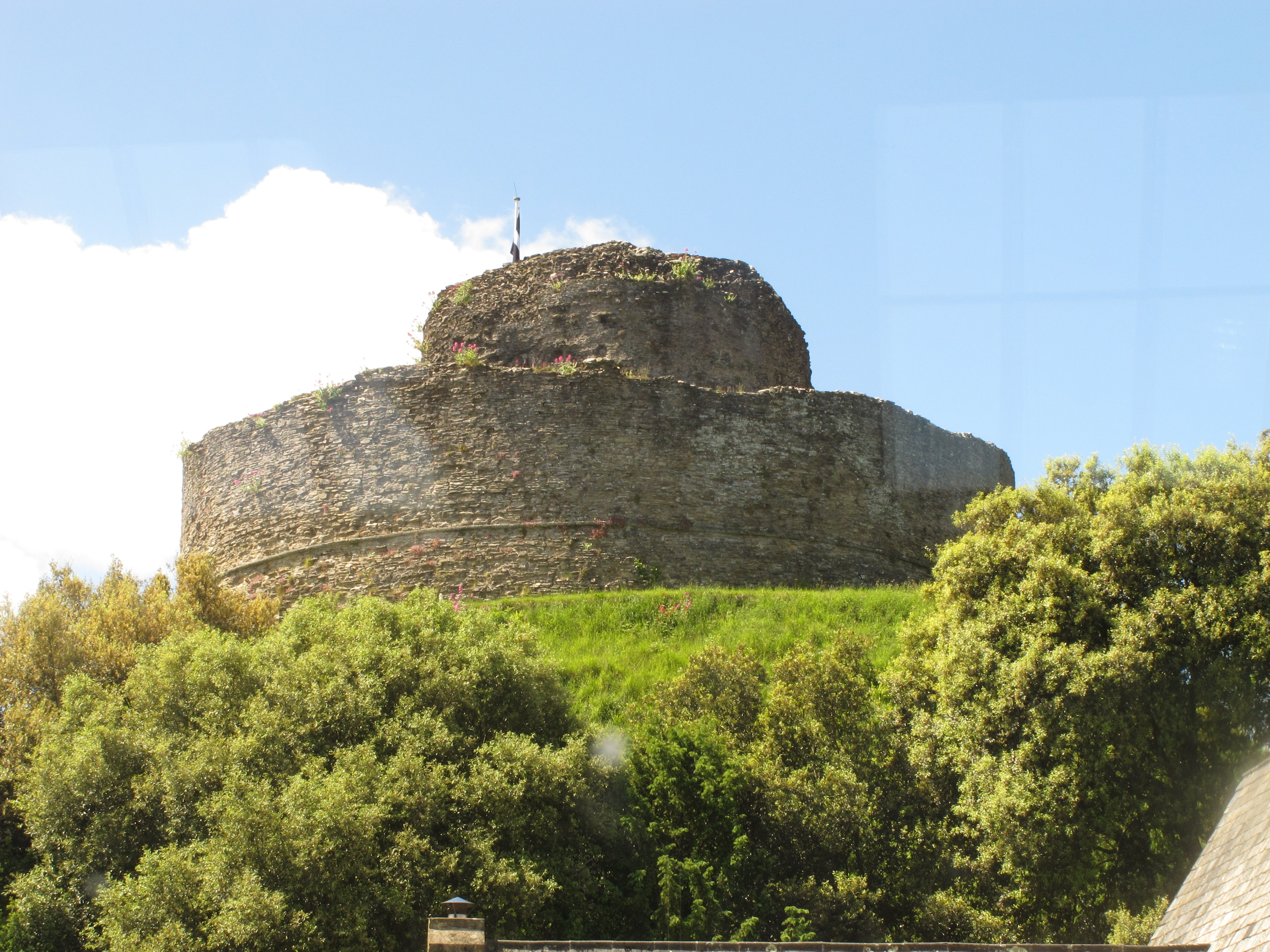
Irrelevant Photo: Launceston Castle

Irrelevant Photo: Launceston Castle

An English friend was so traumatized by her visit to the U.S. that she still talks about “that gray stuff you call tea.”

I hate restaurants like that. Not because of the tea. And not because everyone who works there is dressed better than I am. I’m used to that: I’ve always been dyslexic about style and have now gone entirely post-fashion. It’s because I keep thinking I’ve wandered into some private club and the butler’s going to throw me out any minute.

Are there still butlers loose in the world?

Anyway, tea: In Britain, it’s just a drink. If someone comes to fix the leak under your sink, you ask if they want a cup of tea. If you want to know why three guys are digging a hole in the middle of your street, you wander over and ask if they want a cup of tea. Add a biscuit—which is a cookie, and it doesn’t even have to be homemade—and they’ll tell you anything you want to know. Tea is the kind of drink you put in your thermos to take to work, if you happen to take a thermos to work. People talk about ordinary tea, or breakfast tea, to distinguish it from the fancy teas—Earl Grey, say, of green, or herbal (they pronounce the H). A. calls it builder’s tea, and sometimes builder’s butt tea. Her husband’s a builder, so she gets to say stuff like that.

A builder, by the way, builds buildings. Or fixes them. And a joiner’s a carpenter, not someone who belongs to a lot of organizations. All of them will drink tea. And so should you if you visit, because Wild Thing, who was once a dedicated and not at all fussy coffee drinker, tells me the coffee’s terrible. I gave up coffee long before I moved here, so I can only take her word for it.

A cup of tea is also a measure of time. If I drop by someone’s house and they offer me a cup of tea, they want me to stay long enough to drink it. Friendship is a highly caffeinated undertaking.

Summer Solstice in Cornwall

This far north, the longest day of the year goes on for 26 hours.

Okay, that’s not the literal truth. It’s more like 27.

This morning, Wild Thing and I got up at 3:15 (that’s a.m.), staggered out to the car, and drove down the hill to pick up J. so we could drive to a double set of stone circles some 40 minutes from here and join a group of people who gather at the summer and winter solstices to sing up the sun.

Waiting for sunrise

Waiting for sunrise

If that sounds new agey and corny, it probably is. I’m not given to new aginess myself, but when you’re surrounded by ancient monuments the way we are here, you can be forgiven for sliding into a bit of nouveau-pagan celebration once in a while. Those who take it seriously do, and those who don’t can still stand inside a stone circle put up by prehistoric people for purposes we can only guess at and be overwhelmed by the scale of human history. It’s the closest I’ve come to touching my ancient ancestors—who (by way of full disclosure) aren’t my ancestors at all, except in the spirit of all humankind being one family. But humankind is one family, and those circles get to me. Not for any magical properties, but for their sheer age.

Sunrise

Sunrise

At the stone circles, we joined some hundred other people, dressed in everything from long skirts and ivy-leaf hair thingies, to shorts and blankets, to winter jackets (it gets cold on the moor), and we sang, and the sun came up, as red as it ever was when our ancestors watched it all those thousands of years ago. Then we headed to village pub, which had opened early for us, and we ate breakfast. It wasn’t an exact replica of the way our ancestors and not-ancestors celebrated the solstice, but everything changes with the times.

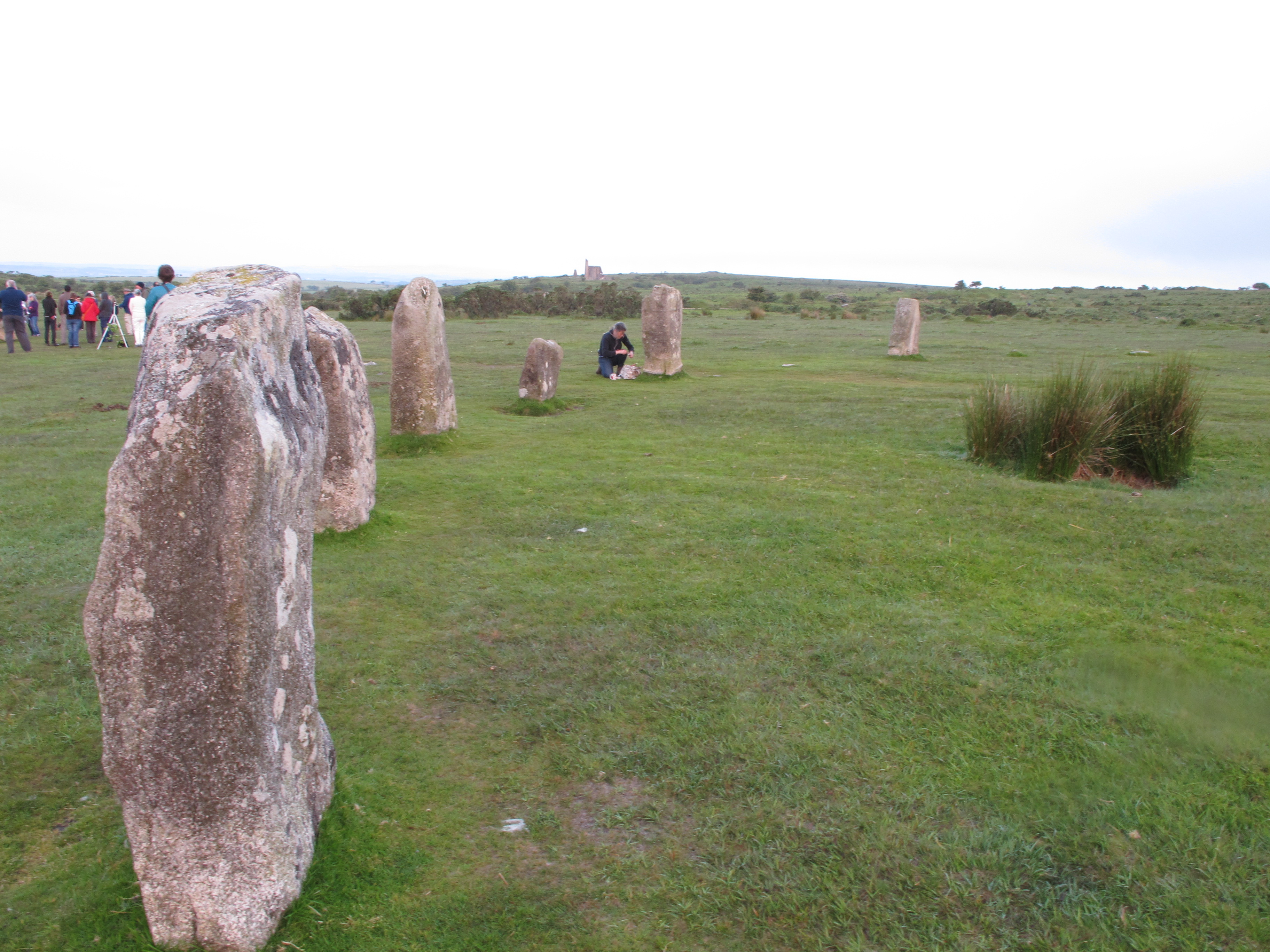
Stone circle

Stone circle

This evening, a group of women from the village will gather on the beach to watch the sun go down. J.’s organized the gathering for several years running, but this will be the first time we’ve gone. All I know is that it involves a bonfire and food. Our ancestors would have understood.

Wild Dartmoor ponies, happy to have the moor to themselves again

Wild Dartmoor ponies, happy to have the moor to themselves again

This is the first year that J. started the day by getting up at silly o’clock to watch the sun come up, and I told J. I half expect the evening to end with her falling asleep on the beach and everyone gently carrying her home.

She said everyone would be more likely to dump her in the sea.

Slugs

Summer evenings here in Cornwall are long and beautiful, and when night falls you’ll find me outside with a flashlight and a pair of scissors, slaughtering slugs.

I can’t begin to tell you how romantic it is living in the countryside. Like something out of a Victorian novel. I snip the poor horrors in half, because otherwise they’ll eat my lettuce, my bean plants, my flowers, and just about anything else we grow. They glue their suckery undersides to leaves, flowers, twigs, and their dead co-religionists (dead slugs are a good source of protein, I guess, and the live ones aren’t sentimental), and they ingest every bit of that except the twigs, which they’ll need as ladders the next night to reach another meal.

A slug. Photo by Peter van der Sluijs.

A slug. Photo by Peter van der Sluijs.

The first person who told me she snipped slugs in half was M. The name doesn’t tell you much, even if you live in the village, because every third person here is named M., but this particular M. is an expert gardener and a lovely and gentle human being, so it was hard to picture her doing that. I shuddered and said, “Ewww,” like a ten-year-old.

But that was before I started gardening.

You have to understand: The slugs here are the size of double-decker buses. Britain was once heavily forested, and people will tell you the trees were chopped down to make way for agriculture and to build ships and all that, but don’t you believe it. It was the slugs. Back in the golden age they ate the trees and now they’re reduced to attacking my lettuce.

Our first spring here, I started trays of plants from seed and the first time I set them out overnight the slugs came through like a line of combine harvesters, leaving nothing but the trays and the soil and the little plastic tags noting what no longer grew in them.

I’m not a stranger to slugs. We had them in Minnesota, but they were small, well-behaved slugs who nibbled but were too polite to gobble. Maybe it was the winters that kept them in check and maybe it Minnesota Nice—that cultural thing that makes Minnesotans say “that’s different” when what they mean is “if I see you do that one more time I’m buying a gun.” The slugs here? I’ve already told you: They’re not just carnivorous, they’re cannibalistic. What more do you need to know?

I should tell you at this point that I’m a vegetarian and that I don’t run around slaughtering things for fun. But I’ve come to understand that it takes industrial-scale slaughter to get in single leaf of lettuce to the plate. And if you’re growing your own, it’s up to you to do the slaughtering.

Some of my gardener friends sprinkle slug pellets or set slug traps, and I’ve tried both. They helped but not enough. And some pellets go on to kill the birds and hedgehogs that eat the dead slugs. Others are marked organic and safe for wildlife, but even so gardeners who use them tend to whisper about it. I don’t know how the pellets kill, but I doubt the slug has a lot of fun in the process. Slug traps tend to use beer, and you could argue that they at least die drunk, so maybe they don’t care.

The only method I haven’t tried is gathering them up and dropping them in salt water, where they fizz and die—or so I’m told. It sounds like a horrible death.

Oddly enough, I do care about that. I’m a vegetarian. I have this habit of imagining myself into other creatures’ places. So if I’m going to slaughter something, I want to kill it as quickly and painlessly as possible. Even if it happens to turn my stomach. So come nightfall you’ll find me crawling around in the dark with my flashlight and my scissors.

The snails are just as bad, by the way, but you can’t snip them. I put them on a rock and stomp them. Just like the heroine of a Victorian novel.

Diversions

Wild Thing and I were driving to Launceston on an A road the other day, but before I write about the diversion I have to go on a digression: An A road is a main road, but out here, surrounded by sheep and cattle and windfarms, main road doesn’t mean four lanes and truck stops. It means two full lanes and a white line to divide them.

So there we were, looking at a field with sheep and Dartmoor ponies, when traffic came to a dead halt.

Not a main road

Not a main road

Now, patience isn’t one of Wild Thing’s virtues, but we waited—mostly because I was driving—and after a while the cars ahead were waved onto a narrower side road, heading north (more or less; nothing here runs in a straight line) when we’d all been heading west. The A road was blocked by a police car, so we figured there’d been an accident. Either that or someone decided a nice diversion would thin the herd. It’s hard to know what causes other people to do what they do. But I should take you on a second digression here: When there’s an accident in the US, as far as I can tell the priority is to keep traffic moving, but here they treat the accident site as a crime scene and traffic can go choke on its own exhaust because it’s not the first thing in anyone’s mind. So you might as well shut off the engine and watch the ponies, because you’ll be there for a while.

I’d already done that, so now I started the engine back up and followed the cars ahead, down a beautiful, narrow road that went in the wrong direction, passing trees, wildflowers, oncoming traffic, and bottlenecks where everything slowed to a crawl. Which is fine if you’re not in a hurry and know the area. We ticked both boxes (as they say here), so all we had to do was drive until we picked up a (more or less) parallel road heading (more or less) west, which would get us to Launceston the back way. If you’re a stranger and without a sat-nav, though, all you can do is follow the car in front, if there is one. And if you end up in their driveway, you have to hope they invite you in for a cup of tea and a glance at a map. Because the rest of the diversion isn’t likely to be marked. No one will have had time, and did I mention that traffic isn’t the top priority? You’ll come to intersections and have to take a wild guess, and since nothing goes straight these can be very wild. But eventually you’ll arrive somewhere, and if it’s not where you wanted to go you can at least plan a route.

Our line of cars was led by a motorhome (sorry: that would be called a caravan), and when you see one of these in Cornwall you can pretty well guess that the driver’s used to driving something narrower and lives where the roads are wider. So at every bottleneck we all slowed to a crawl while the motorhome white-knuckled its way past an oncoming car or cowered in the hedge while some truck or tractor driver crept past.

I shouldn’t be unsympathetic. I did all that when I was new here. And have I mentioned that the road was narrow? Two cars would fit past in most places if the drivers know what they’re doing, but if trucks and tractors and nervous drivers come into the equation somebody has to find a wide spot and pull into it before traffic can move on.

Third digression: They do narrow roads really well around here. I once saw a motorhome stuck in between two houses in a village where the road takes a sharp bend and the houses are built right up to its edge. The driver was walking from one side to the other and rubbing his head. When I went back a few months later, the motorhome was gone and the houses were still standing, so either he disassembled the thing and reassembled it on the far side or found a way past.

Anyway, we bumped around Launceston for a while and a few hours later we left the back way. It was still full of trucks—big honkin’ semis. And they’re not called trucks here. They’re articulated lorries.

Rumors

Walking the dog to the store for the paper this morning, I saw I. and R. standing in the shade of a hedge, catching each other up on who knows what—I was too far away to hear. They talked for a while and parted ways, I. heading down a side road to her house and R walking in my direction.

When we passed, he said, “No papers today.”

I asked if they’d be getting them in later, but he didn’t know. He’d heard it from I. and turned back.  We complained for a while about the distributor the store uses, because this happens a lot, and often, he said, the stores in the next village gets its deliveries.

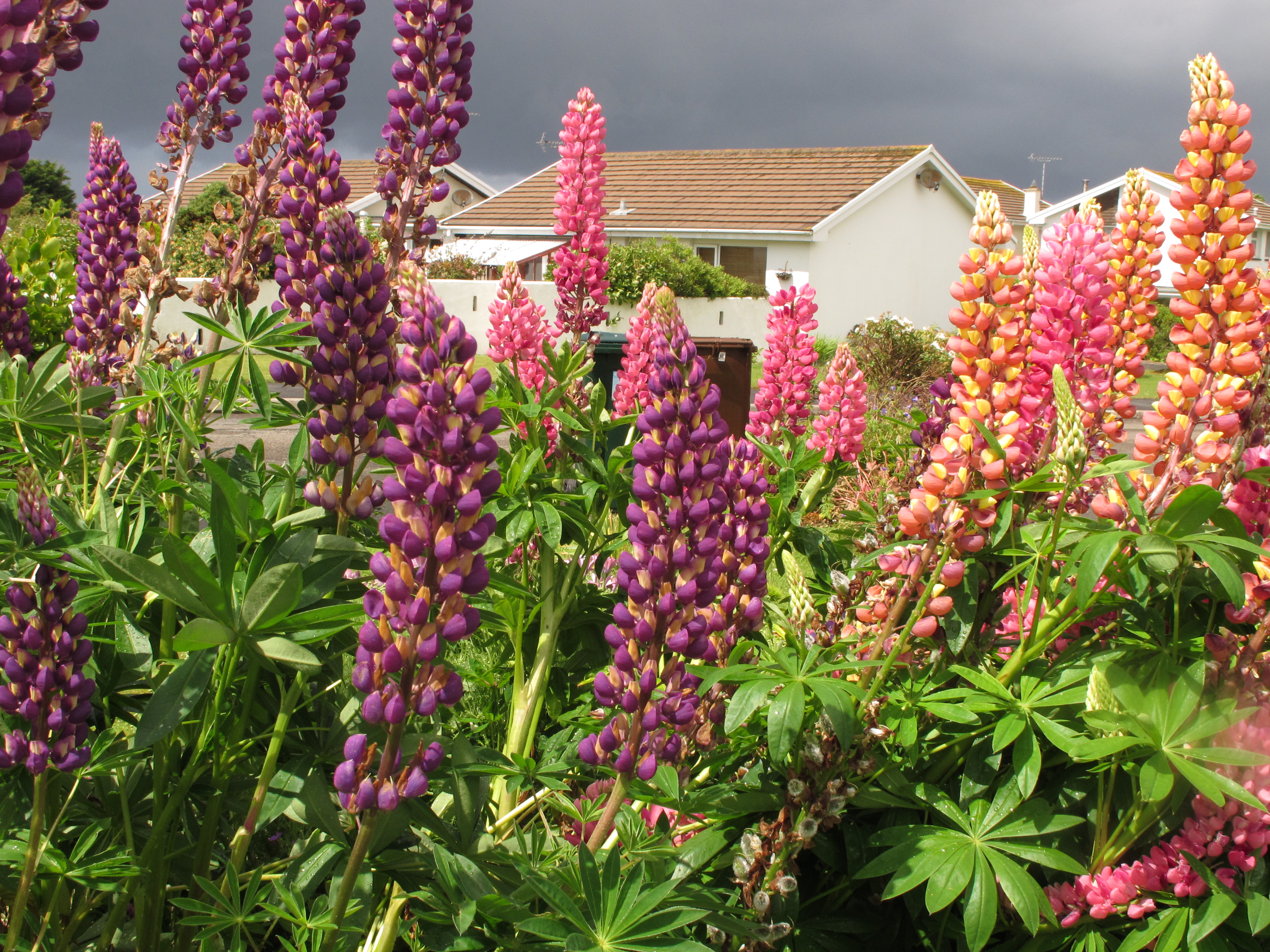
Lupines--in bloom right now.

Lupines–in bloom right now.

Okay, we weren’t complaining about the distributor. We were complaining about the store, for using them.

I had a magazine to drop in someone’s mailbox, so I didn’t turn back, and on the way decided to go to the store anyway, to ask when they expected the delivery. I debated whether to ask for today’s coupon and drive to the next village and buy the paper there. (Newspaper subscriptions, at least out here in the country, involve coupons, which you can either present day by day, anywhere you like, and which give you a discount but no guarantee that the store won’t have run out, or leave with the store, which will then set your paper aside.)

I still hadn’t decided when I got to the store and asked when the papers were expected.   They looked at me blankly.

“We have yours,” they said, and asked who told me they didn’t.

I reconstructed the whisper chain.

“It’s only the Express. R. gets the Mail. We have that.”

And that’s the way word gets around the village. We have no secrets, but have a whole lot of misinformation.

National Insanities

What’s it like living abroad? Every country has its own brand of insanity, but it takes a long time before it seeps into you. I moved here late in my life, so I’ll never understand British craziness the way I understand the American version, but there’s something great about being an outsider. It means you can see a country’s oddities in a way you can’t when you share them.

Sinking-of-ship-cazador-1856 (1)

In 2007, a ship wrecked off the south coast of Devon and its cargo washed up on the beach. (http://www.telegraph.co.uk/news/uknews/1540307/Police-to-clamp-down-on-beach-scavengers.html) It looked nothing like the picture I’ve posted, but there’s a connection, because following ancient local traditions, which date back to the days of sailing ships, everyone for miles around helped themselves. This is called looting if you’re not participating and not letting things go to waste if you are. So far, so logical. But part of the cargo was a container of motorcycles, and instead of pushing, shoving, and grabbing for them, the looters (or non-wasters if you prefer) formed an orderly line and waited their turn. Nobody but Wild Thing and I thought that was funny until we pointed it out, and even then I’m not convinced they weren’t just humoring us when they laughed. Because nothing is more important to the British than forming an orderly line. Except, maybe, calling it a queue.

English Cooking: Baked Beans

English Cooking: Baked Beans

The English aren’t known for their cooking. Or they are, but not in a complimentary way. And I’ll admit they have some odd habits, one of which is eating baked beans on toast. But who am I to criticize? I grew up begging my mother to buy a kind of white bread that I could, and did, squish down to the size of a packing peanut. Which hadn’t been invented yet, but I was ahead of my time. And yes, I did eat it. She’d never have bought it again if all I did was squish it. And I’d have sworn it was good, so I know first-hand that there’s no accounting for taste.

Still, it throws me to see an adult sit down to a plate of baked beans on toast and, with every sign of pleasure, eat it.

Beans on Toast. Really.

Beans on Toast. Really.

But that’s not all that happens with baked beans around here. You can buy a baked potato topped with baked beans. (Or with cheese, or cole slaw, or curry, or roast vegetables, or shrimp, which are mostly called prawns unless they’re small, even for shrimp. And the potatoes are called jacket potatoes.) A full English breakfast includes baked beans, not to mention a grilled tomato. A single can of baked beans includes enough salt and sugar to cover Wales to a depth of half an inch. In spite of which, people eat baked beans in industrial quantities and live to ask for more, and why not? They’re full of fiber, which for all I know mops up the salt. Half the canned vegetable aisle is taken up with baked beans. I’m sure there are all sorts of subtle differences among the brands, but I’ll only do just so much in the name of research, and tasting them lies on the far side of an extremely thick dividing line.

The Life in the U.K. Test

British_Flag (1)It was 2006 when Wild Thing and I left Minnesota for a village in Cornwall. It’s ridiculously beautiful and it’s also—well, British. And we’re American. Actually, by now we’re both British and American, but we’ve been Americans for a lot longer than we’ll ever be British, and these things don’t leave you.

When we applied for permanent leave to remain in the UK, I had to take the Life in the UK test to prove that I was fit to stay. Or maybe what I had to prove was that some ministry or political party was sufficiently tough on immigration to appeal to the anti-immigrant vote. The test is silly, but politics makes people silly. Wild Thing is eight years older than I am and didn’t have to take the test. If you’re past a certain age, you can keep your foreign ways without threatening the country’s integrity. Or something along those lines. The logic of it got lost in the twists and turns of some politician’s brain and if you think about it too much it’ll only upset you.

I bought a government booklet about the test and studied it. Since I worked as an editor before I retired, I couldn’t help tracing through the book’s logic, and I’m prepared to testify that there wasn’t much. A part of it explained how to deal with officialdom, and that was theoretically useful, although by the time I had to take the test life had taught me most of it, as I expect it does to other test-takers. It included information on emergency phone numbers, libraries, the National Health System, that sort of thing. But sandwiched in with that were pages and pages of data: what proportion of the population belonged to which religion, for example. I think I’m right in remembering that Jedi had enough adherents to show up on the list. The patron saints of England, Wales, Northern Ireland, and Scotland, and the days on which they’re celebrated, which are no longer official (and are barely unofficial) holidays, so the information is of no earthly use. I suppose if you belong to a religion that believes in saints you could argue that it’s of some unearthly use, but I don’t know if calendar dates remain relevant in heaven, should such a place turn out to exist. But I duly memorized them, and they weren’t on the test. I have now duly forgotten them. (The test is computerized and the questions vary; not everyone takes the same test. So someone somewhere may get asked about them.) The populations of England, Wales, Northern Ireland, and Scotland. Since there’s nothing involving numbers that I can’t screw up, I spent a lot of time on this and forgot every bit of it ten minutes after the test, which is okay because, unlike the religions, which were in percentages, these were in absolute numbers and  will have changed by now. Although, come to think of it, the religious percentages may have as well.

They also had a list of popular sports. Cricket, which I would have thought was the most British of British games, wasn’t included, maybe because the game takes so long that none of its followers had time to respond to a survey.

Sports weren’t on the test. The only question I still remember had to do with the television license—something along the lines of whether people renting a room in a house would have to pay for a separate television license if they had their own set. The television license pays for the BBC and is, essentially, a tax dedicated to that specific use. Think of it as a toll booth, only it’s not on the highway, it’s on the TV set and pays for the programming, not the road.

All that mess about populations and saints’ days? As far as I know, it’s either in there either to fill out the pamphlet or to distract applicants from learning the information they’ll actually need.

It’s a hell of a way to welcome a person to the country.