Measuring time in the US and UK

When I was fielding comments about the insanities involved in figuring out what I weigh in the U.K., I caught myself just before I wrote that at least we all measure time the same way.

Are you sure? I asked my more-than-usually bewildered self. I imagined someone jumping out the magic surge of the internet to tell me that yes, the hour has sixty minutes everywhere but the minutes are longer in the U.S. Why there? Because everything’s bigger in the U.S. Or that’s what people in Britain tell me. Houses, rooms, scones, the spaces in our parking lots. People. So wouldn’t it be just like us to want a longer minute?

It might, but as far as I know the minute really is the same everywhere. And no, Americans don’t all live in mansions any more than the British all live in castles, although the scones and the parking spaces really are bigger. And some of the rooms and houses. I’m not sure about the people.

Irrelevant photo: freezing fog on Davidstow Moor.

Irrelevant photo: freezing fog on Davidstow Moor.

What were we talking about?

My point about time is that we may measure it the same way, but someone always finds a way to complicate things. Usually me. A few years ago, I was working out a time to pick up M. for—I think—a movie.

“A quarter of,” I suggested.

“What does that even mean?” he said.

“A quarter of six.”

Then I realized he wasn’t asking about the hour, he was asking about the quarter of part. I tried translations.

“Five forty-five? A quarter to? Fifteen minutes to six?”

He shook his head.

“But what, grammatically, does it even mean?”

Well, it means a quarter of, obviously, and I had to say the phrase one more time to realize that it doesn’t, but any sort of logic, mean a thing. A quarter of what? Of nothing. It’s just what we say. We know what it means, so what’s your problem?

On the other hand, the British say “half six.” That’s three, right? No, that’s six-thirty. What, grammatically, does that even mean? About as much as a quarter of. But if you’ve grown up with it, it makes all kinds of sense.

Mercifully, no one’s come along to divide the traditional clock into a more rational system—ten hours, 100 minutes. You know, something easier to calculate with. Because some of us would convert to the new system and some of us wouldn’t and we’d all fight about it, and we’re having enough trouble as it is.

Weighing myself in the U.K. and in the U.S.

J. wrote me early in the year, saying (among other, more interesting, things) that she needs to lose ten pounds of holiday weight. I almost wrote back to ask, “What’s a pound?”

It’s not that I’ve forgotten exactly, and it’s not that no one measures in pounds here. Like everything else about living in a country that isn’t at heart your own, it’s complicated.

In theory, most weights are still given in two systems, metric and imperial, to humor the folks who grew up calculating in a pre-metric world and are either too old or too cantankerous to switch over. Or in my case, too old, too cantankerous, and too mathematically incompetent.

Right. That's me, weighing myself. In grams and kilos. Photo by senov.

Right. That’s me, weighing myself. In grams and kilos. Photo by senov.

Our bathroom scale measures in both kilos (2.2 pounds) and stones (14 pounds). Stones are subdivided into pounds, so it’s not that the pound isn’t on there, just that it’s illegible. To make room for two ways of measuring, the manufacturer had to use small print. Insurance-form size print. But even if the print was large enough for me to read and therefore know that I was something stones and something else pounds, I’d still have to multiply the stones by fourteen, which I’m incapable of doing on the hoof and not interested enough to do with a calculator or a pen and paper. I mean, as long as your clothes fit, who cares?

Well, me, at least enough to step on, if not enough to work out the result.

A sensible person—or one who seriously cared to track her weight—would forget about pounds and switch to one or both of the new systems, but you might as well ask me to track my weight in tablespoons, or in cubits, because the new systems don’t mean anything to me. I look at the numbers. I think, I should remember this. And then I walk away, remembering only that I should remember. Numbers do that to me. I look at them and see an elaborate version of almost nothing.

I do have a kind of geographic memory of where the needle usually sits: halfway between two of the larger marks. When it creeps toward the one on the right, I’ve put on weight. When it creeps to the left, it’ll move back to the middle any day, so it doesn’t mean much.

What are the numbers that the needle sits between? I’m not being coy here; I honestly don’t remember. I mean, I still haven’t learned the multiplication tables. You expect me to know my weight in imaginary measurement systems?

But my weight in pounds? I could remember that. At least I remember what it was when I lived around scales that measured in pounds, because I understand in my body what a pound is. Maybe it comes from growing up with them—from measuring in pounds and feet and inches the growing amount of space I took up in the world. To the extent that I can guesstimate a kilo, it’s only in relation to a pound—twice as much with a little extra thrown in.

And a stone? Are you kidding me?

When I first started buying lunchmeat at the deli counter in our local supermarket (which no one but me calls a supermarket, but that’s a different tale), I asked for a pound. Because that’s also an amount of money, the kid behind the counter froze in front of his scale. Maybe I wanted a pound’s worth of lunchmeat. That’s a measurable amount, although not a hell of a lot, but no one asks for it that way. I said, “Half a kilo?” since in the essentially nonmathematical world I inhabit, that’s close enough to a pound to make me happy. He still looked as if he’d been swept up by a tornado and dumped back in math class: If lunchmeat A leaves display plate B at 10:45 and arrives on scale C weighing half a kilo, how long will it be before my manager yells at me for upsetting a customer?

“Five hundred grams?” I said, feeling as if I’d been swept up by that same tornado and dumped in some alternate universe where I could solve a math problem more easily that some other human being. It was destabilizing, but relief flowed over the kid behind the counter as visibly as if someone had poured it over his head from a bucket.

He weighed my five hundred grams, stuck the label on the bag, and handed it over.

To me, the vegetarian. But that, too, is a whole ‘nother story.

So I haven’t a clue how much weight I’d like to lose. Some of my clothes fit just fine, but the washing machine’s been selectively shrinking the smallest of my jeans. They’re not making denim like they used to. They are, sadly, making desserts exactly like they used to, and my body remembers them fondly. It doesn’t want to let them go.

What I know is this: I weigh something or other. It doesn’t really matter how much. When I stand on the scale, the needle moves and I’m reassured that I’m still present in this strange world of ours.

Winter in Cornwall, Winter in Minnesota

It’s winter here, and it’s behaving the way winter does in Cornwall. I can’t bring myself to say it’s cold.

I lived through forty Minnesota winters, but through all that I never really was a Minnesotan, I was a transplanted New Yorker, but there’s nothing like transplanting myself again to let me know exactly how much of a Minnesotan I became. Because this isn’t cold. It’s chilly, yes, but that’s as far as I can go.

A quick break here for anyone who’s not sure where Minnesota is: Fold the US in half from north to south and it’s right there on the fold, up by the Canadian border. Okay, more or less on the fold. I haven’t actually tried this, but you get the idea. It’s inland, it’s north, and it’s cold beyond anything I ever imagined as a kid in New York City.

Minneapolis after a 15-inch storm in 2010. The Metrodome roof collapsed under the weight of the snow. Again.

Not Cornwall. This is Minneapolis after a 15-inch storm in 2010. The Metrodome roof collapsed under the weight of the snow. Again. Photo by Kevin Jack

Minnesotans talk about Minnesota macho, and that doesn’t have anything to do with bullfights or bar fights or street fights, it has to do with the cold. The high school kids who wait bare headed for the bus at twenty below, their ears daring the frost to bite them? They’re an emblem of Minnesota macho. The auto mechanic I used to know who refused to own gloves (or a hat, while we’re at it), even when he had to work on a car outside in January? You got it. We all had our own version of it, even those of us who went out in so many layers of clothes that we couldn’t lower our arms to our sides. We might look like giant fire hydrants, but we all found some small way to defy the cold—or to tell ourselves we had. Some days, just getting to work qualifies you: You dig out the car; you start the car; you drive the car over ice or snow without having a wreck. Or you wait for the bus. It’s heroic, all of it. There are days when you’d be forty degrees warmer (that’s Fahrenheit) it you sat in your refrigerator. And you could have a snack while you were at it.

Minnesota winters drive people to all sorts of extremes. If you talk about getting cabin fever, everyone knows what you mean: You’ve been stuck inside too long and you’re getting a little strange. When I worked for a writers organization, we gave the winters credit for the number of writers the state produced. This year’s winter has driven P. to working literary jigsaw puzzles. He writes, “As Ezra Pound wrote, ‘Winter is icumen in. Lhude sing goddamn.  Stoppeth bus and sloppeth us. Sing goddamn,’ etc.

“If April with his shoures soote pierces the drought of March, it’ll be a fooken miracle.”

Umm, yes. I guess that’s true. But I’m in Cornwall, and last night we had (gasp, wheeze) a frost. Yes, folks, the temperature dipped one or two horrifying degrees Fahrenheit below freezing. Not only that, some white stuff fell out of the sky in the late afternoon, and since it didn’t stick I’m willing to admit that it looked very pretty while it did it. And the weather folk on radio and TV were all cranked up about it: Cold! Snow!

Well, okay, north of here the weather may be doing something vaguely serious. I’m not there and I can’t say. Cornwall’s the southern bit of the UK, where Britain sticks its toe into the Atlantic, so it’s warmer than the rest of the country. But I listen to the weather forecasts and I swear, even after eight—almost nine—years, I fall for it. I’m ready to wrap myself in a quilt before I go out, since I gave away my winter coat when I left Minnesota and my current one would barely stand up to a Minnesota spring. Then I look at the numbers and realize I’ll be fine. Last night we slept with the window open (that’s for one of the cats; he campaigns all night if he’s locked in), and no heat, thanks. It was fine.

So when someone says, “It’s cold,” as surely they will at some point during the day, I’ll manage to say, “It is chilly.” And I’ll make it sound agreeable, almost as if I’m agreeing, but I’m not exactly.

British and American English: Talking about tea

Tea isn’t just a drink here, it’s a meal and a marker of class. (You’ll find lots of those if you know how to look.) If you’re working class, tea is the evening meal and dinner is lunch. If you’re upper class, the evening meal is supper. Are you still with me? You won’t be for long, because A. adds, “But we all say supper now.”

Who’s “we”?

Sorry, you’re on your own there.

Screamingly irrelevant photo. He doesn’t care what the meal’s called.

And in case this isn’t confusing enough, I’ve read that all this turns into its opposite in other parts of the country, so you have to know where someone’s from to know what they’re eating. Or drinking. Or talking about.

Wild thing was on the phone with H. and invited her to stop by for tea after something they were doing together. H. told us later that she hung up the phone and thought, I wonder what I just got invited for? Because Wild Thing and I don’t play by the same rules as anyone else does, so who knows what we mean when we say “tea”?

We sure as hell don’t.

Everyone seems to agree that afternoon tea (as opposed to just plain old tea) is afternoon tea—you know: a cup of tea and a little something—but if you want that little something in the morning it’s either morning coffee or elevensies. Morning tea? Sorry, there is no such thing. It’s morning coffee. And if you don’t drink coffee? No problem. You can get tea. But it’s still not called tea.

Looking American: On culture, nationality, and immigration

A few months ago, M. told me, “You’re looking very”—and here you have to imagine a short pause— “American today.”

When I stopped laughing, I asked what American looked like, and you can insert another, somewhat longer pause before you go on, because he had to think about it. Or else he was looking for a gentle way to say it.

“You walk as if the sun always shines on you and you own the world,” he said. Not unkindly, I should add, although from someone else it might have sounded like a complaint.

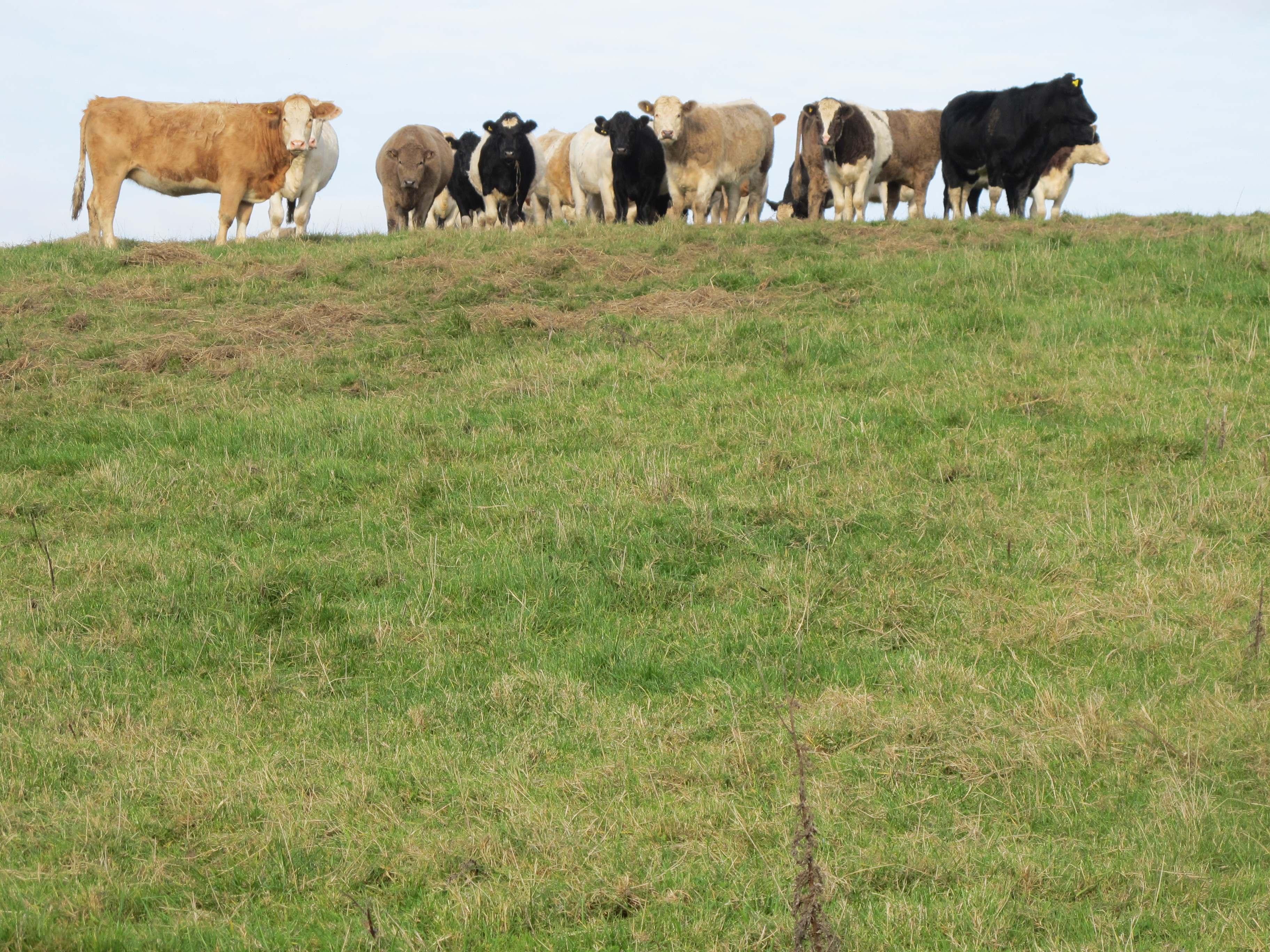
Semi-relevant photo: The sun shining on a herd of cows. (Actually, they were making sure we left their field, and I can't remember if the sun was shining on them or not--it looks like diffuse sunlight. Does that count?)

Semi-relevant photo: The sun shining on a herd of cattle. Actually, they were making sure we left their field, and I can’t remember if the sun was shining on them or not–it looks like diffuse sunlight. That may or may not count.

The sun wasn’t shining on me that day. I’ll skip the details, because they’ll take me off in a whole ‘nother direction, but I’d been shaken by some bad news a few hours earlier, and I was still feeling it.

What does it mean to be so American that I look like I own the world, even (or particularly) when I’m don’t feel that way? Well, what does it mean to belong to any nationality?

The question’s been rattling around in my head lately, at least in part because of the anti-immigrant sentiment that seeps into so much of British politics these days. And into American politics, while we’re at it. You could probably drop any other more or less solvent nation into that sentence, because trouble drives people to immigrate, and the world’s a troubled place these days.

Part of the anti-immigrant feeling is about jobs: If immigrants come over here (wherever here is), they’ll work for less and wages will drop. There’s some logic to this, although what’s really undermining wages is that jobs, and whole industries, have moved overseas, where wages are ruinously cheaper. On top of that, unions don’t have the clout they once did (those two aren’t unrelated), and they were a major force driving wages up.

But another, more emotional, strand of complaint is that immigrants don’t blend in. Basically, the problem with immigrants is that we’re foreigners, and couldn’t we please stop that? Stop talking our languages in public. Stop eating funny foods. Stop dressing differently. Stop running around with different-color skin. Stop cheering for foreign sports teams or holding to foreign religions or using all those alphabets that no decent person knows how to read. I mean, who knows what we’re writing in them?

But once you grow up in a culture, you don’t get to leave it behind—not entirely, even if you want to. No matter how much you work at blending into another one, you carry some part of the original. I walk, apparently, like an American, and I know I sound like one. I even eat like one. The American way of eating involves juggling the fork from the left hand, where we hold it if we need to cut something with knife and fork, to the right hand, which we use to bring the food to the mouth. The British way leaves the fork where it started, in the left hand. This is great, because it lets you use the knife to push food onto your fork—and it’s perfectly good manners when you do. That solves a problem built into the American approach: How do you get the last bits of non-spearable food onto the fork without sneaking a finger onto the plate and hoping no one’s looking? Although it doesn’t solve another problem, which is how to keep the food on your fork, because the British hold the damned thing with the back—the hump—facing up, so that you can’t use the fork’s valley to cradle your food. I haven’t a clue why they do this, but it may explain why mashed potatoes are so popular: you can use them as mortar to hold the rest of your food on your fork.

So I’m a partial fan of the British method, and periodically I try to eat that way—usually with the curved part of the fork facing up, but never mind, I’m compromising here and I want some credit, damn it. All you anti-immigrant campaigners, are you listening? I’m making an effort.

What happens, though? The minute my mind wanders—and it doesn’t take long—my fork’s magically moved itself back to my right hand and I’m eating like an American again. And the sun shines on me.

At this point, while the sun’s shining on me alone, I have to interrupt myself, because I read this post to my writers group and they told me that holding the fork with the hump facing up is posh, presumably because it makes you eat more slowly. Holding it valley-side up is working class. Who’d have thunk? I swear, you have to be born here to figure this stuff out. On the evidence of that alone, though, I ask you: Who should be running the country?

Because of my (sometimes absurd) efforts to publicize both my book and this blog, I’ve written a lot of bios lately (I will post just about anywhere, about almost anything, as long as I get a bio and a link), and I keep describing myself as an American living in Cornwall. That reflects the reality of who I am culturally, but it ignores the fact that I’m a British citizen as well as an American one.

For me, becoming a British citizen was about security, not love or allegiance or culture. I do love the country, but I’m not romantic about citizenship. I wanted to be a citizen because it’s harder to get rid of a citizen than a resident alien. Since the U.K. government had already changed the rules once before Wild Thing and I got the right to stay in the country for the long term,and since we just about got kicked out of the country because of it, we were touchy on the subject. It may be crass, but we wanted the safety that comes with citizenship. We’re grateful for it, but it hasn’t, and can’t, change who we are.

So when I hear someone say that the problem with immigrants is that we don’t acculturate, I can only suggest moving abroad and seeing what happens.

*

A final note: Before my writers group before we fell down the conversational rabbit hole of what it means to have a constitution that isn’t a written document, I learned something else about forks and nationality: More and more of the British are acting like Americans and shuffling their forks from hand to hand as they eat.

And we’re not even the immigrant group anyone’s upset about.

If you want to blame someone, you can blame movies or television, because there aren’t enough Americans here to have that big an impact.

How do foreigners change a culture? Sometimes it’s from a distance.

Manners, American and British

The British have manners. They have such good manners that from time to time they’ll throw them out the window to scold strangers for their lack of them.

Wild Thing and I were in the outdoor section of a café once—a cramped, eat-your-lunch-and-get-out kind of place—and as a couple who’d been sitting nearby wove past our table to leave, one of them said, “In this country, we say please and thank you.”

Sadly, by the time we’d processed the words, they were too far away for a snappy comeback, but “In our country, we’re polite to strangers,” did come to mind. It may not be true, but I still wish I’d been quick enough to say it.

mulfra 030

Irrelevant Photo: Fountains Abbey, in Yorkshire

I have no idea what we’d done, or more likely not done, to piss them off. I’ve been a waitress. Wild Thing and I have both been cab drivers. We’re not the kind of people who think that if they have the money for a meal, or a cab ride, or a tube of toothpaste, it gives them the right to be obnoxious. But we are, I admit, incapable of saying thank you as often as the British do. Buy something at a small store and when you hand in your item to be rung up, the clerk will thank you. When you hand over your money, you’ll get thanked again. (A variation: The clerk may look at the twenty you handed over for something costing less than a pound and say, “Lovely,” or “Brilliant,” as if you’d handed them a slice of chocolate cake, or exact change just when they were about to run out and the banks had all closed and the vandal hordes were all lining up to do their shopping and none of them had brought the exact change.) Then when you go to leave, unless some other customer’s diverted the clerk’s attention, you get thanked a third time, often with the phrase, “Thank you very much, thank you.” Or, “Thank you. Thank you very much, thank you.”

At least it’s like that way out in the country, where we live.

I can’t do that. Can not. Am constitutionally incapable of. I also can’t manage to say you’re welcome three times for a single transaction, especially when I haven’t done anything. I mean, you’re welcome? For what? I bought something. I wanted it enough to hand over money. That’s not a gracious act that I should say “you’re welcome” for. Sometimes I find myself saying “thanks” instead, which is also absurd but doesn’t feel quite as bizarre as “you’re welcome.”

I asked S. once how often she said you’re welcome in response to the multiple thank-yous. She looked startled and said she didn’t think it was “called for” unless you’d done something particularly—well, kind may not have been the word she used but it was the impression she left me with. Unless you’d gone out of your way, somehow. But I doubt she’d never noticed how many times she got thanked per transaction. It’s that old thing about the fish and the water. She swims through an ocean of thank-yous and wouldn’t notice them unless they stopped.

Or that’s what I thought, anyway, until A. and H. told me that you’re welcome is an Americanism, although H. added that there’s an equivalent phrase in Welsh. R. swore that it’s a class thing: If you’re working class, you learn to say “you’re welcome.”

At this point, I understood two things: 1, It’s complicated, and 2, I’ll never completely get it.

“What do you say?” I asked.

“That’s okay” would do, apparently. So would “cheers.” But “cheers” can also be used to mean goodbye, or as a kind of toast—when you lift your glass to someone. According to my British English A to Zed, it also means here’s how! What does here’s how! mean? I looked it up and it’s either too obvious or too unused to include, so I don’t know.

I asked M. and Wild thing what here’s how! meant and they were as blank as I was.

So in this country we say “please” and “thank you,” but we don’t say “you’re welcome.”

If I didn’t know better, I’d think that was rude.

Minims and crotchets: surviving British musical notation

“It’s simple,” G. tells me. “There are two quavers in a crotchet, two crotchets in a minim, and two minims in a semibreve.”

She’s not explaining the Harry Potter universe but musical notation in British as opposed to American. I give her a panicky nod, but I don’t fool her, because she stops before she gets to the full breve—which has a long E so that it sounds like breathe, in case you need to know that. And crotchet is pronounced like crotchety, with a T you can actually hear, not like that thing you do with a length of yarn and a crochet hook.

I explain to G. that I learned to call them whole notes, half notes, quarter notes, and so on, and she seems to believe that if I learn to translate those into the terms she knows we’ll be able to discuss time—that’s time as in music, not as in clocks. But because the eyelids of my mind fluttered when she said “It’s simple” and shut completely when she got to the quavers, my end of the conversation is mostly hand signals. I’m trying to show her the written notes, for some reason, with my fingers indicating whether the notes have stems and whether they’re filled in or hollow in the center.

Surprisingly relevant photo of a courgette. Or a zucchini is you prefer. Photo by Mmm Daffodils, on Wikimedia.

A courgette. Or a zucchini is you prefer. Photo by Mmm Daffodils, on Wikimedia.

G. and I know each other from the singers night at a local pub. Her head harbors a fine range of folk songs, from the sweet to the raunchy, with several stops in between, and she understands both time and notation, although she can’t necessarily communicate either of them to me. In spite of that, we’ve worked out a couple of songs that we sing together, and she tolerates my musical ignorance—a gift I admire even more than her ability to harmonize spontaneously. We’ve been working on a new song, Les Barker’s “Non, No Courgettes,” which is a mash-up of French and English set to the tune of Edith Piaf’s “Non, Je Ne Regrette Rien.”

A courgette, in case you need to know this, is a British zucchini.

Somewhere in the midst of our run-through, I’ve fallen foul of a hemidemisemiquaver. Or something very much like one. There is such a thing. Really there is, although probably not in “No Courgettes.” I can’t say for sure because I wouldn’t recognize one if it snapped my finger off and added salt. All I know is that they’re very short, but then so are piranhas.

So am I, if that’s at all relevant.

I’m not completely uneducated about music. I took piano lessons as a kid, and I’m sure you could have found a more resolutely untalented student somewhere but you’d have had to look hard. The lessons were about either classical music or some damned silly song about my pretty dolly, and I wasn’t interested in either of them. I don’t remember how long I took lessons for. It seemed like forever, and my teacher must have felt the same way, but given how little I know it could have been no more than two months. I came out of it almost able to read music. I can follow the treble clef if the notes don’t go too far above the stave and the time signature doesn’t get complicated and there aren’t more than one or two flats or sharps. Forget about the bass clef—I can’t read that at all. To translate that, if we were talking about words, I could read the vowels but not the consonants. It’s ever so handy.

No one, in all the time I took piano lessons, ever mentioned a minim, a crotchet, or a quaver.

G. lets the abstract discussion slide—this is both wise and merciful—and we tackle the song again, both of us tapping time on the coffee table. In my head, the words run, “Non (two three), no courgettes (two three four)….”

She manages not to pack up her guitar and leave. It helps that one of the cats has crawled into the case and gone to sleep.

Cockney rhyming slang: it’s real

“It’s parky,” J. said while our dogs sniffed each other in the middle of the empty road.

I must’ve looked as blank as I was.

“You don’t know what I’m talking about, do you?” he asked.

I hadn’t even thought to say so. That’s how blank I was.

“Haven’t a clue.”

“Parky in the mold. Cold. “

Not J.'s dog. I'm cheating. Photo by Sellys, on Wikimedia.

Not J.’s dog. I’m cheating. Photo by Sellys, on Wikimedia.

I managed to say, “Oh.” Then I managed to say “I need a translator.” I didn’t manage to ask what parky was, or what it had to do with a mold. I understand just enough about rhyming slang to know that the phrases aren’t nonsense sounds—they mean something—so it would’ve made sense to ask.

If you haven’t heard of rhyming slang, here’s the five-second summary: It started in the mid-nineteenth century, in east London. One theory claims it was used by thieves as a more or less secret language and another says it started as a game. A third says it was a way of reinforcing neighborhood solidarity. Whatever the origin, it works like this: You take a word and find a phrase that rhymes with it: stairs with apples and pears. Then you drop the word that actually rhymes and say, “I’m going up the apples.” And you leave your clueless friend standing in the middle of the road with her jaw hanging open while the dogs sniff each other.

J. and I said goodbye and he promised to clue me in to a few phrases so I can respond to them and make people think, Ooh, she knows what it’s about.

Although clearly I don’t.

A foreigner’s guide to Boxing Day

If you’re not British, or living in a British-inflected country, you’re asking, What?

Boxing Day is the day after Christmas.

So what does everyone do, go out and hit each other?

The people Wild Thing and I know mostly stay home and eat the Christmas leftovers. Especially those brussels sprouts. For breakfast, you can use them in bubble and squeak (which does neither, as far as I can figure out). It involves leftover sprouts (or cabbage, or anything else along those lines) and potatoes, bacon, onion, butter or some other sort of fat, and a frying pan. More or less. It’s one of those recipes that use up whatever you have on hand, so there’s no point in being precise about it.

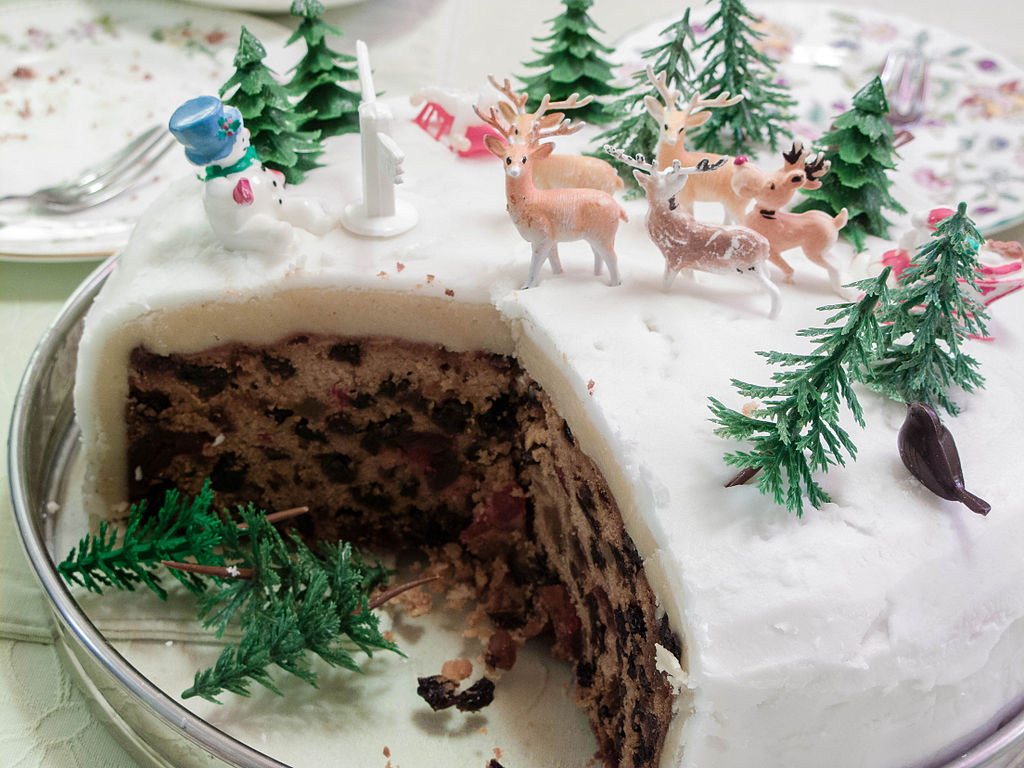
Christmas cake. Photo by James Petts, on Wikimedia.

Christmas cake. Photo by James Petts, on Wikimedia.

After that, you can start on the Christmas cake.

It may be called Boxing Day because it was the day that Victorian ladies and gentlemen gave gift boxes to tradespeople and the servants (who had to work on Christmas day, and probably had to work on Boxing Day as well). Or it may have come from a medieval tradition involving alms boxes, which were opened on Boxing Day and the money given to the poor. Basically no one’s sure, but if you repeat the stories often enough they take on a certain authority.

What’s certain is that it’s a second legal holiday that involves brussels sprouts. Only in Britain.

 *

I’ll be posting once a week until—probably—mid-January, when I’ll go back to twice a week. Enjoy the holidays, whatever you celebrate and however you celebrate them. 

Singing up the sun: A late report on an early solstice

The winter solstice celebration came to Cornwall early this year. No, the earth’s tilt hasn’t changed and the days hadn’t stopped growing shorter, but a group of people around here gather to sing up the sun on the summer and winter solstices and—well, the pub couldn’t handle that many breakfasts on the actual solstice, so having weighed the sun’s schedule against the pub’s schedule, the group met a day early. Or was that two days early? I’m the last person to trust on this kind of information, but what matters most in life, breakfast or accuracy?

Breakfast.

Stone circle at Minions

Stone circle at Minions

I’m not sure if I should say “they” or “we” as I write about this. I’ve joined the group twice now, but by definition it involves getting out of bed in the dark, so I’m a fringe member—always on the verge of rolling over and mumbling, “Next year.” So let’s go with “they.”

The place they meet is on the moor, where three ancient stone circles were built one right next to the other. Last year, a group of archeologists and volunteers uncovered an ancient pathway between two of the circles, then documented it and covered it back up, since that’s the best way to preserve it.

Not only is the place packed with ancient monuments and atmosphere, it’s also windy. The moors are like that. If there’s any wind at all, you’ll take a pounding. So it was cold and we didn’t stay out long, but we stood in the midst of the stone circles and sang, and the harmonies were beautiful. And in response, the sun did what it always does, which is to come up when it’s damn well ready. On this particular almost-solstice morning I’m sure it did come up but we couldn’t really tell. It was cloudy and anticlimactic and we walked to the pub and ate breakfast, but the harmonies really were beautiful and I’ll probably drag myself out of bed at silly o’clock when the summer solstice comes around.