The pandemic update from Britain: protective gear, black holes, and dead rats

Some days the government gives me so much to make fun of that it’s just embarrassing.

Not so many days ago that we’ve forgotten about it yet, the government announced with great fanfare and many imaginary trumpets that it was buying protective equipment from Turkey to make up for the shortfall it had created. 

Okay, they didn’t say it that way. It was something about the shortfall that mysteriously created itself in spite of our government working day and night to procure the best equipment that our heroic frontline staff needs.

Anyway, a shipment was on its way. Along with a few more notes from the trumpets. 

After mysterious delays, the shipment limped into the airport and turned out to be less than a tenth of what they fanfare’d. 

Now the story’s worse than that: The 400,000 surgical gowns that did arrive are unusable. Or possibly most of them are unusable. I’ve heard the story both ways from different news outlets, probably because the trumpets are interfering with reception.

Either way, the gowns would expose the users to infection.

Stop, people. It’s not Christmas. I have more than enough to work with. 

*

Irrelevant photo: A gerbera daisy.

Speaking of protective gear, Robert Jenrick, the housing, community, and local government secretary offered an explanation of why we’re having so much trouble getting protective gear where it’s needed: “Supply . . . in some areas is in short supply.”

Once you understand that, you can be more sympathetic.

Apologies for a messy link here. The quote’s in there, but you’ll have to dig around a bit.

*

Forgive me for recycling something I already put on Twitter, but our cat, Fast Eddie, brought dead rats home for two nights running, and he has me worried: If this keeps up, who’s going to run the country?

*

Now, about that tracing app that People Who Know These Things say may not work: Here’s the problem–or here’s the part of the problem I understand. The app relies on a kind of herd immunity. Not the kind that, if enough people die of Covid-19 and enough people get it but don’t die, will protect the people who did neither. This is virtual herd immunity. It relies on some minimum number of Android users in an area signing up for the app. If they don’t, it won’t work. 

The root of the problem is that Android phones aren’t allowed to stay connected to Bluetooth for long once they’re minimized. Basically, they hang up. Once that happens, the phone won’t register contact with an app on a nearby phone. So if one of the people carrying those phones is infected or needs to be told that the other person is? Even if when they passed each other they fell into each other’s arms and kissed with 46 minutes worth of passion, the apps on their phones would ignore each other. 

The only way to keep the app awake on an Android is for its owner to pass by a whole bunch of other Android owners who are all using the app. If that happens, their phones will chastely brush electronic feelers and the app will send the information to a central database.

Australia tried something similar in its app and now says the app “progressively deteriorated.”

The UK government is now “open” to the possibility of ditching the app and using a different one.

No, I don’t know how much that detours cost either.

*

Astronomers have found a black hole a thousand light years from Earth. That’s close if you’re an astronomer. It’s in (or “among,” and I haven’t figured out what the difference is in this context) the beautifully named HR 6819 system.

What’s that got to do with the pandemic? The black hole is where all the missed targets are being shipped. And the missing protective gear? It’s there too. That’s why supply has been in short supply in undersupplied locations.

A new shipment of bad news has been launched in its general direction but will probably miss by a few dozen light years.

*

I’m always a day or three behind the actual news here. It’s one of the many reasons I recommend reading actual newspapers. The real ones (as opposed to the bottom feeders) are better at this than I am. Even when they’re not funny.

Stay well, everyone. Even when it starts to feel delusional to hide from something invisible, remember that it’s real.

The pandemic news from Britain: tracing, testing, and goals no one expects to meet

Britain’s Prime Blusterer, Boris Johnson, set a new coronavirus testing goal: 200,000 tests a day by the end of May.

Did we meet our last testing goal? Well, no. We were supposed to be testing 100,000 people by the end of April and the government mythically met the goal for one day–the last day April had to offer–by counting tests that hadn’t been tested yet. After that, the numbers dropped down again.

But hey, They’re all all numbers. What’s your problem? When you’ve seen one number, you’ve seen ’em all.

Anyway, we now have a newer, cheerier, even more unreachable goal. And we’re happy.

*

Irrelevant photo, because we all need something cheery in our lives: This is an odd geranium that a friend gave us. It only flowers after three years. Then it kicks the bucket and you have to hope you save some seeds.

Starting on Monday, the lockdown will be eased slightly, allowing people to leave the house more often and for a wider range of activities as long as they keep their distance from other people, although if localized infection rates go up, the restrictions may be adapted for those areas. (The link for that is that same as the one above. We’re all about efficiency here.)

Adapting the restrictions to smaller ares makes sense (as Almost Iowa pointed out in comments he left on an earlier post) but it’s also likely to mean that richer areas, which allow for more space between people when they’re outside and where people are statistically less likely to be hit as hard by the virus, will have an easier lockdown than poor areas.

And by areas, of course, I mean people.

*

I’ve been hearing tales, from here in Cornwall, about people who book Covid-19 tests, show up, and then can’t get tested. One person got to her test to find out that the testing team had already gone home, presumably because they ran out of tests but who really knows?

Instead of doing what Hawley’s Small and Unscientific Survey says half the population would do, which is , “Fuck it,” she booked a second test. But they didn’t get the results back to her, so she followed up. they were backed up, They said. It might take as much as five days before they could test her sample.

After five days, I’m told, the sample has to be thrown away.

But it’s all privatized, so it’s all good. Because when private industry runs things, it’s more efficient.

*

Okay, sooner or later I’ve got to write about the contract-tracing app that’s being introduced. I’ve been avoiding it because I’m too damn old to be at ease in the virtual world. Here’s about as much I can follow:

The National Cyber Security Centre says it’s good, and it says it in as down-homey a way as it can, given that it’s British and I’ve never heard anyone British say “down home.” It’s got to be an Americanism. Someone British might say “homely,” meaning not ugly (which is what an American would mean) but homey, but they wouldn’t say it in this context. I only tossed it in because I thought we needed a break. Homely isn’t the same thing as down home.

I’m sorry, but I have to ask: Why do you read this stuff?

Now, back to our point: The app’s so good that it won’t drain your battery, steal your data, or invade your privacy. It won’t even make you flip the E and R if you write center instead of centre. But that’s because it can’t–nothing’s that powerful yet. I only spelled it that way because, hey, I figure it can spell its name any way it wants.

Do I believe them about the privacy thing?

Umm. I think I’m gonna have to hear it from someone else first, and some experts have raised concerns about it. They know all sorts of things about this that I don’t, so in my ignorance I lean in the direction of listening to them. Especially since one of the reassurances about privacy is that the app asks your permission before it can do various things, and we all know how well we read the fine print when an app asks our permission before it can do something.

The app is a centralized one, so all the information your phone collects goes through whoever’s running this beast–a private company, as it happens, so it will be handled efficiently.

But forget privacy. I’ve clicked okay on so many websites that I doubt I have a scrap of the stuff left. Or if you can’t forget it, set it aside for a minute. Both the Health Service Journal and Business Insider say it won’t work on newer phones and Androids.

Both Google and Apple have dedicated tracing apps that we’re not using.

Downloading it isn’t mandatory, which is a good thing since I have a dumb phone, which is no better with apps than I am.

*

At a virtual summit organized by the World Health Organization, a global alliance pledged $8 billion to develop vaccines and treatments for the virus and distribute them fairly.

The U.S. didn’t take part.

Why not? As the kids all said where I grew up, “Because.”

That was enough to explain pretty much anything.

*

Stay safe out there if you can. I’ve explained this before, but it’s worth repeating: I don’t have so many readers that I can afford to lose any.


The pandemic update from Britain: hope, hype, and a tiger running loose

At the risk of injecting a dangerous note of optimism into these updates, a new blood test looks promising. It might–emphasis on might–be able to pick up traces of Covid-19 a day after a person’s been infected. That would be several days before symptoms show up and most importantly (there may be a small question mark involved here) before a person’s contagious.

That’s four days sooner than any existing test can pick up the beast.

It’s been developed by Darpa–the U.S. military’s Defense Advanced Research Projects Agency–by the folks who usually work on diagnosing germ and chemical warfare poisoning. The test’s been rushed to the Food and Drug Administration for fast-track approval. If it is approved, it’s expected to be available in the U.S. in the second half of May.

Possibly. The fine print is that approval isn’t guaranteed. And they won’t know how early it can pick up an infection until the test gets approval and they can gather data. And I don’t know what the plan is about making it available elsewhere. But if it works and if it’s approved and if it’s widely enough available, it would mean pre-infectious people could be quarantined and the transmission chain could be broken. And I could finally do my own damn grocery shopping.

*

Irrelevant photo: A whatsit plant. We got it last year and whatever is it, it survived the winter.

Two other antibody tests are in the works, one from Roche and one from Quotient. The Roche test has gotten FDA approval. Quotient is in the U.K., so the FDA is irrelevant. It says its screening machines could process up to 36,000 tests per day and give results in 35 minutes with 99.8% accuracy. The snag? Both tests are lab-based. They can’t be done at home.

*

With a whole lot of fanfare, the British government announced that it had met it’s (completely arbitrary) goal of testing 100,000 people a day by the end of April. Some of those tests hadn’t been processed yet, mind you. And others hadn’t actually reached anyone. In fact, some were sent out without return envelopes. And only 7% of the 31,000 for care home staff and residents had been used by last weekend.

I mentioned that in an earlier update, but the details have gotten more absurd, so I thought it was worth repeating.

And you know, a number’s a number, so sound the trumpets, please, bandmaster.

When last sighted, the daily test number had dipped below 80,000.

*

One of the mysteries of Covid-19 is being called happy hypoxia: It involves patients whose blood oxygen levels are so low that they should be unconscious but they’re talking, checking their phones, and generally saying they’re comfortable. Which doesn’t make their blood oxygen levels less dangerous, only mystifying.

*

How are people coping with the pandemic? Some 300,000 people in Britain have quit smoking.  And online searches for puppies have gone up by 120%. The Dog’s Trust is begging people to think about how they’re going to deal with the dog when real life picks up again.

*

In a rare display of good sense and global cooperation, a global alliance is expected to pledge $8.2 billion for Covid-19 research and the equitable distribution of vaccines and treatments. Stay tuned. I’ll let you know more when and if I hear about it.

*

Can we talk about something else?

Police in Kent got a call about a big cat running loose, so they called up a helicopter and an armed response team and went looking for it. They found an 85-year-old sculptor and the life-size tiger that’s been in place for 20 years without scaring anyone until now.

One cop figured it was all because a of a recent Netflix series about big-cat ownership in the U.S..

In the interest of making fun of English place names, I should really mention the location. This happened near Underriver, in Ightham. According to all the laws of the language, Ightham should be either  unpronounceable or leave your tongue twisted back on itself and begging for rescue. How do they deal with that locally? They pronounce it Item.

And yes, English does have laws. It also breaks them anytime it the mood takes it.

And Underriver? How are we supposed to understand that? According to Wikipedia, which may or may not know what it’s talking about at any given moment, the name comes from old English and means under the hill.

That makes perfect sense.

If I really had to, I could also tell you how to report potholes in Underrriver. It’s very useful having me around.

The pandemic update from Britain: research, testing, and spitting your coffee

Britain hit its arbitrary goal of testing 100,000 people a day by the end of April, the government announced triumphantly. How’d they do it? By including 52,000 tests that hadn’t been analyzed yet. Or taken, for that matter. They’d been put in the mail. Presumably to real people, although I can’t vouch for that. I have a picture of some hapless intern sent to the corner mailbox and stuffing them in by the handful. After being told to address them to his or her entire third-grade class, thousands of times over. At the addresses they had then. 

Third grade? Sorry. It’s an Americanism. In Britain, it’d be year three, more or less. 

Without the intern’s work, the number was 73,191.

*

Irrelevant photo: rhododendron

The New Scientist article where I found the real test numbers (although for some reason it didn’t mention the intern) also tells me that the U.S. director of national intelligence announced that Covid-19 was not engineered in a Chinese lab, or in any other lab. It’s a natural occurrence. 

Sorry, Don. 

It also mentions that the English and Welsh coronavirus death rate for people from black African backgrounds is 3.5 times higher than for it is white people in England and Wales. Other ethnic minorities are also getting hit harder than whites. 

I don’t have statistics for the U.S., but I do know it’s hitting black people much harder than whites. Which makes the scenes of armed white guys demanding to end state lockdowns particularly chilling.

*

Since we’re messing around on the New Scientist website, let me quote another article: Just four coronaviruses (virii?) are responsible for 20% to 30% of our colds, and they may once have been deadly, toning down as time went on until now they’re no more than a damned nuisance. 

Researchers now believe that all four of these viruses began to infect humans in the past few centuries and, when they did, they probably sparked pandemics.”

A careless person could almost get hopeful, reading that. Waiting this one out, though, is not a workable strategy. All those people who want to wait for herd immunity? They think they’re not part of the herd. They are.

The New Scientist is a good website and very much worth a trip. Especially since a lot of us can’t go anyplace real these days. 

*

Just to prove that it’s useful, and to lead us all quietly away from that dangerous spark of  hope, I’ll draw on one more article from it: It’ll be a long time before we have a vaccine, it says. If, in fact, it turns out to be possible to develop one for this bug. 

The average experimental vaccine has a 6% chance of being safe and effective enough to make it to the market. Of the vaccines that get as far as trials, about 33% make it to the market.

So let’s assume one of the vaccines being frantically worked on in labs around the world works. It’ll take twelve to eighteen months to manufacture enough doses for it to be widely available, and that would be a remarkable speed. The fastest vaccine ever made to date was for Ebola, and that took five years.

To make a vaccine available faster–. Well, basically, you have to start step two before step one is complete, and maybe step three as well. So if the drug fails somewhere along the way, a lot of money gets lost–and time with it. 

Speed also raises worries about safety. There’ll be less time to study the vaccine’s long-term effects, so problems can be missed. And, let’s face it, when an awful lot of money has been committed, people will be under pressure not to quibble about minor problems that might turn out to be major.

Because we all know how all existing political systems welcome whistle blowers. 

*

Some scientists (and in the U.S. at least, some lawmakers, in a rare moment of bipartisanship) and pushing to test vaccines by deliberately exposing a test group to the virus instead of letting nature take its course and seeing how many people get sick. It could shave months off the trial. It could also kill people or leave them with long-term complications.

If you’re spitting your coffee across the room right about now, I have the impression that the idea made immunologist Matthew Memoli from the U.S. National Institute of Allergy and Infectious Diseases do the same thing, although what he actually said is fairly mild: “Where you’re going to give somebody a virus on purpose, you really want to understand the disease so that you know that what you’re doing is a reasonable risk.”

*

The crews from cruise ships–some 100,000 of them–have been left stranded on the ships after their passengers were repatriated. The crew are shut out of ports and banned from air travel home, leaving them stranded. Covid-19 is rife on some of the ships. 

A couple of class action suits have been filed. On some ships, crews report being treated well while on others food it running out and many people aren’t being paid. 

*

An article in the Guardian’s worth your time if you’re trying to wrap your brain around how this virus works. I’ll pick some pieces out of it, but there’s a lot more. It’s accessible and it’s informative.

One subset of patients are showing brain inflammation, agitation, and personality or behavioral changes. Another–including some young ones–are getting strokes. Some patients have low oxygen levels in their blood but aren’t showing much lung damage. If they were suffering from altitude sickness, it would make sense, but they’re not. One doctor’s hunch is that it must have to do with the blood vessels, but the research hasn’t been done yet. 

Another doctor’s hunch is that the virus affects men more than women because it’s activated by androgens. But again, that’s a hunch. 

*

While we’re talking about subsets, a subset of scientists are trying to figure out how this beast spreads. Ending lockdown without understand that is–

Um. It’s hard to find the right word. Dumb? Dangerous? Dicing with disaster?

No, that last one’s three words. 

Anyway, let’s settle for “a problem” and move on.

So various groups of sciencey minds are coming at this from different angles. One is figuring out how virus-laden aerosols (those are–at the risk of, ahem, oversimplifying and distorting just the slightest bit–the tiniest of spit particles, being ridden like race horses by virus jockeys) behave in air. Another gropu is trying to work out if the aerosols carry enough of the virus to be infectious or if infection can only happen with larger droplets–the kind that go flying on the winds of a cough or a sneeze. They can carry larger doses of the virus (someone’s already told you that more isn’t always better, right?) but don’t travel as far as the aerosols. This involves a high-containment lab where they can spray the things around, varying the temperature, humidity, ozone, and sunlight levels. 

Some people get to have all the fun.

Other groups are studying the pathways the virus follows to pass from patients to health and care workers and then to new patients. Half of all new cases in Britain a couple of weeks ago (sorry–I’m always limping behind events here) were among healthcare workers. 

A lot of modeling has been done on the disease’s spread, but so far it’s all based on assumptions about how it spreads. This is research that could fill in that gap.

In the meantime, I am really tired of washing my hands. I just thought you might want to know that. 

*

In the meantime, 77% of Britons want the lockdown to continue and 15% want to see it end.

What happened about the others? They’re watching Coronation Street and won’t notice the lockdown until they run out of new episodes in June.

The pandemic update from Britain: testing, protective gear, and condom sales

Britain’s still in lockdown, but the government–after a good bit of pushing–has announced that it’s preparing an exit strategy.

That’s not pushing from people who want the freedom to infect their neighbors and loved ones but from people who accept that lockdown’s necessary but want to end it in some way that doesn’t undo the progress. Along, predictably, with pushing from business people who get to sleep at night by counting money disappearing over the fence instead of sheep.  

Stay tuned. We’re told we’ve passed the peak of the epidemic. Stay tuned on that too. I hope it’s true.

Testing & Protective Gear

Britain’s been frantically trying to test more people because the government set an arbitrary goal for itself and doesn’t want to look like the kind of government that can’t meet its own arbitrary goals. Also (and I can’t help thinking it’s their secondary concern, but then I’m getting more cynical by the minute) because testing’s necessary if we’re ever going to get the virus under control. 

Irrelevant photo: begonia

The government is managing to perform more tests. It may even meet its goal. But the testing’s a shambles. To get a test, people are having to drive all over hell and gone and wait in a long line of cars only for some of them to be told that the tests have run out and then (by the computer) that they can’t rebook because they were just tested. (Yes, that seems to have happened to at least one someone.)

A statement from NHS Providers, the organization of National Health Service hospitals, says, “NHS trust leaders…feel they are on the end of a series of frequent tactical announcements extending the testing criteria to new groups with no visibility on any longer term strategy, and are being expected at the drop of a hat to accommodate these changes with no advance notice of planning.”

*

Britain had a chance to buy 50,000 home testing kits from a company in the U.S. but wrote back to say, “Ho, hum, boring boring boring. Not interested.”

The test is less invasive than and at least as accurate as what it’s using now, and it allows people to test themselves at home instead of booking an appointment, driving, waiting, being told they’ve run out of test kits, and all the rest of that joy. And all that sounds good, but the home testing kits didn’t come with a side of fries, so why bother?

And as long as the right number of tests get performed–or at least logged–it’s all good.

*

British coroners have been told not to look at systemic failures to provide protective gear when they consider deaths among NHS workers. They can consider human failure, though. So basically, they can blame the individual but not the system. 

And they wonder why people break windows.

*

Britain isn’t the only country struggling to get protective gear to frontline staff. German doctors have posed naked to draw attention to how vulnerable the lack of protective equipment has left them.  

But Britain is probably the only country that, in order to boost the amount of protective equipment it can boast about providing, counts each glove separately instead of counting them in pairs. It also counted body bags, paper towels, and cleaning equipment as protective gear.

*

A British textile factory belonging to the department store chain John Lewis has at long last been contracted to make 8,000 clinical gowns, but other textile firms say they’re desperate to help and can’t get the government to respond.

See breaking windows, above.

Other Triumphs in the Supply Chain

A batch of 250 ventilators that were bought from China on April 4 have turned out to be unusable and possibly dangerous. They supplied a variable level of oxygen and the oxygen connection base was marked “non-EU.” Technical staff spent days trying to make them work and couldn’t.

They also had a fabric case that made them hard to clean and were designed for ambulances, not hospitals.

Other than that, they were great, though.

They cost somewhere between £1,000 and £2,500 each. I’m not sure why there’s a range of prices but if you’re in the market for a few hundred, you’ll want to hold out for the lower price.

Light Relief and Good News

Three London roommates missed their commute so much that they recreated it in their shower and posted it on TikTok. 

Yeah, go on, follow the link. 

*

Captain Tom Moore, the 99-year-old (now 100-year-old) who raised £33 million for the NHS by walking laps around his garden, supported by his walker, received 125,000 birthday cards. By now it’s probably more. The post office was overwhelmed and his grandson’s school offered to open and display them. 

They found £60,000 inside the cards.

*

This probably won’t surprise you, but condom sales are down since the lockdown started. 

‘Nuff said. 

Drug Dealing

Not long ago (time’s adrift in lockdown, or at least I am, so let’s keep it vague) I wrote that a test of remdesivir had been abandoned because it wasn’t helping and the side effects (liver and kidney problems) were too damaging. But the preliminary results of a different test show more promise: It cut recovery time from 15 days to 11 and the death rate in the group on remdesivir was 8% compared with 11.6% in the control group.

The full data from the trial hasn’t been released and it’s not a knockout blow in any case, so I wouldn’t set off any fireworks yet, but the drug hasn’t been ruled out.

More Light Relief and Good News

A 7-year-old, dressed as a tricertops, has been riding his toy tractor to deliver food to neighbors. Who could fail to be nourished?

I’d love to give you a link for that but you’ll just have to take my word and say “Awww,” because he looked very cute. It was on the evening news and all Lord Google wanted to talk about when I looked for a picture of the kid was a 65-million-year-old triceratops skull that was found somewhere or other and isn’t going to deliver lunch to anyone. 

*

A couple of companies have come together to refurbish bikes that have been abandoned at train stations so they can be donated to key workers. 

No, I don’t know why anyone would abandon a bike at a train station, but some 20 are left behind every month. And they’re lonely. So this is good news for everyone. 

Religion and the Coronavirus

Germany’s government and religious groups are trying to work out safety guidelines for religious services as the lockdown there eases, and one sticking point is how to handle singing, which is not only an important part of many services but a great way to spread the virus. You know all that business about projecting your voice? When you do it, you also project tiny droplets of spit, and riding on them, if you happen to be harboring the virus, are even tinier little viral warriors, looking for new humans to assault, all of them yelling some viral version of “Yee ha!” but they’re so small that you can’t hear them.

I don’t think any controlled studies of this have been done yet, but I can offer you an impressive bit of anecdotal evidence from one Protestant cathedral in Berlin: 59 out of 78 choir members became infected.

*

Many evangelical churches in the U.S. have pushed their members to keep on showing up to services, and they’re logging–this may not surprise you–a high incidence of coronavirus. And hinting that there might be some sort of cosmic justice, that includes their ministers. 

The All-Important R Number

Germany, having slowed the spread of the virus, is warning about the danger of a second wave in the summer or fall. It all has to do with the R number.

You know: the R number. 

Okay, I didn’t know the R number either. It sounds like one of those things from algebra class that helped make high school such a misery, but it’s not. Or if it is, I’m damned if I’ll admit it.

The R number measures how many people an infected person passes the bug on to–in other words, the reproduction rate of the virus. Without controls, an infected person passes it on to two or three people. The German R number is now below one. That means it’s spreading, but slowly. 

If it stays below one, the theory goes, the virus will eventually fizzle out. Anything above one and it will grow exponentially: I give it to, let’s say, one and a quarter people (c’mon–we’re dealing with averages here), they all give it to one and quarter people, and those people all and so forth, and before you know what’s hit you, a lot of people are sick.

German researchers recommend using this time while the spread has been slowed down to massively expand testing capacities and contact tracing.

A German coronavirus expert writes that “to achieve herd immunity we need 60-70% of the population to carry antibodies to the virus. The results of antibody tests suggest that in Europe and the U.S. in general, we are in the low single digits, but the tests are not reliable.” 

A second wave of infections, he says, can’t be contained only by humans handling the contact tracing. Electronic contract tracing will be needed.

*

The British R number right about now is estimated to be somewhere between 0.6 and 0.9. Keep your eye on that word estimated.

*

A study from Imperial College London and Ipsos Mori will follow 100,000 people to see if transmission rates are low enough to come out of lockdown safely. The participants will be given home test kits to see if they’re currently infected, then tested again in four to six weeks, or when it loooks like lockdown restrictions are ready to be relaxed. 

The International Grab Bag

As of April 28, Hong Kong had had just four Covid-19 deaths and 811 recoveries.

Worldwide, there had been 220,000 known deaths and 957,000 recoveries. When you look at those numbers, though, remember that not all coronavirus deaths are officially attributed to the virus. In Britain, for example people who died of Covid-19 in care homes are only now being added to the list of pandemic deaths. It’s a small victory for sanity and reliable statistics, although I’m not sure how much practical difference it makes. I’ve been trying to find out if deaths in the community are being counted and I’m still not sure. 

That still leaves the problem of deciding who’s a coronavirus death when testing isn’t available. To a large extent, it’s up the doctor who signs the death certificate, which could easily lead to undercounting.

*

In the U.S., the number of known coronavirus deaths is now larger than the total number of American soldiers who died in the Vietnam War. If you feel the need for a statistic, 58,220 died in the war

*

Brazil’s response to the virus has been in a category of its own. It’s had 50,000 deaths. When reporters asked its president, Jair Bolsonaro, about the death rate having reached 474 in a day, he said, “So what? I’m sorry. What do you want me to do about it? I’m a Messiah, but I don’t do a miracle

Only he said it in Portuguese, so you’ll find varying translations.

*

Meanwhile, China is trying to contain a new outbreak in a northeastern province, Heilongjiang. 

Money and the Virus

The British government, in its wisdom, has rejected a call to bar companies that use offshore tax havens from receiving bailouts and support packages resulting from the pandemic. 

It was a silly idea anyway. I mean, just because they avoid taxes, why should that keep them from getting taxpayer support?

***

I’ve gone on longer than I meant to, even after booting out a lot of news. I’m going to try posting shorter updates more often and see how that works. In the meantime, stay well. It’s crazy out there. 

The pandemic update from Britain: visors, volunteers, and outsourcing

The ongoing saga of why the British government can’t provide protective equipment for health and care workers just keeps getting stranger. The government’s said all along that the problem is about distribution, not supply. Did anyone believe them? Why would we? Truth’s a scarce commodity lately. It turns out, though, that in a strange way they were telling the truth. 

It all starts with the outsourcing of the British stockpile of  emergency equipment. 

Outsourcing? That’s when the government pays the lowest bidder to do work it used to do itself because, um, it’ll be more efficient that way. And cheaper. And even if it turns out to be neither of those things, by the time that happens no one’s watching anymore and it fits with the political orthodoxy of the moment so it’s all good. That means we have private companies deciding who’s eligible for government benefits, a company with no ships got a contract for post-Brexit shipping, and a private company is managing the nation’s stock of essential emergency equipment. 

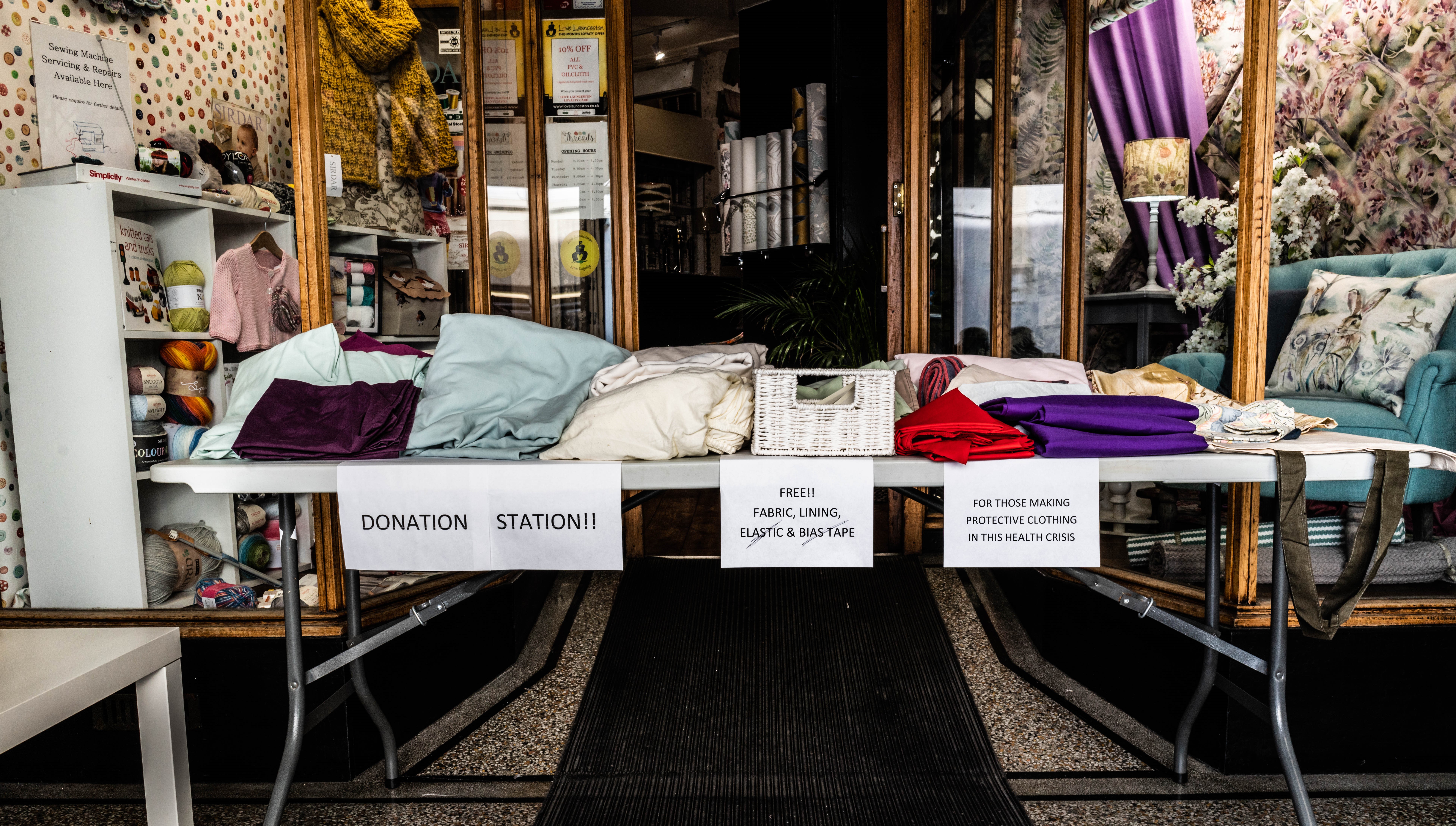
A store in Launceston, Cornwall, has set out a table offering free fabric to anyone making protective gear. Someone in our village is sewing masks to sell at the local shop as a fundraiser for the Air Ambulance.  She ran out of elastic yesterday and offered a free mask to anyone who’d give her some. I think she ignored the woman who offered to cut up her underwear.

Which brings us back to our tale:

In three years, that stockpile’s been in three different warehouses. The company in charge of it has just been sold. There’s also a lawsuit involved, along with a landlord who’s threatening to lock the warehouse gates, with the stockpile on the inside and the need for it on the outside. The cars of warehouse workers were searched one day as they left work and I wish I knew the story behind that but I don’t.

Health Secretary Matt Hancock swears the government’s rising to the challenge and–um, something, but don’t worry about it, it’s all going to be fine. 

The Department of Health and Social Care explained why it would all be fine even if it wasn’t yet by saying, “We’ve had to create a whole new logistics network, essentially from scratch.”

That was on April 12. So far they’ve invented the wheel part of the logistics network. Any day now, they’ll work out how to get the wheel on a truck. Then they’ll drive that much-needed equipment where it’s needed.

As soon as they locate a map. And invent a driver. They’re working on the DNA even as I type.

*

While that was going on, the government made a deal to buy protective gear from a company in Turkey. Planes were sent. Or one was sent and others were on standby The press was called: Look! Protective gear! Eighty-three tones of it! Aren’t we clever? See how we take care of our frontline health workers? It’ll be here on Sunday.

Then the aforesaid Sunday came and the gear didn’t. 

Either someone hadn’t gotten export approvals in Turkey (which the people in charge of that deny) or something else had gone wrong. One theory is that the company that was supposed to supply it overpromised.

On the 22nd–that was the Wednesday after the Sunday in question–a planeload arrived. According to one guess, it carried ten percent of the order.

*


I still haven’t seen an explanation of why the protective gear can’t be made domestically. In 2010 (the most recent year I can find statistics for) £1.5 billion worth of clothing and accessories were made in the U.K. I can’t break out the accessories from that to give you a number for clothing alone, but basically a lot of cloth is involved in this, with all the machinery and skills that involves. And then there are all those people sitting home with pinking shears and sewing machines, pitching in locally, or ready to. They can’t make ventilators, but scrubs? For anyone who can sew, scrubs are easy.

Could local efforts be scaled up with government support? You bet your dining room curtains they could.

Surgical gowns need to be “made from either impermeable material or a water-resistant, tightly woven fabric,” so we can’t all cut up our old sheets and make them, but if the garment industry and the people at home who sew are provided with the fabric, it could be done. They may not turn out everything that’s needed, but right now anything would help. 

*

Semi-relevant comment: “People at home who sew” is an awkward thing to call anyone, but if you’re at all at ease with English you’ll understand why sewers doesn’t work. Seamstresses is gender-specific and so not necessarily accurate. In a tweet, the linguist Lynne Murphy (@lynneguist) mentioned the word sewists, which turns out to be something some people actually call themselves, but I don’t think I can manage it so I’ll just leave a gap in the language and fill it with awkward phrases.

*

With that out of the way, let’s check in on a few volunteer efforts. In Somerset, 700 people are making scrubs and wash bags. They’ve set up a warehouse in a driving school and driving school staff do the deliveries. Local people are donating the fabric. That translates to, Keep an eye on those curtains if they matter to you at all.

In Bedfordshire, a design and technology teacher and a group of volunteers are making visors, with a group called Discover Islam providing funding for the materials and bringing lunch. So far, they’ve made 7,500.

In Kent, a school has been working with the fire brigade, making 20,000 visors. And two brothers in Wrexham, who are eleven and thirteen, started using a 3D printer they got for Christmas to make protective visors for people working in care homes. That sparked thirty volunteers to start working at a school, using donated and crowdfunded printers. They can make two hundred visors a day and hope to shift to an injection-molding process that will turn out eight thousand a day.

One injection-molding machine was donated by a company, Toolmakers Ltd., and the other was donated by the North Wales Freemasons. Who, I’m sure, had one sitting around in the basement, waiting to come out of mothballs.

The brothers are still turning out visors on their home printer.

*

As for the protective gear available in hospitals, it isn’t designed to fit women. On one unit, half the women failed the fit test, meaning they can’t work with the most infectious cases without putting their lives at risk. The only men who fail the fit test are either very small or refuse to shave their beards.

Since eight out of ten (or three out of four, depending on your source, and possibly on how you define your sample and whether you round the numbers up or down)–

Let’s start that again: Since most of the people working in healthcare are women, it only makes sense that the equipment is designed for men.

The problem was raised as long ago as 2016. The people in charge stuffed their fingers in their ears and sang, “Don’t Worry. Be Happy.”

We are all very, very happy.

*

Poison control centers in the US report an increased number of calls from people asking about disinfectants–presumably whether to drink them, inject them, or do both at once while gargling bleach and juggling fire. 

A Fox News article reports that the New York Poison Control center saw thirty cases of exposure to bleach and other cleaners in eighteen hours after Trump suggested that they might cure coronavirus. In a similar period last year, they saw thirteen cases.

Trump is now claiming that when he recommended disinfectants he was being sarcastic, and I recently saw a tweet saying that only a liberal would be stupid enough to drink bleach and liberals are the reasons that products have safety warnings.

My friends, satire is dead. 

*

In Italy, even a Covid-19-impaired sense of smell can catch whiffs of lawsuits related to pandemic deaths. Prosecutors are looking at heavy clusters of deaths to see whether people in authority are responsible. Lawyers are advertising to the bereaved. 

One group of people took to Facebook, first just to bear witness to their losses, but the group quickly turned to gathering evidence for a lawsuit–not against healthcare workers but against “those in leadership positions.” 

“We do not want financial compensation,” Luca Fusco, who started the Facebook group, said. “Our main objective is to have justice from a criminal perspective, so if someone is responsible, we want them to be charged and brought to trial.”

While we’re talking about lawsuits, the state of Missouri has filed a lawsuit against China for economic damages caused by the virus–presumably because China screwed up and the U.S. has handled it so effectively. And an Italian ski resort is suing China’s health ministry.

When all else fails, sue someone. Once upon a time, in a very different world that we all used to live in, I’d have said, “Suing someone? It’s the American way,” but I don’t think I get to make that joke anymore.

*

A drug that looked promising as a treatment for Covid-19, Remdesivir, has failed a double blind test and the trial was stopped early because of the side effects. It was used in China in uncontrolled–for which read, desperate–trials and seemed to help. The drug’s manufacturer says it may be useful in patients who are not as ill as those in the trial. 

I think I hear a hint of desperation in that, caused the sight of money disappearing out the window, but I’m ready to admit (a) that I’m getting more cynical every day and (b) that they could well know something real about this.

Remdesivir was originally developed to treat Ebola.

*

Speaking of privatization–which we’re not anymore, but we were not long ago–a privately run coronavirus test center has managed not to send any test results to some people and to send the wrong test results to other people. 

It’s a drive-through center in–I don’t make this stuff up–Chessington World of Adventures. It’s being run by Boots (a drug store chain, or in British, a pharmacy chain), Serco (an outsourcing company), and Deloitte (which is basically an auditing company and I have no idea why they’re photo-bombing the operation).

They’ve all covered themselves with glory. 

A government lab doing diagnostic tests isn’t doing great work either. Because the country has had trouble getting reagents and assorted chemicals (unnamed, mercifully, otherwise I’d have to spell them), they’ve had to rely on substandard ones and may have missed some infections.

And the government turns out to have ignored offers from leading scientific institutions to help with testing. Along with a businessman’s offer to produce 450 visors a day, which sounds like it’s one of many.

The Cabinet Office said it’s “incredibly grateful for over 8,000 offers of support from suppliers as part of the national effort to ensure appropriate PPE is reaching the front line.

“We are working rapidly to get through these offers, ensuring they meet the safety and quality standards that our NHS and social care workers need, and prioritising offers of larger volumes.”

It has, it says, engaged with over 1,000 companies and is working with 159 potential UK manufacturers.

So that’s going well.

*

A few weeks ago, I mentioned that the government bought some 3.5 million antibody test kits, which were supposed to test whether people have been exposed to Covid-19 and might therefore be immune. If, of course, having had the virus turns out to confer immunity, which no one’s sure of yet.

The best of the tests are only seventy percent accurate. The worst? They’re fifty percent accurate. Given that only two answers are possible, yes and no, that means you could do as well by flipping a coin. 

Sorry, I tried to come up with a better image but couldn’t get a 50/50 chance out of throwing socks at the washing machine or letting the dogs loose in the back yard.

The government’s trying to get its money back. And I’m trying to get back my lost youth.

Not my lost innocence. Innocence is overrated. Or mine was, anyway.

*

South Korea is being looked as a country that might show us how to get out of this mess. It brought the rate of infection down from some 900 daily to dozens and then into the single digits, all without going into lockdown. How? By testing. It set up hundreds of free testing centers–drive through, walk through, mobile. (Not in a World of Adventures park as far as I know. They may not understand what an adventure we’re all having over here.) Then it traced the contacts of people who tested positive and alerted them. 

To avoid pointing a finger at infectious people, they’ve anonymized the alerts. 

Although they didn’t institute a lockdown, they did convince people to distance themselves and urged companies to allow employees to work from home, and they placed some restrictions on public places, schools, and religious services. 

They’re worried about a second wave when those are relaxed, so we can’t say they’ve solved the problem yet. 

*

What are all the lockdowns going to do to the world’s economies? The short answer is that we’re going to be in deep shit. Different types and amounts of shit in different countries, of course, but nobody’s likely to come out of this smelling good.. The International Monetary Fund says the world’s facing the worst depression since the Great Depression of the 1930s. Some experts are predicting famines in the poorest countries

I know. You come here to have a good laugh. Don’t I just know how to have fun?

*

We need one feel-good story. A former paratrooper who was walking the entire British coast, with his dog, to raise money for an armed forces charity was offered refuge on an uninhabited Shetland island for the duration of the lockdown. He was given the key to a former shepherd’s hut–no electricity, no running water–and coal, water, and food are dropped off every couple of weeks, weather allowing. In between, He forages, fishes, collects driftwood, and keeps a three-week supply of dog food on hand.

He had been homeless after he left the forces, struggling with anxiety and depression, and started his walk with £10 in his pocket when he faced homelessness a second time, starting out .

Since he’s been on the island, he said, “I’m the happiest I’ve ever been.”

The pandemic news from Britain: no guns and no protests, but not much protective gear

Britain’s pandemic lockdown has been extended, and no one’s out waving guns and flags and demanding the right to exchange germs on the open market. Instead, the lockdown’s widely supported, although I’ve seen reports that a few people, mostly young and assuming themselves to be immune, have used coughing and spitting as a way to attack  health workers, police, and random civilians. Or pretend to attack them, since I believe their claims that they’re infected as much as I believe their claim to have brains.

My best guess is that this isn’t widespread, but it has a huge resonance. It’s now illegal, but only if you catch them.

Why is the lockdown accepted better here than in the U.S.? For one thing, although British politics are crazy, they’re not as crazy as American politics, and it’s a different breed of craziness. The underlying assumption that the pandemic has brought out is that we’re all connected and everyone is in it together. 

If you pay attention, you’ll notice that some people are in it a whole lot deeper, but that’s not–yet–the dominant note of the national conversation. It’s mostly just cranks like me pointing it out.

It helps that there have been some efforts to support people who are out of work. People who’ve been furloughed from their jobs are promised 80 percent of their pay up to £2,500 per month. None of that money–as I understand it–has reached people yet, but it is in the works.

Some people will fall through the cracks, though: They were hired too late; they weren’t furloughed from their jobs but canned. The system’s chaotic and patchy, but it’s better than leaving everyone to rob stores or understand why they should’ve been donating to food banks back when they could’ve afforded to.

If you’re self-isolating because of the virus, you’re eligible for sick pay.

For the self-employed, everything’s messier, and self-employment is something any number of people were pushed into rather than chose. Delivery companies in particular are known for using the mythically self-employed, although the conditions they work under don’t read like a description of self-employment–or of a decent job.

A mortgage holiday’s been announced. Renters, though–. 

Yeah. Renters don’t get a break. One group of tenants wrote their landlord to ask for reduced rent and were told that they were saving so much on the lunches they weren’t buying and the holidays there weren’t going on that they didn’t need a break. They hadn’t lost a penny.

Which came as a surprise to the tenants, who had a whole ‘nothing impression of their financial situation, but what do they know?

Some tax breaks have been announced.

Businesses have been promised loans, although they’re being channeled through banks and only a small percentage of them have been approved. And, of course, they’re loans. They’ll have to be paid back. 

Richard Branson, the UK’s seventh richest person (£4.7 billion at last call), has promised to mortgage his private island to help get his Virgin Group through the pandemic. He’s also, incidentally, trying to get a £500 million government loan.

Denmark and Poland have refused  to bail out companies registered in offshore tax havens. They’re not in Britain, I know, but it strikes me as worth mentioning anyway. And while we’re crossing borders–or things that soon will be borders–the European Union has banned executive bonuses, dividends, and share buybacks for any company that gets state aid to get through this mess. 

I’d love to do a decent roundup of what support’s promised to who, what’s actually been received, who’s been left out, and how well or badly it’s working, but I haven’t been able to find my way through the maze. What I do know is that some people are getting help and some people aren’t. And most of the ones who aren’t getting help don’t have £4.7 billion under the mattress. Or a private island to mortgage.

Almost a quarter of all British families have taken a financial hit. More than a fifth are struggling to pay their bills. Prices on basic food, toilet paper, and sanitary goods are up 4.4 percent. Or more. Or possibly less. The picture’s changing too fast for the numbers to be accurate for more than three minutes at a time. And I’d love to give you a link for that but the article’s behind a paywall. 

Some of the homeless have been housed, but if you’re both homeless and a migrant, and if the migrant category you fall into doesn’t allow you to have recourse to public funds, you’re shit out of luck: No one’s going to pay the local government to house you, and so local governments aren’t going to house you. 

Some thirty homeless people–both native-born and refugees–are sleeping in Heathrow Airport. One said the airport staff have been kind to them. 

The government’s announced a program to get laptops or tablets to some of the most disadvantaged students while schools are closed, along with broadband, so they don’t fall behind in school. I don’t know when that’s supposed to happen, but I know two kids who don’t have them. 

*

Lots of official programs are bringing together volunteers and people who need help, and so are a lot of unofficial ones. All of them remind us that without each other we’re all lost.

I’m the reluctant recipient of some of that help. I’m 73. Ida–my partner–is 80. It’s a mystery how we got that old. We didn’t start out that way. We stay out of supermarkets–it’s just too hard to control the exposure–although the smaller local stores are manageable. Younger neighbors have picked things up for us when they shop. It wasn’t easy to accept at first, and then somehow it was. 

I’m grateful–and I really, really want to do my own shopping. 

*

Crime’s down in several predictable categories. With so many people stuck at home, houses aren’t getting broken into much. With so few people out in public, muggings are down, along with all the other crimes that concentrate in busy public spaces. 

Football hooliganism? That’s out, since there’s no football. 

What’s football hooliganism? As far as I can figure out, it’s a particularly British thing involving disorderly and sometimes violent behavior at football matches. For some people, getting into a fight seems to be the point of the game.

I wanted to include categories of crime that have gone up, but the Department of Silver Linings vetoed it. Sorry. Everything’s great. Don’t worry.

*

Worldwide, a quarter of a billion people face starvation unless the world gets its act together and sends food. 

*

In Launceston, Cornwall, a fabric shop set a table outside the door, with a sign telling people to help themselves if they’re making protective equipment.

See? I told you everything was okay.

*

Medical people and social workers still can’t get protective gear, and the government’s still saying it’s on the way. The government’s only been in touch with 1,000 out of the 8,000 relevant manufacturers in the country and is working with just 159. Many say they’ve offered to provide certified equipment quickly and have been ignored. It’s being sold abroad. What else are they supposed to do with it?

*

Half of all care workers make less than the living wage. I haven’t found any statistics on what all the delivery drivers and food and farm and store workers are paid. They used to be called low-skilled. Now suddenly they’re being described as essential. 

*

Something in the neighborhood of 700 fake sites are sucking in people who want to set up subscriptions to Netflix and Disney Plus.

*

Folding@home is using donated time on home computers to figure out the workings of the Covid-19 virus and identify drugs that could attack it. Combined, the computers are six times more powerful than the fastest supercomputer. They can perform 1 followed by 18 zeros operations per second. That’s called an exaflop–a quintillion floating operations per second.

Don’t say you didn’t learn anything here. And don’t ask me what a floating operation is. 

*

A flower farm in Somerset is donating its flowers for funerals, key workers, a nearby hospital, and a nursing home. The flowers “keep on growing,” the farm’s managing director said. They don’t know “we’re in lockdown.” 

*

Parliament will meet semi-virtually: 120 MPs will use a video link and no more than 50 will be physically present.

No more than 50 are physically present most of the time anyway. A fair number of debates take place in a nearly empty chamber, with MPs rushing in to vote when bells ring. They’re like Pavlov’s dogs, looking for food to appear in their troughs. But the new system will keep them out of the hallways and lobbies as well as the chamber.

That chamber business makes it sound like you wandered into a movie you won’t want to tell your friends about, doesn’t it?

The problem with the videolink is that MPs who are low on the food chain used to count on buttonholing more important people in the lobbies and corridors. That’ll be hard to recreate. And the time-honored bizarrity of bobbing–alternately standing up and sitting down to get the Speaker’s attention–won’t be possible. Neither will the noisy heckling that MPs indulge in. 

That could only be an improvement.

*

In Muthill, in Perth and Kinross, two women have turned a retired red phone box into a food bank, inviting people to take what they need. The stock ranges from canned goods to chocolate, from fresh fruit and vegetables to jigsaw puzzles–which I admit aren’t edible but can keep you sane in crazy times.

It’s on a give what you can, take what you need basis. 

*

A couple in Westhoughton, in Greater Manchester, have taken to running through town in what the British call fancy dress–in other words, in costume–to keep people amused. Click the link to see them dressed as a dinosaur and a cavewoman. 

*

In New Zealand (which is not in Britain but don’t worry about it), rats are enjoying the lockdown. Pest control was categorized as non-essential–a particularly problematic decision in a country whose ecosystem didn’t evolve in the presence of rats. They threaten any number of native species. 

If there’s a positive side to the story, it’s that people who’d normally be out hunting deer are now hunting local rats. 

The deer have asked me to pass on their thanks.

*

New Zealand went into lockdown earlier than most countries and has had only 13 deaths and not many more than 1,000 confirmed cases. Its prime minister, Jacinda Ardern, took a 20% pay cut in solidarity with the country’s workforce.  

So when comic Laura Daniel was in a TV competition and had to make an iconic New Zealand cake, she baked a tribute to Ardern by creating her face in cake. It was so bad that it went viral and Ardern took the time to send her a couple of emojis. I’m not sure what emo- the -jis are supposed to represent, but hey, who cares? The prime minister she admires texted her.

What did Daniel learn from the experience? “Don’t bake your heroes.” 

I’d add that, if you’re going to lose a competition, lose spectacularly. She’d never have gotten as much publicity if she’d won.

*

A British citizen repatriated from New Zealand last week reported landing in Heathrow and finding no health checks and no Covid-19 testing. 

“All arrivals in New Zealand are quarantined in hotels for 14 days at the government’s expense,” he wrote.

Which might be vaguely related to how few cases the country has.

*

The Taneytown, MD, the police department posted the following on Facebook: “Please remember to put pants on before leaving the house to check your mailbox. You know who you are. This is your final warning.”


And just so speakers of British and British-influenced English are clear on this: In American, pants are trousers, not underwear.

My thanks to cat9984 for letting me know about this important story. 

*

Back in Britain, people may be buying–or trying to buy–more flour, yeast, and toilet paper than usual (not, we hope, all for the same recipe), but they’re buying less makeup.

Is anyone surprised?

They’re also buying more alcohol but less toothpaste and fewer toothbrushes. The kindest explanation for that business with the toothbrushes and toothpaste is that people stockpiled earlier. The other possibility is that everyone’s keeping six feet away anyhow.

*

At least 100 health and care workers in Britain have died of coronavirus.

*

The Medical Defense Union has called for emergency legislation to protect medical practitioners and the National Health Service against negligence claims during the pandemic. Many doctors are being asked to work outside of their areas of expertise. Others have been called out of retirement. Medical students have been thrown in at the deep end of the pool slightly before they finished their training. 

If they don’t get immunity to lawsuits, the NHS could be liable for any claims against them, because the government has promised to cover any lawsuits. 

Some US states have emergency legislation protecting them from civil liability for “any acts or omissions undertaken in good faith.”

*

Horrifyingly, in the US, federal agencies have been seizing shipments of protective gear ordered and paid for by states and health organizations in what is effectively a blockade–the kind of thing a country might mount against an enemy state. The Intelligencer writes, “We don’t know where these supplies are going. We don’t know on what grounds they are being seized, or threatened with seizure.”

The Intelligencer isn’t a publication I know, but its article relies heavily on reporting from the New England Journal of Medicine, and you don’t much more respectable than that.  

Again, from the Intelligencer

This is not just the federal government telling states they are on their own, as it has done repeatedly over the last few weeks . . . [which is] itself a moral outrage . . . because, in many cases, states are legally barred from deficit spending, which means in times of crisis . . . they are functionally unable to respond at all. In such situations, the federal government is designed to serve as a backstop, but over and over again throughout this crisis, the White House has said states will get little to no help — that they are entirely on their own. (The federal medical stockpile isn’t meant for the states, as Jared Kushner has said, as though the country is anything more than its states.)”

The federal government is also bidding against the states, driving the prices up, sometimes until they’re ten times higher.

*

And because we need some good news after that, the Minneapolis StarTribune ran some fine photos of chalk art in the Twin Cities area. I don’t know if they’re from before the recent snowstorm or after it, but I lived there long enough to testify that it wasn’t during it. It’s worth a look.

Sorry this has been so long. The hardest part is deciding what to leave out.

Pandemic news from Britain: conspiracies, opera, and where the flour went

Unemployed air crews have opened a first class lounge in several hospitals so they can give National Health Service staff a break. One of the organizers, Dave Fielding, says the crews offer tea, coffee, snacks, and “fifteen to twenty minutes of escape from the decisions they have to take everyday, because coronavirus has increased the pressure on them so much.” 

In spite of what the lounges called–and to everyone’s credit–they’re open to doctors, nurses, and support staff equally.

*

The conspiracy theory du jour links Covid-19 to 5G masts. At least 20 masts have been attacked in the UK since the crisis started, including one serving a hospital. 

As far as I’ve been able to figure out without doing a deep dive into this particular swamp, the idea is that Wuhan was the first place 5G technology was tried, it weakened people’s immune systems, and that boosted the virulence of the common cold, creating Covid-19.

The fact-checking site FullFact reports that Wuhan seems to have been one of the early cities where 5G was rolled out, but not the only one. There’s no evidence that 5G has any effect on the immune system. It’s carried by radio waves, which are non-ionising–in other words, unlike x-rays and UV rays, they don’t affect our DNA. And Covid-19 isn’t a variant on the common cold anyway. 

Other than that, though, the theory’s solid.

You don’t have to dive very deep before you find claims about a link between 5G and mind control. I found them while I was looking for something else, but my mind was being controlled by outside forces and I didn’t click the link although I so wanted to. 

According to newspaper stories, if you dive deeper than I did you’ll find claims that the Jews are behind it all. The far right, apparently, just hates 5G–and, of course, Jews. 

Which brings me to what I want to know about all these Jewish conspiracies: How come no one ever lets me in on them? I’m Jewish. I can keep a secret. And who’d listen to me if I did tell?

*

South Korea has reported that a group of people who recovered from Covid-19 later tested positive again. Some had no symptoms, others got sick. It’s not clear if they were reinfected or if the virus stayed active in their systems, but either way it raises troubling questions about immunity. And a vaccine.

*

A hospital in Wales is injecting blood plasma from patients who recovered from the virus into patients who are struggling with it. It’s the first trial. If you don’t hear any more about it, assume it didn’t work. 

*

One of the mysteries of these Covid months is where all the flour went

The answer is that it didn’t go anywhere. It’s still out there, but it’s not on your supermarket shelves. With so many people stuck at home, the retail demand for flour almost doubled (that’s in the four weeks before March 22 in case you care). The problem is that suppliers can’t move easily from selling it in bulk to selling it in small bags. That involves production lines and machinery and packaging. And, inevitably, money. If you want a tankerful of the stuff, you can probably arrange for a truck to pull up in front of your house. The problem’s going to be storage. 

It’s also easily available in bags, but we’re talking about the kind of bags that weigh 16 kilos or more. In pounds, that’s 16 x 2.2, which equals more than your back’s going to be happy with since it comes in an awkwardly shaped, and possibly floppy, package. Flour mills may not be quite as happy to send a truck out with a single bag, and it won’t amuse your neighbors for nearly as long as a tanker.

Have I mentioned that flour’s flammable? Or not just flammable: explosive. If you decide you need that tankerful, do be careful. I don’t have so many readers that I can afford to lose any.

*

A doctor who changed careers and became an opera singer has returned to medicine to help out during the crisis. (What the hell–who’s staging operas these days anyway?) In quieter moments, he sings to the staff–through a mask. A co-worker filmed him

He’s a tenor. And only drawn to careers that take years of training.

*

Have I mentioned lately that humans are a difficult species? So who-all’s getting blamed for Covid-19? In China, African students and expatriates are getting tested repeatedly–not to mention evicted and turned away by food stores because they’re assumed to be carrying the virus. 

Incidents of online, off line, and presidential blaming of Asians who just might be Chinese are too numerous to count in both the UK and the US–and for all I know elsewhere.

In India, Hindu extremist groups blame Muslims. 

And of course there are 5G masts, Jews, and the Chinese government–a natural alliance if there ever was one. 

As long as we have someone to blame, we can face anything.

*

I wrote last week about Britain’s shortage of protective gear for medical and social care workers, and of course you memorize every word I write. It’s the shortage that lovely and creative volunteers are moving mountains to make up for. The shortage that’s helping spread the disease, especially to health and care workers and the people they treat.

That shortage. 

It turns out that Britain had three chances to buy masks, gowns, and gloves in bulk. But it would have meant buying them along with the European Union, so the government didn’t do it. Because, hey we’re leaving the EU. And what really matters, after all?

Brexit. That’s what matters.

Or possibly it was because they forgot to read the email. Or because the dog ate their homework.

And, what the hell, as long as I’ve depressed us all, I’ll toss this in: Some hospitals are so short on equipment that they’ve stopped using the usual way of checking staff members’ masks to see if they fit safely. It involves a chemical spray and they’re having trouble getting hold of it.

*

We’re going to skip lightly over some pandemic stories because they’re either too heartbreaking or too frustrating, but I do want to mention a few very briefly. The one about the Home Office refusing to take unaccompanied child refugees from the Greek camps, which are overcrowded, undersanitized, and disasters in the making. The one about foreign doctors living in Britain who aren’t allowed to work here because the General Medical Council is too busy doing whatever it’s doing to register them. One particular group were at the final stage of accreditation when their final exams were canceled. Because, of course, of the virus.

*

After Boris Johnson recovered from the coronavirus and left the hospital, he had high praise for the NHS, mentioning two nurses by name. He didn’t mention that he voted against listing a long-standing cap that had kept nurses’ pay from going up.  

One of the nurses he mentioned is from New Zealand and the other from Portugal. Anyone from the EU working in Britain pays £400 for the privilege. For every member of the family. Per year. After Brexit, that’s due to go up to £625. I believe that’s the amount non-EU workers pay, but I haven’t verified that. 

But hey, we are grateful to them. What, they want better pay too?

Britain has a shortage of 40,000 nurses. 

None of those figures are connected in any way.

*

Britain’s on track to test 100,000 people a day for Covid-19 by the end of the month. The fact that halfway through the month we were only testing 18,000 a day has no bearing on anything. 

*

Sorry–we’re getting a bit grim here. Let’s lighten things up. A ninety-nine-year-old World War II veteran decided to raise £1,000 for the NHS–the National Health Service–by walking laps around his back garden, which is what Americans would call a yard, but a yard in Britain is someplace junky, so he was in a garden. Last I checked, he’d raised £3 million. He uses a walker and is doing ten laps a day.

Britain does have a national religion: It’s the NHS.

*

In London, a couple of actors staged the balcony scene from Romeo and Juliet from their  windows. A neighbor played the sax, flute, and cymbals. Probably not all at the same time. 

*

Someone who was missing his regular pub quiz set one up on Facebook and accidentally made it public. Again, it was a fundraiser for the NHS. The next thing he knew 30,000 people had signed up. 

It’s become a regular thing, with 150,000 people involved, and it’s raised £93,000.

Pub quizzes? No, I don’t understand them either. They’re a British thing and people here just love them. Or people who aren’t me do.

Pandemic news from Britain: the good, the bad, and the bizarre

At the end of March, someone named Sarah Buck tweeted, “Just had a knock on the door and sat on the doorstep was 2 bottles of milk and a loaf of bread. The man who put them there was stood back on the footpath and told me that the items were gifts from Banbury Mosque! They went to every house on our street delivering these!!”

There are many stories like this, all over the country–people stepping in to help as best they can where they’re needed. We’ll let this one stand in for them all.

*

Someone put together an impressive dalek costume and rolled through Robin Hood Bay, near Whitby, announcing, “By order of the Daleks, all humans must stay indoors, all humans must self-isolate.” 

And if you don’t know what a dalek is, you’re making better use of your time than I am. It’s a bad guy from Dr. Who. With a toilet plunger for a nose.  Or maybe it’s an antenna, not a nose. It’s definitely a toilet plunger, though.

You can find the video here.

(That was important enough that it got two links. I hope you’re impressed.) 

*

Startlingly relevant photo, but you’ll need to read to the end to understand why

The prime minister is now in intensive care with Covid-19. Ever since he came down sick, his government has been reciting a soothing drone that consisted mostly of the phrase mild case

Then he went into the hospital. For–we were assured–routine tests. On a Sunday night. But he was still running the country.

How dumb do they think we are?

Very.

Now he’s in intensive care and not running the country. So who’s is? Dominic Raab. [Update: True, but it turns out he has no power. He can’t make decisions without the cabinet’s okay.] But Larry the Cat has been edged out. I’m sorry. I’m really, really sorry. 

Government ministers, by the way, have taken to blaming top civil servants for the mess they–that’s the government, not the civil service–have made in responding to the crisis. 

*

In the interest of fixing this mess, the government has bought 17.5 million home testing kits (or possibly an option on them–I’ve seen it explained both ways) that would allow people to find out whether they’ve had Covid-19. This would allow people who already had it and are immune to go back out into the world.

Unfortunately, they don’t work well enough to be much use. The milder a person’s symptoms were, the less likely the tests are to detect antibodies. On top of that, no one knows for sure if people who’ve had it actually are immune and if so how long their immunity lasts.

Other than that, they’re great and we’re well on our way to solving our little problem.

*

Scotland’s chief medical officer, Catherine Calderwood, warned the public not to go anywhere unless it was essential. It put people’s lives at risk. So listen up, people, we can’t fool around with this.

Then she went to her second home. Twice. And got caught. 

And resigned.

It’s funny how much more essential a trip looks when it’s yours.

*

In response to the local humans going into hiding, goats have wandered into Llandudno, in Wales, and are looking very picturesque, thank you. These are Kashmiri goats, originally from India, and they’ve been in the area since the nineteenth century–long enough to acquire the local accent. In normal times, they only come into town in bad weather. Or when they’ve saved up enough money for ice cream.

The photos are worth a click.

*

I was going to report on what NHS staff are having to use to protect themselves from infection in the absence of genuine protective equipment, but it’ll either make you depressed or homicidal. Ditto the reports of them being warned not to speak out about the lack of equipment and how it’s putting their lives at risk. Both are happening. Read the real news, not just the stuff I post. I can’t make this stuff funny and if I could it’d be immoral. 

After a decade of underfunding the National Health Service, chopping it to pieces, disorganizing it, privatizing it, re-disorganizing it, understaffing it, and blaming the problems on the people who work for it and the previous government, suddenly the Conservatives love the NHS and everyone who works for it. Without proper protective equipment. 

And when this is all over, they’ll privatize more of it. In the name of making it more resilient. You heard it here first.

Me? I lean more heavily toward the homicidal. 

*

Let’s cheer ourselves up. Something called Brewgooder has worked out a way for people to buy four-packs of beer for NHS staff. 

“It’s not much,” it said, “but with beer nationally recognised as a currency of gratitude, it’s a small gesture to show your appreciation to a tireless NHS worked that you don’t know and may never meet.”

*

Postman Jon Matson, in South Tyneside, is doing his bit to lift people’s spirits. He’s delivered mail dressed as Cleopatra, Little Po Beep, a cheerleader, and a soldier. 

Did I mention that he’s got a full beard? You haven’t lived until you’ve seen Little Bo Peep with a beard.

The response was good enough that he’s promised to dress up as someone new every day. And yeah, that’s worth a click as well.

*

In Stockport, someone goes out for an hour a day dressed as Spiderman to cheer up kids. Parents can request a visit to their street as long as the kids promise to stay in and wave from the window. 

*

And finally–and irrelevantly–I put a note on my village Facebook page that I’d lost one of my favorite earrings and if anyone found it I’d love to have it back. I didn’t think I stood a chance of seeing it again, but I had to try. The earring’s small and kind of pavement colored, but in less than an hour a neighbor was at my door with it in his palm.

About thirty seconds before that happened, another neighbor offered a box of chocolates to anyone who found it. She’s now in debt to the tune of one box of chocolates.

Thank you, Paul.

Birds, bills, booze, and the virus: It’s the (old) news from Britain

In early March, with northern Italy beset by the corona virus, a winery in Castelvetro had a problem with one of its valves and ended up sending lambrusco into the kitchen sinks and showers (and, presumably, bathtubs) of twenty neighboring houses. The leak lasted three hours–long enough for the neighbors to bottle a fair bit of wine. 

No one’s demonstrated that it cured the virus, but it did keep twenty families occupied and happy for a while.

*

The British papers reported a rush in the U.S. to buy guns and ammunition in the face of the corona virus. “Why?” people here asked, since American gun culture’s a foreign language to them. “You can’t shoot the bug.”

As the interpreter of all things American, I had to explain: “It’s to protect their toilet paper.”

Irrelevant photo: Crocuses. They’re not afraid of the corona virus.

*

I knew the Covid-19 epidemic was serious when I heard that EastEnders–that essential BBC soap opera–had suspended filming. I’d have thought the world was ending, but they making box sets of dramas available to get people through their isolation. They’re also using local radio stations to coordinate volunteers offering to help the elderly–and I hope other vulnerable people, but that’s not what the new story I read said.

Two notes before I move on: 1) The definition of elderly is “older than me,” even though they seem to have mistakenly asked me to stay out of everyone’s way so I don’t get sick. 2) I am not now watching nor have I ever watched EastEnders.

*

This next story starts with a man getting a bill from a utility company he doesn’t have an account with, Scottish Power. He figures it’s a scam and ignores it. 

He gets calls from the same company. He complains to them about it. He gets referred to the complaints line. 

The complaints line tells him they can’t help because he doesn’t have an account with the company.

He writes the chief exec and gets a letter back assuring him they’ll restore his account to a dual-fuel tariff and thanking him for accepting a phone call he’d never gotten.

He continues to get calls from the company. 

He makes a complaint to the Energy Ombudsman, who (or maybe that’s which) tells him they (or possibly he or she) can’t help because he hasn’t exhausted Scottish Power’s complaints process. 

He gets a newspaper’s consumer column involved, but they can’t manage to get through to the company’s press office. The phone numbers they call aren’t answered, the email addresses are dead ends, and the contact people aren’t contacts. Or, quite possibly, people. In the past, when the paper’s gotten other complaints about the company, the best it’s been able to do is roll the stories together and make them public, hoping to embarrass the company. 

The man blocks the company’s number while he’s at work so at least he can get some work done. 

Last I heard, nothing’s been resolved.

*

Meanwhile, a driver paid an Irish toll electronically. Then she or he–let’s call him or her them for the sake of my sanity–got a letter from Euro Parking Collection saying the payment was overdue. 

The driver sent a screenshot of their bank statement to prove it was paid.

They got a letter asking for more details and sent them.

Silence.

They looked at the website to make sure it had been resolved and ended up resubmitting everything they’d already sent and got a letter back saying the payment couldn’t be traced.

They called and got an automated message that convinced them the company doesn’t respond to calls. They called some more and got someone who said the company would look into it.

Silence.

They called again. It would be looked into.

They got a letter from a debt collection agency. The toll had now gone from £5.52 to £88.43. 

They contacted the company that administers the toll system and got an email asking for the information they’d already sent twice. When they sent a reply, they were told the sender’s mailbox was full.

When the same newspaper column got in touch, the information still couldn’t be located but the company did at least cancel the payment. 

The columnist had almost as hard a time getting through as the civilian.

*

While we’re on the subject of driving, new British cars are cranking out 7% more carbon dioxide than older ones, even though they meet the new emissions standards and have all the cleaner-air bells and whistles. 

How come? They’re bigger and they’re heavier. 

And yes, that includes hybrids. 

Excuse me for a minute while I go slit my wrists.

*

Judith Niemi, from Minnesota, sent me this: The Sibley Guide to Bird Life and Behavior reports that “house sparrows [still generally by non-birders called ‘English sparrows’] have even learned to open automatic doors to grocery stores, cafes, and other sources of food by hovering in front of the electric eye sensors.” 

Judith adds, “The book does not explicitly say that none of the new world sparrows have caught on to this trick; I’m pretty sure it’s just those scrappy, street-smart birds whose lineage has been perfecting various dodges in London streets for centuries. Distracting people with their lechery, perhaps, while their chums picked pockets? Incidentally, since being imported to these shores the species has evolved to be more variable, and often bigger. Just as aggressive. There’s a metaphor in there.”

*

Somehow or other, this story follows from that, although I can’t explain why: In Yorkshire, a pig set fire to its pen. How? Well, first it swallowed a pedometer that another pig was wearing. Then it digested it and–with apologies to those of tender sensibilities–it shit it out, as both humans and pigs will do with the things they swallow. Copper from the battery “reacted with” dry hay and started a blaze. 

Why was the other pig wearing a pedometer? To prove that it was–or presumably they were–free range. 

How did the battery start a fire? It was a lithium-ion battery–the same kind that’s been known to spontaneously combust in cell phones and such.

Why did the pig eat the pedometer? That’s harder to answer. My best guess is jealousy. You know how it is. Why didn’t I get the pedometer?

Was anyone hurt? No. Four pig pens burned but the pigs were fine and headline writers had a wonderful time, writing about pigs pooping pedometer, firefighters saving the bacon, and calories being burned. 

*

The fashion house Hugo Boss has a history of taking smaller businesses and charities to court for using the name Boss, so a comedian formerly known as Joe Lycett went to court to change his name to Hugo Boss. In a tweet, he explained the background and wrote, “All future statements from me are not from Joe Lycett but Hugo Boss. Enjoy.”

*

A newly published British Medical Journal survey from 2016 reports the MPs–that’s Members of Parliament–are more likely to binge drink than the general public is. Binge drinking is defined at six or more units of alcohol at a session.

MP Dan Poulter commented, “It is extraordinary that there are so many bars in parliament where alcohol is available at almost every hour of the day.

“This is not the case in other parliaments elsewhere in the world and is certainly not the case in other workplaces, where drinking alcohol is not acceptable during working hours.”

To illustrate the impact, the Guardian told a tale from 1983, when a junior employment minister, Alan Clark, gave a speech while drunk enough to throw entire pages without reading them. Why not? As far as he could figure out, they made no sense anyway. An opposition MP “asked me what the last paragraph meant,” he wrote. “How the hell did I know?” 

*

And bringing together the tales of the pig and the MP, a plane headed for Iceland made an emergency landing in Edinburgh when a man got drunk enough that he tried to eat his phone. Or at least, he chewed on it hard enough to damage the battery, which fell out and started smouldering on the seat. A flight attendant threw water on it and put it out. 

The passenger was also abusive to other passengers, flight attendants, and the police who came to arrest him when they landed. 

He may be free-ranging again by now. He may even have an ankle bracelet to prove it. But that’s speculation.

*

In the late Victorian era, before mass car ownership, London traffic moved at about 12 miles an hour. In 2018, in Westminster and the City (two parts of London), it moved at 8 miles an hour.

I call that progress.