
Picture a typical English village–
No, sorry. Picture a stereotypical, anachronistic English village. It will have a not-quite-straight street and at least one house with a thatched roof. And flowers. Lots of flowers. It will be summer–and sunny.
That thatched roof sits at the heart of the way the English and the non-English alike construct Olde England in their imaginations, and that has a certain amount of logic to it. Thatch has been covering (some) English houses for a long time, even if it’s out of date now.
The sunshine? It wandered in from some other picture. Forget I mentioned it.
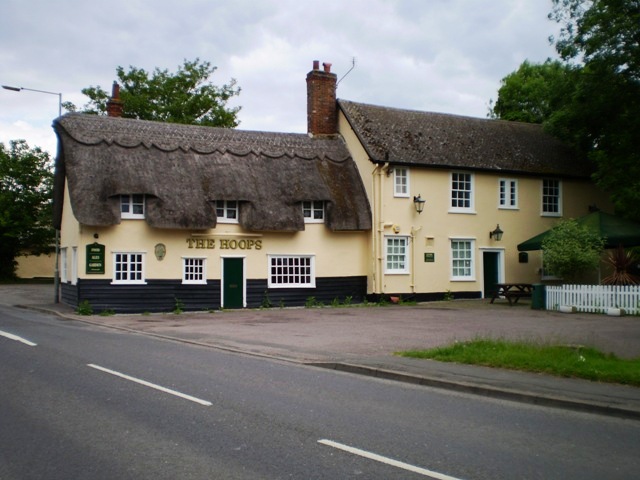
The Hoops PH Bassingbourn
A bit of history
Humans have been trying to stay out of the rain since forever, and thatch is one of the oldest ways our species has found to do that. Archeological evidence dates it back to the neolithic era–4000 BCE. But a leaflet from the New Forest National Park says we won’t find a lot of agreement on its development in Britain “and there has been little professional study of its origins.” So you’ll forgive me if I go a little vague here and skip forward a few thousand years.
The word thatch comes from Anglo-Saxon, the New Forest leaflet says, and they used it as both a noun and a verb meaning, more or less generically, roof covering. That has the virtue of simplicity–or possibly oversimplification. Etymology Online traces the word back further and tells me more than I can take in about its journey through Old English, Proto-Germanic, Middle Dutch, and Old High German.
I’m not good with heights, so when we got to Old High German I fled. We’ll go with the New Forest definition. Besides, Etymology Online also told me how to get rid of toenail fungus. It was an ad but it put me off all the same.
What was thatch made of?
Whatever was available, which is another way of saying it depended on where people lived. The list includes straw, heather, gorse, bulrush, sedge, and sod.
Heather? I can’t see how to make that work either, but it’s on the New Forest leaflet list.
Over the years, layers of soot from open fires built up on the underside of some medieval houses’ thatched roofs and acted as a preservative, keeping a few hundred of them intact until this very moment.
Why the open fires and the soot? Let’s talk about chimneys–or the lack of chimneys.
Chimneys made their way to England in the late Norman period, but they were strictly for the rich. Everyone else cooked and warmed their houses the way they’d always cooked and warmed their houses: they built a fire in the middle of the (one-room) house. The smoke rose and found its way out through the thatch or through a hole in the roof, and as much of indoor life as possible, took place below the level where the smoke was thickest.
The roofs had to be high enough not to catch fire from the sparks, although (generalization alert here) people can be pretty clever when they need to be and I’m sure most of them learned to minimize both sparks and smoke.
Let’s move on
For centuries, thatch roofed many an English house–the material was available locally and you could find a thatcher hiding in every haystack. Then came the industrial revolution and with it England’s canal and later railroad systems, which could carry tiles and slates around the country relatively cheaply. Thatch came to be seen as– Well, let’s quote Thomas Pennant, who wrote in 1782 that the cottage in general, “instead of being half covered with miserable thatch, is now covered with a substantial covering of tiles or slates, brought from the distant hills of Wales or Cumberland. . . .”
Where, I’m reasonably sure, slate and tile roofs had long been more common than thatch.
Pennant? He was a traveler, an antiquarian, and a writer. He was from Wales, which may explain why he didn’t think to add Cornwall to the list of slate-producing parts of the country.
But what matters more is why Pennant considered thatch miserable. For one thing, it’s flammable–so much so that a lot of towns and cities had banned it, notably London after the Great Fire of 1666. You know about people and their prejudices. The flammable roof went out of fashion, leaving people to associate it with rural areas–places that got left behind by the driving might of etc. and so forth. Places where people didn’t know or couldn’t afford any better.
Those rural areas that kept the craft of thatching alive.
Another argument for thatch being miserable is that all sorts of critters can take up residence in it, uninvited. These days they can be kept out with wire netting over the thatch, but that’s a relatively recent development. Chicken wire (the closest thing I could think to ask Lord Google about) wasn’t invented until 1844. So thatch fell out of favor. In 1800, England had some 950,000 thatched buildings. By 1960 that was down to 35,000, but after the Second World War a wave of interest in historic preservation brought thatch into fashion.
These days you can find a thatched roof here and there, but you can’t just wander through a randomly chosen village and be sure you’ll find one, never mind several.
You can, however, wander around the internet and find sites and organizations offering advice on how to preserve your thatched roof if you happen to have one.
The advantages and disadvantages of thatch
Other than looking fabulous and promoting the image of Olde England, what are the advantages of thatch? Sites–admittedly some of them are sites promoting it, so they’re hardly unbiased–talk up its sustainability. Thatch is also good insulation, they say, and keeps a house dry. (In Britain, damp is the enemy of indoor life the way cold is in Minnesota, where I used to live.) Bump around enough sites and you’ll find those basics said in seven different ways, pumping up the list of advantages until it’s ready to explode.
Thatch is also lightweight (that surprised me too) and doesn’t need guttering. On the flip side, with no gutters you can’t collect water for your garden.
You do have a garden, don’t you? You almost have to, to go with your thatch.
Disadvantages? Well, there’s that business about fire. Insurance companies get twitchy about that and only settle down when offered large sums of money at regular intervals. Then there’s the cost of reroofing, which can be terrifying, for a couple of reasons.
First, there’s a shortage of traditional straw. As Hampshire-based master thatcher Tim Anderson writes, “Supply is very dependent on good weather. The seasons have changed in recent years with more heavy rain in June and July. Farmers cut the straw and then leave it to stand in the fields to dry for a couple of weeks. Two harvests ago, it rained for a month and the hay all turned brown and rotted away so there was little that was usable. Some farmers’ entire crops failed.”
All that helps explain why some of those formerly local materials are now being imported. Take one point off the sustainability column, please, and several off the affordability one.
Second, there’s the supply of thatchers. The craft went into decline, although it sounds like it might be a good one to train in now. Thatchers can be booked up for years in advance.
An average cottage might need 15 to 20 tons of straw and take 10 to 12 weeks.
The tonnage there makes me question how light it is, but I swear I read that on–I don’t know, one of the sites I’ve linked to.
Put all that together and a cottage that might’ve once cost £30,000 to reroof can now set you back £60,000 to £100,000–and that’s before you add the cost of scaffolding.
Durability
If you’re looking at that kind of money, you might just want to know how long a roof lasts. One site says a roof made with water reed can last 40 years. Notice the word can there. Notice water reed. They’re not all made that way. So this isn’t a question with a simple answer. The life span will depend on what it’s thatched with and how whatever it’s thatched with was grown. And you should expect the ridge cap to need replacing more often than the roof itself.
You can add a new layer of thatch but sooner or later you’ve got to tear the thing off and start over.
The life span will also depend on how well it’s maintained. A leak will cause problems deeper into the thatch if it isn’t caught and fixed. Too much moisture and you can find moss growing on your thatch. Wind can tear pieces loose. Too much sun and your thatch can turn brittle, shortening its life.
If I read that right, too much weather of any kind should make you lose sleep.
Bump around the internet, though, and you’ll find that techniques and materials have evolved and fire-resistant treatments, ventilation systems, and synthetic thatch have been added to the traditional approaches. How much they solve the problems is anyone’s guess.

