Unknown's avatar

About Ellen Hawley

Fiction writer and blogger, living in Cornwall.

Covid news: Should we be losing sleep over the new variants?

If you’re even vaguely awake (or as our former and once again active home secretary would say, if you’re a Guardian-reading, tofu-eating wokeanista), then you’ll know that Covid has some new variants, and that they have good publicity agents. So how much sleep exactly should you lose?

Not as much as some of the nightmare-on-Covid-Street headlines would have you think.

Let’s sort the variants into separate piles and talk about them.


Irrelevant photo: A California poppy. Or since it’s growing in Cornwall and is at least four generations in, maybe by now it’s a Cornish poppy. (That’s a bit of an in joke and I’ll explain it if anyone’s interested.)

The BA variants

BA.2.75 begat BA.2.75.2, because viruses are good at begatting, even if they’re useless at naming their begotten, and since they work under pressure from both our immune systems and the vaccines that are loose in the world, the descendants that survive tend to be the ones that spread most easily or have some sort of hyped up immunity–and .2 does indeed have some of that.

According to Ben Murrell of the Karolinksa Institutet (that’s not a typo; it’s Swedish), “While antibody immunity is not completely gone, BA.2.75.2 exhibited far more dramatic resistance than variants we’ve previously studied. “

In layperson’s terms, that means, “Well, damn.” It also means some of the antiviral treatments given to people who’ve been hit the hardest won’t work against this one, but all is not lost because one still does. 

That was what passes for good news. (Don’t go away–there’s more good news later on.) On the other side of the balance, the antibodies running around in the blood of anyone with antibodies (that’d be people who’ve been vaccinated or who’ve had Covid) are only about a sixth as effective.

Still, a sixth means they’re not completely ineffective. This is good, but it’s not the good news I was waving signs about. For that, you have to wait. Or skip ahead.

What’s not known yet is how quickly the variant will spread. It’s in several countries but can claim only a minority of cases, so it may not become dominant. It’s also not known whether it’ll drive up hospitalization rates or how protective the vaccines will be against it

Balancing all that out, I’d say it’s not time to panic yet. If you’ll wait a bit, you can always panic later. 


The BQ variants

BQ.1 and BQ.1.1 are not to be mistaken for either meat cooked with a sticky sauce–that’s BBQ–or B&Q, which is a chain of British stores that claims to have everything you need for your home and garden. What my home needs is a good coat of paint, and they do have paint supplies, but the problem is getting the paint and the walls in the right relationship to each other. The last time I tried, the dog and the rug somehow got into the relationship and–

Anyway, no, they don’t really have everything I need.

The BQ variants are making headlines and US influencers are running around saying they’re worse than the CDC is admitting. 

The CDC is the Centers for Disease Control, which technically speaking should get a plural, but never mind. What matters is that if the CDC had said they were world-ending, somebody would jump up and say the CDC was trying to panic us all for dastardly reasons of their own. You can’t win this game.

The BQs were begat by BA.5 and last I looked (that was Octover 23) made up 11% of Covid cases in the US. Like BA.2.75.2, they’re pretty good at dodging the neutralizing antibodies we’ve spent so much time and effort developing.

By the beginning of 2023, the BQs are expected to make of 80% of Covid cases. I think that means the world’s Covid cases, but they could be talking about Europe’s. Let’s not split hairs. They spread, probably because of the way they dodge our antibodies. There’s no evidence so far that they’re more severe than the earlier versions or that they’ve completely sidelined the vaccines.


The XBB variants

Finally, we have the XBB variant, which instead of being begotten combines two earlier variants. I’m not going to try to explain that–let’s just say viruses have many ways to mutate–and you don’t really care which variants they were, do you?

XBB is already creating subvariants. You know, XBB.1 and all that mess. By October 20, it had popped up in 26 countries and was collecting headlines calling it a nightmare variant. It seems to spread rapidly and it too knows how to slip past our neutralizing antibodies–even more so than the new BQ and BA variants. The last of the monoclonal antibodies–the one that works on the B and BQ variants–doesn’t work here. 

It’s not clear yet whether it causes a more severe form of Covid, but in Singapore, where it’s spread widely and which has a 79% vaccination-and-booster rate and  strict control measures in place, it’s been milder. “The number of people dying or in the ICU is really low,” according to Eric Topol of Scripps Research. “Their protection level is really solid.”

What kind of strict measures

“Facemasks remain compulsory on public transport and in most healthcare facilities. Contact tracing requirements remain in effect for events with more than 500 people. Authorities continue to bar unvaccinated people from dine-in services.” People who test positive are quarantined at home.

There’s no evidence XBB and its kiddies make anybody sicker than the earlier variants, and it’s too early to tell how well the new booster shots will work against it, but educated guesses say they’re still be well worth having.

“We’re going to have another wave,” Topol said. “The question is, how bad is it going to be?”

Can’t remember who Topol is? He’s up a few paragraphs.


On the other hand

Should we all just go out and slit our wrists?

No. It’s messy, it causes pain, and it’s not necessary. The new variants are a problem, but–and it’s a big but (with one T, thank you very much)–neutralizing antibodies aren’t the only insult in our immune systems’ vocabulary. We focus on them because they’re easy to measure, but our immune systems know other ways to get under Covid’s skin–or maybe that’s its spike protein. Or–

You know what? Never mind. Failed metaphor. Move on. Nothing to see here.

Our immune systems have T cells. And B cells. And if they’re English speakers, they’ve still got 24 letters in the alphabet once they use those up. What’s more, people who’ve had Covid have some letterless (as far as I know) immune cells throwing parties in their lungs.

We’re not completely unprotected.

The phrase Immune escape (which I’ve avoided using but which serious people will) has been misinterpreted. It sounds like it means time to panic. It doesn’t. 

Especially since multiple articles are telling us about research groups edging closer to a universal (or near-universal–I’ll settle for that) coronavirus vaccine which would, at long last, put an end to this damn pandemic. So put the knife back in the drawer. We can do without the drama, thanks.

Who hasn’t resigned yet? It’s politics in Britain

British politics have been so much fun this week that people were rushing home to watch the news because they need a good laugh. Our newly minted prime minister, Liz Truss, is now our ex-prime minister, although she’ll stay in office until her party finds some unfortunate soul to replace her. She should set a record for the shortest-serving prime minister in the country’s history.

She came into office not much more than a month ago. Then the queen died and for ten days history was canceled, so Truss didn’t have much chance to screw up, or not publicly anyway. What she did behind closed doors was between her and Larry the Cat, chief mouser to multiple prime ministers. So she’s done a lot of damage–not all of it to herself, unfortunately–in a remarkably short time. 

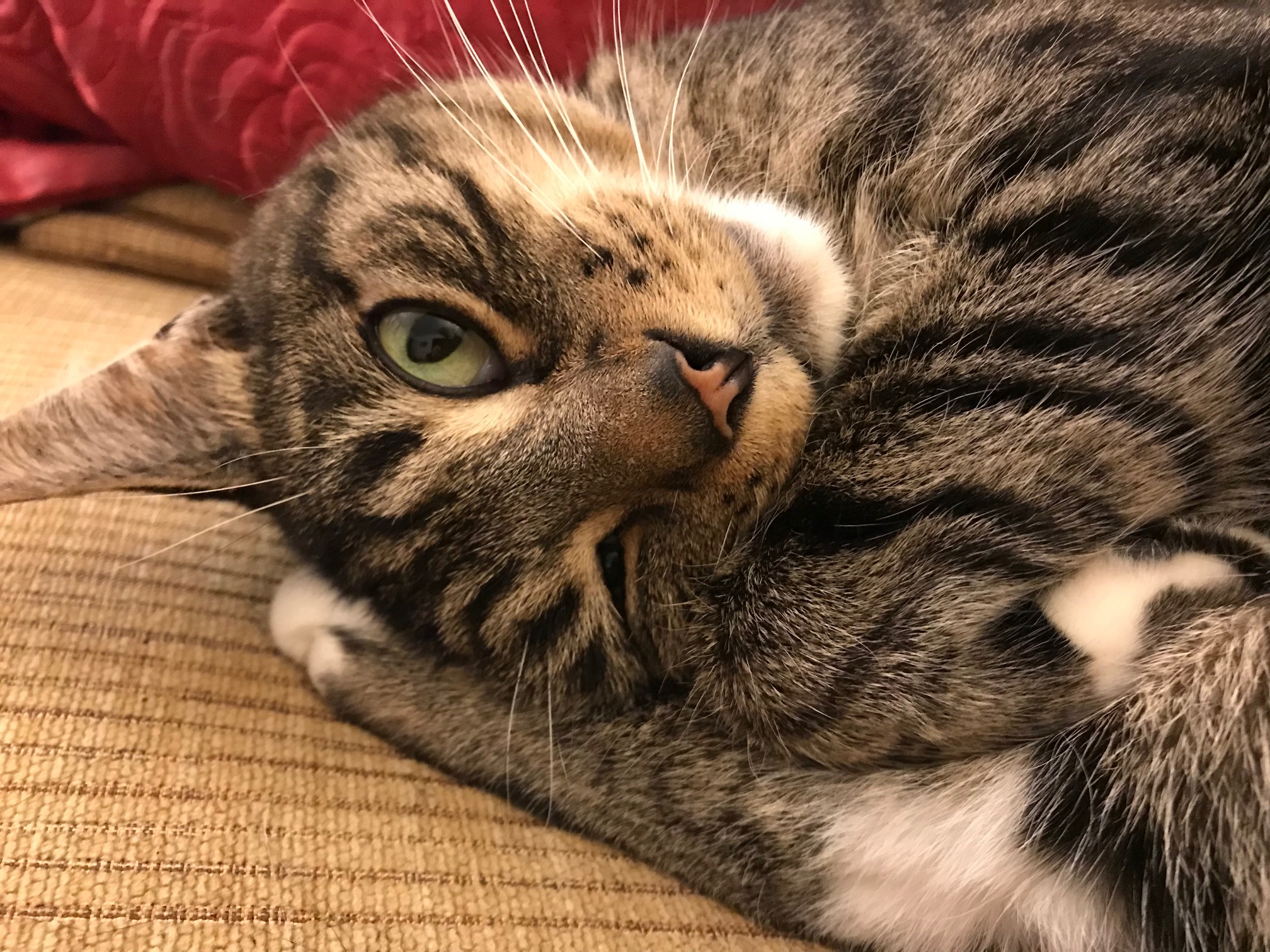
Largely irrelevant photo: This isn’t Larry the Cat, just some cat I saw sitting in a window, looking like it would prefer to be someplace else.

So much for the intro. What’s happening?

We’ll start at something vaguely like the beginning. When she became prime minister, Truss appointed Kwasi Kwarteng chancellor and the two of them put together a mini-budget that in hindsight looks like a suicide pact, although I’m sure they saw themselves as bold, courageous, and several other synonyms. 

The mini-budget involved multiple tax cuts that were heavily weighted toward the people with the most money because, you know, they have so much money. And they dress well and they donate so much to political parties. Who can resist them? Besides, they’d invest that money and the economy would grow and all the cash would trickle down to people with less money, who’d be ever so grateful, and the pie would grow.

Yes, Truss did say the pie would grow. Cartoonists had a glorious few days with that before life got so crazy that growing pies started to look sensible.

In addition to the problems inherent in the trickle-down theory–primarily that it doesn’t seem to work–a more immediate problem was that they hadn’t bothered to say where the money was going to come from to fund the tax cuts, and you have to at least pretend you’ve got that piece before you show the world your completed jigsaw puzzle. 

The pound promptly tanked, which raised the cost of government borrowing, and there’d clearly be a lot since they hadn’t figured out how they were going to cover those cuts. It also raised mortgage rates, because some 20% of mortgages in the country are trackers, which go up when the interest rates rise, and interest rates were imitating that imaginary pie.

Truss’s party began to turn on her publicly–first one Member of Parliament, then several, then a few more. It was an iceberg situation. You judge the size of the hidden opposition by the part that’s visible.

So what does a courageous etc. prime minister do when her party doesn’t like her bold etc. plan? She fires her chancellor, that’s what she does, and exempts herself from the suicide pact, and appoints a new chancellor–in this case Jeremy Hunt, leaving Kwarteng holding the record for the chancellor who spent the second shortest length of time in office. But since the absolutely shortest-serving chancellor left his position by dying, that still gives Kwarteng a sort of first place.


Confession

I’m condensing the events here. And I’m not necessarily sticking to the sequence. It was all happening too fast to untangle, so in deference to the speed of events we’ll shift to the present tense, even thought it’s all in the past now. 

Don’t think about that too much. No matter which way you turn it, it won’t make much sense. Don’t give me any grief about it. I’ve rewritten this damned thing too many times already.


The press conference

If you want to look prime ministerial, you have to hold a press conference, so that’s what Truss does. Surely that’ll calm the markets, the politicians, and that segment of the populace that’s still searching the fields where pies grow. She’s smart enough to know she’s not popular, so she picks through the assembled journalists like someone who’ll only eat the blue M&Ms. Blue is her party’s color, after all, and she needs Tory-friendly questions. She’s surrounded by enemies. The woods are dark and dangerous. It’s hard to tell Grandma from the wolf.

None of the journalists, it turns out, are her grandmother. One asks, “Can you explain . . . why you should remain as prime minister, given that you’ve dumped a key tax cut that led you to be elected and got rid of your chancellor?”

Another asks how come, given that she and the chancellor designed the budget together, “you get to stay?”

A third asks what credibility she has.

A fourth asks why not even Grandma hasn’t seen fit to show her support.

To each question, she blithers something about being determined to “see through what I’ve promised.” 

After eight painful minutes, she ends the press conference and staggers out of the room.


Larry the Cat

Larry the Cat is reported to have chased a fox away from 10 Downing Street, although I have it on good authority that Larry was only asking if it would like to be the next prime minister, at which point it fled. 


Facing the Commons

Since nothing gladdens the heart of a British politician more than making another politician (preferably one from another party) suffer in public, the Labour Party puts forward a question that, under normal circumstances, would bring a prime minister toddling into the House of Commons to answer it personally. 

These aren’t normal times, though, and Truss doesn’t appear, so Penny Mordaunt–a fellow Conservative and at one point a rival for Truss’s current, unenviable position–steps in to answer for her, explaining that the prime minister is not hiding under her desk. 

A new rumor circulates: Liz Truss is hiding under her desk.

Jeremy Hunt–new chancellor, remember–announces that he’s reversing almost all Truss’s tax measures. The pound inches upward. The markets nod dozily.

He reassures us that Truss is still in charge. 

A new rumor circulates. Yes, you guessed it.


Facing the king

Truss is announced to the king for her weekly audience and he says, “Back again?” and then, “Dear, oh dear.”


Facing her own party

In the week before Truss resigned, all you had to do was ask Lord Google, “How long will Li . . .” and he’d finish the sentence with “. . . z Truss be prime minister?” Although, in fairness, he might have suggested something different to you. He knows what you’ve been thinking. He knows when you’re awake. He knew when Truss is in trouble, and so does everyone else.

Okay, that was past tense. Truss resigned twenty minutes ago and I’m rewriting this. Again.  

There were several ways Truss could be dumped, but they boil down to these: 1, Her own party could force her out, or 2, the House of Commons could force her out, triggering a general election.

Or, of course, she could resign and claim it was her own idea.

Her own party was and is somewhere between reluctant and shit-scared to trigger an election right now. Polls suggest that they’re slightly less popular than Covid. One shows ten ministers losing their hind ends, along with the parliamentary seats they sit them on, if an election were to be held now. They include Jacob Rees-Mogg, Jeremy Hunt, and Therese Coffey, the health minister who recently told the world she’d given leftover antibiotics to a friend, enraging the medical establishment, which reminded us all that it’s not only illegal but dangerous. And unbecoming a health secretary, who might ought to maybe at least pretend she knows something about medicine, or at least knows enough to consult people who do.

To make up for it, she ups the ante and suggests that maybe pharmacists should start prescribing antibiotics, because who needs a diagnosis anyway? You just take some little pills and you get better.

But we were talking about polls. Sorry. It’s just so nice to hear that Coffey has an opinion on something other than the series comma. 

That same poll also projects that Boris Johnson would lose his seat and ass and the Conservatives would face a wipeout.

So no, the Conservatives aren’t in the mood for an election right now, and they still have a huge majority, so they’re in a position to block any move in the Commons. This means the first possibility was the one to pay attention to: Her own party forces her out. To do that, they have follow rules the party itself sets, which say the prime minister’s position can’t be challenged until she’s been in office for a year. Unless, of course, the party decides to change its rules, which it can do as soon as enough of the right people are in the mood. 

The last two prime ministers were forced out that way, remember. All it took was a threat to change the rules, although in Boris Johnson’s case most of his cabinet had to resign before he noticed. The point is, though, that they’re getting good at forcing prime ministers out, if not at governing. But rumor has it that they can’t coalesce around an alternative. Or any half dozen likely sounding alternatives. They seem to have poured all the fizz off the top of their beer and now they’re left with–

That metaphor’s not going to work, is it? Never mind They don’t seem to have convinced themselves that any living Conservative politician has what it takes. It’s one of the places where I find common ground with them. The other? That the law of gravity should remain in force.

Some are even talking about bringing Boris Johnson back. 

Nevertheless, speculation about how long Truss will last was so widespread that one paper had a live-streaming lettuce-cam, asking which will last longer, the prime minister or a head of lettuce?

The lettuce had a ten-day shelf life. It won.

Jack Peat, who writes at the London Economic, raised a possibility I hadn’t thought of: A new election doesn’t have to depend on a majority of parliament voting for it. A general strike could force one. We’re already in the midst of multiple strikes, and more are likely, regardless of who follows Truss.

“As we have seen this summer, workers are more organised than they have been in many years, and the worst is still to come as the cost of living crisis really shows its teeth. Such a large movement could force Truss’s hand, and in doing so, trigger the inevitable capitulation of the Tory Party. “

Truss’s resignation (now forty minutes old) makes that unnecessary but who knows what comes next? The strategy might still be useful.


Meanwhile, addressing the nation from under her desk . . . 

. . . Truss announced that she would lead her party into the next election. Several people near where I live said, “Whatever she’s on, I’d like some.”

Larry the Cat reopened negotiations with the fox, whose name has still not yet been made public.


Also meanwhile, at a committee of the House of Lords

Ai-Da, an ultra-realistic robot who paints, testified about I have no idea what. Someone asked how she produces art and she said, “I produce my paintings by cameras in my eyes, my AI algorithms and the AI robotic arm to paint on canvas, which result in visually appealing images from my poetry using neutral networks.”

Neutral is not my typo. The questions were submitted in advance and Ai-Da was giving a prefabricated answer. So someone of the human persuasion thought that particular set of words answered the question. 

And maybe it does. I’ve seen equally enlightening statements written by flesh-and-blood artists, and understood them just as well. 

In response to the next question, Ai-Da shut down and had to be rebooted, giving Truss a workable strategy for her next press conference–which didn’t happen.


. . . while in what passes for the real world

. . . the new chancellor made noises about a return to austerity. You know what that’s like: They start talking about efficiency and trimming fat, but mysteriously leave fat on the programs they like and take the bones and the meat from ones they don’t, leaving them not only less efficient but in pieces. 

Looking around the country, you might not be able to tell that we left austerity behind, but never mind. If we did, apparently we’re going back. Last I heard, the government needs to come up with £70 billion, and reversing the Truss/Kwarteng tax cuts will only cover half of that. 

Inflation was last clocked breaking the 10% speed limit, but necessities are up more than that. Electricity’s gone up 52%, gas 102.2%, cheese, 23.1%, prefab meals, 19%; milk (that’s low fat), 42%, and so on. People are looking for ways to use less and less fuel when they cook–it’s taking that much of a bite out of the budget.


It couldn’t get any worse, right?

Of course it could. Truss’s acting director of communications and key advisor was suspended for saying–or more likely, for being quoted as having said–that Conservative MP Sajid Javid was “shit”–or as one reporter put it, “excremental.” 

Folks, this is why governments need directors of communications. They know what to say in every situation.

The home secretary launched an attack on the Guardian-reading, tofu-eating wokerati. Tofu immediately started trending on Twitter.

Then she resigned, having held the position for 43 days and setting another record. Why? Well, she sent a secret document from her personal email account (apparently to someone who wasn’t authorized to see it anyway) and since she was on her way out she used her resignation letter to savage the government for not taking responsibility for its mistakes. 

But wait. She hadn’t quit, she was fired. Or she wasn’t fired. Or else she was and she and Truss had a 90-minute shouting match. At this point, no one much cares about the details, or at least the tofu-eating wokerati and I don’t and let’s face it, who else matters? She’s gone. Her replacement praised the new chancellor but managed not to mention the prime minister. 

Journalists began asking who was in charge. From under her desk, Truss sent a note saying, “I am.”

A vote in the House of Commons degenerated into chaos, with accusations of screaming, shouting, bullying, and more to the point pushing and shoving so Conservative MPs would vote the way their party wanted them to. This was possible because MPs vote by walking into one room or another–or in this case, by getting pushed into one of them. Apparently if your body goes through the door, it doesn’t matter how it got there, you voted.

The chief whip resigned–and apparently her deputy did as well. 

What’s a chief whip? The person who keeps MPs in line, threatening them with mayhem if they look like they might vote the wrong way. 

What does it mean when a chief whip resigns? It’s the political equivalent of your underwear spontaneously falling off as you stand at the bus stop on your way to work. Only your underwear’s unlikely to yell, as the deputy is supposed to have at the point where he and his underwear left the voting lobby, “I am fucking furious and I don’t give a fuck anymore.” Except the the site where I found that quotes him as saying “f***ing,” which is hard to pronounce, never mind yell.

Then they both unresigned. Or else one of them did. Or neither. Or possibly they never resigned in the first place.

We’re all a bit dizzy and need to sit quietly for a while.

A veteran TV journalist called the Northern Ireland minister–off camera–a cunt and apologized to the world at large, saying it was below the standard he sets for himself. I’m disappointed only that he apologized. Not that I know enough about the Northern Ireland minister, just that–oh, hell, I like a bit of swearing now and then.


Who’s next?

A friend suggested yesterday that we’ve had so many prime ministers lately that we need a collective noun for them. A disappointment of prime ministers? A desperation of prime ministers? Please, help me out here. It’s important and we need the world’s best brains working on it.

I’m writing this on Thursday, October 20. It’s now an hour since Truss resigned. She’ll stay under her desk, pretending to govern, until her party picks a replacement, which is expected to take a week–much less time than it took to choose Truss, but after the MPs narrow down the candidates the final two will be voted on by Conservative Party members, those wise and sober citizens who thought Truss was a good idea. The rest of us will sit on the sidelines.  

[Yet another update: Conservative MPs will narrow the field of candidates down and if two are left standing and unmaimed the choice will go to the members. If only one is still functional, that’s it, the decision will have been made and the members won’t have to bother their little heads.]

As for me, I’ve worn out several of the English language’s verb tenses and refuse to do any more rewriting. I’m posting it early–Thursday evening instead of Friday morning–before anything else changes. For whatever happens next, allow me to refer you to a real newspaper. Even if you’re not a fan, they’ve been a lot of fun lately.

A final word, though: Larry the Cat’s negotiations with the fox are ongoing. The snag, apparently, is that the fox won’t accept the position without a mandate from the voters and the Conservatives are understandably not interested in bringing the voters into the picture right now.

Translating from English to English: What does pudding mean in Britain?

Almost anyone who knows and loves the English language will agree that it’s mildly insane. Some of us admit that reluctantly and the rest of us think it’s what gives the language its eccentric charm. I’m in the second category, so I’m taking us all to play in a spot where linguistic oddity meets food. 

How far wrong can we possibly go?

Very, but let’s do it anyway. The question of the week is, What are the British talking about when they talk about pudding?


Irrelevant photo: a begonia flower

Definitions

As far as I’ve been able to tell after sixteen years of haphazard research, pudding means four very different things in Britain.

  1. Something sweet at the end of a meal. 
  2. Something made with a batter.
  3. Something either sweet or savory (savory being the opposite of sweet) that’s been tied into a cloth and steamed or boiled.
  4. A “sausage-like mass of seasoned mince meat, oatmeal, etc., stuffed into a prepared skin or bag and boiled.” (That’s from the Collins Dictionary.) 

If that last category doesn’t send you running to Lord Google for recipes, I sympathize. It doesn’t sound like my idea of what to cook on a slow Sunday afternoon either, although I’m sure someone will tell me that a mass of seasoned minced et cetera can be delicious, and I’m sure they’ll be right, at least if they’re serving it to meat eaters. I, however, live on raw carrots and the stems of organic herbs, so it’s not for me. Even if I ate meat, though, the word mass is what did me in. Any food writers out there? Put mass on your list of unattractive words.

And speaking of unattractive words…


The unfortunate origins of the word pudding

How did two ordinary syllables come to mean so many different things? Etymology Online takes us back to the year 1300, when pudding meant a sausage made of meat, blood, and all sorts of fun things, stuffed into the intestines of a pig, sheep, or other unfortunate, and then boiled. 

That explains meaning number 4, the boiled mass. 

The word may have come from a Germanic word meaning “to swell,” which means it’s related to words for all kinds of unpleasant swellings. But cheer up, it may come have a whole ‘nother source: a vulgar Latin word by way of an Old French word meaning sausage and having to do with animal intestines.

In the sixteenth century, in fact, if you talked about puddings, plural, you were talking about someone’s intestines, so we’ve got a pretty strong set of sausage-y connections here. But in that same century, pudding was slang for vagina. And–not to be outdone–for penis. 

I wouldn’t suggest holding out for any sort of logic there. Slang isn’t answerable to careful reasoning.

And now, let’s drop that thread before we give up on the topic altogether.


Moving right along

How did the word  transition from a sausage to a dessert? Well, in Tudor times it wasn’t unusual to sweeten a sausage, and to add dried fruit, and a sweet sausage-y thing is surely a step in the direction of what we know as a dessert. 

Also in the sixteenth century, a pudding became something involving flour, milk, eggs, and maybe some dried fruit. It could still be either sweet or savory. That points us to meaning number 1–dessert. The connection to those sausage-y things is that you could take those floury, milky, eggy things and boil them in pudding bags, because if you’re not going to stuff them into an intestine, you have to hold them together some other way. So that takes care of meaning 3, something tied in a bag and acquainted with hot water. 


Yeah, but what about meaning 1?

According to GreatBritishMag, calling something sweet at the end of the meal a pudding has to do with the British class system. 

Everything in Britain has to do with the class system. 

Traditionally, it says, puddings were rustic things eaten by the lower classes–things like rice pudding and (fasten your seat belt) spotted dick.

Yes, spotted dick. It’s a dessert–or a pudding, if you like–and no, you won’t get a funny look or a medical referral if you say you have or want some. 

While the rustic lower classes were eating spotted dick and wondering if anyone would get the joke, the upper classes were eating not pudding but dessert–chocolate mousse, sweet souffles, and that sort of fancified stuff. 

(Truth in blogging paragraph: Dick doesn’t seem to have become slang for penis until the late nineteenth century. EtymologyOnline says, “It has long been a synonym for ‘fellow,’ ” and dates that back as far as the sixteenth century.) 

Forget that, though. Somewhere along the line, and I’m not sure when or how, the word pudding not only jumped classes but appropriated the entire category of sweets-after-a-meal, and ended up being one of the few British words that doesn’t mark a person’s class. (Others in the category are and, of, or, but, and a scant few thousand others.)

Or so say one or two sources. Arguing against them, Country Living magazine lists pudding as upper class and dessert, afters, and sweet (as in (I think), “Should we have a sweet?”) as non-upper class, where they join declasse words such as couch and settee (instead of sofa), pjs (instead of pajamas), and movie (instead of film). Oh, the horror. How could one hold one’s head up–?

Who’s right? I haven’t a clue.


So what gets called a pudding?

Just about anything.

Okay, it does have to be edible–no chairs; no bike racks–and (I think) either solid or semi-solid. And it has to have more than one ingredient. I’m sure there are other limits, but hey, I’m a transplant. I’m doing the best I can here, but you wouldn’t want to trust me out of your sight. 

Now that I think about it, you might want to consult somebody sensible about this, and I invite comments on this from both the sensible and the senseless. 

But with that warning out of the way, foods that have pudding in their names include:

Yorkshire pudding. This is a breadlike thing generally served with meat, gravy, and all the sidekick foods. It used to be served before the meal to fill people up so they’d eat less meat. And it’s baked–it used to be cooked under the meat so it soaked up the drippings–not boiled. It lives in the flour-and-other-stuff room of the pudding house.

Christmas pudding. This is a fruitcake, and it’s steamed or boiled. [You’ll find an explanation of why is isn’t a fruitcake in the comments.] It can sleep in the flour-and-stuff room or the cooked-in-a-bag room, depending on the mood it’s in.

Black pudding. This is a blood sausage and it lives in the sausage room.

White pudding. Another sausage, but bloodless. It lives right near the black pudding.

Rice pudding. This has rice, milk, sugar, and whatever bits of flavoring you like to toss in. I learned to make it on the stove (that’s the hob in British), but most recipes I’ve seen in Britain toss it in the oven. Or, okay, slide in in carefully. It lives in the milk-and-bread room, even if it does substitute rice for flour. A starch is a starch.

Toad-in-the-hole. This involves sausages and a milk, egg, and flour batter, so it wanders from room to room at night, dragging its sleeping bag behind it.

Summer pudding. This is made of bread, fruit, sugar, and nothing else. It’s spectacular, but as far as I can tell it doesn’t have a pass to any of the rooms. It sleeps in the hall, mumbling that it was made in a pudding bowl so why’s everyone so mean?

I could go on but we wouldn’t be much wiser. I’ll stop. 

So what do the British call that stuff Americans call pudding?

Nothing. You won’t find it in Britain, so they haven’t given it a name. I’ve seen sites claiming that the British call it custard, but custard’s a whole ‘nother beast.


The Black Pudding Throwing Contest

It wouldn’t be right to leave the topic without mentioning the World Black Pudding Throwing Championships, held in (you can’t make this stuff up) Ramsbottom in September. Legend has it that the contest dates back to the War of the Roses, when the houses of Lancaster and York ran out of ammunition and started throwing food at each other. 

Legend has it that a lot of legends were made up in the pub, but never mind. The tradition was revived–or started–in 1839 and then re-revived in the 1980s.

The idea is to throw black puddings at a stack of Yorkshire puddings and see how many you can knock down. 

My thanks to The Year without Wimbledon for making sure I didn’t miss this. The information’s spent a long time sitting on my list of topics I never get to. I’m happy to see it fight its way out.

The latest thing in conspiracy theories: It’s the news from Britain

The latest thing in conspiracy theories: It’s the news from Britain

Britain has a special relationship with the US, although Hawley’s Small and Unscientific Survey indicates that only Britain is knows about it. But never mind that. It’s so important that Britain sometimes gives it capital letters: the Special Relationship.

In fairness, Britain hands out a lot of capital letters, so Americans, don’t let that go to your head.

But special relationship or no special relationship, Britain doesn’t like taking second place, even in the production of conspiracy theories, so we’ve come up with a nice one that’s all our own: The security guards who attended King Charles–that’s the monarch formerly known as Prince–at his mother’s funeral used fake hands so they could keep their real ones on the weapons hidden under their coats. 

Well, of course they did. I’ve seen photos circulating on TikTok, and they show the security guys keeping a tight grip on their hands, as if they were afraid they’d drop off. 

Yes, people do stay up nights to work this stuff out.

The paper I found this in seems to have found it credible enough that they trotted out a security expert to explain why that wouldn’t happen in the UK, although it might, of course, in the US.

Isn’t it interesting what people think of the US? We’re a nation where people could, imaginably, hide an extra pair of arms under their coats.

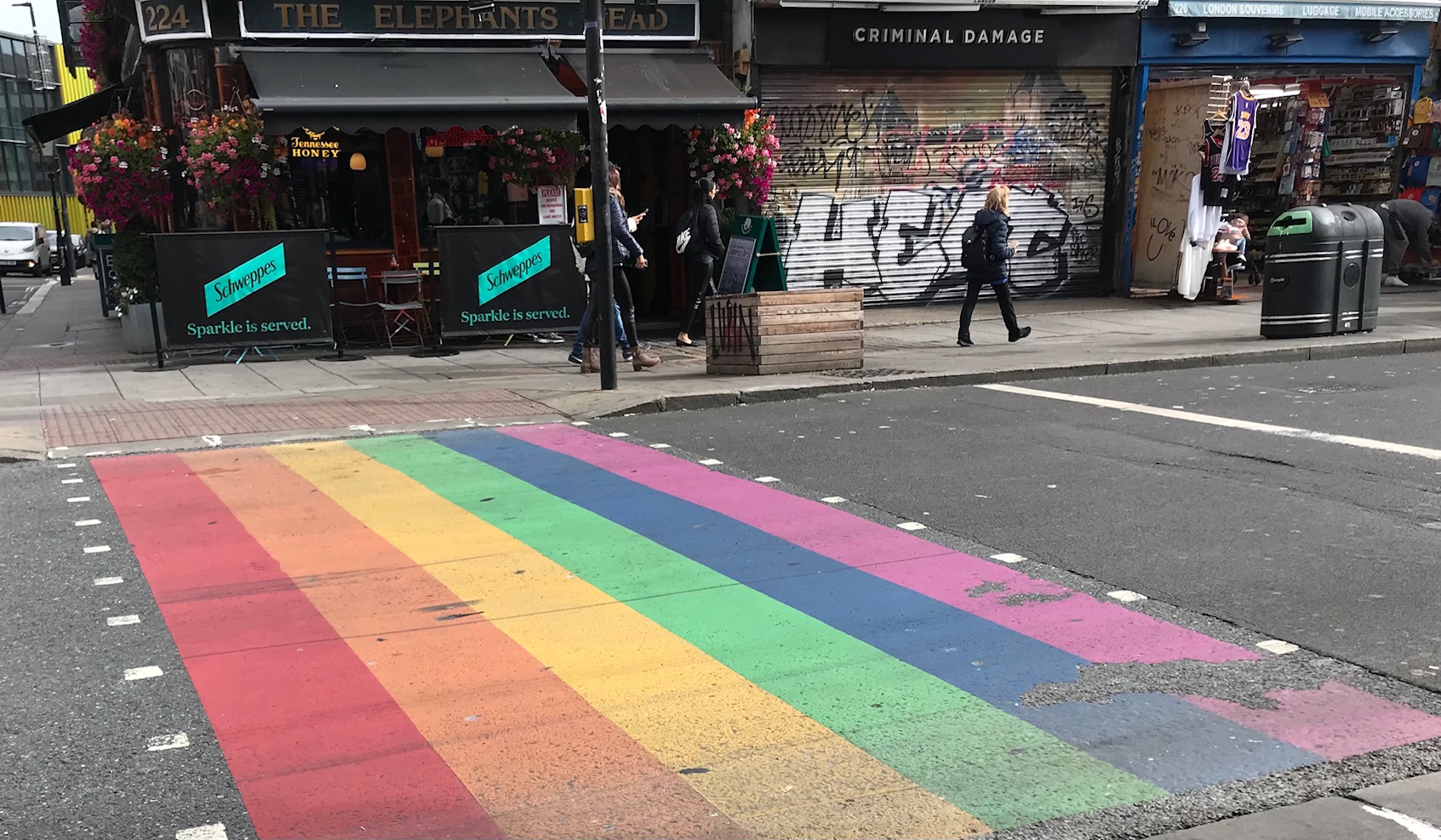
Irrelevant photo: A pedestrian crossing in Camden, London.

But that’s not what the expert addressed. In the US, he explained–and this comes in the form of an indirect quote from the Metro–“close protection officers are more ‘trigger happy’ . . . but the ‘risk is too high’ in the UK.”

In other words, you might be able to run around shooting people at royal funerals in the US (assuming, of course, that you can find a royal funeral), but you can’t do that in Britain. 

No one seems to have asked how long it would take security guys in any country to break their real arms loose if they did need to get trigger happy, but before I’m going to get on board for this one I need an answer. 

But let’s move on

Do you ever wonder why so many conspiracy theories are on the loose lately? It’s a desperate effort to make sense of a  world that’s falling apart. 

That’s not meant as a joke.

So what’s the British government doing to hold it all together? Well, we have a brand new government, cobbled together by the Conservative Party, which still has a hefty majority in Parliament. Already, though, the shine’s coming off it. It–this is the government we’re talking about in case you’ve lost track–announced a new mini-budget that, in the face of a population increasingly desperate about inflation, promised a tax cut for the richest eighteenth of a percent of the population. It would fund that by borrowing money that it would pay back when pigs fly in formation past the Houses of Parliament waving lion-and-unicorn banners and singing “The Marseillaise.”

Why “The Marseillaise”? Irony, that’s why. Their long and less than happy relationship with humans has led pigs to develop a sharp sense of irony.

The pound promptly tanked. That’s the vote that really matters, so the political world came to a rolling boil. MPs in the government’s own party publicly attacked the idea, attacked the prime minister, attacked the chancellor, and attacked Larry the Cat, who in fairness isn’t even in the cabinet. 

Cabinet ministers accused MPs of staging a coup. 

Larry the Cat accused the government of being stingy with the cat treats.

The prime minister said she wouldn’t back down. 

The prime minister repeated that she wouldn’t back down.

The prime minister backed down, but only on the most controversial tax cut, not on other problematic parts of the budget, which I’ll skip over. Come on, do I look like a newspaper? When the details overwhelm the humor, I have to move on.

The prime minister won’t rule out reinstating the tax cut. 

Larry the Cat upchucked a lightly used mouse head on the steps of Number 10.

In the meantime, the government that won’t commit to increasing benefits (Americans can translate that welfare and similar programs) in line with inflation. People–and not just the poorest ones–are seriously worried about how to heat their homes, food banks are deluged, and the National Health Service is coming apart at the seams. 

And we’re hearing a lot of talk about power cuts this winter. 

*

But compassion isn’t completely missing. I recently stumbled over an expensively printed flier with advice on reducing fuel poverty. Some sponsors are in small enough print that I’m not sure if it’s only from the Cornwall Council or if it’s national as well, but hey, if I had anything to do with it I’d want my name in small print as well.

What does it advise us to do?

  • Keep warm
  • Have regular hot meals and drinks
  • Keep moving 
  • Look after yourself
  • Take care of your neighbors

Thanks, guys. I don’t know what we’d do without you.

To be fair, they also give us a handful of phone numbers to try, but I wouldn’t hold my breath about any of them solving people’s problems.

So what does the Department for Fiddling While Rome Burns say?

The government’s addressing the important stuff, though. Therese Coffey–the new health secretary who sports an accent in her first name but I can’t be bothered searching the depths of Word to find it–has taken a tough stand on the Oxford Comma. 

The what?

I’m not exactly British, so I’m not the best person to ask, but back in that big country on the other side of the Atlantic, I learned to call it a series comma. By either name, it’s the comma you either do or don’t use before the final item in a list. You know, when you write to the health secretary and say either, “I find your advice odd, patronizing, and trivial,” or “I find your advice odd, patronizing [no comma, you’ll notice] and trivial.” 

C’mon, this stuff is important.

I won’t try to explain why that’s called the Oxford comma in Britain, mostly since  I don’t understand it either, but Coffey’s agin it. (She wouldn’t approve of agin either, which is why it made its way in here.) She’d no more than located her new office and hung up her coat than she told civil servants to “be positive” in their communications with her, to avoid double negatives, and to not use the Oxford comma. 

After that hit the headlines, her departmental flak-catchers jumped in and acknowledged that the memo was real but said Coffey hadn’t written it. 

“There may have been a bit of over-eagerness” in the content, he, she, they [Oxford comma ahead], or it said.

Wouldn’t it be nice if they were half as eager to shorten the lists of people waiting for medical treatment, fill the National Health Service’s job vacancies, or fix hospital roofs? But those things take money. Oxford commas? They come cheap.

Yeah, but why’d the Conservative’s get a reputation as the Nasty Party?

Gee, I don’t know. I wasn’t here when it happened, but it’s not helped by people like Daniel Grainger, chair of the Young Conservative Network, who arrived in Birmingham for the party convention and tweeted that it was “a dump.” 

He’s stepped down pending an investigation, although that may be over a different tweet–one that, sadly, hasn’t hit the headlines.

How’d the party conference go?

Well, a recent study reports that dogs can sniff out whether people are stressed. I haven’t read that the conference center was surrounded by stress-trained canines, but then I haven’t read that it wasn’t. And for all I know, those hands really were fake. Can you prove they weren’t?

Can we go back to economics, please?

Sure. The Ig Nobel Economics Prize went to Alessandro Pluchino and his colleagues for a mathematical explanation of why success so often goes not to the most talented people but to the luckiest. 

Irrelevantly but irresistibly, the prize for medicine went to Marcin Jasiński and colleagues for showing that patients treated with cryotherapy–a form of chemotherapy that dries out the mouth, gums, and tongue–have fewer harmful side effects when ice cream replaces the ice chips they usually suck on.

They used Ben and Jerry’s, although I expect the improvement would carry over to other brands. 

Bits of good news about Covid

We’re talking about Covid again, so let’s grab some shreds of good news and pile them up like hamster bedding–only (if I remember my brother’s hamster correctly) not as stale smelling.


Shred number one

A study involving older, high-risk adults showed that nasal irrigation reduced the risk of hospitalization and death from Covid and helped people recover faster. 

What does “older” mean if we don’t have a comparison group? C’mon, we all know that in our culture it’s not nice to say someone’s old. They’re trying to be polite. My best guess is, older than the researchers.

Next question: What’s nasal irrigation? An inexpensive and low-tech way of clearing out your sinuses. You squirt a mild sterile saline solution up one nostril, tipping your head so it dribbles helplessly out the other, having found its way via satellite navigation. As the solution falls into the sink, you’ll hear a small voice saying, “You have reached your destination.” 

Irrelevant photo: It must be time for another cat photo. This is Fast Eddie, who doesn’t look like he was assembled correctly but was. Really.

Okay, I asked Lord Google what it involves, and I even tried doing it. It’s mildly off-putting but I’ve done worse things in the name of health. It’s entirely survivable.

But let’s go back to the study: Only 1.3% of the subjects were hospitalized, and none died. Compare that to the control group, where 9.47% were hospitalized and 1.5% died. Group one also got better faster and had fewer symptoms hanging on at the end of two weeks. 

The inspiration behind the study was 1) that saline decreases Covid’s ability to attach to cells–to the ACE2 receptor, in case you’re taking notes and 2) that the larger a person’s viral load is, the sicker they’re likely to be, so if within 24 hours of testing positive (the study’s designers reasonsed) some of the virus was rinsed out, that might reduce Covid’s damage. 

Nasal irrigation is a common practice in Southeast Asia, and interestingly enough death rates from Covid were lower there. That’s not definitive proof, but it’s intriguing enough to make a person design a study around it–if the aforesaid person happens to be in the right line of work, of course. 

Irrigation also helps with colds, postnasal drip,  sinus headaches, and all sorts of fun stuff. It’s said to improve people’s sense of taste and smell and the quality of their sleep. 

I’m starting to sound like a true believer, aren’t I? Sorry. I’ll recover in a minute or two, as soon as I stop this saline solution dribbling out of my left nostril. In the meantime, I can balance things out by admitting that it won’t make you taller or reverse aging.


Shred number two

A small study hints that vaccination may be decreasing the number of people who come down with long Covid. The study comes from the long Covid clinic at the Cambridge University Teaching Hospital, which treats people on the severe end of the spectrum. Between August 2021 and June 2022, it saw a 79% drop in referrals compared to August 2020 and July 2021.

That’s not proof that vaccination’s the cause–it’s only correlation–but it does suggest it.

Other studies also show a decrease, although the numbers have been all over the map. One showed a 15% reduction and another 50%. A third showed “eight of the ten most-commonly reported symptoms were reported between 50 and 80% less often.” I’d translate that into a format that parallels the other studies but somebody glued the pieces in place and I can’t. 

The reason the numbers vary so much is that the studies weren’t defining long Covid the same way or following people for the same length of time. 

So does catching Covid multiple times increase your odds of getting long Covid? The assumption has been that with each infection, you roll the dice again, taking the same risk each time. But one author of the study expects that previous infections will have more or less the same impact as vaccination and the risk will turn out to diminish after the first infection.

Probably.


Shred number three

The omicron variant may be 20% to 50% less likely to turn into long Covid than the delta variant, depending on a person’s age and how much time has passed since they were last vaccinated. 

But–and isn’t there always a but?–because more people caught the omicron variant than the delta, the absolute number of people in the UK who came down with long Covid as a result was higher. 

Sorry. That second paragraph was as welcome as a thorny old blackberry cane sneaking into the hamster bedding.


Shred number four

Allergies might offer some protection against Covid. Do you have hay fever, allergic rhinitis, eczema, dermatitis? Be grateful for your bad luck, because you may be 23% less likely to get infected . Got one of those plus asthma? Be grateful twice: It may have down by 38%. 

That’s not proof, but it’s an interesting possibility.


Shred number five

A study estimates that in the first year Covid vaccines were available, they prevented 19.8 million deaths worldwide. Unfortunately, though, because of how unevenly they were distributed, the advantage was heavily skewed toward the richest countries.

You knew it wouldn’t all be good news here, didn’t you? 

During the first Covid wave, before vaccines were available, shutting schools cut daily deaths by 1.23 per million over 24 days and shutting workplaces cut daily deaths by 0.26 per million over 24 days. (Kids were less likely to get sick but they’re generous little creatures and they do like to share their germs.) For a population of 67 million (which just happens to be Britain’s population), that translates to roughly 82 deaths avoided every 24 days by shutting schools and 17 by shutting workplaces.

Lockdowns and restrictions on public transportation didn’t have as significant an impact. The difference is at least partially attributable to vulnerable people not being able to avoid workplaces and schools.  


Shred number six

India and China have approved inhalable vaccines, and many medical manufacturers are chasing their own inhalable versions. Injected vaccines concentrate antibodies in our muscles, which is useful, but we catch Covid by inhaling it, so the theory goes that loading the nose and mouth with antibodies could potentially keep us from spreading it. In other words, it really could end the pandemic.

Potentially. I don’t think the data on either of the new vaccines have been made public yet, so keep watching.


And now your weekly quota of bad-to-ambiguous news

Tedros Adhanom Ghebreyesus, head of the World Health Organization, said, “Last week, one person died with Covid-19 every 44 seconds. Most of those deaths are avoidable.”

That quote’s from early September .

“You might be tired of hearing me say the pandemic is not over. But I will keep saying it until it is.”

A week later, he said “We have never been in a better position to end the pandemic. We are not there yet, but the end is in sight.”

However, “If we don’t take this opportunity now, we run the risk of more variants, more deaths, more disruption, and more uncertainty.”

WHO is urging countries to continue testing for the virus, to continue sequencing it, and to vaccinate 100% of the most at-risk groups, including health workers and the elderly.

Britain cancels all news out of respect for the queen

In case you managed not to notice, the queen died, but that’s not today’s topic. Let’s talk about Britain’s response, which–depending on your point of view–has been either moving and full of pageantry or expensive and over the top. 

Let’s go straight to the over-the-top stuff. 

News outlets more or less abandoned real news, giving us day after day after day of queen-is-dead coverage, and journalists were driven to such extremes in their efforts to find new angles that on the day of the funeral I found a headline that read, “Viewers left shocked after spider crawls across queen’s coffin during funeral.”

Yes, whatever else you can say, the country’s papers know breaking news when they see it.

Irrelevant photo: Nicotiana–and if it looks like I photoshopped a frowny face into the center, I didn’t. The flower grew that all by its glorious self.

The award for worst managed respectful gesture

Centre Parcs–a chain of holiday villages–first announced that they’d have to kick everyone out on the night of the queen’s funeral because they were closing down. When that got bad publicity, they changed their minds (“We recognise leaving the village for one night is an inconvenience”) but told guests they’d have to stay in their lodges, because the place was still closed. 

That led some denizens of social media to call it a hostage situation, which should also get an over-the-top award but we’ve run out. Sorry. Still, it was thoughtful of them to join Centre Parcs in that over-the-top space so they wouldn’t be lonesome.

The company later re-clarified the situation: Guests could walk around but the facilities would be closed. They offered a 17% discount. 

Your guess about how they came up with that figure is as good as mine. Given that people go there for the facilities, I’d have thought a 100% refund would be more fitting, but after that the story dropped out of the news. 


Gestures that didn’t win awards

From there, the stories get more mundane, but British Cycling–the national body for a sport that I never knew had a national body, or needed one–recommended that no one use their bikes on the day of the funeral.   

Cue bikers threatening to cancel their memberships. Then cue the organization backing down. And apologizing. And clarifying that  “no domestic events should take place on the day of the State Funeral,” whatever that means.

“Any clubs planning rides on the day of the State Funeral may want to consider adjusting their route or ride timings so they do not clash with those of the funeral service and associated processions.

“However, they are under no obligation to do so.”

In other words, please ignore this letter. 

Not to be outdone, the Norwich City Council closed two bike racks from September 9 to September 23, “during the Royal period of Mourning.” 

The British are big on capital Letters.

After a flap, the original sign was taken down and replaced with one explaining that the area would be used for “floral tributes.” But the bike racks are still closed.

In London, the overwhelmed Royal Parks Whatever asked people to please stop leaving Paddington Bears and marmalade sandwiches as tributes. Ditto balloons and candles. Flowers were okay, but without the wrappings, please.

The bears and sandwiches come out of a filmed sketch involving the queen, played by herself, having tea with Paddington Bear, who rumor has it was played by an actor.

The supermarket chain Morrisons showed its respect by turning the beeps on their self-service checkout scanners so low that customers couldn’t hear them and couldn’t tell if their purchases had been scanned or not.

On the day of the funeral, most of the big shops shut for at least part of the day. Most movie theaters also closed,  although a few screened the funeral for free but as a sign of respect weren’t selling popcorn. Or candy, although it’d be funnier to stop at popcorn. 

Cafes and restaurants were mostly closed, but pubs were mostly open. Draw your own conclusions. And Heathrow Airport adjusted its flight patterns and schedule to ensure quiet skies for the funeral. 


What happens next? 

Most significantly, Heinz ketchup will have to change its label, and so will hundreds of other food and drink brands. Why? Because they’ve carried the queen’s coat of arms on their packaging, which they can only do if they have a royal warrant, but royal warrants die when a monarch does.

A royal warrant? That doesn’t mean anyone’s getting arrested. Companies who supply “goods and services to the royals” can apply for them. So now they all have to apply to the new monarch and prove that the royal household uses their products regularly. 

Anytime you feel the need to remember the queen was human, just think of her pouring ketchup on her fries. 

Or maybe she had someone to do that for her.

Bank notes will also have to be changed, since they carry an image of the reigning whoever. That’ll take a couple of years. And coins will have to change, along with postage stamps and some flags–the ones outside police stations and in a few other places–since they have the queen’s initials on them. 

The royal arms, which are on many a government building as well as on government stationery, may change, but that’s up to the new king. And since MPs and members of the House of Lords swore an oath to the queen in order to take their seats, they’ll have to swear a new one, to the king this time.

How much will all this (plus the pageantry and its attendant security) cost? You know the old saying, “If you have to ask, you can’t afford it?” I’m asking, as are a fair number of other people. The country’s in a cost-of-living crisis–11 million people are behind on their bills and 5 million have gone without food in an effort to keep up with them–and the government’s made it  plain that it would cost too much to offer any serious level of support. Besides, it doesn’t believe in that sort of thing.

It’s funny that the things governments don’t want to do are always too expensive but they find a way to manage the things they consider important.


But not everyone’s a monarchist

Mostly, small-R republicans seem to have kept their heads down and waited out the storm. But a handful of people were arrested for publicly protesting the monarchy, some by shouting and some  by holding up signs. One was threatened with arrest for holding up a blank piece of cardboard.

In fairness, one protester was later dearrested.

No, I never heard of it either. And at a protest where a number of people held up blank signs, no one was arrested.

But the arrests that were made, what law was that uncer? A recent one that allows the police to limit protests that they think are, or will be, noisy or disruptive, even if they’re peaceful. You could fit a lot of dissent under that leaky umbrella.

The good news is that, although calling for the abolition of the monarchy is technically still treason and carries a life sentence, the law hasn’t been used since 1879.

When England decriminalized heresy

Before we can talk about when heresy stopped being a crime in England, we have to talk about when heresy became a crime. And before we can do that, we have to talk about what heresy was. Or is, if you like. And before we can do that in any thorough way, we need to gather up all the time the world has available and use it to study the subject.

Which we’re not going to, predictably enough. We’ll take the shortcut. 


Heresy

For heresy to exist, you need orthodoxy: a set of fixed beliefs–preferably religious and powerful–to not believe in. Or since no one will know what you believe unless you make it public, to disagree with. No public disagreement, no heresy. 

Mind you, you don’t have to be the person making your disagreement public. Some other helpful soul can do that for you. It may or may not match any belief you recognize, but good luck proving that. However it happens, the public ingredient has to be added if we’re going to follow the recipe.

Although multiple religions have their battles over orthodoxy, the word heresy is heavily linked to Christianity, although its root comes from a word with no particular negative connotations that meant cult. From its early days, though, the Catholic Church got to work deciding what the one and only correct set of beliefs was and organizing a way to divide correct beliefs from heretical ones, at which point heresy became ba-a-a-ad.


Irrelevant photo: I thought, given the topic, we might need something nice to look at. These are begonias.

In spite of that, believers kept coming up with new and more interesting heretical beliefs. Consult Lord Google on the subject and he’ll lead you to lists: the top 10 heresies of Christianity; the 6 great heresies of the Middle Ages; the complete list of heresies in the Catholic Church. The internet loves lists, especially numbered ones. 

I don’t particularly. We’ll skip them. 

If you’re serious about this, you’ll make a distinction between heresy and schism. I’m not and we’ll skip that too.

I know. You’re disappointed. But let’s define heresy: Canon Law–the ecclesiastical law of medieval Europe–defined it as “error which is voluntarily held in contradiction to a doctrine which has been clearly stated in the creed, and has become part of the defined faith of the church,” and which is “persisted in by a member of the church.”


Heresy as a crime

It’s a big jump, though, from heresy being something the church isn’t happy about to heresy becoming a criminal offense. The first step toward that–

Hang on. Can you step toward a jump? Oh, probably. That’s close enough not to mess up my metaphor. 

Onward.

The first step is that state and religion have to meet, mate, and intermingle their DNA. Be careful when someone proposes that, no matter how many good intentions the proposal’s dressed in. It gives religion the state’s power in punishing heresy and the state a claim to god’s endorsement, which in theory at least means it can’t be challenged. On anything. Because god said so. Neither of those things has, historically speaking, brought out the best in the people involved. 

Before Christianity mingled its DNA with state power, back when it was itself a persecuted minority religion, it advocated freedom of conscience and freedom of speech. Once it merged with the state and saw the error of its ways, freedom of conscience lost its appeal and it started to impose its views on everyone, since they were, by definition, the right ones.

But even if you have the authority to stamp out heresy, how do you establish who the heretics are? Let’s quote from T.M. Lindsay’s “Heresy” in the Encyclopedia Britannica, 9th edition, which is in turn in the online encyclopedia. Theodora, (The link’s above if you want it–or if you don’t.)

“Pope Innocent III [1198  to 1216] declared that to lead a solitary life, to refuse to accommodate oneself to the prevailing manners of society, and to frequent unauthorized religious meetings were abundant grounds of suspicion; while later canonists were accustomed to give lists of deeds which made the doers suspect: a priest who did not celebrate mass, a layman who was seen in clerical robes, those who favoured heretics, received them as guests, gave them safe conduct, tolerated them, trusted them, defended them, fought under them or read their books were all to be suspect.” 

To be on the safe side, lay people could follow Pope Alexander IV’s advice and simply not argue about matters of faith. Basically, they could shut up and believe what they were told.

The church had its own laws and legal system, and it could inflict churchly punishments on people–things like excommunication–but you know how sometimes you just feel the need to hit things with a larger hammer? It was like that, and as early as the fourth century, you’ll find Christian emperors putting heretics to death, and as time whent on we can add torture to the list of risks heretics faced. Or people presumed to be heretics.

By the thirteenth century, witchcraft was getting mixed up with heresy (it all had something to do with the devil, so why not?), and by the fifteenth century the belief had taken root deep enough in the culture that when Protestants started rejecting Catholic beliefs, witchcraft never made the reject list. 


But weren’t we supposed to talk about England?

Sorry, yes, we were. I was trying to find a starting point for heresy being a crime and ended up on a European tour, but let’s come back to England. 

In 1401, Henry IV introduced de Heretico comburendo into common law, allowing a diocesan to sentence a heretic to burn at the stake without consulting the synod or the crown. 

What’s a diocesan? As far as I can figure out, the bishop in charge of a diocese. What’s a synod? A church assembly of one sort or another. Listen, this isn’t my world and that’s the best I can do at short notice. The point is, the diocesan could pronounce sentence on his own say-so, and the sheriff then had to light the match, or its era-appropriate equivalent, since matches hadn’t been invented. So church and state were joining hands in getting rid of those pesky heretics, who kept cantering past, in spite of centuries of effort to keep everyone inside the orthodox corral.

What’s common law? Oh, please. You don’t want to get into that. At least not now. Can we just pretend we know what we’re talking about and move on? What matters is that being condemned as a heretic was enough to get you killed. For both church and state, that worked well until–

You know how I said that in order to have heresy you have to have orthodoxy? Well, this business about killing heretics became problematic when the definition of orthodoxy turned from a solid to a liquid–in other words, during the Reformation. When England was Catholic Protestants were heretics. But then England became Protestant, and Catholics were the heretics. But nothing’s ever quite that simple, because more Protestantly Protestants were also heretics. And just when you thought you had all that figured out, England went Catholic again. Then it went Protestant again. Then it fought a civil war but both sides were Protestant, by which time everyone was so dizzy they had to sit out a few dances.

While they’re out from underfoot, let’s backtrack a bit: Under Elizabeth I (Protestant) heresy laws were repealed, but the authorities could still dig out that old bit of common law, de Whatsitum in Latinensis,  and get the sheriff to light the match. Which still hadn’t been invented. So the repeal was incomplete.

In 1612, Edward Wightman was burned at the stake for heresy. This happened when James I and VI was the king (Protestant, and he was a single person, not two, in spite of all the numbers he had to drag around). Wightman was the last person burned for heresy in England, but he didn’t know that and for a long time no one else could count on it either.

Now we move forward again. Our dancers have recovered, the civil war’s over and the king’s Protestant. The country’s therefore Protestant, as is parliament. But wait, the king’s heir is Catholic.

Let’s pause there for a moment. The king still had the power to tip the country from  one church into another and no one in power can be sure they wouldn’t be looking at a pile of dry wood and a sheriff fingering his imaginary matchbox when power shifts. They don’t know that Wightman’s the last of his particular brand of martyr.

I know, I’ve changed tenses. Doesn’t it all feel exciting in the present tense?

So in 1677, parliament abolishes burning at the stake as a punishment for heresy. This effectively decriminalizes it. And, not incidentally, takes away a powerful weapon that any future Catholic government, should there be one, could use against their nervously and publicly Protestant selves.

To placate the bishops in parliament, they allowed bishops and ecclesiastical courts to continue punishing heresy, blasphemy, and atheism under ecclesiastical law, but not by death. 

Defenses of the freedom of conscience were in the air, but they weren’t what moved the lawmakers. Self-preservation was.

Prime ministers and oversize vegetables: It’s the news from Britain

Britain has a new prime minister, but before we get depressed let’s change the subject and talk about the man in Hampshire who grew the world’s longest cucumber–3’ 8”, or 1.12 meters if you prefer. It weighed 17 pounds, or 7.7 kilos. Or quite possibly both.

What’s the point of growing a vegetable that big? Well, you could make 400 cucumber sandwiches out of it, but only if you like cucumber sandwiches made with tasteless cukes and have a few hundred close friends who do. 

How do I know it’s tasteless? I don’t. It could be bitter. It could have the texture of cardboard packing material. What I do know (since the article I stole this from said so) is that it’s destined for the compost heap, not the table.

In the meantime, we still have that new prime minister. The last one’s been dumped on the compost heap, but only because we didn’t have the heart to deposit him where he belongs. The current one, I predict, will be as much use as a three-and-a-half-foot cucumber and do considerably more damage. Already she’s put someone who talks about “climate alarmism” in charge of energy and climate change. But then, to be fair, I don’t know that the job description specifies working against climate change. It may not. 

Okay, these are blackberries, not cucumbers, and they’re normal size, but this is as close as we get to a relevant photo around here.


What goes into a cucumber sandwich? 

Sliced cukes, preferably with the rind cut off. Butter (or cream cheese). Something herby or some black pepper. One recipe (not the one I’m linking to; it had too many popups) suggests a squeeze of lemon, which sounds like it’ll give you soggy bread, but hey, it’s your sandwich so do what you like. 

Put all that on white bread–lots of white bread–preferably with the crusts cut off so you don’t mistake your 400 sandwiches for anything colorful. Then cut them into triangles, giving you, um, 1,600 sandwich pieces, and you make a huge pot of tea.

If you arrange the triangles on tastefully bleak white plates, they will be practically invisible. 


But forget that. Let’s introduce the bike bus

Kids in a Glasgow primary school can ride the bike bus to school on Fridays.

A bike bus is basically a group of kids and parents moving through traffic like a school of fish. It was started by a parent who’d read about something similar in Barcelona. Because impatient drivers were becoming a problem, the lead bike is now rigged with a gizmo that changes the traffic light at a particularly messy intersection for long enough for 50 or so riders to cross. 

Interviews with the kids were predictably informative. One likes ringing his bell. Another likes talking to her friend on the way to school. And a third has a new bike and it’s red and orange. 


What’s happening in the rest of the world?

Well, researchers at the University of Michigan (which is not in Britain) have developed a wind turbine blade that can be recycled into gummy bears.

I’m tempted to stop there, leaving you with an image of gummy bears mysteriously falling from the sky in a disorganized gummy rainbow when the blades reach the end of their first life. But (however briefly) I’m having a responsible moment, so I’ll explain.

The blades are made from a mix of glass fibers, a plant-based polymer, and a synthetic polymer. When the blades are ready to be replaced, instead of joining that great wind turbine in the sky, they break down (with a little help from an alkaline solution) into their component parts, which can be used to make new turbine blades, or tail lights, or gummy bears, or sports drinks. To demonstrate how safe that is, one of the researchers, John Dorgan, publicly ate a gummy bear they’d made.

“A carbon atom derived from a plant, like corn or grass, is no different from a carbon atom that came from a fossil fuel,” he said. “It’s all part of the global carbon cycle, and we’ve shown that we can go from biomass in the field to durable plastic materials and back to foodstuffs.”

Turbine blades can be as much as half the length of a football field, making them an awkward addition to a landfill. 

Is that a US football field or what the rest of the world calls a football field and Americans insist is a soccer field? I’m not sure. I’m not even sure how the sizes of the two fields compare. What I do know is that the new blades can be recycled endlessly. Unless you eat them. 

*

The urine of the Southeast Asian binturong smells like buttered popcorn. Why is that true? Because they both contain 2-acetyl-1-pyrroline, which smells the same whether it’s at the movies or being excreted onto dead leaves. 

Did you need to know that? Probably not, but now that you do you can’t unknow it–at least not unless memory does its loving job of erasing it for you.

You can thank the Encyclopedia Britannica’s “One Good Fact” email newsletter for that gem, and I can’t give you a link because it doesn’t work that way. You’ll just have to trust me on this.


Copyright news

The copyright’s expiring on some of the classic modern novels, and that means you can buy cheap editions online. 

What do you get for your money? Less than you’d expect, according to a recent (if February is recent) article. An edition of The Great Gatsby ends mid-paragraph and three pages before the author, F. Scott Fitzgerald, thought it did.

Another edition is dedicated not to Fitzgerald’s wife, Zelda, as the original was, but to “Logan and Olivia Barbrook / May your lives be filled with wonderful stories, great adventures and happily-ever-afters, Love Mummy.”

Which somehow doesn’t sound like Fitzgerald. 

One edition changes Fitzgeralds line “At any rate, Miss Baker’s lips fluttered” to “Anyway, Miss Baker’s lipped frizzed.”

Then there’s the cover. One edition showed a couple next to something that looks more or less like a 1980s Dodge Charger. That’s prescient for a book first published in 1925. It’s enough to make your lips frizz.


Let’s go back to oversize vegetables

In Nebraska, Duane Hansen paddled 38 miles down the Missouri River in the hollowed-out 846-pound pumpkin that he grew. 

“I probably won’t try this again,” he said, since it was a little cramped in there. However, no politicians were harmed in the setting of what is unquestionably a world record.


In which we see humanity at its best

Somewhere above Europe, two Air France pilots got in a fistfight in the cockpit. The cabin crew heard the noise, went in, and broke up the fight, with one of them staying in the cockpit until the plane landed to keep the pilots in their seats and flying the plane.

The BBC tells us that France’s air investigation body said the airline’s culture “lacked rigor when it came to safety procedures.”

Covid: It ain’t over till it’s over…

…as the endlessly quotable Yogi Berra may or may not have said.

But forget Berra. The World Health Organization, a.k.a. WHO, isn’t as much fun to quote but it knows how to do footnotes, and that makes it more impressive. In its opinion, the pandemic isn’t over. Between the beginning of 2022 and late August, at least a million people around the world died of Covid. 

Or if you want to start counting at the beginning of the pandemic, that’s 6.45 million. Both numbers undercount the damage, but never mind that. Let’s work with what we’ve got.

”We have the tools that can actually prevent these deaths,” said Maria Van Kerkhove, WHO’s technical lead on Covid. “A lot of people are talking about living with COVID. But we need to live with this responsibly. A million deaths this year is not living with COVID. Having 15,000 deaths per week is not living with COVID-19 responsibly.”

In one recent week, more than 5.3 million new cases were reported worldwide, a number that doesn’t include people who registered positive only on a home test. Or who never tested.

“These are huge numbers, and that’s an underestimate,” said Van Kerkhove. “We do see this virus circulating really intensely around the world.”

Irrelevant photo: an orchid

*

That brings me to the question of why I keep banging on about Covid. Apologies if I’ve gotten boring–Notes isn’t supposed to be mindless, but it is supposed to be a fun read. The problem is that scientists keep coming up with new information. What I’m saying here is, Blame the scientists. If they weren’t so damn good at this, it wouldn’t end up in your inbox.

And if that isn’t a good enough reason, it’s because it still matters. Living with Covid doesn’t have to mean pretending it’s no danger.


Long Covid 

Let’s talk about long Covid. Again. Sorry to keep coming back to it, but not long ago someone challenged me on the extent of the problem (my thanks; it was an interesting discussion) and since long Covid’s hard to define and at least as hard to measure, I didn’t have great statistics to offer. But I have started to see some lately, so let’s play with numbers. They all involve money, since it can be counted, and when you’re dealing with something as hazy as long Covid that’s useful. Besides, as we all know, money matters more than life itself.

So let’s talk money: A report from the US estimates that 4 million people are out of work with long Covid, which could mean $170 billion in lost wages. In a year. The report’s author,  Katie Bach, said, “If this looks like other post-viral illnesses, some people will recover, but there will be this big stock of people who don’t, and it will just continue to grow over time.”

She called it “a shocking number.” 

In mid-2021, the Federal Reserve Bank of Minneapolis estimated that 26% of people with long Covid were out of work or had cut their working hoursAn international survey found that 22% of people with long Covid weren’t working and 45% had cut their hours, and a U.K. survey found 16% had reduced their hours and 20% were on paid sick leave. That was between April and May 2021.

Australia’s treasury reports that the country’s lost 3 million working days to long Covid. Or to put that another way, 31,000 people have missed work every day because of it. 


So how many people have long Covid? I’m not sure anybody has a reliable count, but the U.S. Centers for Disease Control estimate that 19% of people who’ve had Covid get long Covid symptoms. Unfortunately, the number’s less helpful number than it sounds like, because long Covid’s symptoms range from relatively mild to completely hair-raising and the duration ranges from weeks to the possibility of a life sentence.  

*

Are we having fun yet?

Evidence is growing that people who’ve had Covid face an increased risk of neurological and psychiatric problems as much as two years after their infection. That’s not the final word on the subject, but it comes from a study that followed 1.28 million cases over two years. It does seem to be a strong hint. 

The good news? Depression and anxiety are generally gone after two months and are no more common after Covid than after other respiratory infections. And kids are at the lowest risk for kids for later complications. 

End of good news.

Adults 64 and under showed an increased risk of brain fog–640 cases per 10,000 people vs 550 cases per. Over 65s? The number went up to 1,540 per compared to 1,230. For dementia (we’re still talking about the over 65s here) it was 450 instead of 330. Psychiatric disorders? That’s 85 instead of 60. 

Is there anything can we do about it? Hell yes. I’m going to petition the courts to lower my age.

Does the risk end after two years? We haven’t had enough time for anyone to find that out. 

*

A theory that’s loose on social media holds microclots responsible for long Covid, and some evidence does back that up, but (as one article says) hematologists worry that enthusiasm for the theory has gotten ahead of the data.

Danny Altmann, an immunologist at Imperial College London, said, “We’ve now got little scattered of bits of evidence. We’re all scuttling to try and put it together in some kind of consensus. We’re so far away from that. It’s very unsatisfying.”

But that’s not stopping a few medical groups from offering treatment to remove the clots, and some people with long Covid are desperate enough to try anything, which I can understand. But at least some treatments to get rid of clots risk messing with the blood’s ability to clot, and that (she said, indulging in a mild understatement) would not be a good thing.


How Covid’s changing

Its incubation period—the time between when a person gets infected and when they’re shedding enough of the virus to infect other people—is getting shorter, and the shorter that time that period is, the harder it is for vaccines to keep the virus from spreading.  

Yeah, that was news to me too. Measles and rubella have a two-week incubation period, which allows time for a vaccinated person’s immune memory cells to crank out antibodies and keep the person from passing the bug to other people. So vaccines for those diseases stop the spread. In contrast, a Covid vaccine, although it protects the wearer, doesn’t protect the wearer’s friends. Or enemies. 

On the bright  side, the shorter incubation time means people who test positive might not have to isolate themselves for as long.

Every cloud has a silver lining, but the problem with that is that silver linings are too heavy to float. Watch out for falling silver linings.


Expired tests

You may (or may not) remember that a while back I wrote about the expiration dates on Covid tests. After they pass those dates, I led you to believe (if and only if you read it, of course), they start to call in sick and miss work. Well, I need to update that. The U.S. Food and Drug Administration set the expiration dates in the early days of the pandemic, on the basis of the limited information that was available at the time, but manufacturers are testing aging tests them and some turn out to be good beyond their expiration dates.

How do you know if yours still good?

“To check whether your test kit is still good beyond the printed expiration date, you can search on the FDA’s “At-Home OTC COVID-19 Diagnostic Tests” website.

“Type in the brand name on the FDA site, and a link will appear showing a list of updated expiration dates.

“You may have to check the lot number on your package. For instance, say you’re trying to look up an iHealth COVID-19 test kit with lot number 222CO20208. Scroll down the document to find your lot number, and you’ll find that the original expiration date of Aug. 7 has been extended to Feb. 7, 2023.”

Apologies.


An update on Hafiza Qasimi

In early August, I wrote about Hafiza Qasimi, a woman artist fleeing Afghanistan after the Taliban destroyed her paintings and left her unable to work. The campaign to raise the 10,000 euros she needed to apply for a German visa has reached its goal. This allows her to demonstrate that she can support herself for her first year in the country. (The amount will be raised to 11,208 in January.)

In the meantime, Qasimi has reached Tehran. I have no idea how she did that. In Afghanistan, women aren’t allowed to either travel or leave the country unless they’re with their husband or a male a relative. But she managed it, she’s safe, and she’s been offered a three-month residency at a German art gallery is she can get that visa.

The group supporting her is trying to raise more than the 10,000 euro minimum so that she can afford health insurance and other basics. They’re also working with her on a grant application that would allow her to study at art school.

“This,” they say, “will provide her with the space she needs, as a free woman, to renew and develop her artistic work. We are full of confidence and look forward with Hafiza to the future.”

Her brother, who lives in Germany, will be flying to Tehran to see her for the first time in eight years.

If you want to contribute to the fundraising campaign, any amount will be welcome. And if you don’t (or would love to but can’t), that’s okay. Do what you can where you can and wish her joy in her freedom.

How to enjoy British politics: Imaginary menu items, hard hats, and triple negatives

As Britain staggers unenthusiastically in the direction of its new prime minister, whoever that turns out to be, the two contenders are telling us how gloriously they’ll govern the country (if give the chance) while ignoring small things like the inflation crisis, the sewage crisis, the housing crisis, the drought crisis, the energy crisis, the environmental crisis, and the crisis crisis.

But one of them, Rishi Sunak, works harder at it. Because he’s ridiculously rich and people know it, he has to prove he could not only govern but is in touch with the real world. 

In pursuit of that image, he recently told the media that he likes McDonald’s breakfast wraps. Isn’t that the kind of thing the common people eat, after all? He and his daughter eat them regularly, he told the media.

Not anymore. Someone did some digging and found that McDonald’s hasn’t sold them for two years

His campaign team leapt to his defense by saying that, um, yeah, well, he ate them when they were on the menu but “he’s barely seen his kids in the last two and a half years.”

Thanks, folks. That really humanized your guy.

He’s also been spotted struggling to figure out how contactless card payments happen (he held the card in front of a barcode scanner) and filling up a car that turned out to be borrowed. His advisors must’ve told him common people do stuff like that. I don’t think he’s been spotted pretending to wash his clothes at a laundromat (called a launderette in Britain) or playing at being a food bank client, but there’s still time.

Irrelevant photo: a neighbor’s dahlia

*

The strain between Sunak and his former boss, the multi-vacationing prime minister Boris Johnson, brought us a headline I can’t help but admire, since it manages a triple negative: “PM Refuses to Deny He Is Not Taking Sunak’s Calls.”

In the interests of complete transparency, that’s from the print edition. Once it went online, the PM failed to deny, but it’s still a triple negative.

*

But let’s talk about hard hats, because politicians just love to put them on their heads and pose for the press. It makes them look like they’re doing something real. Or at least like they might at any moment.

Knowing that, I asked Lord Google about hard hats and politicians and he led me to a Buzzfeed article that’s well worth a visit: “21 Photos of Politicians in Hard Hats Pointing at Things.”

Call me naive, but I hadn’t noticed what they did after putting on the hats, but I will from now on. So go ahead, follow the link. You know you want to.

I’d tell you what Sunak and Truss are doing and proposing about real-world issues, but it’s all too depressing. And in case it sounds like I think Truss would be less evil or even less absurd, I don’t. I’m damned if I know which will be worse. Both. Either. Sunak just happens to have been funnier lately. I struggle to find a laugh in the Truss stories.


The politics of blood

Scotland’s the first country on the planet to provide free universal access to period products, which is a great thing to do, and in that spirit the Tay region appointed someone to promote the dignity of menstruation. 

Who’d they choose

A man. 

Why? 

Because of his long experience of monthly bleeding, of course. And his background in tobacco sales and as a personal trainer. 

The man in question defended his appointment by saying, “I think being a man will help me to break down barriers, reduce stigma, and encourage more open discussions.”

I have little doubt that it also helped him rise up the list of nominees. It happens so quietly and so often, and we’re so used to it, that we barely notice. Until suddenly something like this comes along and we wonder how that happened.


The politics of swans

Rumor has it that all swans in Britain belong to the queen, but as so often happens rumor has it wrong. Or partially wrong. She owns the swans that aren’t marked as belonging to someone else, and that gives her the title seigneur of the swans. 

Is seigneur a masculine noun? I’m reasonably sure it is. My French was never impressive, but maybe we’d want to make her the seigneuse of the swans. Or maybe, being a queen and all, she’s above gender. 

That’ll upset the anti-woke warriors. Don’t tell Liz Truss. 

The queen’s staff includes a swan warden.

The tradition of marking–or for that matter, owning–swans goes back to the middle ages, when they were a status symbol and aristocrats wanted to have a pair or three paddling on their rivers and on grand occasions carried onto their dinner tables (to be clear: that’s as food, not as guests), but the right to own them could only be granted by the king and only went to the most important landowners, who marked their ownership by nicking the birds’ beaks in distinctive patterns, which wouldn’t have been a lot of fun for the birds. Or the people doing the nicking.

Owning swans is so deeply embedded in the monarchy that it observes a yearly swan upping. Or maybe it does a swan upping. Or, well, I’m not sure, since I’ve never upped a swan. It sounds like some disreputable thing you’d do in a back alley, not on a river. But I do know that the staff does/observes/whatevers it, not the queen herself. And it does happen on a stretch of the water, since that’s where the birds are.

If you want to learn about swan upping you’ll find an article about it in the Smithsonian magazine. 


The politics of money

Britain’s fastening its frayed seat belt and bracing itself for inflation to hit 18% or so, and people who aren’t in Rishi Sunak’s tax bracket are feeling the pinch already, since prices are up 10% from a year ago.  

An assortment of pointing fingers blame the war in Ukraine, Brexit, Covid, the energy crisis, and workers demanding pay increases. If you read enough explanations, you’d be forgiven for thinking that they’re blaming our current inflation on inflation. What’s the cause of inflation? Higher prices on goods from abroad, they answer. Increased cost of supplies. A shortage of workers willing to take low-paid jobs, etc. 

In other words, inflation.

The government–such as it is until we have a new prime minister or the outgoing one comes back from vacation and is jolted awake by his wallpaper, causing him to remember that he’s still the prime minister and is expected to pretend he cares–

Where were we? The government and the contestants in the pre-prime ministerial boxing ring are making a show of pretending they can stop the inflationary cycle by blocking the pay increases unions are demanding, in response to which the unions that aren’t already on strike are making noises that hint they could be soon.  

Which is why a headline saying the average pay of chief executives for Britain’s 100 biggest companies drew my eye went up by 39% last year. That gives them, on average, a take home pay of £3.4 million. Per year. Which is 109 times what the average British worker makes. 

In 2020 it was a modest 79 times the average. 

I don’t believe that includes bonuses. Or perks. And we won’t get into what shareholders make.

But it’s okay, because that doesn’t contribute to the inflationary spiral. 

*

How does executive pay get set? Well, children, I’m glad you asked, because at least some of the time, and quite possibly all of it, the pay of one chief exec gets set by chief execs from other companies, who act as non-executive directors on the boards of companies where they’re not CEOs. And of course they get paid for that. 

This comes to light–bear with me while I take a step sideways–because Britain’s privatized water companies are in the news lately. We’re in a serious drought, drawing attention to the 3.2 billion liters of water that leak from the water companies’ pipes every day. That would fill 1,237 Olympic-sized swimming pools but first you’d have to convince the water to jump into them instead of running pointlessly down the nearest gutter.

The water companies have also been dumping raw sewage into the sea, winning the hearts of surfers and swimmers throughout this beshittened isle. Beaches do not have an exemption. So when, say, United Utilities, which is in charge of leaking northwest England’s water and sewage into places it’s not supposed to go, pays its CEO £3.2 million a year, that has a way of making headlines, and even more so when he also gets paid to sit on the remuneration committee at BAE systems. 

Other water company execs sit on other boards, and on the committees that set pay. One is paid £115,000 for sitting on the  International Airlines Group board and another a measly £93,000 for sitting on the Centrica board. 

Please be sympathetic. It’s not easy to live on just one CEO salary. A person needs those little extras.


What’s happening in the rest of the world?

The Japanese government wants people to drink more booze

That goes against the tide–most governments are discouraging drinking–but alcohol sales are linked to taxes, and taxes are linked to, um, you know, money. In 1980, alcohol accounted for 5% of tax income. In 2011, that was 3%, and in 2020, 1.7%.

Get out there and drink, people. It may not be good for you, but it’s patriotic.

*

In New Zealand, a seal used the cat flap to break into a marine biologist’s house, traumatizing the cat but otherwise doing no damage. The marine biologist wasn’t home, though, leaving his cat, his wife, and his kids to deal with the seal.

This is really the only family emergency where it would be useful to have a marine biologist in the house,” he said. 

The seal was returned to the sea. The cat is receiving therapy and multiple cat treats and is lobbying for one of those high-tech cat flaps that keeps out unchipped intruders.

*

Since we’re talking about water, let’s talk about the news that sponges sneeze.

No, not those plasticky things sold as sponges but the real ones that grow on the seabed. They clear their filtration systems of assorted gunk (sorry for the scientific terminology, but you’re tough; you can handle it), shooting it out through small pores called ostia. It takes anywhere between 20 and 50 minutes for a single sneeze, but what else has a sponge got to do with its time? It doesn’t have to punch a clock or catch a train, so why not luxuriate in a long, slow, cleansing sneeze.

The sponges coat the gunk in mucus before they expel it, which temps nearby fish to eat it, proving, in case you were even in doubt, that nature is disgusting.


Your heart-warming stories for the week

One: During the pandemic, a ransomware group called Maze promised not to attack health organizations. Sweet, right?

But between last April and the end of June, though, attacks on healthcare organizations rose by 90% compared to the same months the year before. Or I assume it’s the year before. A typo has that reading “compared to the same period in 2022.”

Somebody tell me this is still 2022, please. I’m starting to feel a little dizzy.

Anyway, that’s what you get for telling ransomware companies (and the rest of the population) that the pandemic’s over. They were playing nice for a while there. Really they were.

*

That didn’t quite warm your heart? Okay.

Two: The Patmos library in Jamestown, Michigan, was the focus of a year-long campaign by the Jamestown Conservative group, which wanted LGBTQ books taken off its shelves. The books made up, after all, a whopping .015% of the collection. As measured in number of titles, I assume, not weight or word count or font size.

As the Jamestown group explained its objection, “They are trying to groom our children to believe that it’s OK to have these sinful desires. . . . . It’s not a political issue, it’s a Biblical issue.”

The library refused to get rid of the books and in a recent election lost its funding.

Someone or other asked the board president if it was a wake-up call.

“A wake-up call to what? To take LGBTQ books off the shelf and then they will give us money? What do you call that? Ransom? We stand behind the fact that our community is made up of a very diverse group of individuals, and we as a library cater to the diversity of our community.”

Two Jamestown residents responded by starting GoFundMe pages, which in four days raised $59,000 and $2,900, making a total of, um, something larger than either number alone. 

Last I looked, the larger campaign had raised just short of $156,000 and the smaller one had raised over $6,000. 

The tax money the library lost came to $245,000, but the money that’s been raised should keep it open until it can work out a plan, which will probably involve getting tax support on the ballot in a second election. 

BookRiot–a large online site dedicated to books–is calling on readers and writers to support the campaigns and “send a strong message that these tactics don’t work — that they can backfire and provide the library with more support and more funding. And hopefully, next time a book banning group considers defunding the library, they’ll remember Patmos Library.”


And from the Department of Gastronomical Karma…

…comes the news that the US pizza chain Domino’s thought it could challenge Italian pizza makers on their home turf. The theory was that people will eat anything–even American pizza–if it’s delivered to their door. This turned out not to be true. All its Italian branches have now closed and the company that held the franchise is filing for bankruptcy.