Unknown's avatar

About Ellen Hawley

Fiction writer and blogger, living in Cornwall.

Parliament and the Queen’s Speech

Let’s talk about the queen and Parliament. Why? Because it’ll give us an excuse to visit all sorts of traditional English lunacy.

Sorry, pageantry.

The queen appears in Parliament once a year, to deliver the Queen’s Speech, which gets so many capital letters that even I’ll use them, and I’m an aggressively lower-case kind of person. In fact, I’m capitalizing Parliament under protest. I have no idea why I’ve given in on that, but I do draw a line on capping the queen herself. Forget it. She’s lower case like the rest of us.

But back to our topic. The Queen’s Speech is Important. (Sorry—I had a cap left over and needed to get rid of it.) Why’s it so important? It’s one of those if-you-have-to-ask-you-won’t-understand things. Traditions like this make their own reasons, and this one dates back to the sixteenth century, although the current version dates back to 1852, when Parliament reopened after a fire.

Screamingly irrelevant photo: Trebarwith Strand

But let’s start with the older stuff: From there, we’ll gradually slide into the newer part–and we won’t any of us know when it happened.

To begin with, an MP (that’s a member of parliament) has to go to the Palace as a hostage to guarantee that Parliament will give the queen back when the hoopla’s over. (The BBC calls it ceremony. I was tempted to go with uproar. You can take your pick.) It’s not that relations between the Palace and the Parliament are that tense. They haven’t been for centuries, but why abandon a perfectly good bit of tradition just because it’s gotten old and silly? If we’re going to set standards like that, the whole country will collapse.

Then the cellars in Parliament have to be searched to make sure no one’s going to blow the place up, because someone did try roughly four centuries ago. His name was Guy Fawkes, and I assume the plot was real, although I should do some research and write about it one of these days. For now, though, if anyone knows enough to weigh in, please do.

While we’re waiting for that, though, we’ll turn to ITV to tell us a bit more.

“It was the State Opening of Parliament that Guy Fawkes and the Gunpowder Plotters had in their sights in 1605. If they had succeeded they would have wiped out virtually every layer of British authority in one fell swoop. To avoid any repeat of the Plot, the cellars of the Houses of Parliament are still searched every year by the Yeomen of the Guard – the Queen’s traditional bodyguard – in advance of the State Opening. The search is only ceremonial – real life anti-terror measures take place separately and somewhat more rigorously.”

But they’re less picturesque, so forget about them.

During their search, the Yeomen of the Guard carry lanterns, which—I’m no explosives expert but I can take a guess here—aren’t the best thing to combine with the gunpowder they’re looking for. Maybe that has something to do with how sure they are that they won’t find any. Especially since (at least as I understand it) the floors they’re tapping no longer have hollow spaces underneath them because the cellars have been filled in.

You have to love this country.

Once Parliament is declared safe—or possibly before, since no one expects it not to be, except for the fact that the building’s falling apart and has become a fire trap—the queen “is escorted by the Household Cavalry Mounted Regiment and street liners guard the whole route and present arms as the royal party passes.

“The Regalia – the Imperial State Crown, the Cap of Maintenance and Sword of State travel in their own carriage, ahead of the monarch, escorted by Members of the Royal Household.”

If you feel like you’ve dropped into a Harry Potter novel, you’re not the only one.

Okay, now we’ve gotten her to the front door. Or not the front door, the Sovereign’s Entrance, which for all I know is the back door. Remember, things got a little tense for a while between her predecessors and Parliament.

“The Queen is met at the Palace of Westminster’s Sovereign’s Entrance by the Earl Marshal and the Lord Great Chamberlain, who, as Keeper of the Royal Palace, wears scarlet court dress and has hanging at his hip, the golden key to the Palace.

“As the Queen moves up the Sovereign’s Staircase to the Robing Chamber she passes between two lines of dismounted Household Cavalry soldiers in full dress with drawn swords.”

So now we’ve seen her inside and she’s surrounded by people with a golden key and great costumes, although, sadly, no horses.

Is gold too soft to make a useful key? I’d have thought so, but none of this has any bearing on real life. It’s pageantry, so keys don’t have to open doors and cellars that no longer exist still have to be searched.

In the next bit, we run into a problem The queen can’t enter the House of Commons. No king or queen has since 1642, when Charles I barged in and tried to arrest five MPs and kind of, um, lost his head. The Commons may not still be pissed off about it, but no one’s forgotten it either.

It’s okay, though, because if the queen can’t enter the Commons, her messenger can, so Black Rod, runs over for her and the door is ceremonially slammed in his face to demonstrate the Commons’ independence from the crown.

Now I could be wrong, but participating in this tightly choreographed, queen-centered uproar doesn’t strike me as a demonstration of independence, but then—as people often remind me when something British makes as little sense to me as all this does—I’m not British.

Anyway, Black Rod’s full title is the Gentleman Usher of the Black Rod, and he carries—yes—a black rod and wears fabulous, if outdated, clothes. He uses the rod to knock three times on the door that was just slammed in his face, and when he’s let in, he bows left and right while delivering a set invitation. (“The Queen commands this Honourable House…”)

Yup, commands. I guess that’s what passes for an invitation when you hang out with royalty. So much for independence from the crown. And yes, I’m sure someone will explain that the independence is political, or different, or specific, or all of the above, and I’m sure they’ll be right in a way. But I’m not British–or I am, but I’m also not. Either way, if you want to me to stop by for a cup of tea, keep an eye on how you word the invitation, would you? I don’t do well with commands.

The MPs are then led over to the House of Lords by the Sergeant-at-Arms, who’s spelled Serjeant and is carrying a mace.

Keep that mace in mind, because we’ll come back to it.

For the next stage of the ceremony, let’s turn back to the BBC. The link is above.

“MPs . . .follow Black Rod and the Commons Speaker to the Lords chamber, standing at the opposite end to the Throne, known as the Bar of the House, to listen to the speech.

“The speech itself is carried into the Chamber by the Lord Chancellor in a satchel. He hands the speech to the Sovereign and takes possession of it again once it has been delivered.

“Until a few years ago, the Speech was written on a rare form of calf’s skin known as vellum. It is now written on high-quality parchment paper.”

Do either of them feed through a computer printer? Or even a typewriter? Does the speech have to be written with a quill?

However it’s done, the queen doesn’t write her speech; all she does is read it out, and it’s basically a list of legislation the government hopes to pass in the next year—or occasionally two years—so it’s written for her by the government. Her government, as she (or the writer) puts it, as in, “My government will…”

And if she doesn’t like what the speech says? Tough. She reads it anyway. The queen’s supposed to be politically neutral. To my American sensibilities, the speech is a strange mix of the monarchical and the powerless, but it’s considered so important that when a government decides to skip a Queen’s Speech, say because they have a heavy agenda to implement and it will take two years instead of one, everyone takes notice.

This year–she gave the speech in June–she may have been signaling her opinion of the speech’s content. She traveled from the Palace in a car, not the traditional carriage (which looks like the one Cinderella’s godmother conjured up), and the procession to the Lords chamber was missing the usual heralds. Everybody in charge of anything was quick to point out that it all meant nothing—it was just a matter of logistics. And no one believes them.

But it’s harder to explain away what she wore: what ITV news called a day dress, along with a hat whose decorations looked a lot like the European Union flag. The hat ended up drawing more comment than the content of her speech. The going theory is that she’s not happy about Brexit.

‘What power? The power to deliver a speech she may not like although we can’t be sure because she’s not allowed to say.

What does she normally wear? Oh, lord. You really should go look at the photo, but I’ll do my best:

First off, a crown—the imperial state crown that’s already been mentioned. I’m probably supposed to cap that, but I just can’t face one more capital letter. I’d guess she has a crown to match every pair of shoes, but what do I know? She also wears the parliamentary robe, which is long and red and looks like it’s lined with ermine, although I wouldn’t know ermine if it bit me, which once it’s dead it’s not likely to do, so take that as a poetic way of saying it looks expensive. The lords in the House of Lords have ermine robes. At least those who aren’t vegetarians do. The vegetarians wear robes made from parsnips or something else that would easily pass for ermine if you were in the dark and very, very drunk. Which is probably what gave rise to the saying “Drunk as a lord.” It was originally “Drunk as a vegetarian lord who got into the parsnip wine,” but time scraped off the excess verbiage.

Where were we? I was trying to establish that I don’t know much about ermine but that I do have a reason for bringing it into the discussion.

Don’t you just learn a lot here?

This might be a good time to admit that I’m not entirely sure which piece of information comes from what source or exactly which piece of symbolism is displayed when. I’ve done so much cut and paste in trying to make a coherent narrative that I could easily mistake a parsnip for an ermine. But honestly, does it matter? We’ve seen so many symbols carted back and forth that we can be forgiven if we mix a few up. It’s not like we’re going to recreate the whole pageant at home, is it?

So let’s go back to that mace the House of Commons owns. Because, like every other symbol in this mess, it’s Important. It symbolizes the royal authority by which Parliament meets, as well as the authority of the House of Commons’ Speaker.

And, no doubt, its independence.

According to the BBC, “On each day that the House is sitting the mace is carried to the chamber at the head of the Speaker’s procession by the Serjeant at Arms.

“It is placed on the table of the House, except when the House is in committee, when it rests on two brackets underneath the table.

“Interfering with the mace constitutes gross disorderly conduct and is a contempt of the House,” and MPs can be suspended for it.

Several times since 1930, MPs have gotten mad enough to interfere with the mace. In fact, I chose 1930 because that’s when a Labour MP grabbed it and tried to storm out of the chamber. Was he going to take it home? Install it in his office? Toss it in the Thames? Sadly, we’ll never know because someone wrestled it away from him at the door.

In 1988, an MP was angry enough that he broke the thing—at which point you’d expect all business in the country to grind to a halt but it doesn’t seem to have.

You have to take a symbol seriously to focus your anger on it that way. It is, remember, an inanimate object. As such, it has even fewer political opinions than the queen. And in case you think such contempt of a governmental symbol would come entirely from the left, it doesn’t—it seems to be equally distributed between left and right, although I admit I haven’t made a spreadsheet.

You can read more about the incidents here. I’m particularly fond of the Conservative who lost it when a Labour MP sang the Labour Party anthem at him during a debate about the shipping and—as it’s spelled here—aerospace industries. If you’d like to stage that at home, the anthem follows the tune of “O Tannenbaum” (also known “O Christmas Tree”) and the first lines are “The workers’ flag is deepest red / It’s shrouded oft our martyred dead.”

It’s not the cheeriest set of lyrics I know, but labor history’s blood-drenched enough to justify it.

I don’t know the first lines of the debate about shipping. You’ll have to improvise.

What MPs wear in the House of Commons

Let’s talk about British politics. Specifically, let’s talk about the clothes involved in British politics. During June’s heat wave, the House of Commons’ speaker announced that male MPs would not have to wear jackets and ties.

The building’s not air conditioned. I mention that because I come from America, as do a fair number of my readers, and the U.S. has reached to a point where people kind of assume air conditioning in public place. But not much in Britain is air conditioned. Summers are cool here, at least by American standards. You don’t need it, except when (briefly) you do.

trebarwith 049

Irrelevant photo: Thrift, growing on a wall.

When the Financial Times wrote about the momentous changes that tieless, jacketless men would cause, it said the Commons had taken “haphazard steps” toward modernization—which it spelled –isation, but never mind that.

“MPs are allowed to use phones in the chamber, but are still required to employ archaic language rules, including not referring to each other by name. Independent recommendations to allow breast-feeding during debates have not been implemented. There is no electronic voting.”

It was only last February that the Commons clerks stopped wearing wigs.

Allowing phones has been a mixed blessing. When parliament opened (that was also in June), one MP tweeted a photo of the of the occasion, allowing everybody on Twitter to notice something she hadn’t: The MP in front of her was looking at his phone instead of listening to the speeches and his screen seemed to show a surprising amount of flesh.

Scandal, scandal, scandal!

The reason the speaker could rule on ties and jackets is that wearing them is a convention, not a rule. The ban on breast feeding is surely also a convention, since males rarely do that and rules date back to the days when women not only couldn’t become MPs, they couldn’t vote and were only supposed to breathe if their husbands felt it wouldn’t upset the household. So I’m guessing no one thought to write a rule against it–the it here being breast feeding, which I mention because, as always, we’ve wandered a bit.

Maybe we can hope for progress on that (again, that’s breast feeding) in the next decade or six. By which time the creepizoid with the phone may have moved into well-deserved obscurity.

And if he hasn’t? One or both of the following things will happen: 1) After initially being embarrassed/outraged/threatened/whatevered (I don’t claim to understand all the elements that drive him, but I do believe it’s more than the most obvious one) by seeing a woman breast feed in public, and after making obnoxious jokes about her, he’ll gradually become desensitized and maybe even come to understand that this was the original purpose of the equipment. 2) He’ll get older. The hormones he’s been enjoying so much will lose interest in him and move to someone younger and more promising, after which he’ll be left with nothing but a sad, vague memory of why all that used to seem so interesting.

Oh, and/or 3) He’ll become prime minister and swear that wasn’t him in the picture and besides, he was doing research on how easily children can access pornography on their phones and how damaging it can be to their careers. He’ll launch a commission to look into pornography. Et cetera.

Enough about him.

The tie-and-jacket business ended up all over the papers because this is Britain we’re talking about. It has its traditions. In fact, MP Peter Bone—a Conservative—said it was an example of dumbing down. I don’t know what he had to say about the wigs, but I’m sure he’ll be apoplectic when breast feeding’s allowed during debates.

The odd thing about his comment is that he may have been one of the people who rose to speak without a tie. I’m not even going to try to make sense of this.

Nothing I’ve found says what female MPs are allowed to do in a heat wave. They’re supposed to dress with comparable formality, whatever that means.

No MP is supposed to wear a tee shirt—especially one with a slogan—but occasionally one of them does and the fact that it’s frowned on means it gets all the more attention. When an MP wore one saying, “This is what a feminist looks like,” it made the papers. Ditto the one that said, “No more page 3” (a reference to the pictures naked women with improbable breasts–highly improbable breasts–that used to appear on page 3 of the Mail). [Sorry–it’s the Sun. I’m leaving the error so the comment correcting it makes sense.]

But MPs don’t get thrown out for wearing a tee shirt. What happens is that they become invisible to the speaker, who won’t call on them if they want to speak. On the other hand, if the tee shirt speaks loudly enough, that doesn’t matter.

MPs are also not allowed to wear armor in the chamber. I’m guessing that wasn’t a problem during the heat wave, but it is disappointing. If I were an MP, I would so love to do that. They’re also not allowed to speak Welsh (remember, the English conquered the Welsh way back when, and that kind of thing does linger; as far as I can tell, they’re allowed to speak in any other language), call each other by their names (that was mentioned above in a quote, but it’s so strange it’s worth repeating), or call each other pipsqueak, swine, rat, tart, or a few other out-of-date insults. The more modern ones don’t seem to be banned.

They also can’t accuse each other of lying or hypocrisy. Ignorance and malice, I think, are allowed but probably not done.

The BBC says,  “Breaking with convention has always been a way of making a political point. Oliver Cromwell wore plain, and not very clean, linen made by a country tailor, and a hat without a hat band.”

In 1900, it says, new rules were introduced to deal with the tall hats that were in fashion. It quotes Alfred Kinnear, an MP, to explain how it worked:

” ‘At all times remove your hat on entering the House, and put it on upon taking your seat and remove it again on rising for whatever purpose. If the MP asks a question he will stand, and with his hat off and he may receive the answer of the Minister seated and with his hat on.’ ”

Have you got that? Good, because it goes on, no longer quoting Kinnear.

“Until 1998, MPs were able to wear an ‘opera hat’ to draw attention to themselves to raise a point of order. Two of the black top hats were kept in the Commons, but they were scrapped by the Select Committee on Commons Modernisation because they made the House look ridiculous. [No? Really?]

” ‘There are still tags in the cloakroom for MPs to hang their swords on,’ says journalist Quentin Letts. ‘It’s a little red ribbon next to their coat hooks.’ ”

I seem to remember a female MP being told she couldn’t cross the lobby unless she was wearing heels, and there was an almighty flap over that, but I haven’t been able to find anything about it online. Who’d have thought there were so many unrelated issues involving MPs and shoes?

Traditionally, the speaker of the house wore what’s called court dress—knee breeches, silk stockings, and buckled shoes, and over that a silk gown with (or without, in the current speaker’s case) “a train and a mourning rosette (also known as a ‘wig bag’) over the flap collar at the back.”

I have no idea what that last bit means but that’s fine. I’ve found I can lead an entire life with no understanding of wig bags and mourning rosettes. Or silk gowns. Let’s think of it as an elaborate way of saying they look fabulous—in a bizarre and dated sort of way.

But that’s the everyday outfit. For state occasions, “The Speaker wears a robe of black satin damask trimmed with gold lace and frogs with full bottomed wig and, in the past, a tricorne hat.”

A full-bottomed wig is but the kind that flows over the shoulder, as opposed to the shortened wigs barristers wear. A frog is a bit of elaborate trim, not something you find in the local pond.

Recent speakers have been chipping away at this. Betty Boothroyd decided not to wear the wig. Michael Martin refused the knee breeches, the silk stockings, and the buckled shoes. The current speaker, John Bercow, has given up on court dress altogether, although once you eliminate the stockings, breeches, buckled shoes, wig, and three-cornered hat, I’m not sure what’s left. He wore morning dress under the state robe at state openings.

I’m not actually sure what morning dress is. In my house, it’s a bathrobe over a nightshirt, but then I’m not British and I think I’ve pretty well established that I don’t know how to behave. We can safely assume that’s not what he means.

“As seen at the 2015 State Opening of Parliament, Bercow further toned down the state robe by removing the gold frogging on the sleeves and train, so that it now resembles a pro-chancellor’s robe at certain universities. However, he returned to wearing the traditional robe in 2016.”

Which is a relief, because we all hate to see Britain dumbed down. And I, at least, need something to make fun of.

*

On a vaguely related topic, the Guardian ran a letter (forget the link—I’ve worn myself out) about how teachers were supposed to dress and behave in the 1950s. It quoted a handbook warning them not to get drunk on Saturdays or open the door in their braces. If you’re American, those aren’t on your teeth, they’re your suspenders, but if you’re British they’re not your suspenders because suspenders are those old-fashioned things women wore to hold up their stockings—the things Americans called garters.

Are you still with me?

A second letter writer—the Guardian’s letter writers are both insane and wondrous—responded with a tale about a teacher who not only got drunk on Saturdays but was found “wallowing in the horse trough outside his local declaiming: ‘Women and children first.’ ”

So no, Britain’s not all formality and good behavior.

*

I was going to end this by writing about what the queen wears to parliament on the rare occasions when she’s allowed in, but I’ve gone on too long. Another time.

I can’t end, though, without adding that the Church of England’s governing body, the Synod, just voted to allow the clergy to conduct services without wearing the whole formal regalia of–well, don’t ask me what-all it’s called. Let’s just say robes and leave it at that, okay?

Less formal churches have, apparently, already dispensed with the robes, so this only confirms and formalizes an existing trend, but since the Church of England is the Church of England, the change won’t become canon law until the queen approves. I don’t know if she can refuse her approval. Britain has an unwritten constitution (yes, it’s complicated; no, I’m still trying to understand it), which is another way of saying I wouldn’t know where to look if I wanted to find out the limits of her actual powers.

Anyway (she said cheerily), the world is ending. MPs can go tieless, priests are holding services dressed like ordinary mortals, and that teacher a few paragraphs up? He’s probably still in the horse trough, declaiming, “Women and children first.”

In his braces.

Banning pineapples

Breaking news: Pineapples are dangerous.

Okay, that’s not exactly breaking news. The BBC covered it on the 14th and it’s the 15th as I type this. But for Notes? That counts as instantaneous coverage.

Here’s as much sense as I can make of the story: It’s music festival season in Britain, when music lovers pay money to set up tents in muddy fields, ingest various substances, legal and illegal, and listen to their favorite bands play so loud that they damage their own and the audience’s eardrums.

Okay, I haven’t been to any festivals. I admit that. I’m so old that if I showed up people would turn to each other and ask, “What’s she doing here?” So I’m guessing at most of it. Except for the mud. That I have on good authority.

Managing a crowd that size has to be at the back of the organizers’ minds. How do we make sure no one gets hurt? How do we handle food, sanitation, trash collection? So among other things, they issue lists of banned items–things you can’t bring in.

The Reading and Leeds festivals have added pineapples to their list, putting them right up there with weapons, drones, fireworks, glass, gas canisters, non-service animals, and paper lanterns. The BBC explains, “Organisers said it was because fans of Oxford band Glass Animals bring hundreds of the fruit to its gigs, in a nod to song ‘Pork Soda’ which includes the lyrics ‘pineapples are in my head.’ ”

Does that explain anything to you? Me neither. A spokesman for the festivals said, “The tongue may be slightly in cheek on this one.”

Or possibly not. You’ll have to show up with one to find out. The festivals run from August 25 to 27. Hurry.

My thanks to Deb for drawing my attention to this important story.

Weetabix, British breakfasts, and plasticated creativity

Okay, settle down at the back, because this will be on the test: New Zealand impounded 300 boxes of the British cereal Weetabix because it sounded too much like the New Zealand cereal Weet-Bix.

Everyone involved is roaring and snorting and threatening and complaining, and I’m not going to quote any of them because they’re all saying predictable stuff. Except for the article I linked to in the last paragraph, which says—in the least inflammatory possible way—that the cereal’s being held hostage.

Free the Weetabix 300!

The reason I mention this—remember, I’m supposed to be writing about Britain, not New Zealand—is that it reminds me that Weetabix is central to British culture. And that I haven’t mentioned it till now.

What are—or possibly is—Weetabix? It—or possibly they—are made of whole wheat, malted barley extract, sugar, salt, and vitaminny things (or at least things that sound like vitamins, but what do I know?), which are then flattened into—oh, something that kind of looks like an oblong kitchen scrubby—a brown one.

Or that’s what they—let’s go with they, okay?—look like to me anyway.

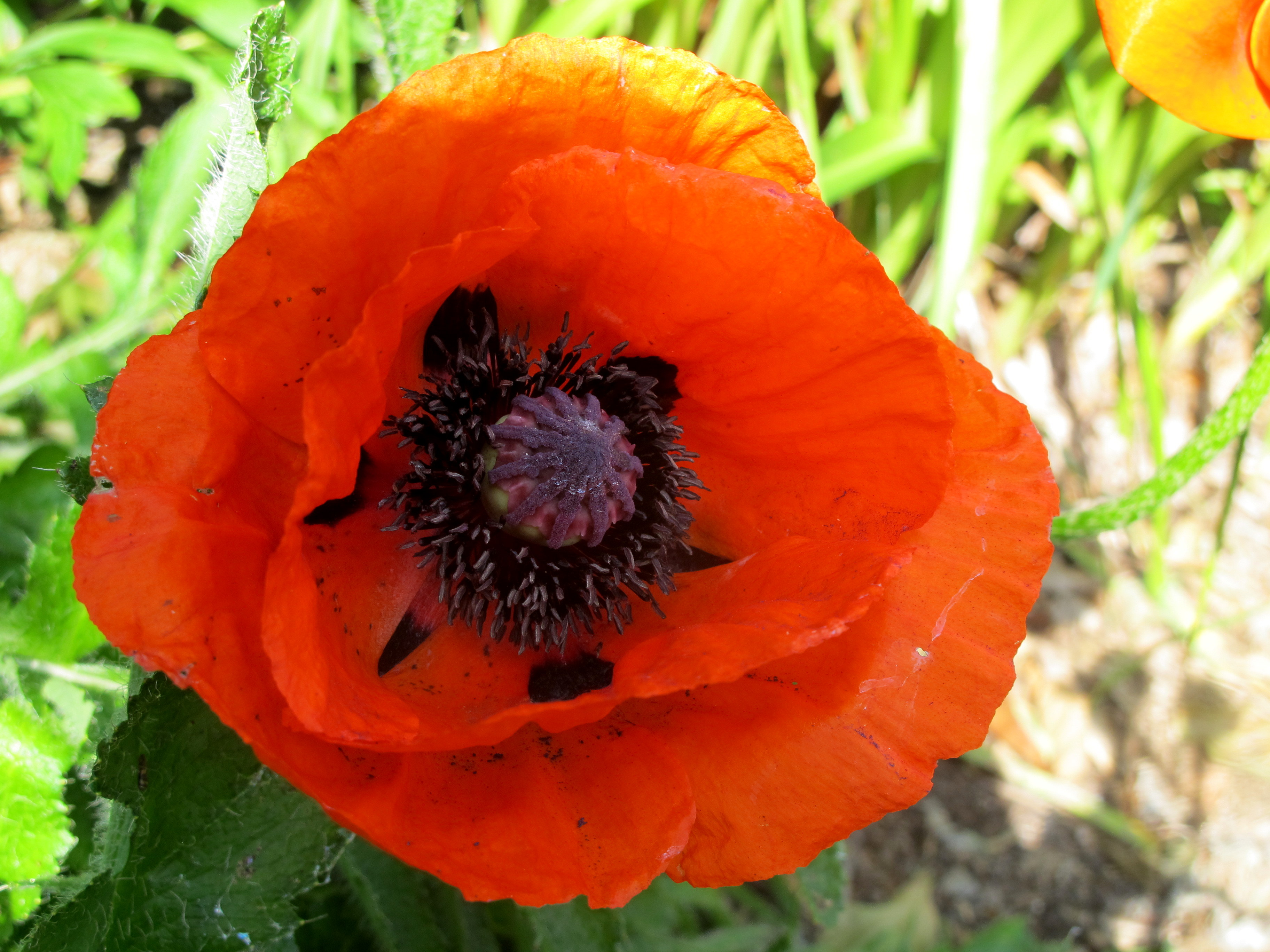
Irrelevant photo: a poppy

Wild Thing and I tried them once. It wasn’t part of an effort to understand Britain better. We were at our local store (which is also our local post office) and some German tourists had just left after trying to ship an entire carton of the stuff home to themselves. When they found out how much it was going to cost, they took their package off the scales and tossed it in the back of the car instead.

By the time we arrived, the women working there were still going helpless with giggles and saying something along the lines of, “A carton of Weetabix,” as if it was the punchline of some long, delicious joke that was too British for us to ever understand. So we thought we should try them. Maybe we thought they’d taste good, or be good for us. Or maybe we just wanted to understand the joke. It was a long time ago and I’m not sure I understood our motives at the time, never mind in hindsight. What I can report is that on contact with milk Weetabix immediately turn mooshy and inedible. We not only didn’t finish our box, we didn’t finish our bowls. I have no idea what we did with the rest. I don’t like to waste food, but you have to make an exception to some rules.

If they’re so nasty, why do people like them? Well, this is a country that loves mushy peas. And porridge, which is only one step away from wallpaper paste. So people here—people, just to be clear about this, who aren’t us, and to be even clearer, some people here, not all people here—just love them.

A quick browse online led me to The Student Room (“The largest student community in the world”; sorry kids—I’ll be out of here in a minute, and anyway, it’s not a locker room; is everyone decent?), which asked the burning question, “What kind of Weetabix do you eat and how?”

It’s interesting (I’m trying not to say “bizarre”) enough that they asked the question, but even more so that people cared enough to answer it. Which reassures me that young people will still rise to an intellectual challenge if you present them with one.

The answers (before I got bored and left, snapping a towel or two on my way out) include: with lots of sugar; with yogurt and jelly; with warm milk and sugar; with cold milk and sugar; microwaved with milk, sugar, and chocolate; with a spoon; with banana; with banana-flavored milk. With more sugar, and a little more sugar after that. The company website promotes the stuff as low in sugar and it’s good to see the impact that’s had on the nation’s health.

The company also promotes it as a kind of all-purpose crunchy base—something you’d spread with soft cheese and Peter Piper’s picked peppers, or with jam, and then, since you have to do something with it, eat. Or laminate and display on your coffee table. They also have recipes. You can bake muffins and loaves and cakes with the stuff, or crumble it up and bread chicken with it. So basically, you can use it for anything. You’re short of wallpaper paste? Weetabix. Your bike tires need patching? Weetabix. Need a base for your kids’ art projects? Weetabix, Weetabix, Weetabix.

The underlying message seems to be that if you buy it, you can be creative. Open a box and spark up your deadly dull life. Just think—you can choose hot milk or cold; banana or anchovies; pickles or iron filings.

Now let’s be clear. I come from the country that brought the world American cheese, Cheez Whiz, and Cool Whip.

I should explain those for readers who’ve kept their innocence: The first two are cheese that’s been processed into unrecognizability. American cheese looks like suspiciously smooth sliced cheese but it has the texture and taste of nice, soft plastic. When I was a kid, I thought it was great. Cheez Whiz squirts out of a can. Do not give it to kids who are having a party. Cool Whip contains (or so Wikipedia said when I checked) water, hydrogenated vegetable oil, high fructose corn syrup, corn syrup, skimmed milk, light cream, less than 2% sodium caseinate, natural and artificial flavor, xanthan and guar gums, polysorbate 60, sorbitan monostearate, and beta carotene.

No, I don’t know what most of that is either.

It also squirts out of a can and produces something that looks like whipped cream and tastes like something that looks like whipped cream. In Canada, they use nitrous oxide as a propellant, That’s laughing gas. This is something else you don’t want to give to kids who are having a party. Especially if they’re old enough to know about the propellant.

If you grew up on real cheese and whipped cream—the kind that recognizably come from dairy products—you’ll be scandalized by all three of them. So I have no right to be snotty about what people in other countries eat. That won’t stop me, but I do want to acknowledge the injustice of it.

The United States also (as far as I can figure out) gave the world the paint-by-the-numbers kit, so the U.S. is no stranger to canned creativity. I was about to say that buying creativity in a cereal box takes us a step beyond that, but then I remembered a series of advertising campaigns implying that creativity consisted of putting something new and exciting on a Ritz cracker. Or maybe it was a Triscuit.

I tell you, I grew up in an exciting world.

So what Weetabix is doing is no worse than that, except that it tastes like moosh and Ritz crackers and Triscuits at least taste like crackers.

Okay, I never tried a dry Weetabix. I’d expect it to taste a lot like hay, but I’m not buying a box just so I can give you a description. I’m going to step aside and trust that someone will step in and tell me—probably that they taste great. If that’s what you hear, take it with a grain of salt, folks. These things are highly subjective.

A report from the Department of Deceptive Appearances

Norway

A Norwegian anti-immigrant group went into fits of online hysteria about a photo of women in burkas only to find out that they were looking at a photo of six empty bus seats. Which, to be fair—and I do want to be fair to people with despicable politics and narrow minds—did look a lot like six women in burkas.

“This looks really scary,” one comment said. “Should be banned. You can’t tell who’s underneath. Could be terrorists.”

I’ve felt that way about bus seats myself. And let’s not get started on the seats in New York subways.

Other comments were about whether bombs or other weapons could be hidden under the seat covers.

Wales

A group of Catholic seminarians were kept out of a Cardiff pub because the staff thought they were a bunch of guys on a stag night.

To understand this—and I don’t, really, but I’ll do my best—you have to understand that the British have a thing about playing dress-up, which they call fancy dress, making it sound marginally more grown up. So guys on stag nights are likely to dress up in costumes and make a complete drunken nuisance of themselves. So the bar has a policy of not letting in “parties wearing fancy dress.”

At some point, the assistant manager decided they were for real and not only let them in but bought them a round. Everyone involved seems to have decided it was funny–unlike (I’m guessing) the Norwegian anti-immigrant group members, who are still too traumatized to ride the bus.

Ants, slugs, and bankers: snippets from the British news

Ants: Flying ants swarmed the Wimbledon tennis tournament on July 5. It’s called Flying Ant Day—the day the young queens, followed by swarms of over-amped males, leave the nest to mate, say wheeee, and start new colonies.

And pester tennis players at Wimbledon, which adds a certain spice to it all. If you’re (a) an ant and (b) into that.

The British press thinks this is a natural phenomenon, but it’s actually one of the ways Americans celebrate Independence Day, and it takes a lot of planning to nudge nature this delicately. For years we’ve been trying to get swarms of flying ants to disrupt British tennis, but it depends on Wimbledon getting warm at just the right time, so most years it doesn’t work. Warm weather’s hard to predict in Britain, and even harder to control.

This year we were only a day late–we were aiming, of course, for July 4. Still, that’s not bad, considering the variables involved.

You’d think that 241 years after we declared independence we’d be over it enough to stop playing pranks on Britain, but some things are hard to give up.

Semi-relevant photo: our pansies, which the slugs and snails just love

A week or two after they disrupted Wimbledon, ants went airborne in the Westcountry and our local paper reported that seagulls were getting drunk on them. The ants contain formic acid, which “disrupts the birds’ cognitive ability.” They’ve been reported flying into cars and buildings. (“Hello, emergency services? I just saw a seagull flying recklessly, and I think it was drunk. Could send someone to investigate?”)

(Sorry–I don’t write British dialogue well and normally I don’t try. I’m sure I should probably work a please in there somewhere.)

Anyway, one expert says they’re under the influence. Another says the problem was the heat. And the ants? “They are a good source of nourishment.”

I don’t normally go expert-shopping, but since almost everything I know about flying ants–actually, considerably more than I know about flying ants–is already contained in the few paragraphs you either just read or skipped over (thought no one would notice, didn’t you?), the best I can do is relay both opinions. So if you plan on eating many flying ants, you’re on your own, because I’m not sure which expert to trust.

Slugs: Naturalist and BBC presenter Chris Packham has asked gardeners to end their war on slugs. And although he doesn’t mention them, presumably on snails, which are nothing but slugs who live in fancy houses and—the world being what it is—get better press and less grief than their lower-rent relatives.

I understand Packham’s argument: Hedgehogs eat slugs. Slow worms eat slugs. So—apparently—do song thrushes.

So what? Well, Britain without hedgehogs would be like Britain without castles, except that castles don’t eat slugs so what use are they, really, in this age of nuclear weapons? Hedgehogs, on the other hand, are cute—and they eat slugs. Which is a circular argument. We need the slugs to preserve the hedgehogs and we like the hedgehogs because they eat the slugs. But we do get a bit of Olde English charm in the middle of the circle, so it’s all okay.

And slow worms? They’re not as central as castles and hedgehogs, but they are part of the British countryside. And even though they look like snakes, they’re not—they’re legless lizards.

What’s the difference between a legless lizard and a snake? No idea, but shouldn’t we keep them around anyway, what with them being part of the British countryside and all? Besides, Britain doesn’t have many snakes. We need slow worms to remind us how few snakes we have.

Okay, I’m bullshitting here, looking for something that sounds like an explanation. As far as I’ve been able to tell, the British are fond of slow worms. I’m sure they have a reason, but it’s not like this stuff is entirely rational.

As for the song thrush, I don’t think I’ve ever heard one but Wild Thing has and says their song is sublime. She was an avid birdwatcher before she lost part of her sight. She’s a somewhat less avid bird listener, not because she doesn’t love their songs but because she doesn’t have a gift for memorizing them.

So there we are. If you want humans to protect something in nature, you have to convince them it’s cute, cuddly, essential to the nation’s self-image, or a good singer. And if it isn’t? You find a way to link it to the cute, cuddly, etc. Which is how you go about protecting the slugs of this world, even though they’re slimy and slithery, eat our flowers and lettuces, and can burrow a full three feet into the earth. We need to protect them because our hedgehogs need them. Our castles need them.

So, if you kill slugs and you’re attacking Wind in the Willows and—oh, I don’t know, Winnie the Pooh (admittedly, those were stuffed animals, but that’s okay, they were very British and very cute) or whatever other stories formed our vision of the British countryside.

I agree with Packham about the need for slugs, but I’m not sure what to do about it. I’m a vegetarian, so you could be forgiven for imagining me as one of those gentle, do-no-harm people who go skipping through fields of wildflowers while taking care not to trample the bugs.

Bullshit. On most summer nights, I go out and slaughter slugs. And their upmarket cousins the snails. When I skipped a few nights recently, they ate so much of my lettuce bed that one head looked like umbrella ribs after the fabric had been ripped away.

So I’m not sure where to go with this. Buy supermarket lettuce? That only outsources the slaughter. Even our most innocent food comes at a cost. But as long as some other category of creature’s paying that cost, we do, as a species, have a tendency to ignore it.

My compromise, at the moment, is to pretend I don’t see the slugs and snails in most of the garden, focusing my slaughter on the veggies and a few flowers where they do the most damage. We have a hedgehog in the neighborhood, and every so often I wonder if it considers the slugs I’ve cut in half edible or if it needs them to be alive and slithering and in pain.

It’s a lovely world we live in. In spite of which, the hedgehog, when we saw it, really was cute. It made me want to go read Wind in the Willows, even though I never liked it and never finished it and it doesn’t (as far as I know) have a hedgehog in it.

Bankers: The tenth anniversary of the last financial crash is coming up and Mark Carney, the governor of the bank of England, wants us to know that the financial system is safer, fairer, and simpler.

Safer, fairer, and simpler than what? Presumably than it was before the crash, but the article I read didn’t actually name the point of comparison, so for all I know he’s comparing it to a WWF wrestling match. (No, I’m not sure what WWF stands for. It’s not the World Wildlife Fund. Let’s go with World Wrestling Foolishness. Or something else with an F. Foam, maybe. Filosophy. Farce. Fixative. Facial Tics. Let it go, people. We’re talking about banking. This is a digression.)

“We have fixed the issues that caused the last crisis,” Carney said. “They were fundamental and deep-seated, which is why it was such a major job.”

Before his reassurance, I was wondering when the next crash would come. And now? I figure it’s coming that much sooner. When they tell you it’s all okay, that’s when you need to worry.

In an earlier article, which presumably we’ve all forgotten by now, Carney said the U.K.’s borrowing binge was worrying him. And the day after he announced that everything was all fine, the morning paper said the Bank of England was worried that credit cards, personal loans, and car loans “could rebound on the banking system.”

I’ve been noticing articles about how shaky the economy is ever since.

So keep one hand on your wallet, folks. The banking system is stronger, softer, and safer than ever.

Or was that fairer, not softer? There’s a toilet paper ad I keep getting it mixed up with.

More than you need to know about fish and chips

Janice Wald at Mostly Blogging called my attention to the role fish and chips play in the British diet, so let’s see what you can learn about them from a vegetarian.

The Federation of British Friers (who are not to be confused with friars, who may have eaten fish on Fridays but otherwise have nothing to do with the story) writes that “fish and chips are the undisputed National dish of Great Britain.”

Yes, they do capitalize national for no better reason than that it matters to them. It’s a British thing, capitalizing words they like.

No, they’re not objective; these are the people who fry fish for a living, or at least represent the businesses that fry fish. But that stuff about fish and chips being the national dish agrees with pretty every other source I checked. Historic U.K. claims, “Fish, chips and mushy peas! There is nothing more British than fish and chips.”

Yeah, they’re asking a lot of that exclamation point, and the poor little thing didn’t manage to generate the excitement they were looking for, but I’ve done a bit of freelance writing myself and I cranked out copy that was just as dismal. So let’s just nod knowingly and move on.

Irrelevant photo: a surfer, riding a rock.

In fact, we’ll move on so fast that we’ll skid right past the mushy peas for now. I’ll come back to them. What you need to know for now is that everyone says fish and chips are as British as it’s possible to be.

Except for beer, because in a recent post I quoted an ad supplement that claimed eccentricity, beer, apologies, and tea were the essential elements of Britishness. It didn’t mention fish and chips. It all goes to show that you shouldn’t take anyone’s word for the essentials of Britishness.

And all the more so since neither source mentioned curry, although people here often say, “Nothing’s as British as a curry.” It’s meant to have an ironic edge, curry being a cultural import and all, unlike the deeply British fish and chips, but it turns out fish and chips also came from someplace else. They—or is fish and chips an it? Singular fish, singular dish, plural chips. It’s messy. Anyway, they or it either were or was brought here by (gasp) immigrants.

And the immigrants in question were, in case anyone isn’t getting this, foreigners, every last one of them.

So what are people who want their British culture pure to do? Give up both curry and fish and chips? What’ll be left?

Maybe a kebab. Or a plate of spaghetti. Or a nice cup of tea.

National purity’s hard to find. If you locate any, send up a flare, would you?

The BBC (which covers all the important stories) reports that “fried fish was introduced into Britain by Jewish refugees from Portugal and Spain. The fish was usually sold by street sellers from large trays hung round their necks. Charles Dickens refers to an early fish shop or ‘fried fish warehouse’ in Oliver Twist (1839) where the fish generally came with bread or baked potatoes.”

Fried fish was (were?) introduced in the seventeenth century—roughly the same time as fried potatoes. (The potato was brought from the Americas earlier, by Sir Walter Raleigh. Unless it was brought by Sir Francis Drake. You can find claims for both.) It was probably the French who first thought of deep frying them.

So that’s yet another bunch of foreigners messing with British cooking.

Chips, by the way, is American for what the British call crisps. Sort of. We (the we here being Americans) usually add “potato,” so it’s potato chips. Chips is British for what Americans call french fries.

Are you still with me? Am I? I went over that three times to make sure I hadn’t gotten lost.

Some of the sources I read are clear about the immigrant role in hooking Britain on fish and chips, but a few manage to run through the entire history without mentioning it. I’d be amused if immigration weren’t such a charged issue just now.

The north and south of Britain both claim to have invented the combination of fish and chips. According to Wikipedia (when I checked; it will have changed by now), “Some credit a northern entrepreneur called John Lees. As early as 1863, it is believed he was selling fish and chips out of a wooden hut at Mossley market in industrial Lancashire.

“Others claim the first combined fish ‘n’ chip shop was actually opened by a Jewish immigrant, Joseph Malin, within the sound of Bow Bells in East London around 1860.

“However it came about, the marriage quickly caught on. At a time when working-class diets were bleak and unvaried, fish and chips were a tasty break from the norm.

“Outlets sprung up across the country and soon they were as much a part of Victorian England as steam trains and smog.

“Italian migrants passing through English towns and cities saw the growing queues and sensed a business opportunity, setting up shops in Scotland, Wales and Ireland.

“To keep prices down, portions were often wrapped in old newspaper–a practice that survived as late as the 1980s when it was ruled unsafe for food to come into contact with newspaper ink without grease-proof paper in between.”

During both world wars, fish and chips were considered so essential to civilian morale that protecting the supplies was a government priority. During World War II, they were one of the few foods that were never rationed, although that doesn’t mean they were always available. When word got out that the local chippie had fish, queues formed and people were willing to wait an hour or more.

I’m not sure if fish and chips are still considered primarily working class or if they’ve gone upmarket. I do know that they’re not as popular as they once were, partly because, as stocks of cod and haddock have been depleted by overfishing, the price has gone up and partly because people have become leery about eating too much fried food. But there are still some still 8,500 fish and chip shops in U.K.

And here we circle back to mushy peas, because all or most of them sell mushy peas as well.

I think. Listen, I’m a vegetarian. I don’t poke my nose into fish and chip shops if I can help it, and I generally can. I’m taking other people’s word for this.

If you’re not British, you’re asking, “Mushy what?”

Peas. They’re dried peas, soaked and then boiled with a little salt, a little sugar, and some baking soda, called bicarbonate of soda here, until they form a lumpy, green moosh and taste of nothing in particular.

Why would anybody eat that, never mind do it? Well, it’s food. If you eat it, it will fill your stomach. And if you grow up on it, you’ll learn to love it. Either that or you’ll run screaming every time they’re mentioned.

When I told my friend R. that Wild Thing and I had worked up our courage and tried mushy peas, she told me people eat them with fish and chips, not on their own. And given the British habit of packing a bit of every food on the plate on the end of their fork, that means they can count of the fish to lend the peas some taste.

How do Americans eat? One food per bite unless the dish itself mixes them the way, say, stew does, or a mixed salad. No, I don’t know why. I also don’t know why the British eat a bit of everything at once. Honestly, I’m no longer sure why anyone does anything. Humans are hard to make sense of.

By the time R. told me that mushy peas weren’t meant to be eaten on their own, we’d each taken one lone bite and didn’t feel the need to try again. I may be a vegetarian and they may be vegetabilian, but I don’t go out of my way to eat oak leaves and grass either, and they’re equally vegetabilian.

I’ve now told you everything I know about fish and chips and mushy peas–and more.

Could the next topic someone throws at me be about something that’s more clearly either singular or plural? Please?


Quotes from politicians who should have shut up

Two quotes from politicians to carry you through the week:

From the Ministry of Mixed Metaphors comes Tim Farron, who was trying to explain why he stepped down as leader of the Liberal Democrats: “I had bet the farm on our position of Brexit but I was content that if I went down with the ship I went down fighting.”

Once the ship goes down, the fields will to be too muddy to plow for a long time, Tim.

And from the Committee for Resurrecting Dead Authors comes Andrea Leadsom, who was briefly in the running to lead the Conservative Party. In what sounds like a desperate attempt to one-up a Labour MP who was praising women’s achievements, she said, “I would just add one other great lady to that lovely list…and that’s Jane Austen, who will feature on the new £10 note, who I think is one of our greatest living authors.”

Austen dies 200 years ago. Waterstones bookstore jumped onto twitter and asked if anyone knew who her agent was so they could book her for an event.