Sexy onions and the Bayeux Tapestry: It’s the news from Britain

A Canadian seed company’s ad for Walla-Walla onions was banned from Facebook for being overtly sexual. 

Why? Well, you know how people say they can’t define pornography but know if when they see it? Well, the algorithm saw some onions dressed in their standard-issue papery brown jackets and one cut down the middle, showing every bit of oniony flesh it had. 

Personally, I don’t find things that’ve been cut in half particularly sexual, but there’s no accounting for what turns people on, and algorithms understand that. 

After a fair bit of glee on social media, the decision was reversed.

And yes, I do know Canada’s no longer British. I cheat. You’d be wise to keep your eye on that if you’re going to be here for long.

*

A new app allows people to construct their own Bayeux tapestries, suitable for online use or printing. You can move figures and scenery into place, change their sizes, and flip them so they face the other way. What you can’t do is reposition their arms and legs. You could make an entire comic book, but you can only work with the figures you’re given as they’re given. 

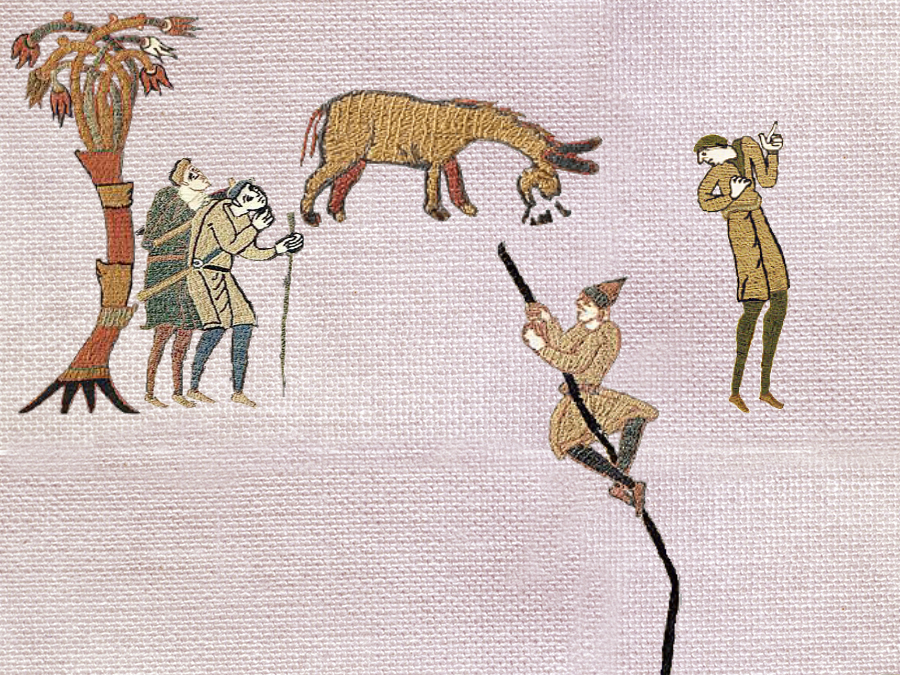
My very own Bayeux tapestry. I have no idea what’s happening here, but the donkey looks like Eeyore and the guy climbing the pole is in trouble.

The Bayeux Tapestry? It tells the tale of the 1066 Norman invasion of England. It was made in England but it ended up in Bayeux and carries its name because possession may be only nine-tenths of the law but it’s ten-tenths of the name.

Not only is the tapestry not originally from Bayeux, it’s also not a tapestry.To be a tapestry, you (or it, in this case) have to be made on a loom. Who knew? The Bayeux Tapestry is embroidered and was made in relatively small pieces, then joined together (none too well according to History Extra) and sewn onto a backing. 

It’s 68 meters long, which is roughly the width of a football field. Or a soccer field if you’re American inflected.   

A Victorian copy of the tapestry hangs in a museum Reading, which unlike Bayeux is in Britain. It’s the same as the original except for a border, the embroidered names of the women who made it, and itty bitty underpants on the men who were running around naked on the one in Bayeux. Because what’s a major historical battle without naked men?

Want to blame Victorian women’s modesty? Sorry, but we don’t get to do that. The undies were added by male staff who photographed the original for the women.

The final piece of the tapestry is missing. You can use the app to create your own. I  recommend it, especially if there’s another lockdown. 

*

If you’re of a sensitive nature, you might want to skip to the next asterisk, but this is bizarre enough that I had to include it. A company called Qiui sells a male chastity device, called Cellmate, as a sex toy. 

Yes. I know.

No, actually, I don’t know. See Walla-Walla onions, above. That’s my final word on the subject.

Cellmate’s also sold as an anti-cheating device, although the mechanics of wearing it for anything other than the short term–

Never mind.

Ah, but this isn’t just your everyday male chastity device, it’s a smart male chastity device. Not because it’s for smart males. The device itself is smart, and that’s where it ran into trouble. It’s controlled by Bluetooth, which means it can be hacked.

What happens when someone hacks a smart male chastity device is that it locks. Or not it: them. All of them, so anyone who happens to be inside one when the electronic switch flips stays inside. Or, to borrow an annoying saying from a TV show, What happens to be in Cellmate stays in Cellmate.

The makers recommend using a screwdriver to break it open. They’ve also updated the app. 

In case you’re interested, they cost £146. You didn’t hear it here and I don’t want to know about it.

*

Let’s move on.

Brexit’s looming and as I write this (Tuesday morning, October 20) I’ve read enough conflicting headlines that I feel like a pool ball bouncing off the bumpers. Or possibly a writer afflicted by an overworked metaphor. 

Can we move on again, please? 

Thank you.

The headlines tell me that the Brexit talks are over, that talks are not-so-over, that the UK is refusing to restart talks although the EU accepted its demands, and that the EU caved. Also the Britain and the EU are beginning to repair the rift and restart the talks. 

I’ll spare you the links for those, if you don’t mind. What we do know is that something is definitely happening.

Unless it isn’t.

I’ve said this before, but you can’t get too many warnings: Stock up on cat food.

*

By now, we (and by we, of course, I mean I) need something other that the onions to feel good about, so let’s cut to the tale of Kamal Singh, a seventeen-year-old ballet student from Delhi, who was offered a place at the English National Ballet school but couldn’t afford to take it. His father’s a rickshaw driver, and he was looking at fees and living expenses that would come to £20,000.

As a younger student, he’d already had trouble keeping up with the £37 monthly fees that his ballet school charged. His teacher recognized both his passion and his gift and told him to come back the next day, he wouldn’t charge him.

He later took him on as a full-time student and organized a scholarship.

A crowdfunding campaign, backed by some Bollywood stars, raised the money Singh needed to take up his place in the ENB and he started earlier in October. 

I dare you not to feel good about that. 

*

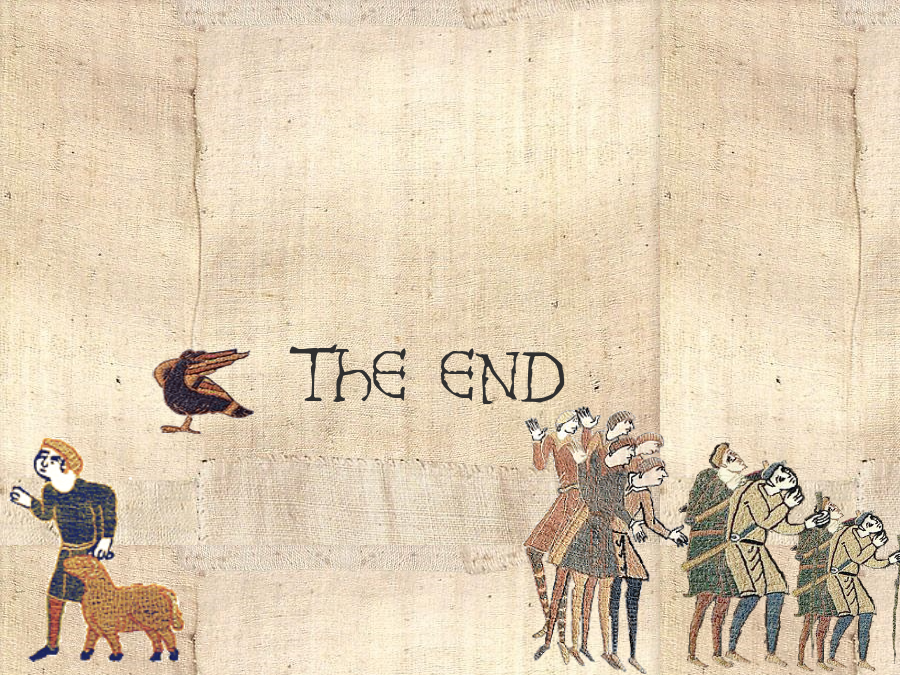
Late addition: The final panel of the Bayeux Tapestry has been discovered. All this time, it was on my computer.

Local lockdowns and, as always, money: it’s the pandemic news from Britain

Britain’s Covid test and trace system may be a functional disaster, but boy is it a moneymaker. Management consultants are taking home as much as £6,250 a day. Admittedly, not all of them, but you know, in a pinch a person could live on that.

One of the big track-and-trace players here is Boston Consulting Group, known to its friends as BCG. You and I can call it Boston Consulting Group. Senior execs are being paid as much as £1.5 million a year to salvage the test-and-trace mess. 

To throw another set of numbers at you, 40 people were paid £10 million for four months’ work. The government’s budgeting £12 billion for the program. 

I have no idea how all those numbers come together. Are we supposed to add them together? Divide? Multiply? Hide them under the floorboards? All I get out of them is that a lot of money’s flying around.

There’ve been too many screwups to list, but a recent one saw the program giving out used swabs for people to test themselves with. 

Irrelevant photo: roses.

*

In the meantime, the government’s at odds with its scientific advisory committee, SAGE, which advocates a short national lockdown–now called a circuit breaker–that would last a couple of weeks. Instead, the government’s doing local lockdowns.

How do they work? 

If you’re in tier one, you can get together with 6 people from up to 6 households (or 6 people from 12 households if your friends are divisible) indoors or out, with or without alcohol. If you add enough alcohol, you won’t care if you’re indoors or out. You’ll find yourself falling on people you barely know, people who come from 12 or 14 different households, telling them how much you love them. That’s not allowed, but it happens anyway. 

If you’re in a pub or restaurant, you have to sit at a table, which means you can only fall on the random acquaintances who are sitting next to you, but you’ll have to leave at 10 p.m., because that’s when pubs and restaurants close now. Once you’re outside, you can fall on all sorts of people and tell them you love them, and it’ll be all the sweeter for not being allowed.

If you’re in tier two, you can get together with 6 people from, oh, you know, hundreds of households, but only outdoors, with or without alcohol. See above for alcohol and closing times and love.

In tier three, you get multiple paragraphs because your life’s going to be complicated. Or at least your restrictions will be. You can’t socialize with anyone you don’t live with or who isn’t in your support bubble. What’s a support bubble? It’s an idea that at one point made sense but no longer does because politicians poked so many holes in it that all the logic leaked out. We’ll talk about it some other time, okay? 

Casinos, betting shops, bingo halls, and soft play centers are closed but gyms and leisure centers aren’t. Why? They have better lobbyists, that’s why.

Pubs are closed unless they serve substantial meals, in which case they can serve alcohol with the meal, but only with the meal. 

Eat slowly.

What’s a substantial meal? The evening news had lots of fun interviewing people about whether a pasty qualified or whether it had to have a side salad or potatoes with it to be a meal. Since a pasty’s pastry with potatoes and some other stuff inside, that’s sort of like having potato pie with a side of potatoes, so nutritionists might get huffy about it, but even they will have to admit that it’s substantial. 

Okay, a traditional pasty has meat and a stray bit of veg, but yeah, it still has a fair bit of potato. 

If you live in, say, a tier three area but work in a tier two area, whose restrictions are you supposed to follow? I haven’t seen anything that explains that. The government’s advising against traveling to any part of the country in a higher tier except for work, education, or a few other reasons. If it advises against traveling to a lower tier, I haven’t seen that either, although you’d think it would make sense. 

Which may be why they haven’t addressed it.

A separated parent asked the prime minister whether he’d be able to see his son. The prime minister, true to form, gave the father the wrong information. The correct answer is yes, you can see your kid, regardless. Johnson’s answer was–well, there’s no point in repeating incorrect information. What he meant was, “Why are you asking me? I’m the prime minister. Go ask someone who knows something.”

What about people in established relationships who don’t live together? If they’re in one of the higher tiers, they get to see each other outside and not touch. Unless they’re in a support bubble. Remember support bubbles–those things I’m working so hard not to define? But they can only ecstatically unite into a single bubble if one of them lives alone, at which point they can safely hold hands. 

By now it would’ve been simpler if I’d just explained support bubbles, but I’ve got too much invested in not doing it. Besides, we all need a little mystery in our lives.

As you can see, it’s a simple system.

In the meantime, the prime minister and the local leaders in Greater Manchester are arguing about whether the area belongs in tier two or tier three. Rumor has it that Johnson wants to impose tier three restrictions but is afraid the police would side with local government and refuse to enforce them. The main difference between the two sides–I think–is how much the government is willing to pay workers who are locked out of their jobs. So far, they’re offering less for the local lockdowns than they did for the national one.

On Saturday, the prime minister and the mayor couldn’t even agree on whether they’ve scheduled a phone call to discuss the problem on Sunday. 

*

Gordon Brown, who was Britain’s chancellor and briefly its prime minister, warned that the country’s facing a double cliff edge, Brexit and the costs of Covid. He knows a shitload more about finances than I do but he’s not so great with a metaphor: “I think we’ve got two cliff edges coming,” he said hallucinogenically. He did modify that by adding, “If it’s possible to go over two cliff edges at once,” but he doesn’t seem to have noticed that cliff edges mostly stay put and insist that you come to them.

Never mind. The point’s still valid.

The pandemic news: Science, social media, and the rule of six

England’s in three separate stages of Covid restrictions right now, with the stage depending on where you live and how high the local infection rate is, but weeks ago the government’s official scientific advisory group urged it to impose a short, tight lockdown to stop the rise in infections. To which the government said, “What do you know? We’re following the science.”

“Wait a minute,” the scientists said. “We’re the scientists.”

“Not the scientists,” the government said. “The science.”

It’s not clear at the moment exactly what science they’re following. I’ve been wondering if they got hold of one of those “The Science of. . . ” books. You know: The Science of Getting Rich, The Science of Storytelling. Or if they have science confused with Scientology.

Entirely relevant photo (if you read to the end), which won’t play well on social media: This is Fast Eddie thinking deeply.

In the meantime, though, everyone’s mad at everyone. Local governments in the areas with tighter restrictions are furious that they’ve been allowed no power (never mind funding or serious consultation) to deal with their local situations. People whose workplaces will be shuttered are mad that they’ll be paid a smaller percentage of what they’d have earned than they were paid during the national lockdown. Disregarded parts of the country are feeling more disregarded than usual. They tend to be the places where the infection rate’s high, because transmission’s highest among low-income groups and minority ethnic groups, which aren’t groups that get a lot of help from governments in general but that get even less when the Conservative are in power. So they’re mad. Parts of the Conservative Party are mad because they don’t want the government closing things. The Labour Party’s mad because it’s sure it could handle the pandemic better than the Conservatives–and to be fair, it would be hard work not to. And I’m not particularly happy because I’m buried in newspaper clippings. 

Yes, I work from actual paper, at least to start with. Some days, all you can see of me is a tuft of white hair and a pile of newspaper. 

Send tea. The dogs will know how to find me. 

*

It’s not just local governments who are feeling slighted. MPs from hard-hit areas are finding out about government plans for their areas via What’sApp or being given twenty minutes notice of briefings. One, from Wigan, claimed she was left out of a briefing because the ministers in charge didn’t know where Wigan is. To make up for that, another was invited to a briefing for an area her constituency isn’t part of. 

A third heard about a twenty-minute briefing eight minutes after it had started.

*

You know those face shields that are (presumably) more comfortable than masks? It turns out that they’re the next best thing to useless. Almost all those lovely, airborne droplets and aerosols that the wearers breathe out escape through the gaps. But you’ve got to admit they make a person look like they’re serious about not spreading the disease.

*

In September, while England was learning to count all the way to six in order to figure out who it was safe to get together with outside of a work or educational setting, a stag hunt not only got 130 people together, almost all without masks, the outfit putting it on also got a £10,000 government grant and a £50,000 loan from pandemic-related programs.

Grouse hunts are also exempt from the six-person get-together limit. But if you want to get together and grouse about how inconsistent the rules are, the limit’s still six.

*

People (predictable creatures that we are) increased their use of social media during lockdown, and it turns out that people who send more pictures on social media are at greater risk of depression. Or so says an admittedly small study involving 170 participants, an online questionnaire, and absolutely no photos of anyone standing on a beach looking 30 pounds thinner and 10 years younger than their actual weight and age. 

Does that mean photo-sharers are depressed (or at risk of . . . ) because they send photos or do they send photos because they’re depressed or at risk of? We don’t know. Or I don’t, and the report I saw doesn’t say. All I know for sure is that one fact one lines up with the other one. So can we be safe, please, just in case sharing photos does cause depression. Tell the cat he can stop doing that thing with the lettuce and the chisel because you’ve put the camera down and you’re going to face an entire day without clicking the imitation shutter even once. Even if he starts playing the banjo, you’re not picking it up. Not today.

Yes, bare-assed reality’s tough, but it’s out there anyway. Might as well see what it looks like.

*

In an earlier post (and if you think I know how much earlier, you don’t understand how things work around here), I mentioned a Covid bailout program for small businesses that the British government set up so loosely that it screamed “Scam me!” and people obligingly did. Well, for the sake of balance, it set up another one to be so complex that only one company got all the way through the process. 

The idea behind Project Birch was that big companies would get emergency finance and in exchange give the government a stake in the company. Ten companies were interested but found the process so complicated that they walked away.

*

The U.N. secretary-general, Antonio Guterres, said that the pandemic has shown us that the world needs universal health care if it’s going to deal with the next pandemic. 

By not responding adequately to this one, we’ve let the pandemic cause more than a million deaths, infect more than 30 million people in 190 countries, wipe out 500 million jobs, and cost the global economy $375 billion a month. 

The standard indicators of human advancement and well-being are going in reverse for the first time since the U.N. started measuring them in 1990.

*

It’s not news that the pandemic’s put a strain on health systems everywhere and that both non-urgent and damn urgent treatments have been postponed. But how is NHS England (NHS being the National Health Service) planning to respond? It plans to fine NHS trusts (that means hospitals, or at least the organizations that run them) that haven’t gotten back to near-normal schedules by the end of the month. Because what could possibly make more sense than taking money away from an overstretched system when it shows signs of being overstretched?

You bet. That’ll learn ‘em.

*

Johnson & Johnson’s vaccine trial has gone on hold while they frantically try to figure out why one of the participants got ill. That’s roughly all the information that’s available, although any decent reporter can fill several paragraphs with it. I’m not a reporter, so all you get is two sentences.

*

The following is a note from that deepest of thinkers, Fast Eddie the cat. He doesn’t usually communicate with strangers, and since he’s broken his silence I believe we should pay attention: 

sddddddddd bbbbbbbbbbbbbbbbbbbbbbbbbm,

Please, people, give it some thought.


Tumble dryers and Twitter: It’s the nonpandemic news from Britain

A university student near Hull got stuck in a tumble dryer that she’d climbed into on a dare. 

Why yes, she and everyone within three miles of her had been drinking. What made you ask?

Her housemates called the fire department and three firefighters worked her loose. Before they left they checked the washing machine. Just in case. To save themselves another trip. 

I was hoping to say that this is what students do when they’re in lockdown, but I don’t know that the University of Hull was in lockdown. What I can tell you is that the university webpage about keeping students safe while they’re on campus doesn’t mention either laundry or laundry-related hardware–an oversight that I’m sure they’ll remedy as soon as I bring this to their attention. I’d have called by now but I wanted to let you know first. 

The student herself admitted that she’d never done her own laundry before. That doesn’t strike me as entirely relevant, since everyone who washes clothes once did it for the first time. The first time I ever took that daring step, I don’t remember being overcome by an impulse to climb into the dryer. Admittedly, my mother talked me through it: See, she told me, this is the water. These are the dirty clothes. What you want to do is introduce one to the other in the presence of this detergent that’s all stuck together because the basement’s a little damp. Just chop some out with this measuring cup, trying not to spray it all over the floor.

But even so, I don’t remember for one second wanting to measure the dryer for size. In fact, thousands upon thousands of people do their own laundry for the first time every year without climbing into the dryer. 

Maybe we’re all repressing the impulse. If you repress it well enough, you can’t be sure it was ever there.

*

Irrelevant photo: a hellebore.

As long as we’re in the Hull area and visiting with firefighters, a nearby crematorium got carried away with its work and set itself on fire. It took eight hours to put out the blaze, which started just before a service, so someone just missed their chance to go out in a blaze of glory.

Sorry. I couldn’t help myself. It’s a genetic problem.

*

A tour group in Iceland lost a tour member and, when she didn’t show up after an hour, hit the panic button and set off a search involving mountain search teams and the rest of the tour party. 

At 3 a.m., a member of the tour realized that she was the person she was looking for. She’d gone back to the bus and changed her clothes, so the 5’2” Asian woman in dark clothes was now a 5’2” Asian woman in some other kind of clothes. 

Cue many headlines about going to Iceland to find yourself.

*

Gay men invaded the Twitter hashtag of the Proud Boys, a far right group (or neofascist, if we’re calling a fascist a fascist this week) that was mentioned approvingly by Donald Trump before Trump himself was mentioned approvingly by the Covid virus. 

The invasion consists of gay male couples posing proudly–with each other, with their kids, with a Canadian Army uniform and a partner.  

The claim that the Proud Boys changed their name to Leathermen to get away from the invasion is, sadly, a spoof, but funny enough that I was happy to believe it until someone challenged me. If you’re not familiar with leathermen, Twitter will introduce you to a bunch of muscular gay men looking very kinky. 

Movies, apps, and money: It’s the pandemic news from Britain


Boris Johnson responded to the news that a movie chain is closing by urging Britons to go to the movies. Or in British, go to the cinema. But the closure’s only temporary, so presumably your patriotic visit to the cinema can also be temporary. 

So can your exposure to the Covid virus.

How does going to the movies fit with the world-beating, Covid-containing rule of six that the government keeps explaining to us? As usual it’s simpler than you moaners are trying to make it sound. You can’t get together with more than six people at your house. Or at theirs. Or at the pub. Or outdoors. You can’t mix socially or go to the movies together. But you can go to the movies with, say, twenty-five strangers if you all happen to go to the same show. And if you happened to meet 24 ½ of your closest friends at the movies by accident, that would be okay because the accidental nature of the gathering keeps the virus from spreading. 

Virii are methodical little beasts. Throw a few random moves at them, like running into 24 ½ friends at the movies, and they get confused. Throw popcorn at your friends to remind yourself of what friendship and community used to feel like and the virii will be knocked out of their orbits.

And there’ll be those empty seats between you, which may genuinely help, although more and more evidence is landing on the side of nearly weightless aerosols dancing the virus through the air of enclosed, poorly ventilated spaces, in which case an empty seat may not be enough.

Irrelevant photo: mallow

Masks do help. The question is, will people keep them on in the dark while they eat their popcorn. 

Remember that the rule of six is a guideline, not a law. 

Or maybe it’s a law, not a guideline.

Oh, hell, no one knows anyway. Don’t worry about it. Enjoy the show.

*

Scotland’s Covid app isn’t the same as England’s. It’s called Protect Scotland, and–have I mentioned that the apps have glitches? A man downloaded it, picked up a ping, picked up another ping, and–I won’t take you through all the details–eventually figured out that the app thought he could catch the virus through the floor from the guy downstairs. Who must either levitate or be extremely tall and store his phone on his head to get within two meters of the upstairs phone, which (I’m going to assume) doesn’t live on the floorboards.

Or maybe the neighbor stores his phone on a top shelf. And the downstairs phone does live on the floorboards.

Anyway, I keep reading that the apps have glitches, but I wouldn’t have predicted that one.

*

Speaking of glitches, the one that disappeared some 16,000 positive Covid test results from England’s test and trace system may have been caused by a size limit on the files Excel spreadsheets can accept. Send anything more and it smiles serenely and cuts off whatever’s at the bottom of the file. 

Problem solved, at least from its point of view.

Excel’s habits aren’t news. In 2013, it masked a loss of–oh, something like $6 billion from JP Morgan’s books. So yes, this could’ve been predicted. 

The test and trace contract, by the way, is up for renewal. Given how expensively it’s been screwed up, I’m going to bet they’ll renew it.

*

The Bounce Back scheme, which was supposed to help small businesses survive the pandemic, may have been scammed out of £1.9 billion. The government was warned ahead of time–twice–that it was a vulnerable program but decided to go ahead. 

And Britain’s five biggest banks will make £1 billion out of it. Legally.

Another £238 million will be spent on work coaches to help people who lost their jobs in the pandemic by coaching them on interviews, CVs, and moving into growing sectors. You know growing sectors, like, um, hang on. Work coaching. That’s a field where they’re hiring. 

*

More evidence is landing on the side of Covid not spreading via contaminated surfaces. Scientists aren’t saying it’s impossible, just that it’s not the root of the spread. 

Yes, it’s still worthwhile washing your hands obsessively, and it may be worthwhile disinfecting the groceries and boiling the mail before you so much as look at it, but the real danger is in sharing poorly ventilated spaces with our fellow human creatures. 


Does the Covid virus work nights? It’s the pandemic update from Britain

With Covid cases rising in Britain and more than a quarter of the country living with local restrictions on top of the national ones, pubs in England have been told to close at 10 pm. So who can resist a story about Parliament’s bars being exempt from the rules?

Parliament has thirty bars and the booze is subsidized, so it’s cheap. And we shouldn’t be calling it booze, because a lot of these people are high-class guzzlers. They’re not in the habit of letting people talk about them as if they were your everyday, low-rent lush. They are extremely high-rent lushes.

But high rent or not, sitting in the House of Commons or the House of Lords is a thirsty job, so they need those bars. Which, I assume, is why they were neatly defined as workplace canteens, which gave them an exemption on both hours and a few other things until the opposition–that’s the Labour Party–started yelling, the whole thing got a bit of embarrassing publicity, and someone decided that, gee whiz, guys, this might give people the wrong idea about us. 

The bars now stop serving at 10 pm, and that will last until either the regulations change or outsiders promise not to notice.

*

Irrelevant photo: Pansies. I’ve given up growing them. The slugs and snails just love ’em.

What’s the logic behind closing the bars at 10 pm? According to our prime minister, who’ll say anything that comes into his head, however incoherent it may be, “What we’ve seen from the evidence is that the spread of the disease does tend to happen later at night after more alcohol has been consumed.” 

What evidence do they have that the disease spreads late at night once the viruses or their containers (that’s us) have gotten shitfaced? Well, the BBC asked the Department for Health and Social Care for the specific evidence and didn’t get it. Instead, the BBC ran through an assortment of data from Public Health England, showing the number of outbreaks in schools, food-related businesses (you can slot the pubs in there), care homes, and workplaces, but it inevitably showed more transmission in places where testing’s heaviest, so it’s anything but conclusive. And it doesn’t mention time of day. Or night. 

Professor Mark Woolhouse, who’s on the government’s infection modelling team, explained (helpfully), “There isn’t a proven scientific basis for any of this.”

So as far as we know, the virus works both the day shift and the night shift.

*

A study has begun on how long Covid can survive once it’s airborne. Figure that out and  you can figure out how to reduce the risk people run in enclosed spaces. 

The consensus is that it’s not just the larger droplets that humans breathe, cough, and sneeze out that carry the disease, it’s also aerosols–tiny beasties less than  5 microns across, which hang in the air much longer than droplets. By way of comparison, a human hair is 60 to 120 microns across. 

Because aerosols are so small, they stay airborne longer than droplets and can be carried by air currents. 

Humans are messy creatures, always breathing–not just in but (annoyingly) out–and we tend to share whatever’s taken up residence inside us. So if the disease does spread on aerosols, keeping two meters away isn’t going to keep us safe. 

Earlier research gave the rough estimate that Covid has a half-life of 1.1 to 1.2 hours in aerosol form, but the new research will create a closer replica of real-world conditions, even varying it for different climates. I’m hoping they don’t tell us that we all need separate countries. In spite of how difficult we are as a species, I actually like being around other humans. Not all of them, but a fair few.

*

Here’s a quick snapshot of Britain at the moment: University students across the country went back to school this month, and (to no one’s surprise) universities are reporting Covid outbreaks. They’re being urged in all directions: to drop all face-to-face teaching, to continue normal teaching, to be sure campuses are two-thirds empty, to quarantine affected students and pretend that in a dorm that solves the problem, to let student life carry on as usual because the climate of fear is doing untold damage, to return the tuition they charged, and to keep the tuition they charged.  

The only way to choose the correct advice is by having a gorilla throw darts at a target.

A report says infections in the food industry are thirty times higher than are being reported. 

A scientist from SAGE–the group of scientists who advise the government–is arguing that repeated two-week lockdowns could knock the virus on the head. Not necessarily hard enough to kill it but enough to make it dizzy.

Outside of Britain? The world has now logged a million coronavirus deaths. Those are the ones that’ve been counted. How many are there really? No one knows. Countries haven’t even agreed on the definition of a coronavirus death, and we won’t get into the problem of figuring out who actually had it when testing is so patchy. But basically, a lot of people have died, and that’s not taking account of the people who are left debilitated or of the economic damage the pandemic leaves in its wake.

*

A quick Covid test is now available. It gives a result in 15 to 30 minutes and works like a pregnancy test, but nine months later you don’t have to wake up in the middle of the night and feed anybody. 

Unless of course you want to. 

The makers claim it’s 97% accurate, but in real-world conditions it picks up something more like 80% to 90% of infections. Other quick tests are sold online, but this is the first one that meets the World Health Organization’s standards. By way of illustration, Spain ordered two sets of rapid tests in March and sent them back.

A second test is expected to get WHO approval shortly.

Under an initiative started by the WHO, the European Commission, the Gates Foundation, and the French government, 20% of the tests will be made available to low- and middle-income countries for $5 per test. The rest will go to wealthy countries. You may notice an, um, imbalance there between what wealthy countries get and what poor ones do, but it’s actually better than the alternative, which is to have them all go to the countries that can pay the most. 

Yes, it’s a lovely world we live in.

Right now, most low- and middle-income countries are doing minimal testing. North America tests 395 people per 100,000 daily, Europe tests 243, and Africa tests fewer than 16, but most of those are in just three countries, Morocco, Kenya, and Senegal.

It’s not clear whether the UK plans to buy any of the tests. It’s committed heavily to two different tests that take 90 minutes, aren’t as easy to use, and cost more.


*

A reporter asked Boris Johnson to explain the tighter local restrictions that northeastern England is living with and, to prove how simple the rule of six is, he got it wrong. It all has to do with how many people you can get together with indoor and outdoors.

Here’s how it really works:

If you’re outside the restricted area, it’s six inside and six outside. But if you’re inside, it’s six inside but not six outside. 

I hope that clears everything up. If not, just hide in your basement, knock the glass out of a periscope, and breathe through that. We’ll look for you when this all passes, as all things must.

Freedom, survival, and flag waving: It’s the pandemic news from Britain

A reporter asked Boris Johnson (although not in these words) whether the mess we call our Covid test and trace system might explain why Italy and Germany have lower infection rates. 

Britain’s a “freedom-loving country,” Johnson explained, “and if you look at the history of this country in the last 300 years, virtually every advance, from freedom of speech to democracy, has come from this.”

In other words, “I may not approve of the coronavirus, but I will defend to the death our right to respond with complete incompetence, as well as my right to give fat contracts to my friends and respond to pointed questions with irrelevant answers.”

Wave that flag, folks. Strike up the band. There’s money to be made.

*

Irrelevant photo: Orange berries. What would you do without me to explain these thing to you?

England’s Covid tracing app, let’s call it App 2 point 0h-Yes-We-Will, is up and running. The older one, App 1 point 0h-No-You-Won’t crashed into the brick wall of reality when it was tested on the Isle of Wight, leaving barely enough shards to make fun of. But take heart: 2 point 0h-Yes-We-Will is off to a roaring start.

  • Android users were able to download the trial version, so of course some of them did. They hated it. 
  • iPhone users who left a hyphen out of the app’s name got the New Zealand version. None of them came within two meters–or several thousand miles–of anyone on the system. This may be the fastest way to stop the spread.
  • NHS workers who downloaded the app and brought their phones to work were told they’d been exposed, even though they were wearing protective gear. 
  • People with older phones were sent into the outer darkness–that place where apps are unavailable and contact with the rest of the human race has to be made in person. “Older” is defined as prior to 2018.
  • People who had symptoms but tested negative can’t enter that into the app. It only accepted positive. But since they’ve been tested, the isolate-yourself countdown began. And couldn’t be turned off.
  • People who took tests outside of the privatized testing system–through NHS England, for example–couldn’t enter them into the app. That was tens of thousands of results that were missed. Daily. 
  • Users could only mark themselves down as infectious if they’ve been tested. The idea–probably a reasonable one, given what the world’s like–was to keep a bunch of wiseasses from saying they were infectious for the sheer joy of sending people home to isolate needlessly and, basically, shutting the country down because it sounded like a fun thing to do on a Saturday night. But since the testing system’s broken and tests are hard to get, people who genuinely were infectious couldn’t prove it to the app. 

Other than that, though, it’s going well. Except for Downing Street at first saying the app couldn’t trace contacts and then having to explain that, well, yes, actually it can. And will. And sing “There’ll Always Be an England” while it does it. 

You have to love these people. I’m not sure what they thought the point of the app was if it couldn’t trace contacts, and whoever they threw out in front of the press apparently didn’t stop to wonder. By now, I expect everyone at the press conference was too punchy to think of the question until it was too late to ask it.

I’ve scrupulously listed the app’s problems in the past tense, although I’d bet a batch of very good brownies that most–possibly all–of them could be hurled into the present tense without damaging my credibility even a small amount.

My credibility’s limited, I know, but I still have more than the people running the country.

Britain, by the way, has more test capacity than Germany, Ireland, South Africa, Spain, or South Korea. And in spite of that, people can’t get tested. 

*

A study said the privatized network of Covid testing labs “bypassed accreditation and raises quality concerns.” It also criticized the system of having people do their own swabs, saying it can lead to useless samples. 

When you do the test, you’re told to swab either your tonsils or their last known address. My tonsils still live with me, as they have for 73 years now, so I know they’re somewhere in Cornwall. But we don’t have the kind of relationship where we do a lot of hand-holding, so when I took a test I couldn’t tell if I was mopping my own tonsils or someone else’s. 

I’m relieved to hear that’s a flaw in the system, not a personal failing.

*

Chancellor Rishi Sunak told us that there’s no “risk-free solution” to Covid and we all have to “learn to live with” it. Human contact is important. Spending money is also important, although I don’t think he exactly said that, but all the same the economy needs us. “Lives can no longer be put on hold,” he said. Britons should learn to live “without fear.”

Personally, I’m more interested in still being alive by the time this ends–assuming it does end–than in being fearless. Preferably with my lungs, heart, kidneys, brain and other body parts still working at full capacity, and with my energy in the functional zone. Also with my sense of taste and smell intact. Fear can be crippling, but its gift is that it can also keep us from crippling or killing ourselves–from walking off cliffs, say. It’s like pain. No one likes it, but it offers us important information. 

I can live with a reasonable amount of fear, especially if it means continuing to live.

*

I can’t speak to Sunak’s genuine competence, but he’s the one member of this government who at least projects the image of it, leading to rumors that he may turn out to be Boris Johnson’s replacement–assuming, of course, that the Tories break with recent tradition and select for competence when they choose their next leader. He may be signaling here that he leans toward the libertarian wing of the party–the let ’em wander free, the virus will take care of itself wing. 

Never say it can’t get any worse.

*

Enough with the politicians. Let’s visit the scientists: 

A Centers for Disease Control study found a correlation between eating out and catching Covid. That’s not proof, it’s just correlation, as in the two seem to be lining up more than is statistically likely. But it’s worth noticing.

Eating out included eating indoors, on patios, and outdoors. 

What’s the difference between a patio and outdoors? Damned if I know. I thought they were both outdoors.

Which should warn you about how little I know.

*

A new Covid test can be done at home and it takes only fifteen minutes. What’s more, it’s cheap, although the article I saw didn’t say how cheap. The problem? It only detects the virus in people with a high viral load. The team that developed it talks about it as complementing existing tests, not replacing them, and says the people with the largest viral load are the people most likely to transmit the virus.

For some time now, I’ve been reading about fifteen-minute tests, half-hour tests, and instant tests that can be done only by large, bearded men with divining rods, but they’re always in development, or about to be set loose in the world but not quite yet. Or that they’re available on the internet but their accuracy ranges from who knows to don’t ask me. 

Then they drop out of sight. The only one that’s resurfaced is the sniffer dogs. Fido’s working in a pilot project in an airport in Finland. Do not go through a Finnish airport with dog biscuits in your pocket.

*

Speaking of viral load, a study in Detroit found the viral load decreasing in hospitalized patients between April and June, and that lined up neatly with a lower number of deaths. They’re not sure why the viral load was lower, but it might be a result of social distancing, lockdown, and face masks–especially when they’re worn over the parts of the face that we breathe through.

Does anyone know why we keep talking about face masks? Is there some other part of the anatomy a mask could cover? The eyes are a possibility, but they’re generally located on the face.

*

The city of Manaus, in Brazil, may have reached herd immunity: 66% of the population may have Covid antibodies. (Yes, but do notice that the word may squeezed itself in there not once but twice.) Getting to that point involved mass graves, overwhelmed hospitals, and corpses piled in refrigerated trucks. People there are still dying of Covid, but the numbers are going down. 

As soon as that went public, experts jumped in to warn against thinking that herd immunity is a viable strategy. 

Florian Krammer, professor of microbiology at Mount Sinai Hospital in New York, tweeted, “Community immunity via natural infection is not a strategy, it’s a sign that a government failed to control an outbreak and is paying for that in lives lost.” 

And after all those deaths, immunity to Covid may be short-term. No one knows yet.

*

I said earlier that I wanted to get out of this mess with my sense of smell intact. Why do I care? Not only because I like food and if you lose your sense of smell your sense of taste goes with it, but because its loss may indicate some serious long-term losses.

Yeah, sorry, yet another study. Those scientists. They will keep worrying about this thing. How are we supposed to live without fear when they keep scaring the shit out of us?

This study takes off from Covid’s demonstrated ability to get into the brain and insult the cells. That’s is childish, I know, but brain cells aren’t used to it and they’re sensitive. Insult them enough and they die. 

True, Covid knows how to do insults. One of its insults involves starving the cells of oxygen, and that would probably upset anyone, so maybe we can cut the brain cells a little slack here.

Covid does less drastic things as well. The loss of smell is one, and the study treats that as a neurological symptom and an indicator that Covid’s up to something in the brain and nervous system. The loss of smell, it says, is caused by an inflammation that could cause long-term neurological problems.

Inflammation, it turns out, causes a variety of neurodegenerative diseases, including Parkinson’s, and 90% of people who get Parkinson’s report a loss of the sense of smell in the early stages. After the Spanish flu epidemic of 1918, survivors had two or three times the risk of developing Parkinson’s.

So yes, even those of us who don’t speak science are starting to see a pattern.

*

From the Department of What’s It Going to Take, People? comes the story of a gospel choir in Spain that scheduled an outdoor concert in September and then rehearsed for it indoors.

Members did the recommended stuff–kept a distance, washed their hands, and wore masks for most of the rehearsal. They even did a temperature check as people arrived. What they didn’t do was open the windows–there were moths out there, and mosquitoes. So they turned on the air conditioning, because hey, it was hot.

When the article was written, thirty of the choir’s forty-one members had tested positive.

Exactly what a gospel choir in Spain sings I don’t know. I’m probably defining gospel in American. 

*

And from the Department of Good News at the End of a Post comes this: A study estimates that England’s decision to house the homeless in unused hotel rooms during lockdown may have saved 266 lives and avoided 21,000 infections, 1,164 hospitalizations, and 338 intensive care admissions among the homeless alone. That doesn’t count the people they’d have gone on to infect.

I’ve been trying to find out if the program’s still going on. I think so, but I can’t swear to it.

Math, medicine, and research: It’s the news from Britain–and elsewhere

Martin Hairer won the $3 million 2021 Breakthrough Prize in Mathematics for explaining the math involved in stirring a cup of tea, which is also the math involved in several other things that don’t sound as silly. It’s complicated stuff–180 pages worth of complicated, involving regularity structures. 

Never heard of them? Neither has anyone else. That’s what’s so impressive. They tame the randomness that throws disorder into equations involving the way forest fires grow, the way a drop of water spreads on a tissue, or the way that cup of tea you’re stirring–

Would you stop that stirring? You’re upsetting an otherwise ordered univer–

Damn. Now see what you’ve done.

Regularity structures may be the genuinely impressive element of his work, but if you want an impressive phrase to use when you’re pretending to explain this to someone who’ll understand it even less than you do and isn’t listening anyway, the phrase you want is stochastic analysis. Or better yet, stochastic partial differential equations. From those words on, everything you say will be nothing but a background hum to whatever’s going on inside your alleged listener’s own head.

If you want complicated math, though, you could try explaining why a bunch of mathematicians are giving out a 2021 prize in 2020.

*

Irrelevant photo: Wind-carved rocks at the top of Rough Tor, which is pronounced Ruff Tor. No, don’t ask me.

If you’re British inflected instead of American inflected (yes, there’s an L in there: infLected), that’ll be maths, not math. I can only assume that the British are better with numbers than the Americans, since they wrestle with them in the plural  and we only have one to fight with. 

*

The Breakthrough Prize is also awarded in the sciences, and Catherine Dulac won one for showing that the neural circuits that govern the behaviors involved in both male-specific and female-specific parenting are present in both sexes. I have no idea what the implications of that will turn out to be, but they should upset a few apple carts. I look forward to hearing more.

*

As long as we’re on the subject of medicine and male/female differences, Rebecca Shanksy, a neurologist from Boston University (no, it’s not in Britain, but never mind) is calling for stricter requirements for medical research to include both female and male animals. 

For decades, researchers have used both male animals and male human subjects on the grounds that the fluctuations of female hormones would–forgive me if I use complicated scientific language here–fuck up their results. 

They did that even when they were studying conditions that mostly affected women. Because you know what women are like. Hormonal. Unstable. Unpredictable. Lots of un- words. 

It turns out, according to Shanksy, that male rodents–the go-to subject of many experiments–are less stable in terms of both hormones and behavior than females.

Shanksy is, by way of full disclosure, a female and therefore likely to be biased and unstable. Unlike males researchers, who are entirely objective and don’t have hormones.

The result of the male bias in research subjects is that drugs are likely not to work as well on women as on men. Ambien, which did its trials using both male mice and male humans, turned out to be metabolized  more slowly by women, and therefore (don’t ask me) more powerful in them. 

Women tend to experience more side effects and overdoses for all drugs. 

The U.S. and Canada now require female test subjects to be included (Britain doesn’t yet), but experiments are often done first on male subjects, with female subjects used later, treating the female subject as a deviation from the male standard. The article I read didn’t go into whether or how that biases the results, but I can see that if the first set of tests establish a standard, you could easily close off avenues that might be open if you worked differently.

*

Were we talking about sexism? The Musee d’Orsay in Paris–a museum with walls full of nudes–wouldn’t let a woman in because an official decided her dress was cut too low. 

And if that wasn’t bad enough, they followed up their decision by telling her, “Calm down, madam.” 

So she did what any good citizen of the twenty-first century would do: She went online and called them out on their double standards and sexism. The museum has apologized, both by tweet and by telephone, but it’s not the first time the museum’s had a problem with women’s real-life flesh as opposed to the artistic depiction of it. It called the cops on a performance artist who posed nude next to a nude painting. She was in jail for two days before a judge threw out a charge of public indecency.

*

An eighty-year-old hiker who’d been missing for three nights turned up not at his own funeral but at a press conference, held in a pub, where his family was about to appeal for help finding him.

Harry Harvey got separated from an organized walking group during a heavy hailstorm and spent three nights wild camping. He had camping gear with him but ran short on food. He described the area where he lost the group as desolate.. 

He eventually spotted a wildlife photographer, who called a rescue team and they brought him to the pub just in time for a dramatic reunion. 

The quotes from his family make them sound a bit on the crabby side about it all. 

*

A research trial that put robots into care homes has been defended on the grounds that the robots aren’t intended to replace humans, only to help fill times when, because the care system’s overstretched, staff don’t have time to spend with residents.

Which is commonly known as replacing humans with robots, only the humans were taken out before the robots were put in and no one had any intention of filling the gap they left–not even with robots.

The robots have wheels and a name, which they all share–Pepper. Also arms and hands. With a bit of programming, they could hold basic conversations with the residents, learn what they’re interested in, play them music, teach them languages, and remind them to take their medicine. 

This could go wrong in so many ways. In Japan and Singapore robots are more widely accepted and have been hacked to intercept phone calls or let the hacker use the robot’s camera and microphone. I don’t find any mention of medication reminders going wrong, but I doubt many of us suffer from the delusion that technology is flawless. 

The two-week trial found that residents’ loneliness levels decreased–not hugely, but a bit. 

*

Britain’s home secretary, Priti Patel, called Extinction Rebellion “criminals who disrupt our free society and must be stopped.” Other cogs in the government chaos have talked about classifying it as an organized crime group, which takes a bit of mental mechanics, since XR is decentralized and I suspect you’d be hard put to find an overall organization. 

The police, interestingly enough, see XR as nonviolent and committed to civil disobedience.

*

We’ll end with some more science awards, the Ig Nobels. This year’s include an one for determining that many entomologists–those are the folks who study insects–are afraid of spiders. Which aren’t insects, so it seems fair. Another went to a study that tried to spot narcissists by the shape of their eyebrows. A third went to a study that looked for a correlation between a nation’s income inequality and the prevalence of mouth-to-mouth kissing.

Covid, Brexit, and a nice cup of tea

Silver Lining Department: Pain researchers have noticed that Covid can block pain receptors, fooling people into thinking they’re not sick. I’d explain that in more detail, but between the first few paragraphs of the article and the last ones all I managed to scrape off the page was an impressive-sounding buzz. 

What I can tell you is that understanding this (as I so clearly don’t) opens up two possibilities: 1, By blocking something called neuropilin-1, doctors could limit Covid’s entry into the body. 2, By blocking neuropilin-1, they could limit the body’s experience of pain. 

In other words, a new approach to pain control may come out of this mess, as well as another possible way to tackle Covid. Take heart, my friends. Every silver lining hides a cloud.

Or vice versa. I keep forgetting.

*

Tragically, that line about silver linings isn’t my own. I stole it from a song by Brian Bedford, “I Hear the Sky Is Falling,” sung by Artisan. It’s a lovely little paranoia song. I recommend it, because we all need a paranoia song to fall back on from time to time. 

*

Irrelevant photo: pears on our tree.

Early research says that Covid doesn’t spread easily among kids under ten. They don’t catch the bug as easily as adults, and when they do they don’t get symptoms as often, which means they don’t cough and sneeze it into other people’s breathing spaces.

That was the silver lining. The (small) cloud is that infected kids do spread it, but at a lower rate. 

After kids turn ten, though, every cell their bodies wakes up, showers, and puts on big-boy pants and a bad attitude, and from then on kids spread it more easily–possibly as easily as adults.

But again, that’s all based on early and limited research. Like so much about this mess, it’s not certain.

*

On Tuesday, when he was announcing a new, improved, world-beating set of Covid restrictions in England, Boris Johnson called for togetherness. Or, to be completely accurate, “a spirit of togetherness.” 

I don’t want to misquote a man whose public statements mean so little.

So what does this one mean? We’re all going to virtually join our sanitized hands, keep two meters apart, and sing “Kumbaya” as we beat the virus by not doing half the things he told us–told us? hell, begged us; harassed us– to do just six weeks ago. 

I support a lot of the changes–the country opened up too quickly, with minimal planning and a screwed-up testing system–but I don’t know how seriously people are going to take them. The government’s blown whatever credibility it back when lockdown started. So even though some of their own scientists (that means the ones they’re willing to listen to, sort of) say the restrictions are late and not enough, getting people to follow them may be like rolling a dead horse uphill in an ice storm. 

*

About a 20% of people in Britain say they’d be likely to refuse a Covid vaccine and 78% said they’d be likely to get it. The missing 2% may be covered by the about at the beginning of the paragraph. Or they may be on break, having a nice cup of tea. It’s a British thing–not drinking the tea but attaching a nice cup of to it. It makes such a difference when you raise it to your lips. Your blood pressure falls. You expect–well, if not exactly wonders, at least niceness. And as a rule, you get it. 

 *

A post or three ago, I wrote about younger women forming a larger part of hospitalized Covid patients, and I’ve found a bit more detail: The study was based on hospital admissions and it noticed a rise in serious cases among women between twenty and forty. Between January and September, 44% of hospitalized cases were women. Since August (yes, you noticed: they overlap), it’s been 48%, driven by a rise in the twenty-to-forty age group, with no matching rise in admissions of men in that group. 

So it’s not a huge rise, but it is an increase. The best guess is that it’s because the work women in that age group do leaves them more exposed to the virus than the work men do. It should remind us, though, that no age group is invulnerable.

*

Hospitalized Covid patients who also had the flu were more than twice as likely to die as those who didn’t (43% as opposed to 26.9%). 

Those numbers don’t actually look like one’s more than twice the other, do they? I’m trusting an article in the Medical Express. Maybe they were in too much of a hurry to check their figures. 

Either way, it was a small study but the findings line up neatly with preliminary findings from another study that’s in progress. To be on the safe side, get your flu shot, okay?

*

The Helsinki airport has started to use sniffer dogs to detect travelers with Covid, and they’re close to 100% accurate. Plus they have lovely soft fur and it only takes then ten seconds to make their judgements, although the process itself somehow takes a minute, probably because humans are slower on the uptake than dogs are.

*

Meanwhile, with the Brexit transition period ending on January 1, we’re told that a reasonable worst-case scenario would involve lines of 7,000 trucks waiting to use the Channel Tunnel. They count on delays of two days and 30% to 60% of the trucks not having the right paperwork. 

And then there’s the possibility that a Covid spike could mean a shortage of port staff and border officials slowing things down a bit more.

And then we have to talk about disruptions to imports. Only we won’t. I’ve exceeded my dire warning limit for the day.

And did I mention that truck drivers will need a Kent access permit if they plan to use the tunnel or ferry to France? 

“We want to make sure that people use a relatively simple process,” Michael Gove said. 

Gove? He’s the minister for the cabinet office, the chancellor of the Duchy of Lancaster, and the only human being I’ve ever seen who looks like a balloon wearing a bow tie. Even when he’s not wearing a bow tie. 

When Johnson’s government tell you the process is going to be simple, you’ll want to sit down and make sure you’re comfortable.

The head of the Road Haulage Association said, “How on earth can [trucking firms] prepare when there is still no clarity as to what they need us to do?” 

We’re looking forward to another interesting year.