On the good ship Boaty McBoatface

The British are famous for their dry sense of humor, but not long ago they took it out for exercise and got it wet.

What am I talking about? The Natural Environment Research Council will be launching a new polar research vessel, which they say “will be the UK’s largest and most advanced research ship yet. She will allow scientists to carry out research safely and efficiently, even through the harshest of winters, in both Antarctica and the Arctic.

So far, so unfunny. But in an effort to create the illusion of public involvement, some genius launched a Name Our Ship campaign.

Irrelevant photo: Yes, the prevailing wind blows from the right. If, of course, you're facing the right way. Photo by Ida Swearingen.

Irrelevant photo: Yes, the prevailing wind blows from the right. If, of course, you’re facing the right way. Photo by Ida Swearingen.

Beware of media consultants bearing catchy ideas. The Research Council didn’t. Instead, they set up a web site, invited public involvement, and it all went wrong. So many people were voting that at one point the site crashed. You think that’s a success?

Nope. The top entry is Boaty McBoatface (ships’ names are italicized, in case anyone’s taking notes), and ol’ Boaty’s the reason so many people voted. Maybe the name caught something the spirit of the times or maybe there’s some more profound reason that I’m too shallow to spot.

After Boaty, you get a couple of serious names and you’ll forgive me if I skip those, right? Then we come to It’s Bloody Cold Here and Usain Boat. After that come Thanks for All the Fish (if you don’t catch the reference, you need to read The Hitchhiker’s Guide to the Galaxy; try to read around the ingrained sexism, because it’s funny in spite of the [I’d like to think] dated attitude) and What Iceberg?

Scroll down a bit and you come to my favorite, Big Metal Floaty Thingy-Thing, as well as Not the Titanic and Boat Marley and the Whalers.

Enough with trying to patch together interesting sentences. Others include:

Ship Happens

Boaty O’Boatface

Boatback Mountain

Fish ‘n’ Chips

Slippery When Wet

Do You Want Ice with That?

Science!!! (I like that one. I hear it in a high, manic, advertising voice.)

It Ain’t Half Cold Mum

ColdTrouser

Aunt Arctica

Float Like a Butterfly (for anyone who’s not old enough to remember, that’s a Muhammad Ali reference)

Big Ship Innit (in case you’re not British, innit translates to isn’t it) and

Bbrrrrrrr (with, yes, two B’s)

At this point, I was reading names that had thirty or so votes and I lost the will to scroll any further. By way of comparison, Boaty McBoatface had 76,470 votes. The next most popular ones were serious, and they had around 7,000 and 5,000. It’s Bloody Cold Here also had some 5,000 and no apostrophe. I added one. I had to. I trust someone will add it officially if the entry wins. Unless either maritime safety or the law of the sea forbids apostrophes.

After Boaty crashed the website, the Natural Environment Research Council announced that the vote is only advisory and they’ll make the final decision themselves, thank you very much. But you kind of knew that, didn’t you?

So there you have the British sense of humor. You thought I meant the names, right? I don’t. I’m talking about public consultation. Bureaucrats just love consulting the public.So much so that when I had to decide what category to file this under, Traditions won out. What could be more traditional than involving and then ignoring the public?


Important stories from the British press

What people lose

You can learn a lot about a country by what it leaves behind. So what does Transport for London report having found on the city’s trains and buses? A life-sized Spiderman doll. A prosthetic leg. Endless wallets, phones, and tablets. Umbrellas. A judge’s wig, a room-sized carpet, and an urn with human ashes. “Enough musical instruments to form a band,” including drum kits. No grand pianos, apparently.

I’m not sure who I’m quoting about that band, but unlike some quotes that drift through the culture, this one seems to have actually been said because the newspaper article I’m stealing the information from put it in quotes. It’s probably from a TfL spokesperson.

Oh, and a brown paper envelope with £15,000. Which the finder actually turned in.

A rare relevant photo: A London tube station. Photo by Ida Swearingen

Vaguely relevant photo: Public transportation, although not in London. This is the Exeter St. David’s train station. Photo by Ida Swearingen

I don’t know what any of that tells you about British culture. That judges wear wigs and ride the tube. That someone either thinks or knows that a judge’s wig is different from a lawyer’s. That stuff drops out of people’s pockets. You know—phones,  wallets, room-sized rugs, tubas. An archeologist would have a field day.

But the real treasures are in the comments at the end of the article, where readers talk about the stuff they’ve lost on public transportation (Guardian readers write the best letters to the editor and their online comments aren’t bad either): “the will to live” (Northern Line, winter of 1993), “the woman I love” (Chalk Farm Station), “my heart” (San Francisco, which is a city, not public transportation, but what are categories for if you can’t break out of them?), and democracy (location not specified but probably also not on public transportation). I won’t spoil all the fun. A lot of the jokes are about that prosthetic leg, but not all. I’ll leave you to discover them for yourself.

Tom Lehrer said, “Life is like a sewer: What you get out of it depends on what you put into it.” That may not be entirely relevant, although in an odd way it does seem to  belong here, but it is at least a genuine quote. (In a comment, Retirementally Challenged introduced the theory that some of the best quotes never got said.) Lehrer’s comment was on a record I played endlessly when I was in my teens. He may be to blame for the way I am.

What someone bought

You can also learn a lot about a country from what it sells. Want to buy a title? One was going to be auctioned off in December with (as far as I can figure out) a starting price of £7,250. I assume it sold. Sorry I didn’t let you know about it earlier but the clipping sank into the morass I call a computer desk and only just surfaced. So let me tell you what you (may have) missed:

The lordship of the manor of Woodbury Salterton village is roughly 1,000 years old. Buy the title (lord or lady) and you can use it on your checks and credit cards. You can join the Manorial Society of Great Britain. You can—. Oh. That’s pretty much it. I suppose you could put it on your mailbox. You could try to get mail and packages addressed to you that way. I have a post about that somewhere. Good luck finding it.

And all that for just £7,250–or maybe more, since it was an auction. What a thrill.

The manor (sorry, not the title; oooh, I’m getting all English, apologizing for stuff that isn’t my fault) was mentioned in the Domesday Book. If you haven’t heard of that, it was commissioned by William the Conqueror not long after 1066, when he decided to find out what he’d gotten his paws on in conquering England. The country, as it turned out, had no football teams at the time, no umbrellas, and no tea. You wonder why he bothered. It probably didn’t even have scones, since baking soda (that’s bicarbonate of soda if you’re British) and baking powder weren’t in use yet. At least not in baking. The Egyptians used a relative of baking soda to clean things and mummify people, but for baking? Nope. Not until the nineteenth century. Next time you find a list of all the marvelous things you can do with bicarbonate of soda, see if mummification’s on it. If not, it’s incomplete.

Where were we? Titles. The Lord or Lady of Whatsit. The newspaper article gushed a bit about the title (or maybe that was the manor; do you really care?) being steeped in English history, but I wasn’t impressed. Pretty much everything here is steeped in history. When they dug trenches for sewage pipes in a neighboring village, they found the remains of a prehistoric encampment and a burial site that mixed Christian (east-west burials) and pre-Christian (buried with grave goods, and I think north-south). One person was buried east-west and with grave goods, so whatever happened after death he or she would be ready for it. So history? You don’t need a title around here, just a sewage pipe.

What the British drink

Sales of tea have gone down 6% over the past five years and ordinary teabags—the ones that make what people call builder’s tea—have gone down 13%. It’s all (or mostly, anyway) the fault of coffee. The British have discovered that coffee can be something more than instant granules stirred into hot water and swallowed quickly enough to keep the taste from becoming noticeable. Coffee’s gone upscale. Tea sales are going down downscale.

There’s an English song that I have got to find time to make fun of someday, “There’ll Always Be an England.” It’s full of pomp and Empire and flag waving, and my apologies if you love it but the first time I heard it I was in one of those situations where you can’t let yourself laugh. I built up enough residual hysteria that I splutter when I so much as read the title. But the reason I’m bringing it up now is this: If tea is losing ground to coffee, will there always be an England? And not, how much longer can we count on it?

Long enough for the British Standards Institution to publish a guide to making the perfect cup of tea. It has the catchy title “Preparation of a Liquor of Tea for Use in Sensory Tests.”

What does it recommend? According to the Independent, it says, “You need a pot made of porcelain, and there must be at least two grams of tea to every 100ml of water. The temperature can’t go beyond 85 degrees when served but should be above 60 degrees for “optimum flavour and sensation.”

The Independent then interrupts the poetic prose and steps in to summarize: ‘The perfect pot size is apparently between 74mm and 78mm wide, and 83mm and 87mm tall. Since the average tea bag contains 1.5g of tea leaves, at least two tea bags should be used for a small pot, and four for a large one.”

The tea should brew for six minutes. And you should pour the milk into the cup first. That last decree is controversial. Seriously. If we have a civil war anytime soon, it will be over whether the tea or the milk should hit the cup first.

Which makes me think that, yeah, there probably always will be an England.

Celebrating Thanksgiving

“I think we Brits are a bit short on things to celebrate at this time of year,” DoneDreaming wrote when I asked what people might like to read about. “With Thanksgiving coming up I wondered if you could give us the lowdown on how we could join in. Do we Brits have what it takes to re-instate Thanksgiving over this side of the pond?”

Well, as every card-carrying American knows, the most important element in a Thanksgiving dinner is canned pumpkin, and—shock, horror, and I hope I don’t create in international incident here—it’s not sold in British supermarkets.

Okay, all you Americans who buy a prefab pie, settle down out there. I’m not bad-mouthing you or your pies or your dinners. My mother did the same and she was a wondrous and wise human being. Not a great cook, but if I had to choose between the two qualities. I’d go for the wonderful person.

Sill, those of us who pride ourselves on doing things from scratch load up on canned pumpkin and bake our pies with it. And somehow or other it never crossed my fuzzy little mind that dumping something out of a can kind of undermines the idea of from scratch until I moved to the U.K. and discovered that no one here had ever heard of canned pumpkin.

It took me several years (during which I begged our friend A. to make the pies) to work up the courage to kill, gut, and skin an actual pumpkin myself. I’m a vegetarian. My sensibilities are delicate. But the job needed to be done—I couldn’t impose on A. forever—and I not only learned to do it, I learned to take our Halloween pumpkin and cut it up and bake it the next day, turning it into pumpkin slurp. One vegetable, two holidays. Vegetarians of the world, all ye who proclaim that you don’t eat anything with a face, I tell you, this takes courage, because that jack o’lantern has a face, and it looks at you reprovingly from the cookie sheet as you shove it in the oven.

But let’s cut to the chase here: You bake a pumpkin, you scrape the slurp out, and you freeze it. Then a day or so before you make your pie you unfreeze it, by which time the water will have separated from the pulp and you can drain it off. Then you use either a food processor or one of those whizzy little blender sticks that are a whole shitload cheaper and you turn it to moosh—exactly the kind of thing you’d find in a can if only you could find a can.

And there you have it: canned pumpkin from scratch.

Wild Thing swears the pies taste better made from true scratch and she may be right. I can’t remember. But they work. That’s the main thing. Because you can’t have Thanksgiving without pumpkin pie. And no, I’m not going to offer a recipe. They’re all over the internet. Take your choice. But do serve it with whipped cream—a dollop on each slice.

The next thing you have to have on Thanksgiving is turkey (or for a small gathering, a chicken pretending to be a turkey). In the U.S. this is a cheap meat. In the U.K., for some reason, it’s crazy expensive, but since we only buy it once a year we just close our eyes and hand over the cash.

But I’m a vegetarian, you say. Yes indeed. But the rest of the world hasn’t come around to my way of thinking and for no good reason I draw the line at eating meat, not at cooking it. Purer vegetarians serve things like tofurky, which is tofu dressed up as turkey. Don’t ask because I’ve never tasted it. In fact, I’ve never actually seen it, just read about it. But its existence is a monument to how central the turkey is.

Back in the old days, you had to get up at 4 a.m. to put the turkey in the oven, because you had to keep opening the oven and basting the bird, which cooled the oven, which slowed everything down. Nowadays I use a magic non-melting plastic bag that keeps all the juices in so it doesn’t need basting and we sleep till a decent hour and feel like we’re getting away with something. The bags are probably ever so slightly toxic—who knows? I have a suspicious mind—but what the hell, we don’t use them often.

Thanksgiving’s a very patterned meal. You have to have cranberry sauce, although you don’t have to eat it. You have to have gravy, and ditto. You have to have potatoes—white, sweet, or both. You have to have a vegetable or salad, and you have to have something breadish, preferably rolls. We have baking powder biscuits—a nod to Wild Thing’s southern origins.

But more to the point, you can’t serve foods that aren’t part of the pattern, although we’ve thrown tradition to the winds for so many years now that it’s in tatters. Our tradition (and it’s not a traditional tradition, just something we’ve always done) is that guests bring a dish to add to the feast, and since we moved to Britain—well, the traditional meal has gone all pear shaped, to use a British phrase that makes no sense but that I love. People bring quiche and cauliflower and cheese and roast vegetables and chocolate cake and things that would have the Pilgrims—who American mythology holds started the tradition—accusing us all of heresy and witchcraft.

But, y;know, the Thanksgiving quiche? Why not?

The most important ingredient, however, is people—the more the better, in my opinion. Our party, sadly, is limited by the size of our house, so we try to keep a lid on it but each year we sneak in an extra person or two and it hasn’t exploded yet. More traditionally, people celebrate with the extended family, but we’ve never lived near our families and Wild Thing was estranged from hers for years, so we gathered up all the friends and acquaintances who were either far or estranged from their families and we made family out of that. It’s been wonderful.

Some families will stop and talk seriously about what they’re thankful for. Most will just eat. Many will watch the football game.

If you’re living outside the U.S., though, Thanksgiving isn’t a holiday so you’ll want to hold your party on a weekend, when people are off work. (Traditionally it’s on a Thursday, and no one who has to work the next day gets much done.) So you pick a random weekend late in November, because what the hell, it’s not the real date.

And then, if you follow the example I’m setting this year, you get the flu and have to postpone the party. In the U.S. if this happened you’d either go ahead, asking someone else to cook the turkey while you hide behind a closed door so you won’t infect your friends, or you’d move it to someone else’s house. Because Thanksgiving has to be held on Thanksgiving or it’s not Thanksgiving.

Outside the U.S., though? What the hell, it wasn’t on the real date anyway.

[Sorry, no irrelevant photo today because I really do have the flu and am putting this together on my toy typewriter, which doesn’t have any photos. Enjoy the holiday, whether you celebrate it or not.]

Bizarre British festivals: the flaming tar barrels

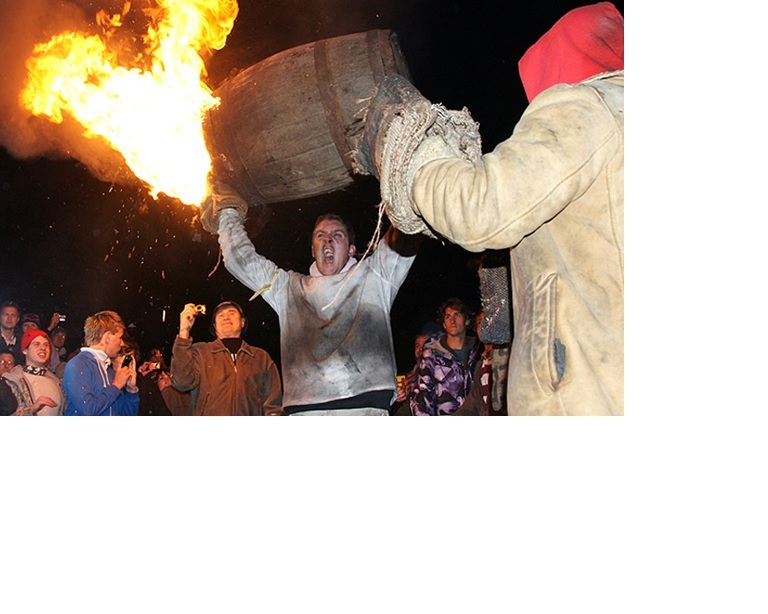
The web site for the Ottery St. Mary Tar Barrels Festival says (or said when I last checked it), “Each year it becomes more difficult to find money to cover the costs of running this event.” Well, yes. Given that it involves a bunch of people running around with flaming tar barrels on their shoulders, I can see why insurance might be an issue.

The event is hundreds of years old, although the web site doesn’t say how many hundreds. Or how many people over the centuries have set themselves or their neighbors alight. It doesn’t matter: It predates insurance, that’s what we need to know.

Holy flaming tar barrels, they really do this. Sorry about the white space. The photo's from the official web site and I can't seem to crop the damned thing.

Holy flaming tar barrels, they really do this. Sorry about all the white space. The photo’s from the official web site and I can’t seem to crop the damned thing.

The web site asks visitors, for the sake of safety, not to pound on the barrels. A few years ago, someone threw a spray can into one of the barrels instead, causing an explosion. I couldn’t find any reference to it on the web site, but maybe they don’t want to plant ideas in anyone’s head. Wise. I should probably follow their lead but–oops, too late. If you feel impelled to show up and throw a spray can into a burning barrel of tar, you didn’t get the idea here, okay?

People in Britain make a big deal out of health and safety concerns being overdone. That’s partly, I think, because complaining about something in ways that won’t change them runs deep in Britain’s cultural DNA and partly because we humans do have a gift for taking a good thing (most of us would agree, for example, that keeping people from being killed and maimed at work is a good thing) and take it to absurd lengths. I was once told, in a second-hand shop (sorry: charity shop), that they couldn’t sell crochet hooks or knitting needles because of health and safety. At the yarn store, where I eventually bought one, they must keep them locked up. Can’t be too careful, you know.

A friend teaches health and safety workshops, and she swears that crochet hooks aren’t one of the things that keep her up at night. So yes, there is some absurdity going on, but it’s not the fault of the people whose job it is to promote health and safety, it’s the fault of overenthusiastic twits who use the phrase to defend whatever crazy decisions they’ve made.

So anyway, you’ll find people who talk about health and safety, as a single phrase, the way a certain kind of person—and you know who they are—complain about political correctness gone mad. (How upsetting that they can’t call entire groups of people names anymore without being told off. Or kick them out of their seats on the bus. Or, you know, lynch them, the way they could in the good old days.) If you listen for a while—especially after you’ve been told you can’t buy a crochet hook—you start to think modern life is being forced into such a narrow mold that humans will never again get to test themselves against any real challenge, and then you open the Ottery St. Mary Tar Barrel web site and think, Wait a flamin’ minute. What about health and safety?

Anyway, Wild Thing and I meant to go this year and bring you a first-hand report, but life got away from us and it’s not going to happen. In fact, we meant to get to every strange traditional festival we heard of but only managed one, the Gloucester Cheese Rolling. Maybe next year we’ll do better.

If you go to the Tar Barrels Festival (hurry; it’s on Nov. 5), leave your spray cans behind and don’t pound on the barrels. If you’d like to bring a small personal fire extinguisher, however, there’s no rule against it. And let me know. I’d love to have a first-hand report.

Of dukes and baronesses and scamsters

In September, Alexander Wood was in court for having posed as the duke of Marlborough (there’s a real one; I just checked) and for having run up a bill in the neighborhood of £10,000 at expensive London hotels. No one asked him for identification because they thought it would be “inappropriate to ask.”  I mean, this is (purportedly) a duke, after all. You don’t do a stop-and-frisk on him, and you don’t ask for i.d., even when he runs up a huge whackin’ bill. They did eventually get suspicious when he bought drinks for fellow guests—something I gather no aristocrat would do.

Setting aside this one person’s motivation (the article makes it sound, not surprisingly, like mental health comes into it), Britain does tempt a person to borrow titles.

Irrelevant photo: teasels

Irrelevant photo: teasels

When I went online to donate the money from our village fundraiser to the Red Cross, I was offered a choice of Mr., Mrs., Miss, Ms, Doctor, Lady, Professor, Reverend, Dame, Sir, Major, Captain, Lieutenant Colonel, Colonel, Sister, Lord, Canon, and Other. Oh, wheee! I lost my nerve before finding out whether Other would have given me a blank space to fill in the title of my choice, but I expect it would have.

As an aside, I was once called a dame, but no one mistook me for an aristocrat and no hotel bill was involved. And it wasn’t a compliment.

The Guardian’s subscription form despairs of coming up with a complete list and just leaves a blank line, where you can play as much as you dare. You want to be a general, or the Lord Mayor of Mill Crick? Feel free. Then sit back and see if your correspondence is addressed appropriately. And complain when it isn’t.

Why the blank instead of the list? I can’t help picturing some committee trying to list everything necessary to this title-obsessed land and sinking under the weight of the task. Why, for example, include Colonel but not General? And since this is the Guardian, a generally leftish and egalitarian paper, what about Private? Don’t privates deserve the respect of their title? And since the women members of the House of Lords are addressed as Baroness (something I happen to know because I’ve written letters to a fair few of them, and there’s a tale of its own), doesn’t that merit a mention? Or does Lady cover it? I haven’t a clue. If they’re Lady Whatsit, even though you address them as Baroness, what do they address themselves as? And what about the Barons? The male members of the House of Lords are Lords, not Barons. No, I don’t understand it either. But there are real barons out there, aren’t there? Granted, they probably don’t read the Guardian, but what if they wanted to?

And what about all the Lord Mayors dotted around the country. And the Counsellors: Spare a moment’s thought for all those long-suffering folks who sit on Parish Councils around the country, doing their unpaid and non-party-political bit for the most local level of local government? And Citizen. It was a popular title during the French Revolution. Give it half a chance and it could catch on again.

You can see the problem. Either the committee voted for the blank line and fled or else they’re still meeting, trying to complete the list, sinking deeper into despair with every passing week. Several of its members have been hospitalized for stress and clinical-level nit-picking.

This is what happens in a status-obsessed society. Everyone with a title needs to be recognized, placated, bowed to even.

And on the lowest level, where the rest of us live our lives? I still can’t get myself called Ms. Instead of Mrs.  No matter how often and politely I ask.

The Mother of Parliaments and the mother of all silliness

After I promoted a post on political absurdity, a Google+ user, Andrew Knighton, wrote to say that “when Caroline Lucas [Member of Parliament for the Green Party] became an MP she received a ceremonial dagger on a ribbon days before she received the computer equipment she needed to do her job. I love absurdity as much as the next man, but as a Brit I’d really like to see the traditions swept up and replaced with decent processes.”

I can’t disagree—what happened is completely batty and I’m sure politics would make more sense if they stopped handing out ceremonial daggers and started handing out computers—but you have to admire the sheer insanity of it all. Or at least, I do.

Before I go on, I should either remind or inform you that Parliament likes to call itself the Mother of Parliaments. I’m not enough of a historian to know if that’s a fair claim, but it does at least explain the title I used.

Screamingly irrelevant photo: Minnie the Moocher (left) and Fast Eddie

Screamingly irrelevant photo: Minnie the Moocher (left) and Fast Eddie

With that behind us, I should tell you that I tried to confirm that whole dagger business by googling variations of Caroline Lucas, ceremonial dagger, and so forth. I ended up with articles on Sikh ceremonial daggers, The Vampire Diaries (I’m sure there’s some connection but I didn’t click through and try to figure out what it is), fracking as a dagger pointed at I didn’t click through to find out what—the heart of England, if I had to guess—and so forth. I did click through to something about the City Remembrancer, whose role dates back to 1571 and who does I didn’t read enough to find out what but damn, wouldn’t it be fun when someone asks what you do to say, “I’m the City Remembrancer”?

Anyway, I can’t confirm that the thing about Lucas and the dagger is true, although I’m sure it is. It’s too batty not to be. What I did find was an article by Lucas on what no one tells you before you enter Parliament.

Among other things, she reports that although the parliamentary smoking ban dates back to 1693, snuff is available at taxpayer expense. She’s never seen anyone dip in, but she did try it once, just to see what it was like. She says Parliament is like Hogwarts meets Gilbert and Sullivan. In the old palace, “The wood panelling is gloomy, the carpets have come straight from a 1970s pub, and there’s a pervading smell of school dinners.” Ah, the majesty of it all.

MPs don’t refer to each other by name when they’re speaking in the chamber. They call each other “the honorable member from [wherever]” or if the person being talked about is of higher status “the right honorable. . . .” She capitalizes all of that. There’s probably a rule about that too. These people can talk in capital letters. Me, I can manage italics once in a while, but I’m sparing with capital letters.

She also writes that most MPs have no idea what they’re voting on, so they have to follow party discipline and vote the way they’re told.

She doesn’t mention daggers, but I recommend the article anyway. Whether you agree with her politics or not, this woman can write. And she’s got a sense of humor.

British wildflowers and British roadsides

I don’t want to romanticize the British countryside—enough people will do that without my help—but British wildflowers are enough to tempt me. They grow along the roads, in the hedges, in the stone walls, in the fields if they can, in the garden if you’ll let them, anyplace a teaspoonful of soil gives them a place to sink their roots. When I first moved here from Minnesota, never mind their beauty, I was overwhelmed by the sheer number of them.

Trying to keep track of things you have no name for, it turns out, is next to impossible, and I’ve gradually learned to name the most common ones. I’ve written about that elsewhere, so I won’t repeat the tale here except to say that I settle for the broadest categories. I can’t tell the one speedwell from the next and forget about all those yellow things that look like dandelions but aren’t (hawkweed, hawkbit, cat’s-ear…).

Thrift growing by the coast. The church in the background is St. Materiana.

Thrift growing by the coast. The church in the background is St. Materiana.

In late June, the “Plantwatch” column in the Guardian wrote about the roadside verges— if you’re not British, those are the stretches of land that run beside the roads—as wildflower refuges. It was one of those things I’d known but hadn’t known, since the thought didn’t come in any form I could use. I hadn’t put words to it. I’d seen the flowers growing there, I’d been struck by their richness, but thinking of the verges as refuges changed the way I see them.

So every day I walk the dog past wildflower refuges.

It turns out that almost half the native plants in Britain—700 species—grow on the verges. It’s perfect habitat: unplowed, unfertilized, unweed-killered, and for long stretches of time, unmowed. Basically, the plants are left along to do what they know how to do.

Before modern medicine, the verges and hedges, as well as being beautiful, were as drugstores. Hedge woundwort is a mild antiseptic. St. John’s wort—now sold as an herbal antidepressant—was used for treating wounds, and modern research shows that it is, in fact, an antibacterial. Valerian was used as a mild sedative, and you can still buy it in health food stores. Scurvywort is full of vitamin C and was used to treat (predictably) scurvy. It’s become more widespread since they started salting roads after a snow, which creates perfect conditions for it. Dyer’s greenweed was used to treat gout. I don’t know how well it worked. Some of the herbal medicines worked reasonably well. Others—let’s just say they gave patients something to think about while they were sick. Maybe it took their minds off their problems for a while.

I have no idea who measures these things, but if you put the verges all together they’d cover the Isle of Wight. How big is the Isle of Wight? Interesting you should ask, since I just happened to google it: 380 square kilometers. What’s that in miles? You don’t want someone like me pretending to answer a question like that.

But forget the numbers. The roadside verges are a treasure chest—one that’s easy to overlook because they’re just, you know, sitting there beside the roads, with no signs, no warnings, and no admission fees.

Tea on the lawn: what could be more English?

Is anything more English than tea on the lawn of a great house? We’ve were talking about stereotypes since I fell for an inaccurate one about Americans, but linking tea on the lawn—especially the lawn of a great house—to Englishness seems like a safer gamble. (Feel free to take me apart on that if I’m wrong.)

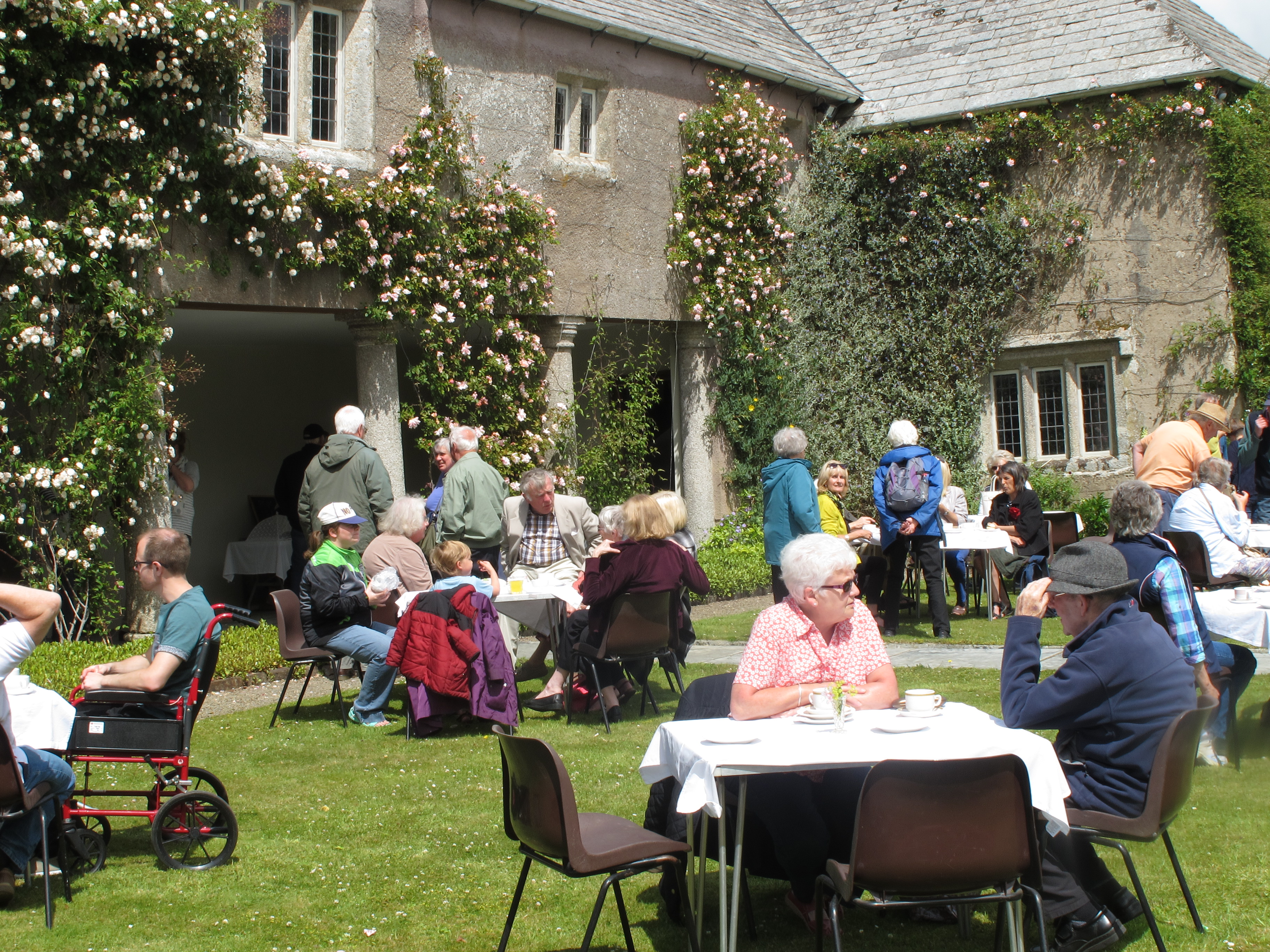
Cream tea at Penhele

Cream tea at Penhele

Recently, Wild Thing and I went to a cream tea at Penhele, a great house not from where we live. It was a fundraiser for the Charles Causley Trust, which (I just checked the website) keeps alive the memory of a local poet and promotes writing in the region where he lived. I’d love to give you a link to some of his poems, but although I’ve been impressed by some of his poetry I didn’t like the only one I found online. Others are under copyright and that makes them a no-go zone. Sorry.

But we didn’t go there to support the Causley Trust. In fact, we didn’t know what the event was raising money for. We didn’t even go for the cream tea, although it was a welcome bonus. What we really wanted was to see the gardens and the house, which are well enough known around here that we ran into half the village almost as soon as we walked in. One of them, J., was a carpenter before he retired (only they say joiner here, or builder, and I’m not all that sure what the difference is) and worked restoring historic buildings. Basically, once he’s done you can’t tell he’s been there. I asked if he knew how old the house was and he pointed to a stone plaque above a doorway in what he told me was the hall. It carried a date in the 1600s—1660, if I remember right. For all I know, other parts are older.

“I worked on those windows,” he said, pointing to the right of the plaque.

I felt like I was sitting next to a rock star.

Most of us—maybe all of us—lined up to buy tea and either scones with jam and clotted

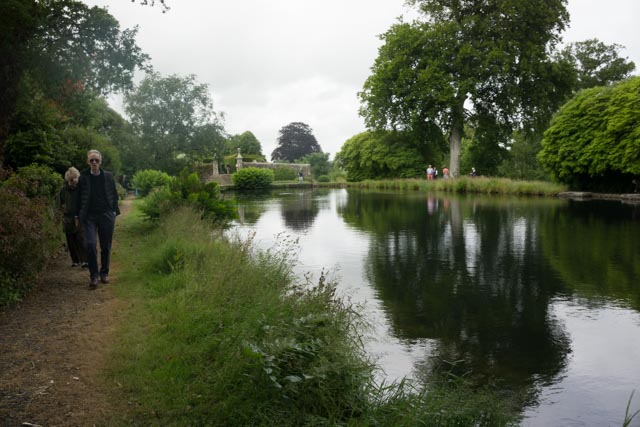
Walking by the lake.

Walking by the lake. Photo by Ida Swearingen

cream (that’s the cream part of a cream tea) or cake, then we drifted along paths and past fields, a lake, a swimming pool (covered), in and out of a series of open rooms formed by a high, dense hedge, and past an empty flowerpot stuck deep into the hedge and looking like a place for someone to hide his or her cigarettes, although I didn’t reach in to be sure since that seemed like an invasion. We paid closest attention to what I’ve learned to call a herbaceous border (you pronounce the H on herb here; I still don’t, but I’ve gotten to the point where both pronunciations sound odd to me), stopping to admire this flower and that one.

penhele 055

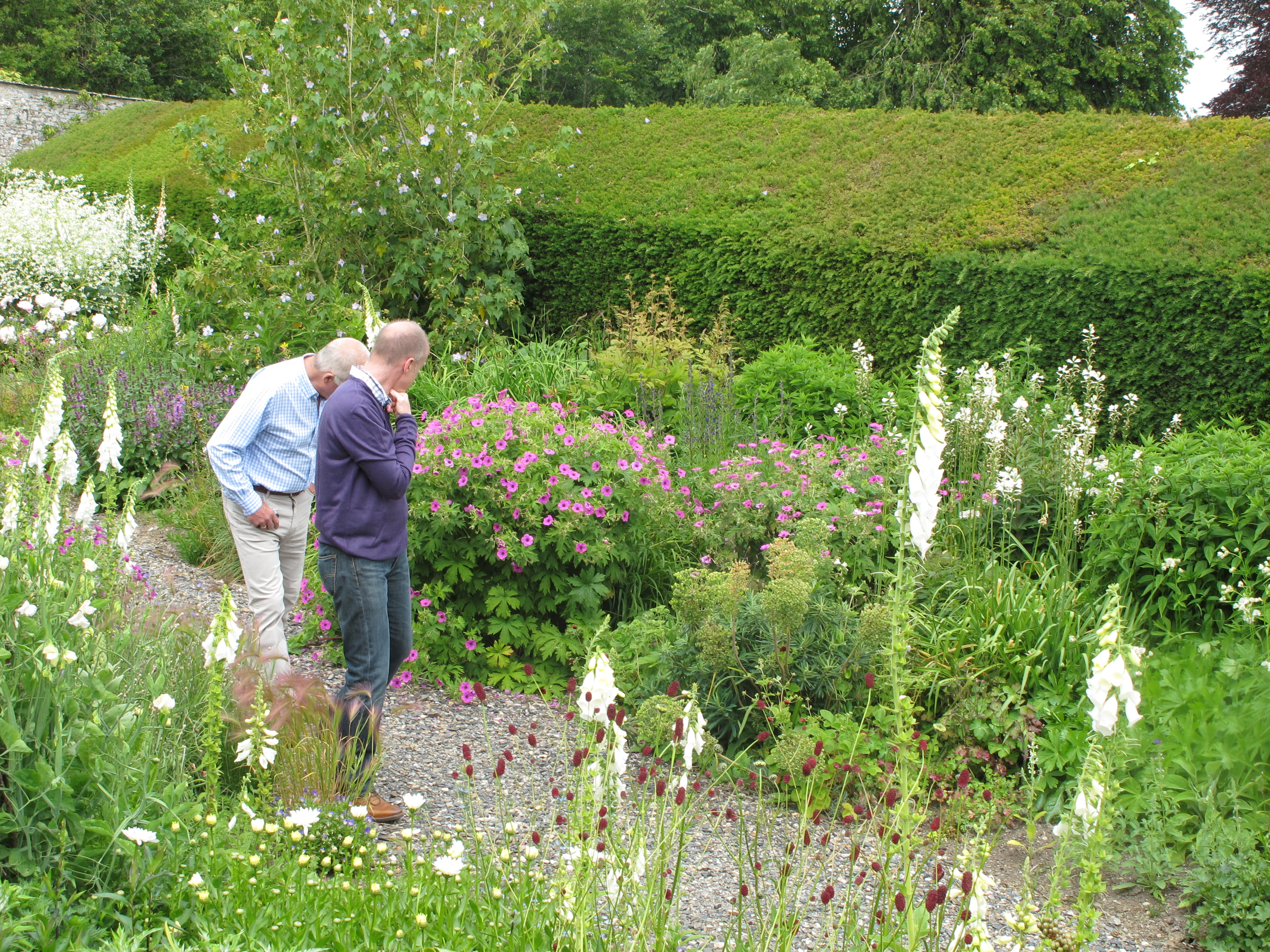
Part of the herbaceous border

According to Wikipedia, herbaceous borders became popular in the Victorian era. They’re basically a bunch of flowering plants—what I’d call a flower bed—and they’re gorgeous but take a lot of work. The Wikipedia entry talks about digging up and splitting and replacing plants, but even more than that they take weeding. Endless weeding.

Did I happen to mention how many weeds Wild Thing and I have grown since I started blogging?

I haven't a clue what the flowers are, so I'm not going to try identifying them.

I haven’t a clue what the flowers are, so I can’t identify them.

I overheard several people saying the same thing that came to my mind: “I wonder how many people it takes to keep it looking like this.” No one had the answer, but quite a few seemed like a fair guess.

It all felt a bit like something out of a BBC costume drama—the great house opened for an afternoon so the villagers could put on their company manners and enjoy a day out. It’s less lord-and-lady-of-the-manor these days, but you can’t help noticing the difference between the place you’re admiring and whatever you call home. Still, whatever people’s feelings were about class and inequality—and I expect they ranged all over the scale—everybody seemed willing to put that aside for the day and enjoy the beauty and the hospitality.

Both class and people’s feelings about class are more open in the U.K. than in the U.S., penhele 061where we break out in a rash if anyone uses the word in any context except middle. And the tradition of a grand house opening its gardens to the public is also something I never heard of in the U.S. Wild Thing and I speculated on whether it dates back to Victorian times or to the medieval period. I’d put my money on medieval, because, as crushing as the lord-peasant relationship must have been, it did lay a few obligations on the lord, and those may have included fetes or feasts.

The inescapable raffle

The inescapable raffle

But that’s guesswork. What’s certain (or as certain as I dare be about anything right now) is that the tradition of great houses opening their grounds for fundraisers is part of an English summer.

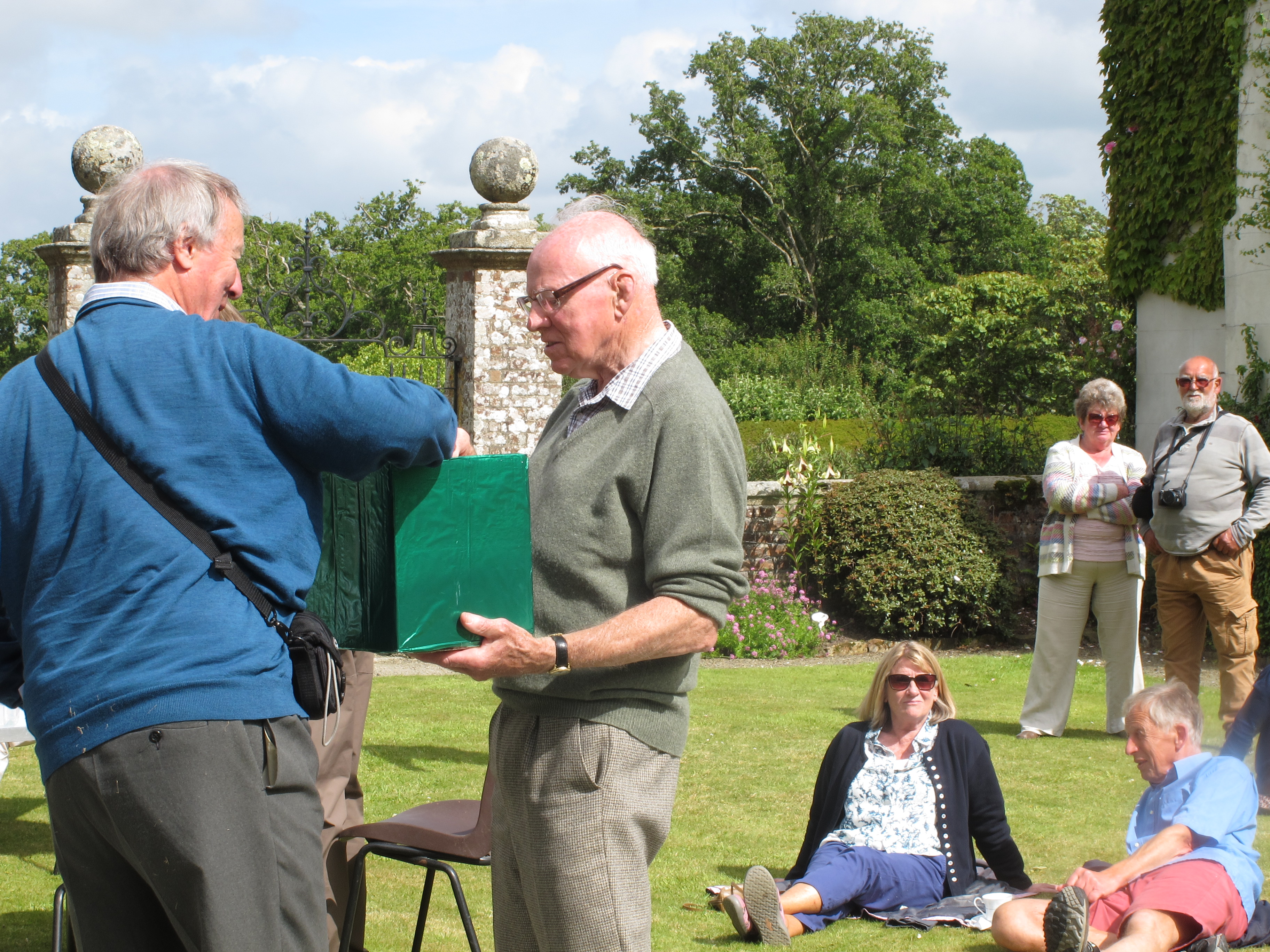
At the end of the afternoon came the drawing for the raffle. You can’t hold a fundraiser in Cornwall without holding a raffle. There’s no law on the books, but it’s just not done. So at Penhele they held a raffle. And we didn’t win anything.

Lewis Carroll and the British Parliament

That great institution the House of Commons meets in a room that doesn’t have enough seats for all its members (called MPs–Members of Parliament).

A good part of the time, this is fine, because most debates take place before an almost empty chamber. That probably says something depressing about how much the debates matter, but let’s move on, because it’s not the point right now. The point is that sometimes everybody does want to be present, and the only way to reserve a seat is to show up before 8 a.m. and put a prayer card on the seat you want.

Yes, a prayer card. It indicates that you’ll attend the prayer that opens each day’s session. And when you do, you and all the other MPs will stand facing the walls behind you.

North Cornwall. Newly mown fields

Irrelevant photo: fields

Yes, the walls behind you. No one knows why, but a fact sheet published by Parliament itself says it’s attributed to “the difficulty Members would once have faced of kneeling to pray whilst wearing a sword.” Never mind the awkwardness of that sentence, or the use of whilst, pay attention instead to the explanation it offers: It would have been difficult to kneel, so they all stand backward? Couldn’t they stand facing forward? Or kneel backward? And would kneeling backward really make a sword fit any better? I’d experiment, but I don’t have the right benches on hand. Or a sword. I come from the wrong class. And country. As far as I know, none of my ancestors ran around wearing swords, never mind praying with them.

But never mind all that. We haven’t dropped into a world that puts a high priority on linear logic. Since I began researching this post, I’ve come to appreciate Lewis Carroll’s Alice in Wonderland and Alice through the Looking Glass in a whole new way.

But we were talking about seats: Having reserved one, an MP actually has to show up for the prayer, regardless of what his or her religion, or lack thereof, may be. Such are the joys and absurdities of established religion.

According to another tradition—one that makes instinctive sense to me, but probably only because I’m used to it– the MPs seat themselves according to party, with the governing party on one side and the opposition on the other. That was simple enough when two main parties controlled the Commons, with a third much smaller party in the background and behaving itself nicely, but the Scottish National Party (SNP) has become a major player very quickly, and it’s feeling its power and not inclined to play nice, so all hell’s breaking loose.

It turns out that on the first day of Parliament, the prayer card rule doesn’t apply. Well, of course it doesn’t; it also doesn’t apply when a litter of all-black kittens is born precisely at noon on a Wednesday in 10 Downing Street. (Yes, I made that up about the kittens, but it makes as much sense as anything else.) So the first day of this new Parliament was a scramble. Having taken a political seat from Labour in the election, an SNP member parked himself in the physical seat that has belonged, unchallenged, to a Labour Party MP, Dennis Skinner, since forever. He and Skinner managed not to wrestle over it, but Skinner was upset enough that he wedged himself into a crack between the seat he considered his by right and the one next to it.

After that, the SNP took a row of seats behind Labour’s traditional front bench. Apparently this defies another longstanding tradition, but I have no idea what that is. As far as I know, Labour MPs didn’t pile in and sit on their laps, but I don’t know why not.

And there you have it. The mother of Parliaments, in all its sober glory.

Bizarre British festivals: Gloucester cheese rolling

What I won’t do in the interests of researching British culture.

Wild Thing and I just got back from the Gloucester Cheese Rolling and I hardly know what to say, except that humans are a very strange species. The Cheese Rolling works like this: The contestants line up at the top of an insanely steep hill. Someone starts a wheel of Gloucester cheese rolling down the hill. Then the contestants run after it. The first one to the finish line wins the cheese.

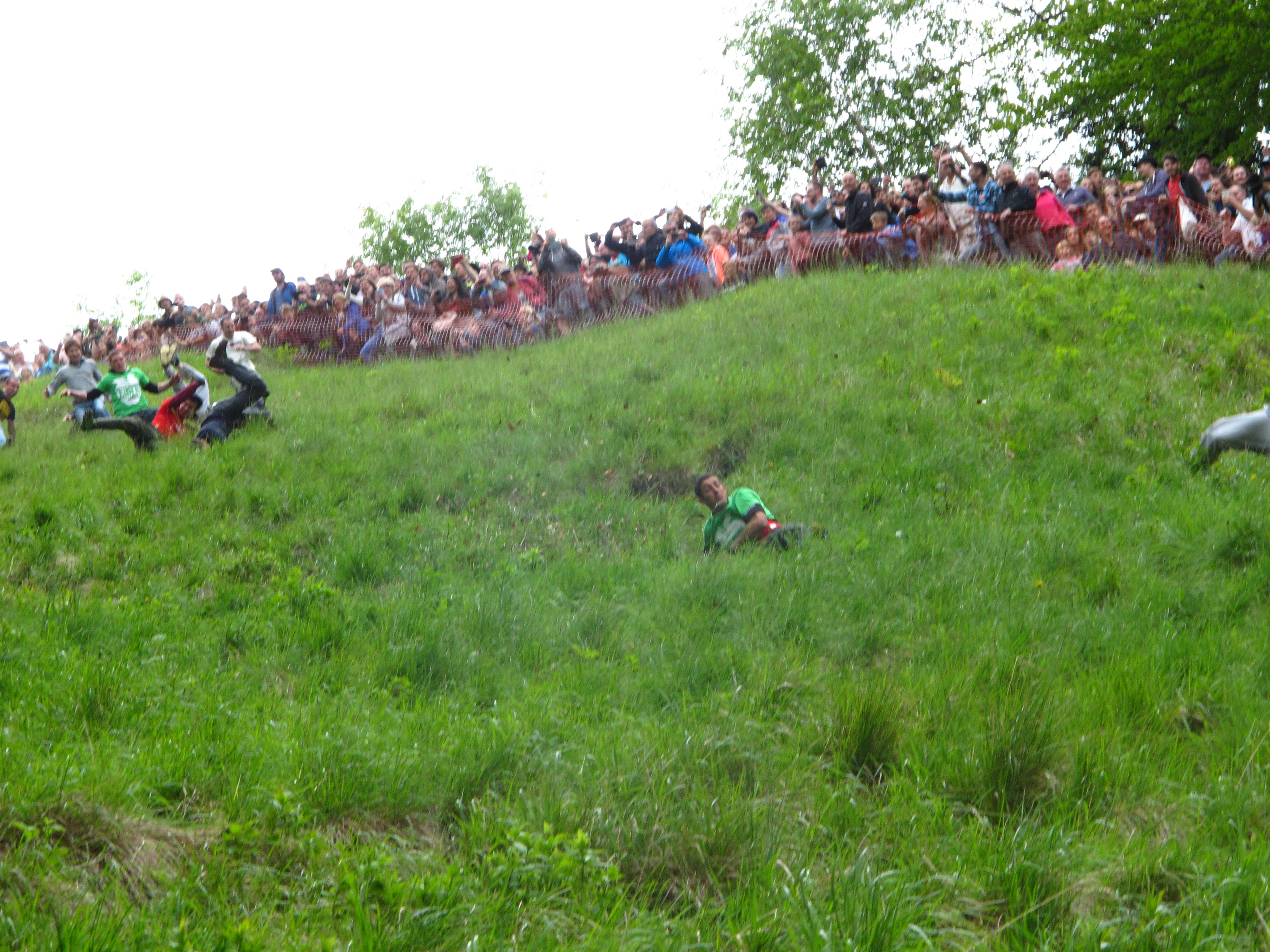
Runners sliding down the hill. The camera’s at an angle and doesn’t do justice to how steep the hill is, but keep scrolling down.

Sounds simple. Did I mention that the hill is steep? Steep enough that before the race started I told Wild Thing I was going to see what was happening at the top. I got maybe ten yards uphill and thought, No I’m not. I was tipped forward, almost on all fours, and my feet were sliding backward. It would have been easier if I’d had a walking stick or two. Or possibly three. Cleats would have helped. So would a tow rope. But with anything short of a tank, it would’ve been a helll of a climb. And then I was going to have to turn around and come down, which is harder. So forget curiosity. Forget pride. I gave up and wedged myself back in where I started out.

Wedged because unless you find a bit of bumpy ground to keep you in place or dig your heels in and put those thigh muscles to work, you slide downhill onto the people below you. You’re not sitting so much as clinging. That’s the hill they’re running down.

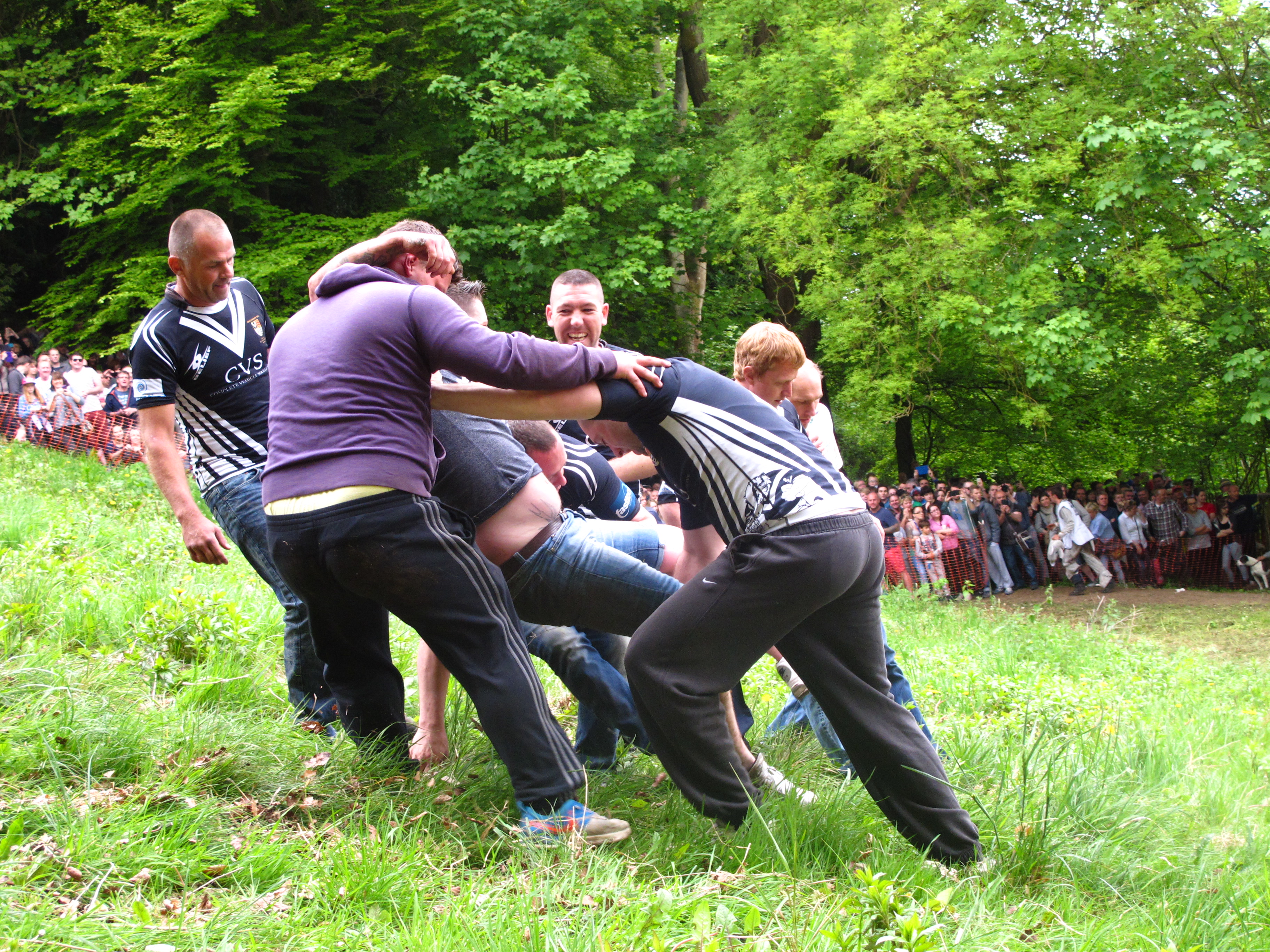
Not many of the runners stay upright. They skid, they cartwheel, and they get hurt—or some of them do. At the bottom, the local rugby team lines up to catch them, otherwise they’d keep going until they reached the Severn, or possibly the Atlantic. If that happens to be the direction they’re running in, which I couldn’t swear to but I think it was and it does sound romantic that way. What I can swear to is that they build up some serious speed. As does the cheese, which someone near us claimed hits 70 mph by the time it gets to the bottom, which happens well before the runners get there.

Helping an injured runner off the hill. Notice how the helpers are struggling to stay upright.

Helping an injured runner off the hill. Notice how the helpers are struggling to stay upright.

I didn’t see the rugby team stop all the runners. I was focused on the people who were struggling downhill, but I did see a few tackled to the ground. Others were blocked, or caught and hugged. Maybe it depended on their size and how fast they were going, or maybe a full-on tackle was a favor saved for friends. A few runners dodged off to the side, and given the heft of those guys I might’ve done the same.

Not that you’ll find me chasing a cheese down a hill. I say, if your cheese goes free-range, let it go.

A runner looks a hesitant about getting caught by the rugby team.

A runner looks a hesitant about getting caught by the rugby team.

One of the strange things about the cheese roll is that as a nation Britain takes health and safety seriously. I was once told in a second-hand store where the clerk said she couldn’t sell me a crochet hook because of health and safety. But before you start muttering about government regulation and the nanny state, consider the cheese roll. It goes on. Because it always has. Because no one’s thought to pass a law banning people from chasing cheese down a hill.

The crochet hook business had nothing to do with government regulation, by the way; it was just someone being a pill.

A few years ago, the group that organized the cheese roll couldn’t get insurance coverage. Tell me you’re surprised. This is where the real health and safety problem comes in. A tradition was about to die, but the community refused to let it and the races were held anyway, with no official organization (at least as far as I understand) and no insurance. If you get hurt, you’re on you’re own, because there’s no one to sue.

The local police hate the cheese roll. Maybe because of the crowds and the traffic and the injuries, or maybe because it’s basically insane, but they haven’t been able to stop it. They close off the nearest highway and people park outside the exclusion zone and walk past them to get there. It must drive them nuts.

We hiked in and ended up sitting next to the partner and son of a local legend who had won, if I remember right, six times in the past. He went home this year with two cheeses. What did they do with all the cheese? I asked her. The first year, he gave a lot to family and friends. After that—and here there was a pause.

“I have a lot in my refrigerator,” she said.

There are several races every year, she said. How many depends on how many cheeses they have.

Well, of course.

Sometimes they don’t have enough cheeses to satisfy the runners, so an extra race pours downhill anyway.

A first-time runner was standing near us, and after his race I asked how it had been.

“Fast,” he said, “and exhilarating. And terrifying.”

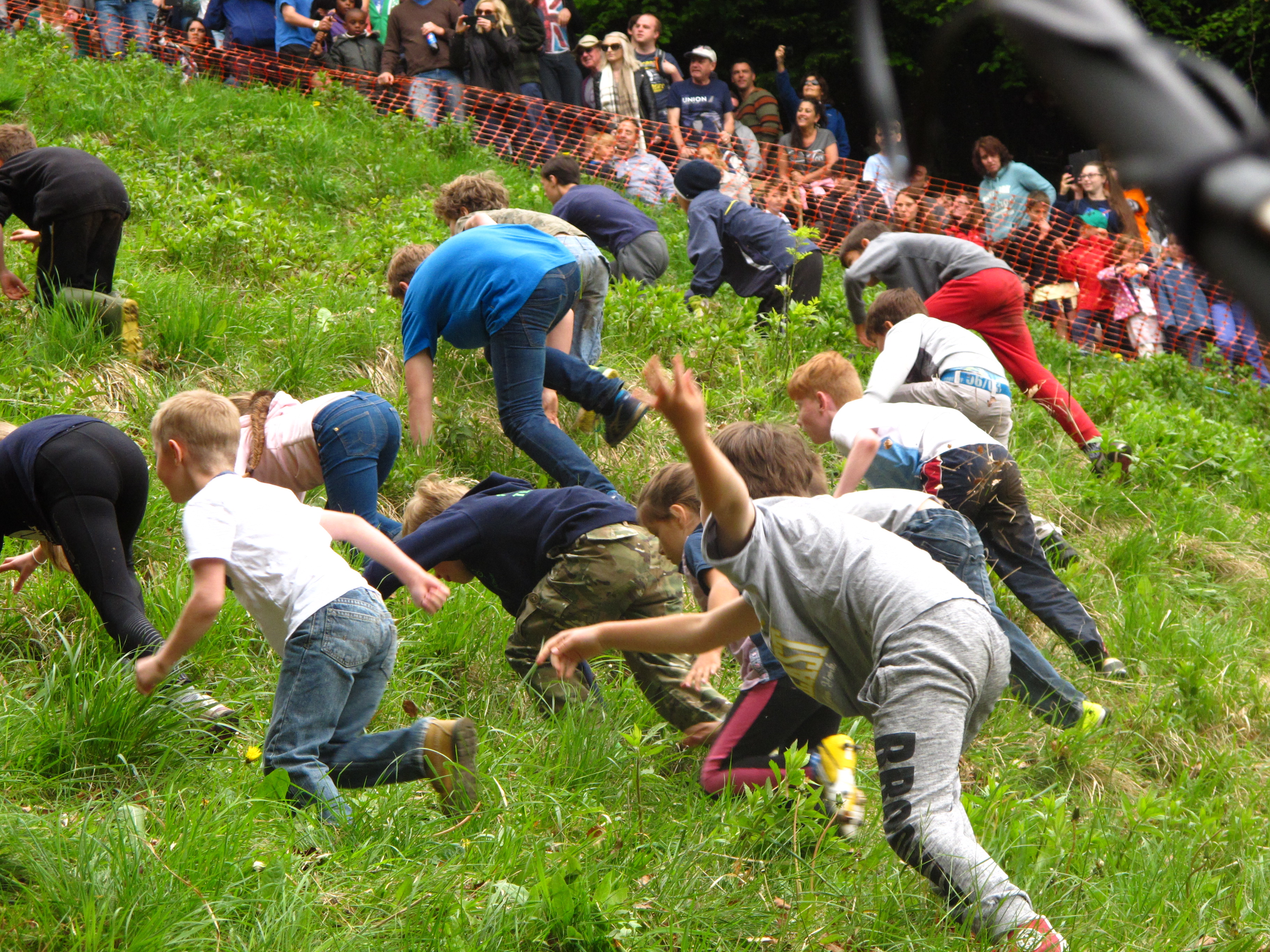
One of the races is for kids, but they go uphill, shepherded by the rugby team catchers and a few adult runners. It’s safer going up. Of course, then they have to come back down to rejoin their families, and inevitably some of them run. And some of them scoot down on their butts. And some of them are terrified. The adult shepherds were very sweet about coming down with them. A rugby player scooted on his butt alongside one kid. Another led one by the hand. The last kid off the hill got a round of applause.

The kids' race.

The kids’ race.

This being England, a few adult runners showed up in costumes—what’s called fancy dress here. One guy came to a halt near us, stopped to make sure someone who’d fallen was okay, then pulled on a mouse’s head and finished the race in it. Another was dressed as a banana in a top hat. Well of course he was. Other costumes I saw were a kilt, a cape, and a tutu combined with a Canadian flag tee shirt.

According to an awkwardly worded Wikipedia entry, “Two possible origins have been proposed for the ceremony. The first is said that it evolved from a requirement for maintaining grazing rights on the common.

“The second proposal is pagan origins for the custom of rolling objects down the hill. It is thought that bundles of burning brushwood were rolled down the hill to represent the birth of the New Year after winter. Connected with this belief is the traditional scattering of buns, biscuits and sweets at the top of the hill by the Master of Ceremonies. This is said to be a fertility rite to encourage the fruits of harvest.

“Since the fifteenth century, the cheese has been rolled down the hill, and people have competed to catch it.”

As is usual with these things, no one knows for certain. One woman from the area thought the race’s history was measured in decades, not hundreds of years. All I know for a fact is that the country’s full of traditional festivals, and some of them are stranger than this one. I hope to get to one of them later in the year.

If you want to know more about the cheese race, here’s a link to an article from a local paper, one to the official site, and one to cheese race pictures.