Feeding hungry kids: the English public strikes back

After the government voted to deny £15 vouchers to low income families in England so that their kids wouldn’t go hungry during the school holidays, a local pub banned the chancellor, Rishi Sunak, from its premises.

For life.

It did the same to three other local MPs who voted against the vouchers with him.  Pubs can do that here, but they usually reserve it for the kind of customer who sets off fireworks on the bar or pulls the plumbing out of the men’s room. But I guess it’s a question of who does more damage in the long run.

The ban was posted on the pub’s Facebook page, which also reproduced a menu from one of the House of Commons’ many restaurants, where steak and chips are going for £11.77–a price subsidized by the taxpayer.

Don’t usually do politics but here goes,” the Facebook page said. “I have never known a Government which is consistently the wrong end of every argument.”

*

Irrelevant photo: The Cornish coastline.

In tweeting about against the vouchers, Conservative MP Ben Bradley wrote, “At one school in Mansfield 75% of kids have a social worker, 25% of parents are illiterate. Their estate is the centre of the area’s crime.

“One kid lives in a crack den, another in a brothel. These are the kids that most need our help, extending FSM doesn’t reach these kids.”

FSM being free school meals. This is shorthand for the voucher program. Which is also shorthand.

Don’t worry about it.

When he started catching flak for that and a few other tweets, he complained that they’d been taken out of context. I’m still trying to figure out how to squeeze any context at all into 280 characters. Short of writing in Japanese, Chinese, or Korean, where a single character can be a whole word. 

*

In the meantime, players from Leeds United donated £25,000 for kids’ meals over the school break, and the club they play for has announced that it will match that.  

Businesses, restaurants, and local governments (including at least a few led by the Conservative Party–the party that voted against the £15 vouchers) have also stepped up with offers to help, and Conservatives are beginning to say that the government misjudged the feelings of the country. Not that kids need to eat and they want to do the right thing, but that people are mad at them.

They don’t even know how to say, “Ooops,” right.

All of it goes a good distance toward restoring my battered faith in humanity, but it’s worth remembering that whether kids get fed will depend on where they live. In some places there’ll be multiple offers and in others there’ll be none.

*

This morning, I listened to Matt Hancock, the secretary of state for health and social care, interviewed on the radio. I was driving and it was him or nothing. We eventually realized that nothing was much better, but before we did I was interested to hear that he’s not singing Ben Bradley’s tune. I doubt even Ben Bradley’s singing Ben Bradley’s tune anymore. It didn’t go over well. What he said was that of course the government’s making sure every child gets fed, but local governments are better at that than central government and we’ve given them money for it.

But, the interviewer said, that was way back when and it was spent long ago.

We’ve given them money, he said in seventeen different ways.

It’s an approach I’ve heard a lot in the last few years. Ask a government minister why the NHS / social care / the schools / fill in the blank is so short of money and they’ll tell you how much money they already spent on the NHS / social care / the schools / fill in the blank. It doesn’t answer the question, and sometimes they’re talking about money that was allocated before William the Conqueror’s boat first touched England’s southern shores, but it sounds like an answer and can usually be counted on to derail the conversation.

*

Since as a nation we’re not handing low-income parents £15 to waste on feeding their kids, let’s review another spending program. No one tweeted that the £12.7 billion program to help the self-employed through the pandemic was pouring spaghetti sauce into crack dens, but a study from the Resolution Foundation says it gave £1.3 billion to workers who hadn’t lost any income while successfully missing 500,000 who did. The study blames a combination of strict eligibility rules and weak assessment. Basically, they excluded lots of categories of the self-employed and then didn’t ask people in the categories they accepted to document their losses. 

The  study also said that the self-employed were hit even harder in the first six months of the pandemic than employees were. Three out of ten stopped working during the worst of the crisis, and one in six is still out of work. 

About 5 million people count as self-employed in Britain, although some of them, inevitably, will be the mythically self-employed. It pays for corporations to offload the expenses of employing people by calling them freelancers, and people are desperate enough to accept that.

Do you remember when life was going to get endlessly better? 

*

The lockdown in Wales is tighter than England’s, and it’s closed shops that sell nonessential goods, which has had the odd consequence of restricting supermarket sales of the same items. They’ve had to have had to cover shelves to hide the socks, the decorative hair thingies, the–

Actually, it’s hard to decide where to draw the line. The cake decorations? They’re edible, so maybe they can stay. The birthday candles? Non-edible but on the same shelves as the cake decorations. The mugs that say, “You’re the best”? The ones that say, “I changed my mind. You’re a cockwomble”?

Let’s turn to the experts: Nonessentials include electrical goods, telephones, clothes, toys and games, garden products, and homewares, and the decision on individual items depends on what part of the supermarket they’re in rather than their inherent essentialness. So forget the cups, but you can probably buy birthday candles.

Supplies for the “essential upkeep, maintenance and functioning of the household,” such as batteries, light bulbs, and rubber gloves, are okay. Because who could function without rubber gloves?

It’s easy to make fun of, and I’m having a hard time holding myself back, but there is a logic to it. To slow the virus, you need to shut down everything you can, but they don’t want to hand supermarkets the business they’ve denied to small shops. Yes, it’s crazy. And yes, it makes sense anyway.

*

While we’re talking about the odd places that rules lead us into, England’s rule of six limits gatherings–indoor, outdoor, underground, and hallucinated–to six people unless they’re all from a single household (it’s slightly more complicated than that, but close enough for our purposes). But some of London’s fancier restaurants have discovered that if people are talking business they can gather in groups of thirty.

Wheee. Take your foot off the brake and don’t be such a scaredy cat. 

One of the restaurants emailed its client list to let them know that “when the topic is business you can still meet over a fabulous working lunch or dinner without the restriction of the ‘single household rule.’ ” 

You will, however, need to employ at least one overcooked adjective and a full set of quotation marks, however unnecessary and aesthetically offensive they may be. 

At one expensive restaurant, the Sexy Fish, caviar sushi sells for £42 a piece, and you can buy a £16,000 Armand de Brignac champagne if you really need to. The reporter who scouted the place and asked diners if they were discussing business got himself thrown out. Which was lucky, because I doubt the Guardian’s budget stretches as far as the sushi, never mind the champagne. 

Politicians and hungry kids: it’s the pandemic news from Britain

After refusing to find common ground with Manchester’s political leadership over money to support workers and businesses devastated by a local lockdown, the government announced a new package of support for businesses and workers devastated by local lockdowns. 

Andy Burnham, Manchester’s mayor, said it was what he’d been pushing for all along

So why did the government let the talks blow up before agreeing to provide support? So it can say, “Nyah, nyah, we win.” The government can now claim that it was their idea all along and that they’ve forgotten where Manchester is anyway.

*

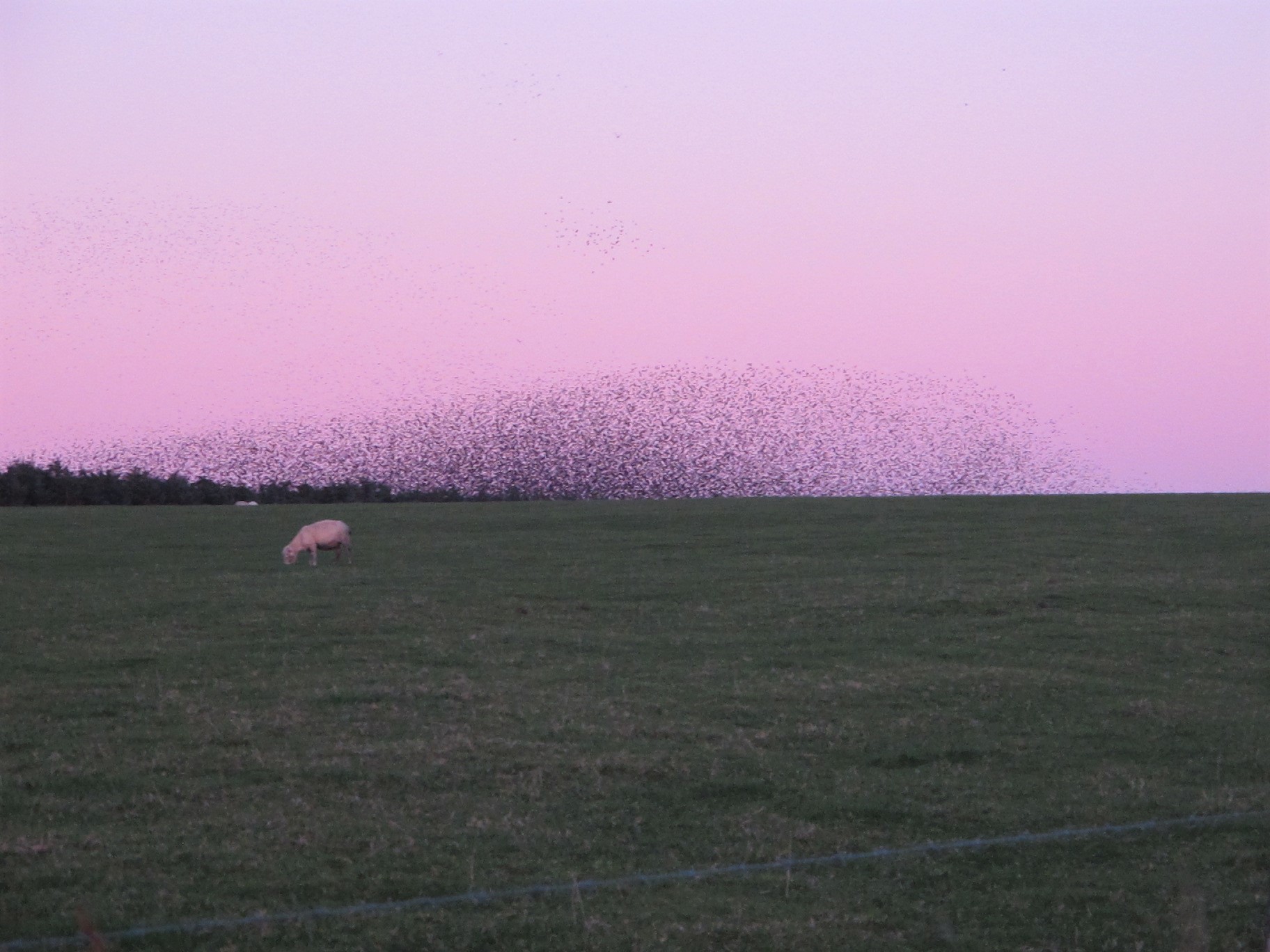
Irrelevant photo: Starlings in the neighbors’ tree. They gather in large flocks in the fall and winter. The Scandinavian starlings spend their winters here. The ones that spend the summer here head south in the winter. Go figure.

This might be an appropriate time to talk about sewage

No, that wasn’t an editorial comment. I am so politically neutral that I can’t even see myself in a mirror. 

Ninety sewage treatment sites in England, Wales, and Scotland are starting to test for Covid. A pilot program in Plymouth spotted an outbreak that was clustered around some asymptomatic cases well before the test and trace system spotted it.

Admittedly, the test and trace system couldn’t spot a Covid-infected camel if it crashed  through the Serco board room with a nickelodeon on its back playing “Somewhere Over the Rainbow,” but the point is that the sewage folks spotted the outbreak at an early stage. They’d have no problem spotting a camel either. 

The nickelodeon might be more of a problem. It needs a different set of reagents and an entirely different testing protocol.

*

Having finally noticed that the test and trace system not only isn’t working but that the percentage of people it contacts has fallen, the government placed an ad for someone with a track record of “turning around failing call centres.” 

The job pays £2,000 a day. And as I often have to remind you, in a pinch a person can live on that.

*

When I was looking for details on the program to support workers and businesses devastated by etc., I thought I could save myself a few keystrokes by just typing in the chancellor’s last name, Sunak. Auto-complete took what I’d written and supplied “flip-flops.” I was delighted: Sunak and Johnson had both flip-flopped on support for etc, and here Lord Google was writing an editorial for me. 

I followed Lord G.’s editorial to pictures of physical flip-flops–those plastic sandals you can slip your feet into without having to fasten anything. Turns out I’d flip-flopped a couple of letters and typed “Sanuk,” a brand of flip-flop that cost anywhere between £20 and £55. 

I remember when flip-flops were cheap. Of course, I remember when gas (or petrol if you speak British) was $0.29 a gallon. I also remember when I was nineteen, and it was a shockingly long time ago. 

*

After rising for seven weeks, the number of Covid cases in England looks like it’s stopped rising. Hospitalizations always tag along behind, kind of like a pesky younger brother, so they’re still going up.

*

An Australian company is working on a Covid test based on saliva–no swabs involved–that reports back in fifteen minutes and uses a hand-held device. That doesn’t necessarily mean the device is cheap–the article didn’t say what it costs–but it does mean you don’t need an entire lab for the test, so there ought to be some savings in there somewhere.

Of course, in Britain, we’ll have to contract with an outsourcing company to bring it into the country, and that should add a few million to the cost, if they get it here at all. But hey, what’s a few million pounds between friends? After all, Parliament just voted not to give low-income families £15 per kid over the school holidays so the kids wouldn’t go hungry. We might as well spend that money somewhere. 

The tests themselves work out to about $25 each, although to get a more exact figure I expect you’d have to do some sort of mathematical gymnastics involving the cost of the hand-held gizmo and the number of tests you’re going to do on each one. 

The bad news is that the system’s still being tested, but the hope is that it’ll detect the virus when people haven’t  yet shown any symptoms but are already contagious. The current tests are most effective after symptoms have started, meaning they give a lot of false negatives.

*

After Parliament voted not to give families that £15 per low-income kid over the school holidays, cafes, restaurants, and local governments stepped in to help fill the gap.

The issue of kids going hungry was raised by a football player, Marcus Rashford, who learned enough about hunger as a kid to qualify as an expert. He shamed the government into creating a program over the summer, but the thing about eating is that having done it once doesn’t keep you from needing to do it again.

Reacting to businesses stepping in to help, Rashford said, “Even at their lowest point, having felt the devastating effects of the pandemic, local businesses have wrapped arms around their communities today, catching vulnerable children as they fell.

“I couldn’t be more proud to call myself British tonight.”

Boris Johnson, on the other hand, “declined to welcome the offers of assistance,” as one paper put it. I assume some reporter gave him the opportunity just to see if he would. But hell, if these kids wanted to eat over the holidays, they should’ve had the foresight to get themselves born into better-off families, the way he did.

Arguing against spending the money on kids, MP Brendan Clarke-Smith said, “I do not believe in nationalising children.

“Instead, we need to get back to the idea of taking responsibility and this means less virtue-signalling on Twitter by proxy and more action to tackle the real causes of child poverty.”

Like low pay, possibly? Or a lack of jobs? 

Nah, it’s got to be personal irresponsibility.

The government’s decision is particularly grotesque since it spent over £522 million on a summer program to tempt people back into cafes and restaurants, but only if they could afford to pay half the cost. And MPs are expected to get a £3,000 raise.

What people really want to know about Britain, part 21ish

It’s time to empty the search engine questions onto the kitchen table and see what Lord Google’s sent us. The questions appear here in all their oddity. And in case you worry that I’m making fun of the people who left them, I’m 99.9% sure that not a one of them stuck around to read my answers. They came, they saw, they thought, What the hell is this?, and they left.

British History and Culture

does anyone know why the british all wore those silly-looking white wigs ?

Oh, I am so glad you asked. I hadn’t gotten a decent search engine question in weeks and I’d been starting to think Lord Google had stopped caring about me. The answer is, first, yes. I know that and, oh, so much more. Most of which I won’t tell you because, having left your question, you’re gone, aren’t you? Besides, it would scare you shitless if you knew what I do. It sure as hell worries me.

But there’s a second part of the answer, which is that they liked their wigs. They took them seriously, in no small part because the wigs allowed them to look down on the wigless–the schmucks who were so poor they had to run around–publicly yet–in their own hair. Wigs were strictly for the upper classes. Think about it. Wigs weren’t just expensive, they were in style. It’s amazing what people will wear if it’s expensive and in style.

People who could afford to had more than one. Think of the wig as the Gucci bag its day. Or if you have a Gucci bag and take it seriously and I’ve insulted  you–sorry–fill in the imaginary blank with any expensive style you do think is ridiculous.

Now, O person who’s no longer here, think about something you own and love that’s the height of fashion. Then think about yourself in forty years, looking at a picture of yourself and (or in) it. Think how silly it (and quite possibly you) are going to look. 

That’s if we’re all still around in forty years, which is looking less likely every week.

Irrelevant photo: flowers from a village produce stall. Chrysanthemums, I’m reasonably sure.

cockwomble definition scottish

Is the Scottish definition of cockwomble different than (or from) the English definition of cockwomble? Or the Welsh, Irish, or Cornish one? I’m outside my area of expertise here  –if I have an area of expertise–but that doesn’t normally stop me from sounding authoritative. So I’m going to say no, the cockwomble grew out of a kids TV show, The Wombles, which was British, not English/Scottish/etc.ish. The show grew out of a kids’ book. A band by the same name grew out of some hallucinogens. 

No, I don’t know that. I’m asserting it in complete ignorance, but I do remember a moment or two of the seventies, which is what leads me to think–

And when someone comes along and tells me I’m wrong about any of that, I’ll be happy to shove over and give them the expert’s seat.

Lord Google is besieged by people asking about a link between cockwombles and Scotland. I know this because I asked him about it myself. I can’t find any reason to think the link exists, but if enough people ask eventually a link of sorts will be cobbled together.

cockwomble oxford english dictionary

I’m sure there’s a cockwomble working at the Oxford English Dictionary. There’s one anyplace with a staff of more than six. There might even be a definition of cockwomble in there somewhere. Dictionaries have gone refreshingly lowbrow these days. But what’s the question doing here instead of at the OED?

self esteem bell ringers

Y’know, I hate the phrase self-esteem. Or maybe it’s not the phrase but the idea. It strikes me as a short answer to a long and complicated question. I don’t trust it. But when you add it to something as noisy as church bells, it gets really annoying. Can we limit the bell ringing to people who don’t feel so damn good about themselves, please?

But since I slammed the question into the British Culture section–and I take these categories seriously, I’ll have you know–I’d better explain that bell ringing is a thing here. There used to be competitions. Maybe there still are.

And with that I’ve exhausted most of what I know on the subject. I’ll just sneak out quietly before anybody notices. 

anglo-saxon england notes

It was your class, sweetie. You’re the one who was supposed to be taking notes.

what were debtors called in great britain

Debtors. Also things like Alfred, Harry, James– Occasionally you might get a Sarah or something along those lines, but with the power to contract debts solidly in the hands of men, that seems to have been less common.

why do we eat brussel sprouts for christmas

Because Santa’s moved on from that coal-in-the-stocking routine. Times change, dear.

berwick on tweed at war with germany

No, no, no. It’s Russia that Berwick on Tweed isn’t at war with even though a lot of people think it is. Germany? Berwick also isn’t at war with Germany, but nobody except one late-night person messing around on the internet thinks it might be.

Although I suppose Berwick can not be at war with one country as easily as with another. Or with all of them at once. With the state the world’s in, it’s good to hear of someplace that isn’t at war. Even if it’s not a country and doesn’t have an army.

perwick island still at war

Look! We’ve got another variation on the theme of Berwick not being at war with Russia.

Lord Google couldn’t lead me to any Perwick Islands, but he doesn’t insist on precise spelling and told me instead about three Berwick Islands. One is in (or off) Australia, one is ditto in relation to Louisiana, and the third to South Carolina. After that we get to Lerwick, on the Shetland Islands.

None of them are at war with anyone. Isn’t that marvelous?

I’m learning so much about how rumors start.

how to pronounce tunnel

This is a perfectly sensible question, given how badly English-language pronunciation aligns with English-language spelling. Unfortunately, this is not a sensible place. Try a dictionary, friend. 

British Politics

supine stem of confiteor

This is a phrase our prime minister dropped into a speech to a bunch of blank-faced school kids, apparently in an effort to convince them that education was exciting and that they’d look back on these days as–well, who knows? The best days of their lives? A time when they’ll learn useless phrases they can later throw into a speech when they have no idea what point they’re supposed to be making? 

In a career that’s long on incoherence, this wasn’t Johnson’s most coherent speech. But it did follow his pattern of being able to say stupid things in Latin. Or partially in Latin. Most of it was in English, but nobody understood that part either.

when did the uk go metric

Some time ago, in a moment of Euro-madness. Or make that several moments of Euro-madness, and I’d give you an actual date but the country crept up on metricosity in stages, giving us one date for petrol (which if you’re American is gas) and diesel, another date for certain types of alcohol, no date at all for beer, at least in pubs, because it’s still sold in imperial measures, and–well, you get the drift. 

Now that we’re leaving the European Union, will we go back to our state of pre-metric innocence? Innocence is hard to recapture and I suspect the shift would be too much trouble for even the most hard-nosed Brexiteers, but I may be underestimating them. Or overestimating them. Or I may be, as a karate teacher I once studied with liked to say, overexaggerating. 

Americans in Britain

baking powder biscuit in england

Outside of my house, you won’t find a single baking powder biscuit in England. You’ll find scones, which are made with baking powder, but they’re a different thing. You’ll also find biscuits, which we Americans–being the perverse creatures that we are–call cookies, and they’re generally with baking powder too, but they’re not baking powder biscuits, they’re just biscuits. Made with baking powder

Are you confused yet? Then you’re getting into the spirit of the thing.

Baking powder biscuits look like scones but they’re not as sweet. 

Yeah, but what about cheese scones. They’re not sweet. 

We’re leaving them out of the conversation because they’ll only leave crumbs on the floor. They’re also different from baking powder biscuits, but (other than the cheese) I can’t explain why. It’s something you just have to take on faith.

You eat baking powder biscuits like bread: with a meal, without a meal, to mop up the gravy, with butter, with jam. The only thing you can’t do with them is toast them because you’ll never get them out of the toaster in one piece. 

Baking powder biscuits are a southern thing. They’re a Black thing. They’re a wonderful thing, and mostly we just call them biscuits. What they’re not is an English thing. Or (since this is probably what the question meant) a British thing. Americans are still trying to work out the difference between England and Britain. What do you expect from us? We still haven’t figured out the difference between the United States and America in general.

Questions that Defy Categorization

Britishfonot

I thought I’d include it so you’d understand how strange it gets around here. Even without my intervention. I have no idea what it means.

how to politely reject the award

You mean on those special occasions when saying, “Fuck you, this is meaningless,” just won’t do? 

It’s not that hard. You start by saying thank you. Then you explain that you don’t do awards. If your reason is that they’re meaningless, you’ll want to keep it to yourself because you’re being polite, remember? If your reason is something inoffensive, you explain it. Then you get out of there while everyone’s still smiling. 

You’re welcome. I’m going to start an advice blog any day now, with a side of good manners and another one of cole slaw.

amazon

Somebody asked to find Amazon and Lord Google sent them to me. That must mean I rank higher than Amazon.

Would you like a side of cole slaw with that?

The pandemic news from Britain, for at least the next 20 minutes

Unless you took too long to get around to reading this, here’s the Covid situation in Britain at this very minute: Wales is in a circuit breaker lockdown, which they’re calling a firebreak in order to distinguish it from the circuit breaker the British government’s refusing to impose on all of England, even though its experts say it should.

A brief interruption, just so we’re clear: Both of those are short lockdowns. And just so we’re even clearer, the British government doesn’t govern Britain as far as lockdowns are concerned. It governs England, which is part but not all of Britain. And when I say England, of course, I also mean Cornwall, because Cornwall’s governed by English law. 

It’s so simple I’m almost embarrassed to explain it.

Irrelevant photo: Cylamen, one of those magical British plants that bloom in the winter.

Scotland’s lockdown will have five tiers, and Northern Ireland’s will be northern. And also Irish, although let’s be honest, I don’t understand what happens up there. They’re across some water, I don’t swim well, and if I say too much I’ll expose my ignorance. They were the first part of the UK to impose a circuit-breaker lockdown. And I have a link to back that up.

None of the lockdowns sound as complete as the lockdown we all went through in March to keep the Covid horse from getting out of the barn, although by then the horse hadn’t just left the barn, it had gone to the pub for a drink and decided to move to a bigger barn. 

Are you still with me? By now, the horse has invested in a whole series of barns, because what’s the point of getting stuck in one barn when you can become a developer? In other words, since the metaphor’s also left the barn, the country locked down too late to control the virus the first time around and is now looking at the second wave and wondering if maybe it shouldn’t take some sort of action in case the wave turns out to be full of swimming horses. 

Stop me, someone.

What the British government’s trying to do where it has some power–in other words in England–is to on one hand lower the number of Covid cases but on the other avoid locking down the whole country. Hence the idea of local lockdowns where the virus is concentrated.

It sounds sensible until you put it into practice, at which point it gets messy. The earliest local lockdowns don’t seem to have worked well, but the emphasis there is on seem. The most authoritative assessment I’ve found is that it’s hard to say whether they’re working. That’s balanced but it’s not reassuring.

The local lockdown that’s getting the most press is Manchester’s, where the mayor, backed by local politicians, including some from Boris Johnson’s own party, wouldn’t agree to go into the most restrictive category because the government refused to give them enough money to cover the losses to workers and businesses. A lot of public snarling followed until Johnson said, “It’s my ball, so I get to make the rules,” and imposed the lockdown anyway. It will take effect on Friday.

One of the major issues they fought over is that people who can’t work during the lockdown will get less than they did during the national lockdown. 

Why? 

Because.

What’re they supposed to live on?

The government doesn’t much care. 

How do I know that? 

I’m channeling them. I hear them in my head, and if you think that’s fun, I invite you to play host to a bunch of overprivileged ex-Etonians. Especially when you thought the wine on sale at the supermarket would be fine.

Eton? That’s a public school, which in British means it’s a private school–a place where parents with too much privilege pay too much money to have their darling boys taught how to be part of the ruling class. 

No, I’m not exaggerating.

*

Universities–which in the US would be called colleges, but that has a whole ‘nother meaning here–are trying frantically to deal with their own localized Covid outbreaks. 

In Bristol, 900 students and staff have tested positive, and both they and the people who’ve been in contact with them are having to self-isolate. Hundreds of students who live in university housing have signed up to a rent strike that’s due to start at the end of the week. They’ve been locked down twenty-four hours a day and want to be released from their rental contracts if they move out or have their rent reduced if they stay. They also want people who test negative to have access to the outdoors, and they’re unhappy with the food boxes that are delivered to them (since they can’t go out), which they say don’t have enough food, don’t work for all diets, and sometimes don’t include essentials like cleaning products or sanitary products. 

Complaints about the food delivered to students who are expected to self-isolate are widespread, and I don’t think this is a case of kids complaining that they’re not getting quail under glass but that a week of instant noodles and energy bars doesn’t make a workable diet. Also that delivering pork products to Muslim students doesn’t communicate cultural sensitivity.

Of course, the kids who put “Send Beer” posters in their windows aren’t doing the cause a whole lot of good, although they are at least finding a way to pass the time that doesn’t involve either property damage or self-harm.

Rent strikes are already going on at Glasgow and Cambridge.

*

Arts organizations have been struggling during the pandemic and lobbying hard for some help, so when some got rescue grants from the government and were told to pour a bit of public praise on the campaign, they (at least mostly) did.

“Welcome this funding on your social media accounts . . . on your websites . . . and in your newsletters,” they were told. “In receiving this funding, you are agreeing to acknowledge this funding publicly by crediting the government’s Culture Recovery Fund.” 

And so on. 

Recipients obediently went online and sang the praises of their glorious leaders, who are also our glorious leaders. 

I used to work for an arts organization and it made my flesh crawl to watch how some of the staff members fluttered around when large donors appeared, but at least the donors had the good grace not to dictate their own thank-you letters.

*

In an unexpected side effect of the pandemic, Britain may be facing a shortage of tracksuit bottoms, leggings, and running shoes. Think of it as the Zoom meeting effect. Only half of you needs to look respectable. 

There’s a more serious side to it, though. A lot of clothing factories in Thailand, Vietnam, Indonesia, and Bangladesh closed in response to the pandemic. Sorry to chuck that in, but it is part of the story.

*

And now a feel-good story as a reward for having gotten this far: 

Football teams (and if you’re American, please understand that in Britain football teams play soccer) have been playing to empty stadiums in the pandemic and making money by broadcasting the games on pay-per-view TV. The cost is £14.95 a game.

Earlier in the pandemic, the games were shown free. And since fans–or many of them, anyway–have already paid for subscriptions to the stations carrying the games, the extra fee didn’t sit well. 

Newcastle United Supporters urged a boycott and raised £19,000 for local food bank instead.

*

The UK will be the first country to deliberately expose volunteers to Covid in order to test the effectiveness of vaccines. They’re called challeng trials, and there’ve been debates about the ethics of doing that with a life-threatening disease that we have no cure for, but it’s a lot faster than injecting people with the vaccine, then winding them up, letting them go about their ordinary business, and waiting to find out if they get the virus.

The volunteers are between 18 and 30, and they’re healthy, so they’re in a relatively low risk group. They’re also, given the dangers that long Covid presents to people in all age groups, incredibly brave.


Sexy onions and the Bayeux Tapestry: It’s the news from Britain

A Canadian seed company’s ad for Walla-Walla onions was banned from Facebook for being overtly sexual. 

Why? Well, you know how people say they can’t define pornography but know if when they see it? Well, the algorithm saw some onions dressed in their standard-issue papery brown jackets and one cut down the middle, showing every bit of oniony flesh it had. 

Personally, I don’t find things that’ve been cut in half particularly sexual, but there’s no accounting for what turns people on, and algorithms understand that. 

After a fair bit of glee on social media, the decision was reversed.

And yes, I do know Canada’s no longer British. I cheat. You’d be wise to keep your eye on that if you’re going to be here for long.

*

A new app allows people to construct their own Bayeux tapestries, suitable for online use or printing. You can move figures and scenery into place, change their sizes, and flip them so they face the other way. What you can’t do is reposition their arms and legs. You could make an entire comic book, but you can only work with the figures you’re given as they’re given. 

My very own Bayeux tapestry. I have no idea what’s happening here, but the donkey looks like Eeyore and the guy climbing the pole is in trouble.

The Bayeux Tapestry? It tells the tale of the 1066 Norman invasion of England. It was made in England but it ended up in Bayeux and carries its name because possession may be only nine-tenths of the law but it’s ten-tenths of the name.

Not only is the tapestry not originally from Bayeux, it’s also not a tapestry.To be a tapestry, you (or it, in this case) have to be made on a loom. Who knew? The Bayeux Tapestry is embroidered and was made in relatively small pieces, then joined together (none too well according to History Extra) and sewn onto a backing. 

It’s 68 meters long, which is roughly the width of a football field. Or a soccer field if you’re American inflected.   

A Victorian copy of the tapestry hangs in a museum Reading, which unlike Bayeux is in Britain. It’s the same as the original except for a border, the embroidered names of the women who made it, and itty bitty underpants on the men who were running around naked on the one in Bayeux. Because what’s a major historical battle without naked men?

Want to blame Victorian women’s modesty? Sorry, but we don’t get to do that. The undies were added by male staff who photographed the original for the women.

The final piece of the tapestry is missing. You can use the app to create your own. I  recommend it, especially if there’s another lockdown. 

*

If you’re of a sensitive nature, you might want to skip to the next asterisk, but this is bizarre enough that I had to include it. A company called Qiui sells a male chastity device, called Cellmate, as a sex toy. 

Yes. I know.

No, actually, I don’t know. See Walla-Walla onions, above. That’s my final word on the subject.

Cellmate’s also sold as an anti-cheating device, although the mechanics of wearing it for anything other than the short term–

Never mind.

Ah, but this isn’t just your everyday male chastity device, it’s a smart male chastity device. Not because it’s for smart males. The device itself is smart, and that’s where it ran into trouble. It’s controlled by Bluetooth, which means it can be hacked.

What happens when someone hacks a smart male chastity device is that it locks. Or not it: them. All of them, so anyone who happens to be inside one when the electronic switch flips stays inside. Or, to borrow an annoying saying from a TV show, What happens to be in Cellmate stays in Cellmate.

The makers recommend using a screwdriver to break it open. They’ve also updated the app. 

In case you’re interested, they cost £146. You didn’t hear it here and I don’t want to know about it.

*

Let’s move on.

Brexit’s looming and as I write this (Tuesday morning, October 20) I’ve read enough conflicting headlines that I feel like a pool ball bouncing off the bumpers. Or possibly a writer afflicted by an overworked metaphor. 

Can we move on again, please? 

Thank you.

The headlines tell me that the Brexit talks are over, that talks are not-so-over, that the UK is refusing to restart talks although the EU accepted its demands, and that the EU caved. Also the Britain and the EU are beginning to repair the rift and restart the talks. 

I’ll spare you the links for those, if you don’t mind. What we do know is that something is definitely happening.

Unless it isn’t.

I’ve said this before, but you can’t get too many warnings: Stock up on cat food.

*

By now, we (and by we, of course, I mean I) need something other that the onions to feel good about, so let’s cut to the tale of Kamal Singh, a seventeen-year-old ballet student from Delhi, who was offered a place at the English National Ballet school but couldn’t afford to take it. His father’s a rickshaw driver, and he was looking at fees and living expenses that would come to £20,000.

As a younger student, he’d already had trouble keeping up with the £37 monthly fees that his ballet school charged. His teacher recognized both his passion and his gift and told him to come back the next day, he wouldn’t charge him.

He later took him on as a full-time student and organized a scholarship.

A crowdfunding campaign, backed by some Bollywood stars, raised the money Singh needed to take up his place in the ENB and he started earlier in October. 

I dare you not to feel good about that. 

*

Late addition: The final panel of the Bayeux Tapestry has been discovered. All this time, it was on my computer.

Local lockdowns and, as always, money: it’s the pandemic news from Britain

Britain’s Covid test and trace system may be a functional disaster, but boy is it a moneymaker. Management consultants are taking home as much as £6,250 a day. Admittedly, not all of them, but you know, in a pinch a person could live on that.

One of the big track-and-trace players here is Boston Consulting Group, known to its friends as BCG. You and I can call it Boston Consulting Group. Senior execs are being paid as much as £1.5 million a year to salvage the test-and-trace mess. 

To throw another set of numbers at you, 40 people were paid £10 million for four months’ work. The government’s budgeting £12 billion for the program. 

I have no idea how all those numbers come together. Are we supposed to add them together? Divide? Multiply? Hide them under the floorboards? All I get out of them is that a lot of money’s flying around.

There’ve been too many screwups to list, but a recent one saw the program giving out used swabs for people to test themselves with. 

Irrelevant photo: roses.

*

In the meantime, the government’s at odds with its scientific advisory committee, SAGE, which advocates a short national lockdown–now called a circuit breaker–that would last a couple of weeks. Instead, the government’s doing local lockdowns.

How do they work? 

If you’re in tier one, you can get together with 6 people from up to 6 households (or 6 people from 12 households if your friends are divisible) indoors or out, with or without alcohol. If you add enough alcohol, you won’t care if you’re indoors or out. You’ll find yourself falling on people you barely know, people who come from 12 or 14 different households, telling them how much you love them. That’s not allowed, but it happens anyway. 

If you’re in a pub or restaurant, you have to sit at a table, which means you can only fall on the random acquaintances who are sitting next to you, but you’ll have to leave at 10 p.m., because that’s when pubs and restaurants close now. Once you’re outside, you can fall on all sorts of people and tell them you love them, and it’ll be all the sweeter for not being allowed.

If you’re in tier two, you can get together with 6 people from, oh, you know, hundreds of households, but only outdoors, with or without alcohol. See above for alcohol and closing times and love.

In tier three, you get multiple paragraphs because your life’s going to be complicated. Or at least your restrictions will be. You can’t socialize with anyone you don’t live with or who isn’t in your support bubble. What’s a support bubble? It’s an idea that at one point made sense but no longer does because politicians poked so many holes in it that all the logic leaked out. We’ll talk about it some other time, okay? 

Casinos, betting shops, bingo halls, and soft play centers are closed but gyms and leisure centers aren’t. Why? They have better lobbyists, that’s why.

Pubs are closed unless they serve substantial meals, in which case they can serve alcohol with the meal, but only with the meal. 

Eat slowly.

What’s a substantial meal? The evening news had lots of fun interviewing people about whether a pasty qualified or whether it had to have a side salad or potatoes with it to be a meal. Since a pasty’s pastry with potatoes and some other stuff inside, that’s sort of like having potato pie with a side of potatoes, so nutritionists might get huffy about it, but even they will have to admit that it’s substantial. 

Okay, a traditional pasty has meat and a stray bit of veg, but yeah, it still has a fair bit of potato. 

If you live in, say, a tier three area but work in a tier two area, whose restrictions are you supposed to follow? I haven’t seen anything that explains that. The government’s advising against traveling to any part of the country in a higher tier except for work, education, or a few other reasons. If it advises against traveling to a lower tier, I haven’t seen that either, although you’d think it would make sense. 

Which may be why they haven’t addressed it.

A separated parent asked the prime minister whether he’d be able to see his son. The prime minister, true to form, gave the father the wrong information. The correct answer is yes, you can see your kid, regardless. Johnson’s answer was–well, there’s no point in repeating incorrect information. What he meant was, “Why are you asking me? I’m the prime minister. Go ask someone who knows something.”

What about people in established relationships who don’t live together? If they’re in one of the higher tiers, they get to see each other outside and not touch. Unless they’re in a support bubble. Remember support bubbles–those things I’m working so hard not to define? But they can only ecstatically unite into a single bubble if one of them lives alone, at which point they can safely hold hands. 

By now it would’ve been simpler if I’d just explained support bubbles, but I’ve got too much invested in not doing it. Besides, we all need a little mystery in our lives.

As you can see, it’s a simple system.

In the meantime, the prime minister and the local leaders in Greater Manchester are arguing about whether the area belongs in tier two or tier three. Rumor has it that Johnson wants to impose tier three restrictions but is afraid the police would side with local government and refuse to enforce them. The main difference between the two sides–I think–is how much the government is willing to pay workers who are locked out of their jobs. So far, they’re offering less for the local lockdowns than they did for the national one.

On Saturday, the prime minister and the mayor couldn’t even agree on whether they’ve scheduled a phone call to discuss the problem on Sunday. 

*

Gordon Brown, who was Britain’s chancellor and briefly its prime minister, warned that the country’s facing a double cliff edge, Brexit and the costs of Covid. He knows a shitload more about finances than I do but he’s not so great with a metaphor: “I think we’ve got two cliff edges coming,” he said hallucinogenically. He did modify that by adding, “If it’s possible to go over two cliff edges at once,” but he doesn’t seem to have noticed that cliff edges mostly stay put and insist that you come to them.

Never mind. The point’s still valid.

Suffragists, sufragettes, and votes for women

English women’s fight for the right to vote began in the nineteenth century, and it started out politely enough. Bills were introduced in Parliament. Bills were defeated in Parliament. 

What could be more polite than that?

In 1897, the National Union of Women’s Suffrage Societies gathered local groups into a national organization and by 1914 it had 54,000 members. Most of them were respectable and middle class, and it’s not too much of a leap to assume that the campaign made a huge difference in individual women’s lives and in how they saw their role in the world. We can make a wild guess and say that many a couple argued about it over their respectable breakfast tables. Or didn’t argue and just let the tension build. 

They also made the issue part of the national conversation.

Irrelevant photo: a red hot poker. Not, obviously, a real one. A flower.

The organization was efficient and nonviolent and the members were, for the most part, dedicated. And you know what? Women kept on not getting the vote. 

Their work played out against a complicated background involving political parties and a lot of wrestling over not just whether women should vote but which men should. So as usual, we need a bit of background: 

From as early as the 1830s, the Chartists, a working-class movement, had been pushing to open the vote up to all men. They presented petitions to Parliament: 1.25 million names on the first one, 3 million on the second, and nobody I checked with says how many on the third. In response, Parliament blew a raspberry and ignored them.

Before the First Reform Bill (that was in 1832) only 3% of adult males could vote. Your right to vote (or not vote) depended on how much you earned and what your property was worth.

After the bill, the vote was broadened but not to all men. Shopkeepers, tenant farmers, and small landowners got the vote. That’s in the counties. In the boroughs, householders who paid at least £10 a year in rent could vote and so could (gasp) some lodgers. 

What’s the difference between counties and boroughs? Beats me, but that comes from Parliament’s own website, so it must be right. It’s probably about the difference between cities and the countryside, but don’t take my word on that. I’m a stranger here myself. The point is that more people could vote, but only a safely respectable kind of more. And since women had come into the conversation they were, for the first time, specifically excluded. 

Isn’t progress a wonderful thing?

The Second Reform Act in 1867 did more of the same, doubling the number of men who could vote in England and Wales from 1 million to 2 million.

Leave Ireland and Scotland out of it, will you? This is complicated enough already.

By 1885, 8 million people out of a population of 45 million could vote–two-thirds of adult men. (Any numbers that don’t add up here can be blamed on women and children being left out of the accounting.)

So when women started pushing for the vote, the first question that popped its divisive little head up like a jack-in-the-box was, Which women? If all women had the vote, then presumably all men should as well. Or should only women who could meet the same property qualifications as men vote? Or how about unmarried women who met the qualifications, since married women were–or so the argument went–represented by their husbands. Or should it be only married women, since unmarried women were at best faintly embarrassing.

Or only women with those huge, amazing hats.

And this is where party politics came into it, because different choices were to the advantage of different parties. 

And if that wasn’t complicated enough, the women’s suffrage movement  was pulled between the women who wanted a single focus for the organization–votes for women–and those who wanted to address other issues too, because wasn’t the purpose of voting to have an impact on issues?

As women’s suffrage gained momentum, the Conservative Party could see the value of having propertied women vote: Well, of course they’d vote Conservative. And you could see why both non-propertied women and working-class (and presumably non-Conservative) men might oppose that. If the country allows only a small group of campaigners into the hall and they go in, closing the door on the rest of them, the people left outside might well ask themselves why they’d bothered supporting the ones who went in and didn’t return that support.

In 1893, the Independent Labour Party was formed–the forerunner of today’s Labour Party. Its goal was to represent the interests of the working class–a tough job at a time when large parts of the working class were still disenfranchised. 

In those conflicting currents, the suffragists bobbed around, lobbying politicians and campaigning for candidates who supported women’s suffrage, getting their hopes raised and crushed with each new bill. But the question of whether women should vote was, increasingly, an issue that couldn’t be ignored. Even people who made fun of it couldn’t ignore it. The Liberal and Conservative parties formed party women’s groups. They weren’t where the power lay, but they involved women in the machinery.

In 1894, women who met the same qualifications as men gained the right to vote in local elections.

In 1897, a women’s suffrage bill that had looked promising was defeated. You probably know what follows when a movement with a lot of momentum runs into a wall. Either it collapses or it explodes.

It exploded. The Women’s Social and Political Union was formed in 1903. The names you might recognize here are Emmeline Pankhurst and her daughters Christabel, Sylvia, and Adela. The group appealed to working-class women, not just respectable ones, and they were called suffragettes by a hostile press. The name was meant as an insult but the group adopted it. Why not? The words Tory and Whig had originally been insults, and both groups ended by embracing them.

In 1905, Christabel and Annie Kenney got themselves arrested when they interrupted a political speech and unfurled a Votes for Women banner. And when I say “got themselves arrested,” I mean that Christabel had to work at it. The police threw them out of the hall and were going to let it go at that until Christabel spat in a police superintendent’s face and hit an inspector in the mouth. 

That did the trick: They both got arrested, they refused to pay a fine, and they were jailed, one for three days and one for seven. 

When they came out, they were met by a thousand supporters and the press, which got them national publicity. 

By 1909 the WSPU was a national organization, selling 20,000 copies of its paper every week, and it had a genius for attention-grabbing actions. Members disrupted political speeches and by-elections. They tried to rush the House of Commons. They broke windows, blew up pillar boxes (which in other versions of the English language would be called mailboxes), attacked paintings in galleries, and bought gun licenses not so they could use guns but to scare the authorities into thinking they might.

They also chained themselves to railings, getting the grill that sectioned off the House of Commons Ladies Gallery removed by chaining themselves to it.

They took advantage of a Post Office service that allowed postmasters to “arrange for the conduct of a person to an address by an Express Messenger,” posting two women to the prime minister, Herbert Henry Asquith, so they could talk with him.

The delivery was refused. 

The sad part was that social media hadn’t been invented. 

It was the eye-catching actions that gave them their reputation, but most of what they did was legal and even peaceful. They drove (at the time that involved horses) around town with placards on carriages. They carried placards themselves, on foot. At a time when women were supposed to be quiet, passive, deferential, and to the best of their ability and training to imitate doormats, this was shocking enough, but they also addressed crowds in theaters and restaurants–crowds who hadn’t come to hear them and were often hostile. They threw leaflets from theater balconies. Many of them were roughed up by crowds of men or by the police. 

In 1913, Emily Davison tried to stop a horse race and was hit by the king’s horse. She died of her injuries a few days later.

In a lot of these actions, women were arrested, and when they were released they were greeted by supporters, who sometimes pulled them through the streets in open carriages, increasing the visibility of their actions. And in prison, many of them went on hunger strikes and were force fed–a brutal and very painful process. 

In The English Rebel, David Horspool asks whether their militancy delivered or delayed votes for women and answers that it probably did both. If you have trouble working that out, go argue with him. I’m not sure both are possible at the same time, but I can see his point anyway. The same argument goes on, although the parallels aren’t exact, when Black Lives Matter demonstrations spill over into rioting or looting. Does it help or does it hurt? It depends on where you do your counting and how. In the case of the suffragettes, even a century later historians can still argue over it.

Whatever the answer turns out to be, it won’t be a simple one.

In 1910, a bill that would have given unmarried women the vote failed. The Liberals thought it might harm their interests. The Conservatives weren’t strongly enough in favor. Militancy had been winding down, but the bill’s defeat wound it up a notch. Asquith’s car was attacked. 

Somewhere in here, the Suffragists’ leadership–and the Pankhurst family–split over tactics. Should they work with men? How violent should their actions be? Should any bill introduced expand the vote for both men and women or should it only be for women?

I’ve been around political activism long enough for this all to sound familiar. If you get deep enough into politics, it can get very crazy very easily, but the alternative is–or at least seems to be–what someone I once knew called crackpot realism, where you dial your goals down to fit what looks possible, accomplishing somewhere between less than you wanted and nothing at all. 

And there things stood when everything was interrupted by World War I. Gavrilo Princip assassinated the Archduke Franz Ferdinand, the European powers all dug trenches and shot at each other, and 20 million soldiers and civilians died. Another 21 million were wounded. 

That was the war to end all wars. 

Yeah, they really did say it would.

The more radical branch of the Suffragettes (that was Emmeline and Christabel’s) suspended their activities, partly, according to Horspool, because Emmeline and Christabel were exhausted but also because they were realistic about how much political oomph women’s suffrage could have in the circumstances. And they did something I find more interesting: They moved to the political right. They suspended the campaign for the vote, backed the war, changed their paper’s name from The Suffragette to Britannia, and diverted the organization’s funds to the war effort, but many suffragettes were pacifists and the organization broke up for good. 

Their support for the war, according to Horspool, consisted of making speeches and editorializing in the direction of industrial workers, who were probably looking for their news and editorials elsewhere.

 Sylvia’s branch of the Suffragettes had become the East London Federation. Its membership was working class and it aligned itself with the Labour Party, campaigning for both workers’ and women’s rights. And–since changing newspaper names was in style–it changed the Woman’s Dreadnought to the Workers’ Dreadnought.

In 1916, the government faced the prospect of an election in which most servicemen wouldn’t be able to vote because of a residency requirement. 

Crisis. Conference. 

The moderates (remember the suffragists, working politely away in the background?) made a pitch for women’s suffrage. The former radicals (remember half the Pankhursts?) withdrew their support for women’s suffrage in case if ended up disenfranchising servicemen.

Aren’t humans strange?

A compromise bill passed in 1918. It gave the vote to women over 30 who were qualified to vote in local elections or whose husbands were qualified. That was about 8 million women. And there it sat for the next ten years, when the voting age was dropped to 21 and all other restrictions were lifted–in other words, women voted on the same terms as men.

Christabel ran for Parliament as a Women’s Party candidate and lost. Later she became a born-again Christian and lectured in California. Emmeline moved to Canada for a while and lectured on social hygiene until the winters drove her out.

I know just how she felt–minus the social hygiene part.

What is social hygiene? “The practice of measures designed to protect and improve the family as a social institution; specifically: the practice of measures aiming at the elimination of venereal disease and prostitution.” 

Bet you didn’t see that coming. 

The pandemic news: Science, social media, and the rule of six

England’s in three separate stages of Covid restrictions right now, with the stage depending on where you live and how high the local infection rate is, but weeks ago the government’s official scientific advisory group urged it to impose a short, tight lockdown to stop the rise in infections. To which the government said, “What do you know? We’re following the science.”

“Wait a minute,” the scientists said. “We’re the scientists.”

“Not the scientists,” the government said. “The science.”

It’s not clear at the moment exactly what science they’re following. I’ve been wondering if they got hold of one of those “The Science of. . . ” books. You know: The Science of Getting Rich, The Science of Storytelling. Or if they have science confused with Scientology.

Entirely relevant photo (if you read to the end), which won’t play well on social media: This is Fast Eddie thinking deeply.

In the meantime, though, everyone’s mad at everyone. Local governments in the areas with tighter restrictions are furious that they’ve been allowed no power (never mind funding or serious consultation) to deal with their local situations. People whose workplaces will be shuttered are mad that they’ll be paid a smaller percentage of what they’d have earned than they were paid during the national lockdown. Disregarded parts of the country are feeling more disregarded than usual. They tend to be the places where the infection rate’s high, because transmission’s highest among low-income groups and minority ethnic groups, which aren’t groups that get a lot of help from governments in general but that get even less when the Conservative are in power. So they’re mad. Parts of the Conservative Party are mad because they don’t want the government closing things. The Labour Party’s mad because it’s sure it could handle the pandemic better than the Conservatives–and to be fair, it would be hard work not to. And I’m not particularly happy because I’m buried in newspaper clippings. 

Yes, I work from actual paper, at least to start with. Some days, all you can see of me is a tuft of white hair and a pile of newspaper. 

Send tea. The dogs will know how to find me. 

*

It’s not just local governments who are feeling slighted. MPs from hard-hit areas are finding out about government plans for their areas via What’sApp or being given twenty minutes notice of briefings. One, from Wigan, claimed she was left out of a briefing because the ministers in charge didn’t know where Wigan is. To make up for that, another was invited to a briefing for an area her constituency isn’t part of. 

A third heard about a twenty-minute briefing eight minutes after it had started.

*

You know those face shields that are (presumably) more comfortable than masks? It turns out that they’re the next best thing to useless. Almost all those lovely, airborne droplets and aerosols that the wearers breathe out escape through the gaps. But you’ve got to admit they make a person look like they’re serious about not spreading the disease.

*

In September, while England was learning to count all the way to six in order to figure out who it was safe to get together with outside of a work or educational setting, a stag hunt not only got 130 people together, almost all without masks, the outfit putting it on also got a £10,000 government grant and a £50,000 loan from pandemic-related programs.

Grouse hunts are also exempt from the six-person get-together limit. But if you want to get together and grouse about how inconsistent the rules are, the limit’s still six.

*

People (predictable creatures that we are) increased their use of social media during lockdown, and it turns out that people who send more pictures on social media are at greater risk of depression. Or so says an admittedly small study involving 170 participants, an online questionnaire, and absolutely no photos of anyone standing on a beach looking 30 pounds thinner and 10 years younger than their actual weight and age. 

Does that mean photo-sharers are depressed (or at risk of . . . ) because they send photos or do they send photos because they’re depressed or at risk of? We don’t know. Or I don’t, and the report I saw doesn’t say. All I know for sure is that one fact one lines up with the other one. So can we be safe, please, just in case sharing photos does cause depression. Tell the cat he can stop doing that thing with the lettuce and the chisel because you’ve put the camera down and you’re going to face an entire day without clicking the imitation shutter even once. Even if he starts playing the banjo, you’re not picking it up. Not today.

Yes, bare-assed reality’s tough, but it’s out there anyway. Might as well see what it looks like.

*

In an earlier post (and if you think I know how much earlier, you don’t understand how things work around here), I mentioned a Covid bailout program for small businesses that the British government set up so loosely that it screamed “Scam me!” and people obligingly did. Well, for the sake of balance, it set up another one to be so complex that only one company got all the way through the process. 

The idea behind Project Birch was that big companies would get emergency finance and in exchange give the government a stake in the company. Ten companies were interested but found the process so complicated that they walked away.

*

The U.N. secretary-general, Antonio Guterres, said that the pandemic has shown us that the world needs universal health care if it’s going to deal with the next pandemic. 

By not responding adequately to this one, we’ve let the pandemic cause more than a million deaths, infect more than 30 million people in 190 countries, wipe out 500 million jobs, and cost the global economy $375 billion a month. 

The standard indicators of human advancement and well-being are going in reverse for the first time since the U.N. started measuring them in 1990.

*

It’s not news that the pandemic’s put a strain on health systems everywhere and that both non-urgent and damn urgent treatments have been postponed. But how is NHS England (NHS being the National Health Service) planning to respond? It plans to fine NHS trusts (that means hospitals, or at least the organizations that run them) that haven’t gotten back to near-normal schedules by the end of the month. Because what could possibly make more sense than taking money away from an overstretched system when it shows signs of being overstretched?

You bet. That’ll learn ‘em.

*

Johnson & Johnson’s vaccine trial has gone on hold while they frantically try to figure out why one of the participants got ill. That’s roughly all the information that’s available, although any decent reporter can fill several paragraphs with it. I’m not a reporter, so all you get is two sentences.

*

The following is a note from that deepest of thinkers, Fast Eddie the cat. He doesn’t usually communicate with strangers, and since he’s broken his silence I believe we should pay attention: 

sddddddddd bbbbbbbbbbbbbbbbbbbbbbbbbm,

Please, people, give it some thought.


How to choose a new career, courtesy of the British government

With 300,000 job cuts planned back in June and July (sorry–statistics lag behind reality) and more cuts hitting the headlines every day or three, with the possibility that unemployment among young people will hit 17% later this year, never let it be said that the government isn’t trying to help the least among us. 

And believe me, they think we’re all the least. 

What are they doing for us? Why, they’ve created a quiz to help us figure out what jobs we’d be good at if our old careers have crashed and burned, or if we never had a career but our jobs are now cinders, or if we graduated to find the job market in flames and the fire department at half mast due to a decade of austerity budgets, or–

Well, you get the picture.

Ever anxious to help people (that was one of the questions on the test), I’ve taken the quiz so that you don’t have to trouble yourself. And by way of full disclosure, I should tell you that this is a test version of the test, so I’m sure–

I’m sure of nothing. Never mind. It’s a test version. We’ll leave it there.

Irrelevant photo: A flower I’ve forgotten the name of–and a butterfly. If someone would remind me, I’d be grateful (for whatever use that is). A friend once called it “that tall, ethereal thing” and it knocked the real name right out of my head.

What the test asks you to do is agree or disagree with a series of statements, and with each question you go deeper into the essence of who you are and what you’re capable of. Then an algorithm compares that with every available shred of information about the job market and spits out your own personal economic self-improvement plan.

How scientific a portrait of you does it build up? Oh, very. Especially when you pick the “it depends” box. 

The questions include: 

I am comfortable telling people what to do. (I am, but I sometimes need to wait until they’ve pissed me off. Then I’m very good at it.)

I make decisions quickly. (I had to switch to a different tab and type that question up for your benefit, so even though I claimed to make decisions quickly, I took my own sweet time with the question. I don’t think I was penalized for it, but they don’t really tell you.)

I take control of situations. (It depends. On what? Oh, lots of things.) 

I like taking responsibility for other people. (It depends. On what? Time, place, and circumstance, mostly.)

I set myself targets and usually meet them. (I accidentally left that one blank and tried to go on. The test sent me back and I said that yes, of course I meet my own targets. But filling out the test correctly was never one of them.) 

I think I am a competitive person. (I think I am? If they don’t trust me to know this about myself, why would they think I’m non-delusional about the others?)

I set myself goals in life. (You asked me this once already. Standardized tests often do that to see if you come up with the same answer when the questions come in different forms, but most of them are subtle enough not to hit you on the head with it.)

Doing well in a career motivates me. (Geez, no. What could be less interesting?)

I try to think differently to others. (I don’t try, sweetie. This is the brain I was issued. This is how it works. Yes, it can be interesting in here at times.)

And so on. 

At about the halfway mark, I started hitting “It depends” on most of the questions. Because I was bored. Because I wanted to see what they’d do with someone in the absence of any discernible personality. And, of course, because it does depend. Everything depends. It depends on how we’re going to interpret the question. It depends on whether I want to make a good impression on myself. It depends on whether I want to play the game fairly. 

Basically, yes, I cheated by not representing my real self, so I don’t claim that the careers scientifically chosen for me are entirely tailored for my oddities, but it turns out that I’d make a good soldier or a good cake decorator.

Also a nursery worker (to translate that, it means working in a preschool; you can see why someone who’d be a good soldier is a natural fit there), a judge (my lack of a law degree doesn’t seem to be a problem), or a dance teacher (the startling number of left feet that were included in the package when I was born present no problem).

And since the travel industry’s thriving right now, I could also retrain as a travel agency manager, a tourist guide, or hotel room attendant. That last one is career-guidance speak for a cleaner. 

An assortment of other people who took the test report that they’d be good boxers, lock keepers, or movie projectionists. Lord Google left me with the impression that lock keeping’s a volunteer job. With time and dedication, you can progress up the ladder to be a volunteer coordinator, but probably still as a volunteer. And one of the big movie chains just closed its doors. 

Reality has also closed its doors. Movie projectionists are looking to retrain as lock keepers.

That leaves boxing. I’d make a good boxer, competing in the overage runt category. But when they asked if I was competitive I said, “It depends,” so they didn’t suggest it for me.

If you’ll excuse me now, I have a couple of cakes to shoot.  I don’t like doing this, but orders are orders.


Tumble dryers and Twitter: It’s the nonpandemic news from Britain

A university student near Hull got stuck in a tumble dryer that she’d climbed into on a dare. 

Why yes, she and everyone within three miles of her had been drinking. What made you ask?

Her housemates called the fire department and three firefighters worked her loose. Before they left they checked the washing machine. Just in case. To save themselves another trip. 

I was hoping to say that this is what students do when they’re in lockdown, but I don’t know that the University of Hull was in lockdown. What I can tell you is that the university webpage about keeping students safe while they’re on campus doesn’t mention either laundry or laundry-related hardware–an oversight that I’m sure they’ll remedy as soon as I bring this to their attention. I’d have called by now but I wanted to let you know first. 

The student herself admitted that she’d never done her own laundry before. That doesn’t strike me as entirely relevant, since everyone who washes clothes once did it for the first time. The first time I ever took that daring step, I don’t remember being overcome by an impulse to climb into the dryer. Admittedly, my mother talked me through it: See, she told me, this is the water. These are the dirty clothes. What you want to do is introduce one to the other in the presence of this detergent that’s all stuck together because the basement’s a little damp. Just chop some out with this measuring cup, trying not to spray it all over the floor.

But even so, I don’t remember for one second wanting to measure the dryer for size. In fact, thousands upon thousands of people do their own laundry for the first time every year without climbing into the dryer. 

Maybe we’re all repressing the impulse. If you repress it well enough, you can’t be sure it was ever there.

*

Irrelevant photo: a hellebore.

As long as we’re in the Hull area and visiting with firefighters, a nearby crematorium got carried away with its work and set itself on fire. It took eight hours to put out the blaze, which started just before a service, so someone just missed their chance to go out in a blaze of glory.

Sorry. I couldn’t help myself. It’s a genetic problem.

*

A tour group in Iceland lost a tour member and, when she didn’t show up after an hour, hit the panic button and set off a search involving mountain search teams and the rest of the tour party. 

At 3 a.m., a member of the tour realized that she was the person she was looking for. She’d gone back to the bus and changed her clothes, so the 5’2” Asian woman in dark clothes was now a 5’2” Asian woman in some other kind of clothes. 

Cue many headlines about going to Iceland to find yourself.

*

Gay men invaded the Twitter hashtag of the Proud Boys, a far right group (or neofascist, if we’re calling a fascist a fascist this week) that was mentioned approvingly by Donald Trump before Trump himself was mentioned approvingly by the Covid virus. 

The invasion consists of gay male couples posing proudly–with each other, with their kids, with a Canadian Army uniform and a partner.  

The claim that the Proud Boys changed their name to Leathermen to get away from the invasion is, sadly, a spoof, but funny enough that I was happy to believe it until someone challenged me. If you’re not familiar with leathermen, Twitter will introduce you to a bunch of muscular gay men looking very kinky.