Looking American: On culture, nationality, and immigration

A few months ago, M. told me, “You’re looking very”—and here you have to imagine a short pause— “American today.”

When I stopped laughing, I asked what American looked like, and you can insert another, somewhat longer pause before you go on, because he had to think about it. Or else he was looking for a gentle way to say it.

“You walk as if the sun always shines on you and you own the world,” he said. Not unkindly, I should add, although from someone else it might have sounded like a complaint.

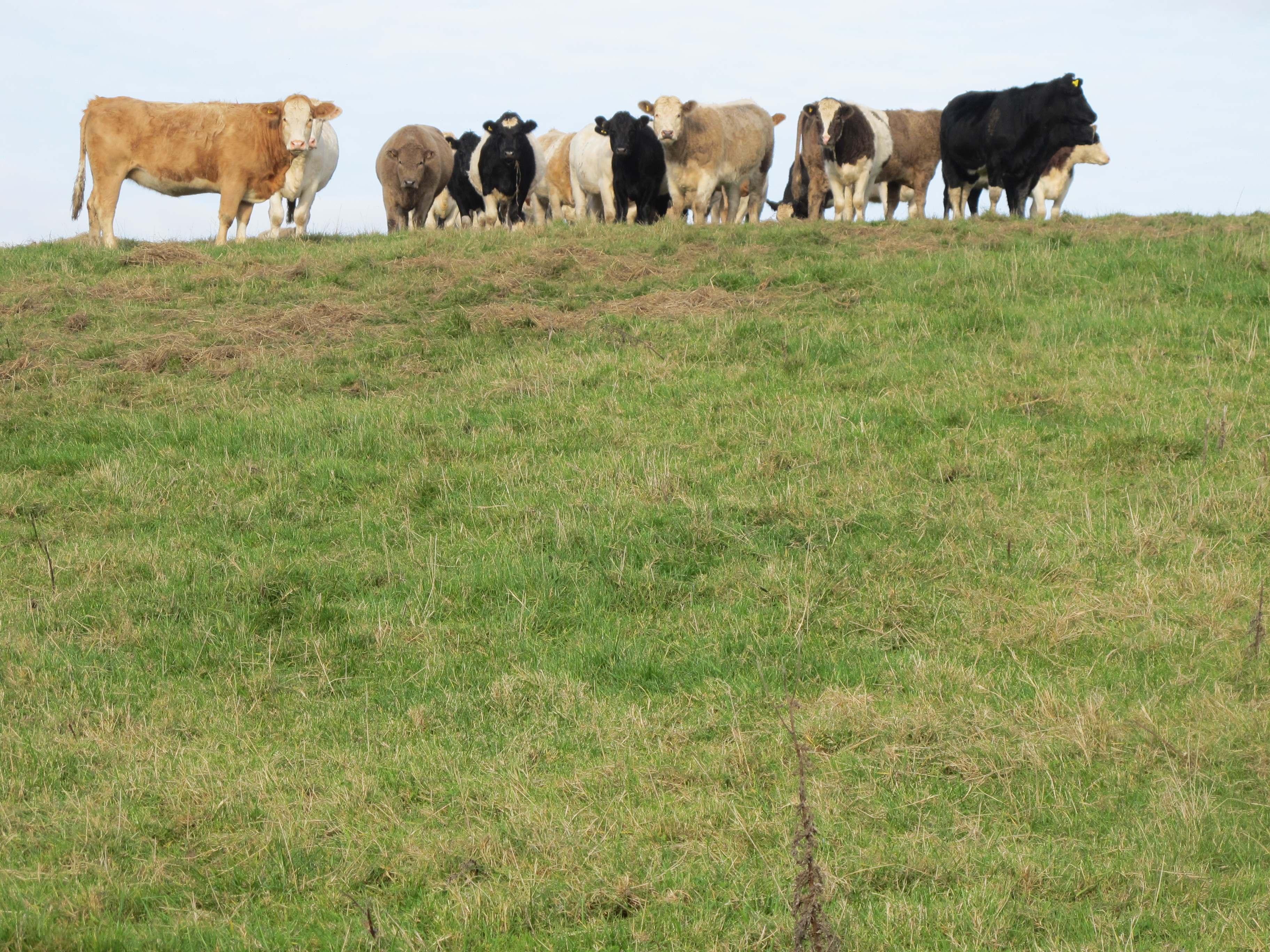
Semi-relevant photo: The sun shining on a herd of cows. (Actually, they were making sure we left their field, and I can't remember if the sun was shining on them or not--it looks like diffuse sunlight. Does that count?)

Semi-relevant photo: The sun shining on a herd of cattle. Actually, they were making sure we left their field, and I can’t remember if the sun was shining on them or not–it looks like diffuse sunlight. That may or may not count.

The sun wasn’t shining on me that day. I’ll skip the details, because they’ll take me off in a whole ‘nother direction, but I’d been shaken by some bad news a few hours earlier, and I was still feeling it.

What does it mean to be so American that I look like I own the world, even (or particularly) when I’m don’t feel that way? Well, what does it mean to belong to any nationality?

The question’s been rattling around in my head lately, at least in part because of the anti-immigrant sentiment that seeps into so much of British politics these days. And into American politics, while we’re at it. You could probably drop any other more or less solvent nation into that sentence, because trouble drives people to immigrate, and the world’s a troubled place these days.

Part of the anti-immigrant feeling is about jobs: If immigrants come over here (wherever here is), they’ll work for less and wages will drop. There’s some logic to this, although what’s really undermining wages is that jobs, and whole industries, have moved overseas, where wages are ruinously cheaper. On top of that, unions don’t have the clout they once did (those two aren’t unrelated), and they were a major force driving wages up.

But another, more emotional, strand of complaint is that immigrants don’t blend in. Basically, the problem with immigrants is that we’re foreigners, and couldn’t we please stop that? Stop talking our languages in public. Stop eating funny foods. Stop dressing differently. Stop running around with different-color skin. Stop cheering for foreign sports teams or holding to foreign religions or using all those alphabets that no decent person knows how to read. I mean, who knows what we’re writing in them?

But once you grow up in a culture, you don’t get to leave it behind—not entirely, even if you want to. No matter how much you work at blending into another one, you carry some part of the original. I walk, apparently, like an American, and I know I sound like one. I even eat like one. The American way of eating involves juggling the fork from the left hand, where we hold it if we need to cut something with knife and fork, to the right hand, which we use to bring the food to the mouth. The British way leaves the fork where it started, in the left hand. This is great, because it lets you use the knife to push food onto your fork—and it’s perfectly good manners when you do. That solves a problem built into the American approach: How do you get the last bits of non-spearable food onto the fork without sneaking a finger onto the plate and hoping no one’s looking? Although it doesn’t solve another problem, which is how to keep the food on your fork, because the British hold the damned thing with the back—the hump—facing up, so that you can’t use the fork’s valley to cradle your food. I haven’t a clue why they do this, but it may explain why mashed potatoes are so popular: you can use them as mortar to hold the rest of your food on your fork.

So I’m a partial fan of the British method, and periodically I try to eat that way—usually with the curved part of the fork facing up, but never mind, I’m compromising here and I want some credit, damn it. All you anti-immigrant campaigners, are you listening? I’m making an effort.

What happens, though? The minute my mind wanders—and it doesn’t take long—my fork’s magically moved itself back to my right hand and I’m eating like an American again. And the sun shines on me.

At this point, while the sun’s shining on me alone, I have to interrupt myself, because I read this post to my writers group and they told me that holding the fork with the hump facing up is posh, presumably because it makes you eat more slowly. Holding it valley-side up is working class. Who’d have thunk? I swear, you have to be born here to figure this stuff out. On the evidence of that alone, though, I ask you: Who should be running the country?

Because of my (sometimes absurd) efforts to publicize both my book and this blog, I’ve written a lot of bios lately (I will post just about anywhere, about almost anything, as long as I get a bio and a link), and I keep describing myself as an American living in Cornwall. That reflects the reality of who I am culturally, but it ignores the fact that I’m a British citizen as well as an American one.

For me, becoming a British citizen was about security, not love or allegiance or culture. I do love the country, but I’m not romantic about citizenship. I wanted to be a citizen because it’s harder to get rid of a citizen than a resident alien. Since the U.K. government had already changed the rules once before Wild Thing and I got the right to stay in the country for the long term,and since we just about got kicked out of the country because of it, we were touchy on the subject. It may be crass, but we wanted the safety that comes with citizenship. We’re grateful for it, but it hasn’t, and can’t, change who we are.

So when I hear someone say that the problem with immigrants is that we don’t acculturate, I can only suggest moving abroad and seeing what happens.

*

A final note: Before my writers group before we fell down the conversational rabbit hole of what it means to have a constitution that isn’t a written document, I learned something else about forks and nationality: More and more of the British are acting like Americans and shuffling their forks from hand to hand as they eat.

And we’re not even the immigrant group anyone’s upset about.

If you want to blame someone, you can blame movies or television, because there aren’t enough Americans here to have that big an impact.

How do foreigners change a culture? Sometimes it’s from a distance.

Beer and British politics: The Pub Landlord runs for office

British politics just got a bit less depressing: A new candidate just entered the race for a parliamentary seat, a comic named Al Murray running under the name of his comedy character, the Pub Landlord. His party’s logo looks a lot like the one the U.K. Independence Party (Ukip) uses, and although I hate to give Ukip any space in my earth-shatteringly influential blog, the joke doesn’t work unless you know a bit about who the Pub Landlord’s making fun of.

Ukip wants to take the U.K. out of the European Union and get rid of all of us pesky foreigners. Or maybe they don’t want to get rid of quite all of us, because Ukip’s leader is married to a woman from Spain, so presumably they’ll make exceptions, but basically they don’t like furriners coming over here, taking British jobs and speaking funny languages on their streets. Last I heard, the party leader’s wife had a paid job in his office, but I guess that wasn’t a British job, it was some other kind of job, so it must be okay.

Irrelevant Photo: Mulfra Quoit, an ancient monument in West Cornwall

Irrelevant Photo: Mulfra Quoit, in West Cornwall

What else does Ukip stand for? Well, it sort of depends when you ask and who you ask and what sort of mood they’re in. And whether they’re still in the party, because periodically one of their candidates goes too far and gets thrown out. One proposed banning Islam and tearing down mosques. Another posted anti-Semitic and anti-Muslim statements on his Facebook page. A third was convicted of assault. Let me quote the Mail Online here: “The Ukip official charged with vetting the party’s election candidates has revealed he spends half his time ‘weeding out the lunatics’. . . .

“The remarks come after one Ukip candidate was recorded making homophobic, racist and obscene comments—while another was exposed as a fantasist after becoming embroiled in a public sex scandal.”

Ukip does stand for a good pint of beer, though—that’s been pretty consistent and to date no one’s been thrown out for it. And they’re polling well considering that they’re a minor and basically bonkers party. Well enough to scare the bejeezus out of the major parties and drag them all into a discussion of what to do about immigration, as if everyone agreed that immigration is what’s wrong with—and probably the only thing wrong with—the country.

But back to the new party: Its name is Free United Kingdom Party, or FUKP. (Yeah, go ahead and pronounce it.) And what’s its platform? The Pub Landlord promises to burn down the Houses of Parliament for the insurance and brick up the Channel Tunnel to keep immigrants out. His most inspired proposal is revaluing the pound so it’s worth £1.10. About cutting immigration, he says, “This is the greatest country in the world and people want to move here. We need an MP to make things worse. Look no further.” On corporations and globalization, he says, “Blah blah blah paradigm blah blah blah, blah blah dialectic blah blah blah blah blah blah game-changer.” Which is pretty much what all the politicians are saying.

Finally, he pledges that the U.K. will leave Europe by 2025 and the solar system by 2050.

Politics hasn’t made this much sense since Screaming Lord Sutch ran on the Official Monster Raving Loony Party ticket.

Manners, American and British

The British have manners. They have such good manners that from time to time they’ll throw them out the window to scold strangers for their lack of them.

Wild Thing and I were in the outdoor section of a café once—a cramped, eat-your-lunch-and-get-out kind of place—and as a couple who’d been sitting nearby wove past our table to leave, one of them said, “In this country, we say please and thank you.”

Sadly, by the time we’d processed the words, they were too far away for a snappy comeback, but “In our country, we’re polite to strangers,” did come to mind. It may not be true, but I still wish I’d been quick enough to say it.

mulfra 030

Irrelevant Photo: Fountains Abbey, in Yorkshire

I have no idea what we’d done, or more likely not done, to piss them off. I’ve been a waitress. Wild Thing and I have both been cab drivers. We’re not the kind of people who think that if they have the money for a meal, or a cab ride, or a tube of toothpaste, it gives them the right to be obnoxious. But we are, I admit, incapable of saying thank you as often as the British do. Buy something at a small store and when you hand in your item to be rung up, the clerk will thank you. When you hand over your money, you’ll get thanked again. (A variation: The clerk may look at the twenty you handed over for something costing less than a pound and say, “Lovely,” or “Brilliant,” as if you’d handed them a slice of chocolate cake, or exact change just when they were about to run out and the banks had all closed and the vandal hordes were all lining up to do their shopping and none of them had brought the exact change.) Then when you go to leave, unless some other customer’s diverted the clerk’s attention, you get thanked a third time, often with the phrase, “Thank you very much, thank you.” Or, “Thank you. Thank you very much, thank you.”

At least it’s like that way out in the country, where we live.

I can’t do that. Can not. Am constitutionally incapable of. I also can’t manage to say you’re welcome three times for a single transaction, especially when I haven’t done anything. I mean, you’re welcome? For what? I bought something. I wanted it enough to hand over money. That’s not a gracious act that I should say “you’re welcome” for. Sometimes I find myself saying “thanks” instead, which is also absurd but doesn’t feel quite as bizarre as “you’re welcome.”

I asked S. once how often she said you’re welcome in response to the multiple thank-yous. She looked startled and said she didn’t think it was “called for” unless you’d done something particularly—well, kind may not have been the word she used but it was the impression she left me with. Unless you’d gone out of your way, somehow. But I doubt she’d never noticed how many times she got thanked per transaction. It’s that old thing about the fish and the water. She swims through an ocean of thank-yous and wouldn’t notice them unless they stopped.

Or that’s what I thought, anyway, until A. and H. told me that you’re welcome is an Americanism, although H. added that there’s an equivalent phrase in Welsh. R. swore that it’s a class thing: If you’re working class, you learn to say “you’re welcome.”

At this point, I understood two things: 1, It’s complicated, and 2, I’ll never completely get it.

“What do you say?” I asked.

“That’s okay” would do, apparently. So would “cheers.” But “cheers” can also be used to mean goodbye, or as a kind of toast—when you lift your glass to someone. According to my British English A to Zed, it also means here’s how! What does here’s how! mean? I looked it up and it’s either too obvious or too unused to include, so I don’t know.

I asked M. and Wild thing what here’s how! meant and they were as blank as I was.

So in this country we say “please” and “thank you,” but we don’t say “you’re welcome.”

If I didn’t know better, I’d think that was rude.

Minims and crotchets: surviving British musical notation

“It’s simple,” G. tells me. “There are two quavers in a crotchet, two crotchets in a minim, and two minims in a semibreve.”

She’s not explaining the Harry Potter universe but musical notation in British as opposed to American. I give her a panicky nod, but I don’t fool her, because she stops before she gets to the full breve—which has a long E so that it sounds like breathe, in case you need to know that. And crotchet is pronounced like crotchety, with a T you can actually hear, not like that thing you do with a length of yarn and a crochet hook.

I explain to G. that I learned to call them whole notes, half notes, quarter notes, and so on, and she seems to believe that if I learn to translate those into the terms she knows we’ll be able to discuss time—that’s time as in music, not as in clocks. But because the eyelids of my mind fluttered when she said “It’s simple” and shut completely when she got to the quavers, my end of the conversation is mostly hand signals. I’m trying to show her the written notes, for some reason, with my fingers indicating whether the notes have stems and whether they’re filled in or hollow in the center.

Surprisingly relevant photo of a courgette. Or a zucchini is you prefer. Photo by Mmm Daffodils, on Wikimedia.

A courgette. Or a zucchini is you prefer. Photo by Mmm Daffodils, on Wikimedia.

G. and I know each other from the singers night at a local pub. Her head harbors a fine range of folk songs, from the sweet to the raunchy, with several stops in between, and she understands both time and notation, although she can’t necessarily communicate either of them to me. In spite of that, we’ve worked out a couple of songs that we sing together, and she tolerates my musical ignorance—a gift I admire even more than her ability to harmonize spontaneously. We’ve been working on a new song, Les Barker’s “Non, No Courgettes,” which is a mash-up of French and English set to the tune of Edith Piaf’s “Non, Je Ne Regrette Rien.”

A courgette, in case you need to know this, is a British zucchini.

Somewhere in the midst of our run-through, I’ve fallen foul of a hemidemisemiquaver. Or something very much like one. There is such a thing. Really there is, although probably not in “No Courgettes.” I can’t say for sure because I wouldn’t recognize one if it snapped my finger off and added salt. All I know is that they’re very short, but then so are piranhas.

So am I, if that’s at all relevant.

I’m not completely uneducated about music. I took piano lessons as a kid, and I’m sure you could have found a more resolutely untalented student somewhere but you’d have had to look hard. The lessons were about either classical music or some damned silly song about my pretty dolly, and I wasn’t interested in either of them. I don’t remember how long I took lessons for. It seemed like forever, and my teacher must have felt the same way, but given how little I know it could have been no more than two months. I came out of it almost able to read music. I can follow the treble clef if the notes don’t go too far above the stave and the time signature doesn’t get complicated and there aren’t more than one or two flats or sharps. Forget about the bass clef—I can’t read that at all. To translate that, if we were talking about words, I could read the vowels but not the consonants. It’s ever so handy.

No one, in all the time I took piano lessons, ever mentioned a minim, a crotchet, or a quaver.

G. lets the abstract discussion slide—this is both wise and merciful—and we tackle the song again, both of us tapping time on the coffee table. In my head, the words run, “Non (two three), no courgettes (two three four)….”

She manages not to pack up her guitar and leave. It helps that one of the cats has crawled into the case and gone to sleep.

A new page

For  anyone who’s not sick and tired of me yet, I’ve added a page of links to essays, posts, and assorted other stuff I’ve published elsewhere on the web. You’ll find a damn good recipe for carrot-pineapple cake, an article on uplifting music and TV shows about breakups (hey, I’ll do damn near anything to promote The Divorce Diet), and all sorts of other weird stuff.

Cockney rhyming slang: it’s real

“It’s parky,” J. said while our dogs sniffed each other in the middle of the empty road.

I must’ve looked as blank as I was.

“You don’t know what I’m talking about, do you?” he asked.

I hadn’t even thought to say so. That’s how blank I was.

“Haven’t a clue.”

“Parky in the mold. Cold. “

Not J.'s dog. I'm cheating. Photo by Sellys, on Wikimedia.

Not J.’s dog. I’m cheating. Photo by Sellys, on Wikimedia.

I managed to say, “Oh.” Then I managed to say “I need a translator.” I didn’t manage to ask what parky was, or what it had to do with a mold. I understand just enough about rhyming slang to know that the phrases aren’t nonsense sounds—they mean something—so it would’ve made sense to ask.

If you haven’t heard of rhyming slang, here’s the five-second summary: It started in the mid-nineteenth century, in east London. One theory claims it was used by thieves as a more or less secret language and another says it started as a game. A third says it was a way of reinforcing neighborhood solidarity. Whatever the origin, it works like this: You take a word and find a phrase that rhymes with it: stairs with apples and pears. Then you drop the word that actually rhymes and say, “I’m going up the apples.” And you leave your clueless friend standing in the middle of the road with her jaw hanging open while the dogs sniff each other.

J. and I said goodbye and he promised to clue me in to a few phrases so I can respond to them and make people think, Ooh, she knows what it’s about.

Although clearly I don’t.

Waiting for the publication fairy

The Divorce Diet is available today, and having promo’d it shamelessly up to now, I’m not doing that today. This is about waiting for some publisher or award committee to wave the magic feather of approval over your work.

A.L. Kennedy, speaking at an awards ceremony, said, “It’s a hard and a lonely life to be a writer—it’s not hard in the manner of being a nurse or a coal miner, but as a writer you have to believe in yourself a lot before anyone else does.”

the divorce dietSome days it’s harder to believe in yourself than to think, Maybe I should just pack it in, which is probably why so many of us look to an outside source for proof that what we’re doing is worth the bother.

Before my first short story was published, I believed publication would transform me into—although I didn’t use these words, even in the privacy of my own head—a real writer. I still believed that before my first book was published, and my second book, and I’ve kept on believing it as The Divorce Diet, my third, worked its way toward publication. Somehow, we never stop believing in the good fairy, even after she morphs into the publication fairy. We still think that as soon as we’ve proved our worth she’ll wave that magic feather. The problem is that the way we have to prove our worth keeps getting harder. There’s always one more test. I’ve read about famous writers who felt slighted because they hadn’t won the Pulitzer, the Nobel, the Massive Damn Whaddayacallit Award. They were still waiting for the publication fairy and her fancy feather.

But before writing can be about publishing, it’s about the act of writing: putting one word after another; and even before that, it’s about finding the place inside you that needs to speak, and charting a path from that place into the world. And then—once, twice, and a thousand times—it’s about believing that the act is worth the effort.

And after you get published? It’s still about the act of writing. We keep going back to that or we’re lost.

I’m writing this in advance of the TDD’s actual release date, so I can’t report on how I feel moment by moment, but I can predict pretty safely: At some point I’ll remember that what day it is and I’ll look around for a big feeling to match it, and it won’t be there. I’ll be the same me that I’ve always been. And when I next sit down to write, I’ll be the same writer I was before, not some magic-feathered genius.

Let me go back to A.L. Kennedy. She’s worked, as a writer, with “people in care homes and hospitals: psychiatric outpatients, people in prisons, people trapped in their own homes, people with all kinds of degenerative diseases or learning difficulties.” And writing could be life-changing for them not “necessarily …because they will end up being writers professionally,… [but] because they get practice to find the words to say who they are and what they want and how their world is and—in short—they will find their voices. And having a voice and knowing you can use it is a very beautiful thing.”

If you blog or write for other reasons, you know this, but it’s easy to lose track of in the scramble to transform ourselves into whatever we think real writers are.

I’m not saying that recognition doesn’t matter. I want it as badly as the next fool. But never think that it’s all that matters. Write because you must. Write because you love it. Write because it gives you strength. If you reach only yourself, you’ve done something of value. If you write well and purely and reach other people, you can give them strength. Or make them laugh. Or let them see the world in a new way. If you reach one other person, that’s a gift to you both. Take joy in it. For its own sake.

A foreigner’s guide to Boxing Day

If you’re not British, or living in a British-inflected country, you’re asking, What?

Boxing Day is the day after Christmas.

So what does everyone do, go out and hit each other?

The people Wild Thing and I know mostly stay home and eat the Christmas leftovers. Especially those brussels sprouts. For breakfast, you can use them in bubble and squeak (which does neither, as far as I can figure out). It involves leftover sprouts (or cabbage, or anything else along those lines) and potatoes, bacon, onion, butter or some other sort of fat, and a frying pan. More or less. It’s one of those recipes that use up whatever you have on hand, so there’s no point in being precise about it.

Christmas cake. Photo by James Petts, on Wikimedia.

Christmas cake. Photo by James Petts, on Wikimedia.

After that, you can start on the Christmas cake.

It may be called Boxing Day because it was the day that Victorian ladies and gentlemen gave gift boxes to tradespeople and the servants (who had to work on Christmas day, and probably had to work on Boxing Day as well). Or it may have come from a medieval tradition involving alms boxes, which were opened on Boxing Day and the money given to the poor. Basically no one’s sure, but if you repeat the stories often enough they take on a certain authority.

What’s certain is that it’s a second legal holiday that involves brussels sprouts. Only in Britain.

 *

I’ll be posting once a week until—probably—mid-January, when I’ll go back to twice a week. Enjoy the holidays, whatever you celebrate and however you celebrate them. 

Singing up the sun: A late report on an early solstice

The winter solstice celebration came to Cornwall early this year. No, the earth’s tilt hasn’t changed and the days hadn’t stopped growing shorter, but a group of people around here gather to sing up the sun on the summer and winter solstices and—well, the pub couldn’t handle that many breakfasts on the actual solstice, so having weighed the sun’s schedule against the pub’s schedule, the group met a day early. Or was that two days early? I’m the last person to trust on this kind of information, but what matters most in life, breakfast or accuracy?

Breakfast.

Stone circle at Minions

Stone circle at Minions

I’m not sure if I should say “they” or “we” as I write about this. I’ve joined the group twice now, but by definition it involves getting out of bed in the dark, so I’m a fringe member—always on the verge of rolling over and mumbling, “Next year.” So let’s go with “they.”

The place they meet is on the moor, where three ancient stone circles were built one right next to the other. Last year, a group of archeologists and volunteers uncovered an ancient pathway between two of the circles, then documented it and covered it back up, since that’s the best way to preserve it.

Not only is the place packed with ancient monuments and atmosphere, it’s also windy. The moors are like that. If there’s any wind at all, you’ll take a pounding. So it was cold and we didn’t stay out long, but we stood in the midst of the stone circles and sang, and the harmonies were beautiful. And in response, the sun did what it always does, which is to come up when it’s damn well ready. On this particular almost-solstice morning I’m sure it did come up but we couldn’t really tell. It was cloudy and anticlimactic and we walked to the pub and ate breakfast, but the harmonies really were beautiful and I’ll probably drag myself out of bed at silly o’clock when the summer solstice comes around.

Celebrating a Bulgarian British Christmas

Since my recent posts were about Christmas in Britain, I should send you to Not Another Tall Blog for a post on what it’s like to keep your original traditions–in this case Bulgarian–when your children are growing up British. Every immigrant has to find a balance between the two cultures they live with, and when you’re raising children in a new culture the issue must be even more pressing.

Angie’s post drew my mind to my grandparents, my father’s parents–Russian-Jewish immigrants who raised eight children in New York City at the beginning of the 20th century–and the decisions they were faced with. There’s a long story there, or may stories, but let’s save them for another day.

Again, happy holidays.