Comparative tipping

According to Kate Fox in Watching the English, you don’t tip bartenders in England (and by extension in Britain), you buy them a drink. Which I always thought was code, in the U.S. at least, for I’ll leave you the price of a drink and you decide whether to drink it or put the money in your pocket. Admittedly, I never spent enough time in American bars to know the rules, so no one should take my word for that. But in Britain it really does mean I’ll buy you a drink. Which the bartender will eventually drink, nodding his or her thanks to you.

Of so Fox says, and I’m sure she’s right. She sees this as marking a sort of official class equality between bartender and customer, regardless of what the class divisions (and oh, will both sides ever be aware of them) are.

Screamingly irrelevant photo: pampas grass, which is (I think) called something else here. Don't you love it when I'm informative?

Screamingly irrelevant photo: pampas grass (and the tip of Wild Thing’s lens). I think it’s called something else here. Don’t you love it when I’m informative?

(I haven’t given you a link to Fox’s book this time, although I have before. I’d link back to the embedded link but I can’t remember which post it was in and, hey people, I only get just so much time on this planet. Besides, you know how to find a book, right?)

But back to our topic: In the only pub where I spend much time—and that only because I like the singers night—the bartenders are also the wait staff, and they do get tipped for serving meals, so it takes a finer eye than mine to figure out the distinction. But it’s true that people don’t tip at the bar.

Except me. For a long time I behaved myself and didn’t tip when I bought a drink, but I’ve worked for tips, as both a cab driver and a waitress, and after a while I just couldn’t help myself. I started tipping. Sometimes at first I had to explain myself—one or another of the bartenders would think I’d miscounted my money and return the extra.

“I’m American,” I found myself telling one of them. “I tip. I can’t help it.”

I also remember saying, “I’m awkward but I mean well” since I hadn’t managed to make it clear that I was tipping—although in the U.S. I expect it would have been more than clear enough.

But no one seems insulted. The tip goes into the jar with the tips from the tables and my behavior goes into the Weird American category.

This comes up because Dan Antion commented that before he visited the U.K. he read that the British don’t tip, so he didn’t.

Sorry Dan, but they do. Not as much as Americans—or at least not as much as New Yorkers and Californians. Midwesterners are more, um, cautious with their tips. Or stingy, if you like. I haven’t done a full survey of the two coasts or of the south and west, so I won’t go out on a limb about how they tip. But the British? They tip wait staff in restaurants and (mostly) in pubs. Either many or most cafes have tip jars. And if they don’t? Wild Thing and I leave the tip on the table.

As far as I can tell, people tip cab drivers. We sure as hell do. And if something gets delivered that’s a pain in the neck for the delivery person, we tip—which often involves offering the money for a drink after work, which may or may not turn into a drink but who cares?

Around the holidays, some people we know leave money for the folks who pick up the trash and recycling and who deliver the mail—although the last one is, I think, never supposed to happen and the post office is probably coming to arrest me for even writing about it, never mind doing it. (I never said I did it, Your Honor, I only implied it. And I could’ve been lying.) Anyway, you can call those tips or Christmas presents or whatever you like. They happen, although not universally.

I’ve been reading, both online and in the papers, about campaigns to stop restaurant chains from stealing their employees’ tips. Yeah, some do that, both in Britain and in the U.S., especially if the customer puts the tip on a credit card with the rest of the bill, but sometimes even when the tip’s in cash—or in some cases if there’s no tip at all, because the restaurant acts as if there was one and charges the waitron what it figures he or she must have gotten. And it’s all okay, because if a businessman can’t steal from people with less power and money than him, how’s he supposed to make an honest buck?

Social media’s been effective at shaming the shit out of some chains that did this, but I expect others are still at it.

So whatever country you live in, tip, and do it in cash. And follow Wild Thing’s dictum: Nobody ever went to hell of overtipping.

Talking about the weather—a lot

Britain really does get a lot of rain. Almost as much as people think it does. Enough that the vocabulary for rain is extensive and specialized. It’s raining stair rods. Or pitch forks. It’s chucking it down, or pissing down, or bucketing down, or mizzling—a lighter, mistier version of drizzling and a word I use sometimes for the pure pleasure of hearing it. In the U.S., it rains or drizzles or rains cats and dogs, but that’s about it. Once in a while, I guess, it mists enough to turn mist from a noun to a verb. But if it does anything else I can’t think what it is. We have words for different kinds of storms, from a shower to a hurricane, but for the rain itself? We haven’t been driven by the sheer indoor boredom of being stuck in the house on 356 consecutive rainy days to come up with new words and phrases.

Or maybe the words came from being out in the rain before the invention of anything that even semi-reliably kept a person dry. Naming the damned stuff could keep your mind off your misery. Or at least keep you busy while you were miserable.

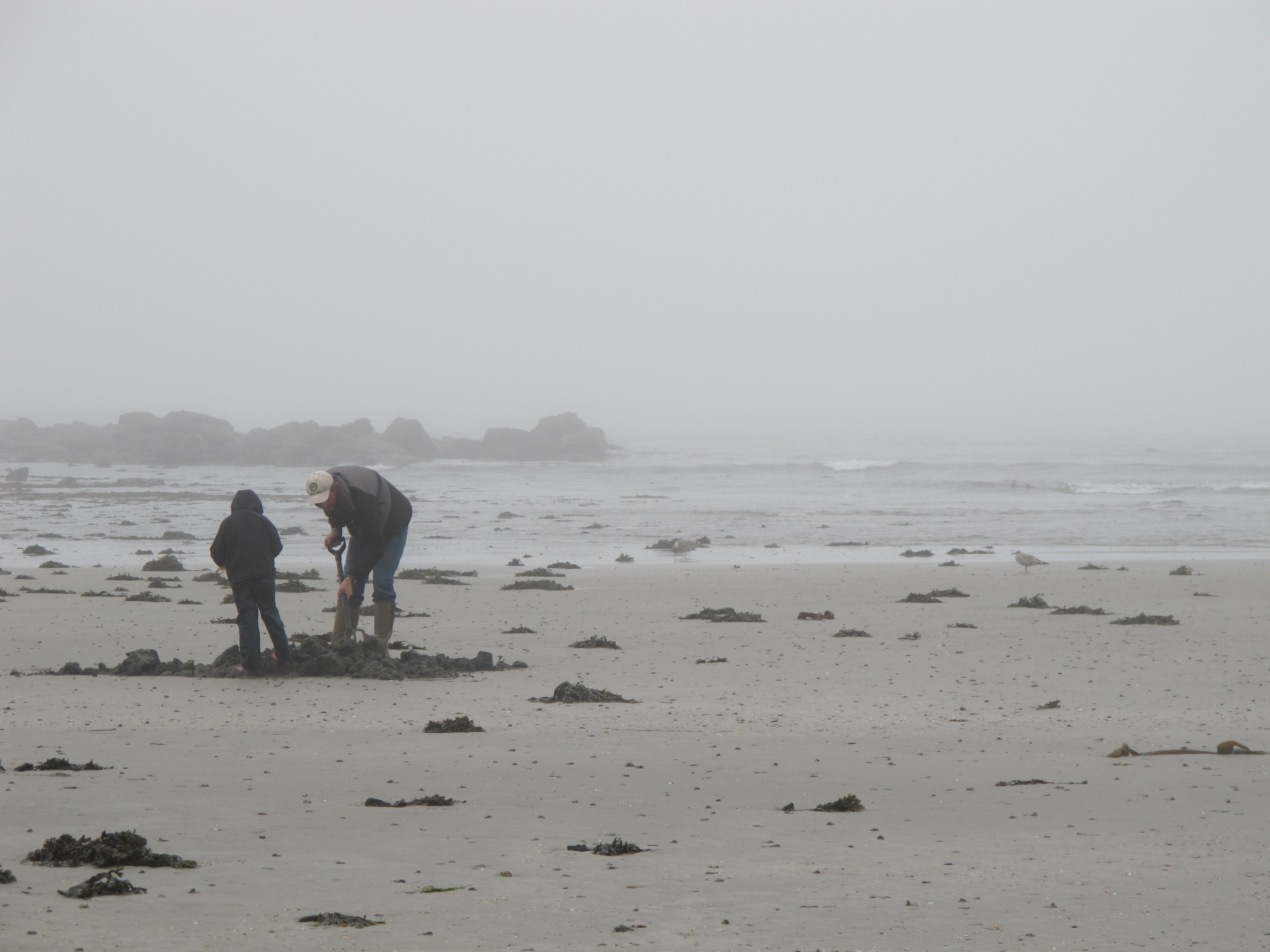
A rare relevant photo: digging clams on a foggy day. Marazion.

A rare relevant photo: digging clams on a foggy day in Marazion.

Once you have a vocabulary, you have to say something with it, which is how we get to attitude. It rains enough here that people grow a kind of fatalism about the weather. I say “grow” because it creeps over them the way mold grows on damp walls. Sometimes it comes out as a wry fatalism and sometimes as plain old moaning. (When I lived in the U.S., a moan was nothing more than a sound. Here it’s transformed into an entire attitude, a form of not-gonna-do-anything complaint. A way of life, in fact.)

The content of wry fatalism and moaning is almost the same. It’s the attitude that makes them different.

“I guess we’ve had our summer,” a neighbor said on a gray day that followed some warm, sunny weather.

I knew enough to say, “Yes, and it was a beautiful day.”

He laughed and I congratulated myself: I’d played my hand in the game of wry fatalism. Not bad for a furriner.

On a different day—a sunny one—another neighbor said, “It won’t last.”

Same thought but pure moan. I wasn’t sure how to contribute. Maybe all I needed to do was shake my head mournfully and agree but I didn’t. What help can you expect of a furriner anyway?

Free of either fatalism or moaning (I think) is weather news. People trade bits of this the way American boys once traded baseball cards. A storm’s working its way across the Atlantic. An arctic front’s moving down from Iceland. A warm front’s bringing rain from Spain (really—no plains anywhere to be found but the rain falls anyway). You name it, we tell each other about it, especially if it’s bad weather. We listen to the weather on the TV. We check online. We get updates on our phones. Okay, I don’t. My phone is nothing but a phone, and I’ve given up on the evening news since I read the paper and enough already, how much weather (not to mention news) does one person need? So I’m using we loosely here. But every other single person in the country does all of those things, and every last one of them tells me about it. And as a result I can tell more people, who already know it and have already told me some version of it but it’s okay, this isn’t really about the information, it’s about talking to each other. We’re trading baseball cards. Baseball cards have no intrinsic value. They exist only to be traded.

No one’s weather news quite matches anyone else’s, but if it did what would we have to talk about?

What the world wants to know about Britain

If search engine terms are any measure of what people want to know about Britain, I’m full of insight. And that other stuff, but it’s not what we’re talking about right now. I’m disguising myself as a sensible bloggist, so behave please. We’re in public.

I keep a list of the search engine terms that lead people to Notes, and that list tells me everything I need in order to fake my way through a serious topic. So here we go, with Google’s lower-case style and lack of question marks carefully preserved where I quote directly. Somehow adding quotation marks seems—oh, I don’t know, un-search-engine-like, so I’ve left them out, even though things would be clearer if I added them.

Profanity

I had four searches about these: who swears more, us or uk (I don’t know, but I’m pretty sure it’ll depend on what you consider a swear word) and usa vs uk profanity. Both of these popped up twice, each worded the same way and in a short space of time, marking them as two repeat searches. What do we learn from this? That the people who are interested in swearing try repeat their searches and return to sites where they probably didn’t find an answer the first time.

Irrelevant photo: Chun Quoit in the fog. This is an ancient monument near Penzance. No one knows what it purpose was, but it looks a lot like a giant stone ironing board.

Irrelevant photo: Chun Quoit in the fog. This is an ancient monument near Penzance. No one knows what its purpose was, but it looks a lot like a giant stone ironing board.

Manners

On a vaguely related topic, I was on the receiving end of five searches about manners: british have nicer manners (than who?); manners and how they started (twice); american manners for brits (see next question); what about manners in the us (we don’t have any, so don’t worry about it). The idea of two polite Brits brushing up on American manners in advance of a trip is touching, in a sad sort of way. It’s thoughtful, it’s polite, and oh sweetheart, it is so not going to help.

Food

The world—and I’m exaggerating only slightly; it’s called the multiplier effect and it allows me to lie in good conscience—is obsessed with lemon drizzle cake. I have no idea why. I mean, it’s good, but I never heard of it before I moved to Britain so how did everyone else? I had three searches for recipes in cup measurements (those would be from Americans), and one asking for metric, one that just asked for and measurements, possibly of the ingredients, possibly of the resulting cake, and possibly of the person who ate it all in one sitting. Plus one wanting an easy american english recipe—presumably that’s one with the excess U’s left out because they’re fattening. I did write a post or two about this, but in trying to come up with a recipe in cup measures I screwed the whole thing up so I’m not going to link back to it, even though it’s the most important topic I’ve written about. Other searches wanted to know about english food, british food, food about england in short note (I am notably short, but I don’t think that’s what this is about), tea, and an american expat making chocolate chip cookies in England (which is cheating a bit since it’s not exactly about Britain but let’s include it anyway because that’s me; I made a batch last week, since I’m the proud hoarder of a new stash of chocolate chips).

Tourism

Tourism sites think we want to know about beaches, castles, and places to stay. Bullshit. Here’s what people want to know: do the british mind american tourists; american tourists hated; annoyed by tourists? Cornwall (the question mark, being in the middle, survived); why are british so mean to american tourists. So, with that level of paranoia, we can answer the next two questions: why so few american tourists (because they think no one likes them) and are americans in awe of Britain when they visit (they might be if they weren’t so busy worrying about whether anyone likes them and why they don’t). And three people wanted to know about emmits, which is a Cornish word for tourists, although not necessarily American ones. It’s not a compliment, so maybe those tourists and would-be tourists are onto something. And in a neat little irony, I just googled emmits notes from the uk to locate the link to the back post on emmits.

Accents and language

Three people want to know how to pronounce the Widemouth part of Widemouth Bay (Widmuth, to save you the search). No one wants to know how to pronounce anything else, although one asked about british place of interest or towns consonants missing. I don’t know what this obsession with Widemouth means. Maybe it’s the center of the universe, although you wouldn’t think so to drive through. Other searches are: talking in british english a sex (no, I don’t understand it either, but then I’m American so maybe I’m not supposed to); do the english have accents to the aussies (is a bear Catholic? does the Pope shit in the woods?); table british accent (this may have to do with food but it may have to do with parliamentary procedure, in which case it’s complicated because to table means different things in American and British usage); british accent are fascinating (yes, but not half as fascinating as Google searches); pure english word list (sorry, kid, but English isn’t a pure language). And finally, about the U.S., what do americans call cats (we call them cats, or sometimes kitty).

Music

The questions here were: raunchy folk songs british (sorry, most of my raunchy ones are American); british musical notation; why is british musical notation weird; british “folk music” strange accents. So, we’re interested in raunchy folk songs in funny accents written in weird notation. I’m so glad people aren’t judgmental about cultural differences.

Wigs

Lots of people want to know about lawyers and their wigs—their history, what lawyers think of them (they all, of course, feel the same way), whether they’re itchy, why lawyers wear silly wigs (no judgment there). Apparently if you know three things about Britain, one of them is that lawyers wear wigs. Another is that people eat lemon drizzle cake. The third? That a lot of weird things go on.

Neighbors

Someone typed in neighbor wants to know everyone’s business uk. I can’t help wondering if they had someone specific in mind. Another was interested in british dog village life and a third in british neighbors and a fourth in miss marple village. If that last one is about Miss Marple’s village, it’s worth knowing that she’s a fictional character, living in a made-up village, where 150% of the population has been murdered. Visiting isn’t recommended. Or, strictly speaking, possible.

Intercultural explorations

These were: what caused strange british traditions (sunspots) and why do english use chocolate eggs not hens’ to celebrate easter (the British have developed chocolate hens and those are their eggs, thank you very much). Don’t you feel better knowing that people are still out there wanting to learn about other cultures?

Other stuff

One person wanted to know about british schoolgirls in uniform and wanted to know it three times. He (and yes, I’m making assumptions; wanna bet I’m right?) didn’t find any photos here but kept coming back anyway. Don’t think about it too much, because it’ll only upset you. Three wanted to know about Mrs. Baggit, including one who wanted to know where to buy a Mrs. Baggit sign. One wanted to know how to break into a british phone boxed. Yes, boxed. It should be easy, since the doors don’t lock—all you have to do is pull. Phone boxes are made that way—the phone company wants you to come in. Or used to when they could still make money on them. The hard part these days is finding one. Maybe the real question was how to break into the money boxes inside them, in which case save your energy, because they’ll be empty.

Someone asked about jack rusel parkins, which baffles me since a jack russell is a dog and a parkin is a kind of cake. Google jack russell parkins, though, and you’ll end up with links to sites about the parson jack russell, which is a specific kind of jack russell.

Someone else seems to have mistaken Google for email and wrote “perhaps you would like to come for lunch or afternoon tea on a s…” It struck me as so forlorn that I’d have gone if I’d known who wrote it. If they weren’t too far away. And if—well, never mind. It’s not going to happen. But I did put quotation marks around the invitation to buffer it from this harsh world.

Other people wanted to know: who funds cornwall gay pride (Moscow); what a crooked stile is; why I (or some vague set of someones) think Britain is called great (in case you’re keeping track, I capitalized that because it’s paraphrased, but what I or whoever thinks is pretty much irrelevant to even a semi-serious answer); the metric system in great britain; winter in cornwall; british sex scandal blog spot; and she steps on snails (oh, indeed she does).

And earning its own paragraph for its sheer oddity, someone was looking for uk bkhgum pales gurd xxx. And landed here, with his or her head still spinning from the ride.

A final searcher was looking for notes from the uk. And found it. Which sounds like the ending to a kid’s picture book.

Updates on tea and medical bureaucracy

I get some fantastic comments on this blog and a few of them just have to break out of the comment section. So I’m going to pick up on four of them, two about tea and two about medical bureaucracy.

Tea

If you’re American, you think I already wrote more about tea than is either intellectually or physically possible. But I live in Britain. Tea is the binding force that holds the nation together, and let me tell you it’s looking a little shaky lately, what with Scotland having held a referendum on whether to leave the union and, far more shockingly, so many kids these days getting their caffeine from energy drinks instead of a respectable source like tea. Not to mention the number of tea drinkers allowing themselves to be seduced by fancy coffee and if that isn’t enough the possibility that Scotland will hold another referendum in the (less than immediate) future.

Screamingly irrelevant photo: fall berries. I'm not even sure what they are.

Screamingly irrelevant photo: Fall berries. I’m not sure what they are but I don’t recommend tasting them.

And I’m not sure how the Welsh feel about referendums and secession. Or even whether some purist is going to tell me that the plural is referenda.

So, yeah. We need our tea. And we need to make it right. Which brings me to the point—and yes, there is one. Or two actually. You only had to wait.

J. tells me (and this was in person, not in a blog comment, which is why she’s going by an initial; the tradition may be silly but at least I’m consistent) that I ignored the role of teapots in my last tea post. Sure, I mentioned them, but you can’t make a nice cup of tea, J. says, unless you make it in a pot. Actually, she probably said “a proper cup of tea,” but I was listening to the sense, not the words, sadly. The sense was this: Make it in a cup and it just doesn’t come out right. Even if you only make a single cup, you need to make it in the pot and then pour it into the cup.

Why? Because it’s not a proper cup of tea otherwise, and if it’s not a proper cup of tea it’s not a nice cup of tea. And if it’s not a nice cup of tea, Scotland might just spin out into the North Sea, leaving the northern edge of England a ragged tear (pronounced tare; people may or may not weep about this, but it’s not what we’re talking about) across the land.

That’s not intended, by the way, as a comment on whether Scottish independence is a good idea. I could argue both sides of the proposition with equal passion. But the spinning into the North Sea? That’s just, you know, a fact.

Oh, and the pot has to be warm. Because the tea will brew better.

J.’s of the bone china school of tea drinking. Because it tastes better that way. It doesn’t have to be a fussy little cup and saucer—a mug’s fine—but for her it has to be made of china. Me? I like a heavier mug, but I try not to argue religion with friends.

So that’s one point. And then in the comment section, helenwood wrote about a job she had long ago, working for a tea importer, pouring water over the leaves so the tasters could sip and spit. But that wasn’t what grossed her out—it was that the tea leaves scattered on the warehouse floor, and presumably walked through by one and all, ended up in teabags.

If anything’s going to convert me to leaf tea, that would do it.

Medical bureaucracies

Moving on, then, from a serious topic to the trivia of our lives, we come to what I wrote about medicine in the U.K.

Ianbcross, a doctor who’s worked in the National Health System, commented that the Choose and Book system gives patients a code so they can make an appointment with a specialist online or by phone. “If there are no appointments available,” he writes, “it is up to the hospital to find one for you. You decide whether to accept it or not. This is for routine stuff. If your doc thinks you might have cancer, you get a two week wait appointment from the hospital. Less choice for you, but as soon as they can, they fit you in. Emergencies go directly to hospital, without passing GO, of course.”

Well, this is a guy who knows the system, and his comment made me wonder if I’d misremembered my experiences and Wild Thing’s. So I did what any sane blogger would do: I took a small and unscientific survey (I’ve stolen that phrase; it’s nice, isn’t it?) and came up with the following revelation: Our local surgery (that’s a doctor’s office if you’re American) is all set up so you can use the Click and Book system, but they don’t tell you about it. If you ask to use it, they’re happy to let you use it. But if you don’t already know about it, you can’t ask. So you sit around waiting for that letter.

Unless—as happened to me recently—you get a phone call. From the wrong hospital. But never mind, it was a phone call and it came quickly.

When I acted as an advocate for our neighbor, it wasn’t about getting an appointment but about shaking loose the report from an appointment she’d already had so she could (a) find out what was wrong and (b) do something about it. The doctor had dictated the letter and there it sat, waiting to be typed. And as far as I could tell there it was going to sit and wait until pine trees grew in hell.

The practice manager and I had a leave-it-with-me conversation, and I left it with her until the end of the day, when I called back. Which reminds me to mention that the NHS has a wonderful service called PALS, which stands for Patient Advocacy SomethingWithAnL SomethingWithAnS, not (as it did when I was a kid in New York) the Police Athletic League. I called PALS just after I talked with the practice manager. I suspect it’s owed the credit for getting that letter in the mail. I heard a rumor the service’s funding is going to be cut. I hope it’s not true, because the idea that within an inevitably bureaucratic system are people whose job is to make a nuisance of themselves when things aren’t working for the patient? That’s inspired.

In another comment, Dan Antion reminded me that in the U.S. the first questions anyone medical asks are about your coverage. If you’re not American, you may need that translated: Do you have insurance? Who’s your provider? What plan are you on (secondary translation: does your insurance plan cover this procedure)? And so on. In other words, everyone talks money while you bleed onto the floor, because money is what matters. (Note to the current U.K. government: Are you sure you don’t want to rethink that whole privatization of the NHS thing?)

And if anyone in Britain thinks it’s just the NHS that has unacceptable delays, he tells the story of a friend with a life-threatening condition who needed surgery and was told she couldn’t be seen for six to eight weeks.

The thing about the NHS is that until the current round of disorganizations were introduced, it’s been a unified system, so people talk about unacceptable delays, and newspapers write about them, and word generally gets passed around and everyone’s outraged and wants something done about it, which creates pressure to actually do something. When emergency rooms keep people waiting for more than four hours, it’s considered unacceptable. In the U.S., my father was left waiting in the emergency room for, if I remember right, seventeen hours. With meningitis. At the age of ninety. And he had good insurance. We were furious, but it was business as usual and didn’t tarnish the hospital’s reputation, or the U.S. medical system’s.

Comparative medical bureaucracies

Of all the phrases the divide British and American English, the one I dread hearing is leave it with me. It’s not a phrase I ever heard in the U.S., and now that I live in Britain I know life is about to spin out of my control when someone says it.

And yes, I do know life’s always out of our control, but we all like to believe, don’t we? We live for the comfort of that illusion. Even when we know we’re full of shit. Maybe especially when we know.

Or some of us like to believe. I like to believe.

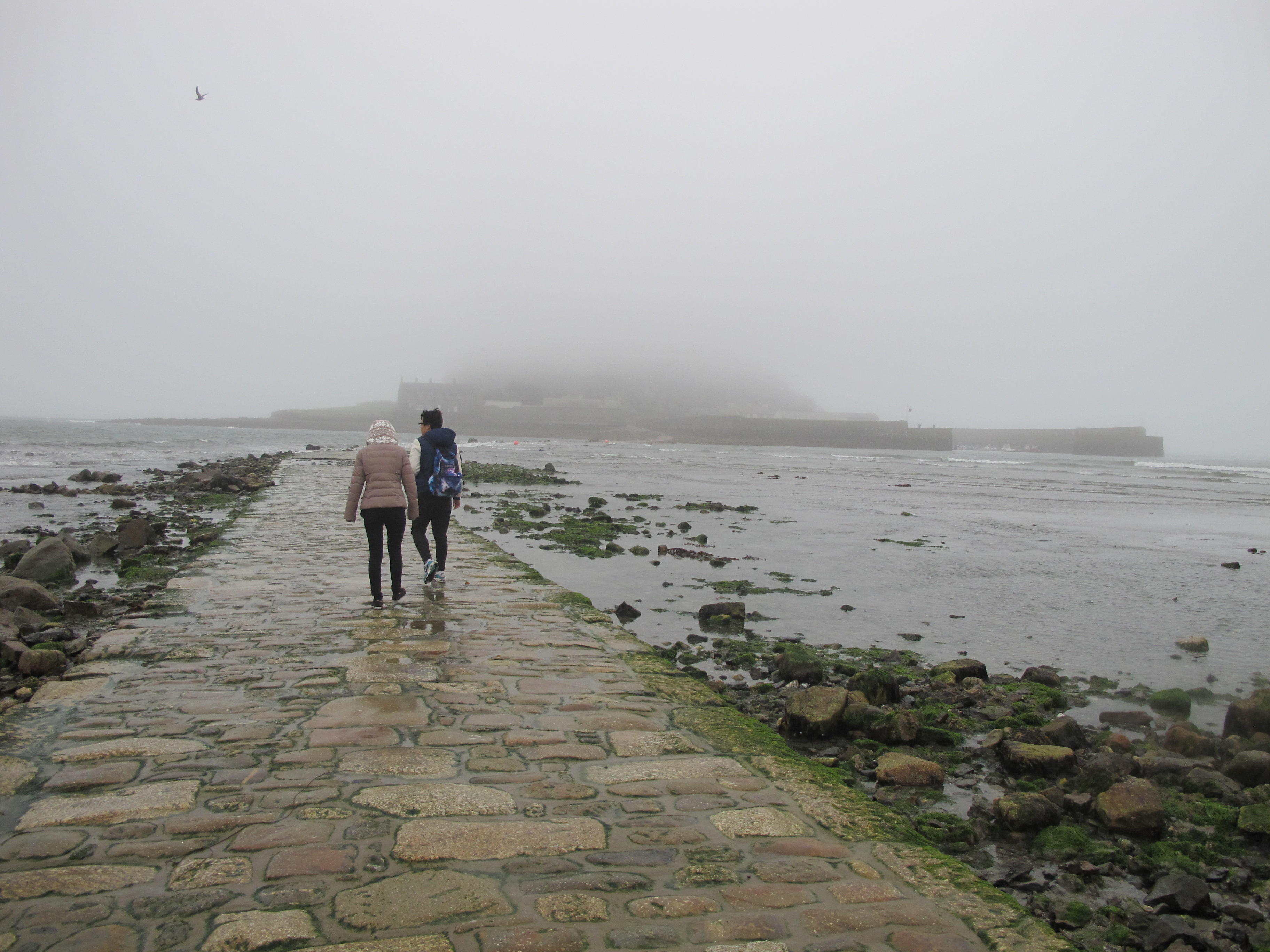
Irrelevant photo: The causeway to St. Michael's Mount, emerging as the tide drops. There's a castle out there, hidden in the fog.

Irrelevant photo: The causeway to St. Michael’s Mount, emerging as the tide drops. There’s a castle out there, hidden in the fog.

Suppose I need a referral from my GP to a specialist and I was supposed to be given an appointment by Wednesday and here it is the Tuesday after that Wednesday and I still don’t have the letter telling me when the appointment is. So I call to ask what happened. I’ve worked out an approach for this kind of situation. I’m polite and I’m relentless. I don’t demand, I don’t insult, and I don’t go away. This is easier to pull off when I’m advocating for someone else, but I can manage it for myself if I have to.

The receptionist says, “Leave it with me.”

Which means one of two things: 1. I will fix this so fast that whoever screwed it up will be dizzy for a week, or 2. I will make a note of this, bury it under a stack of paper, and forget you ever called, because your referral’s still a bunch of electronic blips in my computer but I don’t remember which file it’s in, or which computer, or what electronic means. Furthermore, I have worse problems than you. Don’t call back.

And I’m never sure which. Except for the don’t call back bit. I’m sure what that means.

I’ve learned to ask, “When will I hear from you?” so at least we’ve agreed on a date after which I’m free to make a pest of myself again, but until then I’m helpless. All my polite don’t-go-awayedness? It’s paralyzed by the leave-it-with-me beam of bureaucracy.

In the abstract, I could probably say, “No, sorry, I can’t leave it with you. Gimme my problem back,” but you know that bureaucracy beam? It’s like kryptonite. It keeps me from forming those words.

I did dodge the beam once, when a neighbor was having a medical crisis and D., who’s been a nurse, armed me with a magic phrase: That’s not acceptable. I listened to myself say it and wondered who I’d turned into, but in fact waiting wasn’t acceptable—it was a crisis—and since the phrase was magic it worked.

But you have to be careful with magic phrases. You can’t just spew that’s not acceptable in all directions and under less pressing conditions.

The leave-it-with-me problem stems, I think, from the British medical system’s paternalistic streak. The U.S. system is also paternalistic, but in a different way and—oh, you know how it is: When you’re not used to something, you notice it. The things you’re used to? They’re invisible. And the way they handle medical appointments here? I notice. If you need one, it will all be done for you and you’ll be told when to appear.

What if you can’t make it? You know, if you have to be in court that day or they’ll issue a bench warrant or you have some similar whim you might want to follow? At that point you get to step in and change the date or the time, but you have to wait to be given the wrong date and time before you can step in. And unless your condition’s a crisis, it’ll come by letter.

As far as I can figure out, this is true of both the National Health Service and private-sector medicine. Because that’s how it’s always been done and why change now just because the telephone’s been invented? And that other, even more modern thing, the inter-whateverit’scalled.

In the U.S., I can remember two systems for making specialist appointments. In one, I was given the name of a doctor and clinic (or a list of several) to call and I made my own appointment. In another, I stood at a desk while someone who worked for the clinic that was referring me made the appointment and could talk with me about whether I expected to be under arrest or in court at any given date and time.

In other ways, the NHS is more egalitarian than the U.S. medical system. I just read a nurse’s comment that “everyone is equal in the NHS; I find that amazing. In India, you can’t challenge a doctor, even if he is wrong. Here, a nurse can tell them straight away.” Unless things have changed since I last heard (and it’s not a topic I keep up on), challenges from nurses aren’t welcome in the U.S. yet.

But patients don’t seem to have claimed their power from the system, even if nurses have. So listen up, bureaucracy: I’m registering my complaint. Can I leave it with you?

Making a nice cup of tea

When my British friends seriously want some tea, they get specific about what they want: not just tea but a nice cup of tea.

Let’s take that apart: We can leave a and of alone without destabilizing anything important. But think about the word nice. Because you don’t just have a cup of tea in this country, you have a nice cup of tea. Even when the nice is silent, if you listen carefully you can hear it resonating in the background. I need a nice cup of tea, a nice cup of tea, a nice cup of tea.

And if the cup of tea you get tastes like second-hand dishwater? It’s all the more disappointing, because what you wanted was that nice cup of tea, not this travesty you’ve been handed.

In the U.S., we never sit down to a nice cup of coffee. We drink coffee, we make coffee, we drop by our friends’ houses for coffee, and we go out for coffee. But we don’t expect that comforting nice from it. It’s just, you know, an ultra-fat mocha semiccino with whipped cream and caramel sauce with a side of chocolate chip muffin and a triple bacon cheeseburger deluxe on a sesame seed bun. With mayo.

In other words, it’s no big deal.
Irrelevant photo: wild blackberries

Irrelevant photo: wild blackberries

I don’t know what it says about our two cultures that one seeks comfort from a hot drink and the other doesn’t, but I’ve known people here in Britain to welcome a cup of tea the way I’d expect someone to welcome a stiff drink after a day when the computer blew up, the basement flooded, and the dog filed for divorce; I’ve known them to take the first sip and say, like a borderline alcoholic after a brief flirtation with sobriety, “I needed that.”

Or maybe that’s me I’m quoting. If so, forget it. I’m not British. Or I am, but not deeply enough to count.

So let’s move on. People who expect comfort from a hot drink seem to find it. Point made, in a wobbly fashion.

After nice comes cup. Go into any cafe any you can ask for a pot of tea, and in some for a mug. In most places you’ll get a pot whether you ask for it or not, and all of that is fine, but if the nice gets spoken at all, it comes attached to a cup—one of those curved shells you wrap your hands around while the warmth seeps into your half-frozen soul. The thing you bring to your lips, allowing all the love that went into its making to flow into your metaphorical as opposed to your literal heart. It may have been made in a pot, but whoever made it poured it into a cup for you and that’s what we’re talking about— that cup and its the contents, and by extension the acts of making and handing.

We’ve gone well beyond the rational here. This is about caring and nurturing. It’s about love itself, in an indirect way.

So tea is central to the culture. Does that mean an American can’t march in and make a decent cup? Americans seem to hold one of three opinions:

  1. [Fill in the blank] criticizes my tea-making and always will because I’m American. Even if I do it right, I’ll never do it right.
  2. I’ve been to Britain and read every book ever published on the subject. Tea is my religion and I’ve returned home to convert a refined few among the heathens.
  3. Oh, get over it. It’s just a drink. Wanna cup?

If you’ve been hanging around my blog for any length of time, you can guess which category I’m in.

I don’t know how many categories British opinion falls into on the subject, and that may be for the best. However, in my unbiased opinion, I make a decent cup of tea, and if a friend’s in serious need I can even make a nice cup of tea. It’s hot, it’s strong (except when I make it for M., who drinks it so weak that I just boil the water and wave a teabag through the steam), and under normal circumstances it comes with something home baked.

And with that we arrive to the heart of this post. How do you make a nice cup of tea?

Am I qualified to answer that question? Do I care? Uncertainty hasn’t stopped me in the past, and neither has good sense. I don’t see why they should now. I predict, though, that from here on everyone who drinks tea will disagree with me about something. Have a good time, folks. I’m looking forward to it.

You start with the tea. If you’re American, this is the hard part.

Leaf tea: You can go to a fancy tea store and buy leaf tea, choosing one that was picked before sunrise from plants that have never been spoken to harshly. And you can pay any amount of money you like for the privilege, as long the amount is large. If you live in a tea-drinking country, on the other hand, you can buy leaf tea in a supermarket. No one in sight will know how the plants were spoken to or when the tea was picked. But it’s tea.

Wherever you buy it, try a few kinds and see which one you like.

Which means you have to brew it, and the first trick is to avoid stuffing it into anything that won’t let the water flow through. I’ve tried a variety of brewing gizmos over the years and most of them are as useless as stuffing the leaves in an old sock, and that includes the cloth or paper gizmos that imitate teabags. Why you want to avoid teabags and then use something that imitates them I don’t know, especially when they don’t work as well as the teabags you’re avoiding. (I am going to catch such hell for saying that. I can hardly wait.) Choose the wrong gizmo to stuff your leaves into and you’ll end up with expensive tannish water.

Open baskets do work—in this barbarian’s opinion.

In Britain, a lot of the cafes that use leaf tea dump it directly into the pot and give you a strainer, which comes with something to rest it on so you don’t end up splattering teadrops everywhere. Because the leaves are swimming around in the water, you don’t have to worry about whether the water’s flowing through them. The tea will be good and strong, but if you’re slow about drinking it, it’ll turn bitter. Some cafes give you an extra pot with hot water to thin it out with once that happens, but even with the extra water it sometimes gets strong enough to make you grow hair on your tongue.

Teabags: British supermarkets sell more kinds of teabags than they do baked beans, which is another way of saying you have a lot to pick from. If you’re in the U.S., your choices are limited. You can buy Twinings or something along those lines—one of those brands that entombs each teabag in a little plasticky-foily packet so you’ll understand how special it is, and how special you are to have bought it. I hate Twinings. Which—according to Kate Fox’s Watching the English—is because I’m not upper class. The lower classes drink their tea strong. The upper classes wants theirs to be as refined as they (think they) are, so their tea has to be pale and (lack-of-objectivity alert here) flavorless. So if you’re American and you like Twinings, go ahead and drink it and know that you’ve got more class than I have. Or want, thanks.

When I lived in the U.S., I bought Lyons tea from an Irish store near us and it was strong enough to turn my hair gray. Just look at the photo I use. Back when I drank coffee, I had (mostly) black hair. But Lyons is great stuff. If I hadn’t been able to get that, I think I’d have gone for Lipton’s rather than Twinings. At least it has some oomph to it.

Do I use leaf or teabags? Teabags. I used to keep some leaf tea for special occasions but the tea I made with it was never as good and how’s that a way to celebrate?

Water: This is the other ingredient in tea. If you want, you can use bottled water and it may or may not make your tea taste better. It will be more expensive. Your choice. You can use a kettle or a pan to boil it. If you’re in Britain, you’ll almost surely use an electric kettle because it’s fast. You’ll use it so often that you never put it away. If you’re in the U.S. you can still use an electric kettle but only if you’re willing to invest some time in the project. I grew old waiting for electric kettles to boil in the U.S. I’d have been 56 if I’d just put the water on the stove, but no, I had to buy an electric kettle and so I’m 68.

I have no idea why American electric kettles take so long.

What you can’t do is stick the water in the microwave. Even if it’s in a nice cup. Because microwaves don’t get the water not enough. The true secret of a nice cup of tea is that the water has to be boiling when you pour it over the tea. Or, okay, if it stopped boiling 30 seconds before I get to it, I don’t quibble, I just pour. But if it didn’t boil, or if it boiled back when my hair was black, it’s not worth using.

Do you have to warm the kettle? In my book, it depends on how cold the kettle is. Which depends on how cold the house is. If it’s cold, pour a little of the water in it, slosh it around, let it sit if you want to, warm the thing up, then pour the water out and make your tea. And if you’re making a single cup? I’ve never stopped to warm a cup, although it makes as much sense as warming the kettle. And the tea’s been fine, thanks.

I’ve read that you shouldn’t reboil the water because all the air goes out of it, or all the—oh, I don’t know why you’re not supposed to do it. You’re not. All the experts agree. So put in as much as you need and no more.

How long do you brew it? Well, how strong do you like your tea? I remember a huge ad in Paddington Station saying that after five minutes tea was stewed, not brewed. Stewed tea is bad. Why? Because a huge poster in Paddington Station said so.

I don’t leave my tea that long unless I wander off to do something else and forget it, in which case it may be as much as ten minutes before I wander back. If I’m in a hurry, I stir it. What you (and you’ll notice how seamlessly we’ve switched from me to you here) don’t want to do, if you’re using teabags, is squeeze them. It makes the tea bitter. Really. It does. Just lift them out, all dripping and nasty. Or leave them in, but if the tea’s going to be sitting a while, you may end up with a hairy tongue.

Add milk. Or milk and sugar if you feel strongly about it. Then sit back and enjoy a nice cup of tea. With love.

The fluid ounce and the British passport

A friend in the U.S., L., recently sent me an American measuring cup. I’d asked for it because early in my blogging career I read on an expat blog that the British pint contains one more fluid ounce than the American pint. I tucked that information away in the back of my screaming brain to ponder at some time in the future when I suddenly become competent with numbers.

That’s another way of saying, I ignored the information. Even when I’m working with imperial measures, I don’t measure things by the pint, I measure them by the cup or the fluid ounce. But it nagged at me. What, I couldn’t help wondering at 3 a.m. when my brain was fizzing and the kitten had noticed I was awake and decided to see if he couldn’t sleep inside my nostril, if the ounce itself is different?

Nah, I told myself once morning came, my brain settled down, and the kitten had wandered off to play with the dog. They couldn’t do that to me. I’m a citizen.

Irrelevant photo: Corfe Castle, in Dorset.

Irrelevant photo: Corfe Castle, in Dorset.

I had good evidence for this. Not only a British passport, which they don’t hand out to non-citizens, but the fact that my American recipes work, even though I made every last one of them using British measuring cups.

Except cornbread. That doesn’t work. I’ve tried two or three recipes since I moved here, using cornmeal I brought from the U.S., and none of the results were worth eating. But okay, cornbread’s an American dish and doesn’t cross borders. I accepted that. Everything else was fine.

Except, irrelevantly, tomato sauce, but I don’t measure that, I just kind of combine it. Besides, it’s edible, just not the same as I made in the U.S. The canned tomatoes are British. Even the ones that claim to be Italian. That’s the only way I can account for it.

But back to ounces. I’ve been blogging since—oh, since whenever I started. A year ago? More a year ago? Have I explained that I don’t do numbers? Counting to one is beyond me. So it’s been something vaguely related to a year. Although the British year may be longer than the American one, so what does any of this mean, really, in the great scheme of things? The minute itself may be longer. I’m not about to split hairs.

However long it’s been, that’s how long it’s taken me to think, Y’know, maybe I should check on this fluid ounce thing. And so I asked if L. would send me an American measuring cup, and when she did I poured some water back and forth from hers to a British one and it didn’t come to the same marks.

I poured the water out, put both measuring cups in the drying rack, and refused to believe what, between them, they were telling me. I repeat: I’m a citizen. They can’t do this to me.

I tried again a couple of days later and got the same result, and I responded the same way, except that this time I thought, Maybe if I tried it with milk it would be different. Because milk’s white. It’s easier to read. It would give me the answer I wanted.

Finally I emailed L., explaining some of this (I hadn’t thanked her yet, so it was high time), although I made an effort to sound marginally saner than I do here, and she sent me a link. It turns out the British fluid ounce is 0.9607599ths of a U.S. fluid ounce. That just rolls off the tongue, doesn’t it? It’s exactly the kind of number the average home cook can work with.

This information, I decided, must explain the difference between the number of ounces in the British and U.S. pints—someone added the extra ounce so the pints come out even—and off I trotted to Google to confirm my insight.

Nope. The British pint equals 570 ml and the U.S. one equals 470.

Can you hear me screaming? One of the things I’m screaming is that you have to translate this mess into metric in order to compare it. Without the metric system, we couldn’t even discuss it, because in imperial measures it falls off the edge of the English language. We’d be reduced to pouring water on the floor and comparing the size of the spills.

So thank you for the measuring cup, L. I appreciate it and as soon as the medications and the meditation restore my equilibrium I’m going to make another batch of cornbread. My cornmeal’s only eight years old. It should be fine. And if not, what the hell, I got a blog post out of it.

And since we’re not discussing this, I should ask if you’ve noticed that expat is nothing but a fancy word for immigrant. 

The cream tea wars

Cornwall and Devon are separated by the River Tamar and by a whole lot of bitter claims over who makes the best cream tea. Since a few people have left comments lately saying—and I’m about to paraphrase them both inaccurately and irresponsibly—that almost no wars are worth fighting, I think it’s time we stop and contemplate whether this one might not be. Because some things really do matter.

But first, for the sake of those of you whose feet have never been tucked under a table blessed with a cream tea, I need to explain what I’m going on about. The cream tea one of the few things that might convince this atheist that heaven exists. You take a scone and split it in half, then put jam and clotted cream on each half and as you take that first bite you’ll notice your eyes rolling upward toward the heavens in thanks.

swanage 073

Irrelevant photo: To be fair to both Cornwall and Devon, I’m posting a photo from Dorset. Which probably also thinks it invented the cream tea.

What’s clotted cream, though? It’s roughly as thick as whipped cream (don’t quibble; I did say “roughly”) but unsweetened. As well as yellower, gooier, and better. Ignore the disgusting name.

What’s this got to do with wars? Well, in Devon they think they invented both clotted cream and the cream tea. And they put the cream on first. In Cornwall, they also think they invented clotted cream and the cream tea and they put the jam on first. You at the back, settle down. This will be on the test.

In fact, it’s on the test every time I get a cream tea—which isn’t often because the arteries will only put up with just so much abuse. But it does happen now and then and when it does I sit in front of the scones, the dishes of cream and jam, and can’t remember which goes on first. Because I live in Cornwall, and this is serious stuff. It’s also exactly the kind of stuff my mind spits out like a toddler offered rutabaga. Ptooey, it says. I’m not remembering this, and it dances off to review some song lyric it already knows perfectly well, or the name of a wildflower, or something else of its own damn choosing.

Meanwhile, I could get myself run out of the county for this. And if I do, my mind’s going with me so I wish it would pay more attention.

Why does anyone care? Once upon a time, I’d have said it was just something to fight over, but food scientists have researched the issue, looking for the perfect cream tea formula. It turns out you want 40 grams of scone, 30 of cream, and 30 of jam. And—although they don’t mention this—a good-size pot of tea. With milk, a sunny day, and some people you like. Because hurling yourself at a cream tea on your own is right up there with drinking alone.

It turns out that the Devon method makes it easier to spread the fillings but the Cornish method allows you to serve the scone hotter, because the jam insulates the cream and keeps it from running. They don’t actually say which is better, the cowards. Which means they’ve been overtaken by the fate of most peacemakers, which is to piss off both sides.

You will, of course, pledge your allegiance to whichever side you choose, but don’t be surprised to make a few enemies when you do.

If you don’t live in Britain but want to make your own cream tea so you can participate in our wars? You’ll find a scone recipe in a back post and you shouldn’t have any trouble finding strawberry jam in a store, but you’ll have to either find a fancy supermarket and pay an outrageous amount of money for real clotted cream or try to fake it. Here are a couple of attempts I found online. I can’t vouch for either of them. This one’s from Food.com and used heavy cream and sour cream. And this one’s from Just a Pinch and uses cream cheese and whipping cream. Both add a bit of sugar, which makes me skeptical, but it may work. For the real thing, you’ll have to visit. On a sunny day. With friends.

Comparative racism part 2: What’s it like in Britain?

After writing a guest post about American racism I don’t seem to be ready to leave the topic. My mind keeps circling back to something I’ve avoided writing about until now: British racism.

Why am I avoiding this? Tact? Nah. I have the occasional moment of tact, but as a rule I’m not paralyzed by it. That it’s a hard topic to be funny about? In part, but I hope to manage a bright spot here and there. Ignorance? Well, yeah, there is that. I’ve lived in the U.K. for nine years. That doesn’t make me an expert. It’s a huge, sprawling topic. Plus I live in an absurdly white part of the country. Although my friends and family are a multi-hued (and multi-many other thinged) group, my friends in this country, for the most part, are not.

But still, I listen. I hear things.

Beyond irrelevant photo: grasses after an autumn rain

Beyond irrelevant photo: grasses after an autumn rain

Before I go on, though, I need to explain something. I appreciate it that a lot of people say things like “he used the N-word” in order to avoid using a deeply offensive word. I’m about to use the word, though—not because I think it’s okay, but because I’m writing about people who do, and to dance around the word itself is to dance around the racism it embodies. You know the phrase she wouldn’t say shit if she had a mouthful? Well, we’ve got a mouthful here, and I am going to say shit.

Since I moved to the U.K., I’ve been in a couple of situations where people used the word nigger, not as I’m using it here, to discuss racism, but as a way of talking about black people, and I’ve argued with them about it. If you don’t say something, you become complicit. Besides, I’m not constructed for shutting up about things that matter to me.

Argued makes the interactions sound more reasoned than they were. What I’ve found myself saying is variations on You can’t say that in front of me. Because screw the reasoned argument, people already know why I’m objecting and why explain it one more time? What might make some difference is putting as high an emotional price as I can on using the word.

I won’t argue that it’s the best way to respond, but it’s the one I can manage.

So why am I talking particularly about Britain? It’s not that no one uses the word in the U.S., although I can’t remember the last time anybody in the U.S. crossed that particular line with me. I didn’t live in such a white area, and I’d guess that makes a difference. Or maybe it needs to be explained some other way. I’m not sure. But I’d be surprised if, in a similar situation, anyone in the U.S. would react the way people do here, and if I’m wrong, tell me, because I’m interested. What happens here is that people regularly respond by saying things like, “I like the word,” or, “I don’t mean anything offensive by it,”  which seems to say that nobody should be offended and presumably the argument can then turn to what’s wrong with people who are offended when they shouldn’t be.

Insert a brief incoherent shriek here if you would. I don’t know how to spell one convincingly or I’d insert it myself.

I’ve heard the same argument made about golliwogs—Little Black Sambo-like dolls that make my flesh crawl. I never saw one until I came to Britain, but they have a history here and I’ve met any number of whites who tell they had golliwogs when they were kids and they loved their golliwogs; to them, the dolls aren’t racist. Never mind that they’re caricatures right out of the 1920s-style School of Shameless Racism.

A few of these comments have come from people who are clueless and/or racist, but more of them come from people of genuine goodwill—people who’d be horrified to be thought of as racist. And yet the compass that tells them what’s racist resides inside themselves, not out in the world, among the people most affected by it.

Admittedly, to at least some extent we all have to trust our instincts. But we also have to listen to people who are closer to the front lines on this. Being part of the group in question give you an intense apprenticeship in tuning yourself to racism, sexism, anti-Semitism, anti-WhatHaveYouIsm. And those of us who aren’t part of the group? We might want to listen. And think about what we hear. Because if we’ve lived in a society full of anti-WhatHaveYouIsm, we can’t help but be affected by it. We breathe it in. The spores settle in our lungs and they want to multiply. Hearing from the outside world is a sort of antibiotic. And I’m going to bail out of that metaphor before it goes out of control. I only passed high school biology because the teacher wasn’t what you’d call rigorous.

That’s far from a full report on the differences between American and British racism. (Did I really need to say that?) But it’s an aspect that fascinates and baffles me. I’ll be interested to hear what you can add.

Why is Britain called Great Britain?

The question of why Britain’s called Great Britain popped up in a comment thread, and if I were a better person I’d go back and figure out where it was and link to whoever raised it (it was a British reader in case that strikes you as being worth knowing) but I’m crazed lately. I made a note to do sixty seconds of research on the topic, forgot to copy the link into my notes, and here I am, without a clue where we were at the time.

Sorry.

But the question persists. What are we talking about when we say “Great Britain”?

If you wander around London long enough, you’ll eventually stumble into a street called Great Russell Street. It’s not a particularly big street, but I’m assuming it’s bigger than (not great) Russell Street, which you’ll also stumble into if you stumble long enough. (All this stumbling relies on the same principal as those thousand monkey on typewriters who will eventually produce the entire works of Shakespeare, assuming you can convince monkeys to type. And assuming I can get you to wander long enough. You’re welcome to stop for tea as often as you like if that helps. Or a beer.)

Great, my friends, isn’t a value judgment in either context. It means big. Big honkin’ Russell Street, Big honkin’ Britain.

Irrelevant photo: Fast Eddie is growing and would now like to be known as Great Eddie.

The first person to use great in the context of Britain seems to have been Ptolemy, who wasn’t writing in English so we’re fudging our facts here, but it’s interesting anyway. He called what we now know as England, Scotland, and Wales (and Cornish nationalist would add Cornwall)—in other words, the bigger landmass hereabouts—Great Britain, and Ireland—the smaller one—Little Britain.

Then everyone forgot about it for centuries. They had other things on their minds. In the twelfth century Geoffrey of Monmouth called that bigger landmass Greater Britain to distinguish it from Lesser Britain, which wasn’t Ireland but Brittany. And then they forgot about it all for another long stretch of time.

The phrase pops up again in the fifteenth century in a not very interesting context, then gets serious in the seventeenth century, when James united what were still and continued to be two separate countries, England and Scotland, under a single monarchy—and (although it’s not relevant to our discussion) claimed Ireland and France as well. In the next century, England and Scotland were united into a single country. Wales had been conquered some time before all this and the English had gotten into the habit of thinking it was part of England (the Welsh thought differently), so it didn’t get a separate mention right then.

James, by the way, was either the first or the sixth, depending on whether you’re standing in England or in Scotland when you count. I told you not to trust me with numbers—they go all shifty when I’m in the room. It should also be noted that James couldn’t spell for shit. He called himself the king of “Great Brittaine,”

Well, he was king. He got to spell it any way he wanted. Who was going to tell him he had it wrong? Besides, pretty much everyone did that back then, with pretty much any word they set their feathery pens to.

Fast forward to the days when Britain had an empire. The Great in Great Britain must’ve been handy and did take on the tone of a value judgment. But the origin? Big. Nothing but big.

These days, Great Britain means England, Wales, and Scotland. (The link here is basically a footnote in case you’re seriously interested. I could also link to some kid’s school paper, which for reasons I won’t stop to think about came up at the top of Google’s list, but I won’t.) And Cornwall, as the Cornish nationalists would remind us. Along with some of the surrounding small islands but not others, which are self-governing dependent territories.

Don’t ask.

It doesn’t include Northern Ireland. But in everyday speech, people often use British to cover the entire United Kingdom, which does include Northern Ireland. A website called Know Britain says that from a legal point of view this is inaccurate—and just afterward it notes that the phrase is often used to mean exactly that in legislation, especially in reference to nationality.

So there you go. Are you confused yet? Then my work is done. But because I don’t like to leave a topic until I’ve overdone it, I should add that Know Britain says the British Islands is a political term meaning the United Kingdom, the Channel Islands, and the Isle of Man. But the British Isles is a geographical term meaning Great Britain, all of Ireland, and all the smaller islands around them. Don’t you just love this language?

Someday when I’m feeling particularly brave I’ll tackle the question of which categories of people would say, “I’m British,” and which ones would say, for example, “I’m English,” or “I’m Cornish” and so forth, and what all that means. Or may mean.

But for now we’ll end there . It may not all be good, but it’s great, isn’t it?