The Emmits Come to Cornwall

Summer in Cornwall and the place is full of emmits.

What’s an emmit? A tourist—or in British English, a holidaymaker. And it’s not a compliment. In Cornish, it means ant, and when I asked a friend why tourists were ants she said, “It’s because they line up on the cliffs and look out to sea.”

I’ve never seen ants line up on the cliffs and look out to sea, but I’ve only lived in Cornwall for eight and a half years and all sorts of things happen around here that I don’t know about, never mind understand.

I can’t remember who told me that, but I suspect it was the same person who, when I asked what twee meant, said, “It means”—brief pause here—“twee.”

After that, I bought a dictionary of British English, and just to be on the safe side, one of British slang. Twee, they tell me, means “affectedly quaint.” They don’t mention this, but it does also means “twee.” You just can’t argue with that.

The beach at sunset

The beach at sunset

Anyway, the place is full of emmits. And that’s good, because now that the mines are closed and the seas are damn near fished out, the tourist industry makes up a huge part of the Cornish economy. Emmits rent cottages and flats and rooms. They buy art and ice cream and little plastic spades for the beach. They buy groceries and funny hats and touristy stuff that they’ll throw out in six months. So we need them.

They also drive us nuts.

Wild Thing was driving to Boscastle last week, on a narrow road that for most of its length is too narrow to have lane markings. But that doesn’t mean it isn’t wide enough for two cars to pass. In the winter, we barely slow down to pass each other. But summer brings us traffic jams. The car in front of Wild Thing stopped every time it saw an oncoming car.

This isn’t a bad thing to do, really, and Wild Thing and I are the last people who should be snotty about it, although that doesn’t stop us. When we first came here, we snuggled our rented car into many a hedge and cowered there while other drivers judged the width of the road for us. Not because we’re not timid drivers—we’ve both driven cab for serious lengths of time—but because we weren’t used to the roads. The lanes (where there were lanes) were narrow and almost every turn was blind, on top of which we were driving on the wrong side of the road. It was better to pull over and annoy everyone than to scrape another car.

Now that we’re part of the everyone who’s being annoyed, though, it’s easy to forget all that.

Eventually, the emmit-driven car ahead of her met another emmit-driven car and both of them stopped, each waiting for the other driver to judge the distance. For several long minutes, it looked like a World War I battlefield, with both sides dug into their trenches and no one able to gain ground. Wild Thing was about to get out and ask if she could drive the closer car past when, finally, someone inched forward and, at long last, the deadlock was broken.

She told the story yesterday, when M. and M. and J. all dropped by our house, and J. said that there was plenty of room for two cars to pass. Except, she added as a sort of footnote, in a couple of places.

That’s what we’re like, the everyone the emmits annoy. There’s plenty of room except where there isn’t. What’s the problem? A car and a bus can pass in most places, we agreed, and so can a car and a tractor. You’d have thought it was a highway, the way we talked.

I should now confess that when I’ve written for Americans planning to drive in Britain, I’ve suggested pulling over on the narrowest of roads if the driver’s not sure there’s space to pass. It may drive us nuts but we don’t want an accident either.

Do you notice how neatly I’ve slipped into saying we? Wild Thing and I, with our unreconstructed American accents, don’t think of ourselves as emmits anymore.

When I put emmit into Google to double-check the spelling (I worked as an editor for much longer than I worked as a cab driver, so yeah, I would do that), I was first led to a Wikipedia entry that claimed the word was ancient British. I wasn’t sure what that meant, since ancient British was several languages, so I looked further. Under the spelling emmet, though, I found an entry that defined it as (and I’m quoting from memory), “Holidaymakers who sit their fat asses down on our beaches.” I thought about providing a link but figured someone would edit that out pretty quickly. It now says nothing about beaches or fat asses, but it does say some of the “local Cornish Folk” use the word to describe anyone who hasn’t lived here for twenty-five years.

It’s okay. I drove cab. Believe me, I’ve been called worse.
Pronunciation and British Geography

Let’s start out by all agreeing that English spelling is an invention of the devil—a being whose existence can only be confirmed by studying the way English is written.  The experts tell us that English spelling was systemized at a time when the pronunciation was still changing, so it’s correct enough for the way words were pronounced at the time. And I’m sure that’s true (sort of—it doesn’t allow for regional variations, but let’s keep this simple), but honestly, did we ever a letter like C when either an S or a K would have done just fine? If we needed it to spell chunk, couldn’t we have assigned it the CH sound and saved it for that alone?

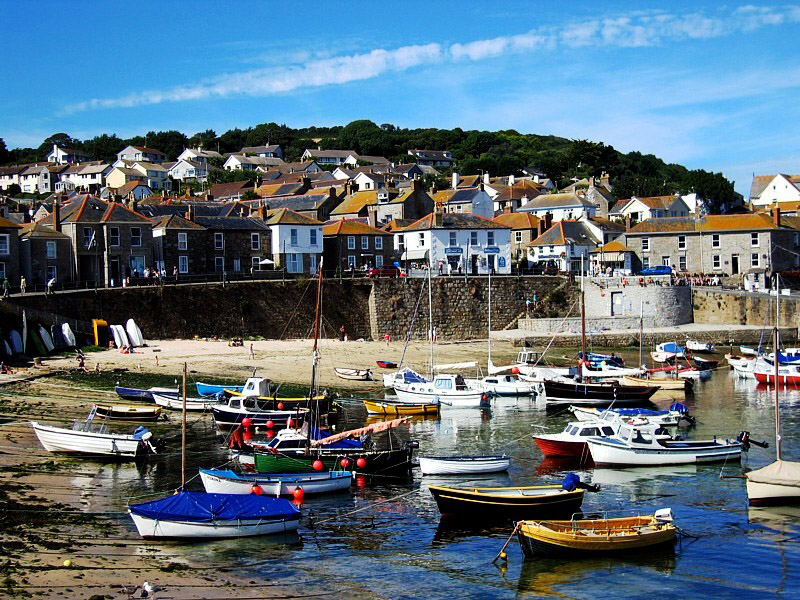
Mousehole02

Mousehole, in Devon. Photo by Waterborough


So let’s agree that the spelling of a word isn’t a trustworthy guide to its pronunciation. Place names, though, are the real killers. Along the north Cornish coast is a town called Widemouth Bay, pronounced WIDmuth. Drive northeast and you come to Sandymouth and think, Right, that’s SANdimuth. Wrong. That’s SANdymouth. Go figure. (That’s an Americanism, by the way—something I found out only recently, when I used it and was met with a blank look.) Keep driving and you come to Woolfardisworthy, which has gone so far out of whack that the road sign actually gives the pronunciation: WOOLsery, only they don’t capitalize the accented syllable, so presumably you could think it was WoolSERRy. Or WoolserrEE. It makes as much sense as anything else. Go to the south coast and you’ll find Mousehole, pronounced MOWZul. A couple of years ago, I drove through a town called Towster (we’re not in Cornwall anymore, Toto, but the pronunciation problems carry over), which is pronounced TOASTer. Yes, the spelling and the pronunciation both make sense, in an English-language, devilish sort of way, but that only points out how little sense the spelling of toaster makes.

I expected to reach Coffee Pot in a few miles.

No one thought a town called Towster was funny except me. I was grief-stricken to be left alone with the joke.

Turn the British loose on American place names and they fall victim to their own language. Michigan becomes MITCHigan. (For all you non-U.S. readers, it’s MISHigun.) Houston becomes HOOSton. (It should be HYOUSton.)

Guys, you have no one to blame but yourselves.

British Brownies and U.S. Scones

My last post included a traditional British scone recipe, and American readers immediately wrote in (on the blog and on Facebook) and said, That sounds great. Can I add cranberries, chocolate chips, and marshmallows? The answer is, of course you can, and it may taste great, but it won’t be a British scone, it’ll be more like a British brownie.

Why is a brownie like a scone? Because once it crosses international boundaries you can’t recognize it.

Irrelevant Photo #2. Dorset. Photographer, Ida Swearingen

Irrelevant Photo #2. Dorset. Photographer, Ida Swearingen

Let’s start with the American scone. It’s great, but it’s got only the faintest relationship to the original. Which is British, and a cousin to the American baking powder biscuit—plain, round, workaday, and delicious. Usually. If it comes in cellophane, be suspicious. It’s usually a little sweeter than a baking powder biscuit, and sometimes comes with raisins, which for reasons I don’t expect to ever understand are called fruit. I mean, yes, they are fruit, in a dried-up sort of way, but the world’s full of fruit. We don’t insist on calling a carrot “vegetable” instead of “carrot,” do we?

Never mind. The fruit scone has raisins. The cheese scone has cheese. The plain scone doesn’t have either one. And the scone with ginger and lemon and blueberries and chocolate chips and deep-fried Mars bars? It doesn’t exist. But the cream tea does exist. It’s tea with two plain scones, jam, and clotted cream, which is cream that’s been beatified. If you see one and you’re not in (a) a highway café or (b) a railroad café, try it.

The American scone is a British scone on steroids. Triple the sugar, double the shortening, quadruple the size, and add every kind of fruit and candy you can think of. Exactly when every American turned into a Texan (you know: Everything we have is bigger, and everything bigger is better) I don’t know, but somehow we did. Or it looks that way from here.

What about the brownie? The British call anything dark, slab-shaped, and sweetened a brownie. Mind you, I’ve had a few over here that were delicious, but if I see them advertised I approach the display case with extreme caution. Wild Thing ordered one in London once. It looked pretty reasonable in the display case but turned up at the table decked out with ice cream, whipped cream, chocolate sauce, and a blood-pressure monitor. The theory must be that if it’s American and you go over the top with it, it must be authentic. I mean, look what the bloody Americans do to the scone.

English Dog Owners

This has happened to me twice now: I was walking the dog—a lovely cluster of fluff and enthusiasm—when another dog walker stopped some 20 feet away and asked, “Is that a dog?”

I looked at her as if I needed to check. Half of me did it to play along with the gag and the other half did it because the question was so strange that maybe it wouldn’t hurt to check. Yes, she was still a dog. Small, I grant you, but so am I. It doesn’t change what we are.

I looked back up.

“Um, yes,” I said. Even the second time, when I knew better.

Would you have to ask if this is a dog?

Would you have to ask if this is a dog?

The other person, both times, reeled his own dog in, explaining that the dog’s snappish with other males, although he’d be fine if my dog were a bitch.

By this time, I understood what the other dog walker saying—bitch, female; dog, male—but excuse me, you can’t call my dog a bitch, and while we’re at it, you can’t tell me my dog’s not a dog. I mean look at her, she’s down there wagging her tail. My cats don’t do that. You want bitch, buddy, talk to me.

But that little drama plays out in my head. When you live in a village you don’t run around starting wars on a whim. Or, yeah, some people do, but their wars enter to gossip chain and circulate forever. Think of it this way: The village keyboard has no Delete button. And whoever you just started a war with? You’ll run into them for the rest of your life.

I admit, I wouldn’t have started a war over this if I was still living in a city. It’s too silly, and I’m not that quick to fly off the handle. But living in a village colors the way I don’t say it. I kept the vague smile that had landed on my face I was first asked if my dog was a dog and I said, “Oh. That. Female. She’s female.”

At which point, both times, the other person let his dog approach and they gave each other a good sniff. The first time, the dog who would have been fine if my dog had been a bitch turned bitchy himself and snapped at her before being hauled off. Which goes to show you something, although I’m damned if I know what.

I won’t swear that any of this is particularly English. We have dog breeders in the U.S., and they probably talk about dogs and bitches, but no one in the States ever asked me if my dog was a dog. Not once.

Folk Music and English Accents

I’ve lived in Cornwall for eight years, and I’ve gotten used to the gap between, on the one hand, Wild Thing’s and my accents and on the other the accents of pretty much everyone else we know. Most of the time, I don’t hear the difference. Even when I listen to the other Americans in the village, I don’t notice their accents. I’m listening to words, not what they’re wrapped in.

Except for the times when I do, of course, when it’s like being hit on the head with a rock. A small, soft rock, but still a rock.

I was at Singers Night at a nearby pub last week when out of nowhere I heard my accent. Whack: small, soft rock to the side of the head.

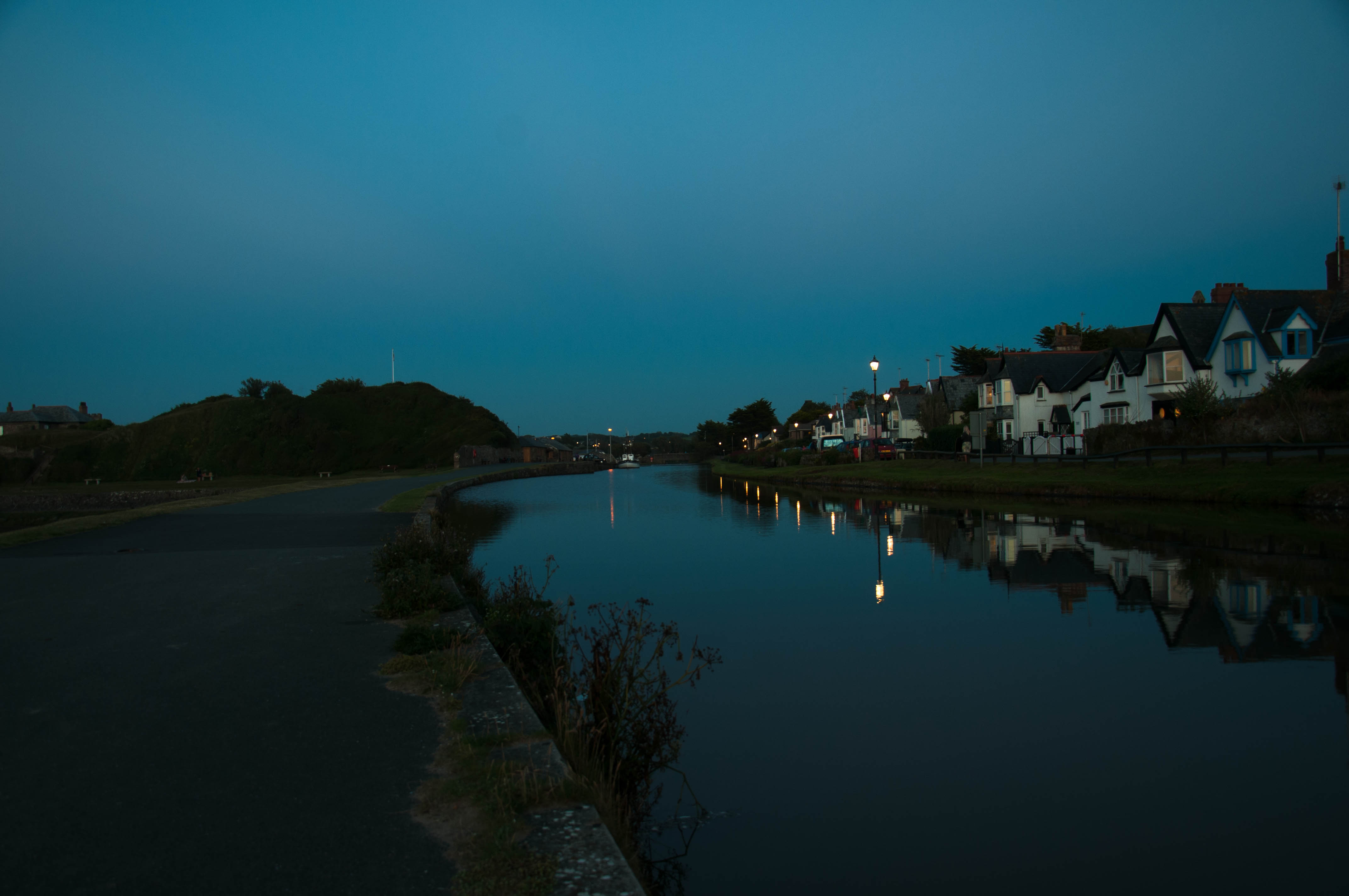
Irrelevant Photo #2: Bude Canal in the late evening light. Photo by Ida Swearingen

Irrelevant Photo #2: Bude Canal in the late evening light. Photo by Ida Swearingen

Singers night is a wonderful, unpredictable gathering of mostly amateur singers, although one professional shows up regularly, for the sheer love of singing. In the summer, the place gets crowded, with some of the visitors singing and others listening and occasionally taking pictures, which is strange since they’ll go home with pictures of a bunch of people in chairs, with their mouths open. But who am I to judge? This particular night gathered in a strong group singers, and any song with a chorus sounded great—rich voices, good energy, harmonies. I admire the hell out of people who can harmonize spontaneously.

G. had started a song whose chorus repeats the line “Didn’t I dance?” and we must’ve sung the words three times before I heard myself: dahnce. My accent had melted into the accents around me instead of sending that good ol’ American A up my nose to spin itself so flat you could use if for a plate.

Dahnce? I thought. Dahnce? Who the hell am I turning into?

Some people pick up accents when they move, but I’m not one of them. To lose my accent, or even modify it, has always seemed like a much larger loss, as if I’d be losing some part of who I am, or hiding it behind a cardboard cut-out of a personality. I lived in Minnesota for decades without picking up more than a bit of shading on the O. Or so M.’s friend, who’s a dialogue coach, tells me. I’d have sworn I still sounded like the purest of New Yorkers, but she has an ear for accents, so I’ll have to take her word for it.

I’m not claiming my attitude’s better than anyone else’s, and to demonstrate how little sense it makes, I’ll tell you that I’m not bad at picking up accents in other languages. In my head, that’s a matter of respect—for the language; for the people who speak it. In English, though, I count the same act as disrespect.

To make even marginal sense of this, I have to mention the toxic history that imitating other people’s accents has in the U.S. When I was a kid, whites imitating African-American or Mexican accents did it badly and to make fun of them. It was skin-crawlingly awful. These days, I know white kids (okay, they used to be kids; you turn your back for ten minutes and they grow up) who adopt African-American accents because they like them and want to blend in. I’m not sure how I feel about that, but I don’t suppose it matters, because it’s not my feelings that count.

My point here is that there’s a do-not-cross line in my head that keeps me from picking up accents in English, but there I was, singing dahnce.

Every language, and every accent within a language, is a song. I’d love to claim credit for that insight, but I heard someone say it in a radio interview. Unfortunately, I haven’t a clue who it was. A woman, I think, so that narrows it down a bit. Whoever you are, I apologize for not crediting you. But to illustrate your point, whoever you are, when I was still living in the U.S., I heard a recording of kids playing in a schoolyard, and without being able to catch a single word I could tell they were English. The song of their accent rose free of the words. And that’s what swept me along in that chorus: the song.

British singers often sing in American accents. It drives the purists nuts, and they blame it on American rock music. If you listen to enough of it, the accent pours itself on top of the notes and you may not even notice that you’ve picked it up.

Unfortunately, picking up an accent doesn’t guarantee that you’ll get it right. You’re likely to revert to your own accent at any time. Sometimes a word is so firmly stuck in your head that you don’t notice you’re reverting: Michigan comes out Mitchigan; Houston comes out Hooston. The line that tickles me is from a hard-luck, down-and-out folk song with the line “I can’t go back home this a-way.” Only it was an English singer, and it came out as cahn’t. “I cahn’t go back home this a-way.” Hard-luck, down-and-out meets silver-spoon. Cahn’t isn’t limited to a silver-spoon accent here, but put it in an American song and it sure sounds like one. And that’s one of the problems with singing in accents that aren’t your own.

Me? I avoid songs that demand an accent transplant. Most of what I sing is American folk music, and the U.S. is a long way from here, so if I end up singing songs I can’t lay claim to by right of either geography or heritage (and I do; they’re fantastic songs), from this distance they don’t sound as absurd as they would if I were back home.

To the extent that I sing English songs, I keep my accent in place and avoid anything I know is going to sound ridiculous. And if anyone who’s heard me wants to warn me off some particular song because I do sound ridiculous, just throw a nice, soft rock at my head. It would be a kindness.

Tea

Americans think tea’s something you drink with your little finger in the air, as if you’d broken it and put it in a splint. We think it’s something you put on a funny accent to ask for. And America’s tea snobs reinforce that. You can’t just drink tea, you need tea made from leaves that were picked while the morning dew was  still fresh on the plant and which were then individually dried and sung to the whole time—by a tenor, thanks; a soprano might crisp the edges and a bass would leave them open to mold. And you need to pay lots o’ money for the resulting tea. I’ve been to restaurants, when I still lived in the U.S., where asking for a cup of tea meant the waiter had to haul out a wooden chest left from the time when restaurants kept a set of dueling pistols on hand in case, you know, a customer needed them. Only now it holds a complete set of hermetically sealed packets, each entombing one lonely teabag. And after all that, they bring you water that isn’t hot enough to lift any flavor out of the tea so you end up with, basically, a cup of bath water.

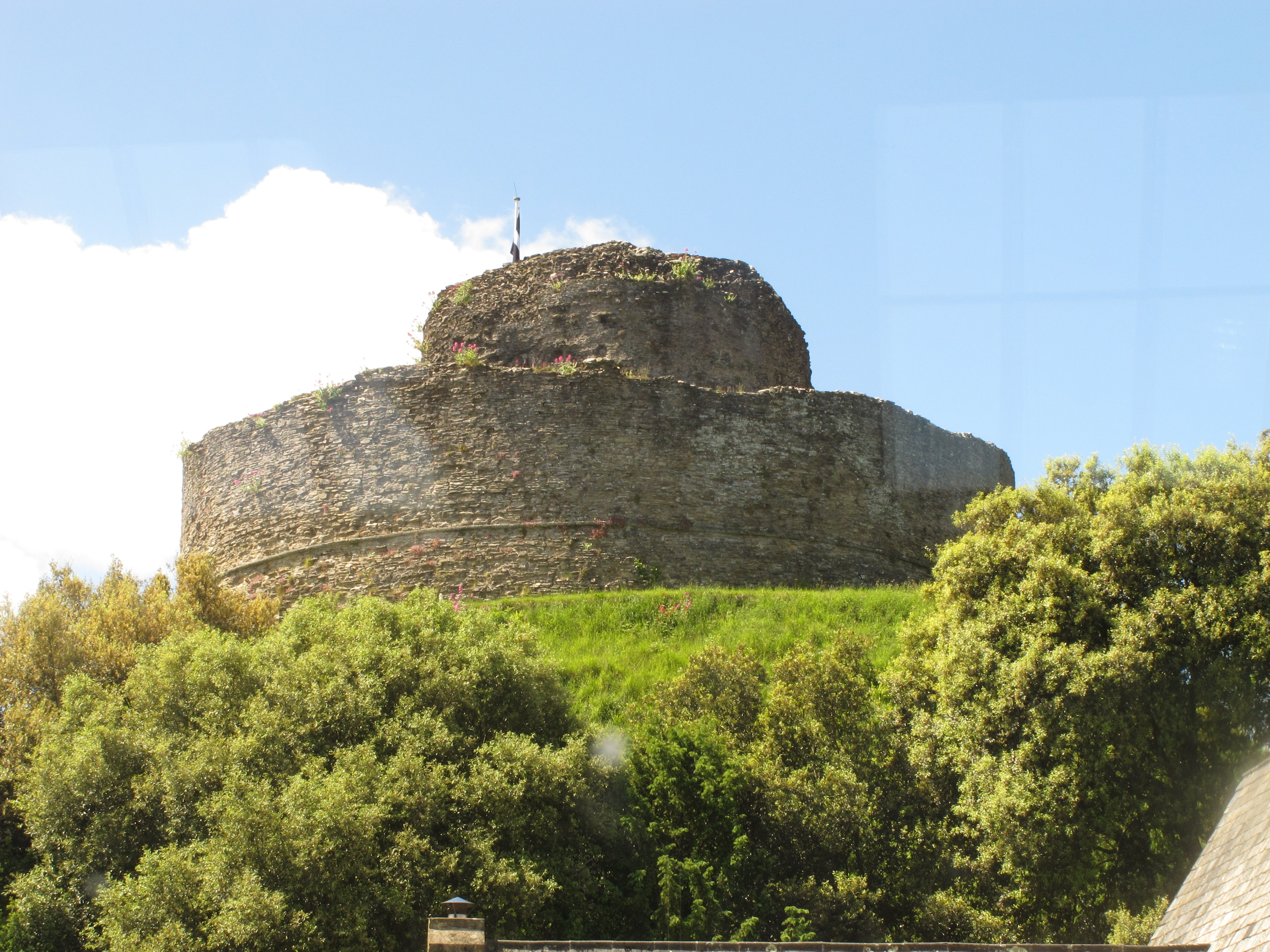
Irrelevant Photo: Launceston Castle

Irrelevant Photo: Launceston Castle

An English friend was so traumatized by her visit to the U.S. that she still talks about “that gray stuff you call tea.”

I hate restaurants like that. Not because of the tea. And not because everyone who works there is dressed better than I am. I’m used to that: I’ve always been dyslexic about style and have now gone entirely post-fashion. It’s because I keep thinking I’ve wandered into some private club and the butler’s going to throw me out any minute.

Are there still butlers loose in the world?

Anyway, tea: In Britain, it’s just a drink. If someone comes to fix the leak under your sink, you ask if they want a cup of tea. If you want to know why three guys are digging a hole in the middle of your street, you wander over and ask if they want a cup of tea. Add a biscuit—which is a cookie, and it doesn’t even have to be homemade—and they’ll tell you anything you want to know. Tea is the kind of drink you put in your thermos to take to work, if you happen to take a thermos to work. People talk about ordinary tea, or breakfast tea, to distinguish it from the fancy teas—Earl Grey, say, of green, or herbal (they pronounce the H). A. calls it builder’s tea, and sometimes builder’s butt tea. Her husband’s a builder, so she gets to say stuff like that.

A builder, by the way, builds buildings. Or fixes them. And a joiner’s a carpenter, not someone who belongs to a lot of organizations. All of them will drink tea. And so should you if you visit, because Wild Thing, who was once a dedicated and not at all fussy coffee drinker, tells me the coffee’s terrible. I gave up coffee long before I moved here, so I can only take her word for it.

A cup of tea is also a measure of time. If I drop by someone’s house and they offer me a cup of tea, they want me to stay long enough to drink it. Friendship is a highly caffeinated undertaking.

Summer Solstice in Cornwall

This far north, the longest day of the year goes on for 26 hours.

Okay, that’s not the literal truth. It’s more like 27.

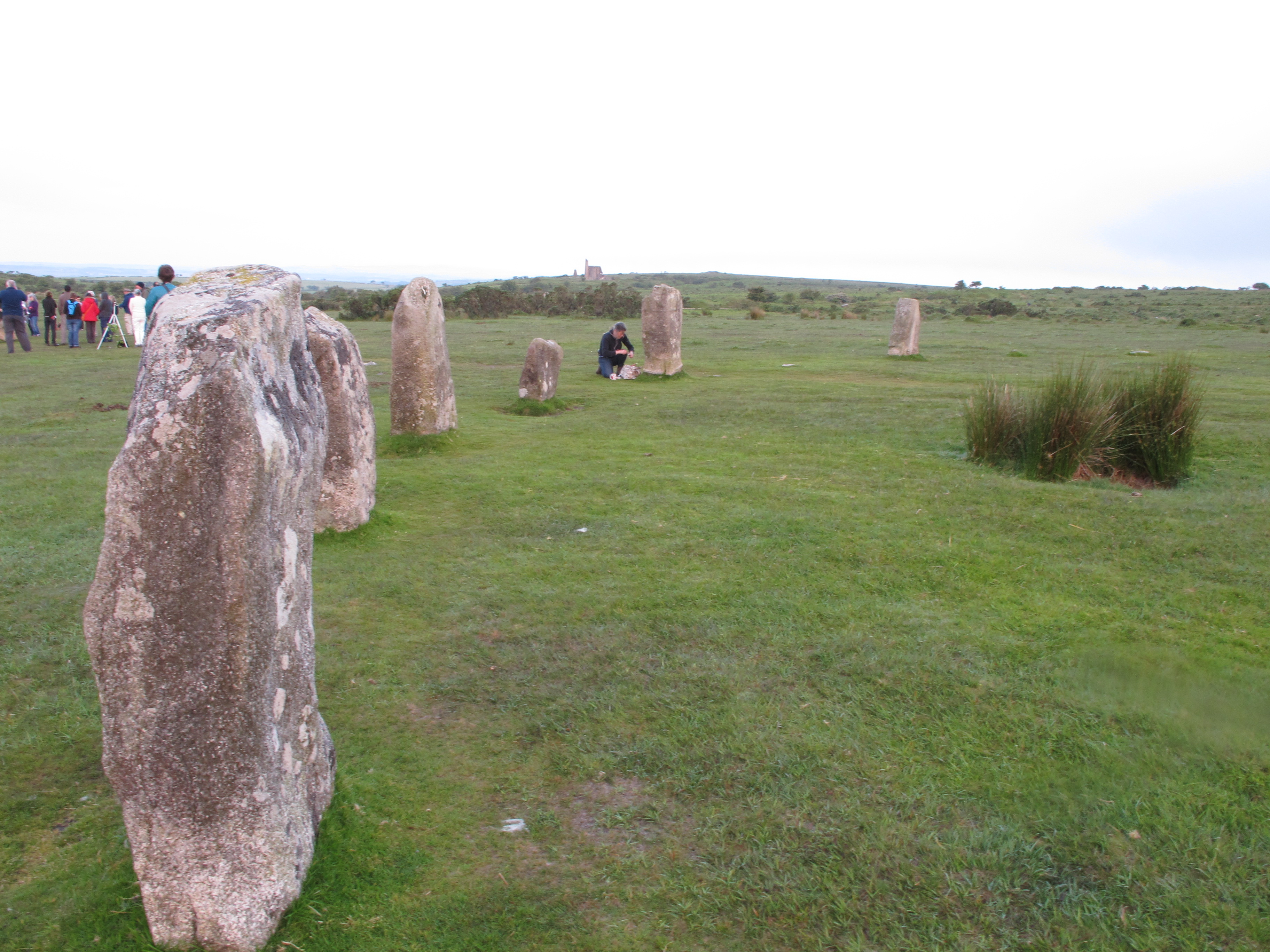
This morning, Wild Thing and I got up at 3:15 (that’s a.m.), staggered out to the car, and drove down the hill to pick up J. so we could drive to a double set of stone circles some 40 minutes from here and join a group of people who gather at the summer and winter solstices to sing up the sun.

Waiting for sunrise

Waiting for sunrise

If that sounds new agey and corny, it probably is. I’m not given to new aginess myself, but when you’re surrounded by ancient monuments the way we are here, you can be forgiven for sliding into a bit of nouveau-pagan celebration once in a while. Those who take it seriously do, and those who don’t can still stand inside a stone circle put up by prehistoric people for purposes we can only guess at and be overwhelmed by the scale of human history. It’s the closest I’ve come to touching my ancient ancestors—who (by way of full disclosure) aren’t my ancestors at all, except in the spirit of all humankind being one family. But humankind is one family, and those circles get to me. Not for any magical properties, but for their sheer age.

Sunrise

Sunrise

At the stone circles, we joined some hundred other people, dressed in everything from long skirts and ivy-leaf hair thingies, to shorts and blankets, to winter jackets (it gets cold on the moor), and we sang, and the sun came up, as red as it ever was when our ancestors watched it all those thousands of years ago. Then we headed to village pub, which had opened early for us, and we ate breakfast. It wasn’t an exact replica of the way our ancestors and not-ancestors celebrated the solstice, but everything changes with the times.

Stone circle

Stone circle

This evening, a group of women from the village will gather on the beach to watch the sun go down. J.’s organized the gathering for several years running, but this will be the first time we’ve gone. All I know is that it involves a bonfire and food. Our ancestors would have understood.

Wild Dartmoor ponies, happy to have the moor to themselves again

Wild Dartmoor ponies, happy to have the moor to themselves again

This is the first year that J. started the day by getting up at silly o’clock to watch the sun come up, and I told J. I half expect the evening to end with her falling asleep on the beach and everyone gently carrying her home.

She said everyone would be more likely to dump her in the sea.

Rumors

Walking the dog to the store for the paper this morning, I saw I. and R. standing in the shade of a hedge, catching each other up on who knows what—I was too far away to hear. They talked for a while and parted ways, I. heading down a side road to her house and R walking in my direction.

When we passed, he said, “No papers today.”

I asked if they’d be getting them in later, but he didn’t know. He’d heard it from I. and turned back.  We complained for a while about the distributor the store uses, because this happens a lot, and often, he said, the stores in the next village gets its deliveries.

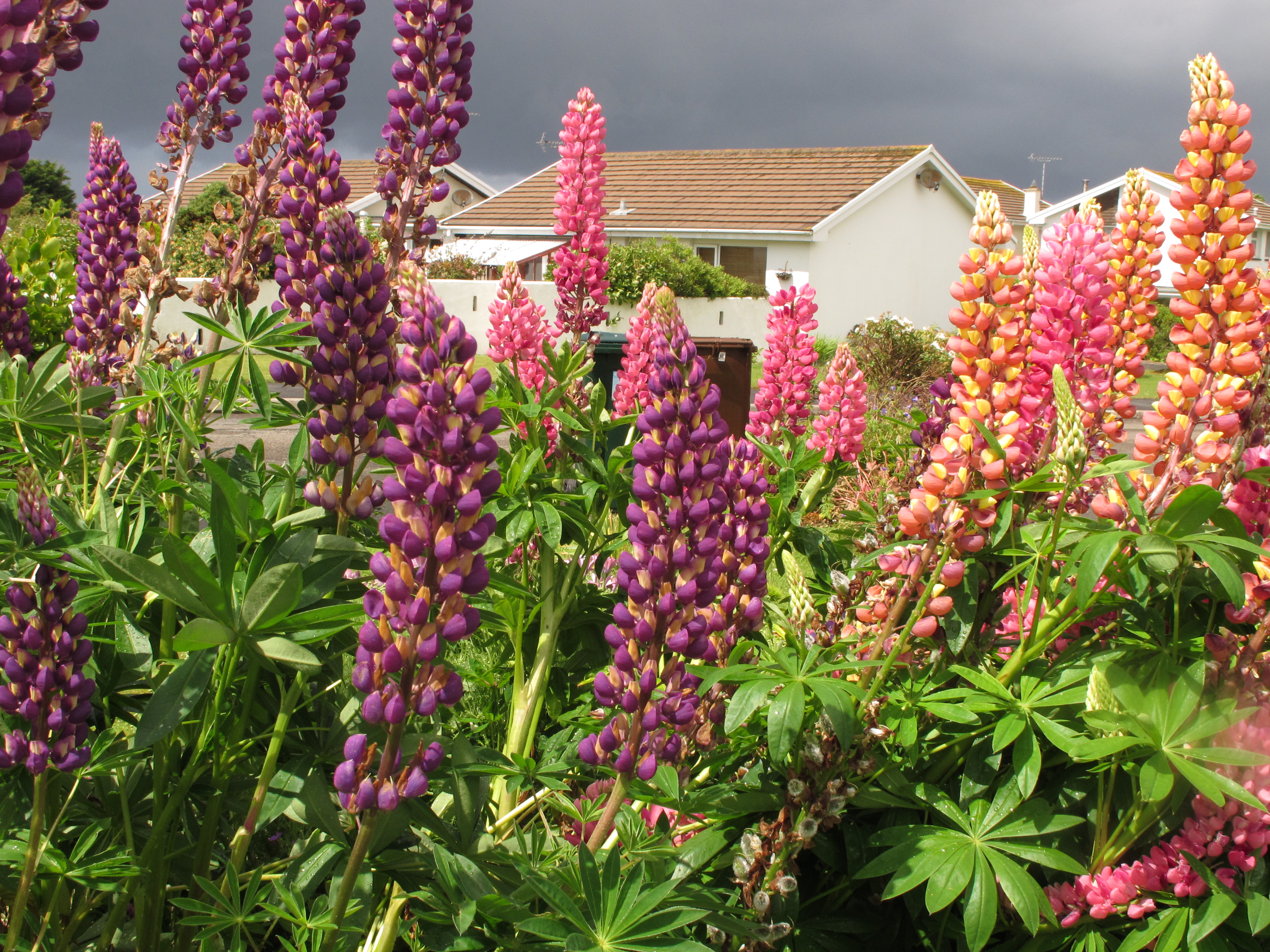
Lupines--in bloom right now.

Lupines–in bloom right now.

Okay, we weren’t complaining about the distributor. We were complaining about the store, for using them.

I had a magazine to drop in someone’s mailbox, so I didn’t turn back, and on the way decided to go to the store anyway, to ask when they expected the delivery. I debated whether to ask for today’s coupon and drive to the next village and buy the paper there. (Newspaper subscriptions, at least out here in the country, involve coupons, which you can either present day by day, anywhere you like, and which give you a discount but no guarantee that the store won’t have run out, or leave with the store, which will then set your paper aside.)

I still hadn’t decided when I got to the store and asked when the papers were expected.   They looked at me blankly.

“We have yours,” they said, and asked who told me they didn’t.

I reconstructed the whisper chain.

“It’s only the Express. R. gets the Mail. We have that.”

And that’s the way word gets around the village. We have no secrets, but have a whole lot of misinformation.

National Insanities

What’s it like living abroad? Every country has its own brand of insanity, but it takes a long time before it seeps into you. I moved here late in my life, so I’ll never understand British craziness the way I understand the American version, but there’s something great about being an outsider. It means you can see a country’s oddities in a way you can’t when you share them.

Sinking-of-ship-cazador-1856 (1)

In 2007, a ship wrecked off the south coast of Devon and its cargo washed up on the beach. (http://www.telegraph.co.uk/news/uknews/1540307/Police-to-clamp-down-on-beach-scavengers.html) It looked nothing like the picture I’ve posted, but there’s a connection, because following ancient local traditions, which date back to the days of sailing ships, everyone for miles around helped themselves. This is called looting if you’re not participating and not letting things go to waste if you are. So far, so logical. But part of the cargo was a container of motorcycles, and instead of pushing, shoving, and grabbing for them, the looters (or non-wasters if you prefer) formed an orderly line and waited their turn. Nobody but Wild Thing and I thought that was funny until we pointed it out, and even then I’m not convinced they weren’t just humoring us when they laughed. Because nothing is more important to the British than forming an orderly line. Except, maybe, calling it a queue.

English Cooking: Baked Beans

English Cooking: Baked Beans

The English aren’t known for their cooking. Or they are, but not in a complimentary way. And I’ll admit they have some odd habits, one of which is eating baked beans on toast. But who am I to criticize? I grew up begging my mother to buy a kind of white bread that I could, and did, squish down to the size of a packing peanut. Which hadn’t been invented yet, but I was ahead of my time. And yes, I did eat it. She’d never have bought it again if all I did was squish it. And I’d have sworn it was good, so I know first-hand that there’s no accounting for taste.

Still, it throws me to see an adult sit down to a plate of baked beans on toast and, with every sign of pleasure, eat it.

Beans on Toast. Really.

Beans on Toast. Really.

But that’s not all that happens with baked beans around here. You can buy a baked potato topped with baked beans. (Or with cheese, or cole slaw, or curry, or roast vegetables, or shrimp, which are mostly called prawns unless they’re small, even for shrimp. And the potatoes are called jacket potatoes.) A full English breakfast includes baked beans, not to mention a grilled tomato. A single can of baked beans includes enough salt and sugar to cover Wales to a depth of half an inch. In spite of which, people eat baked beans in industrial quantities and live to ask for more, and why not? They’re full of fiber, which for all I know mops up the salt. Half the canned vegetable aisle is taken up with baked beans. I’m sure there are all sorts of subtle differences among the brands, but I’ll only do just so much in the name of research, and tasting them lies on the far side of an extremely thick dividing line.