Shipwrecks and wreckers: a bit of English history

Any coastal community sees storms deliver shipwrecks to its shores, and if times are hard no community lets those deliveries go to waste. 

Okay, even when times aren’t hard. As far as I can figure out, humans are wired to accept a free lunch. Or a free shipping container of slightly salted whatever. 

Before we go on, though, I need to build a wall between two words: Wreckers are people who scavenge what they can from wrecked ships or from the cargo that floats ashore. Wrecking is an activity that probably never happened. The Cornish are said (although not by the Cornish themselves, in my experience) to have used lights to lure ships ashore where they’d wreck. There’s not only no evidence that anyone actually did that, it’s questionable that it would even work. But it still means I can’t use the word wrecking here, since I’m talking about what did actually happen.

With that out of the way, let’s talk about the right to wreck–wreck here meaning to scavenge a wrecked ship. And lets watch me jump through linguistic hoops to avoid the word wrecking.

 

The rocks where the L’Adaldise wrecked. (See below. It’ll all make sense.)

The right of wreck

If Wikipedia’s right on this (it has a good overall record even if it’s subject to the occasional fit of madness), the right of wreck, or jus naufragii if we’re going to pretend we know Latin, is a medieval European custom rather than an actual law. 

It was based on the idea that if a ship wrecked it was because god got mad at the crew for–well, something, clearly, so he drove their ship ashore. That made the ship, its contents, and in the early days its crew the property of the finders. Because god had set it all up that way.

Gradually that business about enslaving the crew dropped away, but claiming whatever was left of the ship and its contents? That continued powerfully enough for the Church to condemn it from the 12th century into the 16th.

If you want to know what’s actually happening in a time and place, look at what gets condemned or outlawed multiple times. It’s not foolproof–centuries of hysteria over witchcraft really doesn’t prove the existence of witches–but it’s still a good place to start.

Starting in Norman times, the English crown owned the land–the whole damn land–and that’s relevant because ships tend to wreck where the sea meets the land. The king could and did hand chunks of land to his followers, but it was still his and if one of them pissed him off too badly he could take it back. We could find a parallel there to god getting mad and wrecking a ship because, never mind human ownership, it’s his to wreck, but it won’t stand up to rough handling so let’s not push it too far.

So the king owned the country, even the parts other people owned. Try not to think about it too hard. Just nod your head and agree that of course he got to eat his cake and discover that it was still there, on the plate. He was the king, after all.

What matters for us is that he also owned whatever washed ashore, and he could and did assign it to others, just like he owned land and assigned it to others. 


The right to complicate the situation

Edward I (1239 –1307; you’re welcome) introduced a law stating thatwhere a man, a dog, or a cat escape quick [in other words, alive] out the ship,” the ship wouldn’t be considered a wreck, and neither would its contents. Its owners had a year to claim their property–minus fees, rewards, and droits.

What’s a droit? It seems to involve money, law, and ownership. Beyond that, it’s a rabbit hole. 

The new law kicked off all sorts of arguments and lawsuits about what actually happened in this, that, or the other shipwreck. Did everybody die? Was the cat alive and curled up at someone’s fireside? Was this black cat at fireside the black cat who used to be the ship’s black cat? In other words, was the ship a “true wreck” or was it not?

The abstract of an academic paper that I can’t get full access to (sorry) says, “Different views coexisted about the legality and propriety of shoreline activities, whether salvagers worked with or against established authority, whether wrecking constituted a service, a custom, or a crime, and whether common lawyers or the civil lawyers of the Admiralty had jurisdiction.”

In other words, the law complicated things. And you might want to notice that the paper’s using the word wrecking there in exactly the way I’m not, but I’m pretty sure they lost points for it and I haven’t. 


But let’s stop following the story chronologically . . .

. . . because I’m having trouble unscrambling this egg. The point I want to get to is that somewhere along the line the crown gave seaside landowners the right to salvage whatever god (in his fury) had smashed onto their bit of the king’s shoreline, and this turned out not to be simple either, because the king (in his wisdom) had given the right to the owners of both manors and of hundreds.

Hundreds? The hundred was a political unit smaller than a county, and a manor was a large estate of no specified size but smaller than a hundred (at least usually; I can’t guarantee that it always was) and larger than the egg I can’t unscramble. So a hundred could contain multiple estates. 

In other words, the king just granted the same right to overlapping landowners. This is not a recipe for harmonious living. Cue an assortment of lawsuits, and if you’re interested in them follow the link just above, because we’re headed off in another direction:

If a tenant found a wreck, they were expected to let the lord know, in return for which they’d get half the goods and the lord would get the other half. That amount would’ve ranged from the piddling to the spectacular, but ordinary people lived close to the edge and no find was too piddling to pass up.

What happened if the tenant didn’t notify the lord? In a case in Cornwall, two tenants carried off 54 gallons of wine, were caught, and were fined, although the source I’m relying on doesn’t say how much. More than the wine was worth, I’m sure. 

What we can’t know is how often tenants weren’t caught, because not getting caught leaves no record.


Then the laws got tougher

In 1714, anyone who boarded a wreck without permission or got in the way of the crew salvaging their cargo faced fines and imprisonment. After 1753, they faced the death penalty.

If you want to blame someone for that, I’m told you can blame the philosopher John Locke, who argued for the sacredness of property. The idea caught on among (no surprise here) people who had property, and suddenly it seemed perfectly sensible to say that the purpose of government was to protect and preserve property. Punishments for crimes against property became harsher, usually following some local event that the great and the good could whip themselves into a state of outrage over. Soon a person could face the death penalty for anything from picking pockets to poaching to stealing livestock. 

And here’s a spot where I have to stand on my head to avoid using the word wrecking: scavenging from a wreck went on the list. 

If you’re not in a mood to blame John Locke for that, you can blame the East India Company, which had plenty of property to consider sacred and had lost some expensive cargoes off Cornwall and the Scilly Isles. Along with a few other companies who had a lot to gain, it lobbied to change what was still essentially a medieval law on wrecks. 


The aftermath of one wreck

In 1767 a French ship, L’Adaldise, wrecked off Cornwall, not far from where I live. To be clear, I wasn’t there. I’m not that damn old. I not only hadn’t been born yet, neither had my grandparents. I only come into the story because I know the area. 

A hundred people rushed to the shore, according to the account. At the time, the nearest village would’ve been very small indeed and (if AI can be believed, and it sometimes can) the whole parish (4,000 acres) had a population of 700. I’m guessing it would’ve taken a while to collect 100 people. But Cornwall was a poor county, and a wreck washing ashore could well have meant the difference between eating and not eating.

However many gathered, a lot of people rushed to the shore. Some were salvaging for the lord of the manor and some for themselves, or so the article I’m relying on says. Some had axes and chopped into the hold to get at the cargo, but they also carried off masts, anchors, cables, ropes, and anything else that could be put to use. 

Then everyone went home, including an elderly farmer, William Pearse, who for reasons that aren’t clear to me was the only person arrested (at home) and charged with wrecking. Under the new law, he faced the death penalty. He was held in Launceston jail, which the British in their inexplicable wisdom spell gaol. Eight years later, a reformer described the jail this way:

“The Prison is a room or passage twenty three feet and a half by seven and a half, with only one window two feet by one and a half;—and three Dungeons or Cages on the side opposite the window; these are about six and half feet deep…They are all very offensive. No chimney: no drains: no water: damp earth floors: no Infirmary . . . The yard is not secure; and Prisoners seldom permitted to go out to it. Indeed the whole prison is out of repair. . . . I once found the Prisoners chained two or three together. Their provision is put down to them through a hole in the floor of the room above. . . . And those who serve them there, often catch the fatal fever . . . a few years before, many Prisoners had died from it.”

Pearse was tried in Bodmin, and if he had any witnesses to defend him they would’ve had to make a rough trip across the moor, but no records of the trial exist so we can’t know. I can’t help wondering, though, how anyone could’ve appeared as a witness in his defense without having to admit that they’d been a participant. 

What we do know is that Pearse was convicted and sentenced to death, and so were six others that week, all for theft of one sort or another–except, possibly, for the one person convicted of house-breaking. 


Appeal

Death sentences were often handed out and then commuted them to transportation by the judge. (At the time, transportation was to the American colonies.) Four death sentences from that week were commuted, but not Pearse’s, and the elite of Launceston rallied behind him, campaigning for a royal pardon. 

Why did the local gentry rally behind a poor man? Possibly because they had a lot to gain from wreckers and a lot to lose if the crackdown held. Pearse was being used as a test case.

Campaigning for a pardon involved lawyers, and lawyers involved money, something Pearse didn’t have. It’s not clear who footed the bill, but the local gentry sound like a fair guess. 

Whoever was paying, Pearse now had a high-powered legal team, and local politicians were appealing for a pardon, arguing variously that he hadn’t taken much (“an inconsiderable quantity of rope” and a bag of cotton), that he wasn’t guilty, that the witnesses against him had lied, and that local people were deeply concerned about the case. Pearse’s age could also have been expected to argue for a pardon, and in any case the statute called for the death penalty only if violence was involved

Meanwhile, Pearse sat in that small, foul jail in Launceston.

Following standard procedure, the matter was referred back to the judge who’d condemned him (the logic was that he knew the case best), and the judge wrote, “‘As there were many common people in Court, I took the opportunity of inveighing very warmly against so savage a Crime, and of declaring publickly that no Importunities whatsoever should induce me to reprieve the Criminal.”

Pearse did not get his pardon.

It’s not irrelevant that the judge was also a legal representative for the East India Company. Remember them? The good folks who lobbied for the harsher law?

Pearse was the first person hanged as a wrecker under the new statute.


Current law

That doesn’t really take us to the present day, but let’s hit fast forward. Under the Merchant Shipping Act of 1995, you have to report a wreck or any materials from a wreck to none other than the Receiver of Wreck. That could get you a salvage award, which will vary depending on the value of the wreck and what you had to do to rescue it. What you can’t do anymore is call in the entire village and cart everything away like ants carrying an entire picnic home to the nest.

English Protestantism and the King’s Book of Sports

Like so much of human history, England’s conflict between Protestants and Catholics (and between Protestants and Protestants) was played out against a backdrop of absurdity. That’s not to say it didn’t turn deadly with grim regularity, and at the time I’m sure it all would’ve looked perfectly sensible. Looking back, though–

Yeah, there’s nothing like hindsight. Let’s drop in on one small, strange moment.

The year is 1603. Elizabeth I has died and King James is riding from Scotland–where he’s already king–to London to have all the hocus-pocus of becoming the English king performed over and around him. Along the way he stops in Lancashire, and while he’s there, proto-king that he is, he’s handed a petition complaining that the local clergy and magistrates are keeping people from playing traditional games on Sunday. 

This, my friends, is important. So important that we’ll shift to the past tense.

Irrelevant photo: geranium

Enter the Puritans

The Puritans got their start inside the Church of England, and their goal was to cleanse the church of all traces of Catholicism–the ceremony, the fancy clothes, the incense, the stained glass, the bishops, and pretty much anything else that wasn’t mentioned in the Bible. And since dancing and Maypoles and archery hadn’t been mentioned–

Okay, I have no idea what was mentioned in the Bible. I’d feel safe betting on Maypoles. Dancing and archery? Those look like shakier ground and I won’t be placing any bets. 

But you know how a movement can start out with one clear argument–being or not being in the Bible is surely as simple as a baloney sandwich–and before it’s even lunchtime people are arguing about ketchup and mustard and pickles? And somebody in a fancy suit wants sliced tomatoes and sourdough bread and swears it’s spelled bologna? 

It was like that. Forget that business about the Bible, the rumor was going around that Catholics encouraged games on Sunday in order to keep people away from Protestant church services. Clearly, the only sensible response was to ban the games. Basically, the idea was to close off all other activities so people would come to church out of sheer boredom, although I don’t suppose they’d have made the argument in quite that way.


And now, enter James

James was a good audience for this particular petition. (Remember the petition? If not, return to Go and start over.) Several Puritans writers argued that kings who didn’t support the true religion could legitimately be deposed, which isn’t an argument calculated to win the heart of either king or proto-king. Kings were used to deciding which religion was the true one and watching their subjects fall into line.  

So that didn’t go down well. What’s more, there was a good argument to be made that banning sports on Sunday would drive people not to Protestant services but into the arms of–gasp, wheeze–Catholicism, which didn’t object to a bit of fun on a Sunday.

Sunday, remember, was most people’s only regular day off, so why not allow them a little fun. Catholics would positively come flocking to the Protestant cause.

Once James got to the other side of the checkerboard–or, more accurately, to London–and got himself kinged, he issued the Book of Sports, now known as the King’s Book of Sports, since any idiot can write a book but it takes a certain kind of idiot to be king, and people pay more attention to the second kind of idiot than the first. 

I wish I knew the secret of getting as much press as he did.


The book

The book wasn’t actually a book. It was a proclamation allowing (after Sunday afternoon services) dancing, archery, “leaping, vaulting, or any other such harmless recreation . . . having of May games, Whitsun ales and morris dances, and the setting up of May-poles and other sports therewith used, so as the same may be had in due and convenient time without impediment or neglect of divine service, and that women shall have leave to carry rushes to church for the decorating of it, according to their old custom.” 

Women, as ever, got to have all the fun. They were specifically left out of archery but were at least allowed to take part in the dancing. And no doubt the ales.

But not everything was allowed on a Sunday. There would be no “bear and bull-baiting, interludes, and (at all times in the meane [or in some versions, “meaner”] sort of people by law prohibited) bowling.” 

If you’re having trouble untangling that list, so am I, but it’s not law anymore so we don’t have to lose sleep over it. Tangled or not, though, it calls our attention to the class aspect of the conflict. The original petitioners were from the gentry–the “well-born” people below the level of the aristocracy but very much above, as James had it, people of the “meane [or meaner] sort.” 

Why was bowling on the list of no-no’s? It had become such a craze that working people were thought to be neglecting the work they should be doing. So it was banned for them. But the nation wouldn’t suffer if their betters neglected their duties to roll balls across the ground, because let’s face it, they weren’t producing anything anyway.


And so . . .

. . . merriness was restored to merrie England. (Scotland was still a separate country, which just happened to have the same king, so we’ll leave it out of the discussion.) But let’s not get too merrie, because in justifying his decree James mentions not only the likelihood of attracting Catholics to the Church of England, but the importance of healthy exercise in making men “more able for war, when We, or Our successors, shall have occasion to use them.”

Drink, dance, and be merrie, folks, for tomorrow the king may lead you to slaughter. 

Sorry, I always did know how to spoil a party.

In 1618, James ordered that his proclamation was to be read from every pulpit in the country, but in the face of an uproar from the Puritans, and on the advice of the Archbishop of Canterbury, he withdrew the order

His son, Charles I, wasn’t as wise. In 1633 he reissued the decree, with a few additions, and insisted that it be read, tossing matches into an already combustible situation and leading eventually to the Civil War. 

A quick history of Britain’s gun laws 

Britain has some of the world’s toughest gun regulations, and not only do the vast majority of people approve of that, 76% think they should be stricter. That’s from a sober poll taken in 2021, but Hawley’s Small and Unscientific Survey reports pretty much the same thing. 

How did I conduct my survey? Effortlessly. I’m an American transplant, which leads British friends and acquaintances to ask periodically, “What is it with Americans and guns anyway? Are you people crazy?”

I’m paraphrasing heavily. Most people are too polite to ask if we’re crazy, but if you listen you can hear the question pulsing away, just below the surface. Basically, they’re both baffled and horrified by the US approach.

I should probably tell them that a majority of Americans (56%) also want stricter gun laws but haven’t managed to dominate the national conversation yet. That’s probably because they haven’t poured as much tightly focused money into political campaigns as the pro-gun lobby. 

Am I being too cynical? In the age-old tradition of answering a question with a question, Is it possible to be too cynical these days?

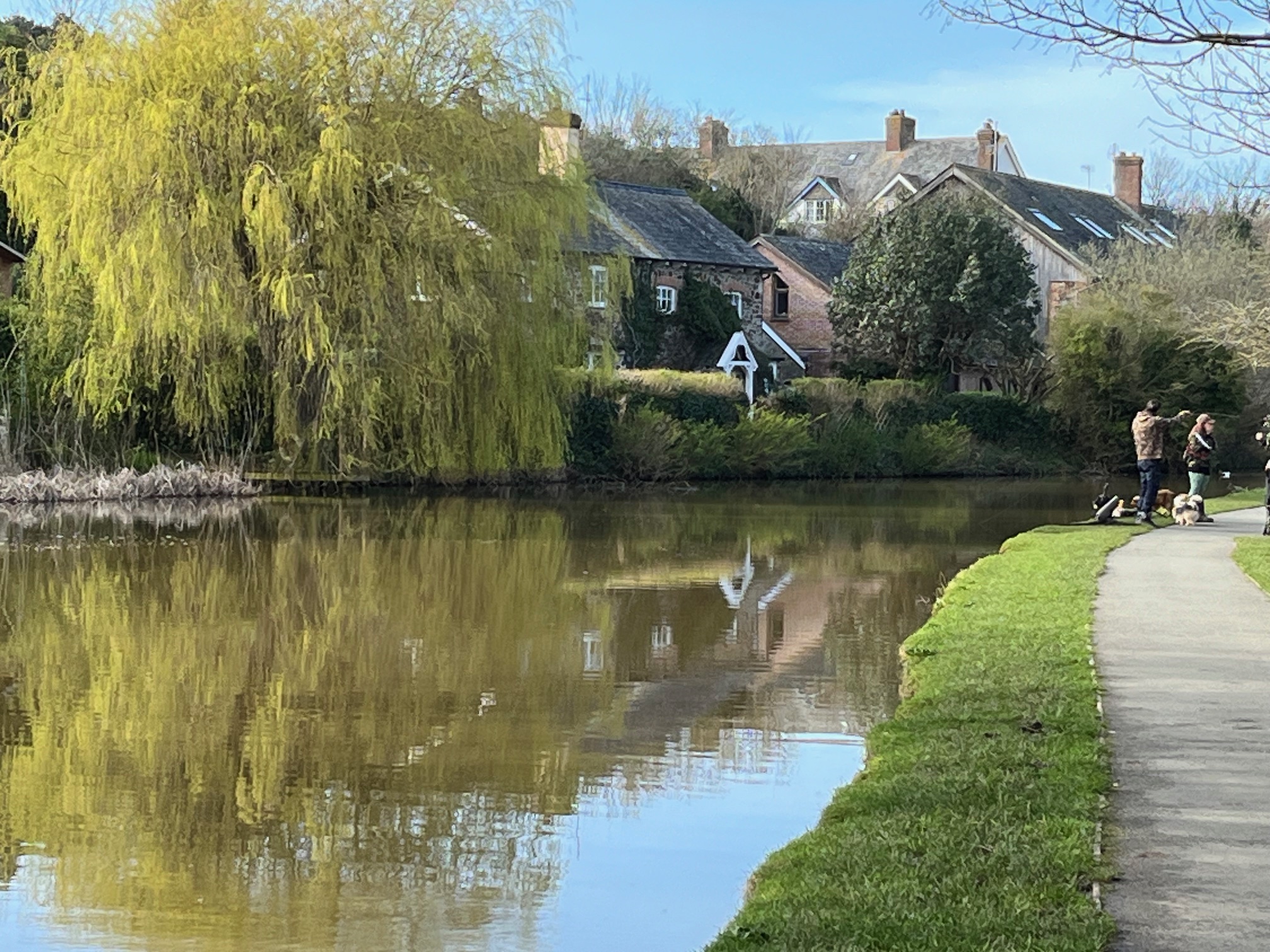
Irrelevant photo: The Bude Canal


What are Britain’s gun laws?

For a long time, they were somewhere between minimal and nonexistent. 

Way back when William and Mary crossed the channel in small boats, the price they paid to become Britain’s joint monarchs was accepting the 1689 Bill of Rights, which acknowledged that Parliament was the source of their power. It also guaranteed the right to bear arms–unless of course you were Catholic, who were the boogeymen of the moment. You were also excluded if you were some other (and barely imaginable) form of non-Protestant.

The relevant section says, “The subjects which are Protestants may have arms for their defence suitable to their conditions, and as allowed by law.” 

That leaves some wiggle room: “suitable to their conditions”; “as allowed by law.” (The US second amendment is ambiguous as well. Maybe it’s something about weaponry.) So when in 1870 a new law required a license to carry a gun outside your home, it wasn’t a violation of W and M’s agreement, because this was a law. As far as I can tell from the wording, if all you wanted to do with your gun was set it on the kitchen table and gloat over it, you could skip the license.

In 1903, a new law required a license for any gun with a barrel shorter than 9 inches and banned ownership by anyone who was “drunken or insane.” 

You could have a lot of fun poking holes in that. Could I get a license if I was sober all week but on the weekend I routinely got so drunk I fell in the horse trough? If I had a title and expensive clothes, would I still be considered a drunk (or a nut)?

Never mind. That was the law they passed. Nobody asks me to consult. It’s a mystery.

But let’s go back a couple of years, to 1901, as Historic UK does in its post on gun laws. Handguns were being widely advertised to cyclists, with no mention of licenses, although the ;need for them may have been so obvious to everyone involved that they didn’t need mentioning. Or enforcement may have been patchy.

Bikes were the hot new thing–the AI of the day–and everyone who had any claim to with-it-ness was rushing around on one. And maybe the cyclists felt vulnerable, out there in the countryside on their own, or maybe gun manufacturers saw an opportunity and manufactured a bit of fear to boost sales. To read the ads, every cyclist needed a handgun. They were advertised, variously, as the cyclist’s friend and the traveler’s friend. One ad said, “Fear no tramp.”

Before World War I (it started in 1914; you’re welcome), Britain had a quarter of a million licensed firearms and no way to count the unlicensed ones. Then the war turned Britain, along with a good part of the rest of the world, on its ear. One of its smaller side effects was that when it ended soldiers came home with pistols. 

How’d they manage that? The army didn’t want them back? I consulted Lord Google on the subject, but I seem to have asked the wrong questions, because he went into a sulk and refused to tell me anything even vaguely relevant. But bring guns home they did, in large enough numbers that the government started losing sleep over it, because this was a turbulent time and  the government had a lot of things to lose sleep over. For one thing, the Russian Revolution not only meant it had to share a planet with a revolutionary socialist government, it also kicked off a wave of revolutions in Europe that must’ve made it look, for a while, as if Britain would end up sharing the planet with multiple socialist governments. 

Life was turbulent on British soil as well. Not all that long before the war, in 1911, a shootout in London involved two Latvian anarchists, a combination of the Metropolitan and City police departments, the Scots Guards, and Winston Churchill. The anarchists might not have been anarchists, though, but expropriators, carrying out robberies to support the Bolshevik movement. Either way, they were well armed and the police were armed only with some antique weapons they pulled together. Until the Scots Guards showed up, they were outgunned. 

In “Forging a Peaceable Kingdom: War, Violence, and Fear of Brutalization in Post–First World War Britain,” Jon Lawrence argues that postwar Britain lived with a fear of violence from returned soldiers, the general public, and/or a government “brutalized” by the war. (The quotation marks are his. I’ll hand them back now that we’re ready to move on.) 

The press was full of violent crime reports. When isn’t it, and when don’t we at least partially believe it’s a balanced picture of the world we live in? Still, the stories are part of the picture: fear was the air people breathed.

The soldiers returning from the war are also part of the picture: they came home to unemployment and its cousin, low pay. A wave of strikes swept the country, including a police strike and in 1919 a strike by soldiers–or if you want to put that another way, a mutiny. Some of that was violent and some wasn’t. All of it kept the government up at night.

In many cases, unemployment led to whites turning their anger on Blacks and immigrants, blaming them for taking their jobs. Familiar story, isn’t it? (Black, in this context, includes people from India. I only mention that to remind us all how fluid the categories that seem so fixed in our minds really are.) 

Longstanding Black British communities were joined by a good number of sailors from both the military and the merchant fleets who were stranded in Britain when they were fired and their jobs filled by white sailors. Their hostels were a particular target for violence. Black and immigrant communities often defended themselves, leading to some full-on battles–and more lost governmental sleep.

For a fuller story on that, go to Staying Power: the History of Black People in Britain, by Peter Fryer. We’ll have to move on, because most of that is, again, a side issue to this topic. The point is that that was a turbulent period with a nervous government. In 1920, a new law allowed the police to deny a firearms permit to anyone “unfitted to be trusted with a firearm”–a loose category if there ever was one. 


And after that?

In 1937–a different era but the midst of the Great Depression, so still a turbulent time–most fully automatic weapons were banned, then in 1967 shotguns had to be licensed. Applicants had to be “of good character, . . . show good reason for possessing a firearm, and the weapons had to be stored securely.” 

In 1987, a man killed 16 people and himself, using two semi-automatic rifles and a handgun, and the government came under pressure to tighten the laws. In response, semi-automatic and pump-action rifles were banned, along with anything that fired explosive ammunition and a few other categories of weapons. Shotguns remained legal but had to be registered and stored securely. 

After a 1996 shooting of 16 schoolkids and their teacher, in which the shooter used four legally owned pistols, a new law banned handguns above .22 caliber, and in 1997 .22s were outlawed.

In 2006, in response to a series of shootings, the  manufacture, import, or sale of realistic imitation guns was banned, although it was still legal to own one. The logic there is that they look realistic enough to commit crimes with, so this isn’t exactly gun control; it’s more like toy control. The maximum sentence for carrying an imitation gun was doubled, and it became a crime to fire an air weapon outside. The minimum age for buying or owning an air weapon went from 17 to 18, and air weapons could now be sold only face to face. 

In 2014, police were required to refuse or revoke a firearms license if the applicant or license holder had a record of domestic violence, drug and alcohol abuse, or mental illness, which implies that they’re expected to actually check.


And the result?

I know a few people in Britain who own rifles and shotguns that they hunt with. When they applied for licenses, they had to show that they had a secure place to store them, that they had a legitimate reason for owning a firearm, and that they were “of sound mind.” They had to pass police checks and inspections of their health, property, and criminal records. If any of them have moaned about it, I haven’t heard it. 

As a way of looking at the impact, I thought I could find a nice, simple set of statistics comparing homicide rates in the US and UK, but nothing’s ever simple. If you use two different sites, one for each country, you end up comparing apples and motor scooters, but I did eventually find one that compares many countries’ murder rate per million people. In 2009 in the UK, it was 11.68; in the US, it was 44.45–four times higher. We’ll skip the intentional homicides, which aren’t  the same as murders, along with the accidental deaths and the suicides. They might all be worth thinking about if we’re talking about the impact of gun ownership on death rates, but they’ll make my life more difficult and I don’t know how you feel about that but it won’t make me happy, so basically, screw it.

Another site I found compares mass shootings between 1998 and 2019. The UK’s had one. Twelve people died in it and one was injured.  The US has had 101, making it the world’s leader in mass shootings. In the deadliest, sixty people died and more than eight hundred were injured. In the second deadliest, forty-nine died and fifty-eight were injured. 

So is the US, with its permissive gun laws, a freer country than the UK? That’ll depend on how you define freedom, and that’s above my pay grade since I do this for free. Some people measure freedom by a country’s voting system, some by people’s sense of security and safety, and some by the right to carry a gun. I have yet to meet anyone in Britain who feels oppressed by the gun laws or measures their freedom by their access to weaponry. I’m sure someone out there does, but they’re a minority, and a small one. 

What about the argument that access to weapons makes the little guy a more powerful political force? My observation is that the little guy struggles to be heard in both countries, but that guns and threats of violence in the US are allowing a minority–a sizable one but still a minority–to increase its power at the expense of their fellow citizens. That’s not a good fit for my definition of freedom.

What people really want to know about Britain, part twenty-something

What search engine questions has Lord Google sent my way lately? Why, how convenient that you should ask. We have, right here before us, the best of them, along with my answers, since I can explain everything.

That’s not to say I can explain it all correctly, but an explanation’s an explanation, as any politician who’s faced an interviewer can tell you. And everything is everything. And circular answers are useful, as Theresa May discovered when she so helpfully explained, as prime minister, that Brexit means Brexit.

It meant nothing and explained nothing, but we can all admit it was an answer.

No egos were bruised–I hope–in the making of this post. Let’s not kid ourselves that the people who drifted here in the wake of these questions fell in love with Notes and stuck around. They came, they saw, they drifted on, and they washed up on some other internet shore.


Irrelevant photo: A flower. One I don’t know the name of.

British History

who is berwick at war with

It’s at war with rumor and commonly held belief, which formed an  alliance years ago, leaving  poor old Berwick fighting on two poorly defined fronts. 

Or maybe I have that back to front and rumor and commonly held belief are Berwick’s allies. That would mean reality’s the enemy. It’s hard to tell in this post-truth era.

Either way, Berwick isn’t (at least in the reality I inhabit) at war with anyone, but judging from the flow of search engine questions about who it is at war with, we’ll never convince the world of that. 

why couldnt the normans hunt in the forest

They could. 

But of course it’s not that simple.

After the Normans invaded England, they seized about a third of the country, announced that it was theirs, and restricted hunting on it. Poaching (which is hunting where you’re not supposed to–in other words, on someone else’s land) became, for a long time, the kind of crime that could get you mutilated or killed. Since it was overwhelmingly the Normans and their descendants who owned the land or could pay for the privilege of hunting on it, let’s keep things simple and say that the Normans could hunt in the forest.

list the efects of the enclosure movement 

I got two copies of this question. I didn’t notice whether they both had the same typo, but my best guess is that someone was doing their homework on the enclosure movement. Sorry, kid, go write your own paper. It’s a complicated process, but basically you find a source of information, you make a few notes, you–

No, I shouldn’t take anything for granted. You find that source of information–preferably a reliable one, because there’s a lot of nut stuff out there. Then you read it. All by yourself. And you write down a few things that belong on the list you were asked to create. 

See? That wasn’t too hard, was it?

I despair.

why is england called britain

For the same reason that a salad is called lettuce, even if it has tomatoes, red cabbage, and one lonely black olive. In other words, because people focus on one of the ingredients and snub the others. 

Olives have feelings too, you know.

In fairness, England has always been the dominant bit of the salad–and that might [sorry, we’re stepping outside of the metaphor for a second here] come back to bite it soon. Scotland shows all the signs of feeling like an olive lately. Which would make Wales and Northern Ireland the tomato and red cabbage, and I understand that I haven’t given them their due in my answer. That’s an ongoing historical problem with the British salad. I also understand that the metaphor’s breaking down and that it’s time for me to get out while I can.

why was suffragists not a turning point in the ‘votes for women’ campaign.

Who says it weren’t?


So what’s Britain really like?

has england incorporated the metric system

You had to ask, didn’t you? If the whole let’s-not-go-metric campaign starts up again, I’ll know who to  blame. But yes, it has, mostly. With some exceptions, the most noticeable of which involve highway miles and the pint glasses used in pubs.

pre metric measurements

Pre-metric measurements are the bests argument for no country ever abandoning the metric system. 

informal judge wig

When my partner and I went to court to convince the British government not to toss us out of the country, we were told that the hearing was informal. The definition of informal–or at least the part of it that I understood–was that the judge didn’t wear a wig.

Hope that helps.

why did they used to make a guy at guyfawkes and sit in the street

To get money for fireworks.

I know, that only makes sense if you already understand the answer, so I’ll explain. Guy Fawkes and some friends tried to blow up Parliament. It was over religious issues, which were also political issues, and it must’ve seemed like a good idea at the time. They got caught before anything went ka-blooey, and every year on November 5 the country marks the occasion with bonfires and by burning a pretend version of Guy, now demoted to simply “the guy”–an effigy, sometimes of a very generic human being and sometimes an elaborate one of whatever political figure seems to need burning in effigy at the moment.  

Back in the day, kids hung out on the streets and asked passers-by to give them a penny for the guy. Then–or so my friend tells me–they’d buy fireworks with however much they had.

Parliament also marks the occasion by a thorough and ceremonious search of the cellars where Guy and his fireworks were hiding. Even though the cellars don’t exist anymore. Because it’s not right to let reality get in the way of a good tradition. 


Food and drink

what they call a can of beer in england

An American import? I don’t think they sell much canned beer here. It’s bottled or it’s on tap. I trust someone will correct me if I’m wrong here.

But where auxiliary verb go?

why do we eat red cabbage at xmas

Oooh, do we? I thought we (a category that excludes me, but never mind that) ate brussels sprouts at Christmas. 

when did brussel sprouts first come to the uk

Before the Home Office was created. The Home Office’s task is to defend Britain’s borders and deport people who (oops) often have every right to remain, destroying both their lives and Britain’s reputation. The Home Office would’ve taken one look at sprouts and sent back to their point of origin as undesirables. And what tradition would we be baffled by if we didn’t have them?

what do britiah call brownies

Brownies.

What do Britiah call themselves?

British.

What do Britiah call definite article?

Missing.

pandemic takeaway food success stories

for the most part, and we should grab our success stories where we can. I expect there are some of these, but I can’t say I know any. 

Stick with me, kids. I know how to do depressing. 


Inexplicable questions

however, _______________, i am going to spend most of the time today talking about why britain _____

I spent a fair bit of time filling in the blanks, convinced I could do something wondrous with this. I didn’t manage to make myself smile, never mind laugh. Gold stars to whoever can.

I have no idea why anyone would type this into a search engine, but if you’ve got nothing better to do I guess it would be interesting.

The Skeleton Army and the Salvation Army

The Salvation Army was founded as a London mission in 1865, offering food and shelter to the down-and-out, the poor, and the very, very drunk. The Skeleton Army was founded by people who enjoyed a good drink and a fight, and in the 1880s and 1890s it harassed the other army.

The Salvation Army came first, so let’s start with them: According to one account, its goal was to wage war on poverty and religious indifference, which testifies to humanity’s long and history of waging war on things that can’t be shot, slashed, or speared. 

And there I was thinking all that war against abstractions and inanimate objects started with the U.S. declaring war on drugs.

Never mind. The Sally wasn’t the first organization to fall in love with a bit of overblown rhetoric, and it quickly took on a military structure, complete with uniforms, recruits, ranks, and marching bands.

Irrelevant photo: An October seed pod. A friend thinks they’re from an iris, in which case I’ll guess a yellow flag, which grows wild.

The Sally’s own website doesn’t talk about warfare but about saving souls and relieving “the Victorian working classes from poverty. In Booth’s eyes [Booth being the founder], this involved morality, discipline, sobriety and employment.”

In other words, unlike the unions and proto-unions of the period, they didn’t see the causes of poverty as low pay and killingly long hours, they were immorality and drinking.

Not to mention gambling and salacious entertainment. 

Within the Salvation Army, women’s ranks–and this was radical for the period–were equal to men’s, and women played a powerful role in the organization. Although having said that, it was started by two people, Catherine and William Booth. I’ve put her name first because I’m like that, but I’m a minority of one in that. He’s credited as the founder and Catherine sometimes gets a mention–and not always by name but just as “his wife.” She may have played a secondary role–I’m not sure–but even if she didn’t, he was the Methodist minister in the family, and if that wasn’t enough he carried a Y chromosome, along with the physical oddities that follow from it, so he walked around with neon arrows pointing him out as the important half of the couple. 

Still, I’m writing that from a contemporary point of view. For the time, the organization was startlingly equal.

The world they campaigned in was a brutal one. Industrialization meant cities and towns had grown massively, and people’s hours, pay, and working conditions were, literally, killing. 

And in spite of the way the language is changing, literally there doesn’t mean figuratively. It means the hours, pay, and working conditions killed people. And crippled them.

Housing was overcrowded, germs hadn’t been so happy since the Crimean War, and beer and gin were cheap, so people drank. Sometimes that was all that got a person through one day and into the next.

Into that setup marched the Salvation Army, not to quietly establish soup kitchens and wait for people to come eat and get preached at but to march down the street, thumping the drum, playing the tuba, waving banners, and preaching against the evils of et cetera.

Et cetera can be extremely evil if left unchecked. 

This won them both recruits and enemies. Plenty of people wanted a drink and a dance and a fight. 

Along England’s south coast, this response coalesced into a group that called itself the Skeleton Army. Chris Hare, a historian from Worthing, one of the Skeleton hotspots, traces their origin to groups of Bonfire Boys–working class young men who raised hell on Bonfire Night, as well as on Mayday and any other occasion that gave them the opportunity. They didn’t bother with ranks or uniforms, but they did sometimes wear yellow ribbons in their caps or sunflowers in their buttonholes.

No, I don’t know how either. Maybe sunflowers were smaller back then, or buttonholes were tougher. 

They also took the Salvation Army’s songs and wrote rowdy lyrics to them. Fair enough. The Sally had taken popular secular songs and reworked the lyrics to suit their purposes, so they were only stealing what had already been stolen.

Skeleton mobs attacked the Salvation Army, throwing paint-filled eggs, dead animals, burning coals–whatever came to hand. Except for the eggs. Those took planning, because getting paint into an egg and keeping it there long enough to throw? That takes work. In fact, how you do it is a deeper mystery than anything the established religions have yet cooked up. But never mind, the eggs appear in more than one telling and seem to have been real. 

Where were the town’s respectable people while all this was going on? Unhappy not about the Skeleton Army but about the Sally. Individually, they wrote letters to the newspapers, worrying that the Salvation Army would give their towns a bad reputation and drive visitors away. 

As for the religious establishment, it preferred its religion inside the church, not bothering people on the street corner. And landowners and industrialists had an interest in keeping their workers drunk and if not happy at least not demanding higher pay and forming unions.

The Salvation Army was anything but revolutionary, but it offered enough prospect of change to worry the powers-that-were. 

Collectively, they were glad to look the other way when the Skeleton Army broke up Salvation Army events. 

To the extent that the police got involved, they were likely to blame the Salvation Army for any uproar. In Worthing, when one “Salvationist applied to the bench for a summons against those who had assaulted him,” he was told,” ‘You know what you do provokes others to interfere with you, and then you come to us for protection.’ ”

In Eastbourne, the mayor and the brewers endorsed the Skeleton Army. In Torquay, the local government banned marching music on a Sunday. It attracted troublemakers, so they arrested the marchers. 

Attacks on the Salvationists–as the articles I’ve read call them–increased, and the women, especially the women in authority, were the primary targets. 

Are you surprised?

One woman, Sussanah Beaty, was killed.

There were riots in Exeter, Worthing, Guildford, and Hastings, and brawls in 67 towns and villages. From the 1880s to the early 1890s thousands of the Sally’s officers were injured. 

But by the early 1890s,  the police became more likely to arrest attackers. Opposition began to die down and the skeleton army faded away.

After that, the story isn’t half as interesting, so we’ll abandon it there.


Lockdown part two: it’s the pandemic news from Britain

England’s about to enter a month-long lockdown that includes pubs, restaurants (except takeaway), nonessential stores, and going in to work if you can work from home. The biggest exception involves schools and universities, and that loophole is big enough that we can move in the construction equipment and build a world-class germ exchange.

Five and a half weeks ago, the government’s own science advisory group suggested a two-week lockdown, but the government, in its wisdom, decided it would be too damaging to the economy. So now we have a longer lockdown in response to a higher number of infections and it will inevitably create a longer economic interruption. And of course it has that big honkin’ loophole I mentioned, so it may not work all that well, but we’re going to pretend that kids don’t spread the virus (which is possible but far from established) and that students, teachers, and staff don’t interact with anyone except each other. 

The emotional pitch for the new lockdown is that if we do this now, we can save Christmas. 

Someone’s been reading too much Dr. Seuss. 

Irrelevant photo. This, dear friends, is a flower.

The press conference where Boris Johnson announced the new lockdown started three hours behind schedule, and I would love to have eavesdropped on whatever was going on behind the scenes. So far, no one’s talking but I’m hoping for leaks. 

The delay left fans of a dance competition show, Strictly Come Dancing, frantic, and the BBC cut away a little early so they could start the show only a few minutes late, thus saving not Christmas but Strictly, which is important enough that the nation’s on first-name terms with it.

Only slightly less important than Strictly is a newly announced extension of the job furlough scheme–the one that pays people whose jobs haven’t gone up in smoke but instead have been shelved and may yet be unshelved. The furlough scheme is full of holes, but it’s better than nothing. 

But. When areas in the north of England were in local lockdowns, people who were eligible for the scheme got a smaller percentage of their usual pay. Now that the whole of England’s going into lockdown, people who are eligible will get a larger percentage. Because, um, yeah, basically the areas up north are up north somewhere, and they have these accents that don’t sound right in the hallowed halls of Parliament and–

Oh, hell, they’re a long way away. Who cares, right? 

That can’t be going down well up north. 

As recently as last week, a local government in West Yorkshire, which was moving into a local lockdown, was told there were no plans to make the lockdown national. I hate to sound naive, but I actually believe this. That’s the way Johnson’s government works: There were no plans. At a certain point, they just jumped. 

*

England–or Britain, if you prefer, because elements of this will overlap–isn’t alone in facing a second spike, but it does have its own particular causes, and an economist from the University of Warwick has traced one of them back to the government’s Eat Out to Help Out scheme, which offered half-price meals (up to a certain limit) to people who ate out at participating restaurants. 

Thiemo Fetzer traced three sets of data: the number of restaurants participating in the scheme in a given area, the days of the week the scheme ran, and the amount of rain that fell during lunch and dinner on those days. (Not as many people eat out when it’s raining hard.) Then he compared those to the number of known new infections in an area and concluded that the scheme “may be responsible for around 8% to 17% of all new detected Covid-19 clusters emerging in August and into early September.”

To which the Treasury Department said, “Bullshit.”

Okay. They said, “We do not recognize those figures.”

In early October, though, Boris Johnson said in an interview, “It was very important to keep [those two million hospitality] jobs going. Now, if it, insofar as that scheme may have helped to spread the virus, then obviously we need to counteract that […] I hope you understand the balance we’re trying to strike.”

If you’ll allow me to translate that, since it’s mildly incoherent, it means we knew it would spread the virus, but we had to balance that against getting people to spend their money.

Another swathe of infections can be traced back to a government effort to save the travel industry by opening “travel corridors”–arrangements that would let people travel to other countries withour having to go into quarantine when they came home. A Covid variant that originated in Spain is now widespread in the U.K.–and a lot of Europe, while we’re at it.

Spain was on Britain’s list of safe places to visit. Just bring your sunscreen and a bathing suit. Come home with some chorizo and a nice tan. The government cares about you and wants to make sure you can have your holiday–or vacation, if you’re speaking American, which no one was. It’ll all be fine.

The Covid variant, by the way, isn’t a particularly significant variation from the original. For a virus, Covid is surprisingly stable, but like all viruses it evolves and that means sometimes the origin of a cluster can be traced. In this case to Spain, and to a government policy that tried to save the travel industry. 

So here we are again, entering our second lockdown. Forgive me if I haven’t managed to be funny this time out. I support the lockdown, late and flawed as it is. Covid’s a dangerous disease, not only because of the deaths it causes and the way it overwhelms our hospitals but also because of the people it leaves disabled for no one knows how long, maybe for months, maybe for a lifetime. If you’re dealt a card out of the Covid deck, you can’t know in advance which one it will be. Will you be asymptomatic, have a bad week or two, become disabled, or die? 

And you don’t know who you’ll pass it on to, because people are infectious not just when they’re sick but before they have symptoms, or if they have no symptoms. So we gamble not just with our own lives but with the lives of people we love and of people we don’t know at all but share breathing space with. 

Stay safe, my friends. Be cautious. 

Wear a damn mask. They do make a difference.


Are clothes essential in a pandemic? It’s the news from Britain

In a protest over the Welsh government’s ban on stores selling nonessential goods during the current lockdown, Chris Noden turned up at a supermarket in nothing but his undies and tried to shop while his wife followed along behind and recorded everything on her phone. A store employee kept him from going in, and as soon as Noden got him to admit that clothing was essential, he decided he’d made his point and left.

“I understand they have to control crowds in shops,” he said later, “but if someone really needs something or an item, what is it to stop them? They are actually blocking these aisles off with sweets, chocolate, bottles of vodka, whisky, lager, they are blocking it off with all nonessential items, essentially. I don’t know what is essential or not, it is a bit mad, like.”

What he’s talking about is that supermarkets blocked off areas selling nonessentials.

It’s true that he does seem to get stuck on a thought and repeat it, but he managed to make his point all the same. It’s also true that he didn’t just wear his undies. He also wore shoes, socks, a mask, and a tattoo. 

The essentials, essentially.

My thanks to Ocean Bream. If it hadn’t been for her, I’d have missed this and what a tragedy that would’ve been.

*

Irrelevant photo: If I remember right, this is a thistle. Gorgeous, isn’t it?

Meanwhile, on October 29, British papers reported that nearly 100,000 people a day were catching Covid in England. That’s based on a study by Imperial College London, which also estimated that the rate of infection was doubling every nine days. That takes us close to the peak of infections last spring, although the death rate for people who have severe Covid is down from last spring, probably because a lot’s been learned about how to treat it.

Every age group in every region shows growth in the number of cases. In London, the R rate–the number of people each infected person passes the disease on to–was 3. The Southeast, Southwest, and East have an R rate above 2. On a national average, it’s grown from 1.15 to 1.56.

Regional lockdowns in the north may have slowed the spread, although they don’t seem to have stopped it. The government is frantically trying to avoid a national lockdown.

*

But it’s all going to be okay, because the government has plans to do a Covid test on 10% of England’s population every week, using tests based on saliva, which are easier to manage than the current ones and give a result in thirty minutes. The plan is ambitious, headline-grabbing, and badly thought out. In other words, pretty much what anybody who watches this government would expect. 

The idea is that local directors of public health will “be eligible to receive” tests “equivalent to” 10% of their population. Which is a roundabout way of saying that’s how many tests they’ll get, but with a small escape clause in case someone needs to wriggle through the definitions of equivalency and eligibility. A properly motivated politician could emerge from that snarl rumpled and stained but still claiming victory.

In a moment of heroic bad planning, the project was launched without anyone talking to the local governments and health officials whose cooperation it depends on. 

What will the program expect of them? The head of the test and trace program, Dido Harding, said local authorities will “be responsible for site selection and deployment of [lateral flow] testing in line with their priorities.”

Lateral flow? Oh, come on, you know that. It’s what happens when things flow laterally, which is to say sideways.  

Did that help? 

I thought it would.

But it’s even better than that, since we’re translating. Things will flow not just sideways but also in a line with their priorities, which we can assume run sideways.

Whose priorities? I’m not entirely sure. Local governments’, probably, and they’ll get to choose their priorities by picking Option A or Option A. That way it’ll be their fault if Option 3 turns out to have been the obvious choice. Honestly, anyone would’ve been able to see it.

And no, I didn’t add that “[lateral flow]” business. That was some desperate reporter trying to condense a document full of waffle and bureaucro-speak.

So are local people wild about the program? Not demonstrably.

An anonymous director of public health said, “There is no point in testing large numbers of the population unless you do something with the results. We really, really want to improve testing and tracing, but once again this is the wrong way to go about it.”

Another public health official–a senior one, whatever that may mean, and also  anonymous–said, “We don’t know who does the contact tracing or how the workforce [to carry out the tests] is resourced. [That means paid for–and this is my addition.] We are trying to work out how this fits with the test-and-trace strategy with PCR testing and how any positive results are followed up and people are isolated.”

PCR testing is the kind that’s currently being done–the slower, more invasive kind of test.

And yet another anonymous senior public health official said, “They have come to us with a proposal that is poorly thought through. It is not clear what the cost is or the amount of work involved and there is nothing about contact tracing.”

As for the existing test and trace system, it might just meet its target of testing 500,000 people a day by the end of the month, but it’s done it by getting the results back to people more slowly than promised–sometimes at half speed–and bungling the tracing element. One in five people who test positive and are referred to the tracing side of the system are never heard of again. They’re abducted by flying saucers and held out of range of cell phones–or if you’re British inflected, mobile phones, whose name only promises that you can move them around, not that they’ll work where you so foolishly brought them. 

Are those lost people isolated while they’re there so they can’t pass on the virus? That’s the thing: We don’t know. But if you will get yourself abducted by flying saucers, you can’t blame Dido Harding for it, can you?

It’s also possible that the system’s missing more than one in five people. It depends when you wandered into the movie. Another article says less than 60% are reached, so that would be two out of five. 

I think. 

Oh, never mind the specifics. It’s all just a lovely, poetic way of saying the program’s a mess.

One article I found included an example of the kind of snafu that happens in the vicinity of the test and trace system: a small war over who’d pay for a portable toilet at a mobile testing station. The central government (I’m reasonably sure that would be the test and trace program itself) refused. Because they’re test and trace, after all, not test and toilet. That left two local entities playing hot-potato with it for days. In the meantime, the station couldn’t be set up, because no matter how little you pay people, and even if you put them on zero-hours contracts, they will want to pee eventually. 

*

However hot that potato was, though, it’s a small one. Here’s a considerably larger one:

After advertising for people with a health or science degree (or an equivalent something or other) to work with experienced clinicians  in the English test and trace system, Serco–a private contractor–instead upgraded a bunch of people who were already working there, people with no relevant degrees or experience and who were working for minimum wage. That’s £6.45 an hour if you’re between 18 and 20 and £8.72 if you’re over 25.

You may have noticed that some years are missing there. That’s okay. Most of the callers are in the 18 to 20 group.

The job as originally advertised–the one the minimum-wage folks got moved into–was supposed to pay between £16.97 and £27.15 an hour. The people who got moved into the job are still working for minimum wage. 

That’s called upskilling. It’s not called up-paying. 

We can’t exactly say they weren’t trained. They got four hours of power-point training, an online conversation, a quiz, some e-learning modules (doesn’t that phrase send a thrill down your spine?), and some new call scripts. 

“It’s been an absolute shitshow,” one highly anonymous caller told a reporter. The callers are talking to people who’ve lost family members. People who cry. People who are in pieces. And the callers’ training manual says things like, “If somebody’s upset, be patient.” 

It leaves some of the callers themselves in pieces. They’re young. They have no training to help them deal with this. They’re in over their heads and they know it. 

I can’t imagine the system’s working any better for the people they call.

Somewhere in between advertising the higher pay level and giving the job to people at the lower one, the Department of Health and Social Care made a decision to split the job in two. The first set of callers would make the initial calls and then “qualified health professionals” would follow up. 

But Mr, Ms, of Mx Anonymous says, “There is no other call by a trained clinician.” The callers read out a list of symptoms, refer anyone who needs medical advice to 111, the Covid hotline, and only if they decide that there’s an immediate risk do they pass calls to a clinical lead. 

So this is, on average, a 20-year-old being asked to decide if there’s an immediate risk. No disrespect to 20-year-olds–I was one myself once–but you don’t have a lot of life experience to draw from at that age.  

Have I mentioned that the test and trace service is privatized? And that to date it’s cost £12 billion–more than the entire budget for general practice. More than the NHS capital budget for buildings and equipment.   

Which is one reason that a group of doctors have called for the money to be diverted to local primary care, local NHS labs, and local public health services. Local, local, and local. 

I’m not expecting anyone to listen to them.

*

And so we don’t end on a completely sour note, Taiwan has marked 200 days without a domestically transmitted Covid case.

Its success is due mostly to reacting early and sanely: establishing coordination between government departments; emphasizing the use of masks; quarantining new arrivals. It didn’t hurt that both the strategy and communications with the public were led by experts.

It’s a radical concept, but it just might work.

The Gawthorpe Maypole Procession and World Coal Carrying Championships 

Every folkloric festival in Britain started at the pub. Even the ones that predate the invention of the pub started at the pub.

And the synthetic ones? You know, the ones that date back seven and a half years and were started by the local Let’s Lure Visitors in Here So They Can Spend Money Commission? 

Yup. Those started at the pub too. 

If we’ve established that, let’s talk about the Gawthorpe Maypole Procession and World Coal Carrying Championships, which is an odd mix of the folkloric and the synthetic and should leave us wondering whether a synthetic festival becomes folkloric if it sticks around long enough. 

In keeping with a tradition here at Notes, I’m posting this in the wrong season. Maypole celebrations have a way of happening in May, but screw it. Even in this time of pandemic, May will come around eventually. But even more than that, the contest won’t be held this year, so we can celebrate early if we want to.

Besides, ever since lockdown hit us, half the people I know can’t keep track of the days of the week, so let’s not be sticklers about the months.

Irrelevant photo: You may have already guessed that this is not a maypole. It’s not even a spring flower, it’s an autumn one, but damn, isn’t it beautiful?

If you’re ready, then, this post is for all you people who want to believe that somewhere people still dance around maypoles and life is bright and shiny and innocent. It’s for you because you’re half right. The maypole half. Bright and shiny? Not when it shares a three-day weekend with a coal-carrying race. As for innocence, I’ve never been to the event so I have no evidence one way or another. I expect it’ll all depends on how you want to define innocence. Also folkloric. But let’s dodge the difficult questions and go straight for the fluff.

The coal carrying event started in 1963, but in the traditional way: A bunch of guys were sitting around a pub, and at this point I’ll yield the stage so the event’s own web page can tell the story, with its own punctuation and dialect. If they overshot the local accent, blame them.

“At the century-old Beehive Inn . . . Reggie Sedgewick and one Amos Clapham, a local coal merchant and current president of the Maypole Committee were enjoying some well-earned liquid refreshment whilst stood at the bar lost in their own thoughts. When in bursts one Lewis Hartley in a somewhat exuberant mood. On seeing the other two he said to Reggie, ‘Ba gum lad tha’ looks buggered !’ slapping Reggie heartily on the back. Whether because of the force of the blow or because of the words that accompanied it, Reggie was just a little put out. ‘Ah’m as fit as thee’ he told Lewis, ’an’ if tha’ dun’t believe me gerra a bagga coil on thi back an ‘ah’ll get one on mine an ‘ah’ll race thee to t’ top o’ t’ wood !’ (Coil, let me explain is Yorkshire speak for coal). While Lewis digested the implications of this challenge a Mr. Fred Hirst, Secretary of the Gawthorpe Maypole Committee (and not a man to let a good idea go to waste) raised a cautioning hand. ‘Owd on a minute,’ said Fred and there was something in his voice that made them all listen. ‘ ‘Aven’t we been looking fer some’at to do on Easter Monday? If we’re gonna ‘ave a race let’s ‘ave it then. Let’s ‘ave a coil race from Barracks t’ Maypole.’ (The Barracks being the more common name given by the locals to The Royal Oak Public House.)”

If I can step in and interpret that last bit for you, what happened was that the secretary said, “Let there be a coal race,” and lo, there was a coal race. And it was good.

Also dirty.

And it still is. Men race with 50 kilo sacks of coal and women with 20 kilo sacks. If you want that in pounds, just multiply it by 2.2. I’m outta here. 

Both groups run 1,012 meters, most of it uphill. Kids, as far as I can figure out, run coalless and a shorter distance.

The rules list lots of things not to do. No coaching during the race. No assistance, no advice, no information, no cutting corners, and no general busybodying, and that’s all in red type with lots of random quotation marks, so you don’t get to tell anyone that you didn’t see the warnings.  

The event is sponsored by Eric F. Box, Funeral Directors. 

No, I can’t explain why Eric is more than one director, but maybe I should’ve mentioned his involvement earlier, by way of a health and safety warning. It’s enough to make a person wonder if, what with all that coal and hopefully a bit of coal dust to keep it company, he counts on the race bringing in a few customers.

But let’s leave Eric and his customers to work things out among themselves and move on to the maypole dance. We’ll do the general history first, then the local stuff.

Did maypole dancing start at the pub? Oh, hell yes, even if it predated the pub’s invention. It’s ancient enough to be considered pagan, it was probably linked to fertility, and it was rowdy–as fertility so often is. You can trace it back to the Celtic seasonal holiday of Beltane if you like–spring, rebirth, all that sort of thing–although the maypole was probably an Anglo-Saxon addition

Or you can trace it to the Roman holiday Floralia if you like.

Hell, you can do anything you want. You can eat your shoelaces if you like. I can’t stop you, can I? 

Assorted websites take the Floralia route, and they’re as convincing as the ones that trace it to the Celts. Me? I don’t honestly care. It was all such a long time ago that we’re left spinning theories–some better informed than others, but still educated guesses at best.

As England Christianized, the church tolerated May Day celebrations, and in medieval England laborers could often claim the day as a holiday. We can’t document that they danced around a maypole, but if we were to bet that they drank and got rowdy and then if we could somehow find out what really happened I doubt we’d lose our money. The day might or might not have involved a pole but it surely involved lots of regional variations.  

According to Gawthorpe’s website, maypole dancing dates back to the reign of Richard II (1483-1485, so you had to hurry or you’d be docked for coming late), but another website says that maypole dancing gets a mention in Chaucer and he died in 1400, meaning we can dock Richard’s pay. 

By the time Henry VIII was rampaging through his assorted marriages (1509-1547), maypole dancing had reached most of England’s rural villages (or so says the Gawthorpe website). Historic UK swears that May Day celebrations were banned in the sixteenth century, which caused riots, but other websites wait an extra century, blaming the Puritans for banning them and letting Henry off the hook. There were May Day riots one year, but they don’t seem to have been related to maypoles or bans.

The Puritans, though, were beyond question skillful disapprovers, and they disapproved of all tha rowdy, paganish carrying on, and their best to stamp out May Day.

Then the monarchy was restored and with it May Day celebrations and maypoles.

Then we skip merrily along until we come to the eighteenth century, when (to give you the flavor of the holiday) a newspaper clipping preserved the tale of some village rowdies stealing another village’s maypole. That seems to have been an accepted part of the carrying on. 

In addition to poles (your own or someone else’s), the holiday seems to have involved flowers, herbs, adults, and general uproar. Also, I’d be willing to bet, alcohol.

The first evidence of maypoles having ribbons is from 1759, and they may have wandered in from Italy. 

Then the Victorians came along and sanitized the holiday, turning it into an activity for kids and calling it an ancient tradition. Maypole dancing was taught to schoolmistresses-in-training, and they made it part of the folk revival of the late nineteenth and early twentieth centuries. 

One website says that the crowning of the queen and the dancing were controlled by the village elite, taking the holiday away from the kind of folk tradition that grew from the ground up.

As for the Gawthorpe, the maypole business sounds painfully respectable, with local dignitaries and a four and a half mile procession involving floats and marching bands and horses. Not to mention some poor girl who gets chosen as queen and some other poor girls who don’t. I’m not sure which is worse. They should all sue. 

Can you sue an entire culture?

The maypole part of the Gawthorpe celebration dates back to 1906, when a teacher at the local school–probably one of the ones who’d been taught the reinvented tradition in teacher training–taught the kids what the website swears are intricate steps. And they probably are intricate because they have to hold ribbons and circle a pole multiple times without tying anyone to it. It takes six months to teach the steps, the website says. Cynic that I am, I can’t help thinking that’s because it takes so much time to chase down the dancers and make them stop having fun, but please don’t mistake me for anyone who knows that. For all I know, it fills every last one of them with joy. 

Give me a coal race any day.

What we’re not supposed to do: It’s the pandemic news from Britain

A whopping 13% of people in England say they fully understand the lockdown rules. In Wales and Scotland, they’re doing better: 15% are fully enlightened. No one in charge of the survey managed to locate Northern Ireland, so I don’t have any data from wherever it is today. 

No, I can’t explain its absence. I’m only somewhat British–I was adopted, and late in life at that–so I can’t be expected to understand how this stuff works, not to mention why. What I can tell you is that 51% of people in England, 62% in Wales, and 66% in Scotland say they understand the majority of the rules. 

Do they really? Maybe. Which also implies maybe not. It was a survey, not a test. 

*

Irrelevant photo: Virginia creeper.

Meanwhile, in response to a ban on social get-togethers, the police in Scotland have broken up hundreds of house parties since August. Or possibly thousands. The number I found was 3,000, but that was how many times they’d been called out, not how many gatherings they broke up. 

Let’s say lots and leave it at that.

What kind of get-togethers? A party involving 270 students at a dorm. A religious gathering of 20 people. The virus doesn’t care whether you’re praying or shouting, “Sweet Jesus, I’ve never been this drunk in my life.” 

Places rented on Airbnb have been used for a number of the parties, indicating that people aren’t in the awkward position of have 264 more friends show up at their house than they’d planned on, they’re going into it with malice aforethought. 

A police spokesperson said the gatherings weren’t limited to any one age group. 

*

A Spanish company, working together with a university, has come up with a machine that should be able to disinfect a room in minutes. It uses cold atmospheric plasma to clean surfaces and to kill 99% of viruses and bacteria in the air.

And if you’re not sure what atmospheric plasma is, what have you been doing with your life? It’s a deeply scientific-sounding phrase that I quoted in order to sound like I know more than you. 

Okay, haven’t a clue. I do understand cold, though. I used to live in Minnesota, which is close enough to Canadian border than the icicles that dangled from their roofs grew right past our windows.

Why don’t we go to a spokesperson, who can explain it all? 

Broadly speaking, we subject the surrounding air to a very strong electrical field, pulling electrons from the neutral particles in the air and forming ions. This system can generate up to 70 different types, from ultraviolet rays to peroxides, ozone, or nitrogen oxides. The synergies between these allow bacteria and viruses to be neutralized.”

Got it?

Me neither. What I do understand is that it’s the size of a laptop, it’s silent, and it can be used to clean either an empty room or one with people in it, recirculating the air. 

Let’s quote the article I stole that information from

“To do this, the system releases ions which, once disinfected, are reconnected in neutral particles.” 

They’re hoping to have it tested and certified by the end of the year. The snag? No one’s said–at least within my hearing–how much it’s going to cost. 

*

Staff at some universities complain that they’ve been pressured to stop working at home and show up on campus so that the schools can create a vibrant atmosphere. Because what could be more exciting, when you’re young and taking on a  debt the size of Wales, than having lots of people around you to participate in the Great Covid Lottery? And who’s more exciting to play it with than the back-office staff? 

One school, in explaining why it needed bodies behind desks, wrote that it was trying to keep students from asking to have their tuition refunded, which at least has the virtue of being honest.

*

The AstraZeneca / Oxford vaccine–one of the front runners in the race to make a massive viral load of money in the Covid vaccine market–reports that it’s sparked a good immune response in older adults as well as the young. Old codgers (and being one, I get to call us that) also have fewer side effects than the young. 

AstraZeneca says it will be available for limited use in the coming months.

Um, yes, and how fast, exactly, will those months be in coming? AZ says before the end of the year where countries approve its use. Britain’s health secretary says the first half of 2021 is more likely. But whenever it happens, it’s likely to be available to only a limited group at first. 

*

Which leads me neatly into my next item, a warning from scientists that the rush to adopt a vaccine may get in the way of finding the best vaccine. Once a vaccine’s in widespread use, it’ll be harder to prove the efficacy of a later vaccine, especially among particularly vulnerable groups. Some mechanism, they say, needs to be set up to compare them.

The vaccines that are ahead in the race are using new approaches, but it’s possible that the older approaches will yield a better result. It’s not necessary, but it is possible.

*

The US Centers for Disease Control has (or should that be have, since they insist on being multiple centers instead of a single one?) redefined what close contact means when we’re talking about exposure to Covid. The earlier guidance counted close contact as being within six feet of an infected person for fifteen minutes. Now the CDC reminds us that six feet isn’t a magic number, and neither is fifteen minutes. They’re rough estimates, and being around an infected person fifteen times in a day for a minute each time exposes you to as much virus as fifteen lovely, relaxed minutes in a single encounter.

That may seem obvious, but someone’s always ready to take these things literally. Some schools were moving students around at fourteen-minute intervals. Quick, kids, the virus is onto us! Everybody split up and move to different classrooms!

Basically, what they’re saying is that the more virus you’re exposed to, the greater your risk. Exposure isn’t something that happens all at once, like falling off a cliff. 

*

And finally, a bit of rumor control: Wales did not classify tampons and sanitary pads as nonessential items and ban their sale during its current lockdown. What happened was that someone tweeted to Tesco that a store had refused to sell her period pads. Tesco tweeted back that it was government policy.

Tesco then deleted the tweet and apologized. It turns out that the store had cordoned off an aisle because of a break-in. Had someone knocked a wall down? No. The police were investigating, and anyone who’s ever been on a British highway after an accident can testify that you don’t mess with the police when they’re investigating. Everything stops until they’re damn well done.

But by the time Tesco deleted its tweet, the rumor-horse was out of the social media barn and galloping happily toward the Severn–the river that divides Wales from England–reciting, “One if by land and two if by sea, and I spreading rumors of all sorts shall be.” 

Sorry. American poem that kids of my generation had to memorize if we hoped for lunch period to ever arrive. It’s “The Midnight Ride of Paul Revere,” ever so slightly bastardized, and it’s totally irrelevant but we’re getting toward the end of the post here and headed not just for the Severn River but the Stream of Consciousness.

Should we go back to our point? Sanitary products are recognized as essential and are available for sale. The Welsh health minister added that stores can sell nonessential items to customers in “genuine need,” which is defined as I think it’s lunchtime and I’m leaving now, so define that for your own hair-splitting self.  

The Welsh government is meeting with retailers to review the regulations and guidelines, after which it will all make sense.

Tea, biscuits, and sewage: It’s the pandemic news from Britain

How did the  Great British Public cope with lockdown? By spending an extra £24m on tea and coffee in the last three months, and they splurged an extra £19m on biscuits–or to put that in American, on cookies. 

Alcohol? Sales were up by 41% this month. And people are reading more, although based on the alcohol sales they can’t remember a word of it come morning.

A number of readers have written that they look for something upbeat in these posts. I hope that qualifies. I’m vain enough that I want people to remember what I write, but let’s face it, I’ve written–yea, and published–some stuff that if they couldn’t remember it by morning they’d be doing me a favor.

*

Screamingly irrelevant flowers. Whatsit flowers. In bloom. In our yard. They’re wonderful–the slugs don’t eat them.

By the end of October, the Great British Government will have some Great British Walk-In Testing Centers open in the hope that they’ll persuade more people to get tested. According to Great Government Estimates, the current testing program is picking up only a third of the estimated 1,700 Great New Infections per day.

Why? For starters, they’re testing either primarily or only people with symptoms. That leaves the symptomless carriers walking around shedding their germs. The rumor mill insists that if you go deeply enough into the small print of the government website you’ll find that symptomless people can be tested, but the font must be too small for my aging eyes. I haven’t found it. 

Of course, you can also just lie about having symptoms, and if I thought I’d been exposed I’d do it with no hesitation, but most people aren’t as [fill in your choice of adjective(s) here] as I am, and counting on people lying when it’s necessary isn’t the best way to set up a program.

Meanwhile, the centralized Test and Trace system is missing 45% of infected people’s close contacts. Or according to a different source, 20%. (Those may cover different areas. They may not. Go figure.)Local teams miss 2%, but we can’t rely on them because it’s important to privatize the service so someone can make a profit.

Does my writing look bitter in this?

*

With twelve hours to go before face masks became compulsory in some places in England but not in others, the government released details on who-what-when-where-how. 

Okay, less than twelve hours, but I like round numbers.

We won’t do all the details. If you need them, go someplace sensible. But to give you a sense of how well thought out the guidelines are, if you’re a shop worker, you don’t have to wear a mask but if you’re a shop customer you do. However, they’re strongly recommended for shop workers. Where appropriate. 

What’s appropriate? The shop has to figure that out.

You do have to wear a mask in a bank. You don’t have to wear one in a movie theater. The virus is highly distractible. Give it a good shoot-em-up and it forgets its goal, which is to spread. Money, on the other hand, bores it shitless, so in a bank it continues to methodically infect your cells and spew forth its colleagues to infect new people.

Assuming, of course, that you’re a carrier. Which I don’t wish on any of us, but we can’t cover all the possible variations here. We’ll sink under the weight of verbiage. It’s bad enough as it is.

You do have to wear a mask when you go into a sandwich shop or cafe, but when you sit down to eat you can take it off. There’s no need to liquidize your sandwich and infuse through the layers or shove the mask into your mouth as you bite into your sandwich. If there’s table service, though, the virus getss lazy, so again, no mask.

Cabinet Minister Brandon Lewis explained that this is all “clear, good common sense.” 

I hope he and I have cleared things up.

Some chains have announced that they won’t be enforcing the rules. The police have said they can’t be bothered. 

Thanks, everyone. Speaking only for myself and a few hundred of my closest friends, we appreciate everything you’re doing to keep us safe. We’ll have to rely on the Great British Institutions of quiet social pressure and tutting. According to Hawley’s Small and Unscientific Survey, they work. My partner stopped at the store today and everyone was wearing a mask except for one man. He looked around uneasily and tied a sweatshirt around his face. So that’s 100% out of a sample of one.

*

Early studies in several countries make it look like sewage sampling will give an early warning of local coronavirus flare ups, even before people notice any symptoms. That bit of news comes from the most romantic of cities, Paris. From Eau de Paris, in fact, which sounds like something ladies dabbed behind their ears and on their wrists when I was a kid but is, in fact, the water and sewage company.

Who said the virus hasn’t brought us anything to enjoy?

*

As long as we’re in France, a hospital in Lyon is running trials on a breathalyzer-like Covid detector that gives a result in seconds. They hope to have it up and running by the end of the year so they can test patients as they come in. If it gets through the early tests, the next hurdle will be making it affordable. At the moment, it’s too expensive to distribute widely.

*

An international team has identified what seem to be the most powerful anti-Covid antibodies. Some of them, they think, hold promise as treatments. You may be able to get more out of the article than I could, so I’ll give  you a link. I didn’t even understand enough to make jokes. What little I’m telling you comes from a dumbed-down summary. What I do understand–or think I understand–is that the antibodies could be reproduced on a large scale and work as a treatment. 

Potentially.

*

And finally, 84 of the world’s richest people have called for governments to tax the world’s wealthiest people–including them–more heavily to fund the world’s recovery from the Covid-19 crisis. The pandemic’s economic impact, they say, could last for decades and “push half a billion more people into poverty” while they–the world’s wealthiest–have money and it’s desperately needed.