Unknown's avatar

About Ellen Hawley

Fiction writer and blogger, living in Cornwall.

Cornish wildflowers: alexanders

Cornwall’s rich in wildflowers. And that’s good, because wages in the county are low, so it’s good to be rich in something–even something that doesn’t pay the rent.

In response to a recent post, Dan Antion asked me to say more about one of them, alexanders, which he noticed in a recent irrelevant photo. Breaking all my self-imposed blogging rules, I’ll repeat the photo below, even though it’s now relevant.

(I don’t actually object to relevant photos, I just object to the effort it takes to come up with them when they don’t present themselves naturally.)

Here’s what I’ve been able to learn about the plant:

Alexanders tend to grow near the sea, because (according to Collins’ Wildflowers) they’re “probably more sensitive” to frosts.

Probably? Doesn’t the author know? He’s writing a plant book. He’s supposed to know this stuff. And more sensitive than what? Tropical lizards?

Never mind. We’ll have to settle for learning what we can here, then moving on.

Repeat photo, which has now become relevant: alexanders

Alexanders flower from April to June and were “formerly grown as a herb, and used in cooking like Celery.”

Why is celery capitalized? Because it’s a Plant and this is a Plant Book and it’s not uncommon in British English to capitalize Words in the middle of Sentences. Especially when they’re Nouns and strike the Author as important. ( I so want to capitalize important, since it’s important, but it’s not a noun, so I’ll restrain myself.) I don’t think it’s the approved style—newspapers and books don’t mess around that way for the most part—but if you get out into the real world, where the rules of grammar and punctuation and all that other good stuff don’t necessarily apply, you’ll find a lot of capital-happy people.

It’s not that we don’t do strange stuff with the language in the U.S., but that doesn’t happen to be the strange stuff we do. Unless we’re talking about corporate or organizational writing, where suddenly all sorts of Committees and other nounish things get capitalized because they’re important and we don’t want anyone to forget it.

Why does the quote read “a herb” instead of “an herb”? Because the British pronounce the H in herb, making it sound like the short version of Herbert.

Okay, I’m not sure they have a shortened version of the name Herbert, I’ve never heard it, but then I’ve never met anyone named Herbert here. Why not? As far as I can tell, it’s because Herbert is slang for someone dopey and dull. I’ve never heard anyone say, “He’s a real Herbert”–in fact, I’ve never heard Herbert used as slang for anything–but that’s the sentence that popped up when I consulted Dr. Google.

Any number of first names don’t cross the Atlantic, and some of the ones that do change genders in mid-ocean.

But back to pronunciation. Americans don’t pronounce the H in herb, so it sounds like a city: an urb, just screaming for an N before the A.

Actually, none of that is on topic. We’re talking about plants.

Field Guide to the Wildflowers of Britain says the plant’s called alexanders  because it’s “a herb of Macedonia, the country of Alexander the Great.” In the seventeenth century, the seeds were sold by apothecaries to cure flatulence and snakebite and to warm a cold stomach.

No, I don’t know what warming a cold stomach means either. Medical writing of that period doesn’t translate well to our understanding of how the body works.

The whole plant’s edible—the stems can be eaten like asparagus, the flower buds in salads, the roots like parsnips, and the dark green leaves “can be made into a white sauce or used as a herb.”

While we’re on the subject of things I don’t know, I don’t understand how dark green leaves make a white sauce. Maybe you serve them with a white sauce. Maybe they make you go color blind.

The plant’s a member of the parsley family.

For some reason, even one lone sample of the plant gets a plural name, as in “alexanders is very confusing.” But the Field Guide doesn’t capitalize random nouns, so let’s trust it on the pluralish name.

The Wildflowers of Britain and Ireland says alexanders were also called horse parsley, black pot-herb (from the color of the seeds), and heal-root. The Romans called it the parsley of Alexander (except of course they called it that in Latin, and that was especially useful since English hadn’t been invented yet) and brought it to Britain with them to use as both a spring vegetable and a medicine. It not only warmed a cold stomach (and I’m not sure if we’re talking here about the way the Romans used it or if we’re back in the seventeenth century), it expelled an afterbirth, broke wind (or, presumably, caused a person to, since being of the vegetable persuasion it couldn’t do that for itself), and provoked urine.

Me? I’d be nervous about provoking urine. I’m not sure what it does once it’s mad at you.

It also did a few other things—or at least it was believed to. Sailors used to put ashore and collect it because it was believed to cure scurvy. I expect they were right about that, since they would have been highly motivated to observe its effect.

It was popular in kitchen gardens until new varieties of celery were introduced.

The tops can be pickled.

All the books that address the question agree that if you’re eating the plant it should be cut early—before the buds open. So I’m too late to taste it for you this spring. And by next year you’ll have forgotten all about it.

How to behave like a British aristocrat

British aristocrats have perfect manners, right? Of course they do. Here’s an example:

The—ahem—fourth Viscount St. Davids was hauled into court earlier in May for making threatening Facebook posts and, being an aristocrat and all, he refused to stand when he was addressed as Mr. St. Davids, insisting on Lord St. Davids.

Oh, lord.

But we haven’t gotten started yet. This is the preamble.

Irrelevant and somewhat weird photo: This is an alexander–a greenish flower that, to me, marks the beginning of the full-on (and by the way, gorgeous) Cornish spring. A friend tells me they’re edible, but I haven’t tried them. Yet.

Mr. Fourth Viscount has a name, it turns out, and it isn’t Lord, or even St. Davids, it’s Rhodri Phillipps—double L, double P, double I except the I’s don’t get to sit together because they made too much trouble in class at the beginning of the year.

I’m sure somebody with deeper roots in the country could tell me the overtones, undertones, and class meanings of the name Rhodri, not to mention of all those double letters, because nothing in this country comes without overtones, undertones and signals about class. With my shallow roots, all I’ve been able to figure out is that Rhodri’s a Welsh name and that Rhod’s (you don’t mind if I call you Rhod, do you Rhod? I don’t mind if you don’t stand. You can lie on the floor as far as I’m concerned. We’re informal around here.). I seem to have gotten sidetracked, so let’s start over. All I’ve figured out is that Rhod’s viscountery is in Wales. Which doesn’t make him Welsh, but somebody with deeper roots is going to have to tell me about that as well. To be Cornish, I’ve been told, you have to have four generations in Cornish soil, but I don’t think you get to be Welsh that easily.

In case you need to know this, you don’t pronounce the S in viscount. It’s VYE-count. Why do they use the S then? It was an alphabetical land grab back when the first dictionaries were being compiled. We’re lucky they didn’t snatch two or the rest of us would’ve had to do without in some of our words. Even as it is, Americans had to substitute Z for S is all the -ization/-isation words.

The VYE-counts had some serious power back. They got to spell things the way they wanted and got to write whatever they wanted on Facebook. Unless it was about the king, of course.

What do you mean they didn’t have Facebook back then? Of course they did. How else would they have managed?

Rhod’s family used to be mere baronets and only became viscounts in 1918. What’s more, their baronetcy only dates back to 1621. They had nothing to do with the way viscount’s spelled, which may account for all the extra letters they stuffed in the family name. It’s a kind of Napoleon thing.

So, what did this parvenu do to be hauled into court? He wrote on Facebook, “£5,000 to the first person to ‘accidentally’ run over this bloody troublesome first-generation immigrant…. If this is what we should expect from immigrants, send them back to their stinking jungles.”

Yup, in addition to being hateful and racist, that sounds like a threat to me. And no, I’m not the person he was talking about. He meant Gina Miller, an anti-Brexit campaigner whose lawsuit forced a vote in parliament on whether to trigger Brexit. In practical terms, it didn’t make a hell of a lot of difference, because Parliament dutifully pulled the trigger, but it may have established an important principle. Or may not have. I’m not at all sure.

It does seem to have upset Rhod, though. Because, after all, Miller’s (a) an immigrant, (b) a woman, and (c) of, I think, Indian heritage. Or something heritage. For the Rhods of this world, I’m guessing it doesn’t much matter what her ethnic background is as long as she has one. (The Rhods of the world, of course, don’t. They’re ethnicity-free. And right in all ways.) There are only two types of people: those like him and scum.

Or maybe that’s three: People like him; white scum who aren’t at all like him but do vaguely resemble him; and ethnically different scum, who are scummier scum than the scum who vaguely resemble him. Because he is the paragon of perfection. Because he has a title that’s not pronounced the way it’s spelled.

This is all guesswork, you understand.

But even allowing for some uncertainty, having the scum he disagrees with win a major case in court? Surely that lands us squarely in the territory of What’s the world coming to?

So, my fellow scum, how do we behave like aristocrats? We need perfect manners, of course, and we need to define perfect manners as whatever the hell we choose to do. Because if we do it, it’s perfect.

When the judge told Rhod the conditions of his bail, he laughed and mouthed “wanker.” In the most mannerly possible way.

Have you ever wondered why Britain maintains its system of aristocrats and titles and antiquated silliness? it’s because the rest of us need models of behavior that we can aspire to.

*

In researching this story, I naively punched “viscount in court” into Google. What did I find? A flat (that’s an apartment) for sale on Viscount Court; an old people’s home called Viscount Court; a lawyer’s office on Viscount Court; statistics about crime on Viscount Court; and an industrial estate (in the U.S., that would be an industrial park—I had to look it up because the phrase had fallen out of my vocabulary; that scares the hell out of me) called Viscount Court. So yeah, being a viscount is very classy. You leach into the geography and end up with old people’s homes and industrial parks sort of named after you. And when you’re not getting accused of crimes yourself, you can fill your time by looking up statistics for crimes committed on the sidewalks that share your title.

Sorry—not sidewalks; pavements.

Living dangerously: the Cornish cream tea goes nationwide

The U.K. coffee chain Costa is boldly going where no sensible business wanted to go before.

What are they doing? Selling cream tea the Cornish way, not the Devon way.

Background break: What’s a cream tea? Two plain scones, strawberry (or sometimes blackcurrant, but they’re going with the more popular strawberry) jam, and clotted cream, which is cream that’s been beatified. I’ve made that joke before. My apologies if you remember it, but I couldn’t think of a better explanation. Plus tea, of course, except that Costa will substitute coffee, which will piss off the purists in both counties.

What’s the difference between the Cornish and the Devon cream tea? In Cornwall, you put the jam on the scone first. In Devon, you start with the cream.

Nations have gone to war over less.

Nobody asked for my advice, but I’d have suggested giving people the fixings and letting them figure out what to do. That would let Costa smile serenely and claim nothing is their fault. Because there’ll be hell to pay over this in Devon.

*

And a quick note: It’s summer, apparently, because the first cygnets—baby swans, to those of you not in the know—have been born at the Abbotsbury Swannery, in Dorset.. The Western Morning News (which I can’t find online, so no link, which is a shame because they had a great photo) reports that this is the traditional signal. Here in Cornwall, it’s gray and I’m wearing two sweatshirts, but who am I to argue with tradition?

A rare relevant photo: Swan with cygnets, from Pixabay.

Mugwumps, haggis, and whether Americans understand geography

If you don’t live in Britain, you may not have heard that Boris Johnson recently called Jeremy Corbyn a mugwump. So I have a couple of questions for you:

  1. Have you ever heard of Boris Johnson?
  2. Have you ever heard of Jeremy Corbyn ?
  3. Do you know what a mugwump is?

If you do live in Britain, I’m going to assume that by now you can answer yes to all three questions, since barrels of ink (real and virtual) have been spilled over this, but bear with me while I fill in a bit of background. Or skip ahead. I’ll never know.

Boris Johnson is the bad boy of the Conservative Party—one of those politicians about whom people say, “He’s not as dumb as he seems to be.” (Apologies for that “about whom.” I don’t usually write that way, but I couldn’t get the sentence to work any other way.) I kind of suspect he is that dumb, but he’s from the 1%– or the 0.1%–and went to all the right schools and knows all the right people. That can make a person look smarter than they are. Because they know the secret handshakes. Because they learned to say stupid things in Latin, which keeps the rest of us from thinking, What was the point of saying that?

So you know, they get hand fed all the stuff that really, really matters in life.

Irrelevant photo: It’s time for a cat picture, don’t you think? Here’s Fast Eddie, sleeping through the news.

Johnson started his career by losing a journalism job for making stuff up, then got another journalism job and continued to make stuff up but he was working for—well, let’s say it wasn’t one of the finer examples of the journalists’ trade, so they didn’t care. Then he went into politics and eventually became a leading light in the Brexit campaign, where he continued to make stuff up, including the promise that if Britain left the European Union there’d be scads of money to invest in the National Health Service, which desperately needs it because the party he belongs to is systematically starving it but has spent a lot of money reorganizing it. Twice.

I don’t sound bitter about this, do I?

And Corbyn? He’s the head of the Labour Party and he’s trying to move it sharply to the left, over the not-dead and loudly protesting bodies of his own party’s officials and Members of Parliament. Why is he the leader of the party if it hates him? Because a majority of the members love him. The party may yet end up exploding like an unpierced haggis in boiling water (see below–it’ll all make sense eventually)  but everything’s still up for grabs.

The newspapers also hate him, but somehow every time you see a picture of him he looks as serene as if he hasn’t noticed.

But back to our exercise in grown-up politics: Boris Johnson called Corbyn a “mutton-headed old mugwump,” and since then every journalist in the country has googled mugwump at least once, but you can do it half a dozen times and still come up with new definitions.

In one version, a mugwump is someone who’s independent, especially of party politics. In another, it’s someone who bolted the (American) Republican Party after 1884. (Sorry–I haven’t bothered with links for all of these. I got bored.) Other sources note that it’s originally from the Algonquin language and means, according to one source, kingpin and according to another war leader. Whatever the original word was, if indeed it was Algonquin, I suspect it’s been mispronounced into unrecognizability by now and I’m not sure I trust the definitions I’m finding either. History’s written by the victors, and I’m pretty sure the dictionaries were too.

Just to confuse the picture, Roald Dahl and J.K. Rowling used the word and assigned it their own, completely unrelated, definitions.

What did Johnson think he meant? Who knows? I suspect he was going for sound, not sense.

Corbyn—wisely, I’d say—hasn’t responded, but his deputy party leader, Tom Watson, after holding out for a few days, took the bait. He called Johnson a “caggie-handed cheese-headed fopdoodle with a talent for slummocking about.” Translation? A left-handed (caggie-handed; Midlands slang) insignificant person (fopdoodle) with a talent for being a slob (slummocking about). And cheese headed? The first thing that comes up on Google is a cheese-head screw—a screw with a raised head. In the U.S., a cheesehead is a person from Wisconsin. You can even buy cheesehead hats to wear to football games.

Oh, hell, I think it’s football. Forgive me. I have a sports allergy.

Anyway, it’s not at all clear what it means but it sounds goods good enough that it might catch on. If only someone will assign it a meaning.

And in case you think any part of that insult was spontaneous, it was announced the day before Watson gave the speech where he was scheduled to use it.

*

While we’re on the subject of Boris Johnson, he used a major speech to tell the world that leaving the European Union would be good for Britain because it would allow the country to sell haggis to Americans.

What, you ask (if you’re not British), is haggis?

No, J.K. Rowling did not make it up. It’s real and it’s Scottish, but what it is depends a bit on who you ask. Wikipedia (at the moment) says it’s “a savoury pudding containing sheep’s pluck (heart, liver and lungs); minced with onion, oatmeal, suet, spices, and salt, mixed with stock, traditionally encased in the animal’s stomach, though now often in an artificial casing instead.”

A pudding, by the way, isn’t necessarily sweet. It can be pretty much any kind of shaky food. It can also be something sausagey. Or, irrelevantly, it can be used to mean any sort of dessert. Basically, it’s one of those words the British use to confuse outsiders.

It works.

MacSween says haggis is Scotland’s national dish: “Simply lamb, beef, oats, onions and spices, nothing more, nothing less.”

Let’s go with the first definition, since it’s the more vivid one. Convincing Americans to buy sheep’s lungs, liver and heart, sewn into a sheep’s stomach along with a bunch of oatmeal is going to be—how shall I put this? You won’t be able to fund the National Health Service on what you make selling that to Americans. We’re delicate little beasts who don’t like to be reminded that the meat we eat originally had internal organs.

And we don’t mix meat with oatmeal.

But I could be totally wrong about that.

Want a recipe? They this one. But be sure to pierce the stomach a few times. As the recipe says, if you don’t it’ll explode when you cook it.

Do the Scots know how to have fun or what?

*

I haven’t exploded any haggis this week, but it’s been a while since I had this much fun with politics. Donald Trump announced that Andrew Jackson “was really angry that he saw what was happening with regard to the Civil War; he said, ‘There’s no reason for this.’”

To his great regret (yes, I’m intuiting that), Jackson was already dead when the American Civil War started, but have you ever heard of American exceptionalism? It’s the belief that America is different (and although this isn’t usually said directly, better) than other nations. Jackson’s comment on the Civil War isn’t what I thought American exceptionalism meant, but I could’ve misunderstood the concept.

The flap about Jackson’s from-beyond-the-grave commentary led to new publicity for a plaque Trump put up on one of his golf courses commemorating a Civil War battle that never happened–the River of Blood.

Tell me, someone: How do we write satire anymore?

*

Derrick Knight asked in a comment, “Aren’t Americans renowned for having no idea of the geography of the rest of the world?”

Well, yes and no. It’s not exactly that we’re ignorant. What we’re doing is carrying on the tradition that brought European explorers to our shores to begin with.

But maybe I’m being defensive. Let’s look at a few statistics:

In 2006, National Geographic News reported that a majority of young Americans couldn’t find Iran, Iraq, Israel, Afghanistan, the Sudan, or Indonesia on a map. Half of them couldn’t find New York State.

In a 2014 survey, six percent couldn’t find the U.S. on a map.

But the problem may be that they can’t read maps. Told they could escape a hurricane by going northwest, only two-thirds in the 2006 survey could find northwest on a map. But every last one of them could find both the refrigerator and the bathroom when they felt the need, so they’re capable of basic navigation.

When I lived in Minnesota, if someone had told me I could escape a hurricane by fleeing to the northwest, I’d have laughed my ass off. Minnesota’s too far inland for hurricanes. Tornadoes? Yeah, we got those, and the common wisdom at the time was that you should hide in a corner of your basement, but I never did remember which one. Not because I didn’t know northwest from southeast but because—well, you’d have had to see my basement to understand why a nice clean death by a tornado looked like a better idea than getting get trapped down there for a few days.

In addition to which my memory’s lousy and always has been.

The article also reports, “Fewer than three in ten [young people] think it’s absolutely necessary to know where countries in the news are located. Only 14 percent believe speaking another language fluently is a necessary skill.

“Fewer than one in five young Americans own a world map.”

And, basically, they don’t seem to care. Did Columbus own a map? If he did, did it help him?

So what do Americans do well? We have a great sense of humor about what we don’t know, at least if we can judge by what seems to have been a school assignment. Scroll through at least a few of these maps. I beg you. They’re wonderful. You might even ask yourself how many of the countries you could label correctly and if you’d have been as funny about the ones you don’t know.

*

I’m thinking about breaking up these longer, multi-topic posts and putting the individual parts up throughout the week. I’ll still post on Fridays–that’ll be my minimum–but the post is likely be shorter if I’ve posted during the week. Any opinions?

How to make clotted cream: a link

Last Friday’s post about lost battleships led–probably inevitably–to a discussion about clotted cream. Maybe you had to be there, but it made a certain kind of sense. The point is that those of you who don’t live in Britain and therefore don’t have easy access to a supply of clotted cream. need to know that Jean at Delightful Repast has a recipe on her blog. It looks simple enough. If you try it, let me know how it is.

Scones, battleships, and why the London underground’s called the tube

Last Sunday, I opened the paper to find almost a full page devoted to a burning question: How do Britons pronounce the word scone?

I’d been under the impression that everybody who isn’t me pronounced it—as the article explained it—so it rhymes with gone. I’m not sure how useful that is, since for all I know the pronunciation of gone shifts from region to country to class to ethnic group. I pronounce it gawn, although I don’t drag out the W. The pronunciation they’re relying on is, I think, something closer to gohn. Or is that gahn?

English is such a mess.

Still, gone is a good enough place to start. Let’s leave it there for a minute or three.

Irrelevant photo: A bunch of junk I picked up in a few minutes on the beach, mostly plastic rope from fishing nets and a few other bits of plastic junk. Plus a shotgun shell. The village’s weekly beach clean continues and the organizers have set up a board encouraging people to do their own two-minute beach cleans. Plastic bags are neatly tucked into a slot in the board so you can grab one to fill. And yes, I’m aware of the irony in that, as I’m sure they are.

I assumed that rhyming scone (more or less) with gone was the English way of saying it. Or possibly the British way. That gets complicated too–sorting out what’s British from what’s English. I couldn’t remember for sure how they say it in Scotland, never mind Wales and so forth. I do know that the further north you travel in Britain, the longer the O gets (it has something to do with the weather), so scoooon would’ve been a reasonable, guess. I’d add more O’s, but any more than that and I’d fall into the North Sea.

As it turns out, scoooon would’ve not only been a reasonable guess but a wrong one. They save scoooon for the village of Scone, and also for the Stone of Scone, (pronounced, more or less, stown of scooooon, not stooooon of scooooon). The Stone–pay attention, because this is important–is (a) not shaped like a scone; (b) not edible, what with it being a stone and all; and (c) a source of conflict between the English and the Scots. It’s also called the Stone of Destiny. You can read a bit about it here. It’s a great, if slightly batty, story, but not one I want to get into here because, hey, we’ve got important stuff to talk about. Like how to pronounce scone.

I rhyme it with cone.

As it turns out, I’ve been wrong, not about how to pronounce it but about what I’ve been hearing. People from Scotland, Northern Ireland, and the north of England rhyme it (more or less) with gone. The newspaper article says that people from southern Ireland (um, I believe that’s called the Republic of Ireland these days, folks) and the English Midlands join me in rhyming it with cone. Wales divides by region. Everyone else does whatever they want, although the gone pronunciation is slightly more common.

Just so you understand how important this is, a group of Cambridge University academics produced a map of this, the Great Scone Map. Isn’t Britain wonderful?

An article in The Big Think adds two useful elements to the discussion: (1) It rhymes scone with either con or cone, and con strikes me as a more accurate and reliable rhyme; and (2) it includes pie charts showing how the word’s pronounced in the U.S. The charts include a category labeled “What’s a scone?” If you fall into that category, you don’t pronounce the word at all.

The rest of the newspaper article goes on to talk about how pronunciations change over time. Trap used to sound more like trep, and pat like pet. How long ago? It doesn’t say, but it does add that poor and pour used to sound different, and in some place still do. It doesn’t—wisely, I’m guessing—try to spell out how they were (or are) different. When I was a kid, a few of my classmates insisted there was a difference between merry and Mary. As they said them, there was, although you had to listen damn carefully. As I said them, there wasn’t.

Some fifty years ago, the article says, caliber was pronounced ca-LEE-ber.

Since, as I’ve said before, I’m 103 (and please note, I haven’t gotten any older since I started blogging a couple of years ago; blogging, if done consistently, will keep you young), fifty years doesn’t seem like such a long time and I’d expect a few recalcitrant ca-LEE-brists to be hanging onto their pronunciation and insisting that the rest of us are ignorant, uneducated, and just plain rude, but I’ve never heard it said that way. Which means something, but I have no idea what.

And there endeth our pronunciation lesson for the week.

*

You probably already know this, but you haven’t heard it from me, so let’s devote a few column inches to Trump’s announcement that he was sending an armada to the Sea of Japan to let North Korea know who the biggest kid on the block is. Except that the ships were some 3,500 miles away and sailing cheerfully in the wrong direction. If you go metric on that, it’s just possible that they were closer. A kilometer’s shorter than a mile, after all.

That has nothing to do with Britain, the alleged topic of this blog, but if Trump and Kim Jong Un manage to blow each other up it’ll involve all of us, no matter where we live, and that’s a good enough excuse to mention it. In the meantime, I just couldn’t pass by an incident that crazy without mentioning it.

If you’ve lost any battleships lately, do leave me a comment. I like to keep up with these things.

*

In an comment on an earlier post, Deb wrote to say, “As I am fairly new to your UK Notes, a request, although perhaps you have already written eloquently about the topic, but tube station and the tube in general… I would love some insight into how that name came to be. Subway is so obviously American and creepy and dark, but tube? Who gets the credit for that?”

Well, how could I ignore a question that says I write eloquently? Or that I might have written eloquently. Hey, I take my compliments where I can find them, even if I have to stretch the language to get them. I might indeed have written eloquently, although as it happens I not only didn’t, I hadn’t even thought about the topic. So here we go:

In the 1890s, electric trains were introduced on the London underground, and with them tube-shaped tunnels. The name dates back to that period and I haven’t seen it attributed to any one source; it just popped into the language and stayed there, as so much of the best slang does. The earlier lines (the first one opened in 1863) used steam trains and I don’t know what they were shaped like. Stars, maybe, or salamis, but “Most days I ride the salami to work” just didn’t have the same imaginative authority.

For what it’s worth, parts of the underground are aboveground. They’re sort of nothing shaped, since it’s hard to figure out where they end.

I never thought of the word subway as creepy and dark. I grew up in New York. The subway—okay, not the subway itself but some of the men on it, and in their absence, the possibility of them—was sometimes creepy but the word was just a word. Most of the time, the subway nothing more than a way to get from here to there. And some of the time—well, my brother was obsessed with trains for a while and the two of us spent hours riding them, preferably in the front car, where we could stare out the front window into the dark, watching the tracks and the signals. That part of the time, they were great. For a while, I wanted to drive a subway train when I grew up, even though women didn’t do that back then.

When we first visited Britain, Wild Thing and I saw a sign in London that said “Subway.” I knew that the trains were either the underground or the tube, but my brain—strange creature that it is—insisted that a subway was a subway anywhere in the world, so we followed the sign into a tunnel. Which led us—well, not exactly nowhere, but under a street. Then, having gotten us to the far side, it abandoned us. It was a sub-way: a way that went beneath something, in this case a street. It all made sense, but I couldn’t help thinking it had done me wrong.

As always, I’m happy to (try to) answer your questions about Britain, the United States, nuclear physics, phenomenology (if I figure out what it is) and anything else that holds your attention for more than ten seconds. I don’t promise that my answer will be of any use at all, but if I can answer it reasonably well (in my own unreliable opinion), or have fun trying, .I’ll tackle it.

*

And finally, a bonus: an irrelevant, news item for those of you who made it to the end: India’s top court set aside a high court decision because no one could figure out what it meant. (Please note, the top court seems to be higher than the high court. I don’t know what that means either.) The part of the decision quoted in the paper runs as follows:

The “tenant in the demised premises stands aggrieved by the pronouncement made by the learned executing court upon his objections constituted therebefore wherewithin the apposite unfoldments qua his resistance to the execution of the decree stood discountenanced by the learned executing court….

“The learned counsel…cannot derive the fullest succor from the aforesaid acquiescence…given its sinew suffering partial dissipation from an imminent display occurring in the impunged pronouncement hereat wherewithin unravelments are held qua the rendition recorded by the learned rent controller.”

Boy, was that hard to type.

Those of you who rely on Word to warn you if your grammar’s falling off the edge of the English language should be aware that it didn’t raise a single grammatical objection to that. In fairness, though, the spell check did go nuts.

Stay out of trouble in whatever unfoldments this week brings you, and do keep track of your battleships, because you never know when and where you might need them. I’m going to go walk the dogs. Somebody has to do something sensible around here.

Immigration, body language, and the apostrophe

A few weeks ago, I had one of those moments that remind me how immigrantish I am, even after eleven years in Britain. I mention it because so many anti-immigrant complaints come down to this: Immigrants too immigrantish. Why can’t they just be like us?

Mind you, I don’t think everybody staying in the cultural boxes they were born to is a recipe for universal happiness, let alone world peace. But those immigrantish moment do remind me why people who live in cultures they didn’t grow up in don’t instantly blend into the new one.

What happened was this: My singing buddy, G., and I were working on a song and decided we’d sing the chorus twice because it’s short and In the kind of music we sing joining in on the chorus is eleven tenths of the fun. So, we figured, let’s give ‘em more chorus.

Then managed to forgot how many times we’d sung it. So, clever me, I thought I’d keep count on my fingers: index finger, one time through; index and middle finger, twice through and time to move on.

By the time I realized what I’d done, I was laughing too hard to sing.

If you’re not British, you have no idea what I’m talking about. Holding up two fingers (if the palm’s facing the owner of the fingers) is right up there with flipping someone the bird. Or is flipping the bird only understood in the U.S.? It’s right up there with holding your middle finger in the air, all by its lonesome. If I’m still basing myself too heavily in the insults and explanations of my native culture, let’s try this: It’s a serious insult.

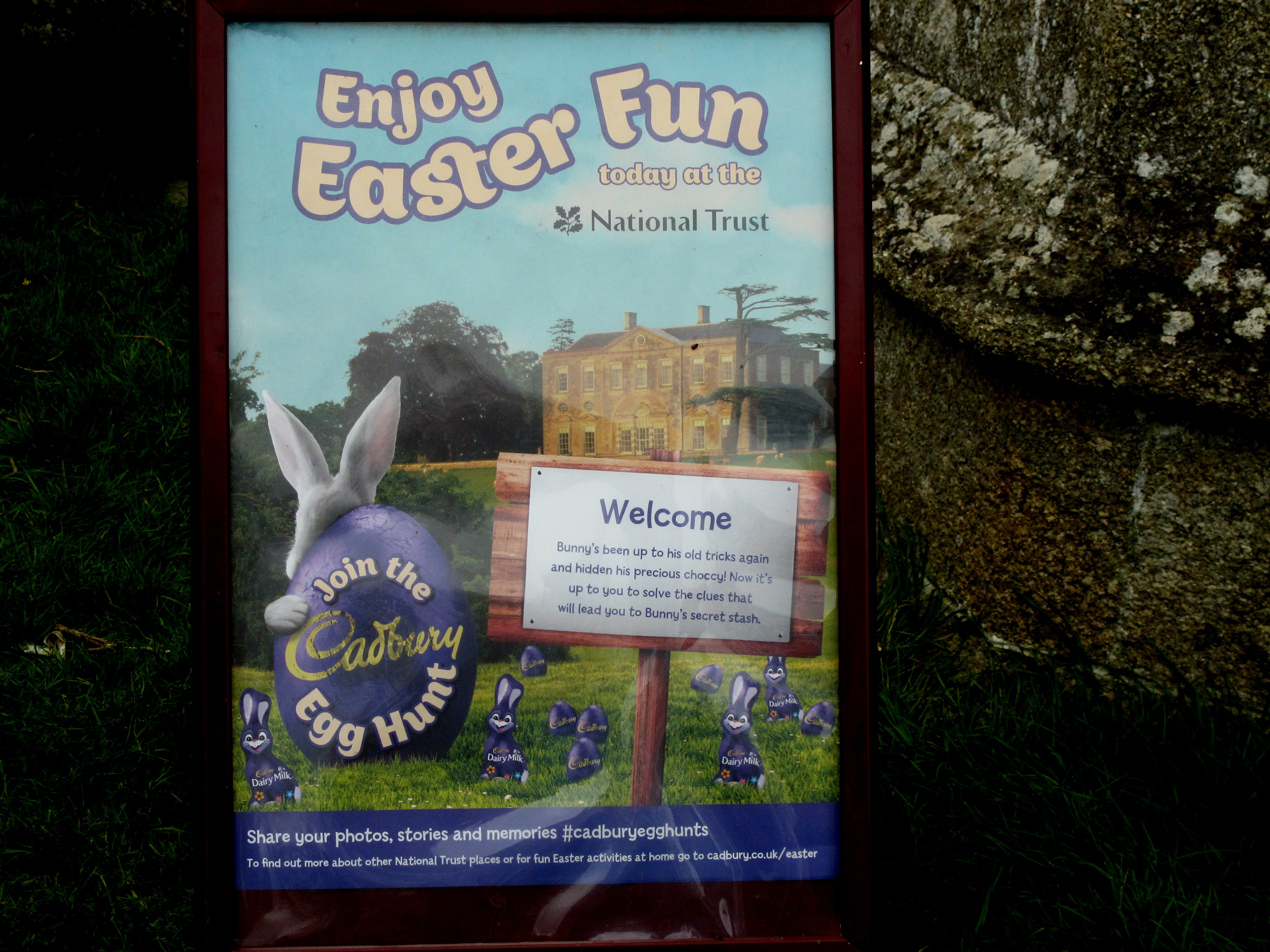
A photo that would’ve been relevant to last week’s post: This is the National Trust/Cadbury poster promoting their egg hunts. You’ll notice that for all the complaints about Easter being airbrushed out, the first line that the eye picks up uses the word.

I’ve lived in the U.K. long enough to know that, but my nerves and muscles haven’t. They’re stubbornly American. On the instinctive level, which is where they do their work, two fingers are just two fingers. If I want to order two teas and there’s some confusion about how many I asked for? May all the gods I don’t believe in protect me, those are the fingers I’d be most likely to hold up. It’s long-distance communication. Communication that carries over the noise of a cafe.

It’s also a good way to very seriously insult someone.

But that’s the thing about nerves and muscles. They work faster than the brain. Faster than the thought, You’re in a country where you don’t count on your fingers that way.

So that’s one reason immigrants are so stubbornly immigrantish: Unless you move to a new country when you’re young, some parts of you just don’t change. Even if you set out to adapt your habits, one by one by one, as I haven’t, there’s always something left.

How do people count on their fingers here? I have no idea. In some countries, I’ve been told, you start with the thumb. Two coffees? That’s the thumb and index finger. Hold up the thumb and middle finger and you’re likely to end up with three coffees.  But in Britain? I can’t remember anyone waving fingers around to let someone else know how many teas or coffees or beers they want. For all I know, it’s an un-British way to communicate.

D. swears that if a doctor asks, “How many fingers am I holding up?” it will always be three. I don’t remember the reason it won’t be one, but she says they’ll be afraid to hold up two and are too lazy to hold up four or five.

Why is sticking two fingers up an insult? No one seems to know. The usual story has to do with the Battle of Agincourt, which was won by English archers and the longbow. The English are still sticking two fingers in the air to show the French they haven’t lost the ones that matter to an archer. Unfortunately, every place I found it explained that way also said it probably wasn’t true.

But if you hear about me getting into a brawl somewhere, it’ll be because it was noisy and I was trying to ask for two of something.

*

From body language, let’s move to the written language. My relocated friend J. pointed me in the direction of this story;

A vigilante has been roving night-time Bristol for thirteen years now, correcting the apostrophes in signs. Yes, friends, someone has dedicated his life to that, and the BBC interviewed him early in April.

Is what he’s doing illegal? “It’s more of a crime to have the apostrophes wrong in the first place,” he said. And although proofing your own writing is a losing battle (I’ll quote on that anytime I have to explain a typo on the blog), I’ve proofed that quote three times to make sure the apostrophe was in the right spot.

The interview led a newspaper columnist, Catherine Bennett, to point out that he’s not the grammar vigilante he claims (somewhere; I’m not sure where) to be, because grammar’s one thing and punctuation’s another. And that’s a powerful argument for not claiming to be an expert on anything: Sooner or later you’ll get something wrong and someone else will find it. And point a finger at you and feel clever about it. That someone may not be an expert themselves, but it takes a whole lot less expertise to find one mistake than it does never to make any.

All this led me to learn that chain stores are dropping their apostrophes all over Britain’s high streets. So far, no pedestrian casualties have been reported.

If you’re in the American Midwest, the high street is the equivalent of Main Street. If you’re anywhere in the U.S. except New York, it’s the equivalent of downtown. If you’re in New York, you’ll just have to muddle through without a translation. Waterstones—the bookstore chain that was once the bad guy in literary circles because it was forcing out independent bookstores but has become the good guy because it’s at least a real bookstore, not Amazon or something else on the internet—has dropped its apostrophe because that works better online. Barclays, Marks and Spencer, and a few others have done the same.

If you want more examples, the comment on this story has more of them than the story itself, which is pretty minimal.

In the U.S., place names are apostropheless because the U.S. Post Office doesn’t believe in them. Harpers Ferry comes to mind. If apostrophes are clothing, Harpers Ferry runs around stark naked.

In Britain, the rule on place names seems to be, Do anything you damn well please. Earl’s Court has an apostrophe if it’s the tube station but not if it’s the event venue, which is Earls Court. (Sorry, event venue is a ridiculous phrase but its the description I found and it knocked any real language out of my brain) On the other hand, the Barons Court tube station has no apostrophe. I could go on, but enough.

The Bristol vigilante will never be out of work. Unfortunately, it doesn’t pay.

A British Easter and the established religion

Easter’s creeping up on us and I’m living in an officially Christian country, which can be a strange experience for this Jewish atheist from the U. S. of no established religion A. In the U.S., I got used to people at least nodding once or twice in the direction of diverse beliefs. Even if those nods were sometimes more form than content, they were better than no nods at all.

Here, at least in rural Cornwall, spring brings Easter and only Easter—a solemn time of year when people gorge on chocolate and, in our village at least, kids roll eggs down a hill. For some people it’s a religious holiday, but for many it’s all chocolate, all the time. Still, religious or not, it is Easter. Almost everyone for miles in any direction, including up, down, and out to sea, is from a Christian background. Religious or not, the Christian holidays are part of their landscape.

Semi-relevant photo: A rhododendron, getting ready to bloom. Come on–it’s a spring flower in a post about a spring holiday. That’s as close a match as you’re likely to find here.

Britain has an official religion, but that’s not the same thing as being a deeply religious country. I have a theory I can’t prove, but for what it’s worth I believe making a religion official drives people away from it in the long run.

I’m not sure how long that run is, mind you, and that’s handy, because if we’re discussing a place where it hasn’t played out that way I get to say, “Give it time.”

If I’m right and you happen to have a religion you like enough to want an entire nation to adopt it, don’t say I didn’t warn you.

This year the Church of England—the country’s official church, remember—accused the chocolate company Cadbury and the National Trust, which owns a gazillion historic properties and runs tourists through them and their associated gift shops in the classiest possible way, of “airbrushing faith” out of its Easter egg hunts.

What did they do? Well, instead of holding Easter egg hunts, this year they called them Cadbury egg hunts. The church is apoplectic. Or, in fairness, parts of the church are apoplectic, but let’s keep using shorthand and say it’s the church as a whole. The sentences get too complicated otherwise, because I’m not sure exactly which parts of the church we’re talking about.

The National Trust pointed out that Easter is mentioned 13,000 times on its website, and furthermore that it was up to Cadbury to name and publicize the events they cosponsored. To translate that, they’re saying nothing happened and we didn’t do it.

Cadbury defended itself by saying that they use the word Easter multiple times elsewhere in their publicity, but the church still isn’t happy. If the word Easter doesn’t appear in the egg hunt name, it just isn’t Easter.

It all reminds me of a game we played when I was a kid, Captain, May I? The kid who was It told someone to take a step forward—a giant step, a baby step, a banana step. I don’t remember what a banana step was, but on 75th Street we had one. Kids who took the step without saying, “Captain, may I?” went back to the starting line.

Well, Cadbury forgot to say Easter in the right line of the publicity and has to go back to the starting line.

A BBC article reproduces one of the egg hunt promos, showing the phrase “enjoy Easter fun” in more eye-catching type than the Easterless egg hunt phrase. But it’s just not good enough. The National Trust has to go back to the starting line too.

The Archbishop of York, John Sentamu, said that not mentioning Easter in the egg hunt name was like “spitting on the grave” of John Cadbury, the chocolate company’s most Christian founder. But Cadbury’s several-times-great- granddaughter Esther McConnell spat back (firmly, gently, and metaphorically) that as a Quaker Cadbury didn’t celebrate Easter. “He believed that every day is equally sacred and, back then, this was expressed by not marking festivals.”

Take that, Archbishop.

The humanist society has called the whole thing a storm in an eggcup, but in case the flap wasn’t silly enough, the prime minister, Theresa May, waded in and said the decision to drop the word Easter was “absolutely ridiculous.”

Thanks, Terry. That deepened the conversation beyond measure.

Or do you prefer Terri?

Several articles have asked (and generally not quite answered) the question, Are egg hunts actually Christian? According to a Huffington Post article, the tradition of decorating eggs predates Christianity. But from an early stage, the egg was also claimed by various Christian groups as a symbol of Christ’s resurrection. So far, so ambiguous. A Wikipedia article (never mind a link—it will all have changed by now) said more or less the same thing. So the egg seems to be both Christian and pre-Christian. And quite possibly non-Christian, although no one I found addressed this.

And the hunt? Nobody seems to be saying.

What about the Easter bunny? That symbolizes how irresistible little fuzzy animals are. The basket of eggs symbolizes breakfast. No religion has an exclusive claim to eggs, bunnies, or breakfast. You can call them what you like without fearing the wrath of an archbishop.

Bunnies, in case you’ve ever wondered about this, do not lay eggs. They don’t eat them either, which is why the Easter bunny’s willing to deliver them to humans.

And chocolate eggs? They symbolize candy companies making a lot of money. In the most religious possible way.

What fascinates me about this whole uproar is that the Church of England seems to be taking the position that it owns Easter and any organization large enough to be seen from space has to pay rent in the form of proper wording. But the holiday long since slipped out of church hands and it’s now a secular as well as (not instead of, mind you) a religious holiday.

That’s the price a religion pays for having dominated the national conversation for so long—and here we’re back to my unproven theory. Some of its holy traditions became folk traditions, and when the folk wandered away from the church, as most people from Christian backgrounds have in Britain, they do whatever they want with them. If they want chocolate rabbits or Easterless egg hunts that include, as some bit of commentary put it, people of all religions and none, then they’ll have them. And other than fussing, there isn’t much the church or the prime minister can do about it.

*

While we’re on the subject of chocolate and silly upsets, let’s talk about a social media storm claiming (oh, the horror of it all) that Cadbury is selling halal chocolate.

We’ll get to what halal chocolate is in a paragraph or two, but first, what’s wrong with that? Well, gasp, Muslims can eat it. Shock. More horror. What will become of the country if it appeases Muslims by changing its time-honored chocolate recipes? Britain will cease to be British, that’s what.

What makes food halal? It has to be porkless, and any meat that’s involved has to be slaughtered in a certain way.  Compared to the complexities of keeping kosher, keeping food halal is simple. Keeping kosher means, no pork, no shellfish, meat slaughtered in a certain way, meat and dairy have to be kept separate, and don’t get me started on what you have to do on Passover because I understand it in only the vaguest way, There are probably other rules, but that’s enough for a quick snapshot.

Jews and kosher, though, aren’t the bogeyman of the moment. Muslims and halal are.

But let’s go back to chocolate candy. It doesn’t have any pork. It doesn’t have any meat. It’s not made anyplace where it could be contaminated with either one. I used to work in a candy factory, so I’m prepared to testify on that. It was pigless, meatless, underpaid work. And my hair smelled like disgustingly chocolate.

So is chocolate halal? Um, sure. So are carrots. So’s lettuce. Ban carrots! Ban salad! Add lard to your chocolate bars! They’ll taste terrible and clog your arteries, but at least they won’t be halal. We’ll starve out the terrorists.

And what product was the flap about? According to the article I found, Cadbury’s Easter eggs. Which Cadbury’s was—as far as I can make out—calling Easter eggs and which probably aren’t marketed heavily to the Muslim market.

The photo accompanying the article was apparently from the Asia-Pacific market and showed someone with a halal certificate and instead of Easter eggs a couple of chocolate bars. Which symbolize the trouble you can get into on the internet by doing nothing more than making chocolate according to the recipe you’ve been using for years.

*

And finally, a quick roundup of grotesquely overpriced chocolate eggs, because here at Notes from the U.K. that’s how we celebrate Easter.

Hotel Chocolat sells the Ostrich Egg–Classic for £90. The dash in the name is theirs, although purists please note, I changed it from an en dash to an em dash, originally so it wouldn’t form a mid-dash break at the end of the line but once I changed the layout because I’m too lazy to change it back. It’s over a kilo of chocolate and the text says, “Ostriches lay the largest eggs of any living bird–and we measured a real one to create the heftiest shell in our range!”

First point: As a general rule, dead birds don’t lay eggs. So you don’t, strictly speaking, need to say “living.”

Sorry, I can’t help myself. I worked as an editor and copy editor, which is a way of saying that I misunderstood people for a living. Some things stay with you even after you retire.

Second point: That bit about the “heftiest shell in our range”? It’s like saying that at five foot not very much I’m the tallest person in my category. The problem is, what category are we talking about?

Poof. The text just disappeared in a puff of semi-organic cocoa.

But let’s move into a higher range. Fortnum & Mason sells the Collosal Egg for £90. It’s 1.4 kilos of chocolate and F & M defies anyone “not to be impressed” by it.

I’m not impressed, because Bettys (there’s no apostrophe in the name) of Harrogate sells its Imperial Easter Egg for £250. It weighs 5 kilos and is delivered personally, whatever that means. You have to call to work out the details–that’s how personal it is.

Winning the competition, however (and remember, this isn’t really a competition you’d want to win) is the Hotel Cafe Royal, which sells an Easter egg for £600. It weighs more than the planet it rests upon and takes three days to make. I have no idea how you’d buy one because it’s so exclusive the hotel website doesn’t mention it. That keeps the riffraff from trying to buy stuff that’s above their station.

That’s a very British concept, getting above your station. I should write about it but I understand it even less than I understand the intricacies of keeping kosher.

I also don’t know how the monster egg is delivered. Maybe you have to arrange to be born inside so you can eat your way out, but that’s not the kind of information the riffraff need to have, so I just don’t know.

For a final bizarre note, the Evening Standard calls a £57.50 egg from Bettys “reasonably priced” but recommends the £37 version “for those on a budget.”

That’s a hell of a budget. And no, if you live somewhere else and are trying to figure out what life in Britain is like, this is not real life.

Whatever you celebrate at this time of year—if you celebrate anything—I wish you a good, non-hysterical, and financially sustainable holiday.

The Oxford comma and political activism

Back when I, very occasionally, taught fiction writing to grade-school kids (if you’re British, that would be—I think—primary school kids, and if it isn’t, little kids will get close enough to follow the story), some nine- or ten-year-old would always ask, “Do we have to use punctuation?”

“Only if you want me to understand what you write,” I’d say if I had my act together that day. If I didn’t, I’d just say yeah, they probably should, and move on.

But I loved the question. It’s so nine- or ten-year-oldish, and that age group was always the most fun to work with. The enthusiasm hadn’t been squashed out of them yet, and they had to skills to actually write something. Plus they asked questions like that.

Well, if somewhere deep inside you’re still wondering whether you have to use punctuation, and why, here’s a story for you:

Irrelevant photo: A camellia, on the grounds of Caerhays Castle–which given that most people around here don’t pronounce the R in any way I recognize as an R sounds like Ca’haze to me.

First, though, a bit of punctuation lore. There are two ways of using the comma when you’re listing things: 1) I ate eggs, toast, and bacon. 2) I ate eggs, toast and bacon. I’m a vegetarian but I’m not so pure that I won’t eat the imaginary stuff. But in the second sentence, I don’t get to eat the final comma, because it disappears.

In the U.S., we called that third comma the series comma, and it’s optional. In Britain, it’s the Oxford comma, presumably because the University of Oxford style guide recommends it although the dominant style says not to use it.

When I was in third grade, our teacher told us that we could either use it or not, and we should decide which style we liked. The series comma was more formal, she said. (My third-grade teacher was a man, but memory insists a woman taught us that. Maybe we had a student teacher, that day, or a substitute, although if it had been a sub there’d have been too much chaos for me to remember anything except, maybe, flying sandwiches. But let’s pretend memory knows what it’s talking about and call the teacher a she.)

I decided I’d use the informal style, because even then I knew informal suited me. I was very taken with the idea that I had a choice.

Years later, when I worked as an copy editor, I learned that most book publishers use the series comma. I didn’t ask why, I just went with house style, because that’s what you do when you’re a copy editor.

It turns out that lawyers like the series comma too.  According to the Guardian (I’d give you an American source–I found several–but they wouldn’t call it the Oxford comma, so we’ll go with a British one), a Maine law says that employers in three forms of work aren’t required to pay overtime:

“The canning, processing, preserving, freezing, drying, marketing, storing, packing for shipment or distribution of…” three kinds of food—don’t worry about which kinds.

Drivers for the Oakhurst Dairy won overtime pay because the lack of a comma means it’s not clear that distribution is a separate kind of work—the law could well be talking about packing for shipment or distribution. And those drivers are distributing.

According to Maine law, an ambiguity in laws covering wages and hours has to be interpreted “liberally in order to accomplish their remedial purpose.” It’s not mentioned in the story, but the list of foods that I said not to worry about uses semicolons instead of commas, but it does use one to separate the final item–a series semicolon–so I’m guessing the intent was exactly what the court ruled.

Why those categories of work shouldn’t be covered by overtime is beyond me, but that’s a different issue.

One of the many odd things about Britain is that people—okay, a small group of people—can actually get worked up about the Oxford comma. I’m not sure what I think about that. It’s heartening that somebody cares. On the other hand, good lord, people, will you look what’s happening in the world? The comma’s the least of our problems.

But–maybe the comma really could save us–before I move on to a story about something else that’s happening in the U.S., here’s my third-grade teacher’s lesson on why we needed to use punctuation. He wrote some words on the board:

“The man ate the waiter watched”

Then he punctuated them two ways:

“The man ate. The waiter watched.”

“The man ate the waiter. Watched.”

We were third-graders, so we giggled hysterically.

I don’t remember anyone asking if we needed to use punctuation after that. And I only remember the words he wrote because in the second version watched was left hanging off the end—not a full sentence and not a satisfying sentence fragment, although I wouldn’t have had the words to explain why it bothered me at the time.

We end up remembering unfinished, bothersome stuff like that.

Okay, a story about the U.S., I don’t live there anymore, but I do follow what’s happening as best I can, and like anyone who’s politically active online, even marginally, I get emails urging me to write one politician or another, or to call about something, or to sign a petition. Lately, those emails seem to come by the thousands. And because I’m a citizen of two countries and a loudmouth in both, I get them from two countries.

So what happens to all those opinions that pour into politicians’ offices? A New Yorker article did a great job of tracing that recently. I won’t try to cover it all—go read it; it’s interesting, and if you wonder whether any of this matters it’ll give you some answers.

Briefly, most communications politicians receive fall into three categories:

Category one is communications about nonpartisan and often technical issues. These can often be effective, calling a politician’s attention to something neutral and fixable. Doing something about these things is safe and makes the politician look and possibly even feel good.

Category two is communications about partisan issues. These are unlikely to change the politician’s basic orientation, although they can call politicians’ attention to parts of their constituencies that they hadn’t been aware of—as in, Oh! I hadn’t realized I had a politically active Iranian-American community in my constituency. Maybe I’d better make some gesture in that direction as long as it doesn’t piss off some other, larger constituency or set of donors. (I do hope I don’t sound cynical here.)

Category three is related to category two in that it consists of opinions about partisan issues but a separate category forms when they arrive in a flood, which indicates that something important is going on out in the real world. That makes politicians worry about their reelection prospects. And that has a way of catching their attention.

Lately, the U.S. Congress has been flooded. Emails have been bouncing back from overstuffed inboxes. Phone lines have been busy and callers haven’t been able to get through. (This is a bit dated but may still be true–I’m not sure.) A Democratic senator reported that his correspondence from constituents went up by 900%. A Colorado Republican got 3,000 calls in a single night and a Washington Democrat got 31,000 in three weeks.

“The thwarted and outraged took to Facebook or Twitter or the streets,” the article says. “The thwarted and determined dug up direct contact information for specific congressional staffers. The thwarted and clever” sent faxes.” One Republican senator received 7,276 faxes in twenty-four hours. “The thwarted and creative phoned up a local pizza joint, ordered a pie, and had it delivered, with a side of political opinion, to the Senate.”

Much of the outpouring has been spontaneous, rather than in response to organizational requests to call or write so-and-so about such-and-such. No one knows if it will continue. But whatever the response turns out to be, it is being heard. Something’s going on out in the real world.

Lately, I’ve been getting a swarm of emails asking me to take a one-click poll about some burning political issue or some politician. Do I like/dislike? Agree/disagree. They need to hear from me. My opinion’s crucial.

I hit delete. Some of the polls reappear. Ellen, the emails say, we haven’t heard from you.

I wrote back to one, asking, “Exactly how stupid do you think we are?”

Oddly enough, no one got back to me on that, although I really did need to hear from them.

Britain: money laundering, sandwiches, poisonous snakes

Because the British government’s taking a hard line on money laundering, it’s not easy to set up a bank account here. Banks and potential customers have to work their way through all sorts of requirements. And yet somehow or other, Britain’s a world money laundering capital.

Funny how that works, isn’t it?

A year or three ago, Wild Thing had to set up a checking account for a small organization that had a treasury of less than £100. Probably a lot less, but I don’t remember. It took four trips to the bank with her passport, a utility bill, and a note from her mother, who is—inconveniently, although not surprisingly given Wild Thing’s age—dead. The note was hard to get and not entirely convincing.

The second person who was going to sign checks had to make two trips and the third had to make just one. Then Wild Thing had to drive back to the bank to pick up the checks.

Couldn’t they have just sent them? Don’t ask me. The bank’s roughly half an hour from our house. Why make things easy?

Irrelevant photo: The daffodils have been in bloom since late January. This one, as you can see, is not involved in money laundering.

At least one of those trips, I admit, was because Wild Thing hadn’t double checked that the name J.’s known by is her actual passport-authenticated, birth-certificate name, and it turned out not to be. But the others? They were part of business as usual.

But that was nothing. For a different organization, she tried to set up an account at a different bank and it took three months. Then the bank closed its branch in the town. We didn’t mourn.

I shouldn’t complain about this being so difficult, because in fact I have laundered money. I’ve also spin-dried it, but I don’t think I ever washed anything larger than a five dollar bill, and it may be in the interest of combating money laundering that the British government introduced its new plasticky five-pound note (no one but me calls them “bills” here) that can be run through the laundry but will shrivel up and die if is it’s run through the dryer. We don’t have a dryer, so however we manage to lose money, it won’t be that way.

But we’re small time money launderers at my house, so it’s—let’s say it’s mildly annoying to learn that in spite of our branch bank’s care in observing the anti-laundering protocols, Britain’s banks laundered £740 million for Russian criminals with links to the Russian government and the KGB.

Allegedly. I do need to say allegedly.

Deutsche Bank is also accused of laundering Russian money. And it lent $330 million to Trump, but it’s okay because the bank’s investigated itself and reports that there’s no link between those two acts. Which lifts a weight off my mind.

What else is happening here?

I’ve just learned that Britons eat a lot of sandwiches. I don’t know how British sandwich eating compares with other countries’, but the numbers–however meaningless they are without a point of comparison–sound impressive. Over the course of a lifetime, the average Briton will spend more than £48,000 on sandwiches. That’s a lot of money, in case you hadn’t noticed. It buys roughly 18,000 sandwiches. If you ever need to know what a lifetime supply of sandwiches consists of, there’s your number.

The typical eater will need eight mouthfuls and six minutes to finish a single sandwich and will prefer to have it cut on the diagonal. The list of favorite fillings is mostly boring, but number 12 is a chip butty–a butty being a sandwich and chips being what I grew up calling french fries, so bread stuffed with fried potatoes. Number 25 is mayonnaise and nothing else.

The list of “unusual” (for which you can read “disgusting” if you like, but far be it from me to push you in that direction) fillings includes mayonnaise and crisps (which I grew up calling potato chips); instant noodles (raw? cooked? six weeks old? I don’t know); lasagna; onion rings and ketchup; mashed potato and sweetcorn (which I grew up calling just plain ol’ corn); leftover carryout (called takeaway here: curry and Chinese food are mentioned); baked beans and cheese; cheese and chocolate spread.

I’m not sure why baked beans and cheese are considered unusual. Baked beans show up in everything except apple pie here, and the firm doing the research is, as far as I can tell, British. But while I’m going off on tangents. I feel the need to mention that British lasagna includes a heavy, pasty layer of white sauce, which I consider an insult to Italian cooking. Or maybe that’s Italian-American cooking. Or American cooking. I don’t really know–I’m not Italian and haven’t studied the evolution of lasagna. What I do know is that I grew up with a different kind of lasagna and consider the British stuff heresy.

Not that I’m stuck in my ways or anything. I just happen to know what’s right. I’ll come back to that below.

The press release spells it lasagne, not lasagna. That’s not enough to condemn an entire nation’s eating habits, but it does call its Italian credentials into question.

What else is in the news? The Western Morning News warns dog walkers that poisonous snakes are on the loose. I can’t find the story online, so you’ll have to take my word for it. But hey, would I lie to you without a good reason?

Snakes on the loose didn’t strike me as particularly funny when Wild Thing read me the headline, so she asked where else snakes would be.

Ah. Good point.

The story below the headline is that a dog walker saw an adder—the only poisonous snake native to Britain—and it reared up and hissed at him. So how did he deal with the threat? Why, he pulled out his phone and filmed it for five minutes.

Are you getting the sense that this wasn’t a life-or-death moment? I don’t particularly want to get bitten by an adder and I won’t shove either of our dogs or the cat in front of one, but adders aren’t generally lethal. Since 1876, there’ve been only 14 known human fatalities. Most dogs, being smaller than your average adult human, are more vulnerable, but the expert the Westy interviewed recommended getting a dog that’s been bitten to the vet asap—carrying it if possible, walking it slowly if necessary. Dogs, he said, generally make a full recovery.

But, guys, I don’t have all that many readers so you need to take care of yourselves out there, okay? I can’t spare you, and poisonous snakes are on the loose. During the winter it was safe enough. They stayed inside, drinking tea and nibbling digestive biscuits while they watched movies on TV. Now, though, the days are getting longer, they’re getting the itch to mate, and they’re outside. On the loose. Be careful, people. You’re not expendable.

And if you do get bitten, please recruit a substitute until you’ve recovered.

But let’s move on while you’re still well, because there’s more news to report.

Thousands of protestors—or maybe I should call them celebrators, or, well, people; let’s settle for people. Thousands of people in London marked the European Union’s birthday by showing their opposition to Brexit in—well, I wasn’t there, but it sounds like the most restrained demonstration ever. Signs included one saying “I’m quite cross” and another saying, “I’m British. I am on a march. Things must be bad.”  The article I read describes it as “not so much a march as a very patient and stubborn queue.”

A queue, in case you need a translation, is a line of people waiting patiently for something. Forget the Church of England; queuing is the national religion.

The march wasn’t all patience and good manners, though. A third sign said, “Buck Frexit.”

Onward.

I’ve been living in Britain so long now that I’m not sure how to call directory assistance in the U.S. anymore. When I was a kid and a young adult, it was free—and they’d give you the associated address as long as you asked for the phone number first. The phone company ran directory assistance, so it was only polite to pretend you wanted to call someone. Then later on, four calls were free. Then one. Then none—they’d started charging, but at least you didn’t need a calculator to figure out how much it would cost.

Britain, though, has a series of directory assistance numbers, and they’re allowed to charge a flat fee of up to £15.98 per call plus £7.99 per minute—and if they put your call through for you, they can go on charging for the every minute you talk. The average charge per call costs less than the maximum but it’s still absurd: £6.98. The services are heavily advertised and are used mostly by the elderly—or those among them (at, ahem, a mere 70, I clearly don’t qualify) who don’t use the internet.

This got into the paper because one 90-year-old was charged £501. No, I didn’t leave out a decimal point. That’s five hundred and one pounds for a single directory assistance call.

A spokesperson for Ofcom, which stands for We’re off meeting with someone powerful and important and don’t have time to communicate with you, said, “We are carefully monitoring the impact of the adoption of these new higher charges and are actively considering whether further action is justified.”

Yup. There’s a lot to consider here. You wouldn’t want to rush into it.

Next we come to a couple of stories about the brain. Only one involves Britain, but let’s not split hairs here.

The first is a New Yorker article that reports on research demonstrating that facts don’t change our minds. Given two sets of facts supporting opposing positions on, say, the death penalty, people will find the one they already agree with more convincing, better researched, and presented in a far superior typeface. The opposing one? It’s a piece of crap.

Appealing to people’s emotions may be a more effective way to change their minds. It doesn’t, unfortunately, guarantee a great decision-making process.

No, I don’t know what to do about it either, but if you’d like a name for it, it’s called confirmation bias. And I fall into the trap as easily as anyone else does, except that I’m right so it’s okay.

The second story is about a series of brain scans that document what we all suspected: that using a sat-nav (make that a GPS if you’re in the U.S.) turns off parts of your brain. This explains why people have been known to drive into the sea in an attempt to reach an island if a sat-nav told them to. It also explains the driver Wild Thing and I tried to convince not to drive up an unpaved, washed-out road a mile from our house. He kept pointing up the hill and repeating, “But the sat-nav says.”

Luckily for him, the road was muddy and he spun his wheels and had to back down before he got to the part that would’ve eaten an axle. Because poisonous snakes could well have been on the loose up there. You can never be sure.

And finally, to reward you for reading this far, I’d like to tell you that the last Friday in April is National Hairball Awareness Day. Break out the cat food. Refresh the kitty litter. We need to celebrate–even if you’re in the wrong nation. (The nation in question is the United States.)

My thanks for Flo for letting me know about this. How could I have lived so long and not found out about it before?