True Lemon Drizzle Escapes the Comments Box

Belladona Took sent a link to a traditional lemon drizzle cake recipe, and it deserves to be let free of the comments box so anyone who reads only the posts can find it. It uses plain flour, so it should translate reasonably well to any country. Judging from the comments on the recipe I published, no two readers share any single measuring preference, so I’ll warn you that it’s measured in cups and so forth and let you decide in the privacy of your own kitchen whether it makes sense to follow the link.

In case it changes any minds, 4 cups of flour equals a pound, so you can still weigh it.

http://www.epicurious.com/recipes/food/views/Lindas-Lemon-Drizzle-Cake-51159200

Enjoy. Or run like hell. It’s up to you. Thanks, Belladona.

Autumn in Cornwall

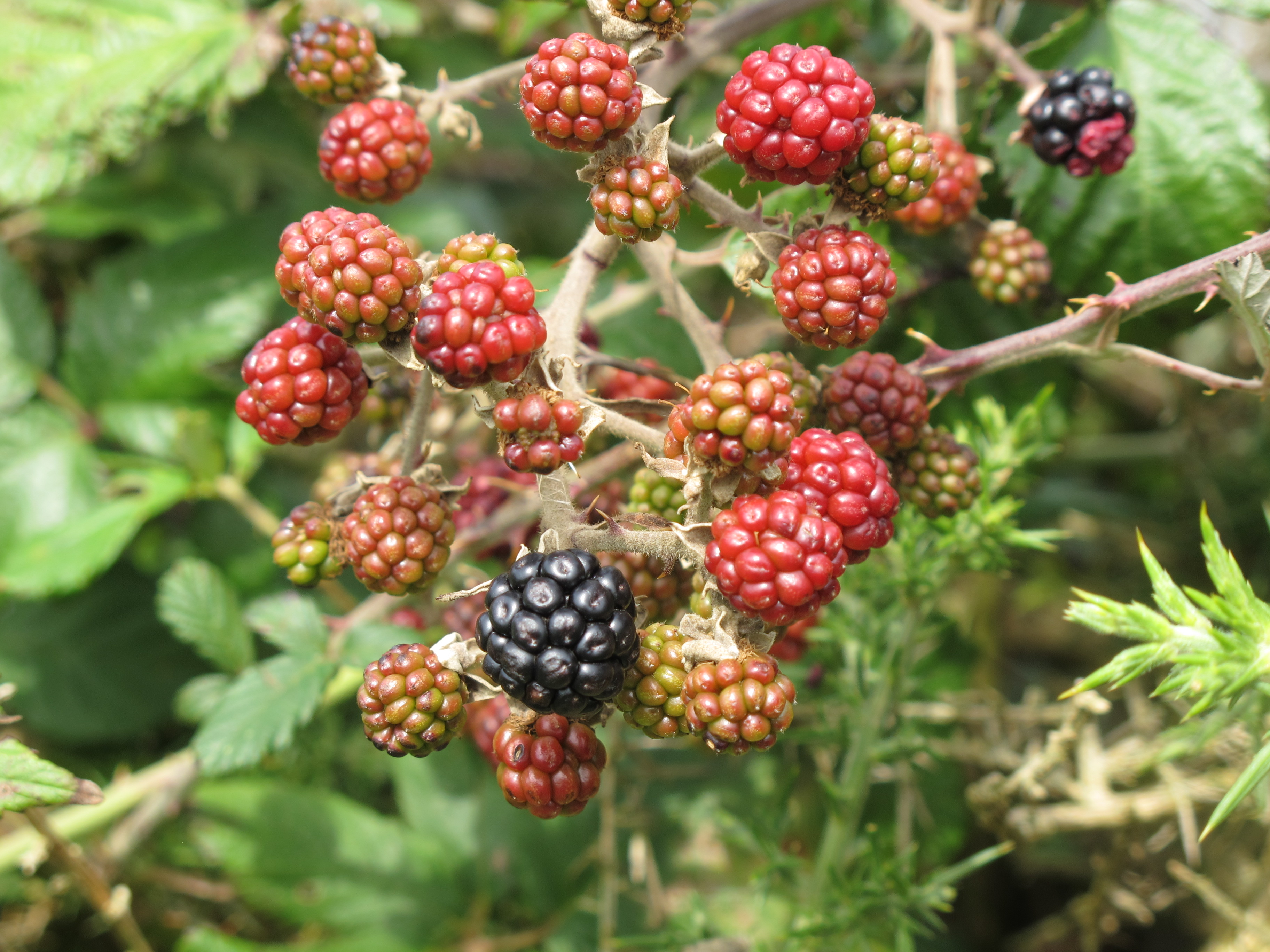
Irrelevant Photo: Wild Blackberries Ripening in the Hedge

Britain, Tea, and Hot and Cold Running Stereotypes

Am I calling up a lazy stereotype when I say that Britain’s a nation of tea drinkers? I know: This isn’t the most important question you’ll face today, but stay with me. I’ll make it worth your time (she said rashly).

A while back, someone read part of an as yet unposted blog entry I’d written about tea and told me I was indulging in stereotypes. She mentioned beer (people do drink a lot of beer here; I’ll give her that), and Starbucks, and the country’s changing habits. She urged me to go deeper into the culture. She didn’t mention Starbucks’ untaxed profits, and I admit they’re not what everyone’s mind would race to in this context, but if you want to go deeper into the culture, they’re sitting there like the Titanic’s iceberg and I can’t type the company’s name without mentioning them. And don’t even get me started on Amazon.

A cup of tea, in motion. Photo by by ŇÄĵŵÅ Ă. Мǻŗǻƒįę.

A cup of tea, in motion. Photo by by ŇÄĵŵÅ Ă. Мǻŗǻƒįę.

She signed off by saying her husband had just made her a cup of tea, which either means she has a sense of humor (she hadn’t noticed mine, so I did wonder) or undercuts her argument, or possibly both. Either way, she left me thinking about stereotypes. Because they’re hard to resist if you’re trying to be funny—and the longer I work on this blog, the better I understand how deeply trying and funny dislike each other.

But I don’t want to stereotype stereotypes. They’re not all the same. Off the top of my head I can break them into two categories. And as soon as you say something like that, someone else comes along and breaks them into seven categories, and someone else comes up with forty-three. Settle down, everyone. It’s not a competition. All we need for this discussion are the harmful kind and the harmless kind. Think of them the way you’d think of spiders, or snakes: Some of them are venomous and some of them aren’t. Remember at the start of the Iraq War, when the French said, Guys, I don’t think this is an entirely good idea, and suddenly the geniuses who (as it turns out) helped destabilize the Middle East were calling them cheese-eating surrender monkeys? That’s not only a very weird stereotype, implying, among other things, that Americans think there’s something suspect about eating cheese, but it’s ugly. (I know, it started ironically, on The Simpsons, but by the time I’m talking about it had cut its ironic moorings and was loose in the world, untethered.) It’s not the most harmful stereotype I ever heard, but it’s surely one of the stranger ones in its category.

Now compare that to the claim that Britain’s a nation of tea drinkers. They’re different, aren’t they?

Is Britain a nation of tea drinkers? We have two cafes in our village, and both have invested in coffee machines. You know the kind. Huge silvery things. You stand behind them and you might as well be piloting a spaceship.

“Potential customer on the road, Captain.”

“Deploy the tractor beam, Lieutenant.”

So customers are tractored in, and they’re grateful. They order lattes and americanos and mocha half-decaf double skim vaguely Italian-sounding whatsaccinos, and they sit at tables in (if they’re lucky) the sun and sip them. But what they’re sipping are indulgences—the kind of thing people will invest in and think, I really needed this, or, Isn’t this nice, sitting here with a coffee? because it’s something special. Follow them home, though, and most of them will drink tea. If they have coffee in the house, it’ll be instant. How do I know? By what people offer me in their homes. By what they choose when they’re in mine.

But forget the cafes. Go to a village event—the kind the village has been holding since caffeine first came to these shores, raising money for the hospices, or the air ambulance, or the church—and you’ll have a choice of tea or coffee. And the coffee will be instant. Because that’s how it’s always been done and that’s how it’s still done. Any place has a tea pot. Any place can boil water. Not every place has a coffee pot.

What happens in the U.S.? Park yourself at the counter of any greasy spoon in the country and ask for coffee. The waitron will turn, grab a pot from a coffeemaker and pour. It’s already made, it’s waiting for you, and most of the time it’s no older than you are, so it’ll taste—well, it’ll taste like coffee. Whether that’s good is a matter of opinion. But it doesn’t matter. They go through enough of it to keep a pot on hand.

Two pots, actually: regular with a black (or is that brown?) handle and decaf with an orange one.

Ask for tea, though, and the waitron will have to check with the boss, because it’s been six years since anyone ordered a cup. I worked in a place like that. The boss probably kept a box of teabags stashed somewhere, but I never had a reason to ask about it.

That’s what life’s like in a nation of coffee drinkers.

But I hate being called superficial, so let’s consider countervailing trends: Before I left the U.S., I’d begun to worry about the younger generation’s moral fiber, because so many of them were getting their caffeine from soft drinks and energy drinks and cold bottled coffees or (yes, I admit it) teas with vacation-sounding names and enough sugar to fill a bathtub, condensed somehow into a fist-sized drink. This struck me as childish—self-indulgent, even. Adulthood involves learning to drink things that don’t taste good, and then learning to like them, and teaching other people to like them, and judging people on the basis of whether they like them. Weren’t these kids ever going to grow up? And more to the point, when it came time to give them house-warming presents, was I ever going to be able to give them coffee mugs?

I should probably pause here and say that I’d stopped drinking coffee by the time I passed this judgment on an entire generation, but I didn’t get my caffeine from cold, sugary drinks, so it was different. And I had once been a coffee drinker, so whatever I did after that was okay, because I’d survived the initiation.

I never claimed that this made sense. What I’m trying to do is make a point, which is, defensively, that I’m capable of going deeper into a culture. And still exaggerating. Which is the essence of stereotype. And the essence of humor. Or, yeah, I’m exaggerating again. It’s the essence of some humor.

If you go deep enough into any culture, you’ll find something to laugh at. Without dismissing it or being ugly.

British Brownies and U.S. Scones

My last post included a traditional British scone recipe, and American readers immediately wrote in (on the blog and on Facebook) and said, That sounds great. Can I add cranberries, chocolate chips, and marshmallows? The answer is, of course you can, and it may taste great, but it won’t be a British scone, it’ll be more like a British brownie.

Why is a brownie like a scone? Because once it crosses international boundaries you can’t recognize it.

Irrelevant Photo #2. Dorset. Photographer, Ida Swearingen

Irrelevant Photo #2. Dorset. Photographer, Ida Swearingen

Let’s start with the American scone. It’s great, but it’s got only the faintest relationship to the original. Which is British, and a cousin to the American baking powder biscuit—plain, round, workaday, and delicious. Usually. If it comes in cellophane, be suspicious. It’s usually a little sweeter than a baking powder biscuit, and sometimes comes with raisins, which for reasons I don’t expect to ever understand are called fruit. I mean, yes, they are fruit, in a dried-up sort of way, but the world’s full of fruit. We don’t insist on calling a carrot “vegetable” instead of “carrot,” do we?

Never mind. The fruit scone has raisins. The cheese scone has cheese. The plain scone doesn’t have either one. And the scone with ginger and lemon and blueberries and chocolate chips and deep-fried Mars bars? It doesn’t exist. But the cream tea does exist. It’s tea with two plain scones, jam, and clotted cream, which is cream that’s been beatified. If you see one and you’re not in (a) a highway café or (b) a railroad café, try it.

The American scone is a British scone on steroids. Triple the sugar, double the shortening, quadruple the size, and add every kind of fruit and candy you can think of. Exactly when every American turned into a Texan (you know: Everything we have is bigger, and everything bigger is better) I don’t know, but somehow we did. Or it looks that way from here.

What about the brownie? The British call anything dark, slab-shaped, and sweetened a brownie. Mind you, I’ve had a few over here that were delicious, but if I see them advertised I approach the display case with extreme caution. Wild Thing ordered one in London once. It looked pretty reasonable in the display case but turned up at the table decked out with ice cream, whipped cream, chocolate sauce, and a blood-pressure monitor. The theory must be that if it’s American and you go over the top with it, it must be authentic. I mean, look what the bloody Americans do to the scone.

How to Bake a Scone

I can’t keep writing about life in Cornwall without posting a scone recipe. And not just any scone recipe, an English scone recipe.

You should understand that there’s no single, definitive English scone. Not only do scones divide into plain, fruit, and cheese (or savory, which is spelled savoury), but any one of those three will vary. You can also find griddle scones and drop scones. They’re like the brownie that way. Or religion. Lots of variations; lots of recipes; lots of people damning each other to hell for doing it wrong. You’ll also find regional variations. I could be wrong about this, but I believe scones get larger as they go north. It may have to do with the weather, or the longer O in the northern accents.

Some recipes include eggs, which is any right-living person would tell you is heresy, so this one doesn’t. I have no idea where I found it, or how much I’ve tinkered with it over the years. Whoever developed it, I’d give you credit if I could. All I can give instead is my apologies, and my thanks, because it makes a damned good scone.

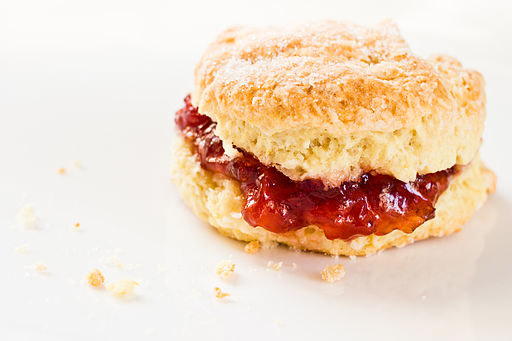
Scone with jam. Photo by Benson Kua, and it's from Canada, not the U.K.

Scone with jam. Photo by Benson Kua, and it’s from Canada, not the U.K.

Scones: Makes 5 or 6

1 ½ cups flour, unsifted (see below)
1 Tbsp. cold butter
1 Tbsp. sugar
½ tsp. baking soda
1 tsp. cream of tartar
½ tsp. salt
[raisins if you want them]
Enough milk to pull the ingredients into a ball

Sift the dry ingredients. (I was taught to sift flour before measuring, transfer it grain by grain into the measuring cup, then sift it again after measuring, but I can’t be bothered. Half the time I can’t be bothered sifting it at all, I just mix the dry ingredients together. If we’re talking about kitchen heresies, this is a big one, but my baking comes out fine, thanks. Just don’t whack your measuring cup down on the counter to make the flour settle, because it will and you’ll end up with too much.) Cut in the butter. (You want to keep the butter cold, which will keep the scone from being heavy, so if you can cut it with a pastry blender, do. If you use your fingers to crumble it into the dry ingredients, handle it as little as possible.) If you want raisins, this is the time to add them. Stir in just enough milk to form the dough into a ball. Roll out to about ¾” thick on a floured surface and cut with a biscuit cutter or, if you don’t have one, the rim of a glass. If you twist your cutter, the scones won’t rise evenly. If your scones don’t rise evenly, it won’t make the least bit of difference, so don’t lose sleep over this. Place the scones on a greased cookie sheet and bake 12 to 15 minutes at 400 degrees. (To make sure they’re done, take the cookie sheet out of the oven, pry one open partway, and peek inside. If it’s gooey, put the cookie sheet back in for a couple of minutes.) Eat with butter—lots of butter—or jam, or both. They’re fine cold, but they’re better hot.

This is the real thing.

English Food: Cheese

The last time I wrote about English food, it was to make fun of baked beans. So let’s talk about a good part of English food: The English are known for their cheese, and justifiably. Cheddar takes as much space in the cheese aisle as baked beans do in the canned vegetable, only it tastes good. And it’s not just connoisseurs and food snobs who go in for the strong stuff, it’s normal people—kids, adults, people who eat baked beans on toast. Cheese turns up in soups, in sauces, on baked potatoes. Okay, everything turns up in baked potatoes, but still. If a store only sells one vegetarian sandwich, it’ll be cheddar. And it’ll be grated, not sliced.

English Blue Stilton. Photo by Dominik Hundhammer

English Blue Stilton. Photo by Dominik Hundhammer

Every year, at Cooper’s Hill in Gloucester, people race—or slide, or roll—down an insanely steep hill chasing a wheel of double Gloucester cheese. The winner gets to keep the cheese. And a generous portion of mud. The race’s official site says of the 2013 race:

“Due to warnings from the police … a substitute, plastic cheese was used this year, so a real cheese was not in fact rolled*.

“This did not seem to matter to either contestants or spectators, but it was a failure as it just did not have the weight to roll properly! In the ladies race, one lady (not the winner) picked it up and carried it down to the finish line.”

“*Upon careful analysis of the movement of the cheese in the videos of the events, it appears that the “cheese” in the first event was significantly heavier than the ones used in subsequent races, it was the only “fast cheese” of the day, it also bounced a lot higher. There is a strong suspicion that this was a ‘real Cheese,’ the ones in the remaining races were made of foam plastic and were much slower, in most cases being passed by the contestants.”

The only injuries that year were a dislocated shoulder and a broken leg. It took more than two hours to get the guy with the broken leg off the hill, with the rescuers walking backward and held back by ropes. It’s that steep. But, hey, the prize is a cheese, right?

One winner said publicly that she didn’t like cheese and was going to offer her prize on E-bay. The bids didn’t come up to reserve price and I hope she learned to love the stuff, because she was the proud owner of an eight-pound wheel of the stuff.

Tea

Americans think tea’s something you drink with your little finger in the air, as if you’d broken it and put it in a splint. We think it’s something you put on a funny accent to ask for. And America’s tea snobs reinforce that. You can’t just drink tea, you need tea made from leaves that were picked while the morning dew was  still fresh on the plant and which were then individually dried and sung to the whole time—by a tenor, thanks; a soprano might crisp the edges and a bass would leave them open to mold. And you need to pay lots o’ money for the resulting tea. I’ve been to restaurants, when I still lived in the U.S., where asking for a cup of tea meant the waiter had to haul out a wooden chest left from the time when restaurants kept a set of dueling pistols on hand in case, you know, a customer needed them. Only now it holds a complete set of hermetically sealed packets, each entombing one lonely teabag. And after all that, they bring you water that isn’t hot enough to lift any flavor out of the tea so you end up with, basically, a cup of bath water.

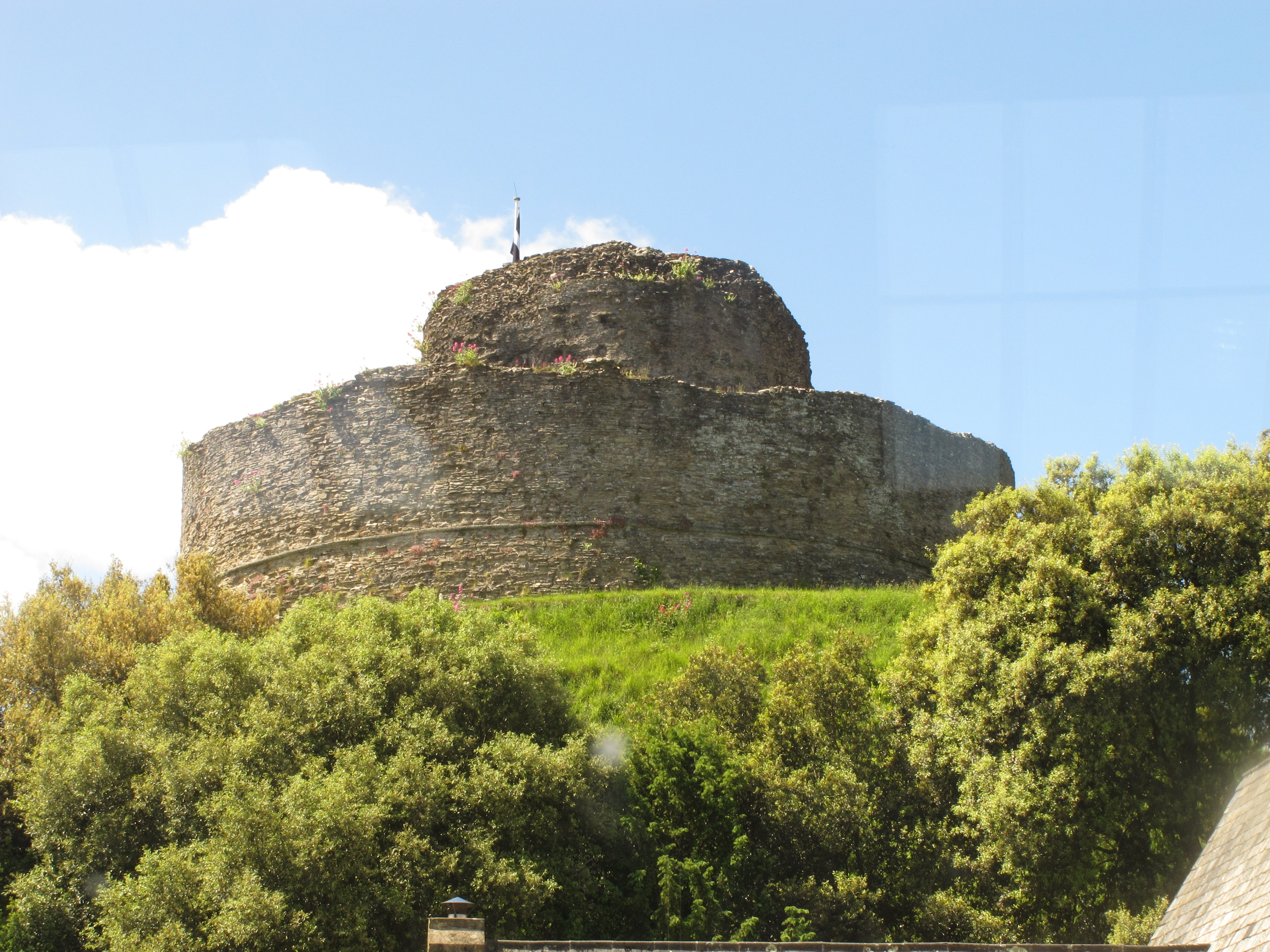
Irrelevant Photo: Launceston Castle

Irrelevant Photo: Launceston Castle

An English friend was so traumatized by her visit to the U.S. that she still talks about “that gray stuff you call tea.”

I hate restaurants like that. Not because of the tea. And not because everyone who works there is dressed better than I am. I’m used to that: I’ve always been dyslexic about style and have now gone entirely post-fashion. It’s because I keep thinking I’ve wandered into some private club and the butler’s going to throw me out any minute.

Are there still butlers loose in the world?

Anyway, tea: In Britain, it’s just a drink. If someone comes to fix the leak under your sink, you ask if they want a cup of tea. If you want to know why three guys are digging a hole in the middle of your street, you wander over and ask if they want a cup of tea. Add a biscuit—which is a cookie, and it doesn’t even have to be homemade—and they’ll tell you anything you want to know. Tea is the kind of drink you put in your thermos to take to work, if you happen to take a thermos to work. People talk about ordinary tea, or breakfast tea, to distinguish it from the fancy teas—Earl Grey, say, of green, or herbal (they pronounce the H). A. calls it builder’s tea, and sometimes builder’s butt tea. Her husband’s a builder, so she gets to say stuff like that.

A builder, by the way, builds buildings. Or fixes them. And a joiner’s a carpenter, not someone who belongs to a lot of organizations. All of them will drink tea. And so should you if you visit, because Wild Thing, who was once a dedicated and not at all fussy coffee drinker, tells me the coffee’s terrible. I gave up coffee long before I moved here, so I can only take her word for it.

A cup of tea is also a measure of time. If I drop by someone’s house and they offer me a cup of tea, they want me to stay long enough to drink it. Friendship is a highly caffeinated undertaking.

English Cooking: Baked Beans

English Cooking: Baked Beans

The English aren’t known for their cooking. Or they are, but not in a complimentary way. And I’ll admit they have some odd habits, one of which is eating baked beans on toast. But who am I to criticize? I grew up begging my mother to buy a kind of white bread that I could, and did, squish down to the size of a packing peanut. Which hadn’t been invented yet, but I was ahead of my time. And yes, I did eat it. She’d never have bought it again if all I did was squish it. And I’d have sworn it was good, so I know first-hand that there’s no accounting for taste.

Still, it throws me to see an adult sit down to a plate of baked beans on toast and, with every sign of pleasure, eat it.

Beans on Toast. Really.

Beans on Toast. Really.

But that’s not all that happens with baked beans around here. You can buy a baked potato topped with baked beans. (Or with cheese, or cole slaw, or curry, or roast vegetables, or shrimp, which are mostly called prawns unless they’re small, even for shrimp. And the potatoes are called jacket potatoes.) A full English breakfast includes baked beans, not to mention a grilled tomato. A single can of baked beans includes enough salt and sugar to cover Wales to a depth of half an inch. In spite of which, people eat baked beans in industrial quantities and live to ask for more, and why not? They’re full of fiber, which for all I know mops up the salt. Half the canned vegetable aisle is taken up with baked beans. I’m sure there are all sorts of subtle differences among the brands, but I’ll only do just so much in the name of research, and tasting them lies on the far side of an extremely thick dividing line.