British school uniforms: a follow-up post

D. tells me that the dowdy little dresses I said the youngest British schoolgirls are stuffed into are voluntary. They’re for summer, she says. They’re cooler. Some girls (or their parents, which is not at all the same thing) prefer them. Furthermore, at least in some schools the boys don’t have the option of wearing shorts in hot weather, which some boys consider discrimination. In 2011, a twelve-year-old boy wore a uniform skirt to school as a protest. A loophole in the rules meant that he was still wearing an acceptable uniform, the clever little devil.

You may be interested to note that if you follow the link to that article, the end disappears quickly and you can’t read it unless you take a phony survey designed to prove that some brand of shampoo is better than chocolate and a sunny day all rolled into one. It will also make you so sexy you’ll give up chocolate voluntarily. Which does seem contradictory, but what do I know about marketing? I’m just the sort of contrarian who wouldn’t take their alleged survey and as a result I don’t know what the rest of the article says, so I can only hope it doesn’t say April Fool. Probably not. The date is May.

Wildflowers, celandine

Irrelevant photo: celandine, a wildflower–one of spring’s early ones, but still in bloom.

British educational terminology: the cheater’s guide

APROMPTreply asked what A-Levels and Sixth Form are, and Diane Clement wanted me to “explain all the education jargon in the U.K., especially this new stuff that sounds like American charter schools.”

Let’s start with Sixth Form, because it’s damn near manageable. The phrase is left over from an earlier way of organizing education—or at least of talking about how it’s organized. What I (being American) call grades and are called years here but were once called forms. The First Form was the first year of secondary school.

Lanhydrock House, Cornwall, rhododendron, azaleas

Irrelevant photo: rhododendrons and azaleas in bloom at Lanhydrock House

Students who stayed in school to study for A-Levels (those are tests, and if I live through this part of the explanation I’ll get to them) went into the Sixth Form, which took two years and was divided into the Upper and Lower Sixths, because it would all be too simple otherwise. To ward off the danger of simplicity even further, some schools called the Upper Sixth the Middle Sixth because students who were trying to get into Oxford or Cambridge would do a third year of Sixth Form and that was the Upper Sixth. But some schools called that the Seventh Form or the Third-Year Sixth.

And you thought English spelling was complicated. The urge to complexify runs deep in the culture.

But move along, folks, nothing to see here, as they say on British cop shows when there’s been an accident and parts of the language lie strewn and bleeding all over the road.

Now that you’ve memorized all that, you should know that it was swept away in 1990—except in public schools, by which, of course, I mean private schools. Do keep up (as they say here). Being private, public schools get to do whatever they want and—well, let’s put it this way: Have you looked at the uniforms those kids wear at the fanciest public schools? I know not many people feel sorry for the rich and ridiculous, but good lord. Somebody should intervene on their behalf. Anyway, the uniforms don’t lead me to think these schools set a tradition aside just because it no longer makes sense.

Or because it never did.

But back to state schools. They now count from Year 1 up to Year 13, which is simple enough, but lots of people still call the last two years the Sixth Form because they used to and who’s to stop them? And in case it all sounds worryingly simple, you should know that Year 1 starts after Reception, so Reception is really the first year except that it isn’t. As an American, I’m used to the idea that first grade comes after kindergarten, therefore this almost makes sense to me, except for that business about calling it Reception, which sounds like a desk near the entrance of a building.

Typically, Sixth Form students don’t have to wear uniforms, which is a big deal, since the poor creatures  have been stuffed into one uniform or another since they first entered the school door. But at least most state schools (emphasis on most) choose something that borders on sensible—sweat shirts, polo shirts, trousers that I’d call pants except that means underwear here so let’s call them trousers. I so want to believe the kids can choose their own underwear.

The littlest girls get stuck wearing dowdy little checkered dresses in some schools. On their behalf, I wish to register an objection–to the dowdiness (I know I said I was post fashion, but there is a limit) but far more so to making them wear dresses. I mean, what year is this, anyway? Are they supposed to sit at their desks and do samplers while the boys go out and play?

Some Sixth Form students go to Sixth Form colleges, which may offer a wider range of courses than schools that combine Sixth Form with the rest of secondary school. In rural Cornwall, this may mean either traveling long distances or rooming near the school during the week, which not everyone can manage, so access is divided by a combination of money and geography..

And in Scotland and Northern Ireland? Every bit of this is called something different. What I wrote applies only to England and Wales.

Isn’t this fun?

And now, undaunted, we stagger on to A-Levels, which are the high-stakes tests at the end of Sixth Form. AS-Levels are the first half of A-Levels. Admit it: You don’t really want details here. O-Levels were replaced by GCSEs, but both are high-stakes tests that come before Sixth Form. All of them can be spelled without the hyphen, although you might lose points for it on the exam.

I’ve been following the education system here long enough to offer the following authoritative report on all these tests: If the average scores go down one year, the press and politicians fret and agitate about why the younger generation is failing to learn and society is failing to stress the importance of education and the schools are failing to teach, and in general there’s hell to pay. If the average scores go up, the press (and some politicians, depending on whether their party’s in power or out) fret and agitate about the tests having been dumbed down. And there’s hell to pay.

How many ways to win can you spot here? I can’t find a single one.

One problem—here and elsewhere—with high-stakes testing is that schools are judged by their students’ test scores (and students’ futures, ever so incidentally, are determined by them) and so they teach frantically to the tests. The tendency, then, is for broad and imaginative teaching to go out the window. For flexibility to go out the window, along with the cultivation of creativity and independent thinking. Because tests can test only those things that can be standardized and measured and marked. They push the schools to become factories. I’d weep, but it’s not likely to make any of us laugh, so I’ll move along, leaving a trail of damp tissues for you to follow.

And it is in this unhygienic way that we come to the educational jargon Diane asked about, and for the most part I haven’t managed to be funny about this, so you’ve been warned. It’s also complicated enough to make Sixth Form look simple, so I’ll narrow it down as tightly as if we were clutching it to our chests and squeezing with it through the eye of an A-Level.

State schools have historically been the responsibility of local councils—or to translate that, of local governments. There’s always a but, though, isn’t there? The money comes from the national government, so you can guess where the power lies, and the last government became obsessed with a Swedish experiment with free schools—schools that weren’t under local government control and that, in theory, would be free to innovate. Parents would be free to choose their children’s school, schools would offer a range of educational approaches and compete for students, and that would force them to improve, and everything would get better and better in this best of all possible worlds.

A recent report from the Organization for Economic Cooperation and Development recommended that Sweden abandon its experiment because it’s led to a steep decline in educational standards, but never mind. What do they know?

So a good chunk of money has been pumped into free schools and academies. I’m not going to get into the difference between academies and free schools because, hey, I’m simplifying here, and it won’t be on the test anyway. Besides, I don’t understand it and, as folks say here, I can’t be arsed to look it up.

Academies and free schools have been started, variously, by concerned parents who have the free time (which usually also means the money) and expertise to do that, by teachers, by for-profit chains, by nonprofits, by religious groups, and inevitably by the occasional scamster. A few state schools have been forced, over parent and staff objections, to become academies on the theory that this will improve them. Under the new government, we can expect more schools to go down that road. The new government just loves free schools and academies.

Unlike state schools, free schools and academies don’t have to worry about responding to a region’s needs. They can and often do open where there are already enough places, meaning government money goes to set up schools where they’re not needed. Also unlike state schools, they don’t have to hire qualified teachers. They don’t have to pay teachers the going rate, because they’re starting from scratch and their teachers have no union. They are, in theory, free of political interference, but they seem to be directly, and heavily, beholden to the central government rather than to the local one, so all this diversification may (emphasis on may; I’ve read about this but didn’t save the articles and I’m not a good researcher, so I can’t find any sources on it right now, which means I’m working from memory and impressions) be centralizing the control of education rather than loosening it.

One argument for these schools is that they’ll provide an alternative to failing schools. I read that so often that a person could begin to think all state schools are failing. They’re not; some have serious problems and others are doing well. From what I’ve read, the academic record of the new schools is mixed. Some do better than the comparable state schools and some do worse. Some aren’t well planned and close without warning, leaving the parents scrambling to find their children other ways to finish out the academic year. Some are in areas where they’re not needed. Opponents argue that they take up a disproportionate amount of the education budget, starving the state schools of funds. Proponents argue that they encourage diversification, excellence, and choice. Do I sound biased? I am, especially about the way the deck’s been stacked against the state schools.

So, to return to Diane’s question, they’re somewhat like the charter school movement in the U.S., but with the added, and I think toxic, element that state schools can, in some situations, be forced to become academies even if they and the parents involved don’t want to.

Follow-up: an innumerate triumphs

To follow up on all our tales of numerical inadequacy (and who would’ve thought that a post about high heels would lead us in that direction, or that a blog about living in the U.K. would lead us to high heels): Kinderhook–who wrote in to say it was math that kept him out of college–just put up a post about estimating a painting job. Estimates involve numbers. Even I know that. Terrifying.

Irrelevant post: new kitten in the house

Since my pioneering use the irrelevant blog photo has been a smash hit with at least one of you and the rest of you are too polite to comment, I’m going to push the boundaries here and add an irrelevant post. This is justified by two things:

  1. When Moongazer left a comment, she asked me to post some kitten photos. In the context, this actually made sense.

  2. A few weeks ago, I wrote about our cat Smudge having been killed by a car and a lot of you sent sympathy and lovely comments and even a poem. So although I can’t write a happy ending, I can share a happy beginning.

kitten. cat. sleeping kitten.

Fast Eddie. He has two speeds, High and Off. This is Off.

Left to my own devices, I’d have waited longer to get another cat, but Wild Thing doesn’t do well with the gaping holes that deaths and departures leave behind, so we now have a kitten, Fast Eddie. And although we still miss Smudge, Fast Eddie’s ridiculously cute, and absorbing in that insane way kittens have. The dog follows him everywhere and licks his ears. She believes she has to stand on him to do this, which is a bit of a problem but at least she’s not a mastiff and he seems to think it’s normal. And who am I to rule on what’s normal?

Fast Eddie and Minnie the Moocher. Sounds like a pool hall, doesn't it?

Fast Eddie and Minnie the Moocher. Sounds like a pool hall, doesn’t it?

We also have one pissed-off older cat. I trust she’ll get over it eventually.


British fashion, high heels, and dyslexia

Diane Clement asked, “Do British women feel the need to teeter around on high heels in their professional lives?? I always feel a bit sad when I see a woman with future foot problems carefully mincing around in them.”

Since I’m as dyslexic about fashion as I am about math, I hadn’t noticed.

How can anyone not notice if another human being is teetering around on something that makes her three inches taller than her normal height and seven times more prone to foot and back problems but that she thinks (and many people agree) make her look fantastic? Trust me, I can. I’m already shorter than 97.3% of the adults around me, so if they all grew by half a foot, what difference would that make to me? I’m already looking up.

Two interruptions here:

  1. 73.9% of all statistics are made up, including this one, so you should go back and reread the paragraph just above with that in mind.
  2. Endemic mathematical incompetence is called dyspraxia, not mathematical dyslexia, but it sounds like a disease and I’d much rather think of myself as dyslexic about numbers. I mean, my old friend T. used to claim she became dyslexic anytime she drove in St. Paul, and if she can have geographical dyslexia I don’t see why I shouldn’t have the mathematical form. However, I hate to offend anyone unnecessarily, so in case misusing of the word bothers anyone let’s put it this way: There is nothing involving numbers that I can’t fuck up.

There, that’s less offensive, isn’t it?

Irrelevant photo: bluebells in flower at Lanhydrock.

Irrelevant photo: bluebells in flower at Lanhydrock.

But back to high heels, which is our alleged subject. I asked M., who knows all, although I admit that as I phrased the question I didn’t work the teetering or the mincing or the foot problems. Researchers shouldn’t let their biases or anyone else’s get in the way, and I do take this blog seriously.

The short answer is yes—women in Britain tend to wear high heels in their professional lives. Although, M. said, styles do change, and sometimes flat shoes are in fashion, or low heels.

This next bit isn’t entirely relevant, but why should that stop me? The last time—and it was roughly a hundred years ago—that I wore heels of any sort I slipped down half a flight of stairs. The nice thing about my fashion dyslexia is that I now wear running shoes regardless of what’s in style. My feet are happy, and if people think I look funny I’m oblivious, so the rest of me is happy as well. My wardrobe and I are now entirely post-fashion.

Have I mentioned that this isn’t a fashion blog? That won’t stop me from answering fashion questions, but it may stop me from answering them competently.

 The Cornish Saints

Cornwall was Christianized by a raft (and I’m using that word metaphorically, but you’ll see why it comes to mind) of saints that most people outside of Cornwall never heard of. I’m guessing the best known is St. Piran—Cornwall’s patron saint and a favorite saint of Cornish tin miners. He sailed over from Ireland on a millstone. (“As you do,” as people here say in just that kind of situation.) He’s said to have liked his drink, and to have died of it. Memory insists that he got drunk and fell down a well, but memory—or the version of it that lives in my head—isn’t reliable and may be making that up. So don’t trust me on that. None of the web sites I’ve checked mention it, although they do mention a lot of drinking on St. Piran’s Day.

Whether or not he was a heavy drinker, the saints in those days weren’t prissy. St. Brychan came from Wales with three wives, twelve sons, and twelve daughters, many of whom became saints themselves. I’ve never heard how they got here—probably a VW beetle—but transportation seems to have been a big thing among them: St. Ia floated over on a leaf and St. Budoc floated over in a barrel.

later may 2015 001

A very British form of protest

Someone was recently convicted of disrupting prime minister’s question time—called PMQ by those in the know—by throwing marbles in the general direction of the MPs. (“Marble-throwing PMQs protestor gets suspended prison sentence”)

No, that’s not the part that strikes me as particularly British. We’ll get to that.  But before we do, I should explain that it takes an expert to tell when someone disrupts PMQ, because the MPs bray at and heckle and bully each other like a classroomful of twelve-year-old boys whose teacher stepped out for a smoke a month ago and still hasn’t come back. (My writers group, whose members are an invaluable and giddy guide to all things British, advises me that the MPs sound like public school boys, which if you’re American means private school boys, because public schools here are private, but that’s too much confusion for one post. Let’s thank them politely and not get into it here.) All that braying and harassing are politics as usual. The reason this guy stood out was because he was in the visitors’ area.

And, yeah, the marbles. I admit that.

Plus his language. The MPs are allowed (even expected) to be horrible to each other, but their language has to be pristine.

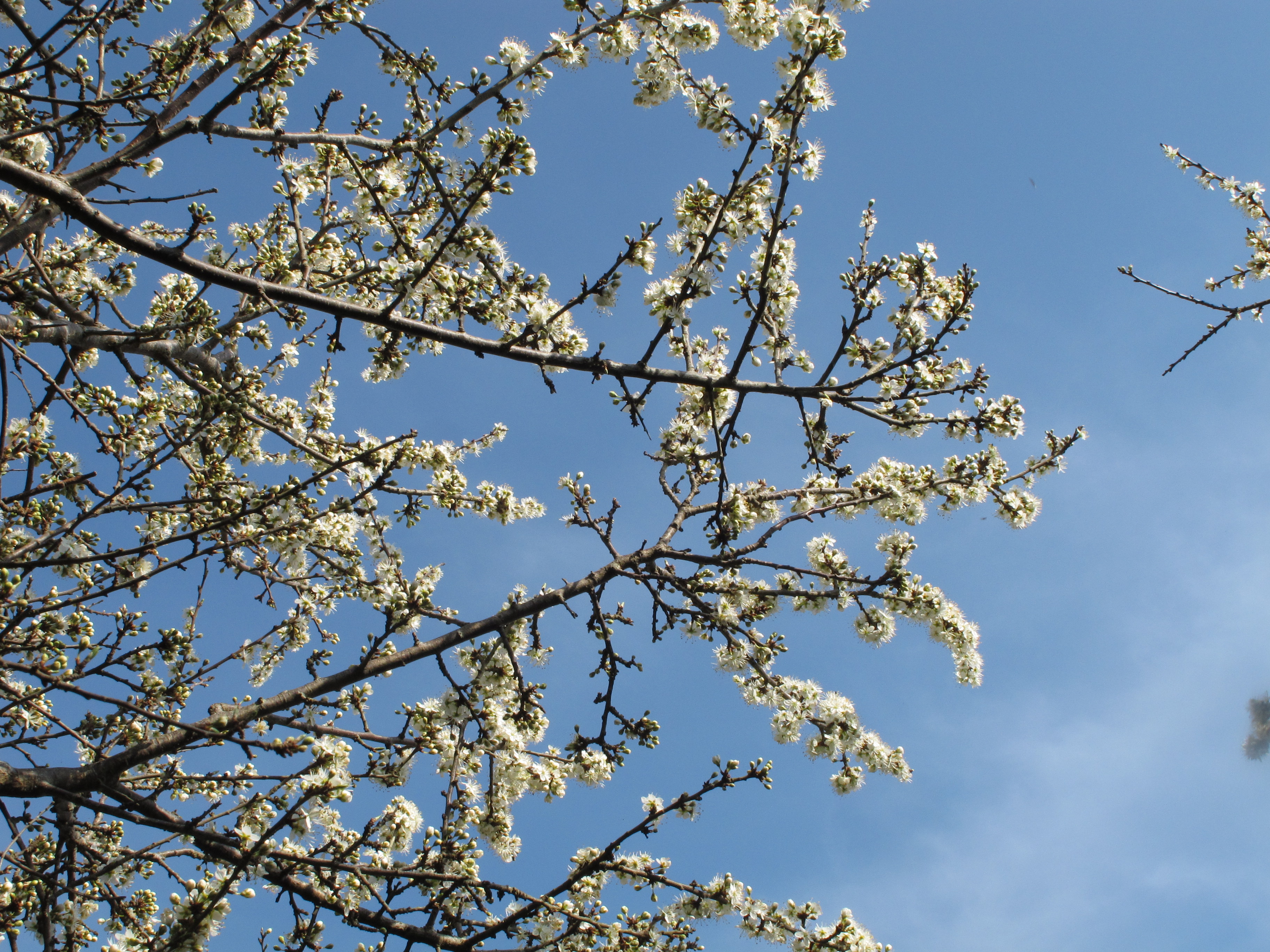
Blackthorn in bloom on the North Cornish coast

Irrelevant photo: Blackthorn in bloom.

What kind of language did the protester use? That’s in dispute. The prosecutor claimed he stood up and said, “I’m sorry about this, ladies and gentlemen. You fucking wankers, you’re just liars.” But the protester, who as far as I can figure out had already pled guilty, interrupted, shouting, “Can I just say, for the record, I didn’t call anyone fucking wankers. I called them dishonourable bastards.”

That “dishonourable”? That’s British. The next person who interrupts the American House or Senate will not, I guarantee, use the word dishonorable, even though I switched to the American spelling to make it a fraction of a percent of a probability more plausible.

The “I’m sorry about this, ladies and gentlemen”? That’s also British.

I’m still not sure what our protester was protesting. According to the article, he has (as the current phrase puts it) mental health problems and felt his life was wasting away. In response, I’m sure the government will make more speeches about putting mental health on a par with physical health and keep on underfunding both.

They’d outlaw marbles but Parliament’s dissolved until the election.

With apologies…

With apologies to everyone who’s already seen it, this is a link to “The British countryside and Winnie the Pooh,” because in a naive effort to make my blog more visible I wiped it off the face of the blogosphere for a day or so, and it’s only gradually fading back into view, so some of you got an email about it and some of you didn’t.

You can’t fade into view. But we don’t quite have a word for that. Think of the Cheshire Cat’s reappearances. Or don’t. It’s not important. And if you’ve already seen the post, this post isn’t important either. If you haven’t, it still isn’t important except as a way to get back in touch.

Remind me never to improve my blog, okay?


Trouble, trouble, trouble

I’m trying to upgrade the site. With luck, you won’t be able to see any difference, but it’ll work better. Upgrading is another word for “it may not be working the way it should.” Hang in there. I’ll have it up and working. Eventually. With the help of someone who knows what he’s doing, because I don’t.