If you’re following Notes, you may have noticed that I just switched the layout so that now you only receive the beginning of the post, along with assorted Link buttons, instead of the whole thing. Or I think I’ve switched it. I’m never sure, once I start clicking various options, that I’ve done what I set out to do. I’d love to know what you think–or whether you care at all. Are you as likely to read the post as you were before? Is it a pain in the neck?
Category Archives: Other Stuff
The Writing on the Sidewalk of a Cornish Village
Either I’m engaging in antisocial behavior or I’m the last defender of decency in Cornwall. Some days it’s hard to tell.
Wild Thing and I live on what’s called the estate. If you’re American, that sounds all grand and Downton Abbey, but what it really means is “the subdivision.” We live in a tiny fragment of suburb, even though we don’t have a city to be suburban to. Our village is spread out—a village without any center—so this is the most densely populated bit. By dogs as well as humans.
Yes, dear ones, I’m writing about dog shit, and I’m not going to call it poo because I just can’t. When I first moved to Minnesota, I heard a wonderful phrase: “She wouldn’t say shit if she had a mouthful.”
Well, I don’t have a mouthful, but I did skid through the stuff and come away with a shoeful, and I can’t see why I should call it anything else. It’s not a beautiful word, but then the shoe wasn’t looking so good either.
Shit was the mildest word I yelled. I’m sure someone was behind a window saying, “Oh, that’s one of the Americans.”
Never mind the language, though. The important point is that somebody hasn’t been cleaning up after their dog.
I know two things about this dog: It’s large and it likes to spread its bounty as far as it’s physically able. I walk with my eyes on the sidewalk these days, the way I did as a kid in New York, before dog owners were expected to clean up after their dogs. My family had a dog. We thought we were being good citizens because we got him to shit between the parked cars. In fact, back then the city put up signs saying “Curb your dog.”
After the shoe incident, I bought myself a box of chalk. Then I waited.
Several days later, I found another deposit. Right by the red metal box that everyone (even me) calls the dog poo bin. I knelt on the sidewalk and chalked, “Clean up after your dog, please.”
I stepped back to admire my work. I’d forgotten the your, so it actually read, “Clean up after dog, please,” as if a computer translation program had written it. I used to work as an editor, so that missing word bothers me, but it did get the point across. And at least I hadn’t forgotten the please.
Good manners are more important here than good grammar. No matter how ungrammatical—or, for that matter, rude—a note you tack up somewhere, you can make it okay if you write “Polite Notice” at the top. I can’t tell you how many signs I’ve seen that declare themselves Polite Notices. Even if you were to say, “Pick up after your dog, you miserable, lazy, unclean excuse for a human being,” if you also said it was a polite notice, it would be okay.
And even if the rest of your wording is polite, you still have to open with “Polite Notice.” Actual politeness isn’t what matters. You have to remind everyone that you’re being polite.
I didn’t open with “Polite Notice.” I didn’t figure a chalked notice on the sidewalk had to, but then (as I’m often reminded) I’m not British. Wild Thing’s sure that what people mean when they say that is that we just don’t get certain things, and that the speaker feels sorry for us. I’m not sure she’s right. I tend to hear it as a statement of fact: We really aren’t British. Or we are—we’re citizens—but on some deeper level we never can be.
I don’t necessarily want to know how the speaker feels about this.
So it’s hard for me to be sure how significant that missing “Polite Notice” is. I may have offended someone other than the dog walker, but I can’t tell. I’m not British.
A Link to Before Sundown
It hasn’t been long since I made jokes about adding an Obnoxious Self-Promotion Page when I created a page about The Divorce Diet (my forthcoming novel, she said with great subtlety). As far as I know I got away with self-promoting without being too obnoxious.
I may be crossing the line now, because you can only be cute about self-promotion just so many times. Still, I’m going to risk it one last time, and after that I’ll quietly add links to the Divorce Diet’s page—reviews, interviews, anything that comes up. At least I think that’s what I’ll do. But before I acquire a dose of good manners, here’s a link to Before Sundown, because Christine Robinson has been kind enough to post an article about me and The Divorce Diet, and I appreciate it.
And if anyone wants to let me know when I do cross the line, you’re invited. It’s information I need.
Update: A Disabled Rider, a Small Cornish Village, and a Crowdfunding Drive
With five days left to go, the crowdfunding drive for Emily Skerrett has raised more than three-quarters of its goal and needs one last push to get it over the top. I’m being vague about the amount because by the time I post this, it will have changed. If you’re new to Notes from the U.K., Emily’s full story is in an older post, but briefly she’s a disabled rider who’s got her sights set on reaching the Paralympics, and her coaches say she’s good enough to get there. At this point, it all depends on persistence, money, and of course luck. She’s not a wealthy woman, and some of us in the village have gotten together to raise money to keep her riding.
If you’ve already contributed, we have our gratitude. If you’ve already passed the word on, you have our gratitude again. If you haven’t and can do either or both of those things, this is the time. We’re close. Spread the word. And share the link.
Thanks.
Heavy Traffic in a Cornish Village
Wild Thing and I were walking the dog the other day and we’d just turned off the main road when a car made the same turn. We moved to the side of the road, stood in the weeds, and corralled the dog so that she did the same. She’s convinced that if her nose is out of the way, that takes care of the problem.
The car passed. The driver waved. We waved and moved back onto the road.
Then another car came past. That’s roughly two cars more than we usually see on this stretch of road.
“So much traffic!” Wild Thing said.
You need a little background here.
First, what I just called the main road? It has two lanes, goes from no place in particular to no place else in particular (I’m going to catch hell for saying that), and no one’s even bothered to give it a name or a number. That’s why I call it the main road. What else am I going to call it? Marlena? Suzette? It’s as main a road as the village has. Everything else is even smaller.
Second, Wild Thing and I are both New Yorkers. I was born and raised there and she lived there for ten years. So it’s not that we’ve never lived with traffic. But human beings are adaptable. When I lived in Minnesota, I noticed that 40 degrees F. was cold in the fall and the most blissful warmth in the spring. So we’ve adapted. Two cars in a single day on the road past the ford? In the off season, when the emmits have gone home? Outrageous!
And we’re not the only ones who resent seeing two cars in a row. Someone who shall not be named, nay, not even by initial (okay, I’ve forgotten who it was), set out a Road Closed sign on one of the back roads. For years. Long after whatever was once wrong (if anything ever was) had been fixed. He didn’t like the traffic.
The locals all knew to drive past it, and when I became a local I taught myself to do the same, although the first time expected to find that the ford (this is a different ford) had risen out of control; that a downed tree had left the power lines sprawled across the road; that a herd of wild elephants had set up camp by the ford and were scavenging downed limbs for firewood. Even though I knew better.
In one version of the story—and no story in the village has only one version—he got tired of people with long vehicles taking the road and getting stuck at the ninety-degree bend where the road narrows down. In another version, a delivery truck got stuck and its cargo had to be off-loaded onto a smaller truck. In a third version, the company kept sending big trucks and they all got stuck—one, two, three pretty trucks, all with the same logo and all stuck where the road bends. It’s a wonderful image. Sadly, it’s the least likely of the versions. A single truck could get stuck there if it was long enough, but by getting stuck it would sacrifice itself for its fellow trucks, who’d have to back up a long way and then cross the ford backward before backing up some more, but they wouldn’t be stuck. That’s village gossip for you. Whatever story you hear, you have to figure it’s related to something real, but you can’t necessarily tell what the relationship is.
Anyway, it’s the off season here in the village, and the traffic’s horrendous. If you were thinking of visiting, wait till it calms down a bit.
New Page Added
I just added an Obnoxious Self-Promotion Page to Notes. It’s titled “The Divorce Diet” and you’ll find it at the top, in the black bar under the photo of the Cornish coast. Even here, in this nearby yet tastefully promotion-free space where we’re speaking, you can hear its crass bass thump leaking through the walls.
But that’s the kind of thing you do when you have a novel coming out. You set all shame to one side and promote the hell out of it—anywhere, everywhere, and in just about any way you can. Does it make a difference? I haven’t a clue, and everything I’m hearing says that no one else has a clue either, but the book’s close to my heart and (sorry to be the one to say this, but I will anyway) I think it’s good, so to hell with manners. The page is up. Feel free to explore. Feel free to pre-order a few thousand copies, to review it online, and to tell 500 of your closest friends about it. Or feel free to ignore the whole shebang. It’s up to you.
After a while, you get used to the bass thump and it doesn’t bother you quite as much. Or you invest in earplugs or poison the neighbor who has the loud sound system. I’m a New Yorker. I know these things.
And while I’m promoting things, you can check out a beautifully written (and, ahem, favorable) review on The Zombies Ate My Brains.
Declining an Award
Notes from the U.K. was nominated for a Very Inspiring Blog Award a while back, and it threw me into a quiet little crisis. I was flattered and even inspired, but also flummoxed. It was Angie K. from Not Another Tall Blog who nominated me, and in her acceptance post she admitted to taking two months to accept her own nomination and do all the things a nominee is supposed to do.
What’s a nominee supposed to do? Thank the person who nominated me and link to them: Angie, many thanks. List seven facts about myself. Display the award and nominate 15 other bloggers. Figure out how to display the award. Follow the person who nominated me. (I did that and it’s been a pleasure; she’s a good writer).
But I coasted for a while before I did anything public, figuring that if it took Angie two months, I could hide for a month or three and still be a moderately good citizen of the net. Or at least not an awful one. Because something made me put off doing those things, and it wasn’t just that I couldn’t figure out how to copy the award so I could display it, although that didn’t help.
At some point during this time, I read a blog that declared itself an award-free zone, and it rang one of those silent brain-bells that are preinstalled in all of us. Yes, I thought. I don’t have to do this, however flattered I am.
So I’m declaring Notes an award-free zone. Why? Partly because jumping through the hoops that come with breaks the focus of the blog. I write about the joys and absurdities of living, as an American, in the U.K. At least in theory I could write about the joys and absurdities of living in the Internet, and somebody probably should, but that somebody isn’t me. So flattered as I am, I’m going to pass.
But I will tell you two facts about myself: I’m as short as Angie K. is tall and I’m the kind of person who can say, in all sincerity, thank you but I have to pass on the honor.
And one final fact: Last week I bought a pair of jeans that didn’t need hemming. I can count on one stubby little hand the number of times that’s happened to me.
Trying to Count the Cornish Wildflowers
Wild Thing and I hadn’t really seen the Cornish countryside until we discovered the footpaths, and the wildflowers bowled me over. I was living in Minnesota then, and when it isn’t frozen solid and buried under snow Minnesota is green and beautiful and all that, but you wouldn’t be tempted to call it lush. It’s too cold for too much of the year. What wildflowers grow there always struck me as self-effacing, somehow, as if they didn’t want call attention to themselves.
A lot the people are like that too.
T. and S., whose roots are in western Minnesota, swear there were more wildflowers when the farmers didn’t use pesticides as enthusiastically as they do these days, and I’m sure that’s true, but still, Minnesota’s a bit like the Puritans were: It’s never going to encourage a wild profusion of stuff it doesn’t absolutely need.
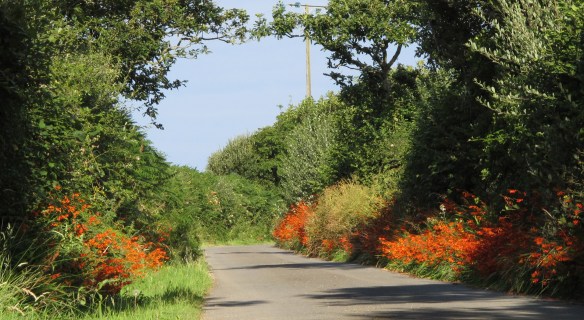
Montbretia, pronounced mombresia. Or something like that. Considered not just a weed but a thug. Isn’t it gorgeous?
So, while I was on parole from Minnesota, I’d walk along the footpaths in Cornwall and try to count how many kinds of wildflowers were in bloom. To understand what a misguided undertaking this was, you have to know that numbers and I are not on good terms. Ask me to remember the number 3 for more than a minute and I’ll need to check my notes. Ask me to solve a word problem (Train A left station B at 3:44….) and I’ll weep. Or at least I’ll want to. So voluntarily counting anything indicates an extreme state of mind. In this case, it was extreme happiness. So much color. So much life pushing up out of the ground. I’m tempted to say so much unnecessary beauty, but yeah, the ecosystem, the necessity of so many things we humans don’t think are necessary because we can’t make any immediate use of them. All of that. Still, you can see what I’m getting at.
The problem with counting wildflowers was that first, if I’m distracted at all, I can’t reliably count from 1 to 70 without losing my way. Did I say 70? Make that 10. But second, and more to the point, I couldn’t keep track of which flowers I’d already counted. If you don’t have names for things, it turns out, it’s hard to remember them. Little yellow flower, bigger yellow flower, little yellow flower that isn’t like the first yellow flower because it has four petals, although maybe the first one did too because I wasn’t noticing petals, only color and size at that point. Little yellow flower that also has four petals but they’re pointy. Little yellow flower that I might have counted already but I don’t think so.
I often wonder how animals remember in the absence of words. Of course, as far as I know they’re not counting, but they do other complex things, like remembering smells and places and long routes. It’s not all looking at a plant and thinking either yumm or bleah, that tastes foul.
Anyway, I bought the first of my wildflower books and began attaching names to what I was seeing. And the odd thing is that this allowed me to see them better—to notice and then remember petal shapes, leaf shapes, the ways leaves grew on the stem, and from there stem shapes and whether the leaf or stem was hairy or smooth. I’m still useless with some of it. Talk of sepals sends me into a panic. Heights given in centimeters might as well be written in an alphabet whose origins aren’t on this planet for all the good they do me.
That first book led to the next book, which was organized differently and promised more, better, deeper. And another book after that. One that had photographs. Another that had drawings. Each one had advantages and drawbacks. Then one organized by color, which I’d always thought would be simpler but still leaves me flipping through page after page, looking for a match for something new that I’ve brought home. Or something that isn’t new—I know I’ve seen it before—but I’ve forgotten its name since last year at this time.
I’m still a barbarian about it all. One of my books (and I pulled it out of the shelf at random) lists 15 kinds of violet, including common dog, early dog, pale dog, heath dog, hairy, sweet, and dame’s. And speedwell? Alpine, blue ivy-leaved, fingered, germander, marsh, spiked, thyme-leaved, wall, water, wood, and on until you reach 25 of them. I’ve tried to see the differences, really I have, but I’ve decided to be happy to look at the damn plant and say, “Violet; speedwell; close enough.”
Although I do love being able to identify the ivy-leaved toadflax.
No matter how many I learn, though (and I haven’t learned that many), there are always more.
If this sounds geeky, that’s because it is geeky, but it’s not about checking off how many flowers I’ve seen or how many names I can recite. By learning the flowers, I’ve learned a new way to watch the seasons roll past. The first wild primroses come into bloom when it’s still winter, and they tell me spring’s coming. Then the celandine comes out. It’s a low-growing yellow flower. Spring progresses with each new flower, and I think of it as a yellow season.
Damn, it’s beautiful here.
Mrs. Baggit Struggles to Keep Britain Tidy
The first time Wild Thing and I visited the U.K., Maggie Thatcher was the prime minister and whatever ministry was in charge of roadsides had planted them with metal signs saying, “Mrs. Baggit Says, ‘Keep Britain Tidy.’”
That bit of brilliant public relations was finished off with a picture of a tied-off bag with a face—Mrs. Baggit’s, presumably, happily stuffed with garbage. It was impossible not to connect her image with Mrs. Thatcher’s, and some small part of my brain continues to insist, in spite of all evidence to the contrary, that Thatcher’s real name was Maggie Baggit.
We did a lot of driving on that trip, so we spent a lot of time looking at the signs and finding funny voices to quote them in.
“Mrs. Baggit says…”
Mrs. Baggit had a lot to say on that trip, all of it scold-y, although I can’t remember exactly what it was anymore. Except, of course, for “Keep Britain Tidy.”
To understand why that kept us amused, you need to know that tidy sounds different to an American ear than to a British one. To me, tidy is fussy. It’s small. All I have to do is think about it and I want to make bitsy motions with my fingertips, as if I’m cleaning up a dollhouse. As far as I can tell, none of that is true in the U.K. It’s just a word here. It means neat and doesn’t make your fingers do funny things in the empty air, although H. tells me the Mrs. Baggit part sounds fussy.
I should stop here and admit that when I started that last paragraph I was going to speak for an entire nation: For us (us here being all Americans—every last differentiated, argumentative one of us) tidy is fussy. Then some minimal sense of modesty (not to mention accuracy) caught up with me and I thought it might be nice if I didn’t mistake my mind for the mind of an entire, not to mention large and varied, country, even if I did grow up and live most of my life there. So I’ve backed off a bit. But I still hold that it has different overtones to an American ear than to a British one. That much, I think, is fair.
Language is like that. We think of it as a solid, but it’s not. It’s one of those slow liquids, like Silly Putty, that changes shape depending on what holds it, or who.
So how successful was the campaign? I never saw British roadsides before it started, so I can’t make a comparison, but I know this much: If you look for litter here, you’ll find it. And if you don’t look for it, you’ll find it anyway. I’ve seen places with more, but Mrs. Baggit hasn’t stopped the litterbugs mid-throw.
And who in their right mind thought she would?
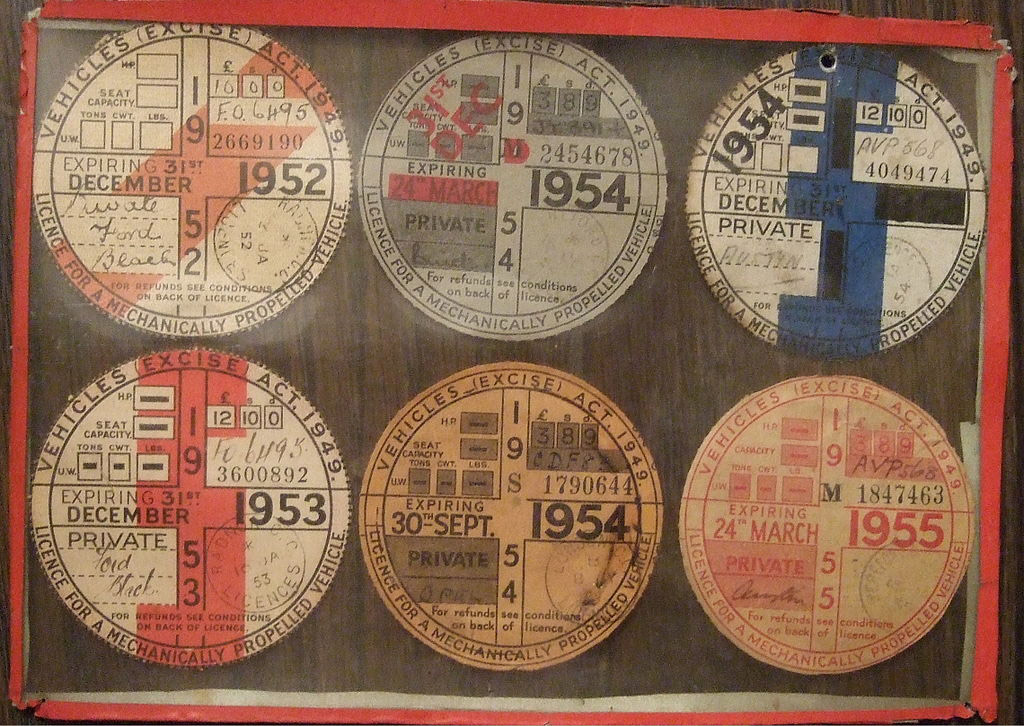
More about Tax Discs
In an earlier post, I mentioned that starting this month the U.K. has abolished tax discs—little round things that go on the car to prove you’ve paid tax on it. This change was made possible by the infallibility of computers. So yesterday I opened the paper and, guess what? “The DVLA’s new vehicle tax website crashed yesterday owing to the large number of people trying to renew their tax online on the day that paper discs were abolished, with the system relying instead on digital records.”
I shouldn’t enjoy this so much. Really I shouldn’t.
And, of course, to prove I didn’t make this up I need a link.
DVLA, by the way, stands for Department of Vehicular Lunacy and Associatedmayhem.