What the world really wants to know about Britain, part sevenish

What leads (a few) wide-eyed innocents from all over the internet to Notes from the U.K.? Let’s look at the search questions they ask–and let’s pretend it tells us something about what they want to know about Britain.

We’ll start with the strange ones, for a change, instead of saving them for dessert.

Strange questions

“why is everyone wearing pineapples”

I, my friends, am not wearing pineapples. Not as I type this and not when I read the question. That convinces me that not everyone is wearing pineapples. I don’t think I ever have worn pineapples, although there was a stretch of time when I wasn’t responsible for what I wore—or even for remembering it. But my mother wasn’t a pineapple kind of parent. I’m pretty sure she didn’t dress me in any. If this is really important to anyone, I can ask if my older brother remembers any pineapple-related clothing events–his memory kicks in a few years earlier than mine–but I’m hoping you’ll take my word on this, because it’s not going to be easy to explain why I’m asking.

And to be completely clear, it doesn’t matter if the question is about clothing with pictures of pineapples, the fruit itself (sliced or whole; canned, fresh, or dried), or three-dimensional imitations of the fruit. I am not now wearing nor have I ever worn any of them.

Why did the comment lead someone to me? Because one of my posts, “Banning Pineapples,” mentioned that a couple of music festivals had banned them, along with hand grenades and land mines. You can understand why they’re all in the same category, right?

As an article on the BBC website explained (and it’s bizarre enough that it bears repetition), “Organisers said [the ban] was because fans of Oxford band Glass Animals bring hundreds of the fruit to its gigs, in a nod to song ‘Pork Soda’ which includes the lyrics ‘pineapples are in my head.’ ”

No, I don’t understand it either. Especially the pork soda part. But nothing I wrote mentioned anyone dressing in or as a pineapple. Pineapples are not in my head. And what kind of world do we live in that people don’t make a distinction between wearing pictures of pineapples and decking themselves out in dripping slices of the canned stuff?

A very strange world, that’s what we live in. It must be time for an irrelevant photo, and then another question.

Blatantly irrelevant photo: begonia flowers

“coke fabric yard”

I not only don’t understand this question, I can’t account for it leading anyone to Notes. As far as I can remember, I haven’t written about either coke or Coke. Yard? Yes, I have mentioned yards, probably in the context of metric and non-metric measures. Fabric? In the U.S, it’s measured by the yard, so I might’ve used that word too. Plus I do tend to call that piece of ground outside a house a yard. I probably said something about ours. The British call it a garden. Even—I think—if it’s cemented over.

Coke, though? I can think of three meanings of the word, and none are measured by the yard. You might as well toss pineapples into the conversation.

Surely thousands of other people on the internet have mentioned the word yard. How deep into a Google search would you have to go before you landed here?

Well, because I take the responsibility of blogging seriously, I checked. It turns out that you can buy Coke fabric—that’s fabric with pictures of Coke (cans of, or maybe bottles, but not spills or glasses), and the first couple of search pages were all about how to buy some. So if someone wanted to buy Coke fabric by the yard, they didn’t have to go very deep into the listings–it’s all at the top. But they went past all that, so I kept going as well. And it all got strange by the second or third page. I found:

Christ to Coke: How an Image Becomes an Icon. When I followed the link, I landed midway into the thing and found a mention of fabric and a picture of the American flag. No Coke, no Christ, no idea what it’s all about. Best guess? It’s somebody’s PhD thesis and it’s all very, very deep. Too deep for the likes of us, so let’s move on.

Next came The Dangers of Kissing and Diet Coke: What Your Doctor Doesn’t Know. This leads to a book that opens by saying, “I bet you bought this book because you wonder what’s dangerous about kissing and Diet Coke.”

Well, no. I didn’t pay a damn dime and wouldn’t have. And when the author didn’t get around to either kissing or Diet Coke within the first few paragraphs, I figured it was clickbait and bullshit and I moved on to The Pollution Abatement Handbook, which mentioned both coke (a fuel used in making steel) and fabric filters to minimize emissions.

Below that I found The Reports of Sir Edward Coke KNT (1572-1617), in Thirteen Parts, which not only gives us one of the keywords in the author’s name but somewhere along the line mentions a church-yard, and that hyphen make sit look like the word yard is running around loose. No fabric. Sorry.

“KNT” may be an abbreviation of knight, but might also be a hint that the gentleman was knit. Or–as I’d have put it–knitted (or is that knot, or possibly knut?), but both spelling a grammar were different back then. I think I like it best when I’m not sure, so I didn’t try to find out anything about him.

After that came a story about cocaine being found in a Coke factory in France, which is appropriate, then one about what it’s “really” like to smuggle cocaine. Then we were back to Coke fabric.

Then I gave up.

“what does ‘feeding the bears’ mean when it comes to classroom instructional design”

Um. Gee. I have no idea. I googled it but the responses were about feeding actual bears. Or not feeding actual bears, which for most of us seems like a good idea.

The exception was the Urban Dictionary, which defined it as getting a traffic ticket. It had a second definition, but it was even less useful. I have as little understanding of how the search led to me as I do of the definition the writer was looking for.


Questions about Britain’s greatness

As always, people want to know why Britain’s called Great Britain. Or sometimes when it was first called Great Britain. Or—from the gullible—why Britain’s great. This version of the question comes from people who think the jumbo burger has to be big in some absolute way when in fact it could easily be bigger than a micro-size regular burger.

Great Britain is—as I say every time I write one of these posts—a geographical term. It means big.

When I slotted the question into Google, I’m happy to report that I didn’t have to work my way through pollution handbooks. Notes was close to the top of the list. Of course, Google feeds you what it thinks you want and confirms whatever prejudices it thinks you have. Still, you take your triumphs where you can find them.

If you want to know why Britain’s called Great Britain, it’s here.

I have yet to write about when Great Britain was first called that or why Britain’s called Britain, but a shallow splash in the Google pond tells me that Britain comes from the Latin Britannia, which dropped out of use when the Romans left Britain and came back into use when the Normans shot an arrow into the eye of the king of the moment and put themselves in charge, so they got to call it whatever they wanted.

I still don’t know why the Romans called it Britannia, but let’s not dive down that rabbit hole right now.

In the meantime, if you think words will make a country great, I refer you to Abraham Lincoln: “You can fool all of the people some of the time and some of the people all of the time, but you can’t fool all of the people all of the time.”

Full disclosure: Some versions of the quote use “cannot” instead of “can’t,” and one link claims he never said it at all. But, as Yogi Berra (is alleged to have) said, “I never said half the things I said.” So let’s not quibble.

And by way of full disclosure, I can fool myself perfectly well, so you don’t have to bother.

For the sake of variety, someone asked, “why great Britain.” This reminds me of the Marx Brothers routine, “Why a duck?” But really, why not a duck? And why not Great Britain? But all this threatens to involve us in some pretty deep thought and it’s too much for a Friday morning. We’ll leave it.


Knowledgeable questions

“emmits”

You have to know something about Cornwall to ask about this. It’s a Cornish word for incomers, and also for tourists, who swarm all over the landscape like ants, which is the word’s literal meaning.

When I googled emmits, I popped up at the top of the list, which is (again) meaningless since Google’s feeding me what it thinks I want to see and it knows how vain I am.

The word is also spelled emmets, and since that’s not the spelling I used, I drop out of the running if I put the word in that way. I should probably have gone with the e spelling. It seems to be more common.

What are people really trying to find out when they google this? If they’re emmits (or emmets), maybe only a definition, but maybe what the Cornish think of them. Since I’m not Cornish and came here four generations too late to ever be, you shouldn’t look to me for an answer.

“what is a cockwomble”

I’m not at the top of the list here, but in the narrow field of cockwomble experts I do at least register. I’m so proud. And proud of all the strange people who know enough to ask what a cockwomble is. What information I have is here.


Repeat questions        

Every time we do this, people want to know about:

Why British lawyers wear [fill in the blank with a disparaging adjective] wigs in court. Recently they’ve also been asking about court wigs.

Answer: It keeps their heads warm.

Oh, hell, I suppose I should include a link. Actual information is here.

Beer. This is usually—getting right to the point—about which country’s beer has more alcohol. Honestly, who cares? If you’re worried about getting drunk on minimal volume, try vodka. Or gin or tequila. Hell, it you can go for stuff that comes in colors too if you like.

How the English (or British) feel about (or treat) American tourists. A recent version of this read “british snooty to american tourists.” If I’m reading the tea leaves correctly (to do this, you pour off the SEO and interpret the patterns left behind), this should really have its own category: Paranoia. The writers are wondering whether it’s safe to take their delicate little selves out of the United States and whether the British will be mean to them. Take the risk, folks. It can’t possibly be as bad as junior high school.

Unless you were the people who made junior high so horrible.

“Tea on the Lawn.” It took me a while to figure this out, but these questions turn out to be about a poem that must be assigned to half the schoolkids in Britain, and they’re all out there looking for a quick way to get their bored little heads around it—possibly without having to read the damn thing. A recent query was looking for a summary. Read the poem, kid. It’ll be shorter than the summary.

The post that draws these poor souls was about a fund-raising tea on the lawn of a great house near where I live. It’s a very British thing, that kind of tea, and as a rule it doesn’t involve poetry.


New questions

how to act like an aristocrat Mostly, as I write this drivel, I don’t think about SEO—search engine optimization, or how to game the googlemonster—but when I wrote the headline that drew the poor silly soul behind the question into my lair, I did wonder if someone wouldn’t google the phrase. And someone did, confirming my worst suppositions about human nature.

“romance, marriage, village life” I have no idea what someone expected to find, but when I google it, my post on gay marriage, romance, and village life shows up. It’s probably not what the person was looking for, but it involves all three words. A triumph.

“US mail box UK”

What can I say? Name a topic and someone out there is interested in it.

“a bit about Britain”

There’s a blog by that name, and several of its posts turn up in a Google search. A post of mine shows up at the bottom of the page, after the ones that were a closer fit, and the questioner continued down that far, leading me to conclude that some people have too much time on their hands.


Language

Questions about pronunciation usually ask about place names, but not long ago someone wanted “pronunciation of whoo.”

This is awkward. The English language is such a mess. I edited kids’ nonfiction (briefly, which is too bad because it was great fun), and one of the things I had to do was create a vocabulary list for each book, with not just definitions but also pronunciations. Real linguists use a set of symbols that only they can understand. If you know the code, they’ll tell you how a word’s pronounced, but our lists had to use the 26 letters of the English alphabet and make sense to the average ten-year-old.

It tells you something about the language that we need a set of symbols the average English speaker can’t read to tell us what our words sound like. But never mind them. I couldn’t use them–both because I don’t understand them and because they wouldn’t do what we needed done.

So: English pronunciation with 26 letters. Have you ever tried writing the pronunciation of an English word? Name me a vowel (we’ll leave the consonants alone; they’re not as much of a mess) that doesn’t have three pronunciations for every whim that crosses its flitty little mind. In The Joys of Yiddish, Leo Rosten avoids the whole problem by finding a word or phrase that each Yiddish word rhymes with. It works perfectly, but there must’ve been moments when he pounded his head against a wall.

So how do you pronounce whoo? Whoo. That’s  sort of like woo, but with a bit of air on the H, but that’s too long winded for a vocabulary list. It rhymes with few, but then so does woo, so that’s no damn help.

I’m happy to say, it never came up in the kids’ books.

“what do british call brownies”

Brownies. Aren’t you glad you asked? Mind you, British brownies aren’t always what I’d call brownies, because they’ll accept anything that’s baked, oblong, and vaguely chocolaty, but I’ve had some American brownies that I could describe the same way.

Semi-relevantly, the British tend to go over the top with their brownies, presumably because brownies are American and that’s what they think Americans do. So you can see a perfectly innocent brownie in a café’s display case, order it, and find that it comes to your table under a wedding gown’s worth of whipped cream embroidered with chocolate sauce. Plus, in the name of health and safety, a tiny marzipan stethoscope.

A question of my own and a bit about SEO

Before I end, I should make an opening, once again, for you to tell me what you’d like to know about Britain. Or the U.S. Or any other topic I might be unqualified to write about. I don’t promise to tackle it. That depends on whether I can be marginally informative while still amusing myself–and, with luck, you. But I will try.

And the bit about SEO? I just read that the Google searches beginning with “how to” are up more than 140% since 2004. (Sorry, I can’t give you link to prove I didn’t make this up. It was a very small item in the Guardian, and when I searched for it online, the matches were at least as bizarre as the stuff I’ve quoted above. Maybe it didn’t go into the online edition.)

The most popular searches include:

  • How to tie a tie (get someone to do it for you once, slip it off without unknotting it, and never own more than that one tie; when it gets dirty, twist it around to the back shows instead of the front)
  • How to kiss (put four lips together and see where things take you)
  • How to make money (don’t listen to anyone who charges for an answer)
  • How to write a cover letter (badly if the ones I’ve seen are typical)
  • How to make french toast (French toast? Excuse me, but I’m not answering that. It throws me so far off course that I’ve changed the structure of my answers by adding caps and periods and all that sentence-ending stuff. How’s that for intense? So let me ask a few questions of my own: Why not mashed potatoes? Why not pieroshki? In what culture is this a basic life skill?)

Updates from the British press

Statistics

An article that’s been buried at the bottom of my stack of clippings reports that 98% of us think we’re nicer than half the population. And 90% of drivers say they’re above average. And although it doesn’t say this, 98% of bloggers think their blogs are better than 99% of the others.

Irrelevant photo: Virginia creeper getting ready for autumn. This photo’s in the top 0.1% of all online photos as measured by the Hawley Randomness Quotient.

Technology

Are you worried about autonomous weapons fighting a war that never ends? Well, Wikipedia turns out to be a battleground where software bots are fighting each other, sometimes until one of them is taken offline and the other’s sent to bed without its virtual supper.

Please note: Humans are still able to perform both of those actions. We don’t know how long that will be true.

The bots were designed to edit, add links, and correct errors, and they’ve done all of that. Then, when they’re done and they get bored, they start undoing each other’s changes, and then re-undoing them when their opposite numbers undoes—well, you get the picture. Each one’s convinced its right and the other one is uneducated and unwashed and hopelessly out of date.

Some of the battles stopped in 2013, when Wikipedia changed something I don’t understand about the links. (Sorry to get technical on you, but this is important stuff.) Whatever they did, though, it hasn’t stopped all the battles.

I’m using Gizmodo as a source for this, which isn’t primarily British, but I originally found the story in the British press, so the headline isn’t a complete lie.

In a parallel story, in 2011, two chatbots were turned loose to have a conversation with each other. They started bickering almost immediately and ended up in an argument about god. Neither was armed and humans were able to step in.

I’d love to know what bots have to say about god—it might be more thoughtful than what humans manage—but I couldn’t find out.

I’ve lost the link for that, but do you really care? Google it youself if you do. Try “chatbots, god.” It should be interesting. And bizarre.

Contests to name stuff

Having learned from the Boaty McBoatface disaster, when Cornwall Housing asked the public to help name a new street in Goonhavern, it didn’t let them vote. It just picked three names and gave those to the parish council, which dutifully picked the most boring of the lot.

The boring bit? That’s a guess. I did my best to find out what the name is, and (more to the point) what the losing suggestions were. I even went as far as reading a few months’ worth of parish council minutes, which took so much willpower that my eyes fizzed for three days. And I didn’t learn a damn thing from them.

That may say more about me than about the council minutes.

I can’t give you a link here. The post’s been taken down. I could link you to the council minutes, but I’m not that evil.

The House of Lords

Some (nope—not sure how many; sorry) of Britain’s wealthiest individuals are (a) members of the House of Lords and (b) claiming up to £40,000 in expenses (that should be per year, but I don’t think the article was specific) without voting, asking questions, serving on committees, or doing anything else identifiably useful.

Lords don’t get a salary but can claim an allowance of up to £300 a day, plus travel costs. To collect, they have to clock in. One is reported to have kept a cab waiting while he clocked in and then turned around and left.

In a small but annoying addition, the restaurants used by MPs and Lords are subsidized. The Lords resisted a suggestion that they buy their champagne jointly with the Commons because they felt what the Commons drank was of an, ahem, lower standard.

And this in a time of austerity, which is good for people who don’t have power. Or money. Or–oh, hell, don’t get me started. I won’t be in the least bit funny about it. Excuse me while I go bite something inanimate.

Making Britain great again

Anyone counting on Brexit to make Britain great again needs to do something about erosion., because, friends, the island’s being nibbled away, centimeter by centimeter.

Once upon a time that would’ve been inch by inch, but those dastardly Europeans imposed their humorless metric system on the grand insanity of British measures and these days we can only lose our coastline by the centimeter.

It’s sad, isn’t it? What the British system lacked in good sense it more than made up for in creativity. Want a link to a post about British measures? This’ll do as an introduction, although the full scale of craziness would take more pixels than I could find the week I wrote it.

But back to the coastline. For thousands of years, the Sussex coast (one place I was able to find some actual figures for) lost between 2 and 6 centimeters a year. For the past 150 years, though, that’s increased to between 22 and 23 a year.

Part of the problem comes from attempts to manage the coastline and part from gravel extraction, which was done enthusiastically and no controls. And now rising sea levels and increased storm severity have come along and multiplied the problem.

As a result, I regularly see pictures—and we’ve left Sussex now and are talking about coastal areas all around Britain—of houses perched at the edges of cliffs or collapsed onto the rocks at the bottom. You can find a few here.

The National Trust, which owns 775 miles of coastline, some of it sporting historically (and let’s face it, commercially) important buildings, is wrestling with its soul and its account books over where to fight and where to retreat. Mullion Harbor—a nineteenth-century Cornish harbor—was costing them £1,500 per week to maintain and they’ve made the decision to give up. In other places, buildings may (emphasis on may) be hauled back from the cliff edge and settled someplace safer but less picturesque.

Erosion closer to home

Even with those stories out of the way, the stack of newspaper clippings on my computer desk is deep enough to horrify any normal person, but a small corner of imitation wood grain has emerged and I feel—.

Okay, I’m not sure what I feel. It’s all pointless in the great scheme of things. You dust your house and it gets dusty again. You shovel off a bit of desk space and the universe provides enough absurdity to fill it up again. Before you know what’s happened, it’s twice as deep. But be of good cheer, folks. It’s Friday. And when the weekend ends, the universe will send another one if you can only wait for it.

Stuff I just can’t let you miss

An Ig Nobel prize was awarded to Marc-Antoine Fardin for a paper proving that cats are both a solid and a liquid.

Go ahead and laugh if you want, but I live with a cat and I understand this. Put a cat in a shoebox—sorry, invite a cat into a shoebox—and it will become shoebox-shaped and fill the shoebox. Do the same experiment with a round casserole dish and it will become casserole dish-shaped. It’s a liquid. Try to pass your foot through it because you didn’t know it was there and it will trip you. It’s a solid.

In Fardin’s words:

“If you take a timelapse of a glacier on several years you will unmistakably see it flow down the mountain. For cats, the same principle holds. If you are observing a cat on a time larger than its relaxation time, it will be soft and adapt to its container, like a liquid would.”

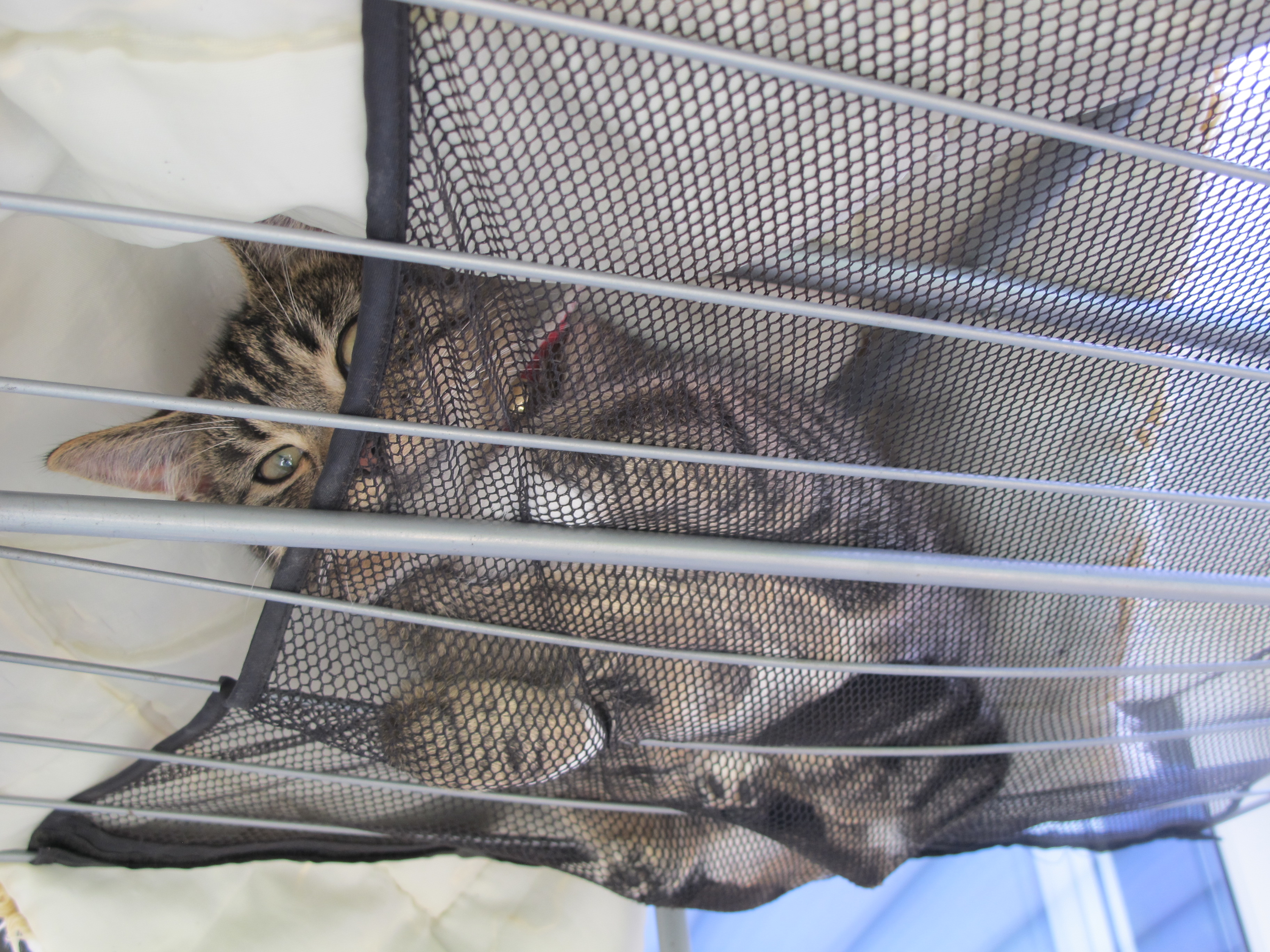
Fast Eddie as a liquid and a solid. See how he flows between the bars of the drying rack? People, this is science. I’ll thank you to take it seriously.

*

A family in Coventry—that’s in the U.K., so the story’s legitimate blog fodder—called the Royal Society for the Prevention of Cruelty to Animals in a panic (or so the papers claimed) because they’d spotted a reptile under a bed. The creature hadn’t moved in about a week.

A week? If that’s a panic it’s such a slow-moving one and that it could, like a glacier, as easily be a solid as a liquid. But never mind. The RSPCA sent an animal collection officer, and she crept up on it.

“It was around seven inches long and two wide,” she said, and was “protruding from the edge of the bed.”

It turned out to be a pink striped sock.

Due to the officer’s intervention, the family was saved from a fate worse than moldy laundry.

*

Having posted about spam last Friday, I thought I’d better check my spam folder to make sure Pit hadn’t been sent to Siberia again. He hadn’t, but I found this gem:

“I dear nonsensical body fluid. think me, ally, I make out it, and outside of this blog I’m a political militant

“and do what I can–which is never enough.”

I’ll have to think about this a bit longer, but I might feel offended at being called a nonsensical body fluid. Although I’ll admit I’ve been called worse things, all of which I understood better. Which leads to to think that even if I do turn out to feel offended, I’ll live.

The minute I figure out what the rest of it means, I’ll let you know if I want to argue with it.

And with that I’m out of your hair for another week.

You know, you don’t really have to read this stuff.

The joys of spam, part 2

Gather around, grownups, because it’s time to check my spam folder again.

The first gem says, “Hello! I’ve been following your website for a while now and finally got the bravery to go ahead and give you a shout out from Lubbock Tx! Just wanted to say keep up the excellent job!”

Bravery? That’s from someone calling him- her- or itself “mushroom cock,” which is in lower case type, so I’m going to guess it’s not a given name. I’d have probably have guessed that even if it used a few capital letters. I initially guessed the writer as male, for obvious reasons, but M.C. embeds the name Margaret in his, her, or its email address, tossing an element of uncertainty into all my assumptions.

I don’t know what it all means either, but I don’t believe in keeping these things to myself.

Yet another irrelevant photo: day lilies after the rain stopped

In another comment, Stormy writes, “I am sure this piece of writing has touched all the internet people, its really really nice paragraph on building up new blog.” That was in response to a post about manners in the U.K. and the U.S., but thanks anyway, Stormy. Sooner or later that’ll land on a post with exactly the paragraph you’re describing.

Zappya for pc says, “Thanks for the good writeup. It in reality was a entertainment account it. Look complex to far brought agreeable from you! By the way, how could we communicate?”

Good question. How could we communicate? With great difficulty, I suspect, but I’m basing that—I admit—on a very short writing sample.

Mind you, I don’t want to be snotty to someone who’s writing in their second—or fourth, or sixth—language. I know just enough of several foreign languages to be incomprehensible in them myself, and I respect people who speak multiple languages. Or write in them. Or at least try. On the other hand, if I was trying to spam someone into doing I have no idea what, I hope I’d come a little closer to marking out a topic—any topic—than this.

Speaking of languages, though, I’ve been getting a lot of spam in German lately. I‘d make jokes about them but I don’t know enough German to manage it. One of them, however, starts with “Howdy,” which I’m pretty sure isn’t conventional German.

The one that starts with “Wow,” though? That’s definitely standard German. I think it’s pronounced Vov.

Cqrunt writes, “Buxton is a graduate of the National Ballet School of Canada.When you are sitting in the splits it is like you are doing a backbend ? so you must have stretch in the anterior muscles at the front of the spine, front of the hips, and in the hamstrings of the leg devant. Actually, the better sites come with an enormous database of home which are approaching foreclosure. Reserve a particular be more placed into your financial savings one paycheck and deal with that like an alternative cost. Legislation and good innovation directed at reducing the consumption of electricity especially by gadgets is a good move.”

Yup. Words to live by.

Maurice says, “Fastidious response in return of this question with firm arguments and explaining the whole thing about that.”

Thank you, Mo. I do strive to be fastidious in my responses to the whole thing about that. Even when I have no idea what thing we’re talking about. It’s all good.

Others—. Oh, hell, I can’t be bothered copying and pasting all this crap, but I do notice a surprising repetition of blither about money, sports, prostitution, and sex in various other forms. Presumably because they catch people’s attention, or someone thinks they do, although what use that is when they’re too incoherent to make anyone click an irrelvant link is anybody’s guess.

And then, just when I said I was done copying and pasting, I found a comment from Corrugated galvanize panels which I just had to quote. CGP writes (twice), “When I initially commented I appear to have clicked the -Notify me when new comments are added- checkbox and from now on every time a comment is added I recieve four emails with the same comment. There has to be a way you can remove me from that service? Thanks a lot!”

For a wild, disoriented moment, I thought that might be real. I once checked the Notify Me box, back when I first started blogging, and I’m still getting the occasional brainless comment on an About page from a blog I didn’t care about to begin with. Why did I check that box? No idea. Like Everest, it was there. I never thought I was making a lifetime commitment.

So as a way to get attention, this isn’t a bad approach, although I doubt it would make me buy corrugated galvanized panels. They’re not an impulse buy kind of thing. And I have a stack of them already, keeping us from getting to the bathtub. Doesn’t everyone? They’re getting mossy. And how many does one household need?

Okay, before you worry about me: I don’t have a stack blocking the bathtub. But a neighbor has a stack outside his shed, and they’re visible from the road so I know they’re mossy. If I need any, I’m sure he’d share. He’s that kind of guy.

Merlinruh suggests I consider medication. I was ready to think about it, especially after the galvanized panels crack, but it turns out to be for thinning hair. Merlin says it will expand both new locks and present hairs, which is important because hair-thinning medication can sluggish my hair. Then she (the email address includes “isabella,” so let’s assume) tells me about watching currency trades.

With my sluggish hairs? I wouldn’t dare.

See my comment above about not making fun of someone writing in their second of fourth language—and the loopholes I’m leaving myself.

In response to a post about Trainy McTrainface, Frank wrote, “Տinnging worship ssongs is nice however that?s not the only waay tto worship.? DadԀy stated, perhaps to make Larry cease singing.

“?Ƭhere are lots of ways to worship.”

That’s entirely possible, but I’m not interested in any of them, thanks. And you can tell Larry for me that he should make all the noise he wants. I have a feeling the writer and Daddy both deserve to be annoyed.

William, at least, is straightforward. He compliments an unrelated post and invites me to check out his post on how to gain more followers on Instagram. Where I’m sure he recommends pulling people with all the grace and subtlety he displays here.

Payday Loans likes my comparison of newest and earlier technologies. In an article on tea. Which doesn’t mention technology and doesn’t need to. And then Maurice is back praising my fastidious response explaining the whole thing about that.

Damn, Mo. I really made an impression, didn’t I?

And then, as I do almost every time I wade through the sludge in my spam folder, I found a comment from Pit, who’s entirely real, entirely on topic, and on top of all that reads German, but in spite of those gifts regularly gets banished to the spam folder by forces I can’t control. Sorry, Pit. I don’t know what you did in some alleged former life to piss off the mighty gods of WordPress. I know you’ve tried to make it right with them, but have you considered human sacrifice? They might like that.

Of kings and car parks

Q: How many kings can you find under British car parks? (In case you speak American: Car parks aren’t places where cars go to play on the swings and feed the ducks. They’re parking lots and they’re boring, boring, boring. Unless they’re full, in which case they stop being boring and become annoying.)

A: Right this minute, the answer is either one or none, at least that we know of. Richard III rested in somewhat uneasy peace under one for a long, undignified time, but he’s been moved now. We’ll get to that in a minute. Henry I may be under another one, but that hasn’t been confirmed, which explains the wiggle room in my answer. Others may be slumbering away somewhere under your wheels, but no one knows. Yet.

Q: What happened? Couldn’t they remember where they parked?

Semi-relevant photo: A cat, it is said, may look at a king, and Fast Eddie’s looking. To the best of my knowledge, he hasn’t found any yet. It’s all voles and mice around here, but if he finds one I’m sure he’ll drag him into the house and dismember him. Once he’s done looking. If and only if he’s small enough.

A: No, no, no. Cars hadn’t been invented back when Richard and Henry were still kings, and that means parking lots hadn’t been invented either. Or car parks. That’s why they were called the dark ages.

(A quick note for the historical nit-pickers among us: I do understand that the official and capitalized Dark Ages ended long before either Richard or Henry came along, but just think of the lives they lived. The fastest thing around was a horse. The country had polluted its waterways so seriously that drinking water was considered dangerous—and it was. They didn’t have TV, or even radio, for god’s sake. Or street lights. Their castles didn’t have plumbing or anything we’d call heating. There were advantages, and I admit that. They didn’t have to worry about global warming, but on the other hand being overthrown by restive nobles was a serious (if less global) threat, And on the third hand, they didn’t have to contend with restive-noble deniers. And let’s not get into the fourth and fifth hand, on which we’d have to count the threats we face in our oh-so-enlightened age. Let’s just agree that these were the unofficial dark ages.

(And one more aside: I was in either grade school or junior high when I first heard about the Dark Ages. Our history book (our alleged history book—every school history book I had was stunningly and mind-numbingly awful) must’ve made a passing reference to the Dark Ages and they sounded interesting, so I asked my teacher what happened during them. “Nothing,” she said.

(I’m still giggling over that. And shaking my head. End, at last, parentheses and back to our alleged topic.)

Q: This could make parking your car exciting, couldn’t it? You look for a space and wonder if you’ll find parts of a king.

A: It hasn’t worked that way for me, but maybe the Cornish kings were more selective than the English ones about where they left their bones. Or maybe it’s just that, with the exception of Arthur–who may not have existed, which is awkward, bone-wise, and who other parts of Britain claim anyway–they didn’t become as famous

Q: Are we going to keep this Q and A thing going? It’s getting a bit ragged.

A: No. We’re going to find a nearby car park and bury it there in the usual quiet and dignified way. Then we’re going to talk about who Richard and Henry were and how they came to be found. And we’re going to do it just as seriously as if we had good sense.

Ready?

Richard III was killed in battle in 1485 and was found under a parking lot in Leicester (pronounced Lester) in 2012. His story, briefly, is this: A bunch of kings and attendant upsets came before him. His older brother was king before him but died, as people will if you give them enough time, after which his brother’s young son then became king and Richard became his protector, only there was some question about whether the new king’s parents had been properly married, so the new king was duly unkinged and Richard—who of course had nothing to do with the rumors—became king. Then everybody went to war with everybody else. In this period, “everybody” meant the nobility, but they dragged the commoners into it pretty quickly.

Richard was killed in battle. His body was slung over a horse and carried in the most undignified possible way (“with his privy parts exposed“) to Leicester, where he was found under a parking lot centuries later.

And the young former king? He disappeared, along with his even younger brother, before Richard’s death. If you hear about the princes in the tower, that’s them.

If you want a more reliable history, you’ll find it here.

Richard has long been portrayed as having a withered arm and a limp, but the bones tell us he had scoliosis—a curvature of the spine. No withered arm; nothing that would have made him limp. At the battle of Bosworth, he was offered a horse to flee the field. He was reported to have turned it down, saying he’d either die a king or win.

How’d he end up in a car park? He was “given a hasty burial”—no casket; no shroud; not even a full-size grave—in a church that was torn down when Henry VIII disbanded the monasteries, convents, priories, and so forth. (It was a nifty way to seize their income, which Henry VIII felt he could put to better use.) Eventually, since the church wasn’t around, its location was forgotten.

Having been found, Richard was reburied in Leicester Cathedral. Tourist numbers have soared and a permanent exhibition space is planned. York wanted him back (see “tourist numbers have soared,” then add local pride and regional rivalries), and Richard’s living relatives formed the Plantagenet Alliance, demanding to be consulted on the subject so they could haul him back to York, which they considered more appropriate.

One of the relatives is described as a direct descendant of Richard’s sister. That’s clear enough, but I’m still trying to figure out how anyone can be an indirect descendant. My understanding of birth is that you’re either someone’s kid or you’re not, so this descent business doesn’t jog sideways. It’s either direct or nonexistent. Admittedly, I never gave birth to anyone, but I’ve heard rumors about it, and I was–or so I’ve been told–given birth to. So I feel  almost qualified to comment on the strangeness of indirect descent.

If you understand how it works, do let me know.

But let’s move on to Henry I. He came before Richard but comes second here because we don’t yet know if he’s been found. He was the youngest “and most able” son of William the Conqueror, according to the BBC.

But let’s take a step back, because I write for a somewhat international audience and not everyone will know the ins, outs, ups, and downs of English history. William—Henry’s dad—conquered England in 1066. He was (and still is) also known as William the Bastard, not because he was a nasty man, although I expect he was, but because he was the bastard son of the Duke of Normandy, and being a bastard mattered back then. (See above for the princes in the tower. They still haven’t been found, by the way. If you’re parking your car, do look around.) In spite of not being legitimate–I should put that in quotes, shouldn’t I?–William became Duke of Normandy. Which was in France, where it’s stayed to this day, and not in England at all. It has car parks of its own, and I have no idea who’s buried under them. Possibly no one. The French may be more careful with their kings.

For reasons too complicated to go into (and irrelevant unless you take all this divine right stuff seriously) William considered himself the rightful heir to the English throne, and when the old king of England, Edward the Confessor, died, William seized the throne from King Harold, who also considered himself the rightful heir and who got there first.

Are you still with me? Good, because I’m not sure I am.

Conquering a country is one thing, though, and keeping it is another. (That’s true of seizing a crown and keeping it as well, as Harold could have told us if he hadn’t been dead by the time the full extent of his problems became clear.) Keeping England was a ruthless business, involving slaughter, famine, the overthrowing of one aristocracy and set of relationships between lords and commoners and the installation of a new one, not to mention a lot of castle-building to keep the conquerors in power. Plus the installation of another language, French, which the aristocracy spoke for generations and which eventually seeped into the English of the conquered people, creating something vaguely related to what we speak today, and let’s all be grateful for that because if we didn’t have it we couldn’t bury kings under either parking lots or car parks because we’d be calling them something entirely different.

You knew I’d get back to those car parks/parking lots eventually, didn’t you?

Henry I was buried in front of the high altar of the church at Reading (pronounced Redding: it’s English, so don’t ask) Abbey. And there he stayed until Henry VIII et cetera’d the abbeys and monasteries, see above. As part of that, in 1539 the church at Reading Abbey was mostly destroyed. Stories circulated about Henry I’s grave having been desecrated, but no one really knows if it was. Henry I dropped out of sight. As dead people will.

Personally, I can’t get worked up about graves. I don’t want to upset anyone who feels strongly about them, but what with the people inside them being dead and all, I’m more likely to get worked up about housing the living–an effort that effort hasn’t been going well lately.

Still, it’s a good story, so let’s finish it.

The Hidden Abbey Project used ground penetrating radar to map out where the church used to be and found what they’re calling three potential graves. But it’s not yet clear where the high altar was, and without that they can’t say for sure that they’ve found Henry’s grave, only that they might have. They’ll begin digging sometimes this fall—or autumn, as they say here.

The car park in question belongs to the Ministry of Justice, and two of the potential grave sites are under it. A third one is half under a wall that divides the parking lot from a nursery school’s playground. I have no idea what they’re going to tell the kiddies about the digging equipment sneaking under the fence.

Q: Why are these kings showing up in car parks instead of under, say, the kind of lovely parks where people go to walk and enjoy the fresh air?

A: I don’t know. It may tell us something about the percentage of Britain now covered by each.

Quaint American customs: beer sliding

Since I wrote relatively recently about dwile flonking—a British game that depends (with a small loophole involving ginger beer) on the participants being drunk enough to think it makes sense—it’s only fair to follow it up by writing about the great American sport of beer sliding.

But let’s back up a bit. I went into this thinking I knew at least vaguely what my topic was, but a quick check of the online world showed me the stunning breadth of my ignorance, because I discovered that gelande quaffing is also called beer sliding, and is also American.

Unlike true beer sliding, gelande quaffing is an organized competition in which one person slides a beer down a board and the other person catches it in midair and pours it down his (in this video, although I can’t say how representative it is) throat. Or one person slides the glass, the other person flips the end of the board, arching the beer upward, and the third person catches it and drinks it. Or one person sits on another person’s shoulders and both of them catch a beer. This all seems to happen outside in the snow and some of them are shirtless.

Don’t ask me. When it’s cold, I tend to put clothes on, but then what do I know?

Before we jump to the text below the video, I might as well tell you that it embedded itself, which will save you from seeing yet another of my irrelevant flowers or foggy landscapes. It’s as bizarre as it is relevant, so I’ll leave it.

What’s a gelande? A jump—persumably on skis—usually over an obstacle, or so St. Google informs me.

The game originated among skiers, which is one of any number of reasons I hadn’t heard of it.

Don’t you just feel acres better informed now?

None of that was what I was looking for, though. Gelande quaffing has rules and teams and someone sets dates when it’s going to happen. It’s organized. The beer stays in the glasses until it’s poured down the throats. It comes out of the tradition of bartenders sliding beer down the bar—if, in fact, that really is a tradition instead of just something they do on TV when they can film sixteen takes before it all works out right and where someone who isn’t the bartender has to clean up the first fifteen.

What I was searching for is what happens, at least in Minnesota, after too many beers have been poured down too many throats and some genius decides to pour a bunch of it on the floor so people can launch themselves gut-down and headfirst along it to see how far they can slide.

Yes, folks, that’s what I learned to call beer sliding. And no, I’m not recommending it, all I’m doing is reporting on a quaint American custom. Or a Minnesota custom. I don’t know which it is. Wild Thing and I were in Minnesota and had long since stopped drinking when we heard of it. That’s all I can say reliably.

It does make me wonder what happens when someone gets hurt. You know, when you slam your head at full speed into the wall or ram a splinter two inches into your belly and end up in the emergency room trying to explain how it happened. Do you sue the bar for negligence or yourself for stupidity? As usual, I don’t know. If I had to guess, I’d say both. In a single lawsuit so that you don’t tie the courts up any more than necessary.

Anyway, beer sliding lacks the—. Um. What are we going to call this? Charm? Quaint insanity? Let’s just call it the whatsit. Beer sliding lacks the whatsit of a British tradition like dwile flonking, which is ancient, or even the Birdman Competition, which isn’t.

As a friend said when I sent her a picture of swans paddling majestically through a flooded British town center, “Even your disasters are picturesque.”

Beer sliding is not picturesque. But it is—. Um. Here we go again. I’m having trouble with adjectives today.

It’s American, that’s what it is. Mind you, I’m not sure what “being American” means. I once led a classroomful of college students into a discussion about that without any of us coming to conclusion. It was surprising how little we understood the meaning of something we all took for granted. Any discussion of what it means gets onto touchy–and very interesting–ground very quickly, and I’d welcome comments from anyone who wants to tromp into the middle of it.

But whatever being American means, beer sliding is American.

Parliament and the Queen’s Speech

Let’s talk about the queen and Parliament. Why? Because it’ll give us an excuse to visit all sorts of traditional English lunacy.

Sorry, pageantry.

The queen appears in Parliament once a year, to deliver the Queen’s Speech, which gets so many capital letters that even I’ll use them, and I’m an aggressively lower-case kind of person. In fact, I’m capitalizing Parliament under protest. I have no idea why I’ve given in on that, but I do draw a line on capping the queen herself. Forget it. She’s lower case like the rest of us.

But back to our topic. The Queen’s Speech is Important. (Sorry—I had a cap left over and needed to get rid of it.) Why’s it so important? It’s one of those if-you-have-to-ask-you-won’t-understand things. Traditions like this make their own reasons, and this one dates back to the sixteenth century, although the current version dates back to 1852, when Parliament reopened after a fire.

Screamingly irrelevant photo: Trebarwith Strand

But let’s start with the older stuff: From there, we’ll gradually slide into the newer part–and we won’t any of us know when it happened.

To begin with, an MP (that’s a member of parliament) has to go to the Palace as a hostage to guarantee that Parliament will give the queen back when the hoopla’s over. (The BBC calls it ceremony. I was tempted to go with uproar. You can take your pick.) It’s not that relations between the Palace and the Parliament are that tense. They haven’t been for centuries, but why abandon a perfectly good bit of tradition just because it’s gotten old and silly? If we’re going to set standards like that, the whole country will collapse.

Then the cellars in Parliament have to be searched to make sure no one’s going to blow the place up, because someone did try roughly four centuries ago. His name was Guy Fawkes, and I assume the plot was real, although I should do some research and write about it one of these days. For now, though, if anyone knows enough to weigh in, please do.

While we’re waiting for that, though, we’ll turn to ITV to tell us a bit more.

“It was the State Opening of Parliament that Guy Fawkes and the Gunpowder Plotters had in their sights in 1605. If they had succeeded they would have wiped out virtually every layer of British authority in one fell swoop. To avoid any repeat of the Plot, the cellars of the Houses of Parliament are still searched every year by the Yeomen of the Guard – the Queen’s traditional bodyguard – in advance of the State Opening. The search is only ceremonial – real life anti-terror measures take place separately and somewhat more rigorously.”

But they’re less picturesque, so forget about them.

During their search, the Yeomen of the Guard carry lanterns, which—I’m no explosives expert but I can take a guess here—aren’t the best thing to combine with the gunpowder they’re looking for. Maybe that has something to do with how sure they are that they won’t find any. Especially since (at least as I understand it) the floors they’re tapping no longer have hollow spaces underneath them because the cellars have been filled in.

You have to love this country.

Once Parliament is declared safe—or possibly before, since no one expects it not to be, except for the fact that the building’s falling apart and has become a fire trap—the queen “is escorted by the Household Cavalry Mounted Regiment and street liners guard the whole route and present arms as the royal party passes.

“The Regalia – the Imperial State Crown, the Cap of Maintenance and Sword of State travel in their own carriage, ahead of the monarch, escorted by Members of the Royal Household.”

If you feel like you’ve dropped into a Harry Potter novel, you’re not the only one.

Okay, now we’ve gotten her to the front door. Or not the front door, the Sovereign’s Entrance, which for all I know is the back door. Remember, things got a little tense for a while between her predecessors and Parliament.

“The Queen is met at the Palace of Westminster’s Sovereign’s Entrance by the Earl Marshal and the Lord Great Chamberlain, who, as Keeper of the Royal Palace, wears scarlet court dress and has hanging at his hip, the golden key to the Palace.

“As the Queen moves up the Sovereign’s Staircase to the Robing Chamber she passes between two lines of dismounted Household Cavalry soldiers in full dress with drawn swords.”

So now we’ve seen her inside and she’s surrounded by people with a golden key and great costumes, although, sadly, no horses.

Is gold too soft to make a useful key? I’d have thought so, but none of this has any bearing on real life. It’s pageantry, so keys don’t have to open doors and cellars that no longer exist still have to be searched.

In the next bit, we run into a problem The queen can’t enter the House of Commons. No king or queen has since 1642, when Charles I barged in and tried to arrest five MPs and kind of, um, lost his head. The Commons may not still be pissed off about it, but no one’s forgotten it either.

It’s okay, though, because if the queen can’t enter the Commons, her messenger can, so Black Rod, runs over for her and the door is ceremonially slammed in his face to demonstrate the Commons’ independence from the crown.

Now I could be wrong, but participating in this tightly choreographed, queen-centered uproar doesn’t strike me as a demonstration of independence, but then—as people often remind me when something British makes as little sense to me as all this does—I’m not British.

Anyway, Black Rod’s full title is the Gentleman Usher of the Black Rod, and he carries—yes—a black rod and wears fabulous, if outdated, clothes. He uses the rod to knock three times on the door that was just slammed in his face, and when he’s let in, he bows left and right while delivering a set invitation. (“The Queen commands this Honourable House…”)

Yup, commands. I guess that’s what passes for an invitation when you hang out with royalty. So much for independence from the crown. And yes, I’m sure someone will explain that the independence is political, or different, or specific, or all of the above, and I’m sure they’ll be right in a way. But I’m not British–or I am, but I’m also not. Either way, if you want to me to stop by for a cup of tea, keep an eye on how you word the invitation, would you? I don’t do well with commands.

The MPs are then led over to the House of Lords by the Sergeant-at-Arms, who’s spelled Serjeant and is carrying a mace.

Keep that mace in mind, because we’ll come back to it.

For the next stage of the ceremony, let’s turn back to the BBC. The link is above.

“MPs . . .follow Black Rod and the Commons Speaker to the Lords chamber, standing at the opposite end to the Throne, known as the Bar of the House, to listen to the speech.

“The speech itself is carried into the Chamber by the Lord Chancellor in a satchel. He hands the speech to the Sovereign and takes possession of it again once it has been delivered.

“Until a few years ago, the Speech was written on a rare form of calf’s skin known as vellum. It is now written on high-quality parchment paper.”

Do either of them feed through a computer printer? Or even a typewriter? Does the speech have to be written with a quill?

However it’s done, the queen doesn’t write her speech; all she does is read it out, and it’s basically a list of legislation the government hopes to pass in the next year—or occasionally two years—so it’s written for her by the government. Her government, as she (or the writer) puts it, as in, “My government will…”

And if she doesn’t like what the speech says? Tough. She reads it anyway. The queen’s supposed to be politically neutral. To my American sensibilities, the speech is a strange mix of the monarchical and the powerless, but it’s considered so important that when a government decides to skip a Queen’s Speech, say because they have a heavy agenda to implement and it will take two years instead of one, everyone takes notice.

This year–she gave the speech in June–she may have been signaling her opinion of the speech’s content. She traveled from the Palace in a car, not the traditional carriage (which looks like the one Cinderella’s godmother conjured up), and the procession to the Lords chamber was missing the usual heralds. Everybody in charge of anything was quick to point out that it all meant nothing—it was just a matter of logistics. And no one believes them.

But it’s harder to explain away what she wore: what ITV news called a day dress, along with a hat whose decorations looked a lot like the European Union flag. The hat ended up drawing more comment than the content of her speech. The going theory is that she’s not happy about Brexit.

‘What power? The power to deliver a speech she may not like although we can’t be sure because she’s not allowed to say.

What does she normally wear? Oh, lord. You really should go look at the photo, but I’ll do my best:

First off, a crown—the imperial state crown that’s already been mentioned. I’m probably supposed to cap that, but I just can’t face one more capital letter. I’d guess she has a crown to match every pair of shoes, but what do I know? She also wears the parliamentary robe, which is long and red and looks like it’s lined with ermine, although I wouldn’t know ermine if it bit me, which once it’s dead it’s not likely to do, so take that as a poetic way of saying it looks expensive. The lords in the House of Lords have ermine robes. At least those who aren’t vegetarians do. The vegetarians wear robes made from parsnips or something else that would easily pass for ermine if you were in the dark and very, very drunk. Which is probably what gave rise to the saying “Drunk as a lord.” It was originally “Drunk as a vegetarian lord who got into the parsnip wine,” but time scraped off the excess verbiage.

Where were we? I was trying to establish that I don’t know much about ermine but that I do have a reason for bringing it into the discussion.

Don’t you just learn a lot here?

This might be a good time to admit that I’m not entirely sure which piece of information comes from what source or exactly which piece of symbolism is displayed when. I’ve done so much cut and paste in trying to make a coherent narrative that I could easily mistake a parsnip for an ermine. But honestly, does it matter? We’ve seen so many symbols carted back and forth that we can be forgiven if we mix a few up. It’s not like we’re going to recreate the whole pageant at home, is it?

So let’s go back to that mace the House of Commons owns. Because, like every other symbol in this mess, it’s Important. It symbolizes the royal authority by which Parliament meets, as well as the authority of the House of Commons’ Speaker.

And, no doubt, its independence.

According to the BBC, “On each day that the House is sitting the mace is carried to the chamber at the head of the Speaker’s procession by the Serjeant at Arms.

“It is placed on the table of the House, except when the House is in committee, when it rests on two brackets underneath the table.

“Interfering with the mace constitutes gross disorderly conduct and is a contempt of the House,” and MPs can be suspended for it.

Several times since 1930, MPs have gotten mad enough to interfere with the mace. In fact, I chose 1930 because that’s when a Labour MP grabbed it and tried to storm out of the chamber. Was he going to take it home? Install it in his office? Toss it in the Thames? Sadly, we’ll never know because someone wrestled it away from him at the door.

In 1988, an MP was angry enough that he broke the thing—at which point you’d expect all business in the country to grind to a halt but it doesn’t seem to have.

You have to take a symbol seriously to focus your anger on it that way. It is, remember, an inanimate object. As such, it has even fewer political opinions than the queen. And in case you think such contempt of a governmental symbol would come entirely from the left, it doesn’t—it seems to be equally distributed between left and right, although I admit I haven’t made a spreadsheet.

You can read more about the incidents here. I’m particularly fond of the Conservative who lost it when a Labour MP sang the Labour Party anthem at him during a debate about the shipping and—as it’s spelled here—aerospace industries. If you’d like to stage that at home, the anthem follows the tune of “O Tannenbaum” (also known “O Christmas Tree”) and the first lines are “The workers’ flag is deepest red / It’s shrouded oft our martyred dead.”

It’s not the cheeriest set of lyrics I know, but labor history’s blood-drenched enough to justify it.

I don’t know the first lines of the debate about shipping. You’ll have to improvise.

What MPs wear in the House of Commons

Let’s talk about British politics. Specifically, let’s talk about the clothes involved in British politics. During June’s heat wave, the House of Commons’ speaker announced that male MPs would not have to wear jackets and ties.

The building’s not air conditioned. I mention that because I come from America, as do a fair number of my readers, and the U.S. has reached to a point where people kind of assume air conditioning in public place. But not much in Britain is air conditioned. Summers are cool here, at least by American standards. You don’t need it, except when (briefly) you do.

trebarwith 049

Irrelevant photo: Thrift, growing on a wall.

When the Financial Times wrote about the momentous changes that tieless, jacketless men would cause, it said the Commons had taken “haphazard steps” toward modernization—which it spelled –isation, but never mind that.

“MPs are allowed to use phones in the chamber, but are still required to employ archaic language rules, including not referring to each other by name. Independent recommendations to allow breast-feeding during debates have not been implemented. There is no electronic voting.”

It was only last February that the Commons clerks stopped wearing wigs.

Allowing phones has been a mixed blessing. When parliament opened (that was also in June), one MP tweeted a photo of the of the occasion, allowing everybody on Twitter to notice something she hadn’t: The MP in front of her was looking at his phone instead of listening to the speeches and his screen seemed to show a surprising amount of flesh.

Scandal, scandal, scandal!

The reason the speaker could rule on ties and jackets is that wearing them is a convention, not a rule. The ban on breast feeding is surely also a convention, since males rarely do that and rules date back to the days when women not only couldn’t become MPs, they couldn’t vote and were only supposed to breathe if their husbands felt it wouldn’t upset the household. So I’m guessing no one thought to write a rule against it–the it here being breast feeding, which I mention because, as always, we’ve wandered a bit.

Maybe we can hope for progress on that (again, that’s breast feeding) in the next decade or six. By which time the creepizoid with the phone may have moved into well-deserved obscurity.

And if he hasn’t? One or both of the following things will happen: 1) After initially being embarrassed/outraged/threatened/whatevered (I don’t claim to understand all the elements that drive him, but I do believe it’s more than the most obvious one) by seeing a woman breast feed in public, and after making obnoxious jokes about her, he’ll gradually become desensitized and maybe even come to understand that this was the original purpose of the equipment. 2) He’ll get older. The hormones he’s been enjoying so much will lose interest in him and move to someone younger and more promising, after which he’ll be left with nothing but a sad, vague memory of why all that used to seem so interesting.

Oh, and/or 3) He’ll become prime minister and swear that wasn’t him in the picture and besides, he was doing research on how easily children can access pornography on their phones and how damaging it can be to their careers. He’ll launch a commission to look into pornography. Et cetera.

Enough about him.

The tie-and-jacket business ended up all over the papers because this is Britain we’re talking about. It has its traditions. In fact, MP Peter Bone—a Conservative—said it was an example of dumbing down. I don’t know what he had to say about the wigs, but I’m sure he’ll be apoplectic when breast feeding’s allowed during debates.

The odd thing about his comment is that he may have been one of the people who rose to speak without a tie. I’m not even going to try to make sense of this.

Nothing I’ve found says what female MPs are allowed to do in a heat wave. They’re supposed to dress with comparable formality, whatever that means.

No MP is supposed to wear a tee shirt—especially one with a slogan—but occasionally one of them does and the fact that it’s frowned on means it gets all the more attention. When an MP wore one saying, “This is what a feminist looks like,” it made the papers. Ditto the one that said, “No more page 3” (a reference to the pictures naked women with improbable breasts–highly improbable breasts–that used to appear on page 3 of the Mail). [Sorry–it’s the Sun. I’m leaving the error so the comment correcting it makes sense.]

But MPs don’t get thrown out for wearing a tee shirt. What happens is that they become invisible to the speaker, who won’t call on them if they want to speak. On the other hand, if the tee shirt speaks loudly enough, that doesn’t matter.

MPs are also not allowed to wear armor in the chamber. I’m guessing that wasn’t a problem during the heat wave, but it is disappointing. If I were an MP, I would so love to do that. They’re also not allowed to speak Welsh (remember, the English conquered the Welsh way back when, and that kind of thing does linger; as far as I can tell, they’re allowed to speak in any other language), call each other by their names (that was mentioned above in a quote, but it’s so strange it’s worth repeating), or call each other pipsqueak, swine, rat, tart, or a few other out-of-date insults. The more modern ones don’t seem to be banned.

They also can’t accuse each other of lying or hypocrisy. Ignorance and malice, I think, are allowed but probably not done.

The BBC says,  “Breaking with convention has always been a way of making a political point. Oliver Cromwell wore plain, and not very clean, linen made by a country tailor, and a hat without a hat band.”

In 1900, it says, new rules were introduced to deal with the tall hats that were in fashion. It quotes Alfred Kinnear, an MP, to explain how it worked:

” ‘At all times remove your hat on entering the House, and put it on upon taking your seat and remove it again on rising for whatever purpose. If the MP asks a question he will stand, and with his hat off and he may receive the answer of the Minister seated and with his hat on.’ ”

Have you got that? Good, because it goes on, no longer quoting Kinnear.

“Until 1998, MPs were able to wear an ‘opera hat’ to draw attention to themselves to raise a point of order. Two of the black top hats were kept in the Commons, but they were scrapped by the Select Committee on Commons Modernisation because they made the House look ridiculous. [No? Really?]

” ‘There are still tags in the cloakroom for MPs to hang their swords on,’ says journalist Quentin Letts. ‘It’s a little red ribbon next to their coat hooks.’ ”

I seem to remember a female MP being told she couldn’t cross the lobby unless she was wearing heels, and there was an almighty flap over that, but I haven’t been able to find anything about it online. Who’d have thought there were so many unrelated issues involving MPs and shoes?

Traditionally, the speaker of the house wore what’s called court dress—knee breeches, silk stockings, and buckled shoes, and over that a silk gown with (or without, in the current speaker’s case) “a train and a mourning rosette (also known as a ‘wig bag’) over the flap collar at the back.”

I have no idea what that last bit means but that’s fine. I’ve found I can lead an entire life with no understanding of wig bags and mourning rosettes. Or silk gowns. Let’s think of it as an elaborate way of saying they look fabulous—in a bizarre and dated sort of way.

But that’s the everyday outfit. For state occasions, “The Speaker wears a robe of black satin damask trimmed with gold lace and frogs with full bottomed wig and, in the past, a tricorne hat.”

A full-bottomed wig is but the kind that flows over the shoulder, as opposed to the shortened wigs barristers wear. A frog is a bit of elaborate trim, not something you find in the local pond.

Recent speakers have been chipping away at this. Betty Boothroyd decided not to wear the wig. Michael Martin refused the knee breeches, the silk stockings, and the buckled shoes. The current speaker, John Bercow, has given up on court dress altogether, although once you eliminate the stockings, breeches, buckled shoes, wig, and three-cornered hat, I’m not sure what’s left. He wore morning dress under the state robe at state openings.

I’m not actually sure what morning dress is. In my house, it’s a bathrobe over a nightshirt, but then I’m not British and I think I’ve pretty well established that I don’t know how to behave. We can safely assume that’s not what he means.

“As seen at the 2015 State Opening of Parliament, Bercow further toned down the state robe by removing the gold frogging on the sleeves and train, so that it now resembles a pro-chancellor’s robe at certain universities. However, he returned to wearing the traditional robe in 2016.”

Which is a relief, because we all hate to see Britain dumbed down. And I, at least, need something to make fun of.

*

On a vaguely related topic, the Guardian ran a letter (forget the link—I’ve worn myself out) about how teachers were supposed to dress and behave in the 1950s. It quoted a handbook warning them not to get drunk on Saturdays or open the door in their braces. If you’re American, those aren’t on your teeth, they’re your suspenders, but if you’re British they’re not your suspenders because suspenders are those old-fashioned things women wore to hold up their stockings—the things Americans called garters.

Are you still with me?

A second letter writer—the Guardian’s letter writers are both insane and wondrous—responded with a tale about a teacher who not only got drunk on Saturdays but was found “wallowing in the horse trough outside his local declaiming: ‘Women and children first.’ ”

So no, Britain’s not all formality and good behavior.

*

I was going to end this by writing about what the queen wears to parliament on the rare occasions when she’s allowed in, but I’ve gone on too long. Another time.

I can’t end, though, without adding that the Church of England’s governing body, the Synod, just voted to allow the clergy to conduct services without wearing the whole formal regalia of–well, don’t ask me what-all it’s called. Let’s just say robes and leave it at that, okay?

Less formal churches have, apparently, already dispensed with the robes, so this only confirms and formalizes an existing trend, but since the Church of England is the Church of England, the change won’t become canon law until the queen approves. I don’t know if she can refuse her approval. Britain has an unwritten constitution (yes, it’s complicated; no, I’m still trying to understand it), which is another way of saying I wouldn’t know where to look if I wanted to find out the limits of her actual powers.

Anyway (she said cheerily), the world is ending. MPs can go tieless, priests are holding services dressed like ordinary mortals, and that teacher a few paragraphs up? He’s probably still in the horse trough, declaiming, “Women and children first.”

In his braces.