Prohibition and sticky toffee desserts

When I last asked for questions about Britain or the U.S., Dan Antion wrote, “The last night I was in London, I had some kind of gooey toffee desert (sticky something). I wrote my friend in Ipswich and said, ‘why did you send us the Beatles and keep this a secret?’ but he never replied. This makes me think there’s a law against describing that dish. If you choose not to write about this or toffee, I’ll understand (but it will confirm my suspicion).”

Never one to be scared off by sensible considerations or petty legalities, I’ll tell you everything I know on the subject. And more. Much, much more.
Irrelevant photo: a volunteer cyclamen that planted itself by the back door

Irrelevant photo: a volunteer cyclamen that planted itself by the back door

It sounds to me like Dan stumbled into an underground club where sticky toffee pudding was being served on the sly. While he was on the pavement humming “Yellow Submarine” and wondering why colors seemed so vivid suddenly, his friend was whispering a secret word to the tough guy lingering by an unmarked door, who gestured them inside and closed the door behind them. They ate and Dan licked his spoon (desserts here come with a big honkin’ spoon) and wondered why the tastes were as vivid as the colors.

It was something to do with the Beatles.

I can’t promise to reproduce that experience, but through the magic of the internet I have gotten access to several highly encrypted recipes. Being so well hidden, there are, of course, problems.

  1. They’re mostly metric, but if you can decode them, you can make then. And if you can make them, you can eat them. I won’t try to convert them because I tried that once and–well, it was over a year ago and I’m still recovering. So you’ll need a kitchen scale to follow them. Sorry, you American cooks. This involves a smallish investment.
  2. Sticky toffee pudding seems to want self-raising flour, and I never used the stuff in the U.S. It’s sold in the southern states but is rare in the northern states and in Canada—or so the wise old internet informs me. It doesn’t like the cold, I guess, but with global warming its range may be expanding. Even where it’s available, though, it’s apparently formulated differently, so using it could make your recipe go all weird.
  3. British supermarkets sell more kinds of sugar than kinds of baked beans, and they lots of baked beans. Lots and lots of baked beans. Start with granulated, demerara, turbinado, muscovado, then go on for another line or two. Me, I ignore most of this and use either white (that’s called granulated) or brown. I may lose some subtle tastes, but it works. However, I do not now and never have substituted baked beans for sugar in any recipe, nor do I recommend that you try.

In case that isn’t complicated enough, I’m going to give you several recipe links:

Behind door one is one of the rare recipes that doesn’t use self-raising flour. It also doesn’t use dates, which makes me suspicious, because dates seem to be important here.

Behind door two is one that uses both dates and self-raising flour. Don’t rule it out, though, because you can make your own self-raising flour from plain ol’ flour by adding “2 teaspoons of baking powder to each cup (150g) of all-purpose (plain flour).”

Since the recipe calls for 175 grams of flour and since my math is shaky at best, I’d have to double that, then toss the extra—what would it be? 100 grams? 125 grams? a bunch?—over my shoulder and onto the kitchen floor and blame Nigella for the mess since it’s her recipe and her substitution suggestion. Or her team’s. She may no longer exist in person but have been replaced by a team of some sort.

The recipe calls for muscovado sugar. See above. Or see the web site that says, “Sugars like muscovado, demerara, and turbinado have flavor depths and aromatic heights that blow plain ol’ granulated sugar out of the water.” Muscovado has a “very moist texture and a strong molasses flavor.” Yeah, yeah, yeah. Me, I wouldn’t put my granulated sugar in the water to start with, so muscovado would have to blow if out of the cupboard. You can get away with brown sugar. Or probably (gasp) white.

Behind door three lurks something scary: the possibility that we’re not looking for sticky toffee pudding at all but sticky toffee cake. But let’s be reckless and yank the thing open it anyway. I didn’t get where I am today by being cautious.

Remind me, would you? Where am I exactly?

Most of the recipes I found for this call for golden syrup, which as far as I know isn’t sold in the U.S. supermarkets, but one doesn’t. For reasons I can’t explain, it pops up behind a box that wants to divert you someplace else entirely, but if you work at it you can still read the recipe.

And then there’s this one that not only doesn’t use golden syrup, it’s measured in cups and baked in Fahrenheit, which makes me think it’s from the U.S.

Sorry, Dan. I’d make this simple if I could but it wouldn’t be half as much fun to write about.

*

For those of you who are following the pet saga at our house, the Big Guy seems to moved on. He went out on Thursday night and hasn’t come back. I’ve put a notice on the village Facebook page, so people are keeping an eye out for him, but as J. wrote, he seems to have a touch of the wanderer in him. It’s been rainy and cold, but he’s good at letting people know what he needs–that’s how he came to us–so I hope he’s found himself a new home.

Fiddling with grammar during a refugee crisis

As the world reels around us, let’s spend a few moments playing with the oddities of English grammar, because what could be—when all is said and done—more useless. And sometimes we need to take refuge in the useless. When we’re done and I dump you back out in the real world, if you find a way to welcome the Middle East’s refugees to whatever shore you live on, I hope our short holiday leaves you strengthened for the task. They could easily, if the world’s axis ran through the planet at a slightly different angle (metaphorically speaking), have been any one of us. Or all of us.

But first let’s scramble back to the safety and silliness of English grammar.

Irrelevant photo: These are the (gorgeous) seeds from a (n equally gorgeous) plant, montbretia, that serious gardeners just hate because it will take over entire counties. As far as I can figure out, it's pronounced momBREEsha.

Irrelevant photo: These are the (gorgeous) seeds from a (n equally gorgeous) plant, montbretia, that serious gardeners just hate because it will take over entire counties before they’re even put their trowels away. As far as I can figure out, it’s pronounced momBREEsha.

I used to work as an editor and copy editor, and I’m retired now so I claim the right to screw up and not feel (too) bad about it. But I love this stuff. Sometimes it’s even relevant to the cultural differences between the U.S. and the U.K. that are supposed to be at the heart of this blog, although the particular questions here aren’t. Never mind. One of the rules at Notes is that when appropriate we can cheat.

Both questions were thrown at me when I asked what people wanted to know about either the U.S. or the U.K. And since these have nothing to do with either, and since I can rant on endlessly about this kind of thing with minimal research, and since, further, I still have the flu, I thought I’d move them to the top of the list.

Tim Gatewood asked, ”How do you feel about using they as a singular pronoun (in place of the ugly he/she/they)? Or using she in place of he as the preferred pronoun? I am doing both in the book that I am writing this month as part of the Write Nonfiction In November challenge and I expect to get some pushback from some folks about both of those.”

By now, any hardy traditionalists out there will be asking why you’d want to do any of that, and the answer is that the use of he, she, and they is one of the many places where the English language is insane. Not to mention sexist. When I was in school, I was taught that you couldn’t write (or say) “Everyone should put on their hat,” because everyone is singular (every plus one, geddit?), so it had to be “his hat.” And if everyone is made up of seventy women and one man? The man outweighs the women. Because that’s just, you know, common sense.

No, it didn’t make sense to me either. And because it doesn’t make sense, they took a lot of time over it, because getting it right marked you as someone with a decent education.

Sigh.

So yes, as the second wave of feminism swept the country, some of us went back to those early lessons and said (as a few of us had at the time and as even more of us thought but didn’t dare say), “Wait a wild, screaming minute there.”

Objecting to this sounds—and is—nitpicky and absurd but it also addresses something very real and damaging. When you’re part of a group that regularly gets airbrushed out thephoto, photoshopping yourself back in matters—however awkwardly it’s done. And believe me, I’ve seen some awkward (and unintentionally funny) attempts, including one effort to introduce a new, non-gender-specific pronoun that if you’d been lead-footed and well meaning enough to use it nobody would have recognized, so you’d have been talking well-intentioned gibberish. But y’know, you try all kinds of silliness when you’re trying to solve a problem. It’s part of the process. The trick is to keep your sense of humor, even if it takes you thirty years to get the joke.

So, what about they as a gender-neutral pronoun? In a lot of places, it works. The reason our grade-school teachers struggled to teach us that everyone takes a masculine pronoun is because they were fighting the natural tendency of the English language to (yes, it actually does this sometimes) be sensible. Kids intuit grammar—it’s an awe-inspiring process that I don’t begin to understand—and what they intuit here is that everyone is plural and doesn’t specify a gender, so they use they. Smart kids. Dumb grammarians.

The problems with the they solution is that if you use it and you’re tuned into grammar at all, you’ll find a natter of grammarians swooping into your mind like the harpies of old who would—am I remembering this right?—pursue you to the ends of the earth if you’d once pissed them off. In other words, you’ll worry about people thinking you’re using they out of ignorance instead of choice.

When I was the editor and entire staff of a small magazine, I did at one point run a note saying that as of that moment I would accept they as a gender-neutral pronoun. Basically, it was a footnote saying, “I’m doing this consciously and if I prove I’m well enough educated I’m free to throw my support to people who aren’t well enough educated to know it’s even an issue.”

Yeah. I know.

But even if you run around with a banner proclaiming that, in some places they jars more than in others, so a writer really has to their step.

Did the they in that last sentence slide past you easily enough or did it shake you to the roots of your dictionary? If it shook you, the problem was that it was too close to something any five-year-old would recognize as singular: a writer. That language doesn’t like that. But Tim doesn’t want to write as if all writers were male, and if the universe is in the business of raining blessings, may it rain blessings on him for it. Because writers aren’t all male and pretending, grammatically, that they are is illogical, insulting, and airbrushing.

What else can you do? Wherever I can, I shift my sentences into the plural: Writers have to watch their step. Think of that as a grammatical get-out-of-jail-free card.

Where it matters to use the singular—and sometimes you need it so the person you’re talking about seems real—I’ve seen writers alternate he and she so gracefully that if I hadn’t been doing a copy edit on the piece I wouldn’t have noticed they were doing it at all. To make this work, you don’t just plug in alternating pronouns. For a stretch of time you call up an example with a gender and follow that example until you’re ready to move on. And the next time you need an example, you shift genders and talk about a different person.

I read once that Finnish has only one gender for its pronouns and it’s neutral, the equivalent of it. Which must make it incredibly difficult to get used to our gender-obsessed language.

Next, Pixieannie asked about prepositions, and I assume that’s about the rule that says you can’t end a sentence with a preposition. This is another rule that our teachers spent a lot of time pounding into our heads because it conflicts with the language’s natural grammar.

What’s a preposition? Anything you can do in relation to a cloud. You can be in it, on it, with it, near it, around it, by it, above it, and so on, endlessly. And the rule, as it was whispered from desk to desk, is that a preposition is something you should never end a sentence with. There was something satisfyingly subversive about that, as well as memorable,

The idea that we should keep those sharp-edged prepositions safely away from the ends of sentences where they might cut our fingers comes from a bunch of seventeenth-century grammarians with nothing better to do than impose Latin grammar on the English language because they believed Latin was a better and more logical language than English. You can find all sorts of sources for this on the internet, but let’s settle for this one.

Or—oh, I can’t help myself—this one.

To demonstrate how badly English wants the right to place its prepositions at the end of sentences, both contain absurd attempts to relocate them to the middle.

It’s easy to find ways that English isn’t logical, especially if we were discussing spelling, but imposing the grammar of one language on another? That fails the logic test with flags flying and engines exploding.

So sweep the harpies of formal grammar out of your head on this one. End your sentences with prepositions. If anyone tells you it’s wrong, smile sweetly and tell them to get stuffed. Or to get an up-to-date grammar book. Or if you want to keep their friendship, talk about the seventeenth century, Latin, and the ways the world’s moved on. Then send ‘em my way.

Celebrating Thanksgiving

“I think we Brits are a bit short on things to celebrate at this time of year,” DoneDreaming wrote when I asked what people might like to read about. “With Thanksgiving coming up I wondered if you could give us the lowdown on how we could join in. Do we Brits have what it takes to re-instate Thanksgiving over this side of the pond?”

Well, as every card-carrying American knows, the most important element in a Thanksgiving dinner is canned pumpkin, and—shock, horror, and I hope I don’t create in international incident here—it’s not sold in British supermarkets.

Okay, all you Americans who buy a prefab pie, settle down out there. I’m not bad-mouthing you or your pies or your dinners. My mother did the same and she was a wondrous and wise human being. Not a great cook, but if I had to choose between the two qualities. I’d go for the wonderful person.

Sill, those of us who pride ourselves on doing things from scratch load up on canned pumpkin and bake our pies with it. And somehow or other it never crossed my fuzzy little mind that dumping something out of a can kind of undermines the idea of from scratch until I moved to the U.K. and discovered that no one here had ever heard of canned pumpkin.

It took me several years (during which I begged our friend A. to make the pies) to work up the courage to kill, gut, and skin an actual pumpkin myself. I’m a vegetarian. My sensibilities are delicate. But the job needed to be done—I couldn’t impose on A. forever—and I not only learned to do it, I learned to take our Halloween pumpkin and cut it up and bake it the next day, turning it into pumpkin slurp. One vegetable, two holidays. Vegetarians of the world, all ye who proclaim that you don’t eat anything with a face, I tell you, this takes courage, because that jack o’lantern has a face, and it looks at you reprovingly from the cookie sheet as you shove it in the oven.

But let’s cut to the chase here: You bake a pumpkin, you scrape the slurp out, and you freeze it. Then a day or so before you make your pie you unfreeze it, by which time the water will have separated from the pulp and you can drain it off. Then you use either a food processor or one of those whizzy little blender sticks that are a whole shitload cheaper and you turn it to moosh—exactly the kind of thing you’d find in a can if only you could find a can.

And there you have it: canned pumpkin from scratch.

Wild Thing swears the pies taste better made from true scratch and she may be right. I can’t remember. But they work. That’s the main thing. Because you can’t have Thanksgiving without pumpkin pie. And no, I’m not going to offer a recipe. They’re all over the internet. Take your choice. But do serve it with whipped cream—a dollop on each slice.

The next thing you have to have on Thanksgiving is turkey (or for a small gathering, a chicken pretending to be a turkey). In the U.S. this is a cheap meat. In the U.K., for some reason, it’s crazy expensive, but since we only buy it once a year we just close our eyes and hand over the cash.

But I’m a vegetarian, you say. Yes indeed. But the rest of the world hasn’t come around to my way of thinking and for no good reason I draw the line at eating meat, not at cooking it. Purer vegetarians serve things like tofurky, which is tofu dressed up as turkey. Don’t ask because I’ve never tasted it. In fact, I’ve never actually seen it, just read about it. But its existence is a monument to how central the turkey is.

Back in the old days, you had to get up at 4 a.m. to put the turkey in the oven, because you had to keep opening the oven and basting the bird, which cooled the oven, which slowed everything down. Nowadays I use a magic non-melting plastic bag that keeps all the juices in so it doesn’t need basting and we sleep till a decent hour and feel like we’re getting away with something. The bags are probably ever so slightly toxic—who knows? I have a suspicious mind—but what the hell, we don’t use them often.

Thanksgiving’s a very patterned meal. You have to have cranberry sauce, although you don’t have to eat it. You have to have gravy, and ditto. You have to have potatoes—white, sweet, or both. You have to have a vegetable or salad, and you have to have something breadish, preferably rolls. We have baking powder biscuits—a nod to Wild Thing’s southern origins.

But more to the point, you can’t serve foods that aren’t part of the pattern, although we’ve thrown tradition to the winds for so many years now that it’s in tatters. Our tradition (and it’s not a traditional tradition, just something we’ve always done) is that guests bring a dish to add to the feast, and since we moved to Britain—well, the traditional meal has gone all pear shaped, to use a British phrase that makes no sense but that I love. People bring quiche and cauliflower and cheese and roast vegetables and chocolate cake and things that would have the Pilgrims—who American mythology holds started the tradition—accusing us all of heresy and witchcraft.

But, y;know, the Thanksgiving quiche? Why not?

The most important ingredient, however, is people—the more the better, in my opinion. Our party, sadly, is limited by the size of our house, so we try to keep a lid on it but each year we sneak in an extra person or two and it hasn’t exploded yet. More traditionally, people celebrate with the extended family, but we’ve never lived near our families and Wild Thing was estranged from hers for years, so we gathered up all the friends and acquaintances who were either far or estranged from their families and we made family out of that. It’s been wonderful.

Some families will stop and talk seriously about what they’re thankful for. Most will just eat. Many will watch the football game.

If you’re living outside the U.S., though, Thanksgiving isn’t a holiday so you’ll want to hold your party on a weekend, when people are off work. (Traditionally it’s on a Thursday, and no one who has to work the next day gets much done.) So you pick a random weekend late in November, because what the hell, it’s not the real date.

And then, if you follow the example I’m setting this year, you get the flu and have to postpone the party. In the U.S. if this happened you’d either go ahead, asking someone else to cook the turkey while you hide behind a closed door so you won’t infect your friends, or you’d move it to someone else’s house. Because Thanksgiving has to be held on Thanksgiving or it’s not Thanksgiving.

Outside the U.S., though? What the hell, it wasn’t on the real date anyway.

[Sorry, no irrelevant photo today because I really do have the flu and am putting this together on my toy typewriter, which doesn’t have any photos. Enjoy the holiday, whether you celebrate it or not.]

Cats, dogs, and questions

Cats: Our oldest cat, Moggy, died a couple of weeks back. She was 18 or 19. Or maybe 20. She was a rescue cat, so we never really knew her age and she didn’t much care so we never got a sensible answer out of her on the subject. She’s much missed, but we figured it was time to let Fast Eddie be the only cat.

Ha. M. and J. had a very friendly stray desperate for a home and yelling bloody murder outside their house and since J.’s allergic the cat’s now at our house and settling in nicely, thanks. We call him the Big Guy.

the big guy 017


He’s not thrilled that we have a dog, but he’s likes the food bowl and the amount of attention he’s getting. We’re checking around to see if we can find his original owner. He’s a lovely cat and somebody somewhere misses him. The going theory is that he jumped in a delivery van and ended up here.

The dog? All she wants to do is knock him down, stand on him, and clean his ears. Which she considers a friendly gesture. We kept them separate for a few days and she had a hard time with it.

the big guy 019the big guy 021


At this point, we can leave them in the same room together as long as we’re there to keep the peace. He and Fast Eddie doing fine. I’ll add some new Fast Eddie photos to the Kitten, cat, and dog page for you cat-picture addicts. So there you have the dog and cat update. It’s totally irrelevant to the blog’s topic.

Questions: Actually, that’s only one question: Do you have a topic you’d like me to address, either about the U.S. or Britain? Let me know what it is and—well, if you’ve been around for a while you know what I’m like. If it grabs me I’ll write about it. I may even be informative—you never know. So give me a push and let’s see what direction we head in. And yes, I’m ending a sentence with a preposition. Because in English it just makes sense.

So daring.

Comparative tipping

According to Kate Fox in Watching the English, you don’t tip bartenders in England (and by extension in Britain), you buy them a drink. Which I always thought was code, in the U.S. at least, for I’ll leave you the price of a drink and you decide whether to drink it or put the money in your pocket. Admittedly, I never spent enough time in American bars to know the rules, so no one should take my word for that. But in Britain it really does mean I’ll buy you a drink. Which the bartender will eventually drink, nodding his or her thanks to you.

Of so Fox says, and I’m sure she’s right. She sees this as marking a sort of official class equality between bartender and customer, regardless of what the class divisions (and oh, will both sides ever be aware of them) are.

Screamingly irrelevant photo: pampas grass, which is (I think) called something else here. Don't you love it when I'm informative?

Screamingly irrelevant photo: pampas grass (and the tip of Wild Thing’s lens). I think it’s called something else here. Don’t you love it when I’m informative?

(I haven’t given you a link to Fox’s book this time, although I have before. I’d link back to the embedded link but I can’t remember which post it was in and, hey people, I only get just so much time on this planet. Besides, you know how to find a book, right?)

But back to our topic: In the only pub where I spend much time—and that only because I like the singers night—the bartenders are also the wait staff, and they do get tipped for serving meals, so it takes a finer eye than mine to figure out the distinction. But it’s true that people don’t tip at the bar.

Except me. For a long time I behaved myself and didn’t tip when I bought a drink, but I’ve worked for tips, as both a cab driver and a waitress, and after a while I just couldn’t help myself. I started tipping. Sometimes at first I had to explain myself—one or another of the bartenders would think I’d miscounted my money and return the extra.

“I’m American,” I found myself telling one of them. “I tip. I can’t help it.”

I also remember saying, “I’m awkward but I mean well” since I hadn’t managed to make it clear that I was tipping—although in the U.S. I expect it would have been more than clear enough.

But no one seems insulted. The tip goes into the jar with the tips from the tables and my behavior goes into the Weird American category.

This comes up because Dan Antion commented that before he visited the U.K. he read that the British don’t tip, so he didn’t.

Sorry Dan, but they do. Not as much as Americans—or at least not as much as New Yorkers and Californians. Midwesterners are more, um, cautious with their tips. Or stingy, if you like. I haven’t done a full survey of the two coasts or of the south and west, so I won’t go out on a limb about how they tip. But the British? They tip wait staff in restaurants and (mostly) in pubs. Either many or most cafes have tip jars. And if they don’t? Wild Thing and I leave the tip on the table.

As far as I can tell, people tip cab drivers. We sure as hell do. And if something gets delivered that’s a pain in the neck for the delivery person, we tip—which often involves offering the money for a drink after work, which may or may not turn into a drink but who cares?

Around the holidays, some people we know leave money for the folks who pick up the trash and recycling and who deliver the mail—although the last one is, I think, never supposed to happen and the post office is probably coming to arrest me for even writing about it, never mind doing it. (I never said I did it, Your Honor, I only implied it. And I could’ve been lying.) Anyway, you can call those tips or Christmas presents or whatever you like. They happen, although not universally.

I’ve been reading, both online and in the papers, about campaigns to stop restaurant chains from stealing their employees’ tips. Yeah, some do that, both in Britain and in the U.S., especially if the customer puts the tip on a credit card with the rest of the bill, but sometimes even when the tip’s in cash—or in some cases if there’s no tip at all, because the restaurant acts as if there was one and charges the waitron what it figures he or she must have gotten. And it’s all okay, because if a businessman can’t steal from people with less power and money than him, how’s he supposed to make an honest buck?

Social media’s been effective at shaming the shit out of some chains that did this, but I expect others are still at it.

So whatever country you live in, tip, and do it in cash. And follow Wild Thing’s dictum: Nobody ever went to hell of overtipping.

Talking about the weather—a lot

Britain really does get a lot of rain. Almost as much as people think it does. Enough that the vocabulary for rain is extensive and specialized. It’s raining stair rods. Or pitch forks. It’s chucking it down, or pissing down, or bucketing down, or mizzling—a lighter, mistier version of drizzling and a word I use sometimes for the pure pleasure of hearing it. In the U.S., it rains or drizzles or rains cats and dogs, but that’s about it. Once in a while, I guess, it mists enough to turn mist from a noun to a verb. But if it does anything else I can’t think what it is. We have words for different kinds of storms, from a shower to a hurricane, but for the rain itself? We haven’t been driven by the sheer indoor boredom of being stuck in the house on 356 consecutive rainy days to come up with new words and phrases.

Or maybe the words came from being out in the rain before the invention of anything that even semi-reliably kept a person dry. Naming the damned stuff could keep your mind off your misery. Or at least keep you busy while you were miserable.

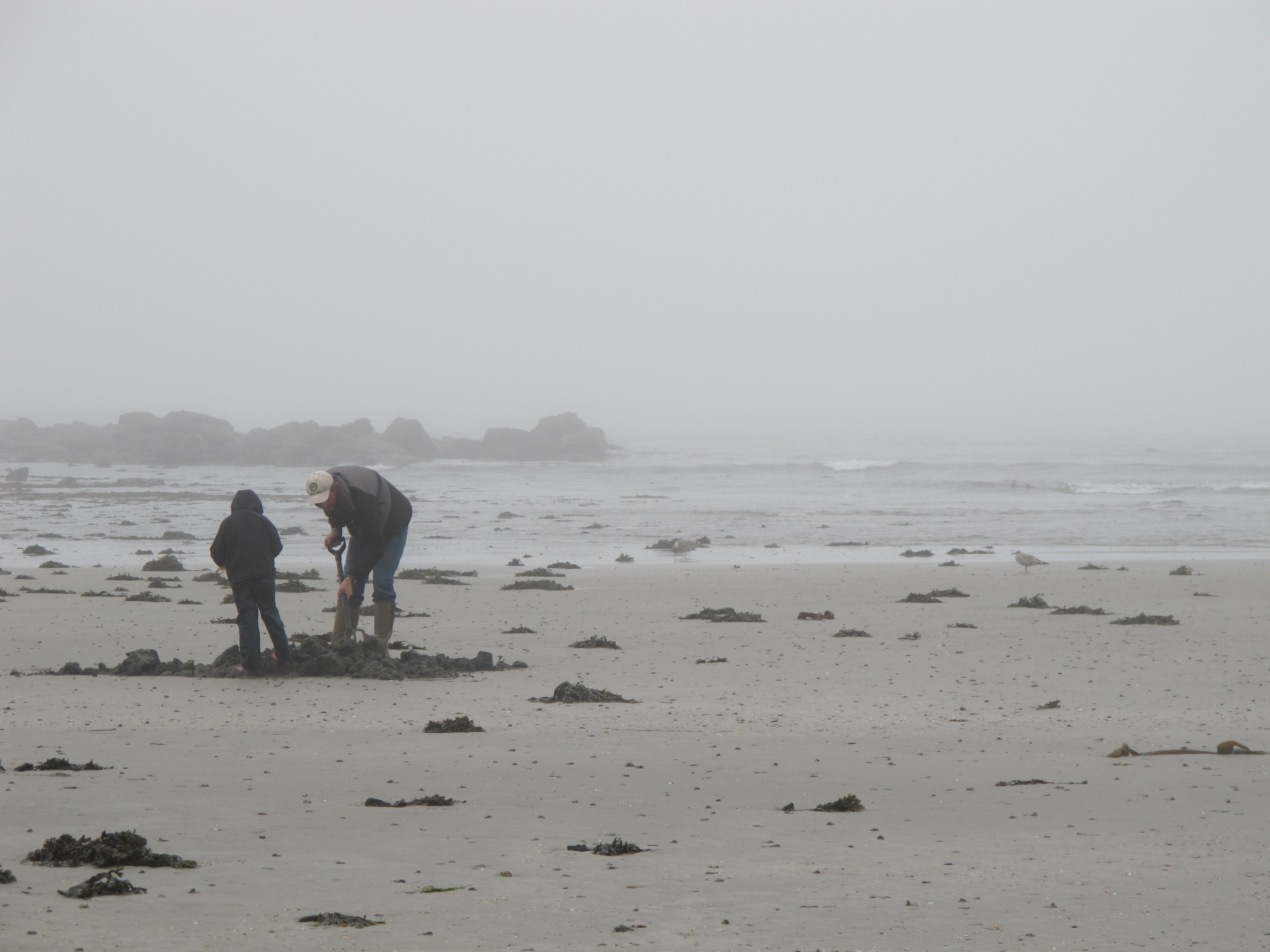
A rare relevant photo: digging clams on a foggy day. Marazion.

A rare relevant photo: digging clams on a foggy day in Marazion.

Once you have a vocabulary, you have to say something with it, which is how we get to attitude. It rains enough here that people grow a kind of fatalism about the weather. I say “grow” because it creeps over them the way mold grows on damp walls. Sometimes it comes out as a wry fatalism and sometimes as plain old moaning. (When I lived in the U.S., a moan was nothing more than a sound. Here it’s transformed into an entire attitude, a form of not-gonna-do-anything complaint. A way of life, in fact.)

The content of wry fatalism and moaning is almost the same. It’s the attitude that makes them different.

“I guess we’ve had our summer,” a neighbor said on a gray day that followed some warm, sunny weather.

I knew enough to say, “Yes, and it was a beautiful day.”

He laughed and I congratulated myself: I’d played my hand in the game of wry fatalism. Not bad for a furriner.

On a different day—a sunny one—another neighbor said, “It won’t last.”

Same thought but pure moan. I wasn’t sure how to contribute. Maybe all I needed to do was shake my head mournfully and agree but I didn’t. What help can you expect of a furriner anyway?

Free of either fatalism or moaning (I think) is weather news. People trade bits of this the way American boys once traded baseball cards. A storm’s working its way across the Atlantic. An arctic front’s moving down from Iceland. A warm front’s bringing rain from Spain (really—no plains anywhere to be found but the rain falls anyway). You name it, we tell each other about it, especially if it’s bad weather. We listen to the weather on the TV. We check online. We get updates on our phones. Okay, I don’t. My phone is nothing but a phone, and I’ve given up on the evening news since I read the paper and enough already, how much weather (not to mention news) does one person need? So I’m using we loosely here. But every other single person in the country does all of those things, and every last one of them tells me about it. And as a result I can tell more people, who already know it and have already told me some version of it but it’s okay, this isn’t really about the information, it’s about talking to each other. We’re trading baseball cards. Baseball cards have no intrinsic value. They exist only to be traded.

No one’s weather news quite matches anyone else’s, but if it did what would we have to talk about?

Bizarre British festivals: the flaming tar barrels

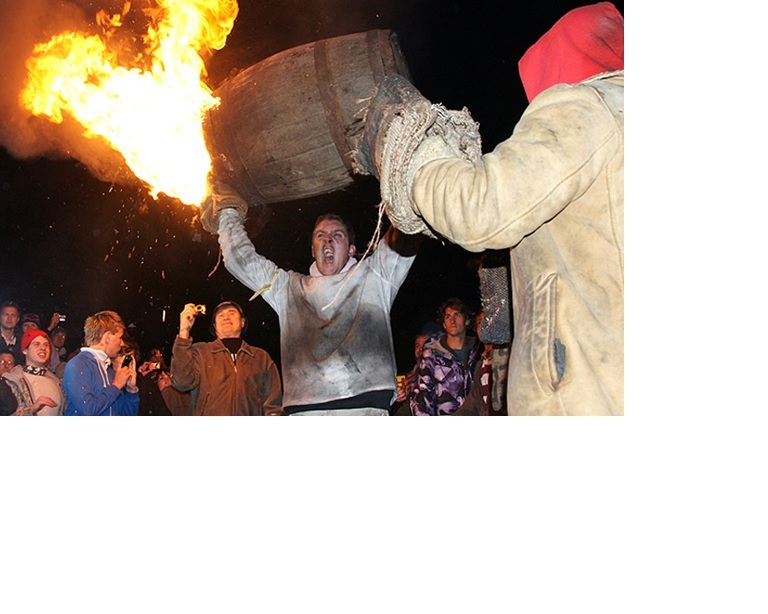
The web site for the Ottery St. Mary Tar Barrels Festival says (or said when I last checked it), “Each year it becomes more difficult to find money to cover the costs of running this event.” Well, yes. Given that it involves a bunch of people running around with flaming tar barrels on their shoulders, I can see why insurance might be an issue.

The event is hundreds of years old, although the web site doesn’t say how many hundreds. Or how many people over the centuries have set themselves or their neighbors alight. It doesn’t matter: It predates insurance, that’s what we need to know.

Holy flaming tar barrels, they really do this. Sorry about the white space. The photo's from the official web site and I can't seem to crop the damned thing.

Holy flaming tar barrels, they really do this. Sorry about all the white space. The photo’s from the official web site and I can’t seem to crop the damned thing.

The web site asks visitors, for the sake of safety, not to pound on the barrels. A few years ago, someone threw a spray can into one of the barrels instead, causing an explosion. I couldn’t find any reference to it on the web site, but maybe they don’t want to plant ideas in anyone’s head. Wise. I should probably follow their lead but–oops, too late. If you feel impelled to show up and throw a spray can into a burning barrel of tar, you didn’t get the idea here, okay?

People in Britain make a big deal out of health and safety concerns being overdone. That’s partly, I think, because complaining about something in ways that won’t change them runs deep in Britain’s cultural DNA and partly because we humans do have a gift for taking a good thing (most of us would agree, for example, that keeping people from being killed and maimed at work is a good thing) and take it to absurd lengths. I was once told, in a second-hand shop (sorry: charity shop), that they couldn’t sell crochet hooks or knitting needles because of health and safety. At the yarn store, where I eventually bought one, they must keep them locked up. Can’t be too careful, you know.

A friend teaches health and safety workshops, and she swears that crochet hooks aren’t one of the things that keep her up at night. So yes, there is some absurdity going on, but it’s not the fault of the people whose job it is to promote health and safety, it’s the fault of overenthusiastic twits who use the phrase to defend whatever crazy decisions they’ve made.

So anyway, you’ll find people who talk about health and safety, as a single phrase, the way a certain kind of person—and you know who they are—complain about political correctness gone mad. (How upsetting that they can’t call entire groups of people names anymore without being told off. Or kick them out of their seats on the bus. Or, you know, lynch them, the way they could in the good old days.) If you listen for a while—especially after you’ve been told you can’t buy a crochet hook—you start to think modern life is being forced into such a narrow mold that humans will never again get to test themselves against any real challenge, and then you open the Ottery St. Mary Tar Barrel web site and think, Wait a flamin’ minute. What about health and safety?

Anyway, Wild Thing and I meant to go this year and bring you a first-hand report, but life got away from us and it’s not going to happen. In fact, we meant to get to every strange traditional festival we heard of but only managed one, the Gloucester Cheese Rolling. Maybe next year we’ll do better.

If you go to the Tar Barrels Festival (hurry; it’s on Nov. 5), leave your spray cans behind and don’t pound on the barrels. If you’d like to bring a small personal fire extinguisher, however, there’s no rule against it. And let me know. I’d love to have a first-hand report.

Bats of America

Truth in Blogging Warning: This post contains no useful cross-cultural information and the incident described is in no way typical of American life.

And with that out of the way,  I’ll refer back, as bloggers do with a look of strained innocence as they post links that drive you deeper into their blogs, to an earlier post about some of the nuttier reasons people call the British emergency services and it reminded me of a time when Wild Thing and I made one of those calls in the U.S.

We lived at the time in Minneapolis, in the downstairs half of a two-family house. That’s in Minnesota. If you’re not sure where that is, take the map of the U.S., fold it in half and look more or less on the fold, just below the Canadian border. Minnesota’s the state curling sweetly around the westernmost of the Great Lakes.

Irrelevant photo: a sign on a public footpath. If you want to get to Sheepdip, turn right.

Irrelevant photo: Sign on a public footpath. If you want to get to Sheepdip, turn right.

The geography’s a side point, though. What matters for this story is that out house was wildlife friendly. That doesn’t mean we had cuddly otters stopping by for coffee or raccoons joining us for breakfast. We had urban wildlife. Every so often, we’d hear yelling upstairs and know that V. had her broom in hand and was killing a rat with it. I love V. and her kids dearly, and I never thought she meant me harm, but I want to put it on record that when she had that broom out I would not want to make her mad.

When I say we had rats, some of you will think the place was a dump, but really it was just a place to live. With great neighbors and a landlord who figured in the cost of the screws when he had to—very reluctantly—replace the back door. And with, you know, the occasional rat. But only sometimes.

This isn’t a tale about either landlords or rats, though, or the ways you can sometimes confuse one with the other. Here’s what it is about:

Every second or third week, I hosted a late-night radio call-in show, and on one particular night I got home at the usual ridiculous hour and before I had time to take off my raincoat a hand reached out of the bedroom, grabbed my collar, and pulled me in backwards.

Was I terrified? Did I think vampire zombies had taken over the house and were about to do whatever it is they do, which I didn’t know the specifics of because I hadn’t watched the movie? No. The only thing I remember thinking was something along the lines of this is strange.

Which was fine because it turned out to be Wild Thing’s hand pulling me backwards. She closed the door after me and said, “We have a bat.”

Wild Thing isn’t hysterical about wildlife. The time the rat came up the toilet, yes, we did what any two sane adults would do in that situation: We closed the lid and we went into the other room and we screamed. C’mon, tell me you wouldn’t. And she’s phobic about snakes. But otherwise, she’s the person you’d call if a bear lumbered into your living room. Because you’d want someone who could stay calm. Someone you could ask, “So what do you think I should do?” and who’d say, “I’d get my ass out of there if I was you,” and you’d say, “Right. I’d thought of that myself but I was afraid I might hurt its feelings.”

I should interrupt myself to say that she’s not a low-key person. It’s something she drops into when bears lumber into the living room.

So this was when we learned that she’s phobic about bats as well as snakes. You don’t know something like that until one starts swooping overhead.

I’d lived in a bat-prone apartment some ten years before and the only one that bothered me was the one that flew into the walls and presumably had rabies. But we had a caretaker there and he came and got the bats out. So I told Wild Thing, calmly, “They don’t land in your hair. That’s a myth.” Because we were hiding in the bedroom and that seemed like something she ought to know.

Having reassured her, I’d planted the image in my head, so I pulled the raincoat hood over my head to cover my hair, marched into the living room, and brought the phone back.

Which left us in the bedroom with the phone. The next question was what to do with it. Our apartment didn’t have a caretaker, it had a landlord who lived in the furthest suburbs and counted in the cost of the screws when he had to replace a door. He wasn’t someone you’d look to for help, even if the place had been on fire.

I seem to remember that we tried turning out the lights and opening the doors before we called anybody. I absolutely remember that it did no good—the bat swooped and circled and did bat things. Then we turned the lights back on and the bat went to roost.

In the end, Wild Thing called the cops. I mean, why not, right? And she talked to someone who said, “We’ll send the Batmobile.”

Strange to say, we weren’t the cops’ top priority that night. We sat on the front porch and waited an hour or so, until finally a cop car pulled up and two cops swaggered out.

Now if you’re not American, you have to understand something about the equipment American cops carry on their belts. It includes a gun, a club, handcuffs, spray deodorant, a large Coke, a donut, and a model of the Washington Monument in granite. All of which not only adds up to quite a bit of weight but pushes their elbows out when they walk. So even the least temperamentally swaggery of them swaggers like they’re headed for the gunfight at the OK Corral. They can’t help it.

One of the two asked, “What seems to be the problem, ma’am?”

Wild Thing said, “We have a bat.”

He froze mid-swagger.

“A bat,” he repeated blankly.

His partner headed up the walk, which shamed the rest of us into following.

The lights were on and the bat had gone to roost on top of the kitchen cabinets, so he said he’d try carrying it out the back door on the piece of wood it was on. Why (parenthetically) did we have a chunk of wood on the kitchen cabinets? Because I’d seen other people take similar things and make them look great. Mine looked like an old chunk of wood that had been dumped on top of a kitchen cabinet but I left it there to see if it wouldn’t look better if it had a year or two to settle in.

Anyway. He picked up the chunk of wood and the bat took off. The second cop made a dive for the bathroom and slammed the door, trapping Wild Thing and me out there with the bat, so we dove under the kitchen table, where we had time to think that someone armed with a gun and a club and spray deodorant and a model of the Washington Monument was hiding in our bathroom.

The first cop—the bat battler—asked where we kept our broom and explained to us, as we hid under the table, that bats fly in regular patterns. He watched briefly to establish what pattern this one was flying, then he whacked it out of the air with the broom and carried it outside.

When he came back in, he opened the bathroom door and poked the broom through the opening.

“Coming to get you,” he said. “Coming to get you.”

The second cop? That was over thirty years ago and they’re both retired, but he’s still hearing about it. I just know that. The first one? He didn’t get an award from the city but he should have. Because forget the pen being mightier than the sword. Our neighbor V. had it right: The broom is more powerful than the anything, and that cop was smart enough to know it.

What the world wants to know about Britain

If search engine terms are any measure of what people want to know about Britain, I’m full of insight. And that other stuff, but it’s not what we’re talking about right now. I’m disguising myself as a sensible bloggist, so behave please. We’re in public.

I keep a list of the search engine terms that lead people to Notes, and that list tells me everything I need in order to fake my way through a serious topic. So here we go, with Google’s lower-case style and lack of question marks carefully preserved where I quote directly. Somehow adding quotation marks seems—oh, I don’t know, un-search-engine-like, so I’ve left them out, even though things would be clearer if I added them.

Profanity

I had four searches about these: who swears more, us or uk (I don’t know, but I’m pretty sure it’ll depend on what you consider a swear word) and usa vs uk profanity. Both of these popped up twice, each worded the same way and in a short space of time, marking them as two repeat searches. What do we learn from this? That the people who are interested in swearing try repeat their searches and return to sites where they probably didn’t find an answer the first time.

Irrelevant photo: Chun Quoit in the fog. This is an ancient monument near Penzance. No one knows what it purpose was, but it looks a lot like a giant stone ironing board.

Irrelevant photo: Chun Quoit in the fog. This is an ancient monument near Penzance. No one knows what its purpose was, but it looks a lot like a giant stone ironing board.

Manners

On a vaguely related topic, I was on the receiving end of five searches about manners: british have nicer manners (than who?); manners and how they started (twice); american manners for brits (see next question); what about manners in the us (we don’t have any, so don’t worry about it). The idea of two polite Brits brushing up on American manners in advance of a trip is touching, in a sad sort of way. It’s thoughtful, it’s polite, and oh sweetheart, it is so not going to help.

Food

The world—and I’m exaggerating only slightly; it’s called the multiplier effect and it allows me to lie in good conscience—is obsessed with lemon drizzle cake. I have no idea why. I mean, it’s good, but I never heard of it before I moved to Britain so how did everyone else? I had three searches for recipes in cup measurements (those would be from Americans), and one asking for metric, one that just asked for and measurements, possibly of the ingredients, possibly of the resulting cake, and possibly of the person who ate it all in one sitting. Plus one wanting an easy american english recipe—presumably that’s one with the excess U’s left out because they’re fattening. I did write a post or two about this, but in trying to come up with a recipe in cup measures I screwed the whole thing up so I’m not going to link back to it, even though it’s the most important topic I’ve written about. Other searches wanted to know about english food, british food, food about england in short note (I am notably short, but I don’t think that’s what this is about), tea, and an american expat making chocolate chip cookies in England (which is cheating a bit since it’s not exactly about Britain but let’s include it anyway because that’s me; I made a batch last week, since I’m the proud hoarder of a new stash of chocolate chips).

Tourism

Tourism sites think we want to know about beaches, castles, and places to stay. Bullshit. Here’s what people want to know: do the british mind american tourists; american tourists hated; annoyed by tourists? Cornwall (the question mark, being in the middle, survived); why are british so mean to american tourists. So, with that level of paranoia, we can answer the next two questions: why so few american tourists (because they think no one likes them) and are americans in awe of Britain when they visit (they might be if they weren’t so busy worrying about whether anyone likes them and why they don’t). And three people wanted to know about emmits, which is a Cornish word for tourists, although not necessarily American ones. It’s not a compliment, so maybe those tourists and would-be tourists are onto something. And in a neat little irony, I just googled emmits notes from the uk to locate the link to the back post on emmits.

Accents and language

Three people want to know how to pronounce the Widemouth part of Widemouth Bay (Widmuth, to save you the search). No one wants to know how to pronounce anything else, although one asked about british place of interest or towns consonants missing. I don’t know what this obsession with Widemouth means. Maybe it’s the center of the universe, although you wouldn’t think so to drive through. Other searches are: talking in british english a sex (no, I don’t understand it either, but then I’m American so maybe I’m not supposed to); do the english have accents to the aussies (is a bear Catholic? does the Pope shit in the woods?); table british accent (this may have to do with food but it may have to do with parliamentary procedure, in which case it’s complicated because to table means different things in American and British usage); british accent are fascinating (yes, but not half as fascinating as Google searches); pure english word list (sorry, kid, but English isn’t a pure language). And finally, about the U.S., what do americans call cats (we call them cats, or sometimes kitty).

Music

The questions here were: raunchy folk songs british (sorry, most of my raunchy ones are American); british musical notation; why is british musical notation weird; british “folk music” strange accents. So, we’re interested in raunchy folk songs in funny accents written in weird notation. I’m so glad people aren’t judgmental about cultural differences.

Wigs

Lots of people want to know about lawyers and their wigs—their history, what lawyers think of them (they all, of course, feel the same way), whether they’re itchy, why lawyers wear silly wigs (no judgment there). Apparently if you know three things about Britain, one of them is that lawyers wear wigs. Another is that people eat lemon drizzle cake. The third? That a lot of weird things go on.

Neighbors

Someone typed in neighbor wants to know everyone’s business uk. I can’t help wondering if they had someone specific in mind. Another was interested in british dog village life and a third in british neighbors and a fourth in miss marple village. If that last one is about Miss Marple’s village, it’s worth knowing that she’s a fictional character, living in a made-up village, where 150% of the population has been murdered. Visiting isn’t recommended. Or, strictly speaking, possible.

Intercultural explorations

These were: what caused strange british traditions (sunspots) and why do english use chocolate eggs not hens’ to celebrate easter (the British have developed chocolate hens and those are their eggs, thank you very much). Don’t you feel better knowing that people are still out there wanting to learn about other cultures?

Other stuff

One person wanted to know about british schoolgirls in uniform and wanted to know it three times. He (and yes, I’m making assumptions; wanna bet I’m right?) didn’t find any photos here but kept coming back anyway. Don’t think about it too much, because it’ll only upset you. Three wanted to know about Mrs. Baggit, including one who wanted to know where to buy a Mrs. Baggit sign. One wanted to know how to break into a british phone boxed. Yes, boxed. It should be easy, since the doors don’t lock—all you have to do is pull. Phone boxes are made that way—the phone company wants you to come in. Or used to when they could still make money on them. The hard part these days is finding one. Maybe the real question was how to break into the money boxes inside them, in which case save your energy, because they’ll be empty.

Someone asked about jack rusel parkins, which baffles me since a jack russell is a dog and a parkin is a kind of cake. Google jack russell parkins, though, and you’ll end up with links to sites about the parson jack russell, which is a specific kind of jack russell.

Someone else seems to have mistaken Google for email and wrote “perhaps you would like to come for lunch or afternoon tea on a s…” It struck me as so forlorn that I’d have gone if I’d known who wrote it. If they weren’t too far away. And if—well, never mind. It’s not going to happen. But I did put quotation marks around the invitation to buffer it from this harsh world.

Other people wanted to know: who funds cornwall gay pride (Moscow); what a crooked stile is; why I (or some vague set of someones) think Britain is called great (in case you’re keeping track, I capitalized that because it’s paraphrased, but what I or whoever thinks is pretty much irrelevant to even a semi-serious answer); the metric system in great britain; winter in cornwall; british sex scandal blog spot; and she steps on snails (oh, indeed she does).

And earning its own paragraph for its sheer oddity, someone was looking for uk bkhgum pales gurd xxx. And landed here, with his or her head still spinning from the ride.

A final searcher was looking for notes from the uk. And found it. Which sounds like the ending to a kid’s picture book.

Updates on tea and medical bureaucracy

I get some fantastic comments on this blog and a few of them just have to break out of the comment section. So I’m going to pick up on four of them, two about tea and two about medical bureaucracy.

Tea

If you’re American, you think I already wrote more about tea than is either intellectually or physically possible. But I live in Britain. Tea is the binding force that holds the nation together, and let me tell you it’s looking a little shaky lately, what with Scotland having held a referendum on whether to leave the union and, far more shockingly, so many kids these days getting their caffeine from energy drinks instead of a respectable source like tea. Not to mention the number of tea drinkers allowing themselves to be seduced by fancy coffee and if that isn’t enough the possibility that Scotland will hold another referendum in the (less than immediate) future.

Screamingly irrelevant photo: fall berries. I'm not even sure what they are.

Screamingly irrelevant photo: Fall berries. I’m not sure what they are but I don’t recommend tasting them.

And I’m not sure how the Welsh feel about referendums and secession. Or even whether some purist is going to tell me that the plural is referenda.

So, yeah. We need our tea. And we need to make it right. Which brings me to the point—and yes, there is one. Or two actually. You only had to wait.

J. tells me (and this was in person, not in a blog comment, which is why she’s going by an initial; the tradition may be silly but at least I’m consistent) that I ignored the role of teapots in my last tea post. Sure, I mentioned them, but you can’t make a nice cup of tea, J. says, unless you make it in a pot. Actually, she probably said “a proper cup of tea,” but I was listening to the sense, not the words, sadly. The sense was this: Make it in a cup and it just doesn’t come out right. Even if you only make a single cup, you need to make it in the pot and then pour it into the cup.

Why? Because it’s not a proper cup of tea otherwise, and if it’s not a proper cup of tea it’s not a nice cup of tea. And if it’s not a nice cup of tea, Scotland might just spin out into the North Sea, leaving the northern edge of England a ragged tear (pronounced tare; people may or may not weep about this, but it’s not what we’re talking about) across the land.

That’s not intended, by the way, as a comment on whether Scottish independence is a good idea. I could argue both sides of the proposition with equal passion. But the spinning into the North Sea? That’s just, you know, a fact.

Oh, and the pot has to be warm. Because the tea will brew better.

J.’s of the bone china school of tea drinking. Because it tastes better that way. It doesn’t have to be a fussy little cup and saucer—a mug’s fine—but for her it has to be made of china. Me? I like a heavier mug, but I try not to argue religion with friends.

So that’s one point. And then in the comment section, helenwood wrote about a job she had long ago, working for a tea importer, pouring water over the leaves so the tasters could sip and spit. But that wasn’t what grossed her out—it was that the tea leaves scattered on the warehouse floor, and presumably walked through by one and all, ended up in teabags.

If anything’s going to convert me to leaf tea, that would do it.

Medical bureaucracies

Moving on, then, from a serious topic to the trivia of our lives, we come to what I wrote about medicine in the U.K.

Ianbcross, a doctor who’s worked in the National Health System, commented that the Choose and Book system gives patients a code so they can make an appointment with a specialist online or by phone. “If there are no appointments available,” he writes, “it is up to the hospital to find one for you. You decide whether to accept it or not. This is for routine stuff. If your doc thinks you might have cancer, you get a two week wait appointment from the hospital. Less choice for you, but as soon as they can, they fit you in. Emergencies go directly to hospital, without passing GO, of course.”

Well, this is a guy who knows the system, and his comment made me wonder if I’d misremembered my experiences and Wild Thing’s. So I did what any sane blogger would do: I took a small and unscientific survey (I’ve stolen that phrase; it’s nice, isn’t it?) and came up with the following revelation: Our local surgery (that’s a doctor’s office if you’re American) is all set up so you can use the Click and Book system, but they don’t tell you about it. If you ask to use it, they’re happy to let you use it. But if you don’t already know about it, you can’t ask. So you sit around waiting for that letter.

Unless—as happened to me recently—you get a phone call. From the wrong hospital. But never mind, it was a phone call and it came quickly.

When I acted as an advocate for our neighbor, it wasn’t about getting an appointment but about shaking loose the report from an appointment she’d already had so she could (a) find out what was wrong and (b) do something about it. The doctor had dictated the letter and there it sat, waiting to be typed. And as far as I could tell there it was going to sit and wait until pine trees grew in hell.

The practice manager and I had a leave-it-with-me conversation, and I left it with her until the end of the day, when I called back. Which reminds me to mention that the NHS has a wonderful service called PALS, which stands for Patient Advocacy SomethingWithAnL SomethingWithAnS, not (as it did when I was a kid in New York) the Police Athletic League. I called PALS just after I talked with the practice manager. I suspect it’s owed the credit for getting that letter in the mail. I heard a rumor the service’s funding is going to be cut. I hope it’s not true, because the idea that within an inevitably bureaucratic system are people whose job is to make a nuisance of themselves when things aren’t working for the patient? That’s inspired.

In another comment, Dan Antion reminded me that in the U.S. the first questions anyone medical asks are about your coverage. If you’re not American, you may need that translated: Do you have insurance? Who’s your provider? What plan are you on (secondary translation: does your insurance plan cover this procedure)? And so on. In other words, everyone talks money while you bleed onto the floor, because money is what matters. (Note to the current U.K. government: Are you sure you don’t want to rethink that whole privatization of the NHS thing?)

And if anyone in Britain thinks it’s just the NHS that has unacceptable delays, he tells the story of a friend with a life-threatening condition who needed surgery and was told she couldn’t be seen for six to eight weeks.

The thing about the NHS is that until the current round of disorganizations were introduced, it’s been a unified system, so people talk about unacceptable delays, and newspapers write about them, and word generally gets passed around and everyone’s outraged and wants something done about it, which creates pressure to actually do something. When emergency rooms keep people waiting for more than four hours, it’s considered unacceptable. In the U.S., my father was left waiting in the emergency room for, if I remember right, seventeen hours. With meningitis. At the age of ninety. And he had good insurance. We were furious, but it was business as usual and didn’t tarnish the hospital’s reputation, or the U.S. medical system’s.