The Met Office, weather forecasters to the U.K., has started naming storms. We’re not talking about hurricanes, just storms big enough to stand out. The idea is that if they have names the public will take more notice of them, and presumably of the danger they pose, and I’d love to make fun of that but as far as I can tell it works. Sad, isn’t it, not to make fun of something just because it’s sensible?
Here’s my evidence that naming works:
When I started writing this, we were waiting for storm Frank to hit. That means I wasn’t just sitting around waiting for some nameless storm, I was waiting for something with more definition than a bunch of unnamed isobars, however tightly packed, on a weather graphic. Frank didn’t pose any particular threat this far south, but we were expecting a bit of drama and I’m a sucker for finding out what’s going to happen next. Without the name, though, I’m not sure I’d have been so consciously keeping an eye out for it.

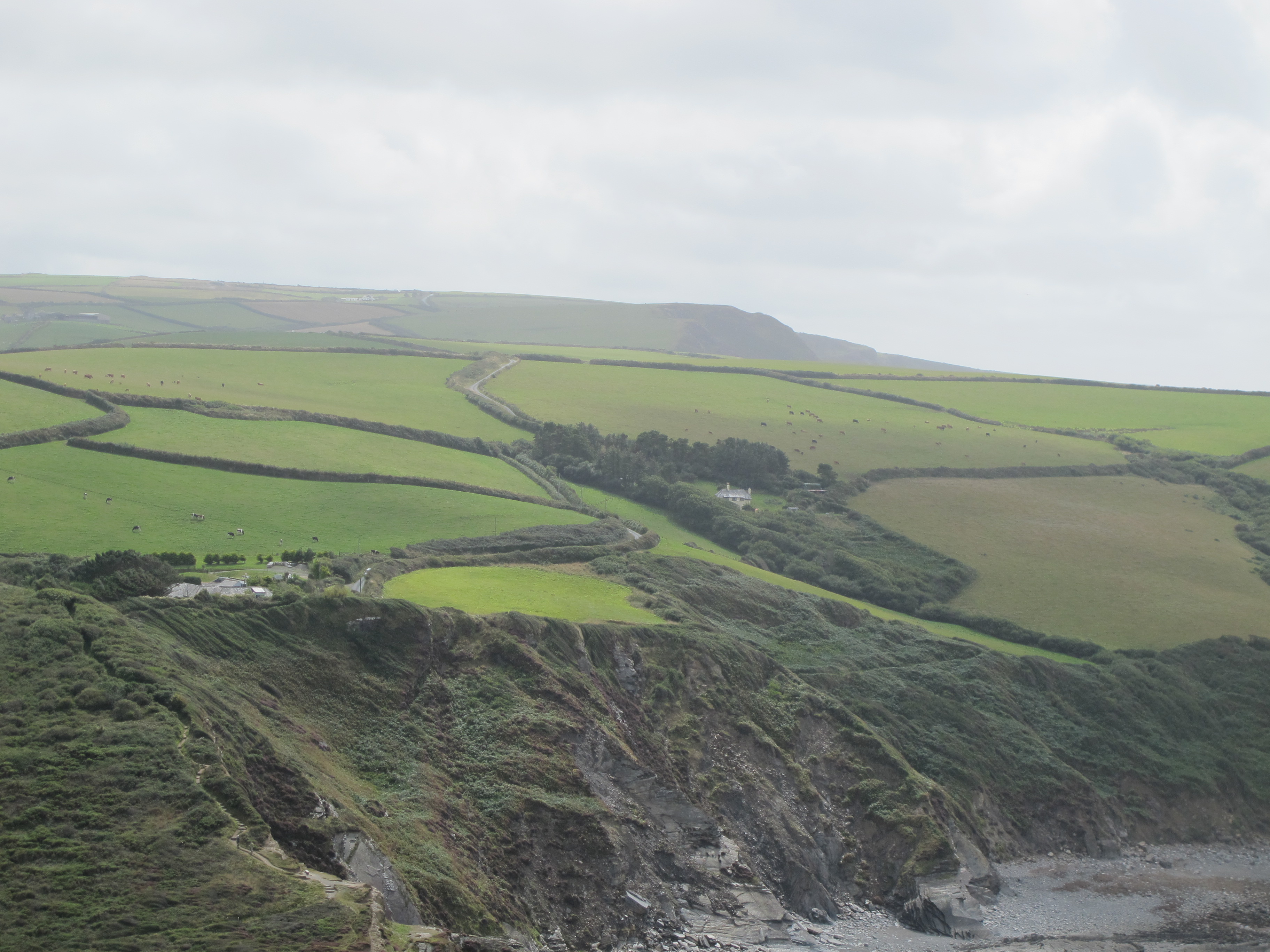
Borderline relevant photo: Boscastle in the evening–and more to the point summer–light.
Back when I lived in Minnesota, we didn’t have an official naming system for storms, but a few got themselves named anyway, and those names give me a hook to hang my memories on.
The Superbowl Blizzard hit during a major football game. I never watch football—I have a serious sports allergy and, sorry folks, I just can’t—but the name means the storm has stayed well defined in my memory. I doubt an unnamed storm would be. The weather had been spookily warm just before the blizzard, and it rained. Then the temperature dropped so quickly that water froze in the storm drains and on the streets. That was followed by a heavy snow, which (do I even need to say this? oh, why not?) fell on top of the ice. The driving was lethal and the walking wasn’t much better.
I was driving cab at the time and had a sort of roommate (we rented a house that split neatly into two apartments, hence the sort of) whose brother came over to get snowed in with us. Minnesotans do that, at least at a certain age. In the morning, none of our cars started—it was too cold. let’s say it was 30 below, but understand that I’m inventing the number. Think of it as a poetic way to say it was brutally cold. I caught a cab to work so I could drive a different cab back and jump all three cars.
That’s one of the things about driving cab. No one really knows what you’re doing once you leave the garage.
Jumping the cars didn’t help—that’s how cold it was. But by then I’d taken the cab out and there was nothing for it but to put in a day’s work. I don’t remember if I made much money—probably not, because although almost no cabs were on the road and every third person in town wanted to get somewhere without risking their own car, the driving was slow, and you can’t make much if the driving’s slow. Still, I remember that day’s work as sublime. Snow brings a special kind of silence to a city, and a sense of gentleness. I passed a man skiing down Cedar Avenue near Lake Street. Almost no one was around except for him and me and one car, stopped at a red light.
In a heavy storm, Minneapolis normally begins clearing and salting the major streets even before the snow stops falling, but the storm had overwhelmed them. The streets that had been plowed were as icy as the ones that hadn’t been. The few cars that were on the streets moved in slow motion, because the only way to stop on ice is very, very slowly. What accidents I saw happened equally slowly, almost as if we were all wrapped in cotton wool.
Would I remember that as clearly if the storm didn’t have a name? The images would still in my head, but I doubt I’d remember that they were from that same storm.
The other named storm that hit Minnesota while I lived there was the Great Halloween Blizzard, which hit before any small storms had given the city a reason to salt the streets. That meant the pavement hadn’t built up a salty residue. (I should admit that the city stopped using actual salt years before this period, but let’s call it salt. It sounds better than non-specific ice-melting chemicals.) So we had a wet, heavy snow hitting bare asphalt and welding itself to it. The first layer of snow packed down to a thick layer of ice, then more snow piled up on top of it. Again, the city was overwhelmed by the storm. And again, the temperature dropped dramatically.
Coming so early in the season, the whole thing took people by surprise. A student in a writing class I taught told me he lost two lawn chairs and a lawnmower under the snow. He’d taken a break in his mowing and—well, I don’t know how long the break was but by the time he went back out it was pretty clear that he wasn’t going to finish the lawn until spring. By which time I doubt he’d be using the mower he started with.
Trick or treaters came to our door that year wearing winter jackets over their costumes.Plus snow boots and gloves and hats and gloves. Unless they had a mask, you had to take it on faith that they’d put on a costume. But not many ventured out. Around 8, a small knot of teenagers showed up, saying, “We’re the last ones. Why don’t you give us whatever you have left?”
They were so outrageous about it, and so damned cheery, that I gave them almost all the candy in the bowl, keeping only a few bits of in case they were wrong.
When the city finally plowed and salted, instead of clearing the streets they made potholes in the ice, and cars crept and bounced through rush hour after rush hour. It was weeks before traffic started moving normally.
I’d remember the storm even without a name because it hit the same day that my 90-year-old father was hospitalized in New York with meningitis. It was days before I could get out of Minneapolis to see him. (He did recover.) But if the storm hadn’t found its own name, I’d have remembered it with a more private name—the Storm When Dad Got Meningitis. That’s a testimonial to the power of names, and to our need for them.
Which brings us back to this current naming project. The U.K. and Ireland are collaborating on it, since the two countries are parked in the Atlantic like a car and a truck, and if a storm hits one it’s likely to hit the other next. Collaboration strikes me as significant, because British weather forecasts ignore the Republic of Ireland. They tell us what the weather will be for Northern Ireland, but across that border into the Republic? Silence. It’s as if Britain’s still sulking that Ireland went independent and by god it’s not going to acknowledge any Irish weather. I don’t notice this so much when I’m listening to the radio. The various regions of Britain get mentioned and I almost never catch the one I’m listening for because either my mind wanders or the puppy starts barking or the oven explodes or the phone rings or, you know, life interferes in one of the many glorious ways it has. But it is noticeable on TV because Ireland’s right there on the BBC weather map but no weather ever touches it. Northern Ireland? Yes, it gets wind, sun, rain, all that stuff. But the republic? Nope. It doesn’t have weather.
I know the Irish aren’t the BBC’s target audience, but still. I’ve heard France mentioned in weather forecasts. I’ve heard the word Spain. But Ireland? Silence.
That must make this collaboration over storm names interesting. Or maybe the word I’m looking for it tense.
But even without the BBC’s ban on Irish weather, the politics of naming storms would have to be tricky. How many names will be Gaelic and how many English? Does each country get so many names per head? Do they have to take account of the number of Irish names that are of English instead of Gaelic origin? Or does each country get to pick the same number of names? Will either country acknowledge the presence of immigrants by picking a name from some third or fourth language group?
Listen, everything’s political. Breakfast cereal is political. A length of blue ribbon is political. My fingernails are political.
Here in Cornwall, Frank didn’t turn out to be anything special. We’ve had so much rain lately that it’s hard to tell one storm from the others. Even the named ones are basically water landing on top of more water. Mercifully, none of them have done worse than leave us wet and wind-blown. But farther north it brought flooding and misery to places that hadn’t recovered from earlier flooding and misery. I’ll have to hear from someone up there to know whether having a name for the storm made them any more aware of it ahead of time or if it only gave them a better way to talk about it.


 Notes from the U.K.