Talking about the weather—a lot

Britain really does get a lot of rain. Almost as much as people think it does. Enough that the vocabulary for rain is extensive and specialized. It’s raining stair rods. Or pitch forks. It’s chucking it down, or pissing down, or bucketing down, or mizzling—a lighter, mistier version of drizzling and a word I use sometimes for the pure pleasure of hearing it. In the U.S., it rains or drizzles or rains cats and dogs, but that’s about it. Once in a while, I guess, it mists enough to turn mist from a noun to a verb. But if it does anything else I can’t think what it is. We have words for different kinds of storms, from a shower to a hurricane, but for the rain itself? We haven’t been driven by the sheer indoor boredom of being stuck in the house on 356 consecutive rainy days to come up with new words and phrases.

Or maybe the words came from being out in the rain before the invention of anything that even semi-reliably kept a person dry. Naming the damned stuff could keep your mind off your misery. Or at least keep you busy while you were miserable.

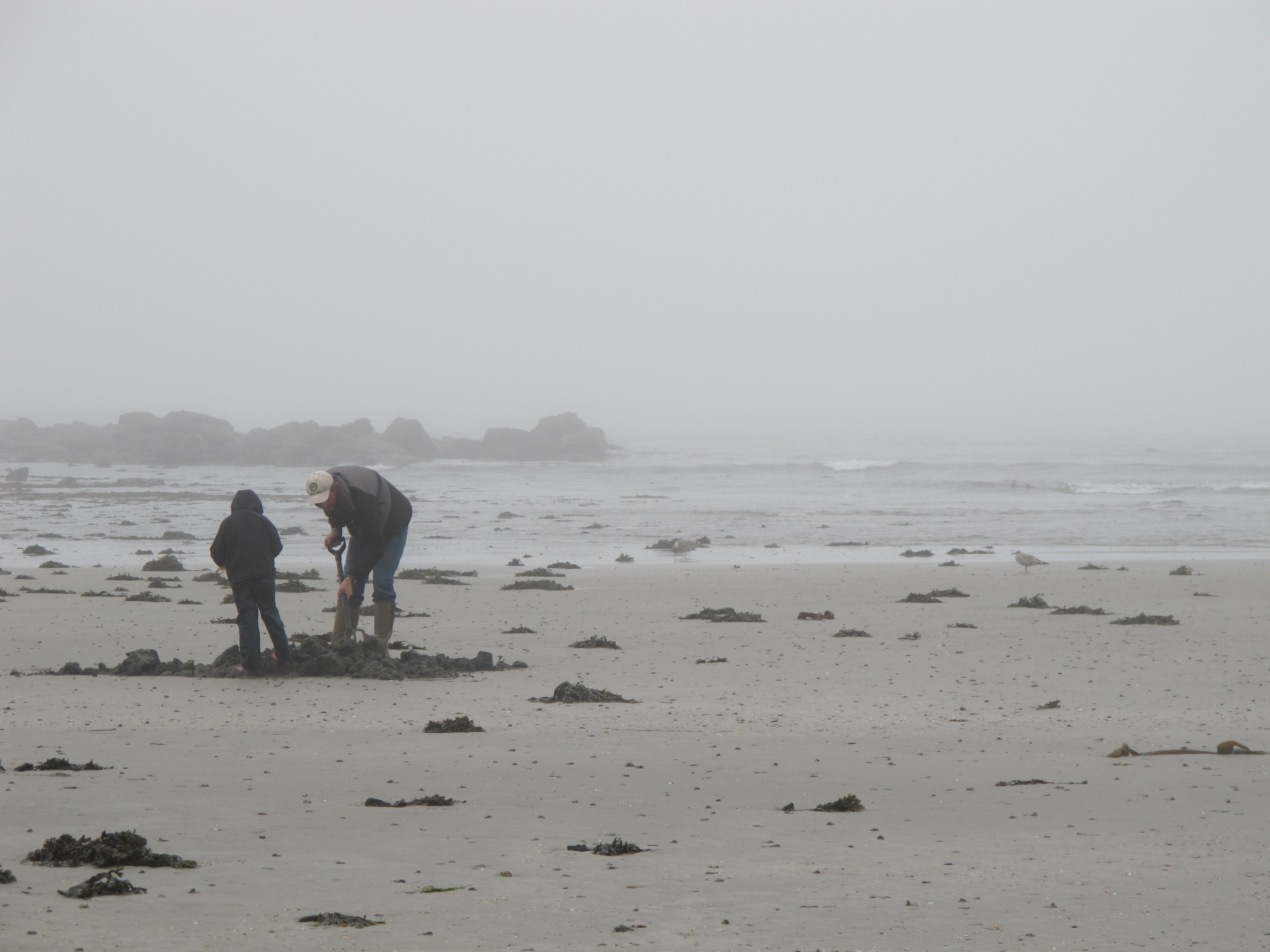
A rare relevant photo: digging clams on a foggy day. Marazion.

A rare relevant photo: digging clams on a foggy day in Marazion.

Once you have a vocabulary, you have to say something with it, which is how we get to attitude. It rains enough here that people grow a kind of fatalism about the weather. I say “grow” because it creeps over them the way mold grows on damp walls. Sometimes it comes out as a wry fatalism and sometimes as plain old moaning. (When I lived in the U.S., a moan was nothing more than a sound. Here it’s transformed into an entire attitude, a form of not-gonna-do-anything complaint. A way of life, in fact.)

The content of wry fatalism and moaning is almost the same. It’s the attitude that makes them different.

“I guess we’ve had our summer,” a neighbor said on a gray day that followed some warm, sunny weather.

I knew enough to say, “Yes, and it was a beautiful day.”

He laughed and I congratulated myself: I’d played my hand in the game of wry fatalism. Not bad for a furriner.

On a different day—a sunny one—another neighbor said, “It won’t last.”

Same thought but pure moan. I wasn’t sure how to contribute. Maybe all I needed to do was shake my head mournfully and agree but I didn’t. What help can you expect of a furriner anyway?

Free of either fatalism or moaning (I think) is weather news. People trade bits of this the way American boys once traded baseball cards. A storm’s working its way across the Atlantic. An arctic front’s moving down from Iceland. A warm front’s bringing rain from Spain (really—no plains anywhere to be found but the rain falls anyway). You name it, we tell each other about it, especially if it’s bad weather. We listen to the weather on the TV. We check online. We get updates on our phones. Okay, I don’t. My phone is nothing but a phone, and I’ve given up on the evening news since I read the paper and enough already, how much weather (not to mention news) does one person need? So I’m using we loosely here. But every other single person in the country does all of those things, and every last one of them tells me about it. And as a result I can tell more people, who already know it and have already told me some version of it but it’s okay, this isn’t really about the information, it’s about talking to each other. We’re trading baseball cards. Baseball cards have no intrinsic value. They exist only to be traded.

No one’s weather news quite matches anyone else’s, but if it did what would we have to talk about?

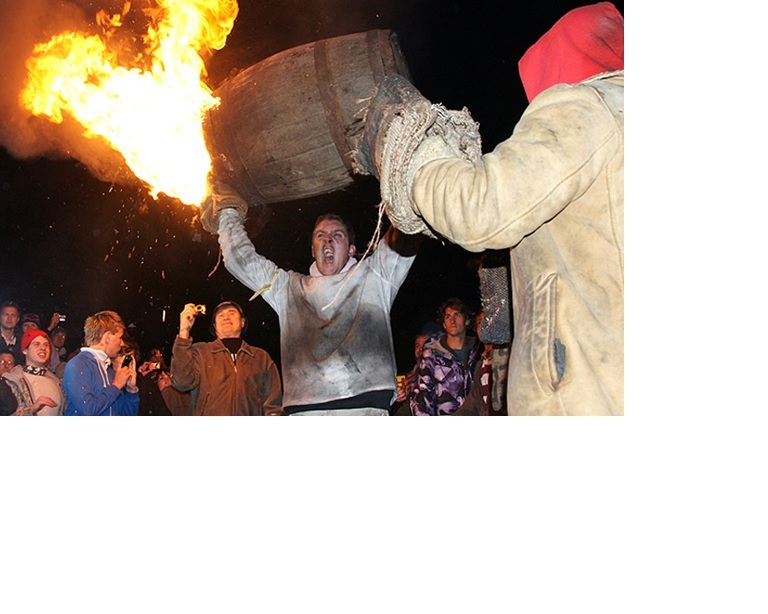
Bizarre British festivals: the flaming tar barrels

The web site for the Ottery St. Mary Tar Barrels Festival says (or said when I last checked it), “Each year it becomes more difficult to find money to cover the costs of running this event.” Well, yes. Given that it involves a bunch of people running around with flaming tar barrels on their shoulders, I can see why insurance might be an issue.

The event is hundreds of years old, although the web site doesn’t say how many hundreds. Or how many people over the centuries have set themselves or their neighbors alight. It doesn’t matter: It predates insurance, that’s what we need to know.

Holy flaming tar barrels, they really do this. Sorry about the white space. The photo's from the official web site and I can't seem to crop the damned thing.

Holy flaming tar barrels, they really do this. Sorry about all the white space. The photo’s from the official web site and I can’t seem to crop the damned thing.

The web site asks visitors, for the sake of safety, not to pound on the barrels. A few years ago, someone threw a spray can into one of the barrels instead, causing an explosion. I couldn’t find any reference to it on the web site, but maybe they don’t want to plant ideas in anyone’s head. Wise. I should probably follow their lead but–oops, too late. If you feel impelled to show up and throw a spray can into a burning barrel of tar, you didn’t get the idea here, okay?

People in Britain make a big deal out of health and safety concerns being overdone. That’s partly, I think, because complaining about something in ways that won’t change them runs deep in Britain’s cultural DNA and partly because we humans do have a gift for taking a good thing (most of us would agree, for example, that keeping people from being killed and maimed at work is a good thing) and take it to absurd lengths. I was once told, in a second-hand shop (sorry: charity shop), that they couldn’t sell crochet hooks or knitting needles because of health and safety. At the yarn store, where I eventually bought one, they must keep them locked up. Can’t be too careful, you know.

A friend teaches health and safety workshops, and she swears that crochet hooks aren’t one of the things that keep her up at night. So yes, there is some absurdity going on, but it’s not the fault of the people whose job it is to promote health and safety, it’s the fault of overenthusiastic twits who use the phrase to defend whatever crazy decisions they’ve made.

So anyway, you’ll find people who talk about health and safety, as a single phrase, the way a certain kind of person—and you know who they are—complain about political correctness gone mad. (How upsetting that they can’t call entire groups of people names anymore without being told off. Or kick them out of their seats on the bus. Or, you know, lynch them, the way they could in the good old days.) If you listen for a while—especially after you’ve been told you can’t buy a crochet hook—you start to think modern life is being forced into such a narrow mold that humans will never again get to test themselves against any real challenge, and then you open the Ottery St. Mary Tar Barrel web site and think, Wait a flamin’ minute. What about health and safety?

Anyway, Wild Thing and I meant to go this year and bring you a first-hand report, but life got away from us and it’s not going to happen. In fact, we meant to get to every strange traditional festival we heard of but only managed one, the Gloucester Cheese Rolling. Maybe next year we’ll do better.

If you go to the Tar Barrels Festival (hurry; it’s on Nov. 5), leave your spray cans behind and don’t pound on the barrels. If you’d like to bring a small personal fire extinguisher, however, there’s no rule against it. And let me know. I’d love to have a first-hand report.

Bats of America

Truth in Blogging Warning: This post contains no useful cross-cultural information and the incident described is in no way typical of American life.

And with that out of the way,  I’ll refer back, as bloggers do with a look of strained innocence as they post links that drive you deeper into their blogs, to an earlier post about some of the nuttier reasons people call the British emergency services and it reminded me of a time when Wild Thing and I made one of those calls in the U.S.

We lived at the time in Minneapolis, in the downstairs half of a two-family house. That’s in Minnesota. If you’re not sure where that is, take the map of the U.S., fold it in half and look more or less on the fold, just below the Canadian border. Minnesota’s the state curling sweetly around the westernmost of the Great Lakes.

Irrelevant photo: a sign on a public footpath. If you want to get to Sheepdip, turn right.

Irrelevant photo: Sign on a public footpath. If you want to get to Sheepdip, turn right.

The geography’s a side point, though. What matters for this story is that out house was wildlife friendly. That doesn’t mean we had cuddly otters stopping by for coffee or raccoons joining us for breakfast. We had urban wildlife. Every so often, we’d hear yelling upstairs and know that V. had her broom in hand and was killing a rat with it. I love V. and her kids dearly, and I never thought she meant me harm, but I want to put it on record that when she had that broom out I would not want to make her mad.

When I say we had rats, some of you will think the place was a dump, but really it was just a place to live. With great neighbors and a landlord who figured in the cost of the screws when he had to—very reluctantly—replace the back door. And with, you know, the occasional rat. But only sometimes.

This isn’t a tale about either landlords or rats, though, or the ways you can sometimes confuse one with the other. Here’s what it is about:

Every second or third week, I hosted a late-night radio call-in show, and on one particular night I got home at the usual ridiculous hour and before I had time to take off my raincoat a hand reached out of the bedroom, grabbed my collar, and pulled me in backwards.

Was I terrified? Did I think vampire zombies had taken over the house and were about to do whatever it is they do, which I didn’t know the specifics of because I hadn’t watched the movie? No. The only thing I remember thinking was something along the lines of this is strange.

Which was fine because it turned out to be Wild Thing’s hand pulling me backwards. She closed the door after me and said, “We have a bat.”

Wild Thing isn’t hysterical about wildlife. The time the rat came up the toilet, yes, we did what any two sane adults would do in that situation: We closed the lid and we went into the other room and we screamed. C’mon, tell me you wouldn’t. And she’s phobic about snakes. But otherwise, she’s the person you’d call if a bear lumbered into your living room. Because you’d want someone who could stay calm. Someone you could ask, “So what do you think I should do?” and who’d say, “I’d get my ass out of there if I was you,” and you’d say, “Right. I’d thought of that myself but I was afraid I might hurt its feelings.”

I should interrupt myself to say that she’s not a low-key person. It’s something she drops into when bears lumber into the living room.

So this was when we learned that she’s phobic about bats as well as snakes. You don’t know something like that until one starts swooping overhead.

I’d lived in a bat-prone apartment some ten years before and the only one that bothered me was the one that flew into the walls and presumably had rabies. But we had a caretaker there and he came and got the bats out. So I told Wild Thing, calmly, “They don’t land in your hair. That’s a myth.” Because we were hiding in the bedroom and that seemed like something she ought to know.

Having reassured her, I’d planted the image in my head, so I pulled the raincoat hood over my head to cover my hair, marched into the living room, and brought the phone back.

Which left us in the bedroom with the phone. The next question was what to do with it. Our apartment didn’t have a caretaker, it had a landlord who lived in the furthest suburbs and counted in the cost of the screws when he had to replace a door. He wasn’t someone you’d look to for help, even if the place had been on fire.

I seem to remember that we tried turning out the lights and opening the doors before we called anybody. I absolutely remember that it did no good—the bat swooped and circled and did bat things. Then we turned the lights back on and the bat went to roost.

In the end, Wild Thing called the cops. I mean, why not, right? And she talked to someone who said, “We’ll send the Batmobile.”

Strange to say, we weren’t the cops’ top priority that night. We sat on the front porch and waited an hour or so, until finally a cop car pulled up and two cops swaggered out.

Now if you’re not American, you have to understand something about the equipment American cops carry on their belts. It includes a gun, a club, handcuffs, spray deodorant, a large Coke, a donut, and a model of the Washington Monument in granite. All of which not only adds up to quite a bit of weight but pushes their elbows out when they walk. So even the least temperamentally swaggery of them swaggers like they’re headed for the gunfight at the OK Corral. They can’t help it.

One of the two asked, “What seems to be the problem, ma’am?”

Wild Thing said, “We have a bat.”

He froze mid-swagger.

“A bat,” he repeated blankly.

His partner headed up the walk, which shamed the rest of us into following.

The lights were on and the bat had gone to roost on top of the kitchen cabinets, so he said he’d try carrying it out the back door on the piece of wood it was on. Why (parenthetically) did we have a chunk of wood on the kitchen cabinets? Because I’d seen other people take similar things and make them look great. Mine looked like an old chunk of wood that had been dumped on top of a kitchen cabinet but I left it there to see if it wouldn’t look better if it had a year or two to settle in.

Anyway. He picked up the chunk of wood and the bat took off. The second cop made a dive for the bathroom and slammed the door, trapping Wild Thing and me out there with the bat, so we dove under the kitchen table, where we had time to think that someone armed with a gun and a club and spray deodorant and a model of the Washington Monument was hiding in our bathroom.

The first cop—the bat battler—asked where we kept our broom and explained to us, as we hid under the table, that bats fly in regular patterns. He watched briefly to establish what pattern this one was flying, then he whacked it out of the air with the broom and carried it outside.

When he came back in, he opened the bathroom door and poked the broom through the opening.

“Coming to get you,” he said. “Coming to get you.”

The second cop? That was over thirty years ago and they’re both retired, but he’s still hearing about it. I just know that. The first one? He didn’t get an award from the city but he should have. Because forget the pen being mightier than the sword. Our neighbor V. had it right: The broom is more powerful than the anything, and that cop was smart enough to know it.

What the world wants to know about Britain

If search engine terms are any measure of what people want to know about Britain, I’m full of insight. And that other stuff, but it’s not what we’re talking about right now. I’m disguising myself as a sensible bloggist, so behave please. We’re in public.

I keep a list of the search engine terms that lead people to Notes, and that list tells me everything I need in order to fake my way through a serious topic. So here we go, with Google’s lower-case style and lack of question marks carefully preserved where I quote directly. Somehow adding quotation marks seems—oh, I don’t know, un-search-engine-like, so I’ve left them out, even though things would be clearer if I added them.

Profanity

I had four searches about these: who swears more, us or uk (I don’t know, but I’m pretty sure it’ll depend on what you consider a swear word) and usa vs uk profanity. Both of these popped up twice, each worded the same way and in a short space of time, marking them as two repeat searches. What do we learn from this? That the people who are interested in swearing try repeat their searches and return to sites where they probably didn’t find an answer the first time.

Irrelevant photo: Chun Quoit in the fog. This is an ancient monument near Penzance. No one knows what it purpose was, but it looks a lot like a giant stone ironing board.

Irrelevant photo: Chun Quoit in the fog. This is an ancient monument near Penzance. No one knows what its purpose was, but it looks a lot like a giant stone ironing board.

Manners

On a vaguely related topic, I was on the receiving end of five searches about manners: british have nicer manners (than who?); manners and how they started (twice); american manners for brits (see next question); what about manners in the us (we don’t have any, so don’t worry about it). The idea of two polite Brits brushing up on American manners in advance of a trip is touching, in a sad sort of way. It’s thoughtful, it’s polite, and oh sweetheart, it is so not going to help.

Food

The world—and I’m exaggerating only slightly; it’s called the multiplier effect and it allows me to lie in good conscience—is obsessed with lemon drizzle cake. I have no idea why. I mean, it’s good, but I never heard of it before I moved to Britain so how did everyone else? I had three searches for recipes in cup measurements (those would be from Americans), and one asking for metric, one that just asked for and measurements, possibly of the ingredients, possibly of the resulting cake, and possibly of the person who ate it all in one sitting. Plus one wanting an easy american english recipe—presumably that’s one with the excess U’s left out because they’re fattening. I did write a post or two about this, but in trying to come up with a recipe in cup measures I screwed the whole thing up so I’m not going to link back to it, even though it’s the most important topic I’ve written about. Other searches wanted to know about english food, british food, food about england in short note (I am notably short, but I don’t think that’s what this is about), tea, and an american expat making chocolate chip cookies in England (which is cheating a bit since it’s not exactly about Britain but let’s include it anyway because that’s me; I made a batch last week, since I’m the proud hoarder of a new stash of chocolate chips).

Tourism

Tourism sites think we want to know about beaches, castles, and places to stay. Bullshit. Here’s what people want to know: do the british mind american tourists; american tourists hated; annoyed by tourists? Cornwall (the question mark, being in the middle, survived); why are british so mean to american tourists. So, with that level of paranoia, we can answer the next two questions: why so few american tourists (because they think no one likes them) and are americans in awe of Britain when they visit (they might be if they weren’t so busy worrying about whether anyone likes them and why they don’t). And three people wanted to know about emmits, which is a Cornish word for tourists, although not necessarily American ones. It’s not a compliment, so maybe those tourists and would-be tourists are onto something. And in a neat little irony, I just googled emmits notes from the uk to locate the link to the back post on emmits.

Accents and language

Three people want to know how to pronounce the Widemouth part of Widemouth Bay (Widmuth, to save you the search). No one wants to know how to pronounce anything else, although one asked about british place of interest or towns consonants missing. I don’t know what this obsession with Widemouth means. Maybe it’s the center of the universe, although you wouldn’t think so to drive through. Other searches are: talking in british english a sex (no, I don’t understand it either, but then I’m American so maybe I’m not supposed to); do the english have accents to the aussies (is a bear Catholic? does the Pope shit in the woods?); table british accent (this may have to do with food but it may have to do with parliamentary procedure, in which case it’s complicated because to table means different things in American and British usage); british accent are fascinating (yes, but not half as fascinating as Google searches); pure english word list (sorry, kid, but English isn’t a pure language). And finally, about the U.S., what do americans call cats (we call them cats, or sometimes kitty).

Music

The questions here were: raunchy folk songs british (sorry, most of my raunchy ones are American); british musical notation; why is british musical notation weird; british “folk music” strange accents. So, we’re interested in raunchy folk songs in funny accents written in weird notation. I’m so glad people aren’t judgmental about cultural differences.

Wigs

Lots of people want to know about lawyers and their wigs—their history, what lawyers think of them (they all, of course, feel the same way), whether they’re itchy, why lawyers wear silly wigs (no judgment there). Apparently if you know three things about Britain, one of them is that lawyers wear wigs. Another is that people eat lemon drizzle cake. The third? That a lot of weird things go on.

Neighbors

Someone typed in neighbor wants to know everyone’s business uk. I can’t help wondering if they had someone specific in mind. Another was interested in british dog village life and a third in british neighbors and a fourth in miss marple village. If that last one is about Miss Marple’s village, it’s worth knowing that she’s a fictional character, living in a made-up village, where 150% of the population has been murdered. Visiting isn’t recommended. Or, strictly speaking, possible.

Intercultural explorations

These were: what caused strange british traditions (sunspots) and why do english use chocolate eggs not hens’ to celebrate easter (the British have developed chocolate hens and those are their eggs, thank you very much). Don’t you feel better knowing that people are still out there wanting to learn about other cultures?

Other stuff

One person wanted to know about british schoolgirls in uniform and wanted to know it three times. He (and yes, I’m making assumptions; wanna bet I’m right?) didn’t find any photos here but kept coming back anyway. Don’t think about it too much, because it’ll only upset you. Three wanted to know about Mrs. Baggit, including one who wanted to know where to buy a Mrs. Baggit sign. One wanted to know how to break into a british phone boxed. Yes, boxed. It should be easy, since the doors don’t lock—all you have to do is pull. Phone boxes are made that way—the phone company wants you to come in. Or used to when they could still make money on them. The hard part these days is finding one. Maybe the real question was how to break into the money boxes inside them, in which case save your energy, because they’ll be empty.

Someone asked about jack rusel parkins, which baffles me since a jack russell is a dog and a parkin is a kind of cake. Google jack russell parkins, though, and you’ll end up with links to sites about the parson jack russell, which is a specific kind of jack russell.

Someone else seems to have mistaken Google for email and wrote “perhaps you would like to come for lunch or afternoon tea on a s…” It struck me as so forlorn that I’d have gone if I’d known who wrote it. If they weren’t too far away. And if—well, never mind. It’s not going to happen. But I did put quotation marks around the invitation to buffer it from this harsh world.

Other people wanted to know: who funds cornwall gay pride (Moscow); what a crooked stile is; why I (or some vague set of someones) think Britain is called great (in case you’re keeping track, I capitalized that because it’s paraphrased, but what I or whoever thinks is pretty much irrelevant to even a semi-serious answer); the metric system in great britain; winter in cornwall; british sex scandal blog spot; and she steps on snails (oh, indeed she does).

And earning its own paragraph for its sheer oddity, someone was looking for uk bkhgum pales gurd xxx. And landed here, with his or her head still spinning from the ride.

A final searcher was looking for notes from the uk. And found it. Which sounds like the ending to a kid’s picture book.

Comparative medical bureaucracies

Of all the phrases the divide British and American English, the one I dread hearing is leave it with me. It’s not a phrase I ever heard in the U.S., and now that I live in Britain I know life is about to spin out of my control when someone says it.

And yes, I do know life’s always out of our control, but we all like to believe, don’t we? We live for the comfort of that illusion. Even when we know we’re full of shit. Maybe especially when we know.

Or some of us like to believe. I like to believe.

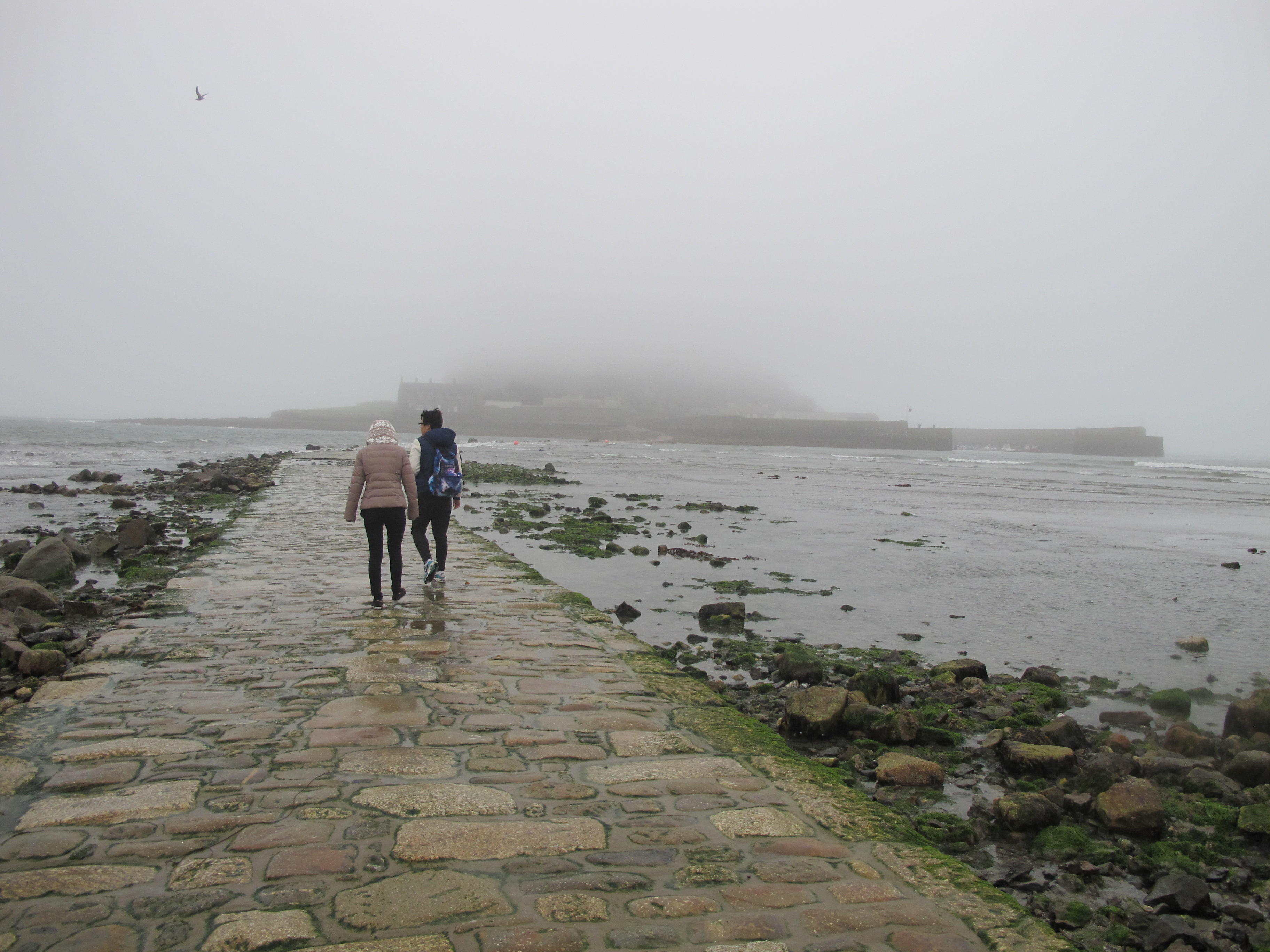
Irrelevant photo: The causeway to St. Michael's Mount, emerging as the tide drops. There's a castle out there, hidden in the fog.

Irrelevant photo: The causeway to St. Michael’s Mount, emerging as the tide drops. There’s a castle out there, hidden in the fog.

Suppose I need a referral from my GP to a specialist and I was supposed to be given an appointment by Wednesday and here it is the Tuesday after that Wednesday and I still don’t have the letter telling me when the appointment is. So I call to ask what happened. I’ve worked out an approach for this kind of situation. I’m polite and I’m relentless. I don’t demand, I don’t insult, and I don’t go away. This is easier to pull off when I’m advocating for someone else, but I can manage it for myself if I have to.

The receptionist says, “Leave it with me.”

Which means one of two things: 1. I will fix this so fast that whoever screwed it up will be dizzy for a week, or 2. I will make a note of this, bury it under a stack of paper, and forget you ever called, because your referral’s still a bunch of electronic blips in my computer but I don’t remember which file it’s in, or which computer, or what electronic means. Furthermore, I have worse problems than you. Don’t call back.

And I’m never sure which. Except for the don’t call back bit. I’m sure what that means.

I’ve learned to ask, “When will I hear from you?” so at least we’ve agreed on a date after which I’m free to make a pest of myself again, but until then I’m helpless. All my polite don’t-go-awayedness? It’s paralyzed by the leave-it-with-me beam of bureaucracy.

In the abstract, I could probably say, “No, sorry, I can’t leave it with you. Gimme my problem back,” but you know that bureaucracy beam? It’s like kryptonite. It keeps me from forming those words.

I did dodge the beam once, when a neighbor was having a medical crisis and D., who’s been a nurse, armed me with a magic phrase: That’s not acceptable. I listened to myself say it and wondered who I’d turned into, but in fact waiting wasn’t acceptable—it was a crisis—and since the phrase was magic it worked.

But you have to be careful with magic phrases. You can’t just spew that’s not acceptable in all directions and under less pressing conditions.

The leave-it-with-me problem stems, I think, from the British medical system’s paternalistic streak. The U.S. system is also paternalistic, but in a different way and—oh, you know how it is: When you’re not used to something, you notice it. The things you’re used to? They’re invisible. And the way they handle medical appointments here? I notice. If you need one, it will all be done for you and you’ll be told when to appear.

What if you can’t make it? You know, if you have to be in court that day or they’ll issue a bench warrant or you have some similar whim you might want to follow? At that point you get to step in and change the date or the time, but you have to wait to be given the wrong date and time before you can step in. And unless your condition’s a crisis, it’ll come by letter.

As far as I can figure out, this is true of both the National Health Service and private-sector medicine. Because that’s how it’s always been done and why change now just because the telephone’s been invented? And that other, even more modern thing, the inter-whateverit’scalled.

In the U.S., I can remember two systems for making specialist appointments. In one, I was given the name of a doctor and clinic (or a list of several) to call and I made my own appointment. In another, I stood at a desk while someone who worked for the clinic that was referring me made the appointment and could talk with me about whether I expected to be under arrest or in court at any given date and time.

In other ways, the NHS is more egalitarian than the U.S. medical system. I just read a nurse’s comment that “everyone is equal in the NHS; I find that amazing. In India, you can’t challenge a doctor, even if he is wrong. Here, a nurse can tell them straight away.” Unless things have changed since I last heard (and it’s not a topic I keep up on), challenges from nurses aren’t welcome in the U.S. yet.

But patients don’t seem to have claimed their power from the system, even if nurses have. So listen up, bureaucracy: I’m registering my complaint. Can I leave it with you?

Making a nice cup of tea

When my British friends seriously want some tea, they get specific about what they want: not just tea but a nice cup of tea.

Let’s take that apart: We can leave a and of alone without destabilizing anything important. But think about the word nice. Because you don’t just have a cup of tea in this country, you have a nice cup of tea. Even when the nice is silent, if you listen carefully you can hear it resonating in the background. I need a nice cup of tea, a nice cup of tea, a nice cup of tea.

And if the cup of tea you get tastes like second-hand dishwater? It’s all the more disappointing, because what you wanted was that nice cup of tea, not this travesty you’ve been handed.

In the U.S., we never sit down to a nice cup of coffee. We drink coffee, we make coffee, we drop by our friends’ houses for coffee, and we go out for coffee. But we don’t expect that comforting nice from it. It’s just, you know, an ultra-fat mocha semiccino with whipped cream and caramel sauce with a side of chocolate chip muffin and a triple bacon cheeseburger deluxe on a sesame seed bun. With mayo.

In other words, it’s no big deal.
Irrelevant photo: wild blackberries

Irrelevant photo: wild blackberries

I don’t know what it says about our two cultures that one seeks comfort from a hot drink and the other doesn’t, but I’ve known people here in Britain to welcome a cup of tea the way I’d expect someone to welcome a stiff drink after a day when the computer blew up, the basement flooded, and the dog filed for divorce; I’ve known them to take the first sip and say, like a borderline alcoholic after a brief flirtation with sobriety, “I needed that.”

Or maybe that’s me I’m quoting. If so, forget it. I’m not British. Or I am, but not deeply enough to count.

So let’s move on. People who expect comfort from a hot drink seem to find it. Point made, in a wobbly fashion.

After nice comes cup. Go into any cafe any you can ask for a pot of tea, and in some for a mug. In most places you’ll get a pot whether you ask for it or not, and all of that is fine, but if the nice gets spoken at all, it comes attached to a cup—one of those curved shells you wrap your hands around while the warmth seeps into your half-frozen soul. The thing you bring to your lips, allowing all the love that went into its making to flow into your metaphorical as opposed to your literal heart. It may have been made in a pot, but whoever made it poured it into a cup for you and that’s what we’re talking about— that cup and its the contents, and by extension the acts of making and handing.

We’ve gone well beyond the rational here. This is about caring and nurturing. It’s about love itself, in an indirect way.

So tea is central to the culture. Does that mean an American can’t march in and make a decent cup? Americans seem to hold one of three opinions:

  1. [Fill in the blank] criticizes my tea-making and always will because I’m American. Even if I do it right, I’ll never do it right.
  2. I’ve been to Britain and read every book ever published on the subject. Tea is my religion and I’ve returned home to convert a refined few among the heathens.
  3. Oh, get over it. It’s just a drink. Wanna cup?

If you’ve been hanging around my blog for any length of time, you can guess which category I’m in.

I don’t know how many categories British opinion falls into on the subject, and that may be for the best. However, in my unbiased opinion, I make a decent cup of tea, and if a friend’s in serious need I can even make a nice cup of tea. It’s hot, it’s strong (except when I make it for M., who drinks it so weak that I just boil the water and wave a teabag through the steam), and under normal circumstances it comes with something home baked.

And with that we arrive to the heart of this post. How do you make a nice cup of tea?

Am I qualified to answer that question? Do I care? Uncertainty hasn’t stopped me in the past, and neither has good sense. I don’t see why they should now. I predict, though, that from here on everyone who drinks tea will disagree with me about something. Have a good time, folks. I’m looking forward to it.

You start with the tea. If you’re American, this is the hard part.

Leaf tea: You can go to a fancy tea store and buy leaf tea, choosing one that was picked before sunrise from plants that have never been spoken to harshly. And you can pay any amount of money you like for the privilege, as long the amount is large. If you live in a tea-drinking country, on the other hand, you can buy leaf tea in a supermarket. No one in sight will know how the plants were spoken to or when the tea was picked. But it’s tea.

Wherever you buy it, try a few kinds and see which one you like.

Which means you have to brew it, and the first trick is to avoid stuffing it into anything that won’t let the water flow through. I’ve tried a variety of brewing gizmos over the years and most of them are as useless as stuffing the leaves in an old sock, and that includes the cloth or paper gizmos that imitate teabags. Why you want to avoid teabags and then use something that imitates them I don’t know, especially when they don’t work as well as the teabags you’re avoiding. (I am going to catch such hell for saying that. I can hardly wait.) Choose the wrong gizmo to stuff your leaves into and you’ll end up with expensive tannish water.

Open baskets do work—in this barbarian’s opinion.

In Britain, a lot of the cafes that use leaf tea dump it directly into the pot and give you a strainer, which comes with something to rest it on so you don’t end up splattering teadrops everywhere. Because the leaves are swimming around in the water, you don’t have to worry about whether the water’s flowing through them. The tea will be good and strong, but if you’re slow about drinking it, it’ll turn bitter. Some cafes give you an extra pot with hot water to thin it out with once that happens, but even with the extra water it sometimes gets strong enough to make you grow hair on your tongue.

Teabags: British supermarkets sell more kinds of teabags than they do baked beans, which is another way of saying you have a lot to pick from. If you’re in the U.S., your choices are limited. You can buy Twinings or something along those lines—one of those brands that entombs each teabag in a little plasticky-foily packet so you’ll understand how special it is, and how special you are to have bought it. I hate Twinings. Which—according to Kate Fox’s Watching the English—is because I’m not upper class. The lower classes drink their tea strong. The upper classes wants theirs to be as refined as they (think they) are, so their tea has to be pale and (lack-of-objectivity alert here) flavorless. So if you’re American and you like Twinings, go ahead and drink it and know that you’ve got more class than I have. Or want, thanks.

When I lived in the U.S., I bought Lyons tea from an Irish store near us and it was strong enough to turn my hair gray. Just look at the photo I use. Back when I drank coffee, I had (mostly) black hair. But Lyons is great stuff. If I hadn’t been able to get that, I think I’d have gone for Lipton’s rather than Twinings. At least it has some oomph to it.

Do I use leaf or teabags? Teabags. I used to keep some leaf tea for special occasions but the tea I made with it was never as good and how’s that a way to celebrate?

Water: This is the other ingredient in tea. If you want, you can use bottled water and it may or may not make your tea taste better. It will be more expensive. Your choice. You can use a kettle or a pan to boil it. If you’re in Britain, you’ll almost surely use an electric kettle because it’s fast. You’ll use it so often that you never put it away. If you’re in the U.S. you can still use an electric kettle but only if you’re willing to invest some time in the project. I grew old waiting for electric kettles to boil in the U.S. I’d have been 56 if I’d just put the water on the stove, but no, I had to buy an electric kettle and so I’m 68.

I have no idea why American electric kettles take so long.

What you can’t do is stick the water in the microwave. Even if it’s in a nice cup. Because microwaves don’t get the water not enough. The true secret of a nice cup of tea is that the water has to be boiling when you pour it over the tea. Or, okay, if it stopped boiling 30 seconds before I get to it, I don’t quibble, I just pour. But if it didn’t boil, or if it boiled back when my hair was black, it’s not worth using.

Do you have to warm the kettle? In my book, it depends on how cold the kettle is. Which depends on how cold the house is. If it’s cold, pour a little of the water in it, slosh it around, let it sit if you want to, warm the thing up, then pour the water out and make your tea. And if you’re making a single cup? I’ve never stopped to warm a cup, although it makes as much sense as warming the kettle. And the tea’s been fine, thanks.

I’ve read that you shouldn’t reboil the water because all the air goes out of it, or all the—oh, I don’t know why you’re not supposed to do it. You’re not. All the experts agree. So put in as much as you need and no more.

How long do you brew it? Well, how strong do you like your tea? I remember a huge ad in Paddington Station saying that after five minutes tea was stewed, not brewed. Stewed tea is bad. Why? Because a huge poster in Paddington Station said so.

I don’t leave my tea that long unless I wander off to do something else and forget it, in which case it may be as much as ten minutes before I wander back. If I’m in a hurry, I stir it. What you (and you’ll notice how seamlessly we’ve switched from me to you here) don’t want to do, if you’re using teabags, is squeeze them. It makes the tea bitter. Really. It does. Just lift them out, all dripping and nasty. Or leave them in, but if the tea’s going to be sitting a while, you may end up with a hairy tongue.

Add milk. Or milk and sugar if you feel strongly about it. Then sit back and enjoy a nice cup of tea. With love.

How people find a blog

Let’s talk about search engine terms. No, I’m not going to hand out blogging advice. You won’t find any advice here that you’d want to follow, on blogging or any other subject. What I want to explore is that strange and lovely world of search engines and algorithms and other things I don’t understand, about which I want to ask the following profound question: What the hell are they thinking?

I know, thinking’s the wrong word. Algorithms don’t think. Someone does, though. A human mind, with an actual human being attached to it, programs these suckers and sets them loose on the world trusting that they’ll connect the right question to the right answer.

Or not caring if they do.

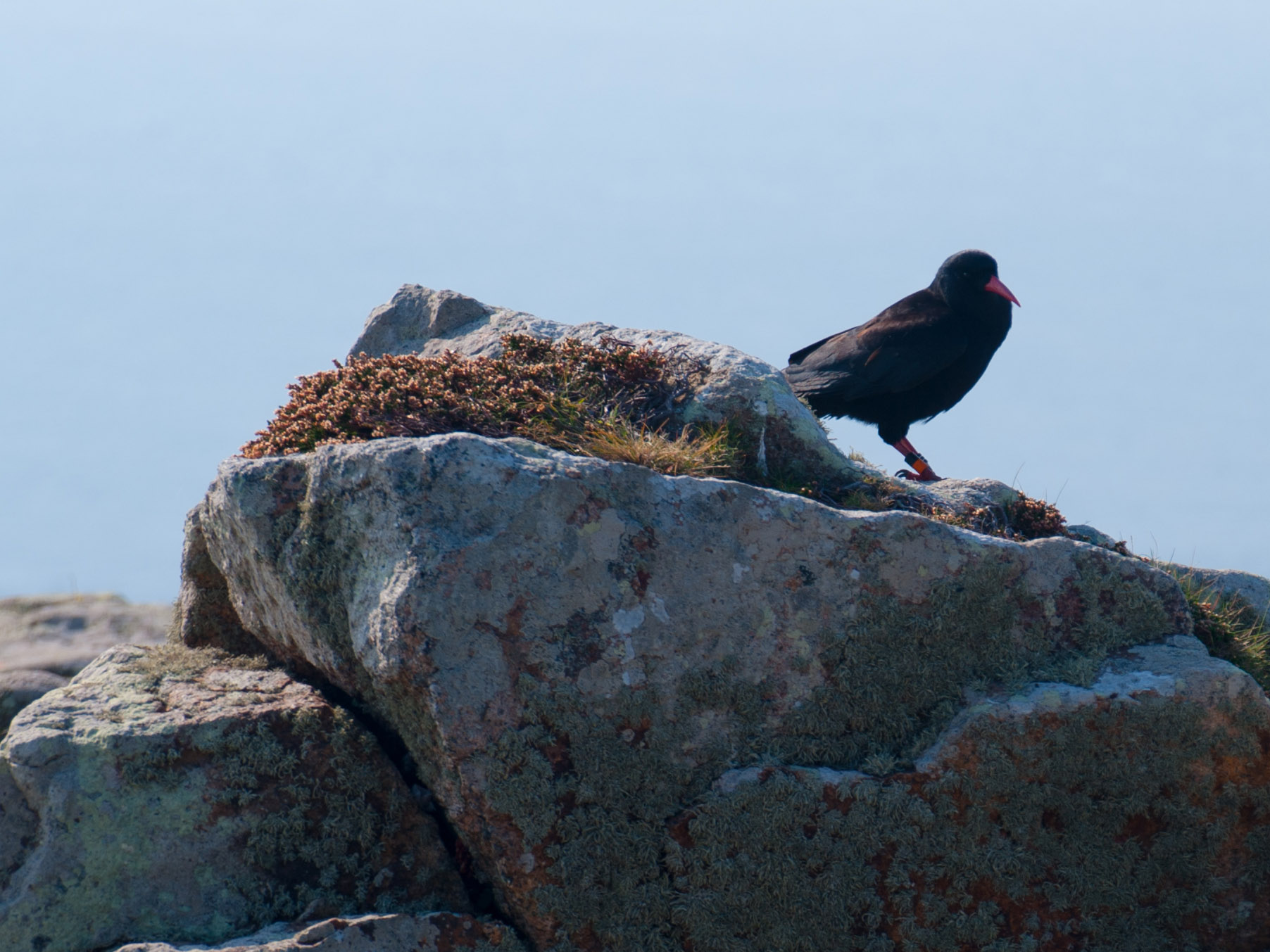
A chough, pronounced "chuff," Cornwall's official bird. It was driven to extinction in Cornwall, but a few years ago a pair flew over from Ireland and nested successfully, and a handful can now be found. Those who know are keeping their locations secret. I know and I ain't telling. Photo by Ida Swearingen, who ain't telling either.

A chough, pronounced “chuff,” Cornwall’s official bird. It was driven to extinction in Cornwall, but a few years ago a pair flew over from Ireland and bred successfully and a handful can now be found. Those who know are keeping their locations secret. I know, at least vaguely, and I’m not telling. Photo by Ida Swearingen, and she isn’t telling either.

And then there are the people who type some of these terms into Google. Spare a moment to wonder what they’re thinking as well.

So here’s how people found Notes from the U.K. (I’ll do a separate post on vaguely relevant search terms. Sooner or later.) They typed in (with Google’s lower case format carefully preserved):

good comments with u: All my good comments contain that letter. Except this one. My bad ones? They don’t.

who are the bigwigs in legal highs: . Okay, I’m pretty clear on what this poor kid was looking for and can make an educated guess or three about what they planned to do with the information. And they were so disappointed to end up in the middle of a discussion of lawyers’ wigs. Sorry, kid. Now get off the internet and go finish your homework. And remember to use the letter u.

kittens dash into rooms they shouldn’t: Rooms and dash are clear enough to work with, but we need a definition of shouldn’t. They shouldn’t because they’ll get scolded? Because they’ll get eaten by the Minotaur? Or the Merrimac? Anyway, we need to define the term. And we need video, which I don’t do. And come to think of it, how young a kitten do they want to see? So I was a disappointment here. I do have a page of kitten pictures, which I haven’t updated lately now that I think about it, but I can’t imagine I’m high up the Google list. How many web sites and blogs did the googler go to before being disappointed by mine? What is it about kittens and the internet that someone went through that many links looking for this?

dog poo for rubbish collection Cornwall: For this, they need to contact the county. Unless they’re looking for dog poo itself. If they can convince me it’s a good idea to donate it, we have plenty. And a nice collection of the cat variety as well. But, well, I will need convincing.

Sumerdress: These are what they wore in Sumeria? Sorry, this isn’t a fashion blog.

kitten club: I can make a fair guess about which regular readers would  join, but I don’t know where to refer them. And a kitten a month? It’s too many. No matter how cute they are. Plus it’s wrong to ship them. They need to be hand delivered, lovingly.

notes of the kettle: This was weird enough that I googled it myself and was, sure enough, led to one of my posts, “Putting the kettle on,” as well as to notes from a community meeting that included the subhead “Vott is kettle,” which is all about JavaScript. Why is said “vott” instead of “what” is a mystery. Or maybe “vott” isn’t a mispronunciation of what but some arcane bit of geek speak. You know: “I’m going to vott your computer now. Stand back.” I’d love to give you a link to this so you don’t think I made it up, but I didn’t copy it down at the time—I was too busy being baffled—and it won’t come up again, but if you want to buy a whistling kettle, several of those links popped up. I think it was when I typed in “vott is kettle.” The connection’s obvious, isn’t it? The kettle whistles and you run into the kitchen yelling, “Vott iz itt dis time?” (Sorry, my phony accent’s a bit woozy. I’m not sure what language group I’m supposed to be imitating and I doubt I’d get it right if I was sure. Normally I wouldn’t stoop to making fun of someone’s accent, but it’s justified this time. Necessary even.) You can find out about Kettle Knudson, who’s either from or visited Bemidji, Minnesota, I’m not sure which, but the story’s in the Bemidji Pioneer. On this I could give you some links but not having them introduces an element of randomness that’s way more fun. What does it all mean, bartender?

tumblr pics of fully clothed grandmothers: I hardly know where to start with this one. Is a website somewhere offering pics of semi-naked grandmothers? And if there is, how do we know the pictures are of genuine grandmothers and not women like me, of a grandmotherly age but without grandchildren, which by any definition I understand disqualifies me from grandmotherhood? I mean, how much less of a turn-on is it once you know the background’s been faked?  You won’t find me on any site of that sort. Not only won’t I lower myself to pretend I have grandchildren but because my clothes are tattooed on, so I’m always fully clothed. Even in the shower. So, how did they find Notes with that in the search engine? The only one of these words I remember using is of, although it’s not impossible that I said everyone somewhere or other was fully clothed. It sounds like me. And in many of the places I go, including the supermarket, they are. Time after time. In fact, even as I type this, I’m fully clothed. It’s chilly in the morning at this time of year. I only frighten the neighbors in warm weather. As for what the googler was looking for, I can only speculate. And I’m not sure I want to.

The fluid ounce and the British passport

A friend in the U.S., L., recently sent me an American measuring cup. I’d asked for it because early in my blogging career I read on an expat blog that the British pint contains one more fluid ounce than the American pint. I tucked that information away in the back of my screaming brain to ponder at some time in the future when I suddenly become competent with numbers.

That’s another way of saying, I ignored the information. Even when I’m working with imperial measures, I don’t measure things by the pint, I measure them by the cup or the fluid ounce. But it nagged at me. What, I couldn’t help wondering at 3 a.m. when my brain was fizzing and the kitten had noticed I was awake and decided to see if he couldn’t sleep inside my nostril, if the ounce itself is different?

Nah, I told myself once morning came, my brain settled down, and the kitten had wandered off to play with the dog. They couldn’t do that to me. I’m a citizen.

Irrelevant photo: Corfe Castle, in Dorset.

Irrelevant photo: Corfe Castle, in Dorset.

I had good evidence for this. Not only a British passport, which they don’t hand out to non-citizens, but the fact that my American recipes work, even though I made every last one of them using British measuring cups.

Except cornbread. That doesn’t work. I’ve tried two or three recipes since I moved here, using cornmeal I brought from the U.S., and none of the results were worth eating. But okay, cornbread’s an American dish and doesn’t cross borders. I accepted that. Everything else was fine.

Except, irrelevantly, tomato sauce, but I don’t measure that, I just kind of combine it. Besides, it’s edible, just not the same as I made in the U.S. The canned tomatoes are British. Even the ones that claim to be Italian. That’s the only way I can account for it.

But back to ounces. I’ve been blogging since—oh, since whenever I started. A year ago? More a year ago? Have I explained that I don’t do numbers? Counting to one is beyond me. So it’s been something vaguely related to a year. Although the British year may be longer than the American one, so what does any of this mean, really, in the great scheme of things? The minute itself may be longer. I’m not about to split hairs.

However long it’s been, that’s how long it’s taken me to think, Y’know, maybe I should check on this fluid ounce thing. And so I asked if L. would send me an American measuring cup, and when she did I poured some water back and forth from hers to a British one and it didn’t come to the same marks.

I poured the water out, put both measuring cups in the drying rack, and refused to believe what, between them, they were telling me. I repeat: I’m a citizen. They can’t do this to me.

I tried again a couple of days later and got the same result, and I responded the same way, except that this time I thought, Maybe if I tried it with milk it would be different. Because milk’s white. It’s easier to read. It would give me the answer I wanted.

Finally I emailed L., explaining some of this (I hadn’t thanked her yet, so it was high time), although I made an effort to sound marginally saner than I do here, and she sent me a link. It turns out the British fluid ounce is 0.9607599ths of a U.S. fluid ounce. That just rolls off the tongue, doesn’t it? It’s exactly the kind of number the average home cook can work with.

This information, I decided, must explain the difference between the number of ounces in the British and U.S. pints—someone added the extra ounce so the pints come out even—and off I trotted to Google to confirm my insight.

Nope. The British pint equals 570 ml and the U.S. one equals 470.

Can you hear me screaming? One of the things I’m screaming is that you have to translate this mess into metric in order to compare it. Without the metric system, we couldn’t even discuss it, because in imperial measures it falls off the edge of the English language. We’d be reduced to pouring water on the floor and comparing the size of the spills.

So thank you for the measuring cup, L. I appreciate it and as soon as the medications and the meditation restore my equilibrium I’m going to make another batch of cornbread. My cornmeal’s only eight years old. It should be fine. And if not, what the hell, I got a blog post out of it.

And since we’re not discussing this, I should ask if you’ve noticed that expat is nothing but a fancy word for immigrant. 

Of dukes and baronesses and scamsters

In September, Alexander Wood was in court for having posed as the duke of Marlborough (there’s a real one; I just checked) and for having run up a bill in the neighborhood of £10,000 at expensive London hotels. No one asked him for identification because they thought it would be “inappropriate to ask.”  I mean, this is (purportedly) a duke, after all. You don’t do a stop-and-frisk on him, and you don’t ask for i.d., even when he runs up a huge whackin’ bill. They did eventually get suspicious when he bought drinks for fellow guests—something I gather no aristocrat would do.

Setting aside this one person’s motivation (the article makes it sound, not surprisingly, like mental health comes into it), Britain does tempt a person to borrow titles.

Irrelevant photo: teasels

Irrelevant photo: teasels

When I went online to donate the money from our village fundraiser to the Red Cross, I was offered a choice of Mr., Mrs., Miss, Ms, Doctor, Lady, Professor, Reverend, Dame, Sir, Major, Captain, Lieutenant Colonel, Colonel, Sister, Lord, Canon, and Other. Oh, wheee! I lost my nerve before finding out whether Other would have given me a blank space to fill in the title of my choice, but I expect it would have.

As an aside, I was once called a dame, but no one mistook me for an aristocrat and no hotel bill was involved. And it wasn’t a compliment.

The Guardian’s subscription form despairs of coming up with a complete list and just leaves a blank line, where you can play as much as you dare. You want to be a general, or the Lord Mayor of Mill Crick? Feel free. Then sit back and see if your correspondence is addressed appropriately. And complain when it isn’t.

Why the blank instead of the list? I can’t help picturing some committee trying to list everything necessary to this title-obsessed land and sinking under the weight of the task. Why, for example, include Colonel but not General? And since this is the Guardian, a generally leftish and egalitarian paper, what about Private? Don’t privates deserve the respect of their title? And since the women members of the House of Lords are addressed as Baroness (something I happen to know because I’ve written letters to a fair few of them, and there’s a tale of its own), doesn’t that merit a mention? Or does Lady cover it? I haven’t a clue. If they’re Lady Whatsit, even though you address them as Baroness, what do they address themselves as? And what about the Barons? The male members of the House of Lords are Lords, not Barons. No, I don’t understand it either. But there are real barons out there, aren’t there? Granted, they probably don’t read the Guardian, but what if they wanted to?

And what about all the Lord Mayors dotted around the country. And the Counsellors: Spare a moment’s thought for all those long-suffering folks who sit on Parish Councils around the country, doing their unpaid and non-party-political bit for the most local level of local government? And Citizen. It was a popular title during the French Revolution. Give it half a chance and it could catch on again.

You can see the problem. Either the committee voted for the blank line and fled or else they’re still meeting, trying to complete the list, sinking deeper into despair with every passing week. Several of its members have been hospitalized for stress and clinical-level nit-picking.

This is what happens in a status-obsessed society. Everyone with a title needs to be recognized, placated, bowed to even.

And on the lowest level, where the rest of us live our lives? I still can’t get myself called Ms. Instead of Mrs.  No matter how often and politely I ask.

How to be British

P. and S. sent me a clipping from their local paper, in which columnist Ericka Waller, moved by the refugee crisis, kindly offers newcomers an eight-point guide to being British. I won’t cover all her points—that dances on the border of copyright violation, not to mention bad manners—but I’ll paraphrase a couple of them. Read the rest for yourself, because you need to know this stuff, even if you’re not British and have no intention of being. And even if you’re already British. With the government’s emphasis on British values these days, you don’t want to give someone the wrong impression, do you?

Besides, it’s a good article.

It may be irrelevant, but it speaks for itself.

It may be irrelevant, but it speaks for itself.

Point number 1: To be British, you must greet people by asking, “How are you?” but if they ask you the same question the only possible answer is, “I’m fine, thanks.” If you say you’re wonderful, you’re being a showoff. If you say you’re terrible, you’re moaning.  If you follow that by going into the details of your toothache or unpaid bills, you’ll either scare people or embarrass them. Or both. People don’t ask because they want to know, they just want to seem polite. Emphasis on seem.

The how-are-you? rule shares a common root with American greeting rituals. We (that’s Americans) ask without remembering that it’s a real question, although we do allow room for someone to say, “Wonderful,” or, “Tired, thanks,” or something along those lines. We also appreciate an occasional twist in the answer—something along the lines of  “better than nothing.” But your toothache? Your unpaid bills? The thousand ways your life’s threatening to fall apart? Nope. We don’t want to know either.

When Wild Thing first started to work as a therapist, she’d occasionally run into clients out in the real world, and if they greeted her she greeted them back. (If they didn’t, she walked on. Being a therapist is—says me who’s never been one but was in a position to observe—deeply weird.) She had to learn not to ask, “How are you?” because in the relationship they’d established that it was a real question. Some people would actually answer. In the middle of a supermarket aisle.

On the flip side, I went to the doctor once about I can’t remember what, and when she walked in and asked how I was I automatically said, “Fine. You?”

She managed not to slap her forehead—or mine—but I expect she wanted to. Imagine that happening to you twenty times a day.

Point number 2: To be British, you must also tut and learn to respond to tutting. “Nothing says Brit like a disapproving tut,” Waller writes. “As you finish the tut, raise your head slightly and roll your eyes elaborately to the heavens for extra punch.” And if someone notices and asks what’s wrong, deny everything. You’re not allowed to explain a tut or say how you actually feel.

As a rule, Americans don’t tut. Or I don’t think we do. But my understanding of the subject is colored by—how am I going to explain this to you? I don’t do well with subtle. If you want to insult me, you need to be clear or it’ll go over my head and where’s the fun in that?

This was a problem in Minnesota, where the official language is Indirect English. Wild Thing was called into service periodically to interpret for me. So maybe I’ve been tutted at all my life and didn’t notice. But I don’t think so. I think we leave the tut, like the tea, to the British.

I’m only aware of British tutting because I’ve been reading about it, both in Waller’s article and in Kate Fox’s wonderful Watching the English. So this is a nation that not only tuts but writes about tutting and ponders the deep cultural meaning of tutting. It wouldn’t be too much to say, the philosophy of tutting. This is a nation that cares about tutting.

The tut is powerful here—or so Fox says. Someone jumped the queue? If they’re British, a lone tut will be enough to shame them back into place. And in case you’re American, you need to understand that a queue is a line, and standing in line is the real British national religion. The Church of England? That’s for show. So we’re talking about someone violating the country’s most sacred principle. And a tut will be enough to remind them of it.

It sounds as if Fox differs from Waller on the tut’s power, but underneath there somewhere I expect they’d agree that it’s power comes from not needing to be explained (or something along those lines—we’re getting into murky waters here) and it will be understood regardless of how much it’s denied.

It’s a wonder this country’s let me stay.