If I haven’t worn out your patience, here’s another review of The Divorce Diet, this one from Judith Collins, at BookLikes.
Another Divorce Diet Review
8


If I haven’t worn out your patience, here’s another review of The Divorce Diet, this one from Judith Collins, at BookLikes.
Monday: We have a mouse problem. At least we think we do. The four-legged residents are paying a lot of attention to one corner of the spare room.
Let me be clear about this. We have two cats. Two of them. Enough, you might think, to vanquish even the wiliest of mice, but no, it’s the dog who usually gets rid of them. The dog who looks like a wind-up toy dreamt up by a particularly extravagant little girl. And not some tough, tree-climbing little girl, but the over-the-top stereotype of a little girl in the pink princess dress, complete with the wings and the wand. If she got the job of inventing a wind-up dog, Minnie to Moocher is the one she’d invent.
Never underestimate a foo-foo little dog. Or a girl in a pink princess dress. She—that’s the dog, now, not the girl—is a stone cold killer.
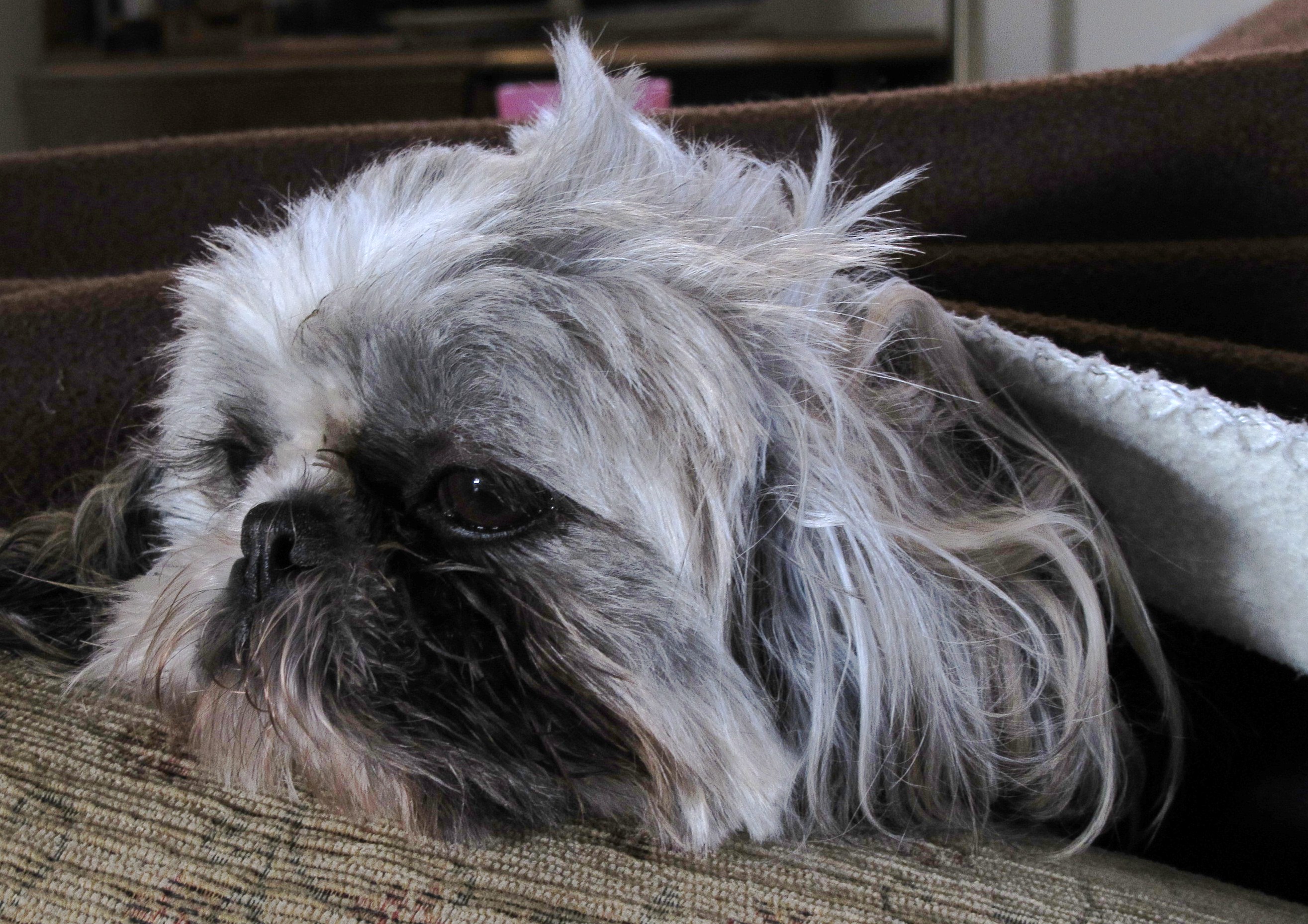
Minnie the Moocher, also known as Killer
But we have to start back a way. We live in the country. The weather’s getting cold. Mice are surely looking for a nice warm place to bed down for the winter, but that’s not how the current one got in. I’m sure of that. Our younger cat, Smudge, brings them in. He wants to start a captive breeding program. We’ve discussed this with him, but have you ever tried arguing with a cat? Save your breath. They’re always right. He thinks like a feudal king: Once he stocks the forest—or the back room—with enough game, he’ll keep himself amused forever.
The little horror is one hell of a hunter. When he was younger he brought in birds, mice, voles, rats, and moles, some dead and some living. I’m not sure which were worse, the ones that were so mangled we had to kill them or the ones that were so unmangled that we ended up crawling all over the house, throwing furniture as we went, while we tried to catch them.
One of the rats was in perfect health. He’d brought it in courteously and left it to explore its new surroundings. I was nowhere around, lucky me—I think I was doing the book tour for Open Line—and it took Wild Thing a full day but she finally killed it by bashing it with the bread box. The hunt involved a lot of yelling and some interesting language, none of it on the part of the rat.
Wild Thing did not get her name by accident. And I really do call her that a good bit of the time.
When we found the second of the moles, it was trying to dig its way out through a wall. It’s almost a swimming motion, the way they dig. I got a plastic box with a lid and Wild Thing got the heaviest pair of gardening gloves she could find. She lifted it into the box, it tried to bite her, I put the lid on, and we drove it to a nearby field. The whole time it was in the box, it kept making those swimming motions, digging its way to freedom. When I let it go, it hit the earth still digging.
I’m a city girl so I don’t really know, but I hope the farmer didn’t mind an extra mole in the field.
When we have to catch living creatures, I’m no worse than Wild Thing. Okay, I’m not much worse. She’s bolder about it, but at least I’m useful. I am squeamish, though, about the wounded and the dead, and for the most part I leave those to her. It’s almost fair. She’s squeamish about cleaning the litter box or dealing with cat vomit. But when she had ankle surgery (which has happened three times now, and she only has two ankles) I’ve had to get over it. The first time, post-surgery, that I looked at a mangled but still living bird, I asked myself, Could you kill it if you were being chased by a bear?
I admit, the question makes no sense. If I were being chased by a bear, killing a wounded bird wouldn’t be at the top of my to-do list. I mean, how would that help? But it did focus my mind. I pulled myself together, took the poor thing outside, and bashed its little head in. It was quick and it was the best I could do for the poor beast.
I dealt with the dead and the mangled for many long weeks. Then Wild Thing started moving around without crutches and I got squeamish again. Funny how that works.
These days, Smudge doesn’t bring his prey home as often, and what he does bring is more likely to be fully dead, and if I find the corpse first I can make myself throw it away without waiting for Wild Thing to play undertaker. I use a broom and dust pan, then wash my hands as thoroughly if I’d just juggled a dozen dead rats and then gutted them, but still, I do get rid of it.
Wild Thing picks ‘em up by one foot or the tail.
Tuesday: We haven’t caught the mouse. For the past week, Wild Thing has had some kind of bug that involves waking up at 3 a.m., turning on the light, and coughing for half an hour, so she’s been sleeping in the spare room—the mouse room. Unless (we haven’t seen it yet) it’s a rat. Last night, when she went to bed, she heard some rustling in the corner.
You have to understand something about our spare room. It’s not large, but it does contain a single bed, a bedside table, a tall, narrow chest of drawers, a computer and computer chair, roughly 150 copies of the village calendar plus a box of envelopes for them, 196 plastic sleeves to protect exactly 4 posters for the village calendar, the prototype of the Soyuz space capsule, manuals for every piece of computer equipment that ever passed through our lives, most of which we no longer own, and a cement mixer. Plus a full-size Cornish gig, with all six oars.
I may be exaggerating, but I flinched away from taking a true and unflinching inventory. There’s a bunch of stuff in there, okay? And a mouse. Or quite possibly a rat.
Wild Thing, as I think I’ve already established, is not faint of heart. Her mother once faced down a pawing, snorting bull armed with nothing better than a broom, and won. Wild Thing is worthy of her heritage. But, c’mon, she was going to be asleep. And a rat—well, we both New Yorkers enough to know that rats are capable of crawling up to a sleeping person and taking a bite if their lips have a trace of food, and she’s been living on cough drops. When I say her lips are sweet, I’m not talking being romantic.
When she heard the rustling, she called out to tell me about it, at which point Smudge the mighty hunter went out the window.
I will say in his defense that he’s as sleek and beautiful as any cat, and as self-involved.
Wild Thing went into the living room, where Minnie and our older cat were still sprawled in front of the wood stove. She picked up the Minnie (who’s not allowed in bed), and took her to bed.
There were no rats in the bed that night. By the time Smudge joined them later in the night, there wouldn’t have been room for one.
The older cat is around 17 and never was much of a hunter. She killed a bird once, and Wild Thing took it away from her. She’s convinced Wild Thing ate it herself and she gave up hunting.
Wednesday 10 a.m.: After I wrote Tuesday’s section of this post, we set a trap, closed off the spare room, and caught nothing. As I type, Wild Thing’s tearing the room apart (I just heard a small avalanche; it sounded like paper mixed with broken crockery). Any minute now she’ll check the cement mixer and see if the mouse bedded down there. I expect it moved into the kitchen, though, or the living room, before we closed the room off. On Saturday we have a bunch of people coming over for a delayed Thanksgiving. Last year a mouse crashed the party and provided no end of entertainment. I’m hoping it doesn’t turn out to be an annual event.
Wednesday 4 p.m.: The spare room has a floor. I hadn’t known that. Everything that used to be on the floor is now piled on top of something else and looks frighteningly well organized. If you don’t look too closely. But what matters is that there were no traces of mouse or rat. What Wild Thing found was a set of wings. (Smudge is known for leaving wings, or the heart and lungs. What can I tell you. He’s a fussy eater.) I don’t want to think too hard about what Wild Thing heard and what the story of the kill was, although I’m sure Smudge would be not just happy but proud to tell the tale, in full detail and bleeding color.
We hope to get through our mis-timed Thanksgiving party without a mouse this year.
For the Americans reading this, hope you had a fine and mouseless Thanksgiving.
N. read last week’s post on toilets and emailed to say that “toilet has a very lower class cachet in current English. Loo or lavatory are the posh versions, just like sofa vs. settee, sitting room vs. lounge, tea vs. dinner, dinner vs. lunch.”
I’ve heard some of those pairings before but have trouble keeping track of which word is high on the class scale and which is low—an incompetence that I kind of enjoy. Let’s face it, it’s all arbitrary and snobbish.

Cornish Engines. The abandoned mine shafts they mark went out under the sea.
The distinctions are equally arbitrary in the U.S., but the silliness we grow up with has a way of looking like perfect sense. When I was a kid, lunch was the down-to-earth meal. Dinner stuck its nose in the air and demanded white tablecloths (not to mention cloth napkins), and it was the evening meal anyway, which we called supper. I not only thought all that made sense, I thought it was fixed for all time and all places and all people. Where Wild Thing grew up, though, dinner was a big midday meal, something you’d have on Sunday, after church, and I’m sure that seemed just as inevitable and fixed.
Then we moved to the U.K., where the things people take for granted are completely different. Settee? To me that sounds fancy, as if I dropped into a Victorian novel. Sofa sounds more ordinary, although I call the thing a couch and it sits in my living room, since I don’t have either a sitting room or a lounge in my vocabulary.
And tea as a meal? When someone talks about eating tea, I get a mental picture of someone struggling with a knife, a fork, and a cup of liquid. I know that’s not what they mean, but no matter how often I hear it, that’s still what I see.
I like it when my vocabulary sets me outside some of the entrenched divisions. True, it sets me deep in the trench of another division, American vs. British, but I’d be there anyway.
I can’t prove this, but I have a hunch that, compared to their U.S. counterparts, the British upper (and, I guess, middle) classes spend an awful lot of time, and find more ways, to establish their separateness (and I’m sure they’d say superiority) through their use of language. It’s an interesting bit of sociology.
Both cultures, though, do their best to avoid saying what they mean when it comes to human waste. Toilet comes from the French word meaning a cover for clothes (toilette). From there, toilet became first the act of dressing, then a dressing room, and eventually that room with plumbing that polite people don’t mention. So basically, it started as a polite word meaning that room where we do those unmentionable things. Eventually, the unmentionable things contaminated the polite word and we had to find an even more polite word so we could back away from our meaning again. I mean rest room? What on earth does that communicate?
For what it’s worth, not every culture does this. The Middle English word for the equivalent of toilet paper was arse-wisp, according to the Online Etymology Dictonary. The Middle English did, apparently, say exactly what they meant, at least about this.
And unless someone brings up a fascinating new aspect of this discussion, I’ll stop writing about toilets for a while. Really. It’s not the thing I most love to think about in the world.
I keep promising myself that I won’t post any more links to me-related posts on other sites, and I keep making a liar out of myself. Partly because I’m at least as vain as the next person, partly because I want to promote The Divorce Diet–I really do love the book and I’m doing any number of absurd things in the name of promotion, so why draw the line here? But also because other bloggers have been generous in giving me space on their blogs, and I want to offer them some visibility in exchange. So whatever I may have told you about not posting more links? I lied.
Here’s a new link: Rachel Carrera runs a generous series of author interviews, and mine’s only one of many. Her blog is varied and interesting, ranging from writing to cats to autism and far beyond. Hope you’ll check it out.
Recent and highly unscientific research reveals that you have to do more than move across an ocean to get away from telemarketers.
Okay, Wild Thing and I knew that already. Since we moved here, we’ve been called by people telling us our computer has been affected by such a dangerous virus that the only way to fix it is to read a credit card number into the phone and take a sledge hammer to the hard drive. We get calls from a recorded voice with an urgent message. So urgent that it doesn’t merit a live call. And so on.
On Wednesday, Wild Thing fielded a call that—well, we never did find out what he wanted. Wild Thing picked up the phone and the caller said, “Can I talk to the lady of the house?”
Some of these calls set off reactions we could never have predicted.
“Believe me,” Wild Thing said, in a doom-laden voice, “you don’t want to talk to her.”
She has no idea where that came from—or which of us was the lady he so didn’t want to talk to.
People here commonly use the word lady where we’d say woman. I notice it and I kind of roll my eyes , but in a detached, mildly amused way. And, I should add, an invisible one—the mental eye roll; the virtual one. Sometimes think I should object, but it doesn’t set off any deep reaction in me. You want to call me a lady? I’ve been called worse things, although I’m not sure any of them were more unlikely.
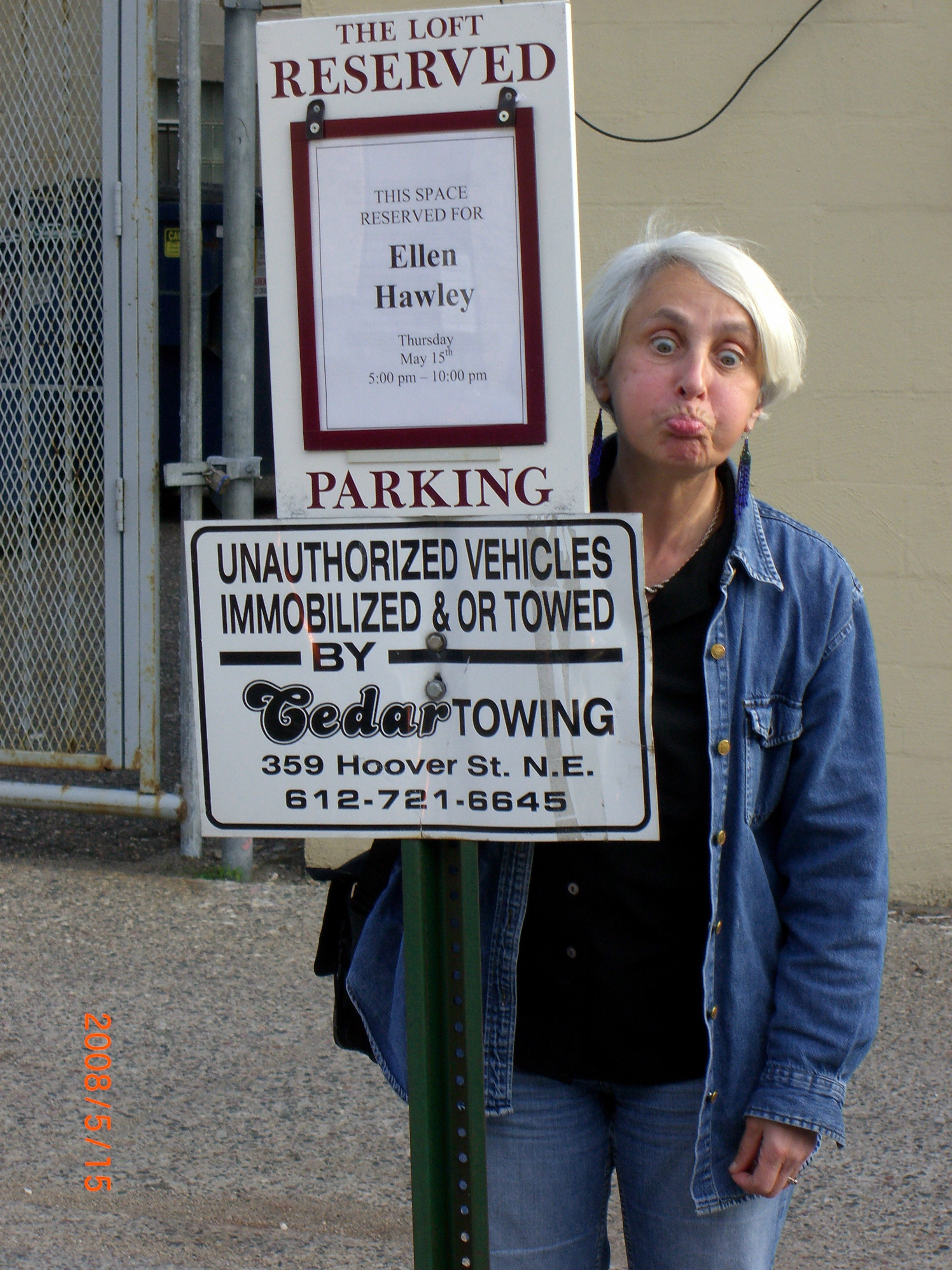
The lady of the house, or one of them, after a reading in Minneapolis, 2008. Photo by Terri Hudoba
In the U.S., the telemarketing calls did set me off. The phone was in my name, so I spent a good bit of time fielding calls for Mrs. Hawley, and very few things push my buttons quite like being called Mrs. Hawley. I can’t entirely explain that, but we can begin by saying that I’m not married and I don’t want to be married, but if I did happen to be married I probably wouldn’t be married to myself. Then I can add that I passionately hate the whole business of women being publicly sorted and addressed by marital status. Top it all off with a hefty dose of I-know-my-reaction-isn’t-helping and throw in a telephone, and even though I told myself over and over not to do it, I’d end up saying, “There is no such person. What can I do for you?”
It was unfair, I know. The callers were following a script. Lots of people we know have worked for call centers, and it’s wrong to make a tough, underpaid job any harder than it already is, but there I was being horrible to the people who read the script, not the ones who wrote it. I knew that. I pledged to reform. And then the phone would ring and off I’d go.
Oddly enough, now that I’m living in the U.K., I’m less rabid about being called Mrs., even though it happens more often here. This isn’t my native culture. It can’t touch me as deeply. That makes no sense, but it’s the only explanation I can offer. It still pisses me off, but I’m more distant about it, and less vocal.
Plus the phone isn’t in my name. That helps.
The lady of the house, though? Sorry, she’s in the back, and the maid’s helping her with her lace gloves. Can you call back when the butler’s available to take a message?
Thanks to everyone who got back to me about whether the extra click would be a problem if the email you receive only carries the beginning of my posts instead of the whole shebang. The comments were useful, and enlightening, and guilt inducing. Because even though a couple of people said the extra click was a pain in the neck, the number of visits to the blog went up. And the gods of blogdom like visits. I do want to keep everyone happy, but the gods must be appeased. So at least for now, I’m going to keep the opening-only format for emails. I hope you’ll click through to the rest of the posts. And I hope you’ll love me anyway.
Or–to hell with love–I hope you’ll read me.
One of the things that impressed me when I first visited Britain was that they had public toilets. Not just along the highways, where I’d learned to expect them, but in towns and villages and cities. I mean, do I resonate with the romance of the place or what? Forget your castles, your prehistoric monuments, your green and pleasant land. Will you look at those toilets? An entire nation had noticed that humans have this recurring, messy, polluting need and had responded logically.
Well—as the kids on my block used to say—holy shit.
I grew up in New York, where if you’re out on the street and need to pee ( or anything else along those lines) you’re—oh, I can’t help myself: shit out of luck, because New York doesn’t do public toilets. You need one? Sorry, that sounds like a personal problem. You can’t expect the city to solve it for you.

Deeply Irrelevant Photo: Fountains Abbey
If you have money, the problem’s manageable. Money has that effect on a lot of problems. You duck into the lobby of a hotel and head for the toilet (which, this being the U.S. and all, is called the bathroom), and if you’re dressed well enough and act like you belong there, you won’t be challenged. Or you stop someplace to buy a cup of coffee and you use the toilet there. That’s a solution that carries its own problem, since you’ll need another cup later on to get rid of the first one, but still, it’s doable.
If you don’t have money—well, that’s one reason so much of the subway smells of urine. I remember seeing a woman at a bus stop simply straddle the curb and let a stream loose from under her skirt. I was torn between shock and very reluctant admiration.
On my first visit to Britain, when I was so impressed with those public toilets, I didn’t find it easy to say “toilet” instead of “bathroom.” I’m American, and was even more so back then. Americans don’t say “toilet” if we can help it. In fact, I was in a café and asked someone who worked there where the bathroom was. She must’ve thought I was going to tear my clothes off and jump in a tub of hot water, because she did a visible double take. I made myself say, “Toilet,” but it didn’t quite repair the damage. She was in no shape to put words together, but she did manage to point.
In Britain, a bathroom has a bathtub. If it has a shower instead, it’s a shower room. If it has neither, it’s a toilet. Even after eight years, though, I feel crass when I say “toilet.” Much more so than when I say “shit.”
The human brain is a wondrous and baffling thing.
These days the U.K. has a government dedicated to cutting the deficit by cutting waste, and—okay, you see the pun coming, don’t you? I can’t help myself. It’s true. The talk’s all about reducing waste, but the reality is about public services crumbling: the health service underfunded, libraries and various kinds of community centers closing, all sorts of infrastructure not being maintained, and yes, toilets closing. Food shelves—which weren’t needed when I first moved here—are springing up and much in demand. A lot of the cuts are being pushed down to the local levels of government, which depend on the central government for a lot of their funding. Since that’s been cut, they have all the fun of deciding what to cut, and they get blamed for cutting it, since they look like the bad guys.
In our village, we initially heard that the county would be closing the toilets by the beach. The parish council entered into endless negotiations over how to keep them open and who’d bear the cost and who’d own them and who’d committed to a long-term cleaning contract that either would or wouldn’t have to be carried over by whoever either did or didn’t own the damned things.
And so on.
It went on for a long time, and in the end the village managed to keep them open. Not only does the cleanliness of the beach depend on them, but so do two local cafes. But not every village or town has managed to find the money, and many toilets have closed.
Maybe it will teach us all to rise above their physical urges.
Let’s hear it for cutting waste, folks.
If you’re following Notes, you may have noticed that I just switched the layout so that now you only receive the beginning of the post, along with assorted Link buttons, instead of the whole thing. Or I think I’ve switched it. I’m never sure, once I start clicking various options, that I’ve done what I set out to do. I’d love to know what you think–or whether you care at all. Are you as likely to read the post as you were before? Is it a pain in the neck?
Either I’m engaging in antisocial behavior or I’m the last defender of decency in Cornwall. Some days it’s hard to tell.
Wild Thing and I live on what’s called the estate. If you’re American, that sounds all grand and Downton Abbey, but what it really means is “the subdivision.” We live in a tiny fragment of suburb, even though we don’t have a city to be suburban to. Our village is spread out—a village without any center—so this is the most densely populated bit. By dogs as well as humans.
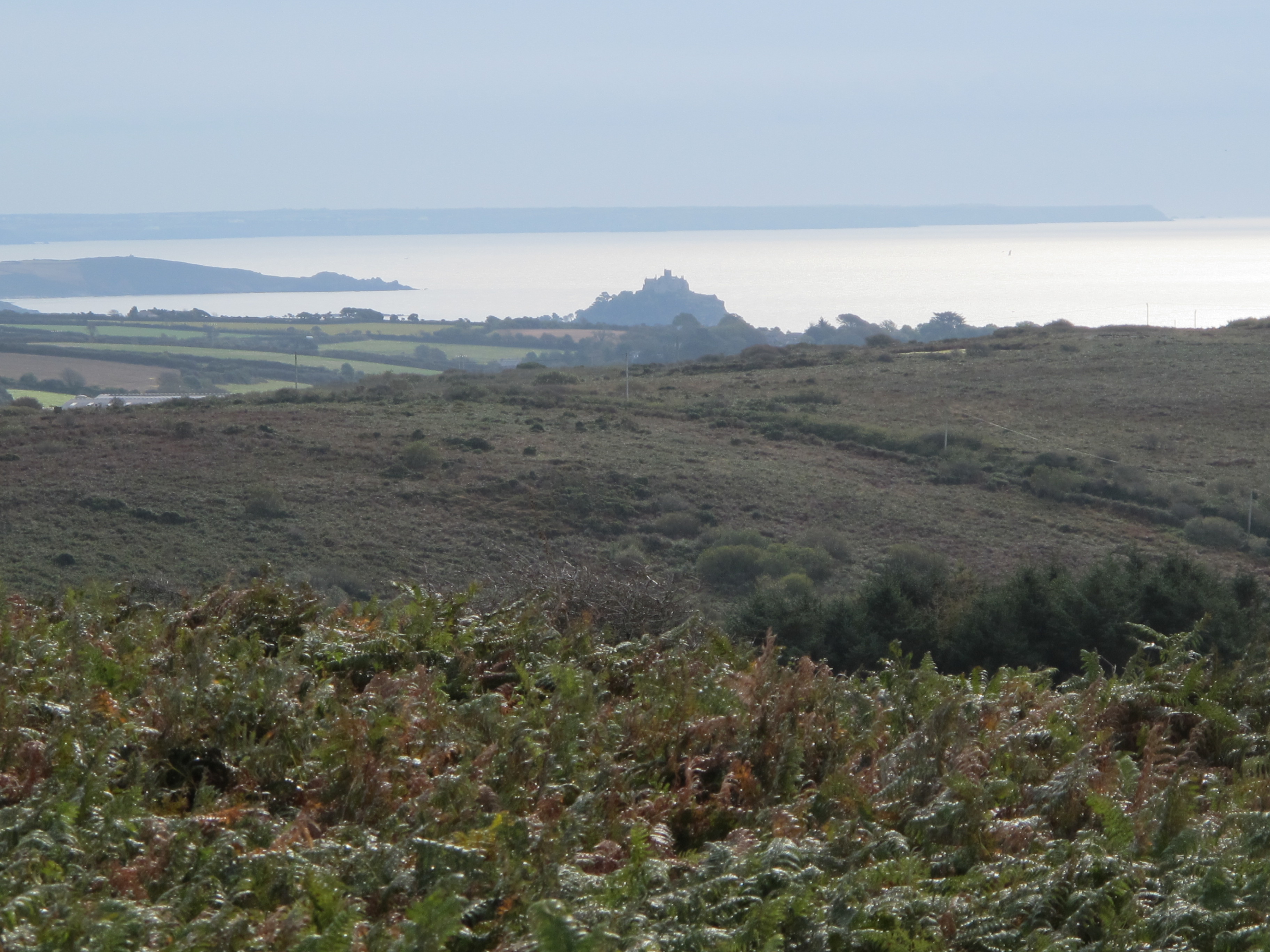
Irrelevant Photo: A view of the south coast and St. Michael’s Mount
Yes, dear ones, I’m writing about dog shit, and I’m not going to call it poo because I just can’t. When I first moved to Minnesota, I heard a wonderful phrase: “She wouldn’t say shit if she had a mouthful.”
Well, I don’t have a mouthful, but I did skid through the stuff and come away with a shoeful, and I can’t see why I should call it anything else. It’s not a beautiful word, but then the shoe wasn’t looking so good either.
Shit was the mildest word I yelled. I’m sure someone was behind a window saying, “Oh, that’s one of the Americans.”
Never mind the language, though. The important point is that somebody hasn’t been cleaning up after their dog.
I know two things about this dog: It’s large and it likes to spread its bounty as far as it’s physically able. I walk with my eyes on the sidewalk these days, the way I did as a kid in New York, before dog owners were expected to clean up after their dogs. My family had a dog. We thought we were being good citizens because we got him to shit between the parked cars. In fact, back then the city put up signs saying “Curb your dog.”
After the shoe incident, I bought myself a box of chalk. Then I waited.
Several days later, I found another deposit. Right by the red metal box that everyone (even me) calls the dog poo bin. I knelt on the sidewalk and chalked, “Clean up after your dog, please.”
I stepped back to admire my work. I’d forgotten the your, so it actually read, “Clean up after dog, please,” as if a computer translation program had written it. I used to work as an editor, so that missing word bothers me, but it did get the point across. And at least I hadn’t forgotten the please.
Good manners are more important here than good grammar. No matter how ungrammatical—or, for that matter, rude—a note you tack up somewhere, you can make it okay if you write “Polite Notice” at the top. I can’t tell you how many signs I’ve seen that declare themselves Polite Notices. Even if you were to say, “Pick up after your dog, you miserable, lazy, unclean excuse for a human being,” if you also said it was a polite notice, it would be okay.
And even if the rest of your wording is polite, you still have to open with “Polite Notice.” Actual politeness isn’t what matters. You have to remind everyone that you’re being polite.
I didn’t open with “Polite Notice.” I didn’t figure a chalked notice on the sidewalk had to, but then (as I’m often reminded) I’m not British. Wild Thing’s sure that what people mean when they say that is that we just don’t get certain things, and that the speaker feels sorry for us. I’m not sure she’s right. I tend to hear it as a statement of fact: We really aren’t British. Or we are—we’re citizens—but on some deeper level we never can be.
I don’t necessarily want to know how the speaker feels about this.
So it’s hard for me to be sure how significant that missing “Polite Notice” is. I may have offended someone other than the dog walker, but I can’t tell. I’m not British.
Since moving to Cornwall, I’ve made it my mission in life to mess with the Britishness of British baking. Not because British baking is bad. It isn’t; it’s fantastic. Have you eaten shortbread? Or scones? Or pain au chocolat? Or—wait a minute, that last one’s French, isn’t it? (And in case you’re not familiar with the stuff, it’s not pronounced like the English word pain, it’s closer to pan, and it’s basically a croissant with chocolate inside. Mmmm.)
So okay, we’re not talking about a tradition that goes back, unmixed and unmessed-with, to Alfred the Intolerable. British cooking has done what pretty much every culture does: it’s adapted, stolen, borrowed, and claimed as its own whatever bits happened to work—so much so that now people ask, with an almost straight face, “What’s more English than curry?”
How am I carrying out my mission? I’m baking, and I’m feeding my friends and neighbors. It all sounds so harmless, doesn’t it?

Irrelevant Photo: Fountains Abbey
So here’s my recipe for chocolate chip cookies, because chocolate chip cookies are even more American than Mom and apple pie. They’re probably more American than the flag. The recipe’s in imperial measures. (Shouldn’t we start calling them American measures, by the way? The empire’s gone and—does any country other than the U.S. still use them these days? And I’m not sure how many people know what imperial measures means.) But back to my point, I’m not going to try translating it into anything sensible like the metric system because the last time I did lost three weeks of my life and didn’t get it right anyway. So forget it. Besides, what’s more American than an irrational and antiquated system of measuring that we inherited from a country that’s since abandoned it and which we will fight to the death rather than give up?
Am I off the topic yet?
The recipe was adapted from one my friend J. found in the Duluth, Minnesota, News Tribune. The introduction explained that the more sugar a cookie has, the more it spreads out in the oven. The original minimized the sugar, which suited me because my chocolate chip cookies had been turning into chocolate chip wafers and I like a thick cookie. I’ve cut the sugar back even further and substituted oatmeal for some of the flour. If that sounds healthy, don’t kid yourself, they’re lethal, but you can increase the sugar if you like. I’ve left the amount a bit vague (a scant ¼ cup, in one place) for exactly that reason. Not to mention because I’m exactly that sort of cook—a bit vague, probably even a bit scant.
If you want the cookies to turn out well (and why would you make them if you didn’t?), you have to find really good dark chocolate—preferably chocolate chips. In the U.S., that means semi-sweet—none of that milk chocolate mess. In the U.K., I’ve had a battle to find good chocolate chips. For years, all I could find were brown waxy things that tasted like buttons that had popped off an old-fashioned shoe. If that’s all you can find, don’t buy them. Chop up chocolate bars (I’ve used 70% chocolate) with the back of a knife and make chocolate chunk cookies, but chunks of chocolate bars don’t keep their shape the way chips do. They’re good but not the same. For some time now, friends have kept us supplied with American chocolate chips, which is a real luxury, especially when you look at the cost of postage, but recently I’ve discovered that Dr. Oetker’s make decent chocolate chips, even if they come in itty bitty bags and are overpriced. In the U.S., you can buy chocolate chips in industrial-size bags. We’re seriously serious about chocolate chips.
If you’re in other countries, I have no chocolate chip advice to offer, but I do know this: If you open the bag and taste them and they don’t taste like much, they won’t get any better when you stir them into the batter and bake them.
The recipe makes an insane number of cookies. (I did warn you that, as a cook, I’m a bit vague.) I freeze whatever we don’t eat on the first day and take them out when we have company. They’re good frozen. Maybe even better. Honest. I discovered this the time I hid them from myself and—surprise surprise—found them. And ate them on the spot.
Chocolate Chip Cookies
1 c. whole wheat flour
2 1/3 c. plain white flour
1 ½ c. rolled oats (any thickness will do)
2 tsp. baking soda (that’s bicarbonate of soda)
2 tsp. salt
12 oz. (that’s 3 sticks if you’re American) butter
Scant 2/3 c. brown sugar
Scant ¼ c. white sugar
4 eggs
2 tsp. vanilla
Lots of dark chocolate chips (about 2 ½ c.)
Cream the butter and sugars. Beat in the eggs, one at a time, and the vanilla. Mix in the dry ingredients, then the chocolate chips. Drop spoonfuls onto greased cookie sheets, leaving some room for them to spread out.
Bake 9 – 11 minutes at 375 F., or 185 c., or 165 c. with a fan oven.
Cool 2 minutes or more on baking sheets before removing.

