Unknown's avatar

About Ellen Hawley

Fiction writer and blogger, living in Cornwall.

Cornwall Gay Pride

We’re a diverse bunch here at Notes, or an ill-assorted one if you like, and I love that, but once in a while it means I second-guess myself before I post something. To be specific, how’s a more conservative subsection of readers going to feel if I talk about a Gay Pride celebration? Am I going to run anyone off?

When I worry about running someone off it’s not about numbers. Sure, I check my stats as obsessively (and pointlessly) as any other blogger, but mostly it’s because I don’t want Notes to turn into an echo chamber for voices who all agree on a 674-point charter that we argued over until we all hate each other. I value the comments I get, and the people behind the comments. I don’t want to lose contact.

But that can’t come at the expense of being who I am. If I shut myself up every time I might drag a reader outside their comfort zone, I’ll bore us all to tears. And right after that I’ll stop writing altogether, because good writing carries an element of risk. You’ll have to judge whether the writing here is that good, but as a goal? It’s what I aim for.

All that long-windedness leads up to this: I went to Cornwall’s Gay Pride Day last weekend, and if that makes anyone uncomfortable, I hope you’ll stay with me anyway. If you don’t, I regret it but that’s what I’m writing about today.

Cornwall Gay Pride.

Cornwall Gay Pride. Photo by Ida Swearingen.

After all that rigmarole, of course, I’ve made myself wonder if anyone who’d be uncomfortable with Gay Pride Day is still around. If you are you’re more than welcome and if you left quietly by the side door I’m sorry to hear it. Thanks for not letting it slam.

Wild Thing and I been in together for 38 years now, which is long enough to have seen a lot of changes in the way same-sex couples are received in the larger world, and a lot of changes in Gay Pride celebrations as well. Here’s what struck me about this one:

First, Cornwall’s a rural county, so it wasn’t a huge gathering, but it was bigger than I expected. It was very much a family celebration: gay people and their families and friends, transsexuals and their families and friends, straight people who weren’t related to anyone but turned out to show support or buy a burger, sit on the grass, and enjoy the entertainment. Little kids, including one girl in a rainbow tutu. And dogs. Lots of dogs.

Organizations had set up booths promoting themselves—hotlines, political parties, the environment agency (!), the fire department (more exclamation marks), the police (multiple exclamation marks). Parents and Friends of Gays and Lesbians had a booth, and they always leave me with a lump in my throat. They were started by a woman whose gay son had been beaten up while distributing gay-related leaflets. First she wrote a letter protesting police inaction. Then she went on the radio and TV, then she joined a Gay Pride March. Soon she had an organization on her hands, and it’s been going ever since.

When so many gay, lesbian, bisexual, and transsexual young people have been rejected by their families, it means the world to see families stepping forward in this way, embracing their relatives and their right to live in the open. Which leads me to this: To the families of the gay etc. kids in my life, I hope you know how spectacular you are, and how much you mean to me.

And here I have to stop and say a word or seventeen about that phrase gay etc. For a while the most common phrase was simply gay, then it was gay and lesbian, then it was gay, lesbian, bisexual, and transgender, which was unwieldy enough that it was usually shortened to GLBT, which I can’t help thinking of that as gay, lesbian, bacon, and tomato. Recently I’ve seen a bunch of other letters added to the string, probably standing for pickles and mayonnaise and a side of chips, which in Britain are crisps, just in case this was in danger of sounding simple.

The world insists on getting more complicated. I’m as baffled as anyone else.

With the possible exception of mayonnaise, adding all these categories does make our language more accurate, and people get both passionate and political about it when they go to name an organization or write a leaflet. But it does make for a lot of words. Or letters. So for the moment, let’s settle for gay etc. I won’t argue that it’s the best phrase or the most accurate one, but it is the shortest.

With that out of the way, let’s go back to the involvement of the police. To understand why this struck me, you need two pieces of background.

One: Back in the day, when gay etc. sex was illegal (note: in Britain only sex between men was illegal, I’ve read, because Queen Victoria refused to believe that women would carry on that way), bars were one of the few places people could meet. The police could raid them at any time, though, because by definition what went on in there was illegal. Not that people were having sex on the premises necessarily. Dancing together was enough. Touching someone was enough. Being there was enough. People would be arrested, lose their jobs, lose their families. Lives were ruined.

Ah, the good old days.

Two, and this isn’t about the politics of being gay etc.: During one of the New York blackouts, a friend’s parents were in Grand Central Station. The friend’s father had MS, and when everything went dark and people started running around in a panic, his wife was struggling to keep him from getting knocked over. She saw a cop and went to him, saying, “Excuse me, but my husband has MS. Can you help us?”

To which the cop said, “Get outta my way, lady, I gotta help the people.”

And they were both straight and white.

God, I love New York.

I had a similar experience with a New York cop after a fender bender, but it wasn’t quite as outrageously absurd, so let’s stay with this as an example of what I expect from cops. I’m not even going to get into Ferguson, Staten Island, and black lives matter, but they’re not unrelated. When you’re outside the mainstream, you don’t assume the policeman is your friend. The history of the police and the gay community? Not friendly. And here they were, setting up booths about diversity, asking us to sign a petition to restore funding that’s been cut from the Devon and Cornwall police budget.

Wild Thing and I had been to a Cornwall Gay Pride Day before, so this wasn’t a complete surprise. That helps explain my final story.

On our way to the park, Wild Thing and I ran into friends, one of them in a wheelchair. We knew the name of the park but weren’t sure how to find it, and we asked a cop if he could point us in the right direction. You can’t do that just anywhere. But he offered to walk with us, and when the way got steep he took over pushing the wheelchair. He was young. We were once, but it was a long time ago. The pride I once took in doing that sort of thing myself has taken second place to the practical problems of bad backs and creaky shoulder joints and the need not to set that wheelchair rolling downhill when it’s supposed to be going up.

I did take responsibility for the liter of milk he’d been carrying.

So there we were, a young cop pushing a woman in a wheelchair to a Gay Pride gathering and three of us following behind with his liter of milk. I won’t argue that the world’s problems are over, but a few things have changed, and it gives me hope to see it.

People risked a lot to make that happen—their jobs, their families, their education, their peace of mind, sometimes their lives. In places around the world, they’re still taking those risks. Here’s a moment of silence to acknowledge them all.

Me, elsewhere: a link

To help you through those long, long days between my Friday post and next Tuesday’s (oh, how you miss me; it must be awful), here are two things in one place: a guest post I wrote on Barb Taub’s Tales from Null City and Barb’s review of The Divorce Diet. For her take alone on what the central character would have done if it had been set in various other decades it’s worth a click or two.

Knowing all the answers in Britain

I can’t continue to write about life on this strange island without talking about the quiz.

No, I’m not talking about the test I had to take in order to stay here. That was a test. If you judge it on length it might have passed for a quiz, but it had too much riding on it. What I’m talking about is the British addiction to quizzes in general.

Am I using the word addiction loosely? No, your honor, I am not. I maintain that the population of this country (which is spread over all of one island and part of another, so I was using the word island loosely in my first sentence) is heavily dependent on the quiz and incapable of going for more than a week without one. This doesn’t apply to every individual, but if we take the population as a whole, addiction isn’t too strong a word.

Chairs for rent, facing the beach. Swanage.

Irrelevant photo: chairs for rent, facing the beach in Swanage

I submit:

Exhibit A: the pub quiz. These are held for entertainment while the participants are in varying stages of inebriation. Pubs that hold them schedule them weekly, indicating that problems would arise if the time between them is extended beyond that interval.

Exhibit B: multiple Radio 4 quiz shows, some of which make fun of quiz shows (see, for example, Exhibit B.1, I haven’t a clue) but are still quiz shows. These also repeat at seven-day intervals and give social approval to quiz addiction.

Exhibit C: village fundraising quiz nights. Yes, people pay money to show up and take a quiz. These are social events, where people compete in teams, reinforcing each other’s addiction. They are held at random intervals, but the social aspect makes them insidious.

And here we’ll take a break from court and gossip in the hall, where I can tell you that I was once asked if I’d pay a pound for a quiz supporting a local folk music group. After a blank moment during which my brain argued about whether I should say “No, I hate quizzes” or buy one and use it for scratch paper, I compromised by saying I’d pay a pound for the privilege of not participating. Everyone went away happy.

I think.

If you’re British, none of this (except maybe my shock and horror over it—and, yeah, the word addiction) is news to you. Of course you think quizzes are entertainment. But if you’re not British—or at least if you’re American, since I’m not all that sure where the rest of the world stands on this earthshaking issue—you’re thinking, They pay money to do what? So let me repeat: The quiz is a form of entertainment in Britain.

But let’s drop the addiction argument, since I only threw it in to justify organizing my examples into exhibits and write “your honor.” We all know an argument like that will fall apart if it’s left out in the rain. And it does rain a lot here.

I have a hard time finding the fun in a quiz. They’re something I escaped when I got out of school—those moments of Quick, prove you finished the reading and understood it. 

Wild Thing, like me, has trouble figuring out how this is fun, but unlike me she has a phenomenal memory. I’ve come to think of her as my external hard drive. She should do well on them. But a fall-back category of quiz questions involves British pop culture circa, let’s say, 1970. Or whenever. It depends on the age of the person who puts the quiz together—and if the quiz-maker’s playing fair, on the age of the audience. This is stuff Wild Thing can’t possibly know. We weren’t here then.

Every so often, she’ll give the person who put the quiz together a hard time about discriminating against Americans. This is done in fun, although (as the idea that the quiz is entertainment proves) fun is in the eye of the beholder. I don’t know that it’s always heard as a joke. And I don’t know that there isn’t a sharp edge lurking under the joke’s padding.

Talking about what I don’t know may not be a bad place to end a post on quizzes, because they have a way of reminding me what vast fields of knowledge lie beyond my horizons. There’s so much stuff I don’t know. Some of that is a problem, either often or occasionally, but the stuff I can’t answer on the (very few) quizzes I’ve participated in has never yet been anything I care about not knowing.

I understand that not everyone cares about the same things. For some reason—damn, the world’s a baffling place—nobody’s brain is a replica of mine, and the things our brains hold onto and value vary. Why should we score ourselves or let other people score us according to some standard that isn’t ours?

Sorry, that sounded way more serious than I expected. Take it lightly, folks. It won’t be on life’s final exam, and life’s final exam won’t be graded anyway.

Chasing lifestyles in Swanage

Wild Thing and I just got back from a few days of bumping around Swanage, a beach town in Dorset, where we were playing tourist. Or holidaymakers, if you want to get all British about it. I’m not sure why one’s a singular and the other’s a plural. Let’s pretend it’s one of those American/British things instead of a rule I just invented.

But forget the grammar. The important thing is that I came home with a burning question: What’s a lifestyle?

The question landed in my head because two shops there seem to sell lifestyles. One advertises lifestyle clothing, the other homeware (singular) and lifestyle.

Marginally relevant photo: a couple by the beach in Swanage. I don't know if this qualifies as a lifestyle.

Marginally relevant photo: a couple by the beach in Swanage. I don’t know if this qualifies as a lifestyle. Probably not, and I like them for it.

Now homeware demands its own moment of thought before we move on to lifestyle, because they’re related. Really they are. I’m guessing homeware is an upscale version of housewares (plural)—the boring stuff I vaguely remember my mother stopping to look at while I pulled on her arm and whined. (I was a charming kid.)

Now that I’m 203, I stop to look at housewares myself, and they’re more interesting than they were in my mother’s day. It’s amazing how the world’s gotten better, in at least this one not particularly useful way.

But homeware? Holy shit. Homeware isn’t just stuff you shove in a cupboard and take out when you need it. It’s made up of lifestyle items.

What am I talking about? I haven’t a clue, and I’m guessing that whoever paid to get that sign painted, if pushed, wouldn’t be able to tell me either. What it implies, though, is that if I own (and therefore, crucially, have bought) enough of this stuff, it will change my life. Or its style.

Are my life and its style the same thing? The slogan implies it. It also implies that if I change the style—the thin outer shell—my life will also change.

From the context, I can guess that if a cereal bowl is a lifestyle item, it costs more than if it were just, you know, a cereal bowl. How much more? Ten percent? Fifty percent? More than that? How much is a lifestyle change worth?

The higher price is essential. If you could get your hands on lifestyle cereal bowls for the cost of ordinary ones, would you believe in their power to change your life? Doesn’t all this depend on the lifestyle object being out of other people’s reach, so that owning it puts you in a special category?

Since we’d been talking about all this, Wild Thing stopped outside the lifestyle clothing store’s window and called my attention to a yellow, semi-see-through blouse. It wasn’t a fully transparent kind of see-through, but if you looked closely enough it you could see the stitching on the seams.

“If I wore that, it would change my lifestyle,” she said.

You need to understand that Wild Thing’s as likely to wear a see-through blouse as she is to wear a suit of armor, but if she did, it would still be Wild Thing in there, and wildly out of place.

None of which exactly addresses the question, which has now expanded from What’s a lifestyle? to include Whatever it is, can you sell it?

Let’s start with the first, What’s a lifestyle?

Years ago, when having a partner of the same sex shocked more people than it does today, someone told me she didn’t approve of my lifestyle. I can’t remember who she was, where we were, or how that came up, but I do remember thinking (and, unfortunately, not being fast enough to say), It’s not a lifestyle. It’s a life.

That wouldn’t have gotten into why she thought I should care what she approved of in my life or my style. We’ll set that aside, though, because our topic today is lifestyle, not silly, self-important people from the past who’d been programmed with a phrase or two that let her think she had the world figured out.

In the context of same-sex relationships, lifestyle was a word tossed around by people who—how am I going to characterize them? People who spent a lot more time than was good for them thinking about what other people did (or might do, since I doubt I could live up to their imaginings) in bed. And their choice of the word made my life sound like something I’d chosen from a delicatessen counter. I’ll have a slice of the blue cheese, please, some Kalamata olives, and, gee, what else do I want today? Maybe a partner of the same sex who the world at large disapproves of? Oh, fun.

So I’ve never been impressed with the word’s accuracy. And now (touching briefly on our second question) I find out lifestyles are for sale. In stores that sell cereal bowls and less-than-opaque blouses.

How times have changed.

It’s worth asking if the objects we own and use change us. They do. If you’ve never spent a day in high heels, try it and you’ll understand. Or an hour. Or, hell, walk from one end of the house to the other and you’ll catch a glimpse of how this works. Now apply that to the more serious changes like fire, or electricity, or central heating. Or clean water and sewage pipes.

Trust me to dive right into the most romantic objects, right?

If our lives demand that we live in and use objects that don’t suit us, we’ll be out of place in our own lives. All I have to do is imagine myself in a corset to know that objects matter. Getting rid of the wrong ones matters. Getting enough of the right ones matters. Having more stuff, though? Or more expensive stuff? What matters there is knowing that it doesn’t, in any deep way, matter. This is about knowing the difference between need and want, and between our own genuine wants and the ones foisted on us by the good folk selling us lifestyles.

I’m not immune to the lure of a beautiful object. Heels aren’t my thing—give me running shoes any day—but I often find myself looking through our mismatched mugs for the one I most want to drink out of. It’s silly—they all hold liquid—but I do it and take some small pleasure from it. It’s not a lifestyle, though, it’s a mug. To be a lifestyle, I suspect, you have to back away from your stuff and your choices and see your life as a creation, an art form. A kind of make-up applied to the face of your existence. Which, to me, seems to create something brittle.

Some bloggers call themselves lifestyle bloggers, meaning (I think) that they write about their own lives. Or maybe they write about the make-up on the face of their lives. Maybe for some of them all it means that they don’t fit any of the other prefabricated niches the blogosphere offers so they pour themselves into this one, whether or not they’d use the word if they weren’t pushed to it.

I’ve struggled with the niche issue myself. I don’t seem to fit any of them and haven’t claimed one. Notes isn’t (as far as I can figure out) an expat blog, isn’t a humor blog, and isn’t, may all the gods anyone ever believed in preserve us, a lifestyle blog. Because I’m not going to blog about something I suspect of being blue smoke and mirrors.

If a lifestyle can be marketed and then constructed out of things we buy, it’s no more than a veneer, a shell, an image we present first to ourselves and then to the world to say, Look how beautifully I’m living. Aren’t I just happy?

And behind that? That’s where the person lives, as happy or unhappy, as wise or foolish, as before the lifestyle goods arrived.

Putting the Kettle On

M. has my oven wired. When I bake, an alarm goes off in her house and she appears, as if by magic, at our door.

“Want a cup of tea?” either Wild Thing or I ask.

“Is the pope Catholic?”

She used to answer, “Is the pope a Nazi?” but that was before Francis. She was raised Catholic, so she gets to say stuff like that. I wasn’t raised Catholic so I don’t, but I will claim the right to quote her.

Irrelevant photo: flowers. As if you couldn't have figured that out.

Irrelevant photo: flowers. As if you couldn’t have figured that out.

I make a pot of tea and set out whatever I just finished baking. If I’m still getting it out of the pan, she asks, “Shall I put the kettle on?” Because you don’t want to stand between M. and a cup of tea, not even if you’re producing baked goods.

She never says, “You want me to I make the tea?” That’s what I’d say. With her, it’s all about the kettle. And while we’re at it, I don’t think I’ve ever said “shall I,” although M. says it as if it were a normal part of speech. And she doesn’t have what people here call a posh accent. She just, you know, uses it like language—ordinary, everyday language.

It’s this kind of thing that makes me doubt I’ll never write British (as opposed to American) dialogue. Oh, I can put together a line or two—enough to keep the blog fed—but if I wanted to write a full scene, never mind a full novel, in it? In no time at all I’d have one of my characters saying, “Want me to make the tea?” instead of, “Shall I put the kettle on?” Only it would be the equivalent on some subject where I haven’t noticed—or maybe even heard—the difference.

I know someone whose mind catalogs these small differences. Talking to her is like reaching into a grab bag: You (or more accurately, she) could pull out almost any sort of accent, along with any region’s phrasebook. It all lives in her head, organized into separate drawers (I know, I know, I’ve jumped metaphors; go ahead and shoot me), each neatly labeled, and none of it escapes to mix itself with her own accent—the accent she uses when she’s being herself. It’s an amazing, fascinating gift.

Me, though? I assimilate languages by steeping myself in them, and once I do I’ve taken on the new flavor. In other words, if I pick up a new accent or phrasebook in English, I’ll lose my clarity on the last one—the one I think is my own. Or more than that—is me. If I weren’t a writer, I wouldn’t have any problem with that. As a writer, though, I’m terrified that I’ll make such a cut-and-paste mess out of my accent that I won’t be able to write in any region’s English.

The Divorce Diet ebook is on sale–again

For reasons that I won’t even try to fathom, The Divorce Diet (ebook only) is on sale again: $4.99 starting on August 29 and ending on October 4.

Somewhere in the depths of my contract, the small print says that I get paid in scrip and good wishes when the book’s discounted, but at this point I’d just as soon get the thing out there so people read it. So if you want a copy and read ebooks, but the beast. I’m happy to see it (or in this case, imagine it) in people’s hands.

And if you happen to follow my Facebook page (something I don’t recommend; it’s so boring I don’t even read it, which is why it almost never gets updated) you will have been notified that it was on sale for an entirely different set of dates. Ignore it. I can’t be trusted with a calendar. I think I have it right this time. But if you see me messing around with numbers, run.

On being an incomer in Cornwall

What are we talking about when we say “community”? Or more to the point, what am I talking about?

Do a bunch of people who live in the same place automatically become a community or do we need to add some length of time? Or practical support, emotional support, friendships? What about mutual interests? By mutual interests I don’t mean everyone being obsessed with needlepoint or punk rock but that people’s individual self-interests intertwine with each other’s and with the group’s.

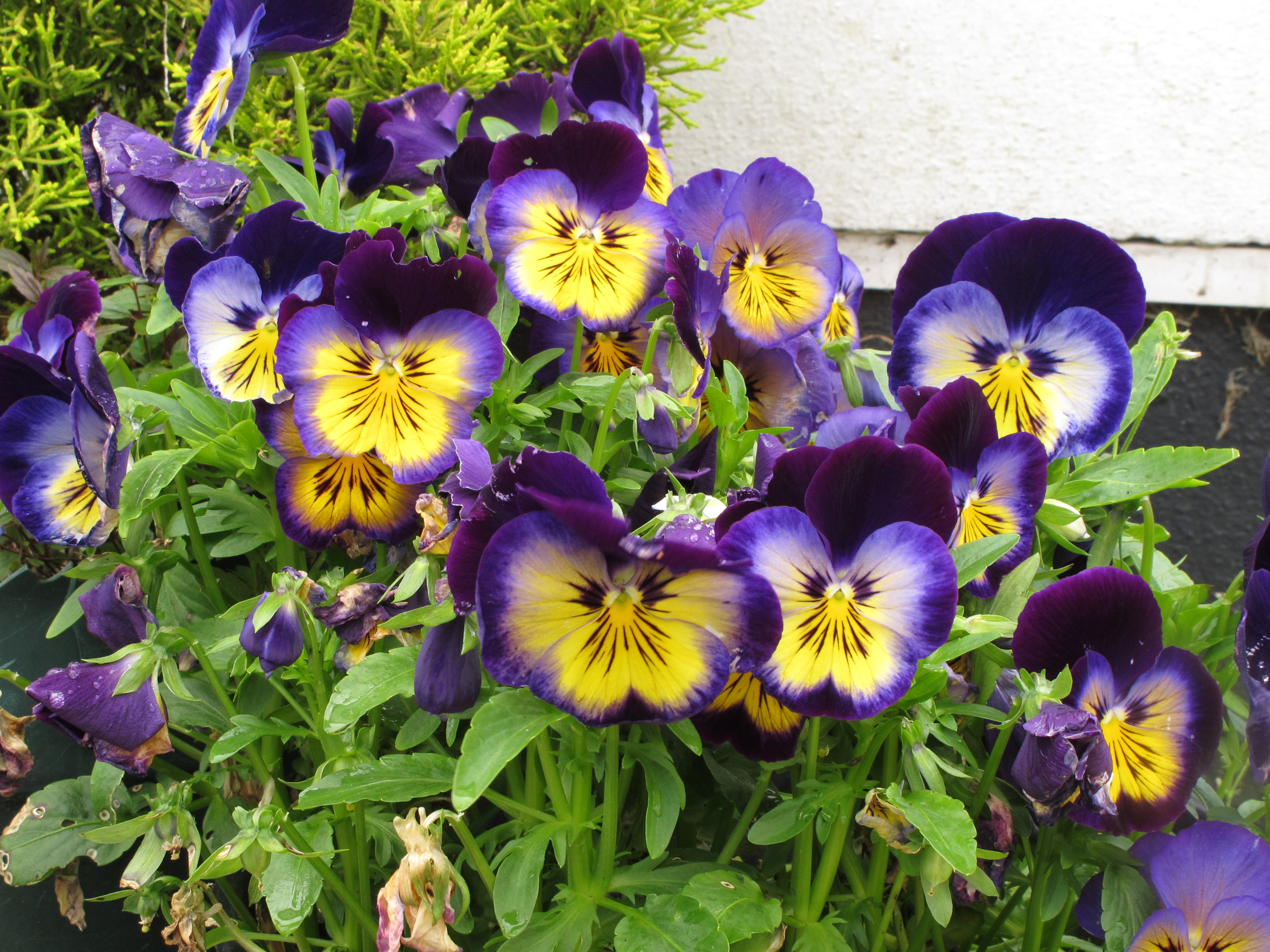
Irrelevant photo: pansies. They bloom all year round here. Having lived in Minnesota, I'm still knocked out by that.

Irrelevant photo: pansies. They bloom all year round here. Having lived in Minnesota, I’m still knocked out by that. These are the ones I’ve rescued, mostly, from the slugs.

Just to complicate things, if we have enough of those elements, do we need to share a place? Does it make sense to use community to mean something a lot like demographic—the African-American community; the Jewish community; the gay community? The groups that spring to mind as examples of this are all minority groups of one sort or another, which says something interesting, although to explore it I’d need a whole ‘nother post and—you may have noticed—it’s not really on topic for Notes.

So having asked those questions, I’m not going to answer them, just leave them with you. Sometimes just asking the questions is worthwhile. Or so I’m going to claim as I duck out on the tough questions.

All this comes to mind because I’ve tossed the word community around pretty loosely lately, and I’m about to do it again.

As an outsider, feeling like I’m part of the community is a big thing. It’s easy to romanticize the idea of community, or this particular community, when I can never be fully a part of it. If I’d grown up in the village, I can imagine my teenage self pounding against its limits, looking for a way out so I could get to what I would have been sure was the real world. I was like that in the community I did grow up in—which at the time I wouldn’t have called a community. As for the real world, I defined it as anywhere I wasn’t.

Some of the kids here are like that. It’s a small village, in a part of the world without a lot of jobs and even fewer that pay well—or that are even full time and year round. Not all the kids move out and not all of them want to, but some can’t wait. Others leave because they have to. Some stay and struggle through, and given the gap between pay levels and the cost of living, it’s not easy.

But here I am, retired and an incomer, counting the signs that I’m part of the community, knowing how absurd I am. I can report two new ones.

We have two overlapping bugs making the rounds, and I caught them both, almost at the same time. What could be more community minded? One’s a bad, fluish cold and the other’s a cough that goes on forever. As nearly as I can reconstruct it, I gave one to Wild Thing and she gave the other to me. Is that a good relationship or what? We thought we were alone in our misery until she staggered to a meeting (you can only isolate yourself for just so long, and besides, the only way to get rid of a bug is to give them to someone else) and returned with a list of other people who’d had one or both for weeks.

So, we have the community cold. Isn’t that heartwarming? It’s also the reason I couldn’t follow up on the second sign that I’m part of the community: J. suggested I write about it the Horticultural Show—a central village institution that I can’t make heads or tails of.

I hesitated because I tend to write—. How am I going to put this? I don’t do travelogues. I don’t do isn’t-it-lovely? With a very few exceptions, if I can’t find something to laugh about—preferably but not necessarily me—then I don’t have a post.

To be clear, I draw the line at writing about other people in ways that would leave them feeling rotten, although the occasional unidentifiable stranger is fair game. As are public figures. I confess, I tend to forget they’re real people.

Given those restrictions, could I go to the horticultural show and find something to write about? J. and I traded emails, and in the process she morphed from the person I’ve known for some years into a cheerleader for the show. Enter something, she wrote. Flowers. Vegetables. Something baked. You’re a baker. It’s right up your alley. Or knit!

Kint? I know how to knit the way I know how to play chess: I know all the moves but much good it does me. I have no way to predict, when I knit, what size or shape the finished product will be, and given the cost of yarn–nah. Besides, I had something like two or three days by then, and if those aren’t enough reasons, I have carpal tunnel syndrome and knitting aggravates it.

As for baking, to enter the show you have to bake something according to a the show’s recipe, not your own. I don’t see the point.

But then, the entire horticultural show is a mystery to me. You wander through and look at, say, eight paper plates of runner beans. Each has the same number of beans. Let’s say three; not many, whatever the actual number is. They all look like runner beans. None of them have spots. None of them have been chewed up by insects. But one plate won first prize and another won second and another won nothing at all, and I can’t see the difference.

So I wrote back to J. that since I didn’t understand how the show is judged it didn’t make sense to enter. Besides, for no reason I could explain, I just plain didn’t want to.

“Let’s pretend,” I wrote, “that it would undermine my journalistic objectivity.”

If you’ve been around here for any time at all, you know how much journalistic objectivity I have, but I did at least include the word pretend.

So she invited me to help set up and watch the judging so I could understand how it worked.

I’d been invited into the heart of village institution.

Which is when I added Wild Thing’s bug (a miserable, fluish thing) to the one I was already carrying and I had to back out. Given that all I could have contributed to the gathering was my germs, J. was glad to have me stay home. And I can’t say I blame her.

Maybe next year I’ll be able to report on the mysteries. Assuming the invitation’s repeated. And assuming I’m not sworn to secrecy.

Hamburger extra: what’s ground beef?

Okay, all you British burger cookers, here’s what you need to know: Ground beef is mince. I called it ground beef because I thought that could be understood in at least two versions of English. Ha. Goes to show what I know. J. called this morning to ask, and I’m glad she did or I’d have gone merrily on thinking I’d been clear. Sorry, everybody. Mince.

Serving Texas hamburgers in Cornwall, part 2: the definitive recipe

I already told you that the only ingredient in a Texas hamburger is beef, and that’s true but I may have oversimplified things. So I’m going to give you the full, formal recipe. Don’t leave here without it.

Before we get down to business, though, I need to explain that the difference between a Texas hamburger and any other kind of American hamburger.

Cornwall; Madron Holy Well

Screamingly irrelevant photo: Tree at Madron Holy Well, near Penzance. The tradition of tying cloth to the tree goes back to pre-Christian times, when it was believed to cure illness. Exactly why people do it today is anyone’s guess. Maybe to cure an illness; maybe to brush shoulders with something ancient or add their bit of cloth to something compelling. I was tempted, because it is compelling, even though I don’t believe it can cure and wasn’t sick to begin with.

People don’t notice regional differences in countries that aren’t theirs, but if you live there, they matter. A California burger comes with lettuce and tomato, and if you live in California it’s just called a hamburger. It’s the rest of the country that calls it a California burger. And a Texas burger? It has one ingredient no one else can match and it has its own cooking method.

The ingredient is attitude. A Texas hamburger has it, and much as I love other parts of the country we just can’t rival Texas for its outright and usually charming bullshit. Without the good ol’ Texas bullshit, what you have is a plain ol’ American hamburger. That’s not bad, but it isn’t from Texas.

If you’re not from Texas can you do Texas bullshit? Probably not. Many and many a year ago in a queendom surrounded by the sea, we were trapped across a table in a broken-down train with an Englishman who lived in Texas and thought he’d learned the trick. What he’d learned to be was loud, self-important, and obnoxious. What he hadn’t learned was charm. It was a very long wait for that train to get moving again.

What do I recommend, then? A) Invite a Texan and turn her or him loose, B) offer your burgers to a group of people who don’t know about the secret ingredient and won’t miss it, or C) call it an American hamburger. Do not, under any circumstances, try to substitute a low-cost bluster for Texas bullshit. You’re better off without it.

And the cooking method? You cook the burgers outdoors, on a hot grill, and you cook them, at most, medium rare. When the burger’s almost done, put the top half of the bun on it. This spreads the grease on it. Wild Thing assures me that’s good.

The grill has to be hot, so the outside gets seared and dark. If you’re using charcoal, Wild Thing tells me you have to let the coals get white hot. Tossing a bit of water on them will release some steam and heat everything up. It’ll also bring a little drama to the process. She uses a gas grill, and she buys hardwood chips, soaks them, and tosses them into the grill to give the meat a smoky flavor. Oak is good, but any hardwood will do. Pine won’t.

What about the folks who can’t bring themselves to eat their burgers rare? We-e-ll, it’s up to you, of course. I suspect Wild Thing’s becoming a bit of a missionary about this, but the fact is that she did re-grill the hamburgers that were brought back to her. Whether she can bring herself to do it a second time is anyone’s guess.

So here’s the recipe. Be sure to get the proportions right:

Texas Hamburgers

Good ground beef

That’s it. Nothing else. Not even salt and pepper. No eggs, no bread crumbs, no shoelaces. Don’t (as I’m sometimes tempted to do) buy cheap ground beef, telling yourself the fat will cook out. Get the good (for which you can read more expensive) stuff, divide it up, pat it into shape, and grill the hell out of it. Put it on a bun, put some ketchup on it, and eat it.

And remember, you got the recipe from a vegetarian.