Unknown's avatar

About Ellen Hawley

Fiction writer and blogger, living in Cornwall.

Link to a new post on Medium

If you’re not at your wits end keeping up with what I’ve already sent out, you can find a new post I just put on Medium. It’s about what, if anything, it means to be Jewish. And an atheist. In Cornwall, where I’m not likely to find another Jew for miles in any direction, including up, down, and out to sea.

As an aside: The contrast between the British and American attitudes toward atheism surprised me when I first moved here. In the U.S., before I called myself an atheist I tended to stop and ask myself whether I had enough energy for the reaction it might cause. I’m happy to talk about religion and the lack of it, but I don’t have a lot of energy for tense, over-emotional discussions, and they can get that way. I don’t enjoy upsetting people. It’s also, honestly, not the topic I find most interesting in life. So I tended to say “I’m not religious,” which as far as I can figure out means the same thing but didn’t shock people in the same way. In Britain, though, it doesn’t seem to be a big deal, which I love.

If you haven’t discovered Medium, it’s an interesting–I’m not sure what to call it. How about phenomenon? It sounds more specific than thing, although it’s not really. It’s a place to post essays and stories, and it structures in a way that helps people to find them–or tries to. Punch in a topic that interests you and it should call up a range of posts. Many of the ones I’ve read are very good. Within it are several magazines, which if they accept your work can give it a bit of an extra boost. And if they don’t accept it? You just post it anyway.

Does my vocabulary look too British in this?

The differences between British and American English are an endless source of—well, pretty much anything you can name: confusion, fascination, amusement, bad temper, accusations (subtle and otherwise) of either ignorance or stuffiness, depending on which side of the Atlantic taught you your rash assumptions.

I’ve written about the differences between British and American English before, which means I’m supposed to slip in a link or ten to tempt newcomers deeper into the blog. That sounds ominous—step deeper into the dark and trackless blog, my dears. But I have to do it anyway. Who am I to defy the rules of the blogosphere? (Note: I already do with my irrelevant photos, and I’m not likely to stop, but once in a while I should behave like a serious blogger.) So here’s the link: This will connect you to a whole category of posts. You can pick through and see what interests you. Or not. I’ll never know.

Semi-relevant photo: What's more English than morris dancing? I like this shot because the guy on the right looks like he's about to brain the guy on the left. Photo by Ida Swearingen.

Semi-relevant photo: What’s more English than morris dancing? I like this shot because the big guy on the right looks like he’s about to haul off and brain the guy on the left. If you squint, the whole thing begins to look like a brawl. Photo by Ida Swearingen.

Where was I? I’m returning to the topic because Karen wrote to say my writing sounded British to her. I asked what specifically struck her that way and she said what “sounds to my American ears not-so-American” were the phrases “‘he wasn’t being immensely clever” and “trying to conduct a bit of business.” 

I’m probably the last person who’d know if those are not-so-American. When I talk, I still sound American enough to get asked if I’m enjoying my stay (well yes, although it seems like I’ve been here for years), but Britishisms have crept into my brain and my speech. I’d like to think I notice them and build walls around them—you know: the kind with turnstiles, so I have to sacrifice a coin before I can get at them—but I’m not sure the system’s working.

In the first phrase, I wonder if what struck Karen isn’t the word immensely, which is formal—a tone I fall into a lot when I’m kidding around, although I’m never sure if it works. On the other hand, clever may be more common in Britain than in the U.S.  Emphasis on may. I’m not sure. But I can call up the sound of an English accent saying “you clever girl” or “clever clogs” (one is a compliment; the other probably isn’t), but I can’t come up with anything like it in an American accent.

What about the second phrase, trying to conduct a bit of business? Bit shows up a lot in British English. Bits and bobs. Or Zadie Smith’s wonderful phrase about nudity in a movie, the dangly bits. Do we use bits much in American? Ask someone if they’re tired and “a bit” wouldn’t be a strange answer, although “a little” might be a bit more common.

Did the bit in that last phrase jump out and sound British?

Conduct again has a formal tone, and although I’d guess it’s used equally in both versions of the language, we (the we here being Americans) do tend to think British English wears a corset (or at least a top hat) while American English slouches on the couch with its feet on the coffee table. That’s because we think everyone in Britain is belongs to the aristocracy. Even when we know better. We know the laws of physics decree that you can’t have an aristocracy without a whole lot of peasants to keep them fed and et cetera’d, but somewhere underneath whatever our good sense we have we still believe the British are all aristocrats.

We (again meaning Americans) are both right and wrong about the formality of British English. It can be more formal. It also can be gloriously rough and informal—like, I’d guess, any language or national version of a language.

Karen went on to write, “Isn’t this a problem writers encounter all the time when they create characters who are ‘other’? How does a woman writer ‘sound’ male? How does a thirty-something author ‘sound’ like a teenager? How does an American ‘sound’ British?”

The answer is that at their best, writers listen, deeply and actively, and learn their limits. I don’t hesitate to write dialog in a man’s voice, or to write from a man’s point of view. We’re not as different as the world tells us we are, and even if we were I’ve lived around men I don’t live with one, but I know what they sound like.

I wrote from man’s perspective in parts of Open Line (and here we go with the links again) and felt that I knew the character well and did him justice. He wasn’t an admirable person, but I ended up liking him. I’d lived inside his head.

Writing the male characters in The Divorce Diet was different. I only got to see them through my central character’s eyes, and if she was fed up with them, so was I. They’re not as fully realized because of the point of view I chose. You can’t tell every story from every perspective. But their dialog? It didn’t feel like a stretch.

But I know my limits and I stay well away from the edges. I’ve watched writers write dialog that goes past theirs. At its best it embarrasses me as a reader and makes them look ignorant. At its worst it comes off as racist. For myself, the rule is this: If you haven’t lived with it, don’t write it. If you don’t know the accent and vocabulary and attitude and life first hand, don’t write it. That doesn’t mean limit yourself to characters who are replicas of yourself. It means know your limits, and if they form too tight a circle, learn more. Live more widely.

Sorry: I’ve expanded the issue beyond vocabulary, but dialog isn’t just about word choice, it’s about the character. And writing about someone from a different demographic group isn’t just about finding the right words. If you don’t know the reality of another person’s life, you won’t write it with any depth or power. Or respect, no matter how good your intentions are.

Maybe that’s why so many male writers have written paper-thin women: They couldn’t see beyond what they wanted from women, or how women affected them, so they couldn’t create any depth in the women they wrote. You can plug other categories of writer and character into that sentence in whatever combination you like, but I have an English degree and ended up reading a dismal lot of paper-thin women. My patience wore thin and it doesn’t seem to be one of those things that repair themselves with time.

But let’s come back to the original question about words. It worries me when Britishisms creep into my brain. Picture me as an auto mechanic and someone’s slipped metric wrenches my toolbox, which would be fine except I work on American cars and nothing but American cars. They’re fine wrenches, but they don’t fit anything in the shop.

I’d love to work on both kinds of car, but I’m just the kind of maniac who couldn’t keep my wrenches apart.

I’ve tried keeping British words out of my head and it’s not possible. My brain loves words, and it vacuums them up wherever it finds them. And as I typed that, a voice in my head supplied the phrase hoovered them up. Because vacuuming’s a brand-name verb here, based on the Hoover vacuum. Like the American word band-aid, which in British is the generic (if, to me, bizarre sounding) sticking plaster.

Some words get planted more deeply because I use them, however hesitantly. There’s no point in asking where the band-aids are if no one knows what I’m talking about. Others plant themselves deeply because they sound good. People here have such a way of leaning into the word bloody that it makes me want to say it myself. If I find myself in the right time and place, cells in my brain jump up and down like popcorn in the microwave, begging, Can we say that? Please can we say that?

The wall-and-turnstile approach to keeping my vocabularies separate hasn’t been a screaming success. I might have more luck if I think of myself as having two toolboxes (or if I run those pesky foreign cars out of my garage), but I doubt it. It’s a problem I haven’t solved.

Any comments on what I sound like to you are welcome. Or on anything else that comes to mind. This should be interesting.

British wildflowers and British roadsides

I don’t want to romanticize the British countryside—enough people will do that without my help—but British wildflowers are enough to tempt me. They grow along the roads, in the hedges, in the stone walls, in the fields if they can, in the garden if you’ll let them, anyplace a teaspoonful of soil gives them a place to sink their roots. When I first moved here from Minnesota, never mind their beauty, I was overwhelmed by the sheer number of them.

Trying to keep track of things you have no name for, it turns out, is next to impossible, and I’ve gradually learned to name the most common ones. I’ve written about that elsewhere, so I won’t repeat the tale here except to say that I settle for the broadest categories. I can’t tell the one speedwell from the next and forget about all those yellow things that look like dandelions but aren’t (hawkweed, hawkbit, cat’s-ear…).

Thrift growing by the coast. The church in the background is St. Materiana.

Thrift growing by the coast. The church in the background is St. Materiana.

In late June, the “Plantwatch” column in the Guardian wrote about the roadside verges— if you’re not British, those are the stretches of land that run beside the roads—as wildflower refuges. It was one of those things I’d known but hadn’t known, since the thought didn’t come in any form I could use. I hadn’t put words to it. I’d seen the flowers growing there, I’d been struck by their richness, but thinking of the verges as refuges changed the way I see them.

So every day I walk the dog past wildflower refuges.

It turns out that almost half the native plants in Britain—700 species—grow on the verges. It’s perfect habitat: unplowed, unfertilized, unweed-killered, and for long stretches of time, unmowed. Basically, the plants are left along to do what they know how to do.

Before modern medicine, the verges and hedges, as well as being beautiful, were as drugstores. Hedge woundwort is a mild antiseptic. St. John’s wort—now sold as an herbal antidepressant—was used for treating wounds, and modern research shows that it is, in fact, an antibacterial. Valerian was used as a mild sedative, and you can still buy it in health food stores. Scurvywort is full of vitamin C and was used to treat (predictably) scurvy. It’s become more widespread since they started salting roads after a snow, which creates perfect conditions for it. Dyer’s greenweed was used to treat gout. I don’t know how well it worked. Some of the herbal medicines worked reasonably well. Others—let’s just say they gave patients something to think about while they were sick. Maybe it took their minds off their problems for a while.

I have no idea who measures these things, but if you put the verges all together they’d cover the Isle of Wight. How big is the Isle of Wight? Interesting you should ask, since I just happened to google it: 380 square kilometers. What’s that in miles? You don’t want someone like me pretending to answer a question like that.

But forget the numbers. The roadside verges are a treasure chest—one that’s easy to overlook because they’re just, you know, sitting there beside the roads, with no signs, no warnings, and no admission fees.

British weather: is everything bigger in the U.S.?

From the July 3 Western Morning News I learned that Americans call the July full moon the Thunder Moon.

We do? I never did. I checked with Wild Thing and she’d never heard of it either. The only moon I ever heard given a name was the harvest moon, and that was only because of the song, “Shine on, etc.” And the writer William Least Heat-Moon, and he’s a person, not a celestial body.

As you might guess, the Westy isn’t the most news-driven of papers, but unless Wild Thing and I are the only two Americans who never heard of a Thunder Moon I’d expect a bit more in the way of fact checking.

Having said that, we’d just had a thunderstorm here in North Cornwall and lost power for a few minutes, and it had led us to compare Midwestern thunderstorms to the ones we’ve seen in the U.K. which strike us as short on drama.

Irrelevant photo by Ida Swearingen

Irrelevant photo by Ida Swearingen

I know, I know. I sound like one of those everything’s-bigger-in-America kind of Americans. I’m not, I swear. I could give you a list of things that weren’t any bigger, but maybe it’s enough to say that I wasn’t. The storms, though? They were. The thunder here rumbles instead of crashes. The lightning tends to stay in the clouds instead of striking down. Yes, we’ve seen lightning strikes since we moved here, but they’re rare, and because of that, memorable. We stood on the cliffs once, watching lightning strike down into the ocean. I was riveted and would have stayed longer but Wild Thing reminded me that we were the tallest things on the cliffs (which is a comment on how low the vegetation is, not on how tall we are) and we’d be the most likely targets when the storm got closer. I was tempted to argue that we had plenty of time but good sense and kindness got the better of me and I followed her to the car.

I do miss those Midwestern thunderstorms. They gather all the energy from half a continent’s heat, then let it loose.

The tornadoes, on the other hand, I wasn’t so crazy about. Wild Thing spent a lot of childhood summers in Oklahoma, in what’s called Tornado Alley, and since she’s lived through plenty of tornadoes she’s convinced she will again. I’ve never been as sure of that. Even after forty years of living with them, when the sirens went off, my body sent out panic signals that didn’t bother to consult my brain.

In spite of that, I never managed to memorize which siren meant this is an early warning and which one meant get to the basement and stay terrified till you hear from us again.

We only went to the basement once. We gathered up the dog and found the cats were already in place. They know. Our basement wasn’t—how can I say this and not sound panicky? It wasn’t a place you’d want to be trapped if the house collapsed on top of you. We believed that basements should be cleaned every twenty years, whether they need it or not, but this being year nineteen we were still coasting. So it would be us, the dog, the cats, the dirt, the junk, the litter boxes, the asbestos lining that was, back then, still in place on our old, old furnace, and who knew what else. On top of that, water leaked in through the walls in heavy storms. Our neighborhood was built—we found out after we bought the house—on what had once been a swamp and wanted to be a swamp again. After a heavy storm, you could walk the alleys and know who had a finished basement by the rolls of soaked carpet waiting to go to the dump. So I pictured the house collapsed on top of us and all our dirt, junk, kitty litter, and asbestos, with the water rising—

And I couldn’t remember which corner they advised hiding in. The southwest? The southeast? Or was it under the stairs?

I looked under the stairs. Some old storm windows were stashed there, so add broken glass to the list.

I was tempted to take my chances upstairs. At least I’d die clean. Then the all clear went off and it all became a funny story.

Tornadoes are strange beasts. They can drive a piece of straw through a tree. They can lift up a house, drop a car in the basement, then put the house back down more or less on top of it. Not undamaged, mind you, but still in place. One that touched down in the Twin Cities picked a bunch of fish out of a Minneapolis lake and dropped them in a St. Paul suburban mall’s parking lot. You could almost think the storms have a sense of humor, although the fish weren’t amused.

Last January, a tornado touched down in London. No, make that a suspected tornado. The damage was minimal (I wouldn’t say that if my garage that been hit, but still, given what’s possible, yes, it was minor) and it wouldn’t have been national news if they weren’t so rare.

The storms you’re used to set your expectations of what storms are. Any tornado in Britain is newsworthy. And the thunderstorm that got us talking about how mild they are here? A couple of friends commented on how wild it had been.

Which brings me back to the Westy and its conviction that Americans call the July moon the Thunder Moon. If anyone’s ever heard it called that, I’d love to know.

More about Charles Causley: a bonus post

In “Tea on the Lawn,” I mentioned the poet Charles Causley, who lived in North Cornwall. It was an aside, but R. emailed to say that she was involved in Causley’s care toward the end of his life and that he was a lovely man.

I never know what part of a post is going to activate someone, and that’s one of the things I’ve come to love about blogging.

Causley “wrote one of the first poems that ever really struck a chord with me,” she emailed, “’The Ballad of the Bread Man’. It was a reworking of the Christmas story. I was eleven or twelve when it was read out at the Christmas assembly at my school. I didn’t know who’d written it, and though it always stayed with me, I didn’t actually come across it in print until after he’d died.”

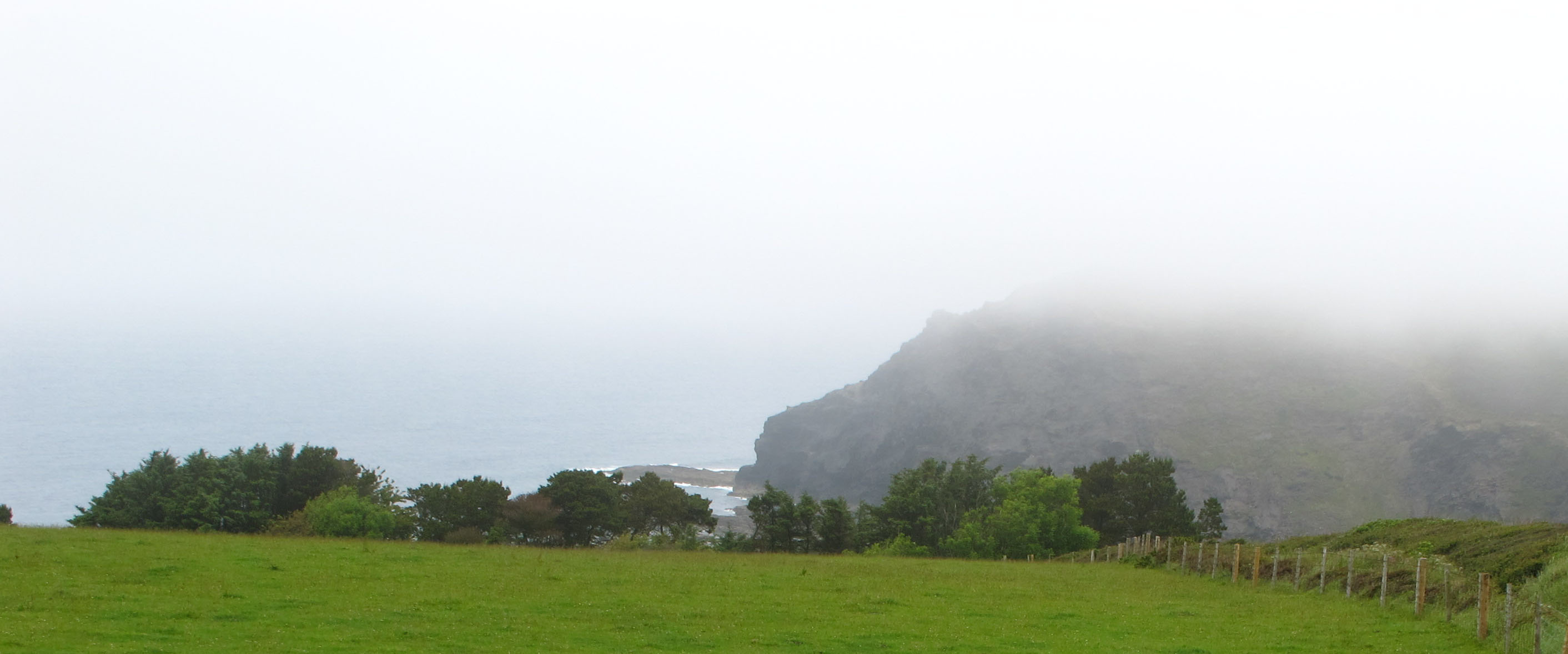
Irrelevant photo, but foggy cliffs seemed to suit the mood.

Irrelevant photo, but foggy cliffs seemed to suit the mood.

As a result, she never got to tell him what it had meant to her. But that didn’t stop her from talking about literature with him.

“We used to have some wonderful conversations about Laurie Lee, and Ted Hughes and the like. And I remember a Fortnum and Mason hamper arrived at Christmas for him; a gift from his publisher. I was so impressed, and all he said was: ‘Well they do get money from selling my books, you know.’

“He was made Companion of Literature. It was 2001 and he got it at the same time as Doris Lessing. It’s held by a maximum of ten people at any one time, and it’s for life. He said they’d only given it to him because he wouldn’t be keeping it for long.

“He’s extremely well loved in Cornwall.”

She added the following memory to give “an impression of his ready wit, even at eighty-four: I was helping him walk down a corridor and the call bell went off.”

Making a reference to the poet John Betjeman’s blank verse autobiography, “he said: ‘Oh you poor girls – summoned by bells, as my friend John would say.’ “

(I’m not sure how important it is to know this, but Cornwall inspired many of Betjeman’s poems.)

“There was a campaign to have Causley made poet laureate when Betjemen died.”

Tea on the lawn: what could be more English?

Is anything more English than tea on the lawn of a great house? We’ve were talking about stereotypes since I fell for an inaccurate one about Americans, but linking tea on the lawn—especially the lawn of a great house—to Englishness seems like a safer gamble. (Feel free to take me apart on that if I’m wrong.)

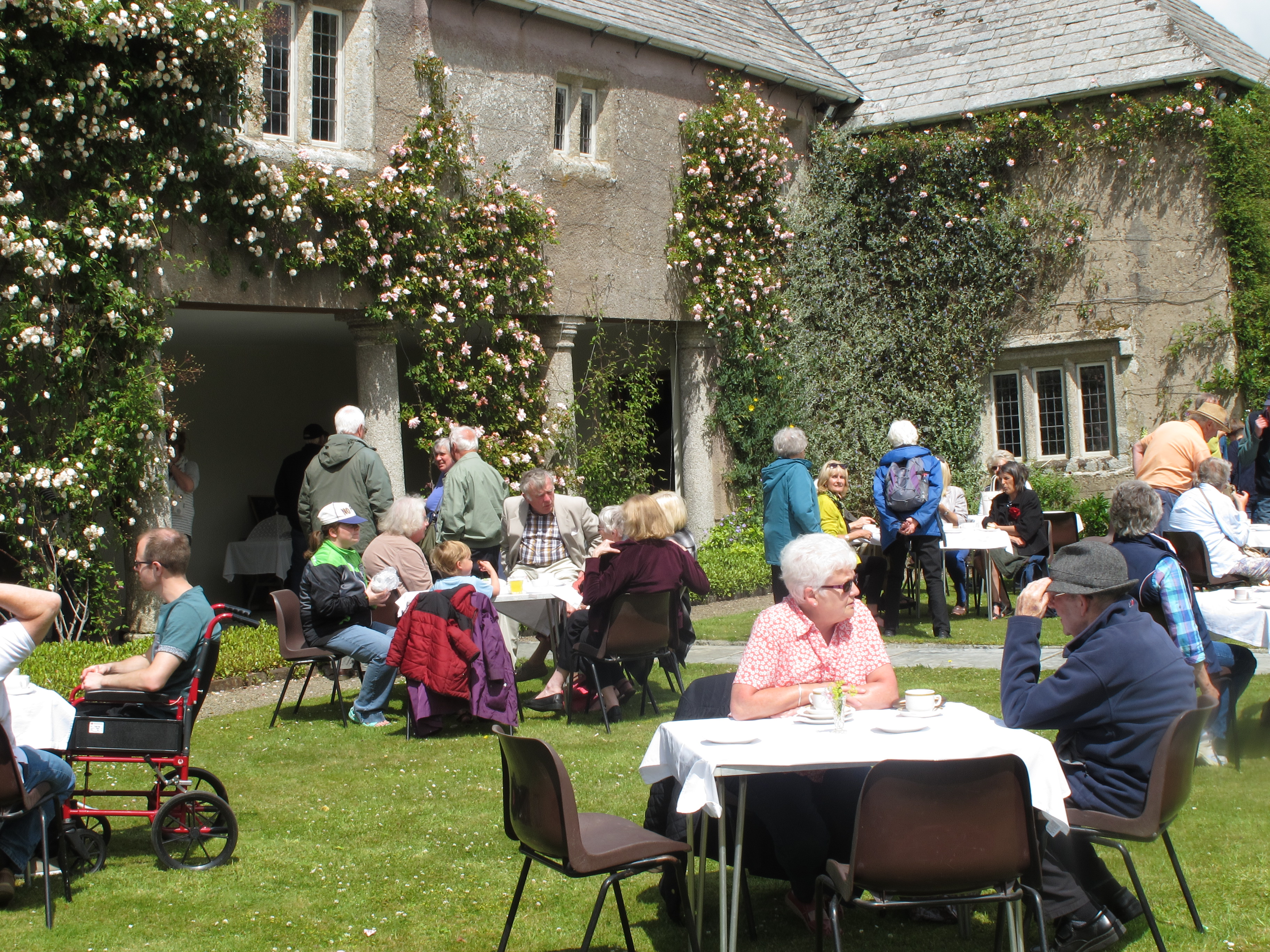
Cream tea at Penhele

Cream tea at Penhele

Recently, Wild Thing and I went to a cream tea at Penhele, a great house not from where we live. It was a fundraiser for the Charles Causley Trust, which (I just checked the website) keeps alive the memory of a local poet and promotes writing in the region where he lived. I’d love to give you a link to some of his poems, but although I’ve been impressed by some of his poetry I didn’t like the only one I found online. Others are under copyright and that makes them a no-go zone. Sorry.

But we didn’t go there to support the Causley Trust. In fact, we didn’t know what the event was raising money for. We didn’t even go for the cream tea, although it was a welcome bonus. What we really wanted was to see the gardens and the house, which are well enough known around here that we ran into half the village almost as soon as we walked in. One of them, J., was a carpenter before he retired (only they say joiner here, or builder, and I’m not all that sure what the difference is) and worked restoring historic buildings. Basically, once he’s done you can’t tell he’s been there. I asked if he knew how old the house was and he pointed to a stone plaque above a doorway in what he told me was the hall. It carried a date in the 1600s—1660, if I remember right. For all I know, other parts are older.

“I worked on those windows,” he said, pointing to the right of the plaque.

I felt like I was sitting next to a rock star.

Most of us—maybe all of us—lined up to buy tea and either scones with jam and clotted

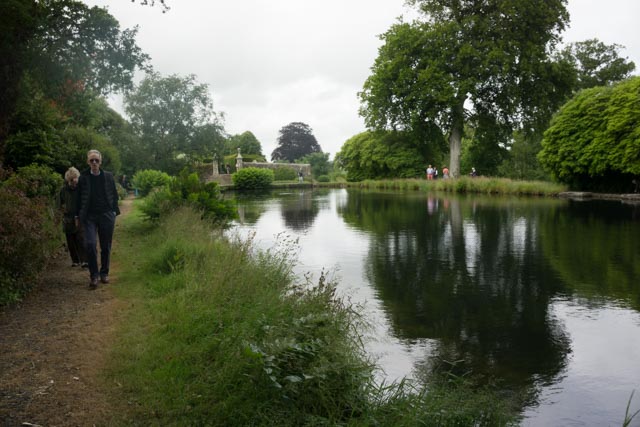
Walking by the lake.

Walking by the lake. Photo by Ida Swearingen

cream (that’s the cream part of a cream tea) or cake, then we drifted along paths and past fields, a lake, a swimming pool (covered), in and out of a series of open rooms formed by a high, dense hedge, and past an empty flowerpot stuck deep into the hedge and looking like a place for someone to hide his or her cigarettes, although I didn’t reach in to be sure since that seemed like an invasion. We paid closest attention to what I’ve learned to call a herbaceous border (you pronounce the H on herb here; I still don’t, but I’ve gotten to the point where both pronunciations sound odd to me), stopping to admire this flower and that one.

penhele 055

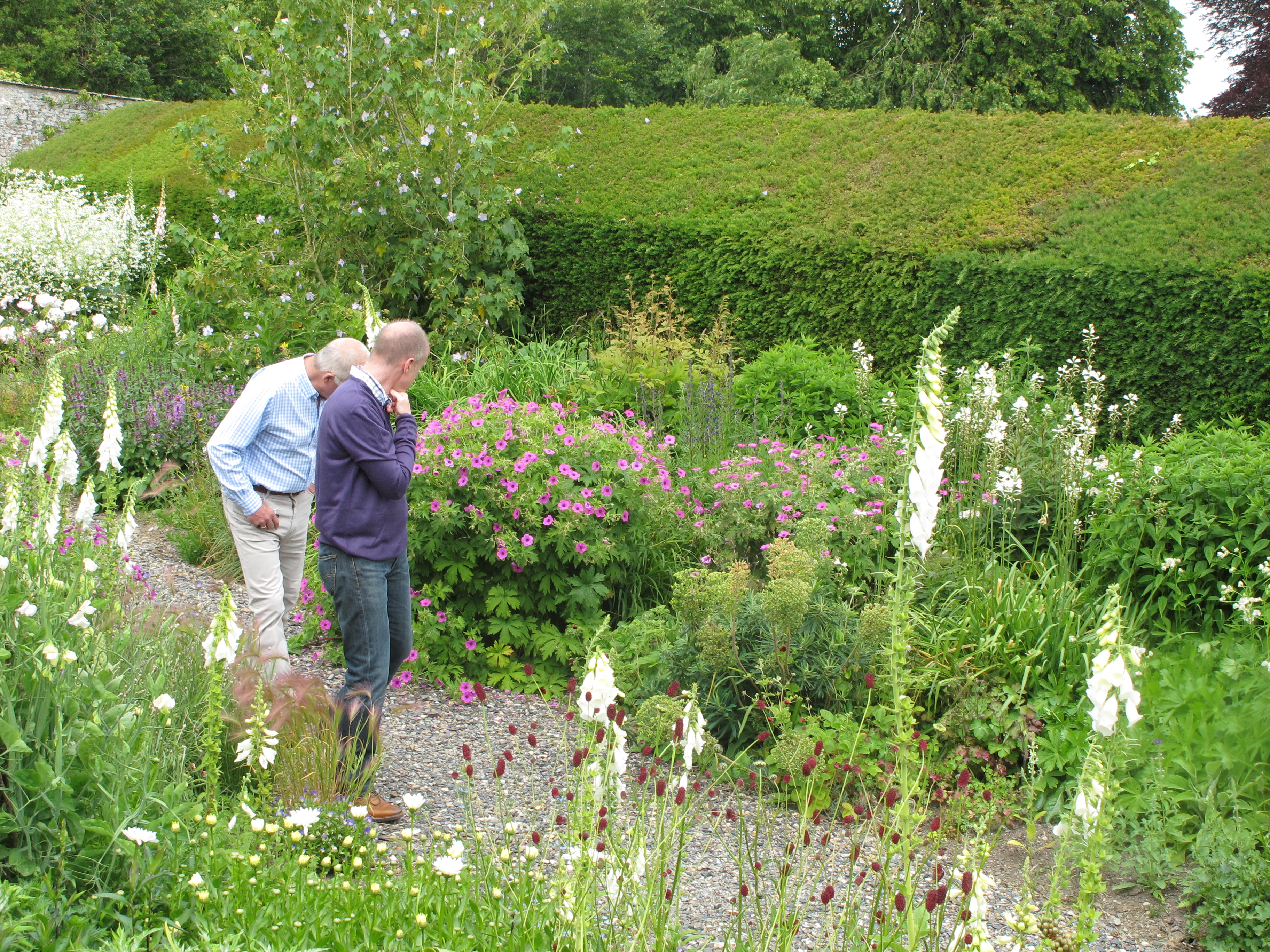
Part of the herbaceous border

According to Wikipedia, herbaceous borders became popular in the Victorian era. They’re basically a bunch of flowering plants—what I’d call a flower bed—and they’re gorgeous but take a lot of work. The Wikipedia entry talks about digging up and splitting and replacing plants, but even more than that they take weeding. Endless weeding.

Did I happen to mention how many weeds Wild Thing and I have grown since I started blogging?

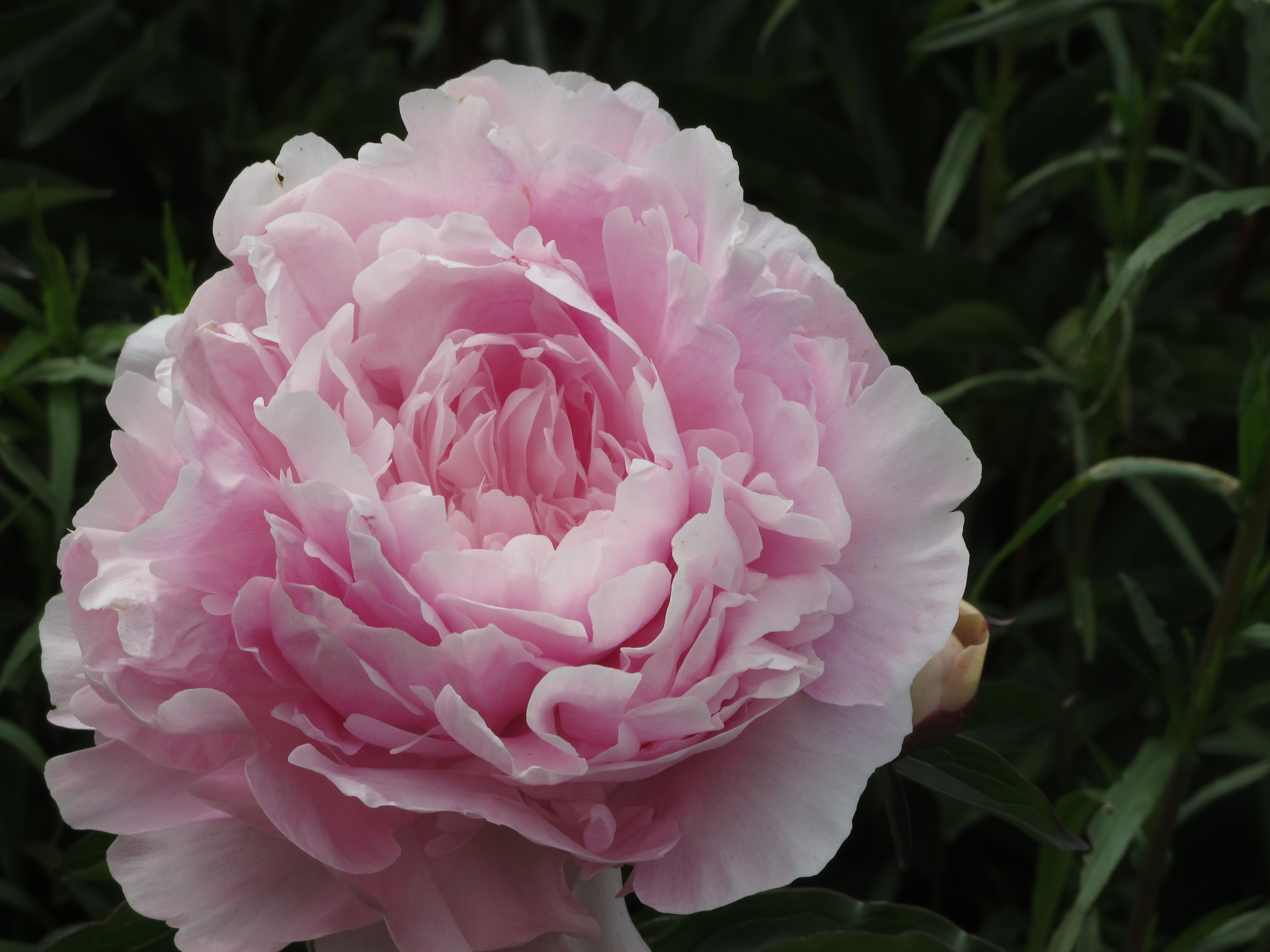
I haven't a clue what the flowers are, so I'm not going to try identifying them.

I haven’t a clue what the flowers are, so I can’t identify them.

I overheard several people saying the same thing that came to my mind: “I wonder how many people it takes to keep it looking like this.” No one had the answer, but quite a few seemed like a fair guess.

It all felt a bit like something out of a BBC costume drama—the great house opened for an afternoon so the villagers could put on their company manners and enjoy a day out. It’s less lord-and-lady-of-the-manor these days, but you can’t help noticing the difference between the place you’re admiring and whatever you call home. Still, whatever people’s feelings were about class and inequality—and I expect they ranged all over the scale—everybody seemed willing to put that aside for the day and enjoy the beauty and the hospitality.

Both class and people’s feelings about class are more open in the U.K. than in the U.S., penhele 061where we break out in a rash if anyone uses the word in any context except middle. And the tradition of a grand house opening its gardens to the public is also something I never heard of in the U.S. Wild Thing and I speculated on whether it dates back to Victorian times or to the medieval period. I’d put my money on medieval, because, as crushing as the lord-peasant relationship must have been, it did lay a few obligations on the lord, and those may have included fetes or feasts.

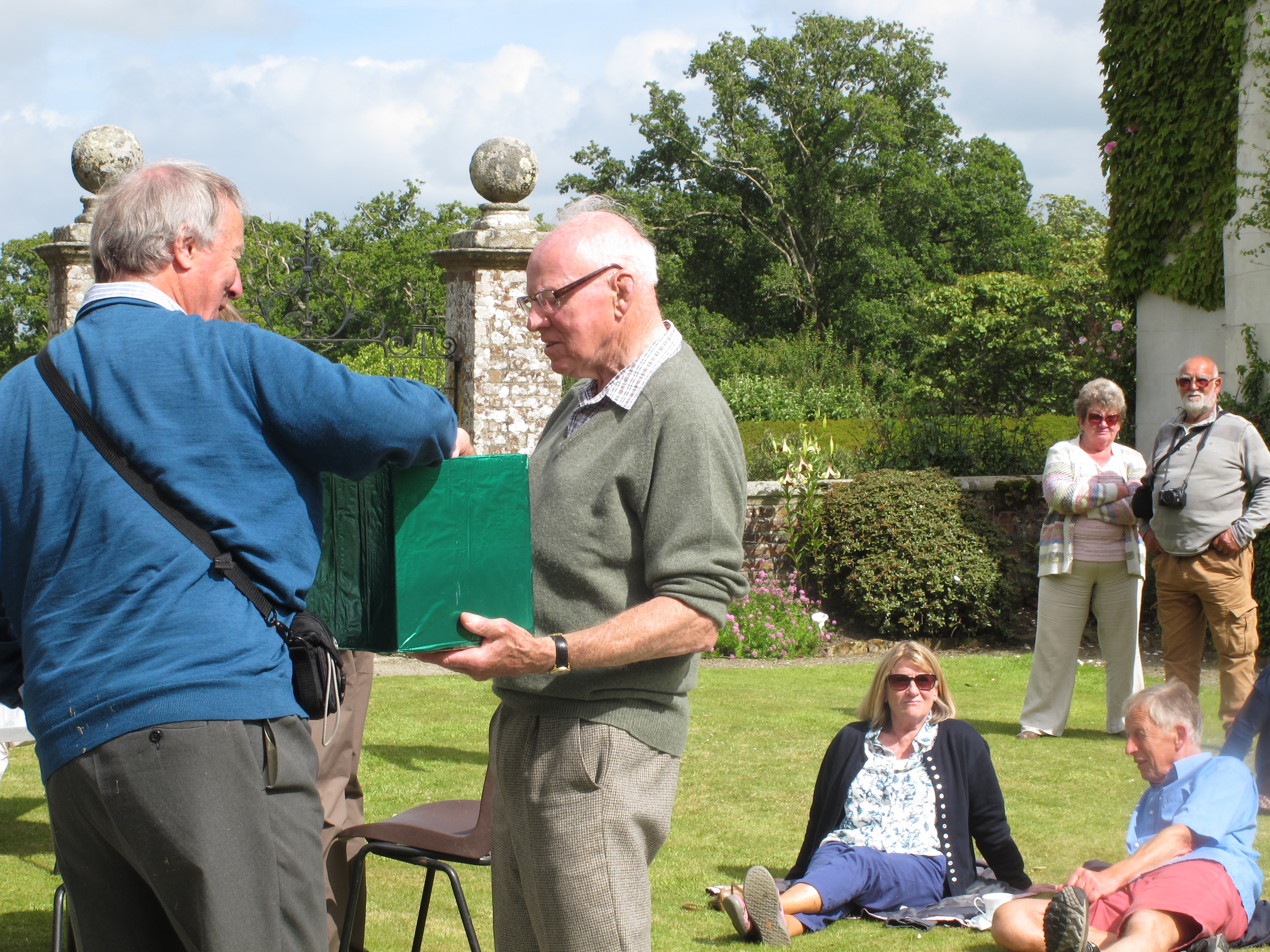
The inescapable raffle

The inescapable raffle

But that’s guesswork. What’s certain (or as certain as I dare be about anything right now) is that the tradition of great houses opening their grounds for fundraisers is part of an English summer.

At the end of the afternoon came the drawing for the raffle. You can’t hold a fundraiser in Cornwall without holding a raffle. There’s no law on the books, but it’s just not done. So at Penhele they held a raffle. And we didn’t win anything.

How Minnesotans call their kids: an extra

After reading my comment on how differently Minnesotans and New Yorkers call their kids, P. wrote to say, “You may be right about Minnesota nowadays, but in the late forties my mom called to me down the block in south Minneapolis. Other moms did the same thing.”

But sometime in the fifties, he writes, “a seismic shift  occurred, and the practice suddenly vanished. I like to think that Minneapolis was more like a big small town before then, and many houses in the neighborhood were owned by people who were fresh off the farm and spoke in heavy Scandinavian accents, now nostalgically recalled by Garrison Keillor and parodied by the Coen brothers. They used to call their children as if they were calling them across eighty acres of corn. They also mostly drove Chevies, while my Father drove Frazers, which they stopped making in 1952. Then Minnesotans decided they needed to become respectable and they elected Eisenhower. The shouting is gone now, and they switched to Buicks.”

British stereotypes of Americans–and my own

In the U.K., Americans have a reputation for bluntness, but do we live up to the stereotype?

In my last post, without even noticing it I went along with the stereotype, and Belladonna Took wrote, “It absolutely fascinates me that you consider Americans ‘blunt and to the point.’ Maybe that’s true over on the East Coast, but here in the Pacific Northwest? Oh dear, hmmm, I think perhaps it may be a little different. (Note: Everything in the preceding sentence after ‘Oh dear’ is Pacific Northwestese for ‘Oh hell no.’ And it’s pronounced in a lilting smiley voice, so I should probably insert lots of smiley faces. Only stuff it, I won’t, because I’m from Johannesburg.)

“…I had lived here two years before it finally dawned on me that when smiling women remarked, “You’re very direct, aren’t you?” they weren’t actually complimenting me.”

Irrelevant photo: flowers growing in a drystone wall

Irrelevant photo: flowers growing in a drystone wall

Well, damn, it’s amazing what I can learn when I listen to people.

Although I lived in Minnesota for forty years, I’m a New Yorker by birth,by accent, and by attitude, and I don’t think I’m the only New Yorker who’s blunt, but having fallen for one stereotype I’m starting to question everything I take for granted. Still, I think that’s what we’re generally like. Not all of us, but enough to set a pattern.

For years after I moved to Minnesota, I felt like a steamroller. With no particular effort and no intention at all, I seemed to leave people flattened on the pavement, and hell, all I was doing was talking. It’s not that I like an argument, but I do like a good, spirited discussion, and to the people I was now around in Minnesota that sounded like an argument. I guess. You’d have to ask them what it was really about, although they might be too polite to tell you, because if New York’s known for its directness, Minnesota’s known for Minnesota Nice: a relentless effort to keep things bland. Smooth that surface, folks, because it’s all that matters.

Years ago on A Prairie Home Companion (and the link’s to the show’s general website, not the specific shows I’m about to mention), Garrison Keillor did some bits about how Minnesotans talk. They were, I think, from Howard Mohr’s How to Talk Minnesotan. One that stayed with me was what a Minnesotan would say to someone using a welding torch on a full gas tank. It was, more or less, “Y’know, most fellas wouldn’t want to do that.”

In Minnesota when you’re making people uneasy, they’re likely to say either “that’s different” or “that’s interesting.” Ditto if you’ve thoroughly pissed them off. It took me a long, long time to understand what the phrases meant.

So I had a hard time those first few years. Or was that the first few decades? From this distance, it seems like no time at all. For a while, I tried toning myself down and ended up furious at everyone. Eventually I gave that up and let people look after their own welfare. They lived through the experience and I was happier, which it made me easier to be around, so I’m guessing everyone benefited. I was never going to blend in, so the only question was to handle my difference.

I’d lived there for several decades when my supervisor at work pulled me aside to tell me I was intimidating other (unnamed) staff members. Not by anything specific I’d said or done, just by my way of being in the world. If it had been something specific, I’m pretty sure I’d have reacted differently, but since this was about who and how I was, I surprised us both by laughing. She was twenty years too late, I told her, because I’d stopped thinking it was something I could change and anyway I’d stopped wanting to change it .

Twenty was a random grab for a largish number, but the rest of it was as true as anything can be in this complicated world of ours.

If you’re looking for a nifty strategy to help you get along with your supervisor, I don’t recommend that one, but to her credit she dropped the issue, and if she held it against me she kept it to herself. She wasn’t a native Minnesotan, but she’d adapted better than I had. So how did she really feel? I had no way of knowing and I was happy enough to leave it there.

At times when we lived in MInnesota, Wild Thing’s translated for me, because indirection isn’t a language I’m ever going to understand well. But she grew up in Texas and indirection is as natural to her as what other people think is an argument and I think is a discussion is to me. When her mother was bone-deep furious at someone, she’d do what she called heaping coals of fire on their head, which meant smiling and being nice to them to prove how angry she was. And, I’m guessing, how much better than them she was.

So, yeah, Wild Thing made a great translator.

One time we’d gotten a—no, I can’t resist it—whole shitload of manure for the garden and it was sitting in a pile by the alley, where I usually parked. And being the let’s-do-it-later kind of gardeners that we are, it sat there long enough that a neighbor said something about it. I don’t remember exactly what, but it had to do with there being a lot of it. Or how long it had been there. And I smiled and nodded and said yes it was a lot and yes it had been a while.

I’m clueless but I’m not unfriendly.

Then Wild Thing explained: The neighbor wanted some, and wanted to be invited to take it. And wasn’t going to ask. Ever. So we invited and she took and we all lived happily ever after.

I’m not sure how much of the U.S., geographically speaking, values directness and how much values indirectness. I’ve only lived in New York and Minnesota. If some of you want to fill in from your own experiences, it would be fascinating.

I can say two things, though. One is that stereotypes are powerful. If they match any tiny breath of experience in your head, as this one did in mine, you can find yourself blown right into a wall on a full-out storm wind. So thanks to Belladonna for providing the wall. I’m grateful.

The other is about the grain of truth in the stereotype. What I think gives rise to the impression of American bluntness is a sort of surface openness. In public, we take up more physical, emotional, and auditory space than the British. I wouldn’t say we’re uninhibited, but we can give that impression. And we recognize different rules of politeness. It’s easy to mistake all that for bluntness.

I offer than last piece especially as a theory, and I’d love to hear what you think of it. Am I anywhere near the mark?

Divorce Diet ebook now on sale

The Divorce Diet ebook is on sale from today until August 7 “at all major retailers,” the publisher tells me. Cost? $2.99. Apologies for posting the information twice. The first time was well before it actually went on sale and as soon as I hit Publish it occurred to me that I should have waited. Clever me. So here’s the news again.

What’s The Divorce Diet? A novel dedicated to every woman who ever walked away from a relationship. Or a diet. And it happens to be mine, so I’m doing a little shameless promotion here. Chapter one is online if you want to give it a taste test.