British Christmas traditions: the brussels sprout

Health and Safety Warning: This post contains exaggerations that may be detrimental to your mental health. Or your credibility if you take them literally when linking to the post. The Druids did not actually worship brussels sprouts. No one knows much about what the Druids did. And with that out of the way, do read on.


What is it about the British and brussels sprouts at Christmas? I address this topic because judging from my search engine queries it’s what people want to know. Or at least what one very determined person wants to know. Within a few days, I had at least five variations on the question Why do the British eat brussels sprouts at Christmas? It may have been more. I lost track in there somewhere. Why the person kept coming back if I hadn’t already managed to answer the question I don’t know. Determination shading into obsession?

Anyway, the question matters, and I’ve addressed it before but I don’t feel I did it justice. Because I sidestepped several crucial facts.

Irrelevant photo: gorse (that's the yellow stuff) and heather (that's the purple)

Irrelevant photo: Gorse (that’s the yellow stuff) and heather (that’s the purple). And grass (that’s the green and the tan.)

First, if Google is to be trusted (it’s not) you can spell the vegetable with or without an S: brussel sprouts or brussels sprouts. The first spelling matches our pronunciation (we just can’t make the double S audible unless we say it while standing on our heads and gargling salt water). Besides which, it’s easier to type without the extra S. The second spelling replicates the name of the city where they didn’t originate. According to Brussels Sprouts Info (everything important has its own web site these days), they’re believed to have been grown in Italy as far back as Roman times and began to be grown on a large scale in Belgium as far back as the sixteenth century before spreading outward from there.

The more common spelling seems to keep the extra S.

Second, you can either capitalize the B or not, depending on whether you capitalize the F in french fries. I don’t, but Word does and gives me bad marks every time I go back and un-cap it. It’s easier to use a cap, which is probably why I don’t. It’s a small and pointless way to fight the monopolies that are taking over our spelling. Not to mention our lives, economy, and politics. Take that, monopolies: I’m using a lower case F and a lower case B. That sound you hear? It’s Microsoft crumbling in the face of my defiance.

Third, the world contains more than 110 varieties of brussels sprouts and I bet you can’t tell any one of them from the other more than 109.

You notice how vague they are on the actual number? It’s probably because someone’s out there devising a new variety even as I type.

So far so uncontroversial, but now we come to:

Fourth, the real reason they’re eaten in Britain at Christmas is a tightly held secret and I’m going to reveal it to you and only you because, hey, it’s just us here, right? No one else is listening. I’d get into serious trouble otherwise. So here’s the truth: The Church of England may be the official and established church in this country, but it’s a thin and brittle overlay. Underneath lies the country’s deeper religion, worship of the Great Brussels Sprout. (And here, yes, it’s capitalized. Even by me. It’s a god and all. You want to show a little respect.)

What did the Druids worship? The Great Brussels Sprout. They painted themselves blue and cultivated the sacred plant. And they were nekkid when they did it.

How’d they cultivate it if brussels sprouts didn’t yet grow in the British Isles? I did say Google couldn’t be trusted. Its sources are giving you the official history. You can only find the truth by going into the dark web, where danger lurks behind every pixel, so I don’t dare give you any links. Folks, I’ll take the risk myself but I can’t be responsible for your safety. You’ll have to find it on your own or trust my report: The truth is that the Romans quietly exported the brussels sprout from Britain to Italy, and once it was established there they claimed to have developed all more than 110 varieties themselves.

Back in Britain, the Romans suppressed both the Druids and all outward forms of sprout cultivation and worship, but the belief ran deep in the population, and it survived, waiting from the sprout’s return.

How’d it do that when the pre-Roman British tribes (the Iceni, the Caledones, the Parisi, the Cornovii…) were overrun by the Angles and the Saxons and the Vikings and the Normans, making for a choppy history and a messy but interesting language? Because knowledge of the Great Brussels Sprout is planted deep in the soil. You don’t have to learn it from your community. If you get yourself a shovel and start digging, it works its way into your bloodstream. You feel a compulsion to worship something green and brassican. Rumor has it that they made do with cabbages until the brussels sprout was re-imported and jogged their memories of what the Great God really looked like. These were agricultural people, remember. They had lots of shovels. So when Christianity became the dominant religion, the best it could do was drive sprout worship deep underground, and from there it rises, godlike, every year.

Do I consider it strange, you ask (or at least you should ask), that people eat the sprout they worship? Isn’t that a bit, um, grotesque? Not at all. The Great Sprout is the essence of all sprouts and is itself inedible. The sprouts people eat at Christmas are merely its representation. And those among us who claim the ones on the plate are also inedible? They’re closest to the holy nature of the Great Brussels Sprout and everybody should back off and stop giving them a hard time.

Fifth (we were counting, remember?), the brussels sprout ripens around Christmas time. How many other vegetables are willing to do that? So of course people eat it.

*

And on a marginally sensible note, last week I forgot to link back to Laura, at A PIct in PA, who first used to word tickety boo, giving me a great excuse for another important post. She’s a Scot living and raising her kids in Pennsylvania, and she keeps a fine blog with lots of nifty artwork.

It’s all tickety boo

You want the American stereotype of British English? The phrase tickety boo comes as close as anything I can think of. It sounds like something that escaped from a 1920s comedy involving a butler who wears a bowler hat to hide his brains and a dim-witted aristocrat who needs a top hat to accommodate his sense of entitlement. Oh, and there’d be a lot of alcohol—martinis, probably—and women (strictly secondary characters) in what were then scandalously short skirts and are now scandalously modest.

Strangely, though, tickety boo is something people still say. Right now, in—what year is this anyway? Twenty something or other. And not clueless aristocrats either. Ordinary hatless, butlerless people who I know.

Or whom I know if you insist.

moose 005

Oh, and did I mention that we got a puppy? He’s the one of the right: nine weeks old and named (what else?) Moose.

So shut up, Ellen, and tell the good people what tickety boo means. It means is okay. or everything’s fine. It has an every little thing’s in place sound to it, although none of the definitions I found in my extensive five-minute Google search mention this. Still, my ear insists on it, and puts the emphasis on little.

It’s informal, as you might have guessed from the sound.

The Urban Dictionary says the origin may be Scottish, but along with the Oxford Dictionary it traces the origins, tentatively to Hindi, although the two dictionaries quote different versions of a Hindi phrase—or (let’s be skeptical) an allegedly Hindi phrase. If I had to bet on one version, I’d put my money on the Oxford one, but let’s not pretend I know anything about this. Oxford sounds impressive and its phrase sounds less like something an ear tuned exclusively to English might have mangled .

How a phrase originates in Scotland and India I don’t know, but to demonstrate the phrase’s Scottish roots, the Urban Dictionary refers to Danny Kaye singing “Everything is Tickety Boo” in a film I never heard of, Merry Andrew. Convincing stuff, right? Kaye was an American actor—the New York-born son of Ukrainian-Jewish immigrants whose original name was Kaminsky, which I’m reasonably sure isn’t Scottish or Hindi.

Andrew is the patron saint of Scotland, so maybe we can make some sort of backing for the theory there.

Do you begin to get the sense that everything isn’t quite tickety boo about all this? That maybe some of the sources you find through Google aren’t perfectly researched? Maybe even that guesswork is involved in tracing word origins?

The Collins Dictionary, playing it safe, says the origin is obscure. Several sources say the phrase is outdated, even archaic. Which would imply that my friends are archaic. Sorry, but we’re not having any of that.

The Oxford Dictionary adds, helpfully, that tickety boo rhymes with buckaroo, poo-poo, shih tzu, Waterloo, and many, many other words that wouldn’t spring to mind if you were going for logical connection instead of pure sound. If anyone would like to use those in a rhymed, metered poem and submit it to the Comments section, I will shoot myself. Although not necessarily with a gun.

*

In Tuesday’s post I left some of you with unanswered questions—which bless your tickety little hearts, you asked—about why I’m cutting back my posting schedule. I didn’t mean to be cryptic or to worry anyone. Here’s what’s happening:

Ever since Wild Thing was diagnosed with macular degeneration and had to quit driving, I’ve been thinking about posting less often. Not necessarily forever, but for now. The changes in our lives haven’t been easy to get used to, either emotionally or practically, and one result is that I haven’t been keeping up with the details of my life lately.

While I was arguing with myself over whether or not to cut back, I got a bad cold, which came close on the heels of a miserable flu, and on Monday night I realized I had nothing at all to say for Tuesday’s post. The only thought in my head was, Do we have enough cold pills? So that tipped me over the edge. If I’d a bit more room in my head for thoughts, I might have said all this in Tuesday’s post but I didn’t and so I couldn’t.

I’m pulling back from some other commitments as well and hoping all this will leave me time to moult—you know, drop old feathers, grow new ones, maybe some listen to music more often, do more baking, spend more time with Wild Thing, and do more work on the book I’m theoretically writing. Maybe even shovel out the house a bit more often.

But you’re not rid of me yet. I’ll be around on Fridays. And already I’m missing my old schedule.

Adaptation and pig headedness

Wild Thing and I need to renew our American passports. To do that, we each have to send in two passport photos measuring two inches by two inches. British passport photos measure something else by something else, as do driver’s license and everything else photos, so we can’t just plonk ourselves in that little booth in the supermarket entrance, looking our worst, plug some money into the slot, and walk away with photos. And for all I know, an inch in the U.K. isn’t the same as an inch in the U.S. Why should it be when a cup, a pint, and yea, even a breath of air all change size as they cross the Atlantic?

But don’t let me sulk about that. I have and it didn’t help. The U.S. embassy is very clear about what it wants. Send us the wrong size photo, it warns, and we’ll send them back.

And put us on a watch list so we’ll never be allowed to fly again. Because the wrong size passport photo? It’s an indicator of political unreliability and who knows where it could lead.

Irrelevant photo: The beach in a storm. The wind was high enough that I had  stop walking during the gusts.

Irrelevant photo: The beach in a storm. The wind was high enough that I had stop walking during the gusts.

So we went to a local photography studio. We walked in looking our worst and came away with two two-by-two photos each. In the process, we got to know the photographer’s two dogs (sorry—I’m not making up the numbers; there really are that many twos involved) and their histories and friendships and enemyships. (Did I mention that if you ask about a dog around here, you’ll find out about the dog?) A neighbor stopped by with a chew stick for each of them, as she does every working day. We discussed dogs a bit more, then moved on to being Cornish (“you have to have four generations in the ground here before you’re Cornish,” the neighbor said).

Wild Thing said we had dual citizenship. I can’t remember why that came up, but it made sense at the time. The neighbor said that if we were British we had to say—and I may well get this wrong but I’ll do my best—“dyual.” Or maybe I should spell that DYOO-wel, as opposed to the American DOO-wel.

The photographer agreed.

The hell we do, I thought and didn’t bother to say. It’s not something I need to argue since I have no intention of doing it.

But Wild Thing’s an accent adaptor. She repeated “dyual.” I don’t know how close she was but close enough that they accepted it for at least the effort.

I tell you this story because when I asked what people wanted to know about either Britain or the U.S, bethbyrnes wrote, “My family is from England and I grew up with a lot of rules. When I go back to the UK, I get the impression that the Brits (my family included) see Americans as naughty children and treat us accordingly. I so love England and thought of moving there eventually but I feel I might resent being seen in such a negative light. What do you think? Am I imagining this? I hope this isn’t too rude to ask!”

That isn’t even bordering on rude. But then, I’m an American, and not one with an ear for subtle rudeness.

I suspect the answer depends in part on how seriously you take dual/dyual comments. I heard the conversation as good-humored bullshit—the kind of thing you say to someone so that you have something to say to someone. In other words, teasing. Which has an ugly side, a side that not only hurts people’s feelings but also enforces conformity, but it also a we-all-agree-not-to-take-this-seriously side. What people really mean is often a matter of guesswork, and I tend to hear that second side more often than the first. I won’t argue that I’m right, only that I tend to hear it that way.

Wild Thing, I think, takes these comments more seriously than I do. When—as often happens—people talk about some TV show or comic that they find hysterically funny and we say it leaves us cold, someone’s bound to say, “Oh, well, you’re not British.” Wild Thing hears an element of pity in it. I hear a simple statement of fact. I don’t know who’s reading the signs more accurately.

I can’t remember ever thinking that we were being treated as naughty children, although we’d be an easy target for that. J. did once say that now that we were British we had to start eating dessert with a dessert spoon (which I’d have called a soup spoon) instead of a fork, but again I heard it as good-humored teasing and kept right on using my fork. I do set out dessert spoons for our friends, but you’ll find forks right beside them. Choose your weapon. This comes up often since we’re part of a small group devoted to eating dessert, discussing politics, and occasionally taking action. Not to mention trading the odd bit of gossip. The group meets at our house. So setting out spoons? I don’t expect my friends to change the way they eat any more than I expect to change the way I do. But I’m hard headed. I can take a fair bit of criticism, comment, and teasing, as long as it’s well meant, without feeling like I’m under attack.

And when a comment is meant seriously? When people genuinely do think I should eat differently, talk differently, or turn myself into their idea of what a person should be? I don’t spend much time with people like that and they don’t go out of their way to spend time with me, oddly enough. They’re welcome to their opinion and much good may it do them.

So yes, people like that are out there. But another group seems to think of Americans as free spirits and envy us our lack of inhibition. But Wild Thing, who was a family therapist before she retired, makes an interesting distinction between being uninhibited and being emotionally free. Americans, she says, are indeed less inhibited, but not necessarily emotionally free. I had to think about that for a while, but I’ve come around to her way of seeing it.

Even if it’s not true that Americans are free spirits, though, the belief’s a great counter-balance to the you’re-doing-it-wrong group.

Both responses, I think, stem from the number of rules the British grow up with. As does teasing people about differences. People learn not to call attention to themselves in public. Say you’re out in public and you trip and people rush to help you up. Huge embarrassment. Sat people you know wave their arms to get your attention from a distance.  Ditto, apparently. And so on. Not everyone abides by the rules to the same extent, and there are patterned ways to break them, but the rules exist.

Whether as an American you’re treasured or criticized because you break them will depend on who you hang out with. And whether the comments you hear bother you will depend on how deeply you take these things in.

The British and their pets

Let no one say I hide from the tough topics. I asked what you wanted to hear about and I got questions about budget cuts (destructive), mental health services (needed more than ever given the budget cuts), British television (mixed but I’m not much of a TV watcher these days), and what the British think of Americans (long story). So let’s start with the heavy-duty stuff and talk about the British and their pets. This is justified because Sandy Sue wrote, “I’d love to hear about Brits and their pets. In one post you said they don’t holler for their animals like we do–I loved that. More!”

Okay.

Spoiler alert: The Big Guy's been found.

Spoiler alert: The Big Guy’s been found.

Dogs played an important part in introducing us to the village. Wild Thing has a gift for starting conversations with pretty much anyone, and if she sees someone with a dog she stops to talk if she can. In any country. In Kate Fox’s book Watching the English, I read that dogs are an accepted conversation starter. A bit like the weather. They’re a nice neutral topic that allows shy people to connect, and Fox writes about the English as a publicly shy people. The national assumption is that each person goes into the public sphere surrounded by an invisible privacy bubble and it would be rude to break in. Commuters who see each other morning after morning may, after a year or so, go all out and nod to each other. Which is why they need pre-programmed topics—the weather, the dog, the whatever—in order to break out and enjoy a bit of human companionship.

Lucky us that Wild Thing’s quirks fit so well with the country’s. Our acquaintances and then friendships in the village grew out of Ida’s habit of talking about dogs. When we first came here as visitors, we met a few dogs, and through them a few people, and through them a few more people, and here we are, all these years later, still pestering them.

One of the first things Wild Thing noticed was that if you asked people about their dogs, a certain number of them would tell you entire tales: She’s a rescue dog and she’s settled in wonderfully but she’s still afraid of people with hats. Oh, he’s had a difficult day—he saw the vet this morning. Last week she was stung by a bee and it’s been very traumatic. These weren’t just dogs we were hearing about. Each one was the central character in a novel.

I don’t know if more people adopt abandoned dogs in the U.K. than in the U.S., but I do know we hear about it more often. Stop to admire a dog and if it’s a rescue dog that’s the first thing you’ll learn. Which leads me to wonder not only if more people adopt rescue dogs here but if more people abandon them. Or is it that more of them find a home? Or do we just hear about it more because people need the outlet of talking about their dogs?

Dogs are welcome in more public places here than in—well, it’s hard to generalize about the U.S., but certainly than in Minnesota. Lots of cafes and pubs welcome them. If we’re not sure and don’t see a sign in the window, we’ve learned to poke our heads through the door and ask. A few even offer dog biscuits. Some set water bowls outside the door, whether or not dogs are welcome inside. At singers night in the nearby pub, dogs are a regular part of the mix. Every so often one will add a well-timed howl and be welcomed with general hysteria. One of the organizers has a small repertoire of dog songs that he’ll sing at times like that. Mostly, though, the dogs are content to listen and hope someone will drop a sandwich.

As a result of being taken more places (or I’m guessing it’s a result), dogs are generally more relaxed in public than a small and unscientific survey leads me to believe they are in the U.S. I do hear and read about aggressive dogs, but so far our experience has been good. A bit of growling now and then, the occasional pup who’s too big and enthusiastic its brain, but mostly they get along peaceably and behave well. Even if one or another of them howls at a song. We’ve all wanted to once in a while, haven’t we?

We’ve usually warned away from snappish ones by their owners.

In Minnesota, state law governed where dogs could and couldn’t be taken. A coffee shop near our old house let dogs in because they couldn’t see a reason not to, and it worked well until they got caught by an inspector from the Minnesota Department of Dog Fur and General Bad Behavior and received a couple of stern warnings. They still couldn’t bear to kick dogs out but we took pity on them and stopped bringing ours in. Other dog-owning regulars did the same. Then the state passed a law that made it illegal to tie a dog outside while you went in for coffee. No, it didn’t specify coffee. It could have been shampoo or a bottle of milk. But it limited what people could do with their dogs. We could walk them and take them back home. We could keep them at home, and we could let them out in the yard if we had a way to keep them inside it. But we couldn’t integrate them into our lives the way we can here.

Because I live in the country, people keep other pets and semi-pets. On the other side of the valley, B. keeps peacocks. Come spring we hear them yelling something that sounds like “Help! Help!” The peahens want nothing more out of their lives than to lead their chicks onto the road and wander up and down it, and I’ve learned to slow down near B.’s house. The peacocks like the road as well. One year I saw the local half-size bus herding a peacock down the road toward me at maybe half a mile per hour. As the bird walked, he threw his feet forward—not quite in a goosestep but it was close enough to make me understand why they named the step after a bird. He had his fan spread and was yelling furiously for help, or for reinforcements. When he got to the house and no reinforcements had come, he stepped aside and let the bus through.

I didn’t have a camera.

Any number of people keep chickens and a few keep geese. Some of these are just chickens and geese and some are pets. One year two of M.’s chickens died, leaving her with just one, which was so lonely she’d follow M. from place to place as she worked in the garden and would sit on the windowsill when M. went in. Eventually M. got another hen or two and the chicken went back to acting like a chicken.

M.’s hens are battery hens that aren’t laying as heavily as they used to and would otherwise be slaughtered. They come to her practically featherless and in terrible shape, hardly knowing what to do with the great outdoors. Then before long they feather out and start pecking.

A few years back, someone not far from the village adopted a lamb with a broken leg that she found on the moor. She located the farmer and told him about it and the farmer offered to shoot it, so she loaded the lamb in the car, got its leg set, and raised it until it became a ram and a bit of a handful, when she found someone with a smallholding who was willing to take it. By that time, it didn’t consider itself a sheep anymore and didn’t settle in well with the other sheep. Eventually it made itself a home with the horses.

And then, of course, there are cats.

When the stray we adopted, Big Guy, disappeared a couple of weeks ago, we put a note on the village Facebook page, which is all you have to do to activate the village network. For a while, the comments were all about I hope you find him and next time try putting butter on his feet the first time you let him out. Then last Saturday night we got a phone call: The Big Guy had showed up outside S.’s house, yelling his head off, and they were feeding him. They’d heard he was ours. The kids wanted to adopt him and the parents were being won over. They said he was shy about coming inside but they’d made him a space on the porch, where the boiler is, so it’s warm. Their house is just downhill from where he was first found. Apparently that’s where he wants to live. It’s got a beautiful view and I guess he likes it. Wild Thing told them that he didn’t seem happy here, so if they were willing to keep him that would be great.

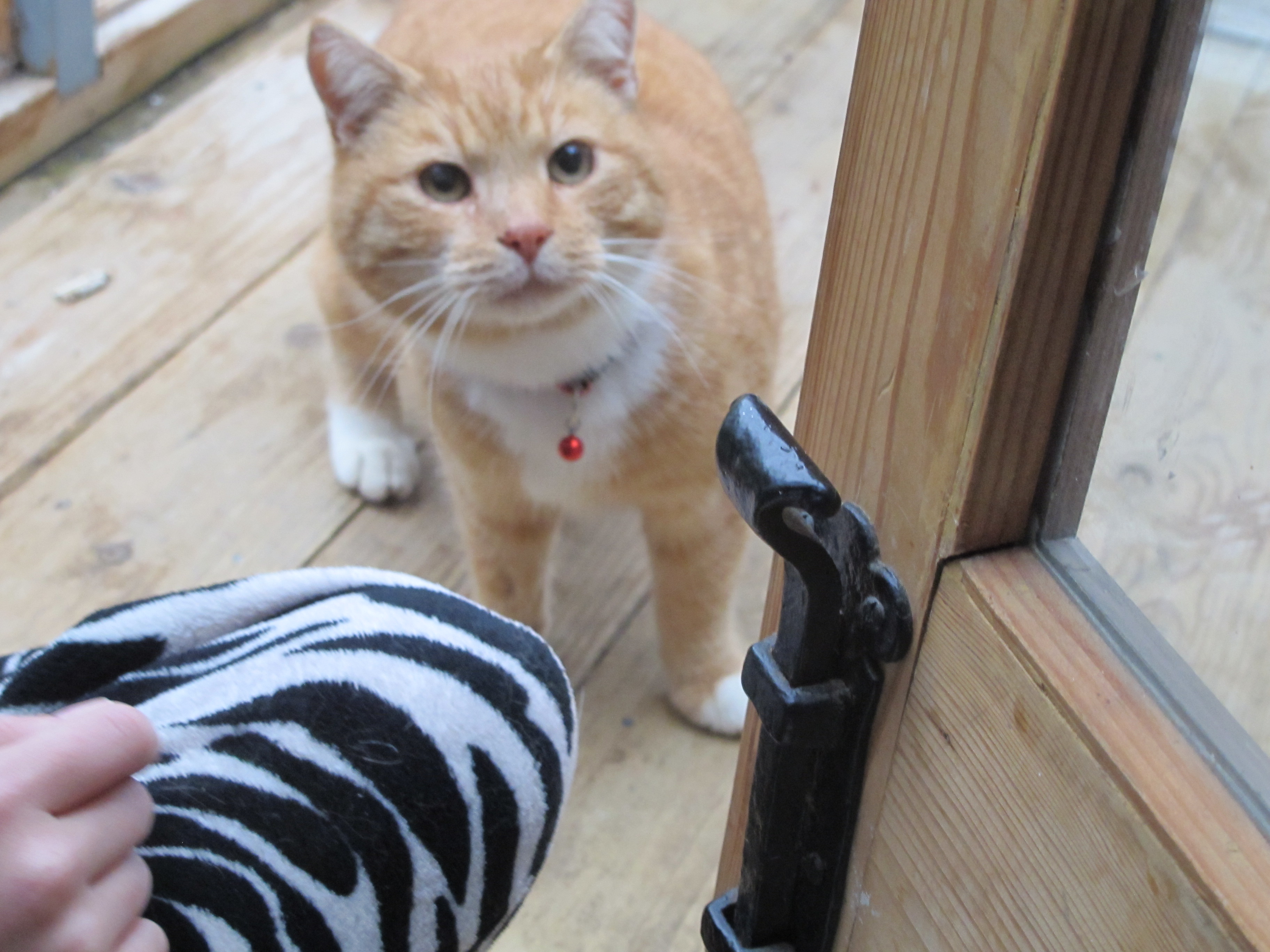
I stopped by on Sunday morning to bring them some cat food left when Moggy died. Fast Eddie still eats kitten food. And dog food. He plans to be a dog when he grows up. Anyway, I stopped by and there was the Big Guy, cuddling with one of the kids. He was happy to see me but not as if he’d been lost and I’d found him. He was indeed a bit shy about coming into the house but when he saw a bowl of cat food he decided he’d take the risk. It’s hard to know whether he’ll stay, but he does seem to like the neighborhood, they’re treating him well, and I think he’s found a home. Even if they do call him Marvin—Starvin’ Marvin.

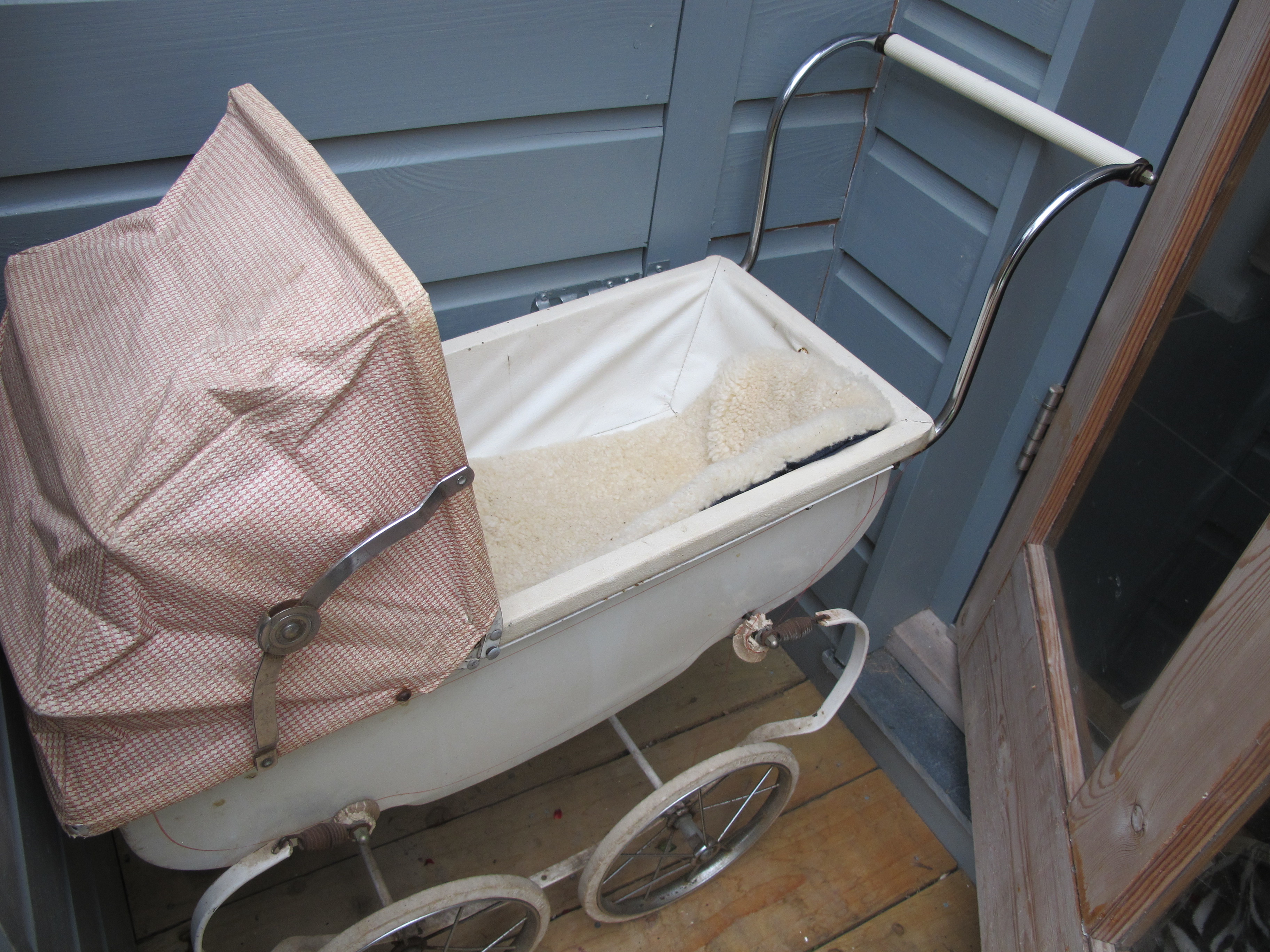
I don't  think the Big Guy's going to sleep here--he's not much of a jumper--but they made him a nice warm bed in an old doll carriage.

I don’t think the Big Guy’s going to sleep here–he’s not much of a jumper–but they made him a nice warm bed in an old doll carriage.

While I was down there, Wild Thing got a call from S.’s neighbors, who reported that the Big Guy had been trying to get into their house. Then A. called. She thought she’d seen the Big Guy at yet another house in the neighborhood and she’d gone to ask if he was their cat but they don’t have a cat.

Oh, and W. thought he’d seen the Big Guy running across a back road nearby.

It takes a village to find a cat. And in Big Guy’s case, to house one. For the moment, though, he’s housed and fed, which is good because it’s been raining a lot and the wind has been so strong that during some of the gusts I couldn’t walk into it.

How is this any different from the U.S.? People in our old neighborhood people also put themselves out to care for cats. One of ours, the much-loved Big Ol’ Red Cat, was a stray who was taken in initially by our neighbor, D. But she couldn’t keep him because the cat she already had was pounding on him, so she brought him to us and he settled in happily. The underlying feeling about cats was the same. But in a city a cat can fall off the radar without wandering far. Just like a person can. Living in the city, you end up with a series of short stories. In a village, you hear the entire novel.

Wild Thing and vision loss

This past year, Wild Thing lost part of her sight to wet macular degeneration. Reading’s possible but not simple. She’s had to quit driving, which since we live at the end of beyond is a major adjustment for both of us. Independence matters hugely to her. And to me. And around here, without a car? It’s difficult. The village is on a bus route, although with endless government budget cuts I’m not sure how long that will be true. But even so, it’s a minor route. You can get to one of two nearby towns and a village or four, but you may have hours to kill before you can get home.

She’s gotten an electric bike–she has enough sight left to manage that–but even so it’s a huge adjustment for both of us.

So I’m going to break two unwritten rules here: 1. This isn’t a me-blog, and I don’t write about our lives unless they touch on the intercultural mayhem of two Americans living in Britain; 2. I don’t reblog anything that isn’t tightly related to that topic. But hell, they’re my rules, so I get to break them. I’m linking you to a post on Wild Thing’s blog, where she writes about the last day she drove to the moors so she could do some photography. She knew she wouldn’t be driving much longer. She wasn’t sure how much longer she’d be able to use a camera. The day had the intensity of a farewell. The photographs are damn good.

If we’re lucky, the doctors will be able to stop any further deterioration (all hail the National Health Service, which allows everyone access to free medical care) and she’ll be able to keep on using a camera. But we won’t know for another couple of months.

This is one of Wild Thing's photos from about a year ago.

This is one of Wild Thing’s photos from about a year ago.

What’s all this Thanksgiving hoo-ha?

I don’t do reblogs unless they’re tightly linked to the sort of insanity I indulge in here, but Dream Big, Dream Often‘s “36 Little Known Facts about Thanksgiving” is a good introduction to unexpected aspects of the holiday. I’m not sure he really reaches 36, since he starts by lettering his list, then starts a second time, still using letters. then starts at third time at 1. But we’re among friends, so who cares? It’s worth a read.

Prohibition and sticky toffee desserts

When I last asked for questions about Britain or the U.S., Dan Antion wrote, “The last night I was in London, I had some kind of gooey toffee desert (sticky something). I wrote my friend in Ipswich and said, ‘why did you send us the Beatles and keep this a secret?’ but he never replied. This makes me think there’s a law against describing that dish. If you choose not to write about this or toffee, I’ll understand (but it will confirm my suspicion).”

Never one to be scared off by sensible considerations or petty legalities, I’ll tell you everything I know on the subject. And more. Much, much more.

Irrelevant photo: a volunteer cyclamen that planted itself by the back door

Irrelevant photo: a volunteer cyclamen that planted itself by the back door

It sounds to me like Dan stumbled into an underground club where sticky toffee pudding was being served on the sly. While he was on the pavement humming “Yellow Submarine” and wondering why colors seemed so vivid suddenly, his friend was whispering a secret word to the tough guy lingering by an unmarked door, who gestured them inside and closed the door behind them. They ate and Dan licked his spoon (desserts here come with a big honkin’ spoon) and wondered why the tastes were as vivid as the colors.

It was something to do with the Beatles.

I can’t promise to reproduce that experience, but through the magic of the internet I have gotten access to several highly encrypted recipes. Being so well hidden, there are, of course, problems.

  1. They’re mostly metric, but if you can decode them, you can make then. And if you can make them, you can eat them. I won’t try to convert them because I tried that once and–well, it was over a year ago and I’m still recovering. So you’ll need a kitchen scale to follow them. Sorry, you American cooks. This involves a smallish investment.
  2. Sticky toffee pudding seems to want self-raising flour, and I never used the stuff in the U.S. It’s sold in the southern states but is rare in the northern states and in Canada—or so the wise old internet informs me. It doesn’t like the cold, I guess, but with global warming its range may be expanding. Even where it’s available, though, it’s apparently formulated differently, so using it could make your recipe go all weird.
  3. British supermarkets sell more kinds of sugar than kinds of baked beans, and they lots of baked beans. Lots and lots of baked beans. Start with granulated, demerara, turbinado, muscovado, then go on for another line or two. Me, I ignore most of this and use either white (that’s called granulated) or brown. I may lose some subtle tastes, but it works. However, I do not now and never have substituted baked beans for sugar in any recipe, nor do I recommend that you try.

In case that isn’t complicated enough, I’m going to give you several recipe links:

Behind door one is one of the rare recipes that doesn’t use self-raising flour. It also doesn’t use dates, which makes me suspicious, because dates seem to be important here.

Behind door two is one that uses both dates and self-raising flour. Don’t rule it out, though, because you can make your own self-raising flour from plain ol’ flour by adding “2 teaspoons of baking powder to each cup (150g) of all-purpose (plain flour).”

Since the recipe calls for 175 grams of flour and since my math is shaky at best, I’d have to double that, then toss the extra—what would it be? 100 grams? 125 grams? a bunch?—over my shoulder and onto the kitchen floor and blame Nigella for the mess since it’s her recipe and her substitution suggestion. Or her team’s. She may no longer exist in person but have been replaced by a team of some sort.

The recipe calls for muscovado sugar. See above. Or see the web site that says, “Sugars like muscovado, demerara, and turbinado have flavor depths and aromatic heights that blow plain ol’ granulated sugar out of the water.” Muscovado has a “very moist texture and a strong molasses flavor.” Yeah, yeah, yeah. Me, I wouldn’t put my granulated sugar in the water to start with, so muscovado would have to blow if out of the cupboard. You can get away with brown sugar. Or probably (gasp) white.

Behind door three lurks something scary: the possibility that we’re not looking for sticky toffee pudding at all but sticky toffee cake. But let’s be reckless and yank the thing open it anyway. I didn’t get where I am today by being cautious.

Remind me, would you? Where am I exactly?

Most of the recipes I found for this call for golden syrup, which as far as I know isn’t sold in the U.S. supermarkets, but one doesn’t. For reasons I can’t explain, it pops up behind a box that wants to divert you someplace else entirely, but if you work at it you can still read the recipe.

And then there’s this one that not only doesn’t use golden syrup, it’s measured in cups and baked in Fahrenheit, which makes me think it’s from the U.S.

Sorry, Dan. I’d make this simple if I could but it wouldn’t be half as much fun to write about.

*

For those of you who are following the pet saga at our house, the Big Guy seems to moved on. He went out on Thursday night and hasn’t come back. I’ve put a notice on the village Facebook page, so people are keeping an eye out for him, but as J. wrote, he seems to have a touch of the wanderer in him. It’s been rainy and cold, but he’s good at letting people know what he needs–that’s how he came to us–so I hope he’s found himself a new home.

Fiddling with grammar during a refugee crisis

As the world reels around us, let’s spend a few moments playing with the oddities of English grammar, because what could be—when all is said and done—more useless. And sometimes we need to take refuge in the useless. When we’re done and I dump you back out in the real world, if you find a way to welcome the Middle East’s refugees to whatever shore you live on, I hope our short holiday leaves you strengthened for the task. They could easily, if the world’s axis ran through the planet at a slightly different angle (metaphorically speaking), have been any one of us. Or all of us.

But first let’s scramble back to the safety and silliness of English grammar.

Irrelevant photo: These are the (gorgeous) seeds from a (n equally gorgeous) plant, montbretia, that serious gardeners just hate because it will take over entire counties. As far as I can figure out, it's pronounced momBREEsha.

Irrelevant photo: These are the (gorgeous) seeds from a (n equally gorgeous) plant, montbretia, that serious gardeners just hate because it will take over entire counties before they’re even put their trowels away. As far as I can figure out, it’s pronounced momBREEsha.

I used to work as an editor and copy editor, and I’m retired now so I claim the right to screw up and not feel (too) bad about it. But I love this stuff. Sometimes it’s even relevant to the cultural differences between the U.S. and the U.K. that are supposed to be at the heart of this blog, although the particular questions here aren’t. Never mind. One of the rules at Notes is that when appropriate we can cheat.

Both questions were thrown at me when I asked what people wanted to know about either the U.S. or the U.K. And since these have nothing to do with either, and since I can rant on endlessly about this kind of thing with minimal research, and since, further, I still have the flu, I thought I’d move them to the top of the list.

Tim Gatewood asked, ”How do you feel about using they as a singular pronoun (in place of the ugly he/she/they)? Or using she in place of he as the preferred pronoun? I am doing both in the book that I am writing this month as part of the Write Nonfiction In November challenge and I expect to get some pushback from some folks about both of those.”

By now, any hardy traditionalists out there will be asking why you’d want to do any of that, and the answer is that the use of he, she, and they is one of the many places where the English language is insane. Not to mention sexist. When I was in school, I was taught that you couldn’t write (or say) “Everyone should put on their hat,” because everyone is singular (every plus one, geddit?), so it had to be “his hat.” And if everyone is made up of seventy women and one man? The man outweighs the women. Because that’s just, you know, common sense.

No, it didn’t make sense to me either. And because it doesn’t make sense, they took a lot of time over it, because getting it right marked you as someone with a decent education.

Sigh.

So yes, as the second wave of feminism swept the country, some of us went back to those early lessons and said (as a few of us had at the time and as even more of us thought but didn’t dare say), “Wait a wild, screaming minute there.”

Objecting to this sounds—and is—nitpicky and absurd but it also addresses something very real and damaging. When you’re part of a group that regularly gets airbrushed out thephoto, photoshopping yourself back in matters—however awkwardly it’s done. And believe me, I’ve seen some awkward (and unintentionally funny) attempts, including one effort to introduce a new, non-gender-specific pronoun that if you’d been lead-footed and well meaning enough to use it nobody would have recognized, so you’d have been talking well-intentioned gibberish. But y’know, you try all kinds of silliness when you’re trying to solve a problem. It’s part of the process. The trick is to keep your sense of humor, even if it takes you thirty years to get the joke.

So, what about they as a gender-neutral pronoun? In a lot of places, it works. The reason our grade-school teachers struggled to teach us that everyone takes a masculine pronoun is because they were fighting the natural tendency of the English language to (yes, it actually does this sometimes) be sensible. Kids intuit grammar—it’s an awe-inspiring process that I don’t begin to understand—and what they intuit here is that everyone is plural and doesn’t specify a gender, so they use they. Smart kids. Dumb grammarians.

The problems with the they solution is that if you use it and you’re tuned into grammar at all, you’ll find a natter of grammarians swooping into your mind like the harpies of old who would—am I remembering this right?—pursue you to the ends of the earth if you’d once pissed them off. In other words, you’ll worry about people thinking you’re using they out of ignorance instead of choice.

When I was the editor and entire staff of a small magazine, I did at one point run a note saying that as of that moment I would accept they as a gender-neutral pronoun. Basically, it was a footnote saying, “I’m doing this consciously and if I prove I’m well enough educated I’m free to throw my support to people who aren’t well enough educated to know it’s even an issue.”

Yeah. I know.

But even if you run around with a banner proclaiming that, in some places they jars more than in others, so a writer really has to their step.

Did the they in that last sentence slide past you easily enough or did it shake you to the roots of your dictionary? If it shook you, the problem was that it was too close to something any five-year-old would recognize as singular: a writer. That language doesn’t like that. But Tim doesn’t want to write as if all writers were male, and if the universe is in the business of raining blessings, may it rain blessings on him for it. Because writers aren’t all male and pretending, grammatically, that they are is illogical, insulting, and airbrushing.

What else can you do? Wherever I can, I shift my sentences into the plural: Writers have to watch their step. Think of that as a grammatical get-out-of-jail-free card.

Where it matters to use the singular—and sometimes you need it so the person you’re talking about seems real—I’ve seen writers alternate he and she so gracefully that if I hadn’t been doing a copy edit on the piece I wouldn’t have noticed they were doing it at all. To make this work, you don’t just plug in alternating pronouns. For a stretch of time you call up an example with a gender and follow that example until you’re ready to move on. And the next time you need an example, you shift genders and talk about a different person.

I read once that Finnish has only one gender for its pronouns and it’s neutral, the equivalent of it. Which must make it incredibly difficult to get used to our gender-obsessed language.

Next, Pixieannie asked about prepositions, and I assume that’s about the rule that says you can’t end a sentence with a preposition. This is another rule that our teachers spent a lot of time pounding into our heads because it conflicts with the language’s natural grammar.

What’s a preposition? Anything you can do in relation to a cloud. You can be in it, on it, with it, near it, around it, by it, above it, and so on, endlessly. And the rule, as it was whispered from desk to desk, is that a preposition is something you should never end a sentence with. There was something satisfyingly subversive about that, as well as memorable,

The idea that we should keep those sharp-edged prepositions safely away from the ends of sentences where they might cut our fingers comes from a bunch of seventeenth-century grammarians with nothing better to do than impose Latin grammar on the English language because they believed Latin was a better and more logical language than English. You can find all sorts of sources for this on the internet, but let’s settle for this one.

Or—oh, I can’t help myself—this one.

To demonstrate how badly English wants the right to place its prepositions at the end of sentences, both contain absurd attempts to relocate them to the middle.

It’s easy to find ways that English isn’t logical, especially if we were discussing spelling, but imposing the grammar of one language on another? That fails the logic test with flags flying and engines exploding.

So sweep the harpies of formal grammar out of your head on this one. End your sentences with prepositions. If anyone tells you it’s wrong, smile sweetly and tell them to get stuffed. Or to get an up-to-date grammar book. Or if you want to keep their friendship, talk about the seventeenth century, Latin, and the ways the world’s moved on. Then send ‘em my way.