Angie K., at Not Another Tall Blog, just posted an interview with me and a review of The Divorce Diet. Many thanks, Angie.

Angie K., at Not Another Tall Blog, just posted an interview with me and a review of The Divorce Diet. Many thanks, Angie.
Recently, a teachers’ conference objected to the government’s drive to teach British values in the schools, saying it was becoming “the source of wider conflict rather than a means of resolving it.” (“Teachers urged to ‘disengage’ from promotion of British values”)
I’ve been hearing about British values since I first came to this country, and I always wonder what they are. Standing in orderly lines? Forming brass bands? Not using sunscreen on the beach, even though you’re light-skinned and have already turned an alarming shade of pink? It’s a heavy responsibility, settling on a handful of characteristics to sum up an entire nation.

Irrelevant photo: The coast on the same hazy day as the last waves-in-the-haze picture I posted. The haze was caused by a sandstorm in the Sahara.
What did the Department for (not of, thank you very much*) Education decide were the ultimate British values when they pushed the nation’s protesting teachers under the wheels of this particular train? “Democracy, the rule of law, individual liberty, and mutual respect and tolerance for those of different faiths and beliefs.” (“Schools ‘must actively promote British values’ – DfE”)
Don’t you just love a politician who can say stuff like that with a straight face? Because, of course, no other country in this battered old world can lay claim to those ideals. If you’re startled awake some night and hear that set of values marching down the street behind a brass band, you’ll know right away what country you woke up in.
Any discussion of British values is complicated by a central reality of Britain, which is that the country’s a mash-up of four (or five, if you’re a Cornish nationalist) nations**, and the people most likely to call themselves British seem to be those of us who aren’t English, Scottish, Northern Irish, or Welsh. Or Cornish. In other words, those of us who came from someplace else. Those of us whose children the Department for Education is worried about Britishizing.
As far as I can tell, summing up either a country or its values is a messy business, whatever country you pick. When I still lived in the U.S., I taught briefly in a community college, and we’d read an essay by an immigrant that made a passing reference to, if I remember right, “being more like an American.”
“What,” I asked, on the spur of the moment, “does it mean when you say someone’s like an American?”
It wasn’t a question I had an answer for, and as it turned out no one else did either. The class broke into small groups, and a couple of them set about finding some essential trait that would separate the Americans from the non-Americans, but pretty much everything people suggested fell apart. Being born in the country? Nope. You could still become a citizen, and a citizen was an American. Being a citizen, then? Well, legally, yes, but some non-citizens are as culturally American (whatever that means) as any citizen. One small group, pushed, I think, by a single enthusiast, decided that speaking English was a dividing line, but the other groups didn’t jump in to endorse that. Personally, I’m all for speaking the language of a country you live in (British and American expats in non-English-speaking countries, are you taking notes?), but not every immigrant can learn a new language. My great-grandmother never did, even though the price she paid was not being able to talk freely with her grandchildren. It wasn’t lack of motivation. She wasn’t young when she immigrated and she couldn’t make the adjustment. Maybe she wasn’t good with languages. Maybe she was terrified. I don’t know.
No one, including me, thought to mention that other countries speak English and it hasn’t made them particularly American. In fact, some countries—mentioning no names—think they speak it better than we do. And then there are the Puerto Ricans. They’re U.S. citizens by birth. If some of them speak only Spanish, either by choice or because it’s their only language, are they any less American?
I won’t go on. We couldn’t say what being American meant, although we all thought we knew.
So, British values? Sorry, folks, but I’m not hopeful. I will, however, have a hell of a good time listening to the debate as it staggers on.
—————–
*My spies tell me it used to be the Department of Education, but the name was changed at some point. I’m sure the education system is better because of it.
**I owe the insight about the U.K. being a country of four (or five) nations to my writers group. The United Kingdom looks a whole lot more united from the other side of the Atlantic. In fact, Scotland came very close to leaving in 2014. Somebody tell me: Did that get any coverage in the U.S.?
I was listening to the radio a while ago (Radio 4, a BBC station, has some great shows, along with some deeply strange ones) and someone said in passing that in the U.S. class is all about money. And I stopped mid-stir (I listen to the radio either in the car or when I’m cooking) and thought, Well, what else would it be about?
Why, heritage, of course. Generations of titles and inbreeding and self-congratulatory silliness. The system’s antiquated and doesn’t match the realities of power anymore, but it’s still creaking around the room on its arthritic legs and interrupting the conversation with irrelevant and embarrassing observations every chance it gets. An aristocratic family may have given its grand house to the National Trust because it couldn’t afford the upkeep, it may have sold it to a celebrity or some foreign oligarch, or it may have kept the place and opened part of it for the riffraff to wander through and gawp at (or as much of the riffraff as can afford the entrance fees, which range from the predictable to the exorbitant), but by god it still has a name and thinks it matters. (We all have names, I remind myself, but they’ll be happy to tell you that they really have names. The rest of us just have a bunch of sounds for other people to call us by. And in my case, the family name has changed a few times, so that says something about how important we thought it was.)
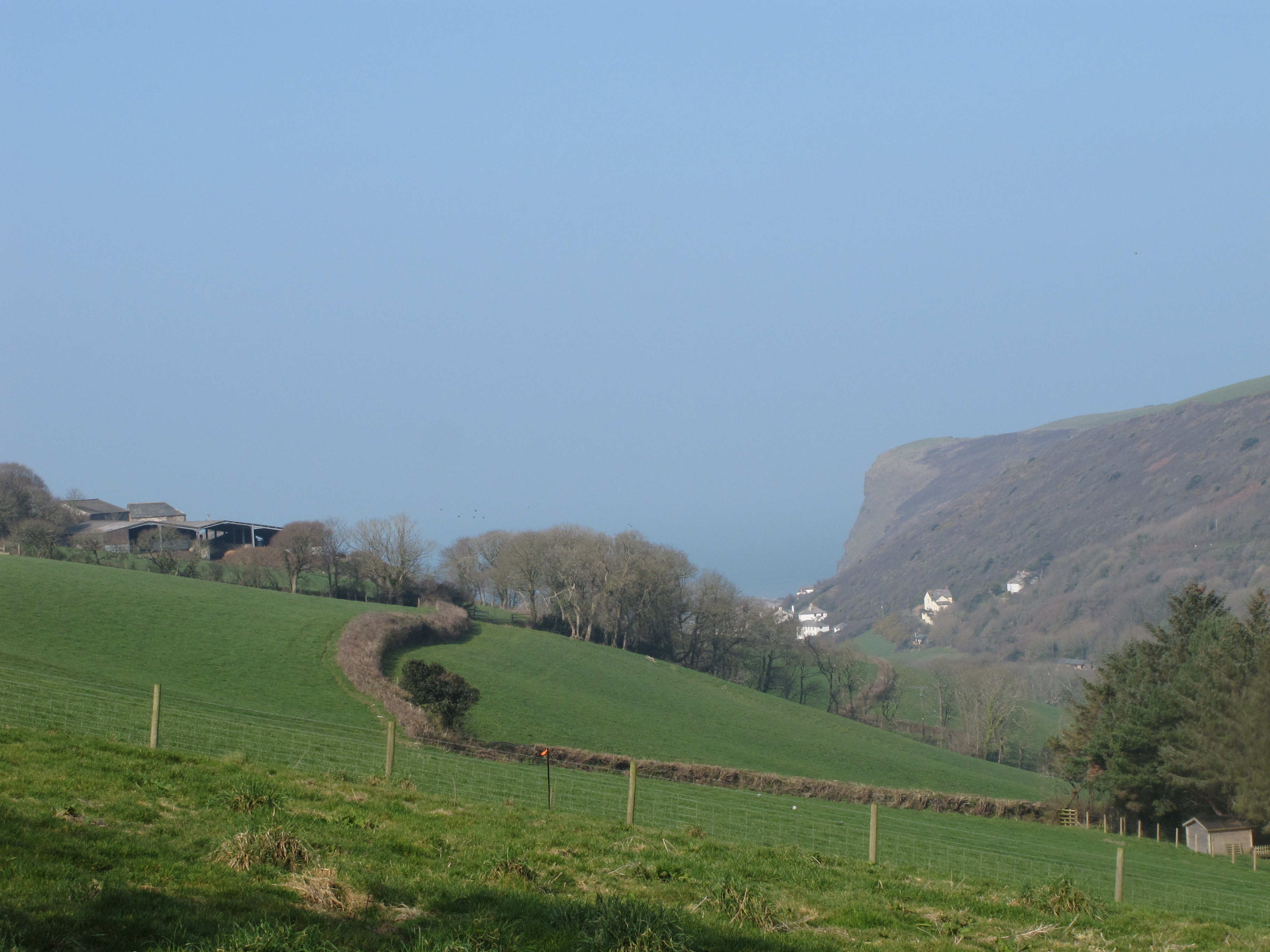
Irrelevant photo: The cliffs on a hazy day.
But even in Britain, class isn’t all about heritage anymore. Pick any village and someone’s likely to think they’re the lord or lady of the manor. It’s possible that their ancestors once were, but it’s equally (or maybe even more) likely, at least in our part of the country, that they moved down from London a few years ago, bringing a pile of money made doing who knows what, and now that they’ve bought a big house in a small village it’s all gone straight to their head. They throw their weight around in village events and committees, half expecting to recreate the days when Lord Hooha’s word was law. But whether or not they actually are Lord Hooha, it’s not the nineteenth century, never mind the middle ages. Sometimes they get away with it but often they don’t. Either way, the rest of us are torn between annoyance and mockery.
The Methodist Church in our village has its annual egg roll at this time of year, and you need to understand that this is an event, not something to eat. If it was something to eat and if we were speaking British, it would be an egg on a roll. If we were speaking American, it would be a deep-fried appetizer from a Chinese restaurant—what the British call a spring roll. But no, this is more along the lines of the Gloucester Cheese Roll, only without insanely steep hill and the ambulances. And the cheese. It’s a bunch of kids rolling eggs down a hill. The one who reaches the bottom first (or at all, since chickens never designed their eggs for racing) wins. I’m not sure what the prize is. A deep-fried appetizer from a Chinese restaurant? An egg sandwich? A chocolate bunny?
I’ve never gone to the event, but I was specifically invited the year A. was a judge. Unfortunately, I got sick and stayed home, and that left me free to imagine it any way I want. What I imagine is that Easter in Britain is about rolling an egg down a hill.

Irrelevant photo: A tiny waterfall. Looking at this, you can almost believe the legends of fairies and little people.
In its more commercial form, Easter’s also about chocolate eggs, and these are massive things—not American football size, but moving in that direction. All your childhood dreams of greed, shaped like an egg. The Guardian (that’s a newspaper, in case you need to know) likes to compare the prices and qualities of different brands of food, and this year’s chocolate Easter egg comparison shows that some of them get into silly money territory. Hotel Chocolat? £27, and it’s filled with smaller chocolates.Harrods? £29.95. The paper recommends that one for Russian oligarchs, who aren’t known for their sense of humor so let’s assume the paper’s not making fun of them, and for safety’s sake neither am I. Marks & Spencer has one for £40 and that kind of money buys it its very own link. (FYI: Links here are not for sale unless I’m making fun of something at the other end, in which case no one’s likely to offer me money. I am so pure I’m almost invisible.) M & S’s egg is a “giant golden lattice egg with a delicate show-stopping small egg perched inside. . . . Because they’re so special, we’ve only made 7,500 eggs, each one numbered on the presentation box for an extra touch of luxury.” And then you eat the sucker and it’s gone, leaving you with nothing but that numbered presentation box and a bunch of adjectives. Spend enough money and you get a lot of adjectives. The original copy had even more, but I’m still an editor at heart and just had to cut some. And in case you’re worried, the gold is edible. Which is another adjective but an important one The Guardian doesn’t specifically recommend this particular egg for Russian oligarchs. I’m not sure why.
Back in the land of the sane, you can find chocolate eggs in supermarkets for £5, or for £2.99.
And we still haven’t gotten to chocolate bunnies. I’ve seen these in two sizes: nestle in your palm size and coffee mug size. I brought a small one home from a grocery shopping trip and Wild Thing reports that they’re good.
In the U.S., you can’t make your way through a store in the weeks before Easter without tripping over egg-dying kits. Or—well, I assume that’s still true. It’s been a long time since I’ve been around, never mind at Easter. In Britain, though, making Easter eggs from actual eggs don’t seem to be a big thing.
And this seems to be a leap, but it’s not: When I first started to write fiction, I wrote a transparently autobiographical story about my Jewish atheist family that included the sentence, “We celebrated Easter.”
My father read it.
“We never celebrated Easter,” he said.
I think that, in his quiet way he was scandalized. He was also, in my opinion, wrong.
It’s true that we didn’t celebrate it in a religious way. But we dyed eggs every year, and found people to give them to (who may have wondered about them but were kind enough not to ask). My brother and I woke up to Easter baskets—jellybeans, a chocolate rabbit (in my memory, they were huge), a panorama egg with a sugar shell and little cut-out figures inside, small chocolate eggs in foil wrappers, all of them nestled in fake grass.
Give a kid candy like that and she’ll think it’s a celebration. Add dyed eggs and, yes, you have a holiday. Sorry, Dad.
It didn’t turn me religious, but it did leave me with a fondness for chocolate bunnies, even though I don’t eat them anymore. I worked in a candy factory when I was in my twenties, and it left me immune to candy’s lures. The one exception is good, and very plain, dark chocolate. But I do like to see chocolate bunnies in their gorgeous foil wrappers.
I can even get sentimental about jellybeans. They never did taste good, but I ate them anyway. Like Everest, they were there. How could I not?
So if you celebrate Easter, happy Easter. And if you don’t, I can still recommend the chocolate bunnies. They don’t care what you believe.
With apologies to everyone who’s already seen it, this is a link to “The British countryside and Winnie the Pooh,” because in a naive effort to make my blog more visible I wiped it off the face of the blogosphere for a day or so, and it’s only gradually fading back into view, so some of you got an email about it and some of you didn’t.
You can’t fade into view. But we don’t quite have a word for that. Think of the Cheshire Cat’s reappearances. Or don’t. It’s not important. And if you’ve already seen the post, this post isn’t important either. If you haven’t, it still isn’t important except as a way to get back in touch.
Remind me never to improve my blog, okay?
Nothing reminds me that I’m living in the British countryside quite the way crossing a ford does.
I know. Fords have been around ever since people and small rivers were first introduced, but even so the fords in our village make me think I live in Pooh Corners. And for the record, no, I’m not sure there were any fords in Winnie the Pooh, but there was a stream and—well, I don’t want to pretend I’m being reasonable about this. What I’m remembering, I think, is one of the illustrations, about measuring the height of a stream during a flood.
Funny what sticks with you from your childhood.

Irrelevant photo: North Cornwall’s coast on a hazy day
This all goes to show you what a New Yorker I am. New York City doesn’t do fords. In fact, it doesn’t do streams. As far as I know, many years before I was born, someone (or more accurately, some many) maneuvered all of New York’s streams into pipes and then paved them over. The city does have three big honkin’ rivers (or two, or maybe one, depending on what you count as a river and what you count as a straight), and that’s plenty, thanks.
When you grow up with pavement, not having streams seems natural. So much so that I used to wonder where streams came from. Not where rivers came from. They came from upstream, as any fool could see. In case you need further proof of how attuned I was to the natural world, I once looked into a huge hole in the street and was surprised to see earth and rock under the pavement. I don’t know what I expected, but scaffolding probably wouldn’t have surprised me. So living in Cornwall not only with streams but with fords? That’s exotic.
Wild Thing grew up in Texas, and her family used to spend time in Colorado. She swears that when they came to a ford and the river looked higher than usual, her parents would have her wade across to make sure it was safe for the car. She never got washed away, so I’m guessing these weren’t raging torrents. Her parents weren’t reckless or neglectful, but it’s also true that they never stopped her from exploring abandoned mine shafts, so I don’t have the impression that they were over-protective either.
In fairness, she wouldn’t have told them she was exploring mine shafts, but a different set of parents might have asked. Or discussed. Or at least warned.
Whatever the pluses and minuses of their approach, she came out of it with an enviable gift for gauging the depth of a stream, and that’s something I don’t have. I understand three levels: low enough to wade; higher than the waterproof part of my shoes; and ask Wild Thing before taking the car across. The first two are reliable. The third? It’s helpful only if Wild Thing happens to be with me. So far I’ve managed not to get swept away, which is why I’m sitting here typing this. I’ve turned back only once, and I probably I didn’t need to, but I figured it was better to wonder than to be wrong.
Years ago, some government agency set up gauges beside the fords. These look like gigantic rulers and go from 1 at the bottom to You’re in Deep Shit at the top, although in my city-bred opinion you’re in trouble by the time the water reaches 1, because for the most part the gauges sit serenely above the normal flow and I’d turn back long before the water reached them, even though at most fords that means having to back a long way. I’m good at backing a car. I’m not good at estimating fords. Give me a choice and it’s pretty clear which I’ll take.
I’m not sure what the gauges are for, really. Maybe so that, Pooh-like, we can measure the depth of the stream for no better reason than to know if it’s still rising. The valleys here are sharp and narrow, so the rainfall spills into the streams quickly. In a heavy storm, a stream that’s normally a trickle can rise to a torrent, especially if the ground’s already saturated. It can fall just as quickly as it rises, and I suppose a gauge could keep you amused while that’s happening, although you might be smarter to go back to your nice warm kitchen and wait. You could also look for another route if you’re driving. If you’re walking, the fords have foot bridges, so you should be fine. If the water comes up over that, you’d be smart to get out of there instead of watching the gauge.
In my city-bred opinion.
*
And unrelated to that, Notes has now been updated, with a new theme that looks one hell of a lot like the old one but should work on phones. In addition to that, it was going to have all sorts of added Googlery that would tell me if a gnat flew past your screen while you were reading it, and which would also reach through atmosphere and hijack unsuspecting readers, launching my stats to astronomical levels, but the whole thing went wrong and instead my posts stopped reaching most of you. The ancient Greeks called it hubris. So the googlery’s disappeared, everything except the new, barely discernible new theme is back (I hope) to where it started, and I’m toning down my ambitions. Or looking for another way to channel them.
Thanks to the people who wrote to say they couldn’t click through to the “Trouble, trouble, trouble” post. It’s now reappeared (along with a great comment from Cats at the Bar) and I’ve lost another post, which was nothing but an attempt to update the people who couldn’t click through to “Trouble, trouble, trouble.”
Don’t worry about it.
If you have any trouble let me know. But if you get this, that probably means you’re not having any problems.
Arghh.
I’m trying to upgrade the site. With luck, you won’t be able to see any difference, but it’ll work better. Upgrading is another word for “it may not be working the way it should.” Hang in there. I’ll have it up and working. Eventually. With the help of someone who knows what he’s doing, because I don’t.
In my unending efforts to compare Britain and the U.S., I helped out with a bulk mailing on Tuesday night. Bulk mailing is an American term meaning “damn, we have a lot of paper here.” I’m not sure how you say that in British.
Back in Minnesota, I was the entire staff of a very small writers magazine, and in the early years part of my job was to gather a crew of volunteers and mail the thing. Because it was cheaper to do a bulk mailing, we did a bulk mailing. (Hey, we were a nonprofit. Money was tight.) This involved crawling around the floor, attaching address labels, and sorting everything according to zip code, and it was this last bit, the sorting, where we’d get into trouble. Every month, I introduced new volunteers to the post office’s bulk mail regulations in tooth-shattering detail, but I never found the right words to make it all clear. That was because what we had to do ran off the edge of the English language.

Irrelevant photo: The primrose path. Really. These are wild primroses growing along Lover’s Walk. I don’t think the flowers are why the path got that name. Lover’s Walk is one of the few paths in the parish where a couple stood any chance of finding a little privacy.
It was something like this: If we had more than ten addresses in a single zip code, we’d band them together. If we have less, we’d combine it with others in nearby zip codes according to some complicated system I barely understood at the time and can’t come close to remembering now. Even if did remember, though, it ran off the edge of the English language so no explanation would help. Then we’d label the bundles and combine them in some equally obscure and incomprehensible way and dump them in canvas sacks, which again had to be labeled before we hauled them down the stairs and threw them in the back of my car.
That last bit? The one that involved heavy lifting? That was the easy part.
Then I delivered the sacks to the loading dock of the main post office and waited for the phone to ring, which it often did a day or three later. It would be someone from the post office would tell me to come back down, pull the sacks out of the canvas wheelie things they’d been thrown in, and fix the mailing in some obscure way I barely understood at the time and don’t understand at all now.
Remember those new volunteers I said I had trouble explaining the system to? Well, none of this was their fault. If ever there was a system calculated to help me screw up, the U.S. Post Office had found it.
Eventually the organization I worked for paid another organization to do the mailing. Whether that was for efficiency or mercy, I don’t honestly care. I’m still grateful, and the Minneapolis Post Office held a three-day celebration. No mail was delivered until the hangovers wore off.
And now here I am on British soil, and by one of the universe’s little ironies, I was the one who organized last Tuesday night’s mailing. The Truro Post Office is hiring crisis counselors already and we haven’t even delivered the boxes.
What we were mailing was called an election address (anyone but a post office would call it a leaflet) from a parliamentary candidate who has about as much chance of winning the election as I do of following complex instructions from the post office. Any post office. The candidate’s not running to win, although I’m sure he wouldn’t mind if he did, but to raise awareness of the way the National Health Service is being chopped up and privatized and underfunded. I won’t go off into a political rant here, and if you disagree, that’s fine, because the political bit ends here. The point is, even though he’s not running in our district, six friends and I thought it was important enough that we gathered to help out, together with one chocolate cake (which had no opinions on the subject and didn’t survive the night), many rubber bands, five or six kitchen scales, and an awful lot of paper.
Parliamentary candidates in England (and I assume the rest of Britain) have the right to mail one, ahem, election address to everyone in their constituency (which I’d call a district, but I’m not in the U.S. now, so constituency it is). These don’t have to be individually addressed, mercifully, or we’d still be there, pasting and sorting and gashing our teeth. And probably, by now, throwing chocolate cake.
But addressed or not, a post office is a post office, and it has its regulations. The leaflets had to be sorted into bundles of a hundred and banded. We could use either one rubber band on these or two. My instructions didn’t say what would happen if someone used three, but none of us was brave enough to try. Every last leaflet in the bundle had to face the same way. We weren’t sure if the bundles all had to be placed in the boxes facing the same way, so we made sure they did.
We had 24,000 leaflets to mail, which I kept calling 2,400 and, occasionally, 44,000, which helps explain why I shouldn’t be allowed out in public but doesn’t explain why anyone let me to stay in the room while numbers were in use. Rather than count all 24,000 (or 2,400, or 44,000) sheet by sheet, the campaign office had told us to count a few initial bundles and weigh them, and that’s what the scales were for. A hundred leaflets weighed 792 grams. Except when they weighed 790 or 798, because kitchen scales aren’t as accurate as the digital displays make them look like they are. Or except when I’d drift into my dys-whatever-it-is that people allergic to numbers have, and I’d weigh out 992 grams and a few minutes later someone would ask why one of the bundles was so thick and reweigh it.
Then the bundles had to go into boxes, all facing the same way, thanks, and each box had to have a printed label that included a blank spot for the number of leaflets inside. For the sake of our sanity, we put the same number of bundles in each box—twelve.
Do you have any idea how hard it is to count to twelve?
Never mind. We finished in time to eat the cake and all get home by ten. The boxes have to be dropped off on Friday—the day I’m posting this—at a tightly scheduled time, and the person dropping them off has to wear a hi-vis jacket and safety shoes. If male, he has to part his hair on the right and wear black-framed glasses; if female, she must not have used hair spray for two days prior to appearing at the post office and should wear contact lenses.
I’m waiting for the post office to call me down to Truro so I can fix whatever I screwed up. A bundle deep inside one of those boxes has 98 leaflets. Or 102. I’ll have to unband and count them all to find out which one it is.
The post office doesn’t have my phone number, but it’ll find me anyway. Some things that you do in life will follow you, no matter where you hide.
If you haven’t had your fill of absurdity, here’s a link to Mother Hen’s most recent post on British and American English, which explores a few differences.
I’m going to interrupt my exploration of the spidery corners of British culture—you know, the stuff I claim to be doing in the heading of my blog—to explore a spidery corner belonging of the blogosphere.
The other day, I got an email from someone who said nice things about my blog. I fell in love immediately. Who wouldn’t? She has such good taste. She wanted me to write a post that the company she works for would then promote through social media. Since I’m crap with social media and I assume they’re not (although how I think I know that is anyone’s guess), this is a tempting offer.

Irrelevant photo: Here’s Wild Thing and me, failing to see the solar eclipse on a piece of used paper. You can just see the type on the other side. Out of camera range was a piece of cardboard with a hole in it, through which the image of the sun declined to make itself seen. The sky was hazy, and I’m guessing that was the problem. Either that or the image of the sun was holding out for non-recycled paper.
What does she want me to write about? My ideal night out in a foreign city and how to connect with a culture using language and food.
Well, I like language. I like food. In my barbarian way, I like culture(s). I even like cities, and Britain has almost as many cities as it does bizarre festivals. (I made that up. It can’t possibly.) So maybe this fits. Admittedly, my ideal night out is a whole lot less raucous than most people want to read about, but what really bothers me is this feeling that I’d be selling out if I bent the blog off course (if it is off course, which I haven’t established yet) just so I could wolf down the first commercial carrot anyone has bothered to dangle in front of me.
And hell, the carrot isn’t even money. I’m mean, if you’re going to sell out, shouldn’t you get paid?
That tells you I come from a print background. I mean, in blogworld we’re supposed to be thrilled if our words are discovered and circulated, but we’re not supposed to think about money. Even when the circulator hopes to make money out of the exchange.
Does anyone notice something slightly wrong about this?
Even so, I am thinking about it. Carrots are food. I like food. We’ve established that. And I’m crap at social media. We’ve established that as well. It’s the commercial aftertaste of this particular carrot that bothers me.
In the name of transparency, I should say that I haven’t a clue whether I’m supposed to be writing about her request or whether the post—if I ever write, let alone post, it—is supposed to appear completely natural and unsolicited. Also in the name of transparency, I’ll add that I’m not sure how I feel writing about our email exchange. I don’t know if I’m talking behind her back, and if I am whether it’s okay since it’s not gossip, just discussion. Hell, I don’t even know if her back’s turned. Maybe she’s reading this. If so, I hope I’m not creating any hard feelings. She presented me with an interesting problem, and I want to explore it. And she was drawn to my blog, she said, by its creativity, which I take to mean its unpredictability. So here’s me, folks, being unpredictable.
If anyone has opinions or past experiences with this kind of thing, I’d love to hear them. Let’s explore.
 Notes from the U.K.