How people find a blog, part 2. Or 3.

What does the world really want to know about Britain? For the second (or possibly third; I’ve lost track) time, I’ll tell you. And how do I know? you ask (if you have any sense). I track the questions that lead people here, and this is an entirely scientific and reliable system because search engines are entirely reliable and the internet is a place of complete sobriety and good sense.
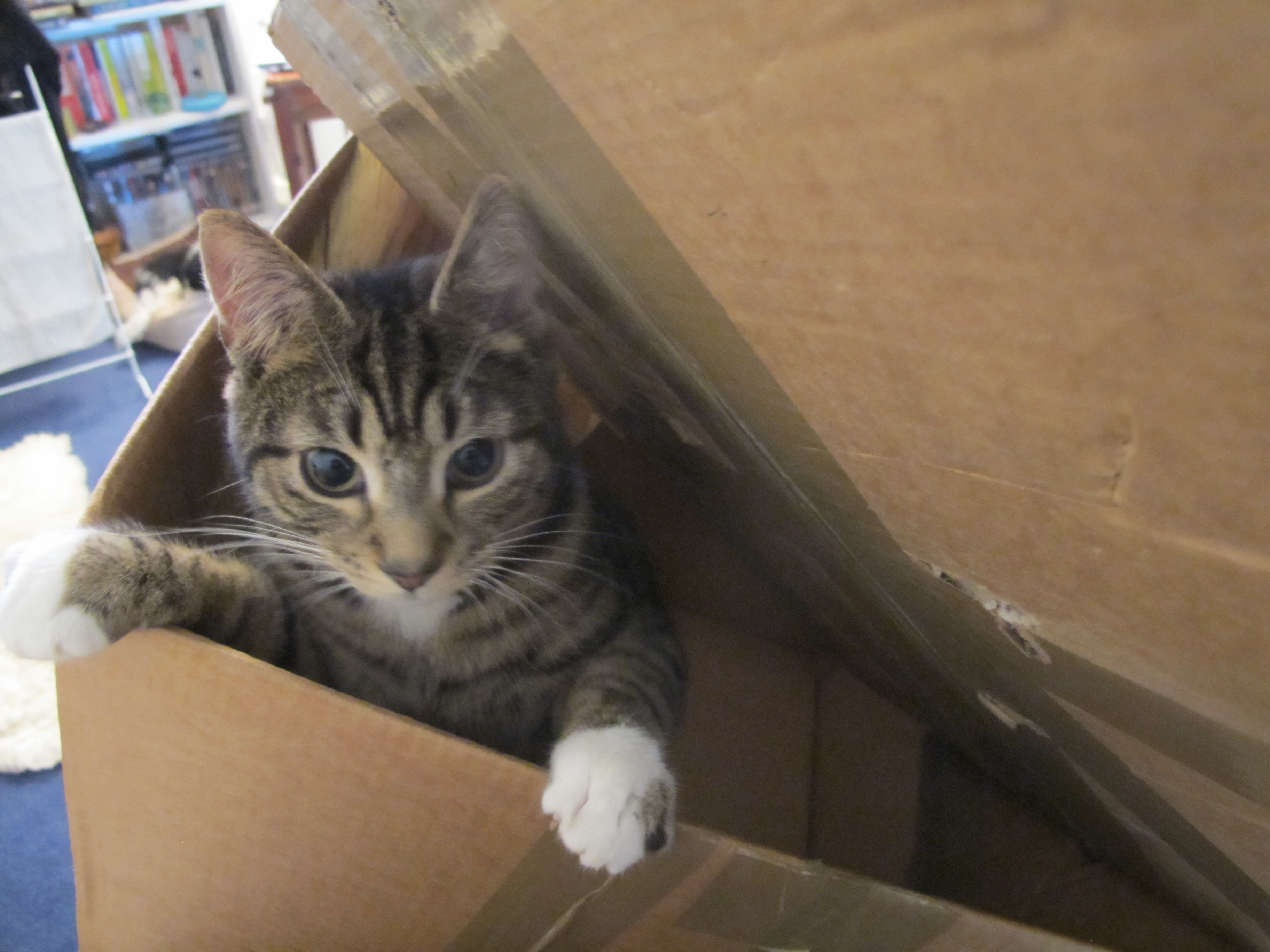
Semi-relevant photo: Fast Eddie, who gets a mention below.

Semi-relevant photo: Fast Eddie, who gets a mention below.

People have asked about:

Geography:

Why Britain is called Great Britain. This is the most commonly asked question and it comes in assorted forms and with an interesting misspelling or three thrown in to keep me amused. It’s also one of the questions I actually answered.

The Silly Isles in Britain. This search is so logical and so wrong. Give the writer credit for knowing how the islands are pronounced, then get out your red pen and write “Scilly Isles.”

Do Brits still like American tourists? I’m not sure. Did they ever? Maybe not, because people also want to know Why Brits hate American tourists, Not to mention Do Brits see Americans as naughty children? and (irrelevantly) Why do Americans love the British? None of this is exactly geography, but I’m assuming the writers are thinking of traveling. Close enough. And really, folks, the answer to all of this is that there is no single answer. The British haven’t achieved a unanimous opinion on this. I’m tempted to add “or on anything else,” but that’s just wise-assing around. They have a consensus and maybe even unanimity on the weather and on baked beans.

Culture:

Gloucester cheese rolling. I’m glad to see it getting some recognition. This is a deep and resonant part of British culture. It must be, because I can’t think of any other way to explain it. Someone was also looking for British culture celebrations, although it’s hard to know if they wanted deep-rooted folk traditions (in which case see not just Gloucester but also the flaming tar barrels) or high culture, in which case go elsewhere because I’m useless.

(A note about why I’m providing links on some topics and not on others: Some posts are easy enough for me to dig out. Others are buried somewhere in this morass, and as people here say with such style, I can’t be arsed.)

American and British manners. That’s easy: We (that’s Americans) have none; they (that’s the British) have lots. I’ll group this with American and British dinner manners TekeT. What does TekeT mean? For all I know, it’s some obscure element of British dinner-table manners that I haven’t picked up on and, oh, how I’ve been offending people. Or the cat walked across the keyboard. But what I really want to know is how the writer got two capital letters past Google’s No Caps filter, because those capital Ts are from the actual search question. And no, it’s not really a question, but let’s move on. For no particular reason, I’ve added caps into the questions in this post, except for those two Ts. But to answer briefly, British eating is knife right, fork left and how you hold the fork indicates your class. What should a foreigner do? Dive for cover, because whatever impression you want to leave people with—except the impression that you’re an outsider—you won’t get it right. Americans, on the other hand, juggle the tableware from one hand to the other. Not the plates, though. Or the glasses. Sorry. Just the fork and knife. What should be done to show good manners in Britain? I had a burst of these, possibly from some single person who didn’t find an answer but kept coming back, and possibly from the misdirected half of a class whose teacher assigned the question. It’s an interesting concept. I always thought of good manners as something you have—you know, the way you have a dime or a stomach ache or black hair. But this is about showing them, the way you show a bus pass. If I ever figure out the answer or why the difference is significant, I’ll write a post.

Poster showing difference between city life and village life (maxi…). I’m guessing that “maxi…” is a word limit that got cut off, although how a word limit applies to a poster I don’t know. But whatever the word limit is, kid, go do your own homework.

American swearing vs. British swearing. Ah, now this is important. Sadly, I don’t feel I can do justice to the British side of the topic. Maybe we could explore it as a community. If we put all our twisted little minds together we’ll learn something interesting. As for me, I swear in American and if you’ll forgive me for bragging, I’m not bad at it. Still, I don’t want to monopolize that side of the conversation, so I welcome all contributions, British, American, and other. I’ll open by saying that Americans don’t use bloody as a swearword and—if you’ll forgive a generalization—aren’t sure if it’s a mild one or a strong one. Who’s next?

The British and their pets. They have them. They love them. (Sorry—more generalizations. When you write about a culture as if it was all one thing, that happens.) If you want to start a conversation, look for someone with a dog and ask about it. Or talk to the dog. The person may answer.

New subsection, same topic:

Why are these stupid wigs worn in court? This came from a lawyer or judge. Notice that phrase “these stupid wigs.” The writer has one in hand. Or on head. And is not happy about it. I sympathize. I got several versions of the question. Most included the word stupid, one was about judges’ wigs, one was about lawyers’ wigs, and one was about ill-fitting wigs.

What has happened to Mrs. Baggit signs? Ah, nothing goes to the heart of British culture like a judge’s wig or a Mrs. Baggit sign. They read (and that read can be read as either present tense or past; take your pick), “Mrs. Baggit says, ‘Keep Britain tidy.’ ” But to answer the question, I have no idea. They are (or if they’ve all disappeared, were) so obnoxiously fussy that I just loved them. In a twisted sort of way. If they’d been in the American countryside, they’d have been used for target practice. Or they’d be decorating the walls of some teenage bedrooms.

Do bearskin hats grow? No. Once the bear’s dead, the hat can’t grow.

Neutral accent different from British accent if migrating to UK. There is no such thing as neutral accent, my friend. Every accent’s an accent. Even yours. Even the one you teach yourself in order not to sound like yourself.

British pub archive quizzes. Sorry, if an archive exists, you won’t find here. I hate quizzes. Go make up your own.

Who are the emmits? If you’re asking, sorry, dear, but you are. And so am I.

Tutting in U.K. This also goes to the heart of British culture. Probably even more than the Mrs. Baggit signs, the wigs, and the baked beans. Since I’m not only an emmit but a foreigner, I can’t give a tutorial on either tutting or being tutted. All I can tell you is that if you’ve been tutted, you broke one of the culture’s unwritten rules. And the laws of probability state that it was probably about standing in line—or queuing, as the British say. It’s the national religion and if you sin you will be tutted.

Brit TV. Yes, they have it here. Some of it is good. Some of it isn’t. And some of it is the Chelsea flower show. Or Springwatch—an hour a day for an entire week on wildlife in spring. Whether that’s good or bad depends on your taste in TV.

Crime in Britain. They have that too. Possibly even at the Chelsea Flower Show.

Flying the flag, U.S. & U.K. They tend to do it less here. I’m guessing they already know what country they’re in. In the U.S., we have to reassure ourselves about that.

Food:

Scheme to compliment Dorset cream 68. Does it have to be a scheme? Can’t you just come out and tell it it’s wonderful? But before you compliment the Devon stuff, you should at least check out Cornish cream. They’re exactly the same (as far as this emmit can tell), but in bitter competition. But about that “68”: It worries me. If it’s a year, the cream will have gone bad by now.

Toffee sticky pudding recipe. (Also sticky toffee pudding recipe.) A few people knows what matters in life.

Must eat sprouts during Christmas in U.K. I had a burst of questions about brussels sprouts and then silence—maybe because the season was over. They’ll be back next year.

Why English beer tastes like American beer. Dunno. I always heard that it didn’t.

British garlic cheese. I haven’t seen any anywhere. On the other hand, I haven’t been looking. It doesn’t taste like American beer, though.

Scones with jam in the middle. You put the jam in the middle after you bake them. Scones are like toast that way—a do-it-yourself operation. The only time I can remember seeing them pre-jammed is at village events, probably to keep anyone from taking too much. Or (to put a kinder interpretation on it) because it’s faster and less messy .

Lemon drizzle cake using cup measurements. Every time I review the searches that lead people here, someone—and usually several someones—is (or are, take your pick since we’re working with both the singular and the plural) asking for a lemon drizzle recipe using cup measurements. Sadly, I completely bungled the one I posted. Will the shame never end?

A nice cup of tea analysis. Is that Freudian or chemical? Did someone spill tea on the couch? What does it all mean, doctor? Who wrote on making tea? Um, lots of people. Including me. Which goes to show you that it doesn’t take an expert. As far as I know (and that’s not far), Freud had nothing to say on the subject.

Random:

The difference between US and UK bureaucracies. What a strange world. Someone actually asked that and more or less found an answer, although I wouldn’t offer it as a definitive one.

UK headline style. That came from someone with the mind of a copy editor, only instead of going to an authoritative source (as any good copy editor would) he or she cast his or her (this gets silly very quickly, doesn’t it?) self at the mercy of Google and the internet and just look where he or she landed. In a blog written by someone who wants to use they as the generic pronoun but hesitates to do it in a sentence about copy editing even though she (that’s me—or I, if you like) does (or do) it elsewhere. Oh, stop. Even I lost my way in that mess, and I once knew what I was trying to say. Anyway, I don’t know what the official style guide is over here. I’m retired and even if I weren’t I doubt I could adjust well enough to edit in British. But having worked as an editor and copy editor in the U.S., I can insist on finding some authoritative source, which is to say NOT THIS BLOG.

Season’s greetings. I’m afraid it’s a bit late for the holidays. This seems to be an email that someone typed into the search box. I had no way to let the sender know it went astray. I feel bad about this one.

Weather:

I had a bunch of questions about naming storms in the UK and in Ireland, maybe because that was in the news for a while. The topic’s dropped out of the news and so have the questions, but storm Jacob was pounding us on Wednesday morning, when I started writing this. One of the dogs got blown over on the way to the store. Not that the winds were apocalyptic. He’s the pup—the silly one you’ll find in the photos here—and he was off balance anyway. But it was wild out there. I got them home just before it started hailing.

Not about Britain but too good to leave out:

Could a bat have flown into a high shelf for shoes in my closet? Yes, I’m pretty sure it could have. Did it? Well, it didn’t take the train, so if you found one there I’d say the answer’s yes. Are the shoes relevant to your question? Probably not, but they’re interesting. It never crossed my mind to put shoes on a high shelf. At my house, they go on the floor, where my feet spend their time. That’s either logical or unimaginative. Or maybe it’s just because I’m short.

American greeting rituals. Mostly we just say “hi,” but occasionally we tear off our clothes and run three circles around the nearest piece of furniture while waving feathers. Then put our clothes back on and act as if nothing happened. But that’s only with people we know well. As a casual visitor, you’re not likely to witness it or have to take part.

Sex scandal American. What, was there only one?

Americans commenting on your U.K. accent. Ah, yes, they will. But they’ll love it. Even if they make fun of it, somewhere in there they’ll believe it’s the most sophisticated accent on earth.

The cutest kitten in the universe. That would be mine. Just ask him. But he’s almost a cat now. He’s still cute, but he’s lost that kitten factor. Very sad.

All-time strangest search:

Veri veri sepr sex. I’m reasonably sure that’s not Latin for I had super sex last night and want to tell someone I don’t know all about it. But I never studied Latin, so don’t take my word for it.


Important stories from the British press

What people lose

You can learn a lot about a country by what it leaves behind. So what does Transport for London report having found on the city’s trains and buses? A life-sized Spiderman doll. A prosthetic leg. Endless wallets, phones, and tablets. Umbrellas. A judge’s wig, a room-sized carpet, and an urn with human ashes. “Enough musical instruments to form a band,” including drum kits. No grand pianos, apparently.

I’m not sure who I’m quoting about that band, but unlike some quotes that drift through the culture, this one seems to have actually been said because the newspaper article I’m stealing the information from put it in quotes. It’s probably from a TfL spokesperson.

Oh, and a brown paper envelope with £15,000. Which the finder actually turned in.

A rare relevant photo: A London tube station. Photo by Ida Swearingen

Vaguely relevant photo: Public transportation, although not in London. This is the Exeter St. David’s train station. Photo by Ida Swearingen

I don’t know what any of that tells you about British culture. That judges wear wigs and ride the tube. That someone either thinks or knows that a judge’s wig is different from a lawyer’s. That stuff drops out of people’s pockets. You know—phones,  wallets, room-sized rugs, tubas. An archeologist would have a field day.

But the real treasures are in the comments at the end of the article, where readers talk about the stuff they’ve lost on public transportation (Guardian readers write the best letters to the editor and their online comments aren’t bad either): “the will to live” (Northern Line, winter of 1993), “the woman I love” (Chalk Farm Station), “my heart” (San Francisco, which is a city, not public transportation, but what are categories for if you can’t break out of them?), and democracy (location not specified but probably also not on public transportation). I won’t spoil all the fun. A lot of the jokes are about that prosthetic leg, but not all. I’ll leave you to discover them for yourself.

Tom Lehrer said, “Life is like a sewer: What you get out of it depends on what you put into it.” That may not be entirely relevant, although in an odd way it does seem to  belong here, but it is at least a genuine quote. (In a comment, Retirementally Challenged introduced the theory that some of the best quotes never got said.) Lehrer’s comment was on a record I played endlessly when I was in my teens. He may be to blame for the way I am.

What someone bought

You can also learn a lot about a country from what it sells. Want to buy a title? One was going to be auctioned off in December with (as far as I can figure out) a starting price of £7,250. I assume it sold. Sorry I didn’t let you know about it earlier but the clipping sank into the morass I call a computer desk and only just surfaced. So let me tell you what you (may have) missed:

The lordship of the manor of Woodbury Salterton village is roughly 1,000 years old. Buy the title (lord or lady) and you can use it on your checks and credit cards. You can join the Manorial Society of Great Britain. You can—. Oh. That’s pretty much it. I suppose you could put it on your mailbox. You could try to get mail and packages addressed to you that way. I have a post about that somewhere. Good luck finding it.

And all that for just £7,250–or maybe more, since it was an auction. What a thrill.

The manor (sorry, not the title; oooh, I’m getting all English, apologizing for stuff that isn’t my fault) was mentioned in the Domesday Book. If you haven’t heard of that, it was commissioned by William the Conqueror not long after 1066, when he decided to find out what he’d gotten his paws on in conquering England. The country, as it turned out, had no football teams at the time, no umbrellas, and no tea. You wonder why he bothered. It probably didn’t even have scones, since baking soda (that’s bicarbonate of soda if you’re British) and baking powder weren’t in use yet. At least not in baking. The Egyptians used a relative of baking soda to clean things and mummify people, but for baking? Nope. Not until the nineteenth century. Next time you find a list of all the marvelous things you can do with bicarbonate of soda, see if mummification’s on it. If not, it’s incomplete.

Where were we? Titles. The Lord or Lady of Whatsit. The newspaper article gushed a bit about the title (or maybe that was the manor; do you really care?) being steeped in English history, but I wasn’t impressed. Pretty much everything here is steeped in history. When they dug trenches for sewage pipes in a neighboring village, they found the remains of a prehistoric encampment and a burial site that mixed Christian (east-west burials) and pre-Christian (buried with grave goods, and I think north-south). One person was buried east-west and with grave goods, so whatever happened after death he or she would be ready for it. So history? You don’t need a title around here, just a sewage pipe.

What the British drink

Sales of tea have gone down 6% over the past five years and ordinary teabags—the ones that make what people call builder’s tea—have gone down 13%. It’s all (or mostly, anyway) the fault of coffee. The British have discovered that coffee can be something more than instant granules stirred into hot water and swallowed quickly enough to keep the taste from becoming noticeable. Coffee’s gone upscale. Tea sales are going down downscale.

There’s an English song that I have got to find time to make fun of someday, “There’ll Always Be an England.” It’s full of pomp and Empire and flag waving, and my apologies if you love it but the first time I heard it I was in one of those situations where you can’t let yourself laugh. I built up enough residual hysteria that I splutter when I so much as read the title. But the reason I’m bringing it up now is this: If tea is losing ground to coffee, will there always be an England? And not, how much longer can we count on it?

Long enough for the British Standards Institution to publish a guide to making the perfect cup of tea. It has the catchy title “Preparation of a Liquor of Tea for Use in Sensory Tests.”

What does it recommend? According to the Independent, it says, “You need a pot made of porcelain, and there must be at least two grams of tea to every 100ml of water. The temperature can’t go beyond 85 degrees when served but should be above 60 degrees for “optimum flavour and sensation.”

The Independent then interrupts the poetic prose and steps in to summarize: ‘The perfect pot size is apparently between 74mm and 78mm wide, and 83mm and 87mm tall. Since the average tea bag contains 1.5g of tea leaves, at least two tea bags should be used for a small pot, and four for a large one.”

The tea should brew for six minutes. And you should pour the milk into the cup first. That last decree is controversial. Seriously. If we have a civil war anytime soon, it will be over whether the tea or the milk should hit the cup first.

Which makes me think that, yeah, there probably always will be an England.

Comparative weather

I was once stuck on a train next to a man whose idea of a conversation starter was to tell me that Britain has the most varied weather in the world. I’d only recently moved here from Minnesota, where the temperature ranges from unspeakably hot to unimaginably cold, with an unbearably beautiful week or three in the spring and fall, and I was still having trouble distinguishing the British winter from the British summer, so I nodded vaguely and opened my book. I mean, if I was going to argue, or even discuss this, where would I start?

So what’s the weather really like? I live in Cornwall, which is the southwest tip of the island, so I apologize to the rest of the British Isles if I’m misrepresenting them, but here’s how I know it’s winter: It rains and the sky’s gray. How do I know it’s summer? The tourists (who are called holidaymakers) show up, and they buy ice cream cones and dress up in hiking gear and drive our narrow roads slowly, looking terrified. Or they dress up in beach clothes and sit on the sand till their skin turns a painful shade of boiled lobster. It rains less but it’ll probably still be gray. Everything grows madly. I love the Cornish summer, but it’s basically an absence of winter, plus ice cream.

Vaguely related photo: the cliffs in summer. If you look closely, you'll see an ice cream cone just outside the frame, on the left.

Vaguely related photo: the cliffs in summer. If you look closely, you’ll see an ice cream cone just outside the frame, on the left.

When we left Minnesota, Wild Thing and I gave away our winter jackets. Talk about burning your bridges. They were good to a thousand below (Fahrenheit or Celsius; at that temperature, who cares?) and wearing them made us look like short versions of the Michelin Tire Man. What we wear as winter jackets now would get us through the early part of a Minnesota fall and after that would be about as useful against the cold as blue paint and wax paper.

I will admit that the Cornish summer is warmer than the winter, but a hot day gets into the 70s and it’s a rare day when the breeze doesn’t have a gorgeous cool undertone. If it gets into the 80s, everyone—including the papers—talks heat wave. I know it’s touched 90 when people around me wilt. Mostly it’s in the 60s, and I’m not complaining about that. In the winter, it rarely drops below freezing, and if it does it’s not likely to stay there once the sun comes up. And I’m not complaining about that either.

The biggest difference between winter and summer is the length of the days. Summer evenings go on forever. As do winter nights. Cornwall is further north than Minnesota, even if we think it’s the tropics. On the other hand, there’s lots of north to the north of us, so I don’t want to make it sound too extreme. The sun does come up in the winter, and it goes down in the summer.

Every so often in the winter, the local weather report will warn us, in a sobering sort of voice—the kind could induce controlled panic—that it’s going to get cold. Wild Thing and I get ready to sew the dogs into their long underwear. But before we have time to get out the sewing box, they put the three-day forecast on the screen and we realize that they’re talking about a five degree drop. Admittedly, that’s centigrade, but still, that’s something like ten degrees Fahrenheit. So it’ll be cooler, and it’ll probably be grayer and windier, but the dogs have fur and live indoors and they’ll be fine. We can leave the window open at night and not die of it. A fire will feel nice in the evening but once it goes out the house will be unheated and the pipes won’t going to freeze.

I’ve lost track of the number of times our pipes froze in Minnesota, in spite of central heating. I got to be good at thawing them out. For a long time we used the hair dryer, then we discovered electric paint strippers. They’re wonderful. Finally a plumber—clever man—moved the pipes away from the north wall and they never froze again. I don’t remember where the paint stripper ended up, but we didn’t dare give it away. Minnesota’s like that. You don’t want to be unprepared.

The weather I take seriously these days is rain. Here in Cornwall, we’re getting off lightly, by which I mean it’s nothing worse than wet, windy, and miserable, but the flooding in northern England and in Scotland is serious–people flooded out of their homes, bridges collapsed (okay, one bridge, but it was dramatic), power out, rescue services working like mad. I’ve been reading a lot recently about the value of flood abatement as opposed to flood defenses: letting rivers meander, the way they did before we clever little monkeys got in there and straightened them; planting trees on hillsides, which take major amounts of water out of the ground; letting fields flood, as they did before we clever little monkeys decided they shouldn’t, all of which (and more) could save cities. None of it is as sexy as big engineering projects, apparently, although speaking just for myself I never could keep sex and engineering in my mind at the same time. But to each his or her own, and if you’re a fan of engineering I won’t argue–except, just to contradict myself, to say that there does seem to be a whole side of flood prevention that we’re ignoring.

British Christmas traditions: the brussels sprout

Health and Safety Warning: This post contains exaggerations that may be detrimental to your mental health. Or your credibility if you take them literally when linking to the post. The Druids did not actually worship brussels sprouts. No one knows much about what the Druids did. And with that out of the way, do read on.


What is it about the British and brussels sprouts at Christmas? I address this topic because judging from my search engine queries it’s what people want to know. Or at least what one very determined person wants to know. Within a few days, I had at least five variations on the question Why do the British eat brussels sprouts at Christmas? It may have been more. I lost track in there somewhere. Why the person kept coming back if I hadn’t already managed to answer the question I don’t know. Determination shading into obsession?

Anyway, the question matters, and I’ve addressed it before but I don’t feel I did it justice. Because I sidestepped several crucial facts.

Irrelevant photo: gorse (that's the yellow stuff) and heather (that's the purple)

Irrelevant photo: Gorse (that’s the yellow stuff) and heather (that’s the purple). And grass (that’s the green and the tan.)

First, if Google is to be trusted (it’s not) you can spell the vegetable with or without an S: brussel sprouts or brussels sprouts. The first spelling matches our pronunciation (we just can’t make the double S audible unless we say it while standing on our heads and gargling salt water). Besides which, it’s easier to type without the extra S. The second spelling replicates the name of the city where they didn’t originate. According to Brussels Sprouts Info (everything important has its own web site these days), they’re believed to have been grown in Italy as far back as Roman times and began to be grown on a large scale in Belgium as far back as the sixteenth century before spreading outward from there.

The more common spelling seems to keep the extra S.

Second, you can either capitalize the B or not, depending on whether you capitalize the F in french fries. I don’t, but Word does and gives me bad marks every time I go back and un-cap it. It’s easier to use a cap, which is probably why I don’t. It’s a small and pointless way to fight the monopolies that are taking over our spelling. Not to mention our lives, economy, and politics. Take that, monopolies: I’m using a lower case F and a lower case B. That sound you hear? It’s Microsoft crumbling in the face of my defiance.

Third, the world contains more than 110 varieties of brussels sprouts and I bet you can’t tell any one of them from the other more than 109.

You notice how vague they are on the actual number? It’s probably because someone’s out there devising a new variety even as I type.

So far so uncontroversial, but now we come to:

Fourth, the real reason they’re eaten in Britain at Christmas is a tightly held secret and I’m going to reveal it to you and only you because, hey, it’s just us here, right? No one else is listening. I’d get into serious trouble otherwise. So here’s the truth: The Church of England may be the official and established church in this country, but it’s a thin and brittle overlay. Underneath lies the country’s deeper religion, worship of the Great Brussels Sprout. (And here, yes, it’s capitalized. Even by me. It’s a god and all. You want to show a little respect.)

What did the Druids worship? The Great Brussels Sprout. They painted themselves blue and cultivated the sacred plant. And they were nekkid when they did it.

How’d they cultivate it if brussels sprouts didn’t yet grow in the British Isles? I did say Google couldn’t be trusted. Its sources are giving you the official history. You can only find the truth by going into the dark web, where danger lurks behind every pixel, so I don’t dare give you any links. Folks, I’ll take the risk myself but I can’t be responsible for your safety. You’ll have to find it on your own or trust my report: The truth is that the Romans quietly exported the brussels sprout from Britain to Italy, and once it was established there they claimed to have developed all more than 110 varieties themselves.

Back in Britain, the Romans suppressed both the Druids and all outward forms of sprout cultivation and worship, but the belief ran deep in the population, and it survived, waiting from the sprout’s return.

How’d it do that when the pre-Roman British tribes (the Iceni, the Caledones, the Parisi, the Cornovii…) were overrun by the Angles and the Saxons and the Vikings and the Normans, making for a choppy history and a messy but interesting language? Because knowledge of the Great Brussels Sprout is planted deep in the soil. You don’t have to learn it from your community. If you get yourself a shovel and start digging, it works its way into your bloodstream. You feel a compulsion to worship something green and brassican. Rumor has it that they made do with cabbages until the brussels sprout was re-imported and jogged their memories of what the Great God really looked like. These were agricultural people, remember. They had lots of shovels. So when Christianity became the dominant religion, the best it could do was drive sprout worship deep underground, and from there it rises, godlike, every year.

Do I consider it strange, you ask (or at least you should ask), that people eat the sprout they worship? Isn’t that a bit, um, grotesque? Not at all. The Great Sprout is the essence of all sprouts and is itself inedible. The sprouts people eat at Christmas are merely its representation. And those among us who claim the ones on the plate are also inedible? They’re closest to the holy nature of the Great Brussels Sprout and everybody should back off and stop giving them a hard time.

Fifth (we were counting, remember?), the brussels sprout ripens around Christmas time. How many other vegetables are willing to do that? So of course people eat it.

*

And on a marginally sensible note, last week I forgot to link back to Laura, at A PIct in PA, who first used to word tickety boo, giving me a great excuse for another important post. She’s a Scot living and raising her kids in Pennsylvania, and she keeps a fine blog with lots of nifty artwork.

Comparative tipping

According to Kate Fox in Watching the English, you don’t tip bartenders in England (and by extension in Britain), you buy them a drink. Which I always thought was code, in the U.S. at least, for I’ll leave you the price of a drink and you decide whether to drink it or put the money in your pocket. Admittedly, I never spent enough time in American bars to know the rules, so no one should take my word for that. But in Britain it really does mean I’ll buy you a drink. Which the bartender will eventually drink, nodding his or her thanks to you.

Of so Fox says, and I’m sure she’s right. She sees this as marking a sort of official class equality between bartender and customer, regardless of what the class divisions (and oh, will both sides ever be aware of them) are.

Screamingly irrelevant photo: pampas grass, which is (I think) called something else here. Don't you love it when I'm informative?

Screamingly irrelevant photo: pampas grass (and the tip of Wild Thing’s lens). I think it’s called something else here. Don’t you love it when I’m informative?

(I haven’t given you a link to Fox’s book this time, although I have before. I’d link back to the embedded link but I can’t remember which post it was in and, hey people, I only get just so much time on this planet. Besides, you know how to find a book, right?)

But back to our topic: In the only pub where I spend much time—and that only because I like the singers night—the bartenders are also the wait staff, and they do get tipped for serving meals, so it takes a finer eye than mine to figure out the distinction. But it’s true that people don’t tip at the bar.

Except me. For a long time I behaved myself and didn’t tip when I bought a drink, but I’ve worked for tips, as both a cab driver and a waitress, and after a while I just couldn’t help myself. I started tipping. Sometimes at first I had to explain myself—one or another of the bartenders would think I’d miscounted my money and return the extra.

“I’m American,” I found myself telling one of them. “I tip. I can’t help it.”

I also remember saying, “I’m awkward but I mean well” since I hadn’t managed to make it clear that I was tipping—although in the U.S. I expect it would have been more than clear enough.

But no one seems insulted. The tip goes into the jar with the tips from the tables and my behavior goes into the Weird American category.

This comes up because Dan Antion commented that before he visited the U.K. he read that the British don’t tip, so he didn’t.

Sorry Dan, but they do. Not as much as Americans—or at least not as much as New Yorkers and Californians. Midwesterners are more, um, cautious with their tips. Or stingy, if you like. I haven’t done a full survey of the two coasts or of the south and west, so I won’t go out on a limb about how they tip. But the British? They tip wait staff in restaurants and (mostly) in pubs. Either many or most cafes have tip jars. And if they don’t? Wild Thing and I leave the tip on the table.

As far as I can tell, people tip cab drivers. We sure as hell do. And if something gets delivered that’s a pain in the neck for the delivery person, we tip—which often involves offering the money for a drink after work, which may or may not turn into a drink but who cares?

Around the holidays, some people we know leave money for the folks who pick up the trash and recycling and who deliver the mail—although the last one is, I think, never supposed to happen and the post office is probably coming to arrest me for even writing about it, never mind doing it. (I never said I did it, Your Honor, I only implied it. And I could’ve been lying.) Anyway, you can call those tips or Christmas presents or whatever you like. They happen, although not universally.

I’ve been reading, both online and in the papers, about campaigns to stop restaurant chains from stealing their employees’ tips. Yeah, some do that, both in Britain and in the U.S., especially if the customer puts the tip on a credit card with the rest of the bill, but sometimes even when the tip’s in cash—or in some cases if there’s no tip at all, because the restaurant acts as if there was one and charges the waitron what it figures he or she must have gotten. And it’s all okay, because if a businessman can’t steal from people with less power and money than him, how’s he supposed to make an honest buck?

Social media’s been effective at shaming the shit out of some chains that did this, but I expect others are still at it.

So whatever country you live in, tip, and do it in cash. And follow Wild Thing’s dictum: Nobody ever went to hell of overtipping.

Talking about the weather—a lot

Britain really does get a lot of rain. Almost as much as people think it does. Enough that the vocabulary for rain is extensive and specialized. It’s raining stair rods. Or pitch forks. It’s chucking it down, or pissing down, or bucketing down, or mizzling—a lighter, mistier version of drizzling and a word I use sometimes for the pure pleasure of hearing it. In the U.S., it rains or drizzles or rains cats and dogs, but that’s about it. Once in a while, I guess, it mists enough to turn mist from a noun to a verb. But if it does anything else I can’t think what it is. We have words for different kinds of storms, from a shower to a hurricane, but for the rain itself? We haven’t been driven by the sheer indoor boredom of being stuck in the house on 356 consecutive rainy days to come up with new words and phrases.

Or maybe the words came from being out in the rain before the invention of anything that even semi-reliably kept a person dry. Naming the damned stuff could keep your mind off your misery. Or at least keep you busy while you were miserable.

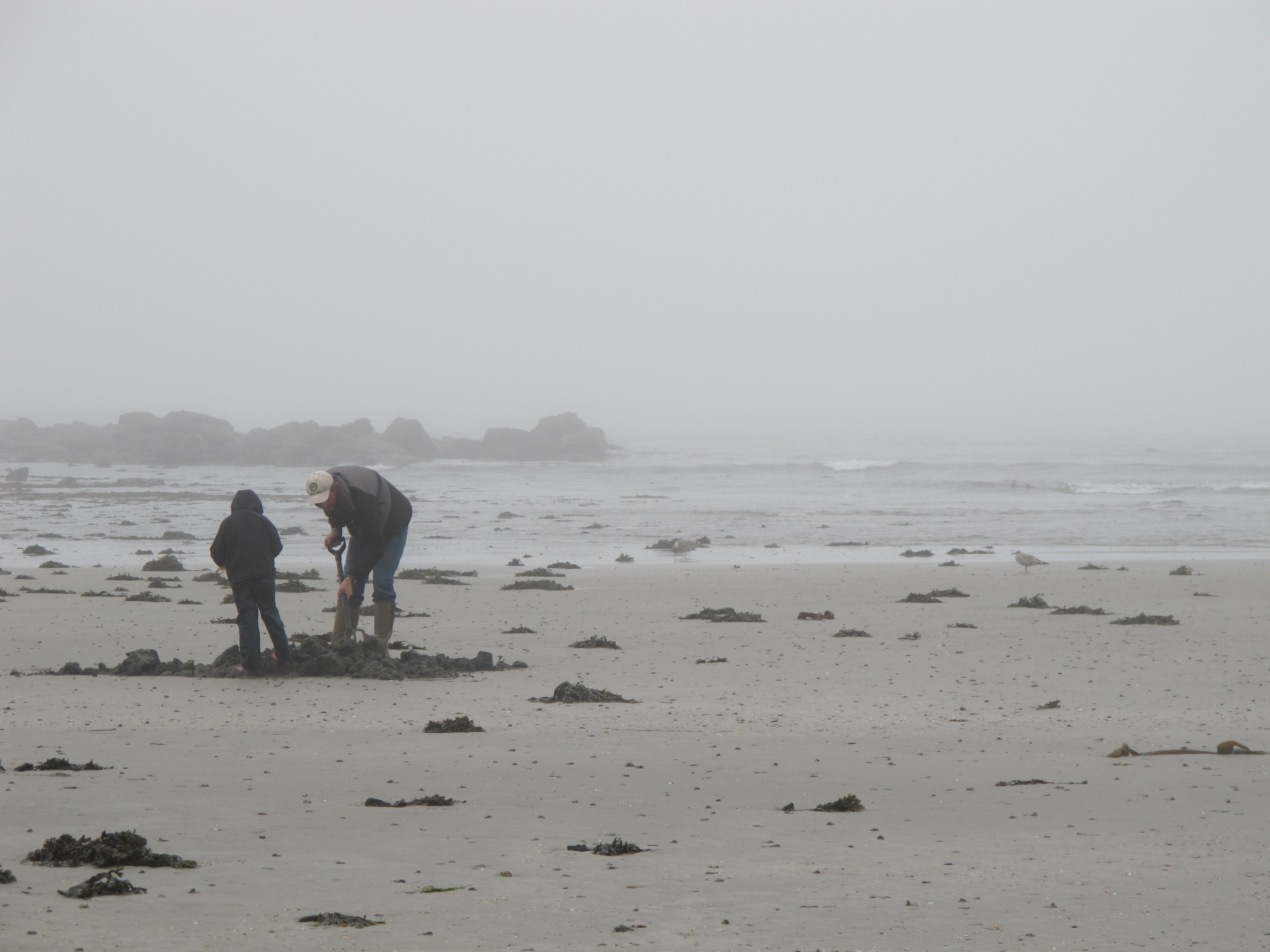
A rare relevant photo: digging clams on a foggy day. Marazion.

A rare relevant photo: digging clams on a foggy day in Marazion.

Once you have a vocabulary, you have to say something with it, which is how we get to attitude. It rains enough here that people grow a kind of fatalism about the weather. I say “grow” because it creeps over them the way mold grows on damp walls. Sometimes it comes out as a wry fatalism and sometimes as plain old moaning. (When I lived in the U.S., a moan was nothing more than a sound. Here it’s transformed into an entire attitude, a form of not-gonna-do-anything complaint. A way of life, in fact.)

The content of wry fatalism and moaning is almost the same. It’s the attitude that makes them different.

“I guess we’ve had our summer,” a neighbor said on a gray day that followed some warm, sunny weather.

I knew enough to say, “Yes, and it was a beautiful day.”

He laughed and I congratulated myself: I’d played my hand in the game of wry fatalism. Not bad for a furriner.

On a different day—a sunny one—another neighbor said, “It won’t last.”

Same thought but pure moan. I wasn’t sure how to contribute. Maybe all I needed to do was shake my head mournfully and agree but I didn’t. What help can you expect of a furriner anyway?

Free of either fatalism or moaning (I think) is weather news. People trade bits of this the way American boys once traded baseball cards. A storm’s working its way across the Atlantic. An arctic front’s moving down from Iceland. A warm front’s bringing rain from Spain (really—no plains anywhere to be found but the rain falls anyway). You name it, we tell each other about it, especially if it’s bad weather. We listen to the weather on the TV. We check online. We get updates on our phones. Okay, I don’t. My phone is nothing but a phone, and I’ve given up on the evening news since I read the paper and enough already, how much weather (not to mention news) does one person need? So I’m using we loosely here. But every other single person in the country does all of those things, and every last one of them tells me about it. And as a result I can tell more people, who already know it and have already told me some version of it but it’s okay, this isn’t really about the information, it’s about talking to each other. We’re trading baseball cards. Baseball cards have no intrinsic value. They exist only to be traded.

No one’s weather news quite matches anyone else’s, but if it did what would we have to talk about?

Bizarre British festivals: the flaming tar barrels

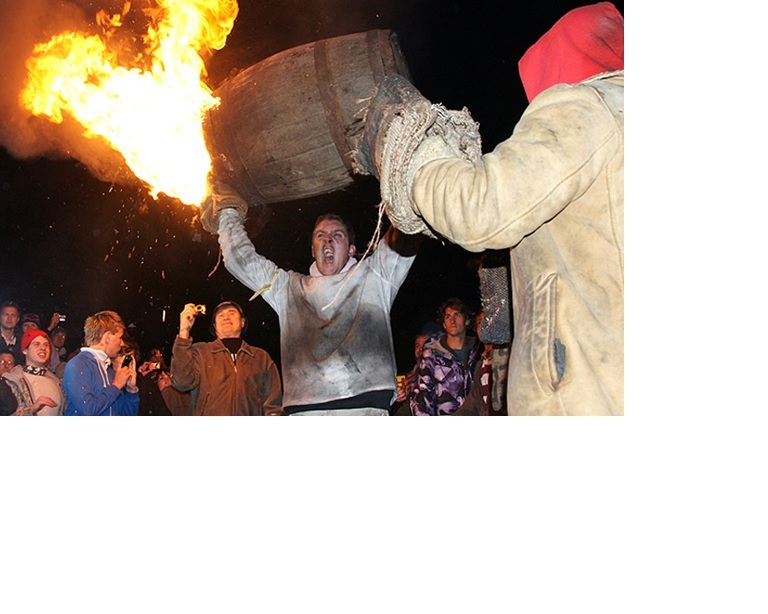
The web site for the Ottery St. Mary Tar Barrels Festival says (or said when I last checked it), “Each year it becomes more difficult to find money to cover the costs of running this event.” Well, yes. Given that it involves a bunch of people running around with flaming tar barrels on their shoulders, I can see why insurance might be an issue.

The event is hundreds of years old, although the web site doesn’t say how many hundreds. Or how many people over the centuries have set themselves or their neighbors alight. It doesn’t matter: It predates insurance, that’s what we need to know.

Holy flaming tar barrels, they really do this. Sorry about the white space. The photo's from the official web site and I can't seem to crop the damned thing.

Holy flaming tar barrels, they really do this. Sorry about all the white space. The photo’s from the official web site and I can’t seem to crop the damned thing.

The web site asks visitors, for the sake of safety, not to pound on the barrels. A few years ago, someone threw a spray can into one of the barrels instead, causing an explosion. I couldn’t find any reference to it on the web site, but maybe they don’t want to plant ideas in anyone’s head. Wise. I should probably follow their lead but–oops, too late. If you feel impelled to show up and throw a spray can into a burning barrel of tar, you didn’t get the idea here, okay?

People in Britain make a big deal out of health and safety concerns being overdone. That’s partly, I think, because complaining about something in ways that won’t change them runs deep in Britain’s cultural DNA and partly because we humans do have a gift for taking a good thing (most of us would agree, for example, that keeping people from being killed and maimed at work is a good thing) and take it to absurd lengths. I was once told, in a second-hand shop (sorry: charity shop), that they couldn’t sell crochet hooks or knitting needles because of health and safety. At the yarn store, where I eventually bought one, they must keep them locked up. Can’t be too careful, you know.

A friend teaches health and safety workshops, and she swears that crochet hooks aren’t one of the things that keep her up at night. So yes, there is some absurdity going on, but it’s not the fault of the people whose job it is to promote health and safety, it’s the fault of overenthusiastic twits who use the phrase to defend whatever crazy decisions they’ve made.

So anyway, you’ll find people who talk about health and safety, as a single phrase, the way a certain kind of person—and you know who they are—complain about political correctness gone mad. (How upsetting that they can’t call entire groups of people names anymore without being told off. Or kick them out of their seats on the bus. Or, you know, lynch them, the way they could in the good old days.) If you listen for a while—especially after you’ve been told you can’t buy a crochet hook—you start to think modern life is being forced into such a narrow mold that humans will never again get to test themselves against any real challenge, and then you open the Ottery St. Mary Tar Barrel web site and think, Wait a flamin’ minute. What about health and safety?

Anyway, Wild Thing and I meant to go this year and bring you a first-hand report, but life got away from us and it’s not going to happen. In fact, we meant to get to every strange traditional festival we heard of but only managed one, the Gloucester Cheese Rolling. Maybe next year we’ll do better.

If you go to the Tar Barrels Festival (hurry; it’s on Nov. 5), leave your spray cans behind and don’t pound on the barrels. If you’d like to bring a small personal fire extinguisher, however, there’s no rule against it. And let me know. I’d love to have a first-hand report.

Comparative medical bureaucracies

Of all the phrases the divide British and American English, the one I dread hearing is leave it with me. It’s not a phrase I ever heard in the U.S., and now that I live in Britain I know life is about to spin out of my control when someone says it.

And yes, I do know life’s always out of our control, but we all like to believe, don’t we? We live for the comfort of that illusion. Even when we know we’re full of shit. Maybe especially when we know.

Or some of us like to believe. I like to believe.

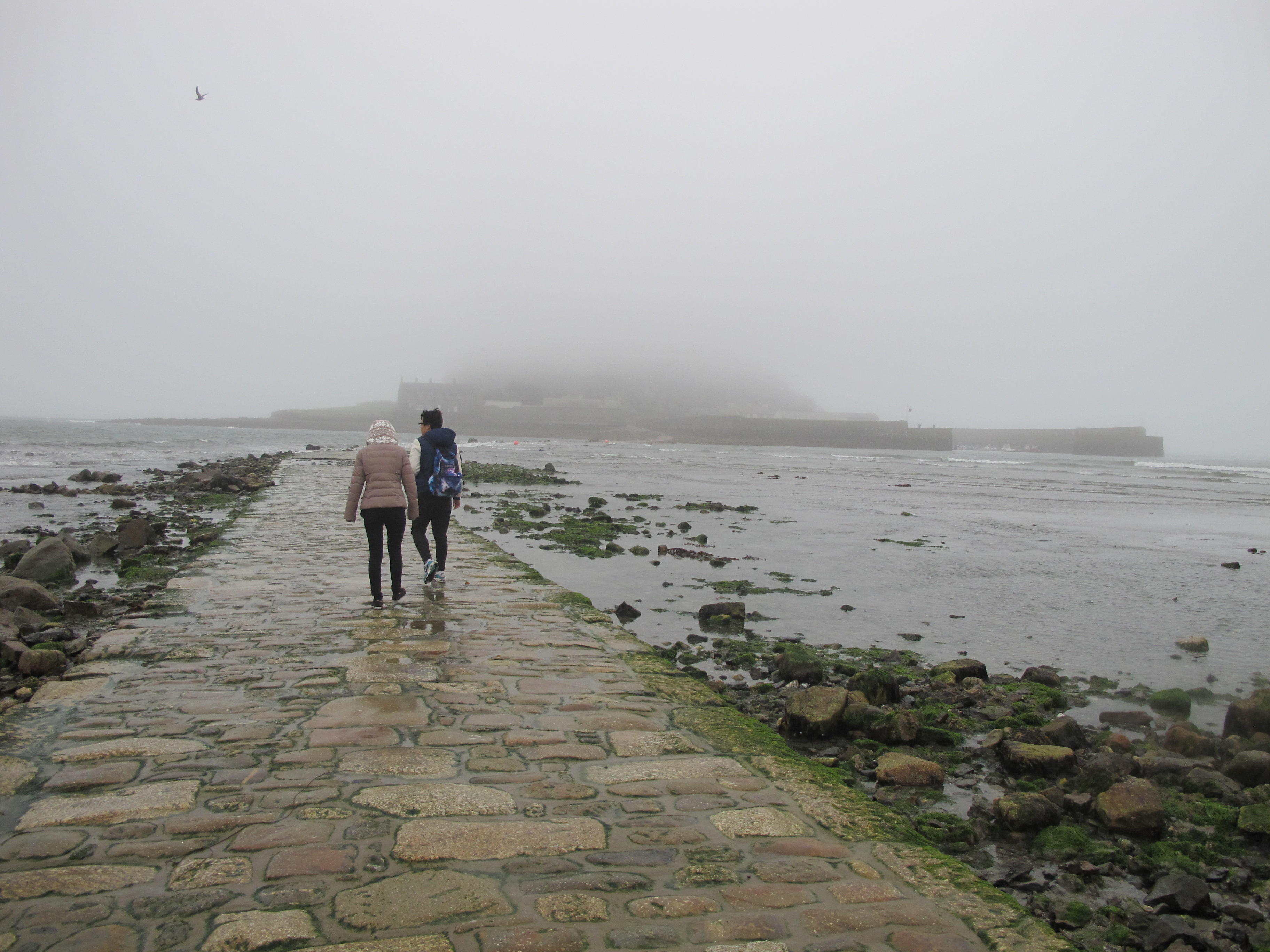
Irrelevant photo: The causeway to St. Michael's Mount, emerging as the tide drops. There's a castle out there, hidden in the fog.

Irrelevant photo: The causeway to St. Michael’s Mount, emerging as the tide drops. There’s a castle out there, hidden in the fog.

Suppose I need a referral from my GP to a specialist and I was supposed to be given an appointment by Wednesday and here it is the Tuesday after that Wednesday and I still don’t have the letter telling me when the appointment is. So I call to ask what happened. I’ve worked out an approach for this kind of situation. I’m polite and I’m relentless. I don’t demand, I don’t insult, and I don’t go away. This is easier to pull off when I’m advocating for someone else, but I can manage it for myself if I have to.

The receptionist says, “Leave it with me.”

Which means one of two things: 1. I will fix this so fast that whoever screwed it up will be dizzy for a week, or 2. I will make a note of this, bury it under a stack of paper, and forget you ever called, because your referral’s still a bunch of electronic blips in my computer but I don’t remember which file it’s in, or which computer, or what electronic means. Furthermore, I have worse problems than you. Don’t call back.

And I’m never sure which. Except for the don’t call back bit. I’m sure what that means.

I’ve learned to ask, “When will I hear from you?” so at least we’ve agreed on a date after which I’m free to make a pest of myself again, but until then I’m helpless. All my polite don’t-go-awayedness? It’s paralyzed by the leave-it-with-me beam of bureaucracy.

In the abstract, I could probably say, “No, sorry, I can’t leave it with you. Gimme my problem back,” but you know that bureaucracy beam? It’s like kryptonite. It keeps me from forming those words.

I did dodge the beam once, when a neighbor was having a medical crisis and D., who’s been a nurse, armed me with a magic phrase: That’s not acceptable. I listened to myself say it and wondered who I’d turned into, but in fact waiting wasn’t acceptable—it was a crisis—and since the phrase was magic it worked.

But you have to be careful with magic phrases. You can’t just spew that’s not acceptable in all directions and under less pressing conditions.

The leave-it-with-me problem stems, I think, from the British medical system’s paternalistic streak. The U.S. system is also paternalistic, but in a different way and—oh, you know how it is: When you’re not used to something, you notice it. The things you’re used to? They’re invisible. And the way they handle medical appointments here? I notice. If you need one, it will all be done for you and you’ll be told when to appear.

What if you can’t make it? You know, if you have to be in court that day or they’ll issue a bench warrant or you have some similar whim you might want to follow? At that point you get to step in and change the date or the time, but you have to wait to be given the wrong date and time before you can step in. And unless your condition’s a crisis, it’ll come by letter.

As far as I can figure out, this is true of both the National Health Service and private-sector medicine. Because that’s how it’s always been done and why change now just because the telephone’s been invented? And that other, even more modern thing, the inter-whateverit’scalled.

In the U.S., I can remember two systems for making specialist appointments. In one, I was given the name of a doctor and clinic (or a list of several) to call and I made my own appointment. In another, I stood at a desk while someone who worked for the clinic that was referring me made the appointment and could talk with me about whether I expected to be under arrest or in court at any given date and time.

In other ways, the NHS is more egalitarian than the U.S. medical system. I just read a nurse’s comment that “everyone is equal in the NHS; I find that amazing. In India, you can’t challenge a doctor, even if he is wrong. Here, a nurse can tell them straight away.” Unless things have changed since I last heard (and it’s not a topic I keep up on), challenges from nurses aren’t welcome in the U.S. yet.

But patients don’t seem to have claimed their power from the system, even if nurses have. So listen up, bureaucracy: I’m registering my complaint. Can I leave it with you?

Making a nice cup of tea

When my British friends seriously want some tea, they get specific about what they want: not just tea but a nice cup of tea.

Let’s take that apart: We can leave a and of alone without destabilizing anything important. But think about the word nice. Because you don’t just have a cup of tea in this country, you have a nice cup of tea. Even when the nice is silent, if you listen carefully you can hear it resonating in the background. I need a nice cup of tea, a nice cup of tea, a nice cup of tea.

And if the cup of tea you get tastes like second-hand dishwater? It’s all the more disappointing, because what you wanted was that nice cup of tea, not this travesty you’ve been handed.

In the U.S., we never sit down to a nice cup of coffee. We drink coffee, we make coffee, we drop by our friends’ houses for coffee, and we go out for coffee. But we don’t expect that comforting nice from it. It’s just, you know, an ultra-fat mocha semiccino with whipped cream and caramel sauce with a side of chocolate chip muffin and a triple bacon cheeseburger deluxe on a sesame seed bun. With mayo.

In other words, it’s no big deal.

Irrelevant photo: wild blackberries

Irrelevant photo: wild blackberries

I don’t know what it says about our two cultures that one seeks comfort from a hot drink and the other doesn’t, but I’ve known people here in Britain to welcome a cup of tea the way I’d expect someone to welcome a stiff drink after a day when the computer blew up, the basement flooded, and the dog filed for divorce; I’ve known them to take the first sip and say, like a borderline alcoholic after a brief flirtation with sobriety, “I needed that.”

Or maybe that’s me I’m quoting. If so, forget it. I’m not British. Or I am, but not deeply enough to count.

So let’s move on. People who expect comfort from a hot drink seem to find it. Point made, in a wobbly fashion.

After nice comes cup. Go into any cafe any you can ask for a pot of tea, and in some for a mug. In most places you’ll get a pot whether you ask for it or not, and all of that is fine, but if the nice gets spoken at all, it comes attached to a cup—one of those curved shells you wrap your hands around while the warmth seeps into your half-frozen soul. The thing you bring to your lips, allowing all the love that went into its making to flow into your metaphorical as opposed to your literal heart. It may have been made in a pot, but whoever made it poured it into a cup for you and that’s what we’re talking about— that cup and its the contents, and by extension the acts of making and handing.

We’ve gone well beyond the rational here. This is about caring and nurturing. It’s about love itself, in an indirect way.

So tea is central to the culture. Does that mean an American can’t march in and make a decent cup? Americans seem to hold one of three opinions:

  1. [Fill in the blank] criticizes my tea-making and always will because I’m American. Even if I do it right, I’ll never do it right.
  2. I’ve been to Britain and read every book ever published on the subject. Tea is my religion and I’ve returned home to convert a refined few among the heathens.
  3. Oh, get over it. It’s just a drink. Wanna cup?

If you’ve been hanging around my blog for any length of time, you can guess which category I’m in.

I don’t know how many categories British opinion falls into on the subject, and that may be for the best. However, in my unbiased opinion, I make a decent cup of tea, and if a friend’s in serious need I can even make a nice cup of tea. It’s hot, it’s strong (except when I make it for M., who drinks it so weak that I just boil the water and wave a teabag through the steam), and under normal circumstances it comes with something home baked.

And with that we arrive to the heart of this post. How do you make a nice cup of tea?

Am I qualified to answer that question? Do I care? Uncertainty hasn’t stopped me in the past, and neither has good sense. I don’t see why they should now. I predict, though, that from here on everyone who drinks tea will disagree with me about something. Have a good time, folks. I’m looking forward to it.

You start with the tea. If you’re American, this is the hard part.

Leaf tea: You can go to a fancy tea store and buy leaf tea, choosing one that was picked before sunrise from plants that have never been spoken to harshly. And you can pay any amount of money you like for the privilege, as long the amount is large. If you live in a tea-drinking country, on the other hand, you can buy leaf tea in a supermarket. No one in sight will know how the plants were spoken to or when the tea was picked. But it’s tea.

Wherever you buy it, try a few kinds and see which one you like.

Which means you have to brew it, and the first trick is to avoid stuffing it into anything that won’t let the water flow through. I’ve tried a variety of brewing gizmos over the years and most of them are as useless as stuffing the leaves in an old sock, and that includes the cloth or paper gizmos that imitate teabags. Why you want to avoid teabags and then use something that imitates them I don’t know, especially when they don’t work as well as the teabags you’re avoiding. (I am going to catch such hell for saying that. I can hardly wait.) Choose the wrong gizmo to stuff your leaves into and you’ll end up with expensive tannish water.

Open baskets do work—in this barbarian’s opinion.

In Britain, a lot of the cafes that use leaf tea dump it directly into the pot and give you a strainer, which comes with something to rest it on so you don’t end up splattering teadrops everywhere. Because the leaves are swimming around in the water, you don’t have to worry about whether the water’s flowing through them. The tea will be good and strong, but if you’re slow about drinking it, it’ll turn bitter. Some cafes give you an extra pot with hot water to thin it out with once that happens, but even with the extra water it sometimes gets strong enough to make you grow hair on your tongue.

Teabags: British supermarkets sell more kinds of teabags than they do baked beans, which is another way of saying you have a lot to pick from. If you’re in the U.S., your choices are limited. You can buy Twinings or something along those lines—one of those brands that entombs each teabag in a little plasticky-foily packet so you’ll understand how special it is, and how special you are to have bought it. I hate Twinings. Which—according to Kate Fox’s Watching the English—is because I’m not upper class. The lower classes drink their tea strong. The upper classes wants theirs to be as refined as they (think they) are, so their tea has to be pale and (lack-of-objectivity alert here) flavorless. So if you’re American and you like Twinings, go ahead and drink it and know that you’ve got more class than I have. Or want, thanks.

When I lived in the U.S., I bought Lyons tea from an Irish store near us and it was strong enough to turn my hair gray. Just look at the photo I use. Back when I drank coffee, I had (mostly) black hair. But Lyons is great stuff. If I hadn’t been able to get that, I think I’d have gone for Lipton’s rather than Twinings. At least it has some oomph to it.

Do I use leaf or teabags? Teabags. I used to keep some leaf tea for special occasions but the tea I made with it was never as good and how’s that a way to celebrate?

Water: This is the other ingredient in tea. If you want, you can use bottled water and it may or may not make your tea taste better. It will be more expensive. Your choice. You can use a kettle or a pan to boil it. If you’re in Britain, you’ll almost surely use an electric kettle because it’s fast. You’ll use it so often that you never put it away. If you’re in the U.S. you can still use an electric kettle but only if you’re willing to invest some time in the project. I grew old waiting for electric kettles to boil in the U.S. I’d have been 56 if I’d just put the water on the stove, but no, I had to buy an electric kettle and so I’m 68.

I have no idea why American electric kettles take so long.

What you can’t do is stick the water in the microwave. Even if it’s in a nice cup. Because microwaves don’t get the water not enough. The true secret of a nice cup of tea is that the water has to be boiling when you pour it over the tea. Or, okay, if it stopped boiling 30 seconds before I get to it, I don’t quibble, I just pour. But if it didn’t boil, or if it boiled back when my hair was black, it’s not worth using.

Do you have to warm the kettle? In my book, it depends on how cold the kettle is. Which depends on how cold the house is. If it’s cold, pour a little of the water in it, slosh it around, let it sit if you want to, warm the thing up, then pour the water out and make your tea. And if you’re making a single cup? I’ve never stopped to warm a cup, although it makes as much sense as warming the kettle. And the tea’s been fine, thanks.

I’ve read that you shouldn’t reboil the water because all the air goes out of it, or all the—oh, I don’t know why you’re not supposed to do it. You’re not. All the experts agree. So put in as much as you need and no more.

How long do you brew it? Well, how strong do you like your tea? I remember a huge ad in Paddington Station saying that after five minutes tea was stewed, not brewed. Stewed tea is bad. Why? Because a huge poster in Paddington Station said so.

I don’t leave my tea that long unless I wander off to do something else and forget it, in which case it may be as much as ten minutes before I wander back. If I’m in a hurry, I stir it. What you (and you’ll notice how seamlessly we’ve switched from me to you here) don’t want to do, if you’re using teabags, is squeeze them. It makes the tea bitter. Really. It does. Just lift them out, all dripping and nasty. Or leave them in, but if the tea’s going to be sitting a while, you may end up with a hairy tongue.

Add milk. Or milk and sugar if you feel strongly about it. Then sit back and enjoy a nice cup of tea. With love.

Of dukes and baronesses and scamsters

In September, Alexander Wood was in court for having posed as the duke of Marlborough (there’s a real one; I just checked) and for having run up a bill in the neighborhood of £10,000 at expensive London hotels. No one asked him for identification because they thought it would be “inappropriate to ask.”  I mean, this is (purportedly) a duke, after all. You don’t do a stop-and-frisk on him, and you don’t ask for i.d., even when he runs up a huge whackin’ bill. They did eventually get suspicious when he bought drinks for fellow guests—something I gather no aristocrat would do.

Setting aside this one person’s motivation (the article makes it sound, not surprisingly, like mental health comes into it), Britain does tempt a person to borrow titles.

Irrelevant photo: teasels

Irrelevant photo: teasels

When I went online to donate the money from our village fundraiser to the Red Cross, I was offered a choice of Mr., Mrs., Miss, Ms, Doctor, Lady, Professor, Reverend, Dame, Sir, Major, Captain, Lieutenant Colonel, Colonel, Sister, Lord, Canon, and Other. Oh, wheee! I lost my nerve before finding out whether Other would have given me a blank space to fill in the title of my choice, but I expect it would have.

As an aside, I was once called a dame, but no one mistook me for an aristocrat and no hotel bill was involved. And it wasn’t a compliment.

The Guardian’s subscription form despairs of coming up with a complete list and just leaves a blank line, where you can play as much as you dare. You want to be a general, or the Lord Mayor of Mill Crick? Feel free. Then sit back and see if your correspondence is addressed appropriately. And complain when it isn’t.

Why the blank instead of the list? I can’t help picturing some committee trying to list everything necessary to this title-obsessed land and sinking under the weight of the task. Why, for example, include Colonel but not General? And since this is the Guardian, a generally leftish and egalitarian paper, what about Private? Don’t privates deserve the respect of their title? And since the women members of the House of Lords are addressed as Baroness (something I happen to know because I’ve written letters to a fair few of them, and there’s a tale of its own), doesn’t that merit a mention? Or does Lady cover it? I haven’t a clue. If they’re Lady Whatsit, even though you address them as Baroness, what do they address themselves as? And what about the Barons? The male members of the House of Lords are Lords, not Barons. No, I don’t understand it either. But there are real barons out there, aren’t there? Granted, they probably don’t read the Guardian, but what if they wanted to?

And what about all the Lord Mayors dotted around the country. And the Counsellors: Spare a moment’s thought for all those long-suffering folks who sit on Parish Councils around the country, doing their unpaid and non-party-political bit for the most local level of local government? And Citizen. It was a popular title during the French Revolution. Give it half a chance and it could catch on again.

You can see the problem. Either the committee voted for the blank line and fled or else they’re still meeting, trying to complete the list, sinking deeper into despair with every passing week. Several of its members have been hospitalized for stress and clinical-level nit-picking.

This is what happens in a status-obsessed society. Everyone with a title needs to be recognized, placated, bowed to even.

And on the lowest level, where the rest of us live our lives? I still can’t get myself called Ms. Instead of Mrs.  No matter how often and politely I ask.